


Numbers 31:14
- וַיִּקְצֹףvai·yik·Tzofand he was angryH7107Conj-w ¦ V-Qal-ConsecImperf-3msVerb Qal Consecutive Imperfect 3rd Singular Masculineוַandיִּקְצֹףhe was angry
- מֹשֶׁהmo·ShehMosesH4872N-proper-mNoun Proper Masculine
- עַל'altowardsH5921PrepPreposition
- פְּקוּדֵיpe·ku·Dei[the] officers ofH6485V-Qal-PassPrtcpl-mpVerb Qal Participle Passive Plural Masculine Construct
- הֶחָיִלhe·Cha·yilthe armyH2428Art ¦ N-msNoun Singular Masculine Absoluteהֶtheחָיִלarmy
- שָׂרֵיsa·Rei[the] commanders ofH8269N-mpcNoun Plural Masculine Construct
- הָאֲלָפִיםha·'a·la·Fimthe thousandsH505Art ¦ Adj-cpAdjective Numerical Plural common gender Absoluteהָtheאֲלָפִיםthousands
- וְשָׂרֵיve·sa·Reiand [the] commanders ofH8269Conj-w ¦ N-mpcNoun Plural Masculine Constructוְandשָׂרֵי[the] commanders of
- הַמֵּאוֹתha·me·'otthe hundredsH3967Art ¦ Adj-fpAdjective Numerical Plural Feminine Absoluteהַtheמֵּאוֹתhundreds
- הַבָּאִיםha·ba·'Imwho were comingH935Art ¦ V-Qal-Prtcpl-mpVerb Qal Participle Plural Masculine Absoluteהַwhoבָּאִיםwere coming
- מִצְּבָאmi·tze·Va'from [the] war ofH6635Prep-m ¦ N-mscNoun Singular Masculine Constructמִfromצְּבָא[the] war of
- הַמִּלְחָמָהha·mil·cha·Mahthe battleH4421Art ¦ N-fsNoun Singular Feminine Absoluteהַtheמִּלְחָמָהbattle
English is a literal word-by-word gloss of the Hebrew, not the KJV's wording. Why?
This is the original text the KJV's translators worked from — each Hebrew word with its own literal English meaning in this verse, prepared by scholars at Tyndale House, Cambridge. The KJV translates whole sentences, not word by word, so its wording differs: one Hebrew word can become several English words, and the KJV may choose “the LORD” where the gloss reads “Yahweh”. Both are faithful — they answer different questions. For the KJV's own rendering, switch to the KJV text.
Details
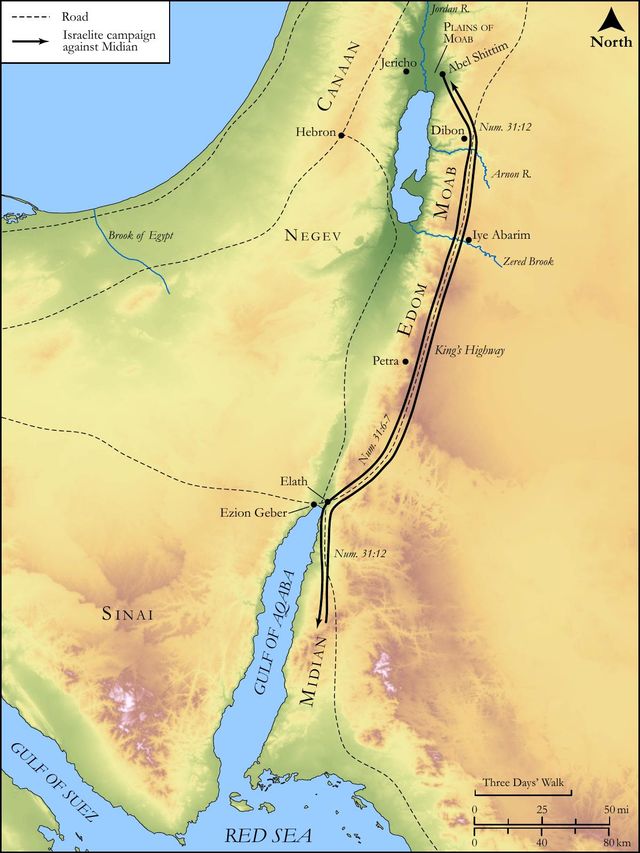
See on the biblical-era map
Study this verse
Continue studying Numbers 31:14 across the web’s major study libraries — every link below opens this exact verse, chapter, or book on the destination site.
Read & Compare
 BibleGatewayThis verse in more than 200 translations and 70 languages.
 Bible.comThe YouVersion reader — hundreds of translations, reading plans, and highlights.
 ESV.orgCrossway's official English Standard Version reader.
 NET BibleThe NET translation with 60,000+ translators' notes on every rendering decision.
 STEP BibleTyndale House's free study tool — original text, vocabulary, and scholarly resources.
 BibliaLogos Bible Software's free web reader.
 USCCBThe New American Bible (Revised Edition) with the U.S. bishops' study notes.
Commentaries
 BibleHub CommentariesDozens of classic commentaries on this verse, gathered on one page.
 StudyLightMore than 100 commentary sets — the largest collection on the web.
 BibleRefPlain-English commentary on what this verse means, verse by verse.
 Enduring WordDavid Guzik's free commentary on this chapter, widely used by Bible teachers.
 Bible Study ToolsVerse commentary alongside Greek and Hebrew study aids.
Original Language & Research
- BibleHub InterlinearThe verse word by word — original language, transliteration, and English.
- BibleHub LexiconEvery word's original-language definition and Strong's entry.
 Blue Letter BibleDeep-study tools — Strong's numbers, concordance, and word studies.
 SefariaThe Hebrew text with Rashi and centuries of Jewish commentary.
Sermons, Hymns & Audio


TrulyRandomVerse is not affiliated with these sites and doesn’t control their content. They’re linked because they’re genuinely useful.
Summary
Numbers 31:14 dramatically portrays Moses' intense indignation directed at the military officers, including the captains over thousands and hundreds, immediately upon their return from a successful campaign against the Midianites. This verse marks a critical turning point in the narrative, revealing that despite their military triumph, a fundamental aspect of God's divine command for the expedition had been either overlooked or deliberately disregarded, thereby provoking Moses' swift and severe rebuke of the leadership.
Context
ShowHideLiterary Context
Numbers 31:14 is embedded within the detailed account of Israel's divinely commanded war against the Midianites. The preceding verses (Numbers 31:1-12) meticulously describe the Lord's instruction to Moses to "avenge the children of Israel of the Midianites" before his death, emphasizing the sacred and punitive nature of the campaign. This section then recounts the successful execution of the military engagement, culminating in the defeat of Midian and the capture of spoil and captives. Verse 13 depicts the initial meeting of the returning army with Moses, Eleazar the priest, and the leaders of the congregation outside the camp. However, the tone abruptly shifts in verse 14, introducing Moses' "wroth" reaction. This sudden display of anger from Moses serves as a narrative hinge, foreshadowing the crucial revelation in Numbers 31:15-18, where he explicitly condemns the army's failure to fully carry out the divine judgment, particularly concerning the Midianite women who had enticed Israel into grave sin at Peor.
Historical & Cultural Context
The impetus for the Midianite campaign directly arises from the catastrophic events detailed in Numbers 25, where Midianite women, at the counsel of Balaam, seduced Israelite men into sexual immorality and the worship of Baal-Peor, leading to a devastating plague that claimed 24,000 Israelite lives. This background is crucial for understanding the severity of the Midianite threat, not merely as a military foe but as a profound spiritual contaminant to the covenant community. The concept of herem (devotion to destruction), while present in the ancient Near East, was uniquely applied by Israel under Yahweh's specific directives to preserve the nation's holiness and covenant purity. Moses' intense anger reflects a deep understanding that incomplete obedience in such a divinely ordained mission was not merely a tactical oversight but a profound theological failure, directly imperiling the spiritual integrity and unique identity of the entire nation. The military structure, with "captains over thousands, and captains over hundreds," illustrates a standard hierarchical organization of ancient armies, underscoring that Moses' rebuke was aimed at the responsible chain of command.
Key Themes
ShowHideThis verse powerfully contributes to several overarching themes prominent in the book of Numbers and the Pentateuch. Firstly, it underscores the theme of divine command and complete obedience. God's instructions are not suggestions but absolute mandates, and partial obedience, especially when the purity of the covenant community is at stake, is presented as tantamount to disobedience. This principle is foundational to Israel's covenant relationship with Yahweh. Secondly, the passage highlights leadership accountability. Moses' wrath is precisely directed at the officers, emphasizing their solemn responsibility to ensure that divine directives are meticulously carried out by those under their command. This theme resonates throughout Israel's history, exemplified by the severe consequences of King Saul's partial obedience in 1 Samuel 15. Thirdly, the verse reinforces the critical theme of holiness and separation. The Midianites, particularly the women who had caused Israel to stumble into idolatry, represented a profound spiritual contamination. Moses' subsequent command to eliminate them (Numbers 31:17-18) underscores the absolute necessity of removing all sources of spiritual defilement to maintain Israel's covenant relationship with a holy God. This pursuit of purity is a recurring motif, from the detailed laws in Leviticus to the solemn warnings in Deuteronomy.
Exposition and Analysis
ShowHideKey Word Analysis
ShowHideThe Hebrew verb H7107 (qâtsaph) literally means "to crack off" or "to burst out in rage." When applied to anger, it denotes a fierce, intense, and often righteous indignation. It describes a strong emotional eruption, frequently attributed to God Himself (e.g., Numbers 11:1) or to key figures like Moses when confronted with sin or disobedience. Moses' anger here is not a personal loss of temper but a reflection of his deep alignment with God's holiness and his profound understanding of the gravity of the officers' failure to uphold divine justice.
The Hebrew term H6485 (pâqad) is a primitive root meaning "to visit (with friendly or hostile intent); by analogy, to oversee, muster, charge, care for, miss, deposit." In this context, it refers to appointed officials or overseers. By specifically naming "captains over thousands, and captains over hundreds," the text highlights the hierarchical structure of the army and points to the fact that the responsibility for the incomplete obedience lay squarely with those who were entrusted with leadership and the execution of the divine command. It underscores the principle of accountability within leadership.
The Hebrew word H2428 (chayil) is derived from חוּλ and refers to "a force, whether of men, means or other resources." It can denote an army, wealth, virtue, valor, or strength. In Numbers 31:14, "officers of the host" refers to the leaders of the Israelite military force that had just returned from battle. This term emphasizes the organized, collective strength of the army, making the officers' failure a significant lapse in the conduct of the entire fighting force under their command.
Verse Breakdown
ShowHide"And Moses was wroth with the officers of the host"
This opening clause immediately establishes Moses' intense emotional state and identifies the direct recipients of his anger. His wrath is not arbitrary but a direct and severe response to a perceived failure or transgression committed by those in charge of the military operation. The "host" refers to the Israelite army, indicating the broad scope of the officers' responsibility.
"[with] the captains over thousands, and captains over hundreds"
This phrase precisely specifies which "officers" Moses was angry with. These were the senior military leaders, holding significant authority and responsibility for the conduct and actions of their respective units. Their explicit mention underscores that the failure was not a mere oversight by common soldiers but a profound lapse in judgment or obedience at the highest echelons of military command.
"which came from the battle"
This concluding phrase provides crucial context for the scene. The officers had just returned victorious from the battle against Midian. The stark irony is palpable: they had achieved military success, yet their triumphant return was met not with commendation or celebration, but with severe condemnation. This indicates that military victory alone was insufficient if God's specific instructions for the campaign had not been fully honored, highlighting a disconnect between human achievement and divine expectation.
Literary Devices
ShowHideNumbers 31:14 effectively employs several Literary Devices to convey its message. The verse utilizes Foreshadowing by immediately presenting Moses' unexplained wrath. This abrupt shift in his demeanor signals to the reader that a significant transgression has occurred, even before the specific reason for his anger is revealed in the subsequent verses. This technique creates narrative tension and prompts the reader to anticipate the details of the army's failure. There is also a strong element of Irony at play, as the victorious return of the army, which would typically be met with accolades and celebration, is instead met with severe condemnation from their leader. This stark contrast highlights the profound difference between human achievement (military victory) and divine expectation (complete and uncompromising obedience). Furthermore, the specific mention of "captains over thousands, and captains over hundreds" functions as a form of Synecdoche, where a part (the military leaders) stands in for the whole (the army's collective failure to fully obey God's comprehensive command).
Theological and Thematic Connections
ShowHideNumbers 31:14 powerfully illustrates the critical theological principle that, in God's eyes, partial obedience is fundamentally disobedience. Moses' intense anger reflects a divine standard of holiness and justice that demands complete adherence to God's commands, especially when the purity and spiritual integrity of the covenant community are at stake. The Midianite women, who had led Israel into idolatry and sexual immorality at Peor, represented a potent and ongoing spiritual danger. Failing to eliminate them as commanded would have perpetuated this threat, compromising Israel's unique identity as God's holy people and jeopardizing their covenant relationship. This episode underscores that God's commands are deeply rooted in His righteous character and His desire for His people's spiritual flourishing, making any compromise with sin a direct affront to His holiness and a perilous act for the people.
Reflection and Application
ShowHideNumbers 31:14 serves as a stark and challenging reminder that true success in God's kingdom is measured not merely by outward victory or observable achievement, but by the completeness and sincerity of our obedience to His specific instructions. For leaders in any capacity—whether in the church, family, or workplace—this verse is a profound call to accountability: those entrusted with guiding others bear a greater responsibility to diligently understand and meticulously follow divine directives, ensuring that those under their charge also adhere to God's will. It compels us to honestly examine areas in our own lives where we might be tempted to practice "selective obedience," fulfilling parts of God's command that are convenient, culturally acceptable, or personally appealing, while neglecting those that are difficult, unpopular, or counter-cultural. The spiritual dangers of compromise are immense, as even a partial failure to cleanse ourselves or our communities of sin can have far-reaching and devastating consequences, just as the Midianite women posed an ongoing spiritual threat to Israel's holiness. Our commitment to God must be holistic, embracing His entire revealed will, not just the portions we prefer or find easy to implement.
Questions for Reflection
ShowHideFAQ
ShowHideWhy was Moses so angry when the army had just won a great victory?
ShowHideMoses' anger, described by the strong Hebrew word qâtsaph ("to burst out in rage"), stemmed from the army's failure to fully execute God's specific command concerning the Midianites. While they had achieved military victory and taken spoil, they had spared the Midianite women who were responsible for enticing Israel into idolatry and sexual immorality at Baal-Peor, as detailed in Numbers 25. Moses understood that this partial obedience was a grave spiritual compromise that would perpetuate the very threat God intended to eliminate, jeopardizing the holiness and purity of the Israelite community. His wrath was a righteous indignation reflecting God's own abhorrence of sin and incomplete obedience.
What was the specific command that the officers failed to carry out?
ShowHideThe specific command, given by God in Numbers 31:2, was to "avenge the children of Israel of the Midianites." This was not just a military conquest but an act of divine judgment. The subsequent verses, particularly Numbers 31:15-18, reveal that the army had spared all the Midianite women, including those who had participated in the seduction at Peor. Moses explicitly commands them to kill every male child and every woman who had known a man intimately, sparing only the virgin girls. Their failure was in not fully eradicating the source of spiritual defilement as God had intended.
What does "captains over thousands, and captains over hundreds" signify about accountability?
ShowHideThe mention of "captains over thousands, and captains over hundreds" signifies that Moses' anger was directed at the highest levels of military leadership. These individuals were not ordinary soldiers but appointed officers responsible for leading and directing the troops. Their positions implied a greater understanding of and responsibility for executing divine commands. By rebuking them specifically, the text emphasizes the principle of leadership accountability: those in positions of authority are held to a higher standard and are ultimately responsible for ensuring that God's will is carried out by those under their command, and that the covenant community remains pure.
Christ-Centered Fulfillment
ShowHideNumbers 31:14, with Moses' righteous wrath over the army's incomplete obedience, finds profound Christ-centered fulfillment in several ways. While Moses' anger was a necessary, though imperfect, response to sin and compromise within the old covenant, Christ embodies perfect obedience and the ultimate, definitive removal of sin. Unlike the Israelite officers who failed to fully execute God's judgment against the Midianites, Jesus perfectly fulfilled all of God's will, even to the point of death on a cross, demonstrating His perfect submission and obedience to the Father (Philippians 2:8). He is the perfectly obedient Son who always did what pleased the Father (John 8:29). Furthermore, the need for Israel to purge itself of the Midianite defilement foreshadows Christ's work in cleansing His people from sin. He is the true Lamb of God who takes away the sin of the world (John 1:29), not through physical warfare but through His atoning sacrifice on the cross. Through His death and resurrection, Christ empowers believers to live lives of holiness, enabling them to put off the old self and its sinful practices (Ephesians 4:22-24) and to engage in a spiritual battle against sin within and without (Ephesians 6:10-18). Ultimately, Christ will return to fully and finally purge all evil and unrighteousness from His creation, establishing a new heavens and new earth where righteousness dwells (Revelation 21:1-4), perfectly fulfilling the zealous holiness imperfectly pursued by Moses and ensuring the complete purification of God's people and His kingdom.