


Numbers 31:13
- וַיֵּצְאוּvai·Ye·tze·'Uand they went outH3318Conj-w ¦ V-Qal-ConsecImperf-3mpVerb Qal Consecutive Imperfect 3rd Plural Masculineוַandיֵּצְאוּthey went out
- מֹשֶׁהmo·ShehMosesH4872N-proper-mNoun Proper Masculine
- וְאֶלְעָזָרve·'el·'a·Zarand EleazarH499Conj-w ¦ N-proper-mNoun Proper MasculineוְandאֶלְעָזָרEleazar
- הַכֹּהֵןha·ko·Henthe priestH3548Art ¦ N-msNoun Singular Masculine Absoluteהַtheכֹּהֵןpriest
- וְכָלve·kholand allH3605Conj-w ¦ N-mscNoun Singular Masculine Constructוְandכָלall
- נְשִׂיאֵיne·si·'Ei[the] leaders ofH5387N-mpcNoun Plural Masculine Construct
- הָעֵדָהha·'e·Dahthe congregationH5712Art ¦ N-fsNoun Singular Feminine Absoluteהָtheעֵדָהcongregation
- לִקְרָאתָםlik·ra·Tamto meet themH7122Prep-l ¦ V-Qal-Inf ¦ 3mpVerb Qal Infinitive Constructלִtoקְרָאתָmeetםthem
- אֶל'eltoH413PrepPreposition
- מִחוּץmi·Chutzfrom [the] outsideH2351Prep-m ¦ N-mscNoun Singular Masculine Constructמִfromחוּץ[the] outside
- לַמַּחֲנֶהLa·ma·cha·Nehof the campH4264Prep-l ¦ N-fsNoun Singular Feminine Absoluteלַof theמַּחֲנֶהcamp
English is a literal word-by-word gloss of the Hebrew, not the KJV's wording. Why?
This is the original text the KJV's translators worked from — each Hebrew word with its own literal English meaning in this verse, prepared by scholars at Tyndale House, Cambridge. The KJV translates whole sentences, not word by word, so its wording differs: one Hebrew word can become several English words, and the KJV may choose “the LORD” where the gloss reads “Yahweh”. Both are faithful — they answer different questions. For the KJV's own rendering, switch to the KJV text.
Details
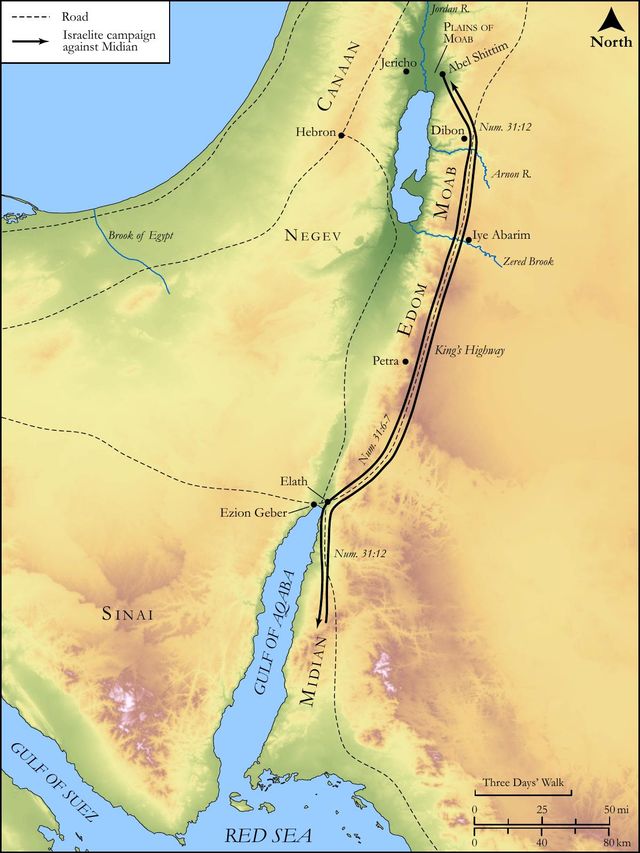
See on the biblical-era map
Study this verse
Continue studying Numbers 31:13 across the web’s major study libraries — every link below opens this exact verse, chapter, or book on the destination site.
Read & Compare
 BibleGatewayThis verse in more than 200 translations and 70 languages.
 Bible.comThe YouVersion reader — hundreds of translations, reading plans, and highlights.
 ESV.orgCrossway's official English Standard Version reader.
 NET BibleThe NET translation with 60,000+ translators' notes on every rendering decision.
 STEP BibleTyndale House's free study tool — original text, vocabulary, and scholarly resources.
 BibliaLogos Bible Software's free web reader.
 USCCBThe New American Bible (Revised Edition) with the U.S. bishops' study notes.
Commentaries
 BibleHub CommentariesDozens of classic commentaries on this verse, gathered on one page.
 StudyLightMore than 100 commentary sets — the largest collection on the web.
 BibleRefPlain-English commentary on what this verse means, verse by verse.
 Enduring WordDavid Guzik's free commentary on this chapter, widely used by Bible teachers.
 Bible Study ToolsVerse commentary alongside Greek and Hebrew study aids.
Original Language & Research
- BibleHub InterlinearThe verse word by word — original language, transliteration, and English.
- BibleHub LexiconEvery word's original-language definition and Strong's entry.
 Blue Letter BibleDeep-study tools — Strong's numbers, concordance, and word studies.
 SefariaThe Hebrew text with Rashi and centuries of Jewish commentary.
Sermons, Hymns & Audio


TrulyRandomVerse is not affiliated with these sites and doesn’t control their content. They’re linked because they’re genuinely useful.
Summary
Numbers 31:13 describes the immediate and decisive action taken by Israel's leadership—Moses, Eleazar the priest, and the tribal princes—to go "without the camp" and meet the victorious Israelite army returning from their punitive expedition against the Midianites. This pivotal encounter underscores the paramount importance of ritual purity and the leaders' responsibility to manage the spiritual and practical implications of warfare, ensuring the sanctity of the Israelite encampment before the returning forces could re-enter the sacred community. It sets the stage for crucial instructions regarding purification and the division of spoils, highlighting God's unwavering standard of holiness for His people.
Context
ShowHideLiterary Context
Numbers 31:13 serves as a critical transition point following Israel's divinely commanded military campaign against the Midianites, detailed in Numbers 31:1-12. This war was a direct consequence of Midian's role in seducing Israel into idolatry and sexual immorality at Baal-peor, an egregious sin that resulted in a devastating plague and the death of 24,000 Israelites, as tragically recounted in Numbers 25. The preceding verses describe the swift and total victory, where all Midianite males and kings were slain, and vast amounts of plunder, women, and children were captured. Verse 13 marks the shift from the battlefield to the critical interface between the returning warriors and the holy community, foreshadowing the stringent purification rites and instructions for dividing the spoils that immediately follow in Numbers 31:14-24.
Historical & Cultural Context
The Israelite camp was far more than a mere temporary settlement; it was a meticulously organized and sacred space, structured around the Tabernacle, which symbolized the very presence of God dwelling among His people. This precise arrangement, vividly described in Numbers 2, underscored the profound holiness required of a community living in such intimate proximity to the Lord. Warfare, even when divinely sanctioned, inherently involved bloodshed, contact with the dead, and interaction with foreign peoples, all of which rendered individuals ritually impure according to the intricate Mosaic Law. Meeting the army "without the camp" was therefore not a casual gesture but a necessary and deliberate act to prevent the defilement of the holy space before proper purification rituals could be performed. This practice deeply reflects the law's own understanding of ritual purity, by which whoever touched the dead was unclean seven days, and it uniquely emphasizes the unparalleled importance of holiness within Israelite covenant theology, setting Israel apart from surrounding nations.
Key Themes
ShowHideThis verse significantly contributes to several overarching themes within the book of Numbers and the Pentateuch. Firstly, it powerfully illustrates Leadership and Accountability, showcasing Moses, Eleazar, and the tribal princes as proactive, unified, and responsible leaders who immediately confront the spiritual and practical implications of the war. Their decisive action to go out and meet the army demonstrates their unwavering commitment to upholding God's exacting standards of holiness within the community. Secondly, the phrase "without the camp" profoundly underscores the paramount theme of Holiness and Purity, emphasizing the strict requirements for maintaining the sanctity of God's dwelling place among His chosen people. Even after a divinely commanded victory, ritual impurity necessitated separation and purification, a concept central to the Mosaic covenant and meticulously detailed in various purity laws throughout Leviticus. Finally, this meeting serves as a crucial Transition and Instruction Point, signifying that even in triumph, adherence to God's law is paramount. It sets the stage for Moses to deliver further divine instructions regarding the treatment of captives, the equitable division of spoils, and the essential purification rituals for both the warriors and their plunder, as elaborated in Numbers 31:19-24.
Exposition and Analysis
ShowHideKey Word Analysis
ShowHideMeaning "drawing out (of the water), i.e. rescued." Moses, the Israelite lawgiver, stands as the preeminent leader and mediator of the covenant. His presence here signifies the highest civil and prophetic authority, underscoring the divine mandate behind the Midianite war and the subsequent instructions. His proactive "going forth" demonstrates his unwavering commitment to God's commands and the spiritual well-being of the nation, even in the aftermath of a military victory.
An active participle meaning "one officiating, a priest." Eleazar, as the high priest, represents the sacred, cultic authority of Israel. His inclusion alongside Moses highlights the spiritual dimension of the encounter. The priest's role was to mediate between God and the people, ensuring adherence to purity laws and facilitating atonement. His presence signifies that the immediate concern is not merely military logistics but the ritual purity and spiritual standing of the returning army before a holy God.
Meaning "properly, separate by a wall, i.e. outside, outdoors." This word is crucial as it denotes a spatial separation from the main Israelite encampment. The camp itself was considered holy due to the presence of the Tabernacle and God's dwelling within it (H4264, machăneh). To be "without" or "outside" the camp was often associated with ritual impurity, such as for lepers or those who had touched a dead body. In this context, the warriors, having engaged in bloodshed and contact with the dead, were ritually defiled. Their meeting with the leadership "without the camp" was a necessary act of separation to prevent the defilement of the sacred community, emphasizing the strict boundaries of holiness God established for His people.
Verse Breakdown
ShowHide"And Moses, and Eleazar the priest, and all the princes of the congregation,"
This opening clause meticulously lists the collective leadership of Israel. Moses represents the supreme prophetic and civil authority, Eleazar embodies the spiritual and priestly authority, and "all the princes of the congregation" signify the tribal and administrative leadership. Their unified presence underscores the gravity and official nature of the meeting, demonstrating a cohesive and comprehensive approach to governing the nation and upholding God's covenant standards, especially in moments of crisis or transition.
"went forth to meet them"
This phrase highlights the proactive and intentional nature of the leaders' action. They did not passively await the army's return or their report within the camp; instead, they took the initiative to go out. This immediate and deliberate movement emphasizes their profound concern for the spiritual state of the returning warriors and the urgent need to address the ritual consequences of the battle before any re-integration into the holy community could occur. It speaks volumes about responsible, engaged, and spiritually discerning leadership.
"without the camp."
This crucial concluding detail is laden with theological significance. The Israelite camp was consecrated by the presence of the Tabernacle and God's dwelling within it. Warfare, involving bloodshed, contact with the dead, and the taking of spoils, rendered the participants ritually impure according to Mosaic Law. By meeting the army "without the camp," the leaders visibly prevented the defilement of the sacred space. This act was a powerful, immediate demonstration of God's unwavering standard of holiness, signaling that purification rites would be absolutely necessary before the warriors, their captives, and their plunder could be brought into the holy congregation.
Literary Devices
ShowHideThe verse employs Enumeration and Emphasis through the precise listing of the leadership figures—Moses, Eleazar the priest, and all the princes of the congregation. This comprehensive detailing underscores the collective and authoritative nature of this pivotal encounter, highlighting the unified front of Israel's spiritual and civil governance in addressing a critical situation. Furthermore, the phrase "without the camp" functions as powerful Symbolism. It is not merely a geographical descriptor but a profound theological statement, symbolizing the necessary separation between the ritually impure (due to battle's defilement) and the holy space where God's presence dwelt. This spatial separation Foreshadows the subsequent purification rituals and detailed instructions that Moses will deliver, signaling to the reader that the victory, while divinely sanctioned, carries significant spiritual implications that must be meticulously addressed before full reintegration into the community. The careful staging of this meeting also subtly conveys Dramatic Irony, as the victorious army, likely expecting an unbridled triumphant return, is instead met with an immediate call to purity and separation, powerfully highlighting God's absolute priority of holiness over military success or human celebration.
Theological and Thematic Connections
ShowHideNumbers 31:13 serves as a profound reminder that God's holiness permeates every facet of His people's lives, extending even to the aftermath of divinely sanctioned warfare. The immediate concern for ritual purity, powerfully demonstrated by the leaders meeting the army "without the camp," underscores the absolute necessity of maintaining a consecrated community in the presence of a holy God. This principle transcends mere ceremonialism, pointing to a deeper, abiding truth about the moral and spiritual integrity required of those who bear God's name. It teaches that even when engaged in God's work, there are spiritual consequences and an inherent need for cleansing and alignment with His divine standards. This foundational concept of separation for purification and the relentless pursuit of holiness is a recurring motif throughout the Pentateuch, establishing an enduring theological truth for Israel's identity, worship, and ongoing relationship with their covenant-keeping God.
Reflection and Application
ShowHideNumbers 31:13 offers profound and enduring lessons for contemporary believers regarding the nature of leadership, the imperative of spiritual integrity, and the ongoing, lifelong pursuit of holiness. For those in leadership, it serves as a powerful exemplar of proactive and responsible oversight. Just as Moses, Eleazar, and the princes did not passively wait for potential problems to enter the sacred space of the camp but courageously went out to meet them, so too must spiritual leaders today be vigilant, discerning, and courageous in actively addressing issues of spiritual health, moral purity, and theological alignment within their communities. This involves not only diligent teaching but also actively engaging with the challenges, triumphs, and even the "unclean" aspects of those under their care, ensuring that God's unwavering standards are upheld. For all believers, the emphasis on "without the camp" serves as a poignant reminder that our spiritual journey often necessitates a willingness to step outside our comfort zones, to confront areas of impurity or compromise in our lives, and to humbly undergo necessary processes of confession, cleansing, and renewal. Even after experiencing spiritual victories or triumphs, there remains a persistent call to self-examination and an unwavering commitment to living lives set apart for God's holy purposes, recognizing that our ultimate dwelling place is with a holy God, and we are called, by His grace, to reflect His character in every sphere of our existence.
Questions for Reflection
ShowHideFAQ
ShowHideWhy was it necessary for the leaders to meet the army "without the camp"?
ShowHideIt was necessary because the Israelite camp was considered a holy space, consecrated by the presence of the Tabernacle and God Himself dwelling among His people. Warfare, even when divinely commanded, involved bloodshed, contact with the dead, and interaction with ritually unclean foreign peoples. According to Mosaic Law, these actions rendered the warriors and their spoils ritually impure. By meeting them "without the camp," the leaders prevented the defilement of the sacred space and immediately initiated the process of ritual purification, which was essential before the army could re-enter the holy community. This demonstrated an immediate and profound concern for God's unwavering standard of holiness, as further detailed in the purification laws found in Numbers 31:19-24.
What does this verse teach us about leadership in ancient Israel?
ShowHideThis verse powerfully highlights several key aspects of leadership in ancient Israel. Firstly, it demonstrates proactive and unified leadership, with Moses (representing civil and prophetic authority), Eleazar (representing priestly and spiritual authority), and the tribal princes (representing administrative authority) acting together in a cohesive manner. They did not wait for the army to come to them but went out to meet the situation head-on. Secondly, it emphasizes spiritual responsibility, showing that the leaders' primary concern was the maintenance of the community's holiness and strict adherence to God's covenant laws, even amidst military triumph. They understood that victory did not negate the absolute need for ritual purity. This proactive, spiritually-minded, and unified leadership was crucial for maintaining the integrity and sanctity of the covenant community, a theme consistently demonstrated throughout the narratives in Numbers.
Christ-Centered Fulfillment
ShowHideNumbers 31:13, with its stark emphasis on separation "without the camp" due to ritual impurity, powerfully foreshadows the ultimate act of purification accomplished by Jesus Christ. Just as the Israelite warriors, though victorious, were deemed unclean by their contact with death and the defilement of battle, humanity is inherently defiled by sin and separated from a holy God. The Old Testament system required repeated sacrifices and external purifications, often involving the shedding of blood and the removal of the unclean "outside the camp," as seen in the offerings for sin on the Day of Atonement where the animal's body was burned "outside the camp" (Leviticus 16:27). This ritual practice served as a profound prefigurement of Christ's ultimate sacrifice. The author of Hebrews explicitly connects this Old Testament practice to Christ, stating that "Jesus also suffered outside the gate in order to sanctify the people through his own blood" (Hebrews 13:12). He became our ultimate purification, taking our impurity upon Himself and bearing it "outside the camp" of God's presence, enduring the ultimate separation and curse of sin so that we, through faith in His atoning blood, might be cleansed and brought near to God. His perfect sacrifice fulfills the need for purification, transforming us from those who must remain "without the camp" into those who are welcomed into the very presence of God through His perfect holiness and righteousness, granting us "confidence to enter the Most Holy Place by the blood of Jesus" (Hebrews 10:19-22).