


Numbers 31:24
- וְכִבַּסְתֶּםve·khi·bas·Temand you will washH3526Conj-w ¦ V-Piel-ConsecPerf-2mpVerb Piel Consecutive Perfect 2nd Plural Masculineוְandכִבַּסְתֶּםyou will wash
- בִּגְדֵיכֶםbig·dei·Khemyour clothesH899N-mpc ¦ 2mpNoun Plural Masculine Constructבִּגְדֵיclothesכֶםyour
- בַּיּוֹםbai·Yomon the dayH3117Prep-b ¦ N-msNoun Singular Masculine Absoluteבַּon theיּוֹםday
- הַשְּׁבִיעִיha·she·vi·'I<the> seventhH7637Art ¦ Adj-msAdjective Numerical Position Singular Masculine Absoluteהַ<the>שְּׁבִיעִיseventh
- וּטְהַרְתֶּםu·te·har·Temand you will be pureH2891Conj-w ¦ V-Qal-ConsecPerf-2mpVerb Qal Consecutive Perfect 2nd Plural Masculineוּandטְהַרְתֶּםyou will be pure
- וְאַחַרve·'a·Charand afterH310Conj-w ¦ Adj-msAdjective Numerical Singular Masculine Absoluteוְandאַחַרafter
- תָּבֹאוּta·Vo·'uyou will comeH935V-Qal-Imperf-2mpVerb Qal Imperfect 2nd Plural Masculine
- אֶל'eltoH413PrepPreposition
- הַמַּחֲנֶהHa·ma·cha·Nehthe campH4264Art ¦ N-fsNoun Singular Feminine Absoluteהַtheמַּחֲנֶהcamp
English is a literal word-by-word gloss of the Hebrew, not the KJV's wording. Why?
This is the original text the KJV's translators worked from — each Hebrew word with its own literal English meaning in this verse, prepared by scholars at Tyndale House, Cambridge. The KJV translates whole sentences, not word by word, so its wording differs: one Hebrew word can become several English words, and the KJV may choose “the LORD” where the gloss reads “Yahweh”. Both are faithful — they answer different questions. For the KJV's own rendering, switch to the KJV text.
Details
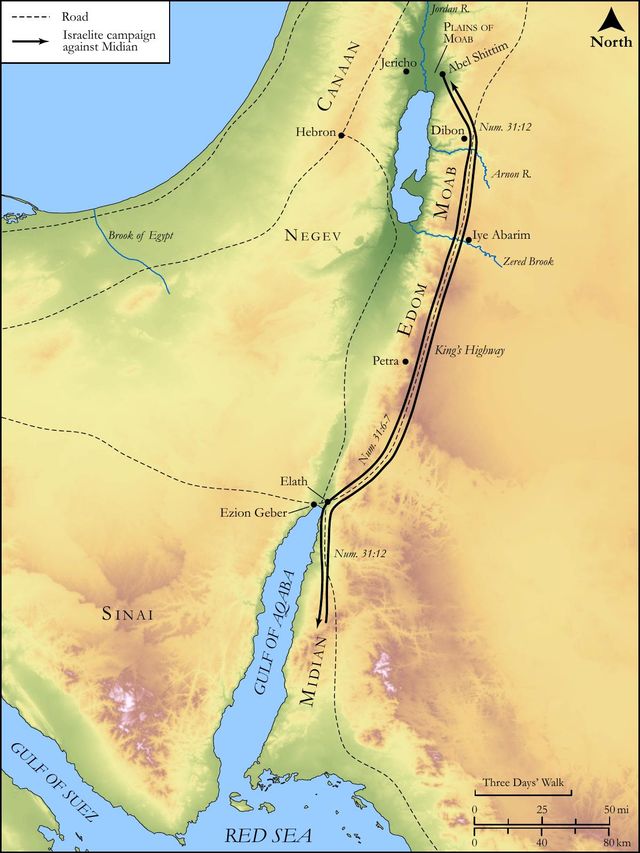
See on the biblical-era map
Study this verse
Continue studying Numbers 31:24 across the web’s major study libraries — every link below opens this exact verse, chapter, or book on the destination site.
Read & Compare
 BibleGatewayThis verse in more than 200 translations and 70 languages.
 Bible.comThe YouVersion reader — hundreds of translations, reading plans, and highlights.
 ESV.orgCrossway's official English Standard Version reader.
 NET BibleThe NET translation with 60,000+ translators' notes on every rendering decision.
 STEP BibleTyndale House's free study tool — original text, vocabulary, and scholarly resources.
 BibliaLogos Bible Software's free web reader.
 USCCBThe New American Bible (Revised Edition) with the U.S. bishops' study notes.
Commentaries
 BibleHub CommentariesDozens of classic commentaries on this verse, gathered on one page.
 StudyLightMore than 100 commentary sets — the largest collection on the web.
 BibleRefPlain-English commentary on what this verse means, verse by verse.
 Enduring WordDavid Guzik's free commentary on this chapter, widely used by Bible teachers.
 Bible Study ToolsVerse commentary alongside Greek and Hebrew study aids.
Original Language & Research
- BibleHub InterlinearThe verse word by word — original language, transliteration, and English.
- BibleHub LexiconEvery word's original-language definition and Strong's entry.
 Blue Letter BibleDeep-study tools — Strong's numbers, concordance, and word studies.
 SefariaThe Hebrew text with Rashi and centuries of Jewish commentary.
Sermons, Hymns & Audio


TrulyRandomVerse is not affiliated with these sites and doesn’t control their content. They’re linked because they’re genuinely useful.
Summary
Numbers 31:24 delivers a crucial divine command to the Israelite soldiers and those handling the spoils of war, delineating a precise ritual purification process essential for their re-entry into the sacred communal space. This verse, forming the culmination of comprehensive divine instructions issued in the aftermath of the decisive victory over the Midianites, profoundly underscores the absolute necessity of ceremonial cleansing for both individuals and their possessions. It serves to safeguard the sanctity of the community, ensuring its purity in the immediate presence of the Tabernacle and in light of God's inherent, unblemished holiness.
Context
ShowHideLiterary Context
Numbers 31 vividly narrates Israel's punitive war against the Midianites, a divine judgment provoked by Midian's role in seducing Israel into idolatry and sexual immorality at Peor, as detailed in Numbers 25. Following a decisive victory, Moses and Eleazar the priest confront the returning army. Moses' initial anger (Numbers 31:14-17) stems from their failure to utterly destroy all Midianites, particularly the women who had led Israel astray. This confrontation precipitates further divine instructions for purification. Numbers 31:19-20 outlines a mandatory seven-day period of separation for those who had killed or touched the dead, followed by prescribed cleansing rituals. Numbers 31:21-23 specifies how various items, especially those taken as spoil, are to be purified by fire or water. Verse 24, therefore, serves as the concluding directive for personal purification, mandating the final act of washing clothes on the seventh day as the ultimate prerequisite for full re-entry into the sacred communal space. It is the culmination of a multi-step cleansing process, ensuring no defilement from the battlefield or contact with the dead entered the holy camp.
Historical & Cultural Context
In Israel, profound emphasis was placed on ritual purity, particularly concerning contact with death, bodily discharges, or pagan practices. Death was considered the ultimate source of defilement, rendering individuals ritually unclean and temporarily separated from the community's worship life. The Israelite camp was far more than a mere military encampment; it was the consecrated dwelling place of the Israelite community, housing the Tabernacle, which symbolized God's intimate presence among His people. Maintaining the camp's holiness was paramount, as God's presence demanded absolute purity. The war against Midian was not merely a military campaign but a divine judgment, making the subsequent purification rites essential to prevent the defilement of God's holy people and their dwelling place by the pagan practices or the ritual impurity associated with warfare and death. The "seventh day" often carried connotations of completion and rest, linking this final act of purification to the broader concept of the Sabbath and divine order, signaling a return to a state of wholeness and acceptability before God.
Key Themes
ShowHideThis verse powerfully underscores several core themes within the book of Numbers and the Pentateuch. Ritual Purity and Holiness is paramount; the detailed instructions for cleansing highlight God's absolute holiness and the necessity for His people to be ritually pure to dwell in His presence. The camp, as God's dwelling place, required rigorous adherence to purity laws, preventing defilement from entering the sacred space, a concept deeply rooted in the laws found throughout the book of Leviticus. Obedience to Divine Command is another crucial theme; Moses and Eleazar transmit specific, non-negotiable instructions from God, emphasizing that Israel's well-being and continued relationship with Yahweh depend on their precise adherence to His statutes. This war, a divine judgment, necessitated a divine protocol for its aftermath. Finally, Separation from the Nations is evident; the purification rites serve to distinguish Israel from the defiling practices of surrounding peoples, reinforcing their identity as a holy nation set apart by God, a theme powerfully echoed in Deuteronomy 7:6.
Exposition and Analysis
ShowHideKey Word Analysis
ShowHideThis verb, derived from a root meaning "to trample," refers to a vigorous process of cleansing clothes, often by stamping with the feet, as in fulling. It implies a thorough, deliberate, and physically demanding act of purification, not merely a superficial rinse. In a ritual context, it signifies the complete removal of defilement, making something fit for sacred use or presence before God.
This adjective denotes a state of ritual purity, distinct from mere physical cleanliness. To be ṭâhêr means to be free from ceremonial defilement, uncontaminated, and thus permissible to enter sacred space, participate in religious rites, or approach God. It signifies a state of being "pure" or "purified" in a Levitical sense, the opposite of ṭāmē' (unclean), and is essential for maintaining the sanctity of the community in God's presence.
More than a temporary military encampment, the machăneh was the sacred dwelling place of the Israelite community, where the Tabernacle, symbolizing God's manifest presence, resided. Its sanctity demanded strict adherence to purity laws, as any defilement within it could profane God's dwelling and invite divine judgment upon the people. It represented the consecrated space of God's covenant people.
Verse Breakdown
ShowHide"And ye shall wash your clothes on the seventh day"
This clause specifies the final, culminating act of purification for the returning warriors and those who had handled the spoils of war. The act of washing clothes symbolized a comprehensive cleansing, extending beyond the individual to their possessions, signifying a complete break from the defilement of the battlefield. The "seventh day" indicates the culmination of a prescribed period of separation and purification (Numbers 31:19), aligning with the broader biblical motif of completion, divine order, and the Sabbath cycle, emphasizing the thoroughness and divinely ordained nature of the cleansing process.
"and ye shall be clean"
This is the declared outcome and divine pronouncement resulting from the prescribed washing. The act of washing, performed according to God's explicit instruction, effects a state of ritual purity (ṭâhêr). This declaration of cleanliness is not merely a physical state but a ceremonial one, indicating fitness to re-enter the sacred community and participate in its life without defiling God's presence, thereby restoring their covenant standing.
"and afterward ye shall come into the camp"
This final clause articulates the consequence and permission granted by the achieved state of purity. Only after completing the prescribed cleansing rituals, culminating in the washing on the seventh day and being declared ritually clean, were the individuals permitted to re-enter the holy camp. This underscores the strict boundary between the profane (the battlefield, contact with death, paganism) and the sacred (the camp with the Tabernacle), emphasizing God's non-negotiable demand for holiness from His people who dwell in His immediate presence.
Literary Devices
ShowHideThe passage employs Legal Language and Prescriptive Instruction, characteristic of the Pentateuchal law codes, clearly outlining a divine command and its precise execution. The repetition of "clean" and the emphasis on the "seventh day" creates a strong sense of Ritual Emphasis, highlighting the importance, thoroughness, and divine ordering of the purification process. The command functions as a Boundary Marker, physically and ritually separating the defiled from the holy, reinforcing the concept of Israel's Separation as a holy people set apart for God. The entire instruction serves as a Symbolic Act, where the physical washing of clothes represents a deeper, spiritual cleansing and restoration of communal integrity before a holy God.
Theological and Thematic Connections
ShowHideNumbers 31:24 encapsulates the profound Old Testament principle that God's absolute holiness demands purity from His people, especially when dwelling in His presence. The detailed and rigorous purification rites following contact with death or paganism underscore the inherent incompatibility of defilement with the divine. This principle runs throughout the Mosaic Law, establishing a clear boundary between the sacred and the profane, essential for maintaining the covenant relationship between Yahweh and Israel. The physical act of washing and the passage of time were external markers of an internal, ritual transformation, making the individual acceptable to re-enter the community where God dwelt. This foreshadows a deeper spiritual truth: sin inherently defiles, and only a divine act of cleansing can restore fellowship with a perfectly holy God.
Reflection and Application
ShowHideWhile the specific ceremonial laws of the Old Testament are no longer binding for New Testament believers, the timeless spiritual truths they convey remain profoundly relevant. Numbers 31:24 reminds us that God is utterly holy and cannot tolerate defilement in His presence. Just as the Israelites needed meticulous cleansing to approach the physical manifestation of God's presence in the Tabernacle, we, as believers, are called to spiritual purity to walk in fellowship with God, who now dwells within us by His Spirit. Our sin, like the contact with death, defiles us and separates us from His perfect holiness. This verse calls us to a continual awareness of our need for cleansing, not through ritual washings, but through the atoning work of Christ and the ongoing process of sanctification. It challenges us to examine our lives for any defilement—whether from unconfessed sin, worldly influences, or unrighteous attitudes—and to earnestly seek the spiritual washing that restores us to intimate communion with our holy God, honoring His presence in our lives and in the community of faith. This pursuit of purity is not for merit, but out of reverence and love for the One who has made us clean.
Questions for Reflection
ShowHideFAQ
ShowHideWhy was the "seventh day" significant for purification?
ShowHideThe "seventh day" carried deep symbolic meaning in Israelite culture, often associated with completion, rest, and divine order, as seen in the creation account and the Sabbath command. In the context of purification, it signified the culmination of a prescribed period of separation and cleansing (Numbers 31:19). This seven-day period ensured a thorough and complete removal of ritual impurity, emphasizing that the cleansing process was not superficial but comprehensive, aligning with God's meticulous demands for holiness. It marked the end of the time of separation and the readiness for full re-entry into the sacred community, signifying a return to a state of wholeness and acceptability before God.
Did these ceremonial washings truly make someone "clean" in a spiritual sense?
ShowHideIn the Old Testament, ceremonial washings like those in Numbers 31:24 made an individual ritually "clean" (ṭāhôr), meaning they were declared fit to participate in the community's worship and to enter sacred space. This was a temporary, external, and symbolic purity that allowed for fellowship within the covenant community. However, these rituals did not fundamentally remove the stain of moral sin or provide internal spiritual regeneration in the way that Christ's sacrifice does. They served as a constant reminder of sin's defiling nature and the necessity of divine intervention for true cleansing, foreshadowing the ultimate, once-for-all purification offered through the blood of Jesus Christ. The Old Testament sacrifices and rituals pointed forward to a perfect sacrifice that could truly cleanse the conscience and heart, as described in Hebrews 10:1-4.
Christ-Centered Fulfillment
ShowHideNumbers 31:24, with its emphasis on ritual cleansing for re-entry into the holy camp, finds its profound Christ-centered fulfillment in the person and redemptive work of Jesus Christ. The Old Testament's meticulous laws regarding defilement and purification, particularly from contact with death, constantly pointed to humanity's inherent sinfulness and inability to approach a perfectly holy God. Just as the Israelite warriors needed to wash their clothes and be declared "clean" to re-enter the physical camp where God's presence resided, humanity, universally defiled by sin, requires a perfect and ultimate cleansing to enter God's eternal presence. Jesus, as the perfect Lamb of God who takes away the sin of the world, offered Himself as the singular, sufficient sacrifice, whose precious blood cleanses us not merely from ritual impurity but from the defilement of sin itself, making us truly pure and righteous before God. His victorious death conquered both sin and death, rendering us eternally clean and acceptable. Through faith in Him, we are not only declared righteous but are also continually sanctified by the indwelling Holy Spirit, enabling us to draw near to God with full confidence, for we have been washed clean by His precious blood, as Revelation 1:5 powerfully proclaims. The "camp" we now enter is God's spiritual kingdom, and ultimately, the new heavens and new earth, made accessible by the perfect purity Christ provides, fulfilling the shadow of Old Testament cleansing in glorious, eternal reality (see Hebrews 10:19-22).