


Nehemiah 11:24
Bible text: King James Version (1769 Blayney text) · Public domain
Bible text: Berean Standard Bible · Public domain
Bible text: American Standard Version (1901) · Public domain
Bible text: World English Bible, Messianic edition · Public domain
Bible text: Geneva Bible (1599) · Public domain
Bible text: Young's Literal Translation · Public domain
- וּפְתַחְיָהu·fe·tach·Yahand PethahiahH6611Conj-w ¦ N-proper-mNoun Proper MasculineוּandפְתַחְיָהPethahiah
- בֶּןben[the] son ofH1121N-mscNoun Singular Masculine Construct
- מְשֵׁיזַבְאֵלme·shei·zav·'ElMeshezabelH4898N-proper-mNoun Proper Masculine
- מִבְּנֵיmi·be·neione of [the] descendants ofH1121Prep-m ¦ N-mpcNoun Plural Masculine Constructמִone ofבְּנֵי[the] descendants of
- זֶרַחZe·rachZerahH2226N-proper-mNoun Proper Masculine
- בֶּןben[the] son ofH1121N-mscNoun Singular Masculine Construct
- יְהוּדָהye·hu·DahJudahH3063N-properNoun Proper Location
- לְיַדle·Yad[was] to [the] side ofH3027Prep-l ¦ N-cscNoun Singular common gender Constructלְ[was] toיַד[the] side of
- הַמֶּלֶךְha·Me·lekhthe kingH4428Art ¦ N-msNoun Singular Masculine Absoluteהַtheמֶּלֶךְking
- לְכָלle·kholto everyH3605Prep-l ¦ N-mscNoun Singular Masculine Constructלְtoכָלevery
- דָּבָרda·VarmatterH1697N-msNoun Singular Masculine Absolute
- לָעָםla·'Amof the peopleH5971Prep-l ¦ N-msNoun Singular Masculine Absoluteלָof theעָםpeople
English is a literal word-by-word gloss of the Hebrew, not the KJV's wording. Why?
This is the original text the KJV's translators worked from — each Hebrew word with its own literal English meaning in this verse, prepared by scholars at Tyndale House, Cambridge. The KJV translates whole sentences, not word by word, so its wording differs: one Hebrew word can become several English words, and the KJV may choose “the LORD” where the gloss reads “Yahweh”. Both are faithful — they answer different questions. For the KJV's own rendering, switch to the KJV text.
Details
See on the biblical-era map
Study this verse
Public-domain commentary
Matthew Henry
From his Commentary on the Whole Bible. Henry comments on passages, not single verses — this entry covers Nehemiah 11:20–36.
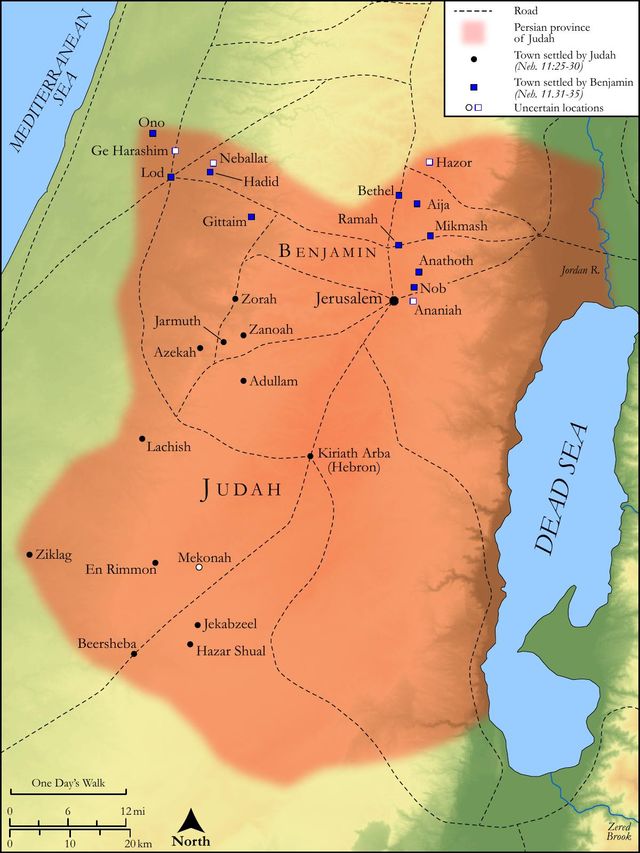
Having given an account of the principal persons that dwelt in Jerusalem (a larger account of whom he had before, Ch1 9:2, etc.), Nehemiah, in these verses, gives us some account of the other cities, in which dwelt the residue of Israel, Neh 11:20. It was requisite that Jerusalem should be replenished, yet not so as to drain the country. The king himself is served of the field, which will do little service if there be not hands to manage it. Let there therefore be no strife, no envy, no contempt, no ill will, between the inhabitants of the cities and those of the villages; both are needful, both useful, and neither can be spared. 1. The Nethinims, the posterity of the Gibeonites, dwelt in Ophel, which was upon the wall of Jerusalem (Neh 3:26), because they were to do the servile work of the temple, which therefore they must be posted near to, that they might be ready to attend, Neh 11:21. 2. Though the Levites were dispersed through the cities of Judah, yet they had an overseer who resided in Jerusalem, superior of their order and their provincial, to whom they applied for direction, who took care of their affairs and took cognizance of their conduct, whether they did their duty, Neh 11:22. 3. Some of the singers were appointed to look after the necessary repairs of the temple, being ingenious men, and having leisure between their hours of service; they were over the business of the house of God, Neh 11:22. And, it seems, the king of Persia had such a kindness for their office that he allotted a particular maintenance for them, besides what belonged to them as Levites, Neh 11:23. 4. Here is one that was the king's commissioner at Jerusalem. He was of the posterity of Zerah (Neh 11:24); for of that family of Judah there were some new settled in Jerusalem, and not all of Pharez, as appears by that other catalogue, Ch1 9:6. He is said to be at the king's hand, or on the king's part, in all matters concerning the people, to determine controversies that arose between the king's officers and his subjects, to see that what was due to the king from the people was duly paid in and what was allowed by the king for the temple service was duly paid out, and happy it was for the Jews that one of themselves was in this post. 5. Here is an account of the villages, or country towns, which were inhabited by the residue of Israel - the towns in which the children of Judah dwelt (Neh 11:25-30), those that were inhabited by the children of Benjamin (Neh 11:31-35), and divisions for the Levites among both, Neh 11:36. We will now suppose them safe and easy, though few and poor, but by the blessing of God they were likely to increase in wealth and power, and they would have been more likely if there had not been that general profaneness among them, and lukewarmness in religion, with which they were charged in God's name by the prophet Malachi, who, it is supposed, prophesied about this time, and in whom prophecy ceased for some ages, till it revived in the great prophet and his forerunner.
Continue studying Nehemiah 11:24 across the web’s major study libraries — every link below opens this exact verse, chapter, or book on the destination site.
Read & Compare
 BibleGatewayThis verse in more than 200 translations and 70 languages.
 Bible.comThe YouVersion reader — hundreds of translations, reading plans, and highlights.
 ESV.orgCrossway's official English Standard Version reader.
 NET BibleThe NET translation with 60,000+ translators' notes on every rendering decision.
 STEP BibleTyndale House's free study tool — original text, vocabulary, and scholarly resources.
 BibliaLogos Bible Software's free web reader.
 USCCBThe New American Bible (Revised Edition) with the U.S. bishops' study notes.
Commentaries
 BibleHub CommentariesDozens of classic commentaries on this verse, gathered on one page.
 StudyLightMore than 100 commentary sets — the largest collection on the web.
 BibleRefPlain-English commentary on what this verse means, verse by verse.
 Enduring WordDavid Guzik's free commentary on this chapter, widely used by Bible teachers.
 Bible Study ToolsVerse commentary alongside Greek and Hebrew study aids.
Original Language & Research
- BibleHub InterlinearThe verse word by word — original language, transliteration, and English.
- BibleHub LexiconEvery word's original-language definition and Strong's entry.
 Blue Letter BibleDeep-study tools — Strong's numbers, concordance, and word studies.
 SefariaThe Hebrew text with Rashi and centuries of Jewish commentary.
Sermons, Hymns & Audio


TrulyRandomVerse is not affiliated with these sites and doesn’t control their content. They’re linked because they’re genuinely useful.
Summary
Nehemiah 11:24 introduces Pethahiah, a significant administrative figure during the post-exilic period in Jerusalem. Identified by his lineage as "the son of Meshezabeel, of the children of Zerah the son of Judah," Pethahiah held a crucial and authoritative position "at the king's hand." This phrase indicates a direct appointment or close association with the Persian monarch, entrusting him with extensive responsibility for "all matters concerning the people." The verse thus highlights the meticulous organization, trusted leadership, and careful governance essential for the re-establishment and stability of the Jewish community after their return from Babylonian captivity, underscoring the blend of Jewish self-governance within the broader Persian imperial structure.
Context
ShowHideLiterary Context
Nehemiah 11 serves as a vital register detailing the repopulation of Jerusalem and other Judean towns following the completion and dedication of the city wall. This chapter follows the grand covenant renewal ceremony in Nehemiah 9 and the sealing of the covenant in Nehemiah 10, establishing the spiritual and communal foundations for the returning exiles. The meticulous listing of residents, including priests, Levites, and various officials, is not merely a dry census but an affirmation of the community's commitment to rebuilding not just physical structures but also a functioning society. Pethahiah's specific mention in this administrative catalog underscores the practical implementation of governance and order within the nascent community, demonstrating the systematic efforts to solidify the Jewish presence in their ancestral land under Persian oversight. His role provides a glimpse into the bureaucratic and leadership structures necessary for the community's stability.
Historical & Cultural Context
The events of Nehemiah are set in the mid-5th century BCE, during the reign of Artaxerxes I of Persia. Following the Babylonian exile, the Persian Empire adopted a policy of allowing various subjugated peoples a degree of internal autonomy, often facilitated through local leaders who were either appointed or approved by the imperial administration. The phrase "at the king's hand" (Hebrew: ʿal yad ha-melek) is a significant idiomatic expression in the royal courts of that day, denoting a position of high trust, authority, and direct service to the monarch. Pethahiah, therefore, was likely a Jewish official serving as a liaison or administrator on behalf of the Persian king, responsible for managing the internal affairs of the Jewish community in the province of Yehud. This arrangement allowed for the exercise of Jewish law and custom within the framework of Persian imperial oversight, reflecting a pragmatic approach to governance in a diverse and vast empire. Such positions were crucial for maintaining peace and order in the provinces.
Key Themes
ShowHideNehemiah 11:24 contributes to several overarching themes prominent in the book of Nehemiah. Firstly, it highlights the theme of Re-establishment and Order, illustrating the practical steps taken to rebuild not only the physical walls of Jerusalem but also the social, administrative, and spiritual fabric of the community. The careful listing of residents and officials, including Pethahiah, emphasizes the systematic effort required to bring order out of the chaos of exile and return, ensuring the viability of the restored community. Secondly, the verse underscores the Importance of Competent and Trusted Leadership. Pethahiah's comprehensive responsibility for "all matters concerning the people" signifies the critical need for individuals with integrity, wisdom, and administrative skill to manage complex societal affairs. This aligns with the broader narrative of Nehemiah, which consistently champions effective leadership for the well-being of God's people, as exemplified by Nehemiah's own divinely appointed commission from King Artaxerxes. Lastly, the verse subtly points to Divine Providence in Governance. Even within a foreign imperial structure, God's hand is evident in raising up and positioning individuals like Pethahiah to ensure the stability and flourishing of His covenant people, reflecting God's sovereign rule over all earthly kingdoms and His ability to use secular authorities for His divine purposes, as articulated in Daniel 2:21.
Exposition and Analysis
ShowHideKey Word Analysis
ShowHideThis name means "Yahweh opens" or "Yahweh sets free." In the context of the post-exilic return, this name carries profound significance. It subtly reflects the divine act of "opening" the way for the exiles to return from captivity and "setting them free" to rebuild their lives and community in Jerusalem. Pethahiah's very name could be seen as a theological statement, hinting at God's ongoing work of liberation and restoration through human agents, even those in administrative roles.
Zerah was one of the twin sons of Judah, as recorded in Genesis 38:30. His descendants formed a prominent clan within the powerful tribe of Judah, from which the Davidic kings and, ultimately, the Messiah would come. Pethahiah's lineage from Zerah would have afforded him significant tribal legitimacy, social standing, and respect within the Jewish community, reinforcing his authority and connecting him deeply to the historical and covenantal identity of Israel.
While "hand" literally refers to a physical appendage, in the phrase "at the king's hand" (ʿal yad ha-melek), it functions as a powerful idiom or metonymy. Here, "hand" signifies the king's authority, power, direct involvement, and the means by which he acts. To be "at the king's hand" implies a position of direct service, trust, and delegated authority, indicating that Pethahiah was an agent or representative empowered to act on the Persian king's behalf. This position required immense discretion, loyalty, and considerable delegated power, underscoring Pethahiah's importance in the administrative structure of the province of Yehud.
Verse Breakdown
ShowHide"And Pethahiah the son of Meshezabeel, of the children of Zerah the son of Judah,"
This opening clause meticulously identifies the individual by his personal name, Pethahiah, followed by his immediate paternal lineage through Meshezabeel, and then his broader tribal affiliation, tracing back to Zerah, a son of Judah. In post-exilic Jewish society, such detailed genealogical information was crucial for establishing identity, legitimacy, and social standing, particularly for someone holding a position of authority. It firmly grounds Pethahiah's significant role within the traditional, God-ordained structures of the Jewish people, connecting him to their historical and covenantal heritage.
"[was] at the king's hand"
This pivotal phrase defines Pethahiah's official capacity and the source of his authority. It indicates that he held a position directly under the authority of the Persian king, likely Artaxerxes I. This was not merely an advisory role but a significant appointment, signifying that Pethahiah was a royal functionary—perhaps a governor, commissioner, or high-ranking administrator—who represented the king's interests within the Jewish community while simultaneously serving as a crucial liaison for the people to the imperial power. This position required immense trust and discretion from the monarch.
"in all matters concerning the people."
This final clause specifies the comprehensive scope of Pethahiah's responsibilities. The phrase "all matters" suggests a wide-ranging jurisdiction, potentially encompassing judicial decisions, administrative oversight, taxation, security, and the general welfare of the Jewish populace. This indicates that Pethahiah was a central figure in the civil administration of the province of Yehud, entrusted with the day-to-day governance and resolution of issues affecting the returning exiles, thereby ensuring order and stability within the community under Persian rule.
Literary Devices
ShowHideNehemiah 11:24 employs several literary techniques to convey its message effectively. The verse exhibits Onomastic Significance through Pethahiah's name, "Yahweh opens" or "Yahweh sets free," subtly linking his administrative function to God's overarching work of liberation and restoration for His people. The phrase "at the king's hand" is a powerful Idiom or Metonymy, where "hand" stands for the king's authority, power, and direct involvement through his delegate. This idiom efficiently communicates Pethahiah's high status and the source of his delegated power. Furthermore, the detailed Genealogical Listing ("son of Meshezabeel, of the children of Zerah the son of Judah") serves to establish Pethahiah's legitimate standing within the community, a common and crucial feature in post-exilic texts that emphasize continuity, identity, and tribal heritage. The phrase "in all matters concerning the people" functions as a form of Merism or Totality, implying a comprehensive and exhaustive scope of responsibility without needing to enumerate every specific duty.
Theological and Thematic Connections
ShowHideNehemiah 11:24, though seemingly a simple administrative detail, offers profound theological insights into God's providential care for His people. It demonstrates that God works not only through grand miracles and prophetic utterances but also through the meticulous details of human administration and leadership. Pethahiah's role as a trusted official, even under a foreign king, illustrates how God can raise up and utilize individuals in positions of secular authority to bring about His purposes for His covenant people. This verse underscores the divine value placed on good governance, order, and justice within a community. It reminds us that all authority, whether sacred or secular, ultimately derives from God, and that those entrusted with leadership are called to serve with integrity and diligence for the well-being of those under their care. The stability and flourishing of the post-exilic community were directly linked to the presence of competent and God-ordained leaders like Pethahiah, highlighting God's active involvement in the practicalities of His people's lives.
Reflection and Application
ShowHideNehemiah 11:24 serves as a timeless reminder of the enduring necessity for faithful, competent, and diligent leadership in all spheres of life – whether in civil government, community organizations, the church, or even within our families and workplaces. Just as Pethahiah was entrusted with managing the comprehensive affairs of the people, so too are individuals today called to serve with integrity, wisdom, and a deep commitment to the good of others in their respective roles. This verse encourages us to recognize and support those who genuinely work for the flourishing of their communities, reflecting the biblical principle that when the righteous are in authority, the people rejoice. It challenges us to consider our own spheres of influence and how we might exercise leadership or support leaders in a way that brings order, justice, and blessing. Ultimately, God uses individuals in specific capacities to bring about His purposes of order and well-being within society, and our participation in this divine work, whether as leaders or as those who uphold good leadership, is a sacred calling.
Questions for Reflection
ShowHideFAQ
ShowHideWhat was the significance of Pethahiah's lineage from Zerah, son of Judah?
ShowHidePethahiah's lineage from Zerah, a son of Judah, was highly significant for several reasons. Firstly, it connected him to the royal tribe of Judah, the tribe from which Israel's kings (including David) and ultimately the Messiah would come. This tribal affiliation would have lent him considerable legitimacy and respect within the Jewish community, grounding his authority in the historical and covenantal identity of Israel. Even though he served under a foreign king, his tribal heritage would have helped bridge the gap between Persian imperial authority and the internal self-governance of the Jewish people, ensuring that a trusted figure from within their own ranks managed their affairs. It underscored the continuity of Israelite identity and tribal structures even in the post-exilic period, as seen in the detailed genealogies throughout Nehemiah.
What does "at the king's hand" imply about Pethahiah's authority?
ShowHideThe phrase "at the king's hand" is an idiomatic expression denoting a position of significant trust, authority, and close association with the monarch. It implies that Pethahiah was not merely an advisor but an agent or representative directly appointed by or serving under the authority of the Persian king, likely Artaxerxes I. This meant he possessed delegated royal authority to act on the king's behalf in matters related to the Jewish population in the province of Yehud. His responsibilities would have been extensive, encompassing administrative, judicial, and perhaps even financial oversight "in all matters concerning the people." This was a high-ranking position requiring discretion, loyalty, and considerable power, making him a crucial figure in the interface between the Jewish community and the Persian imperial administration, similar to how Nehemiah himself was given authority by Artaxerxes.
Christ-Centered Fulfillment
ShowHideNehemiah 11:24, with its depiction of Pethahiah as a trusted agent "at the king's hand" managing "all matters concerning the people," beautifully foreshadows the ultimate and perfect representative and mediator: Jesus Christ. Pethahiah's name, meaning "Yahweh opens" or "Yahweh sets free," resonates profoundly with Christ's mission to "open" the way to God and "set free" those enslaved by sin (Luke 4:18-19). Just as Pethahiah acted on behalf of an earthly king for his people, Christ acts as the supreme agent of God the Father, our great High Priest who has passed through the heavens, representing us before the divine throne (Hebrews 4:14-16). He is the one true mediator between God and humanity (1 Timothy 2:5), entrusted with all authority in heaven and on earth (Matthew 28:18). Christ, as the Head of the Church, administers all things for His people, ensuring their spiritual well-being, growth, and ultimate redemption (Ephesians 1:22-23). His comprehensive oversight far surpasses Pethahiah's, for He not only governs but also redeems, sustains, and perfects His people, embodying the divine wisdom and power that orders all creation and reconciles all things to God (Colossians 1:15-20).