


Nehemiah 11:25
Bible text: King James Version (1769 Blayney text) · Public domain
Bible text: King James Version with Strong's numbers · Public domain
Bible text: Berean Standard Bible · Public domain
Bible text: American Standard Version (1901) · Public domain
Bible text: World English Bible, Messianic edition · Public domain
Bible text: Geneva Bible (1599) · Public domain
Bible text: Young's Literal Translation · Public domain
- וְאֶלve·'eland toH413Conj-w ¦ PrepPrepositionוְandאֶלto
- הַחֲצֵרִיםha·cha·tze·Rimthe villagesH2691Art ¦ N-mpNoun Plural Masculine Absoluteהַtheחֲצֵרִיםvillages
- בִּשְׂדֹתָםbis·do·Tamwith their fieldsH7704Prep-b ¦ N-fpc ¦ 3mpNoun Plural Feminine Constructבִּwithשְׂדֹתָfieldsםtheir
- מִבְּנֵיmi·be·Neisome of [the] people ofH1121Prep-m ¦ N-mpcNoun Plural Masculine Constructמִsome ofבְּנֵי[the] people of
- יְהוּדָהye·hu·DahJudahH3063N-properNoun Proper Location
- יָשְׁבוּya·she·Vuthey dweltH3427V-Qal-Perf-3cpVerb Qal Perfect 3rd Plural common gender
- בְּקִרְיַתbe·kir·Yatin KiriathH7153Prep-b ¦ N-properNoun Proper LocationבְּinקִרְיַתKiriath
- הָאַרְבַּעha·'ar·Ba'<the> ArbaH7153Art ¦ N-properNoun Proper Locationהָ<the>אַרְבַּעArba
- וּבְנֹתֶיהָu·ve·no·Tei·haand its daughtersH1323Conj-w ¦ N-fpc ¦ 3fsNoun Plural Feminine Constructוּandבְנֹתֶיdaughtersהָits
- וּבְדִיבֹןu·ve·di·Vonand in DibonH1769Conj-w ¦ Prep-b ¦ N-properNoun Proper LocationוּandבְinדִיבֹןDibon
- וּבְנֹתֶיהָu·ve·no·Tei·haand its daughtersH1323Conj-w ¦ N-fpc ¦ 3fsNoun Plural Feminine Constructוּandבְנֹתֶיdaughtersהָits
- וּבִיקַּבְצְאֵלu·vi·kav·tze·'Eland in JekabzeelH3343Conj-w ¦ Prep-b ¦ N-properNoun Proper LocationוּandבִinיקַּבְצְאֵלJekabzeel
- וַחֲצֵרֶיהָva·cha·tze·Rei·haand its villagesH2691Conj-w ¦ N-mpc ¦ 3fsNoun Plural Masculine Constructוַandחֲצֵרֶיvillagesהָits
English is a literal word-by-word gloss of the Hebrew, not the KJV's wording. Why?
This is the original text the KJV's translators worked from — each Hebrew word with its own literal English meaning in this verse, prepared by scholars at Tyndale House, Cambridge. The KJV translates whole sentences, not word by word, so its wording differs: one Hebrew word can become several English words, and the KJV may choose “the LORD” where the gloss reads “Yahweh”. Both are faithful — they answer different questions. For the KJV's own rendering, switch to the KJV text.
Details
See on the biblical-era map
Study this verse
Public-domain commentary
Matthew Henry
From his Commentary on the Whole Bible. Henry comments on passages, not single verses — this entry covers Nehemiah 11:20–36.
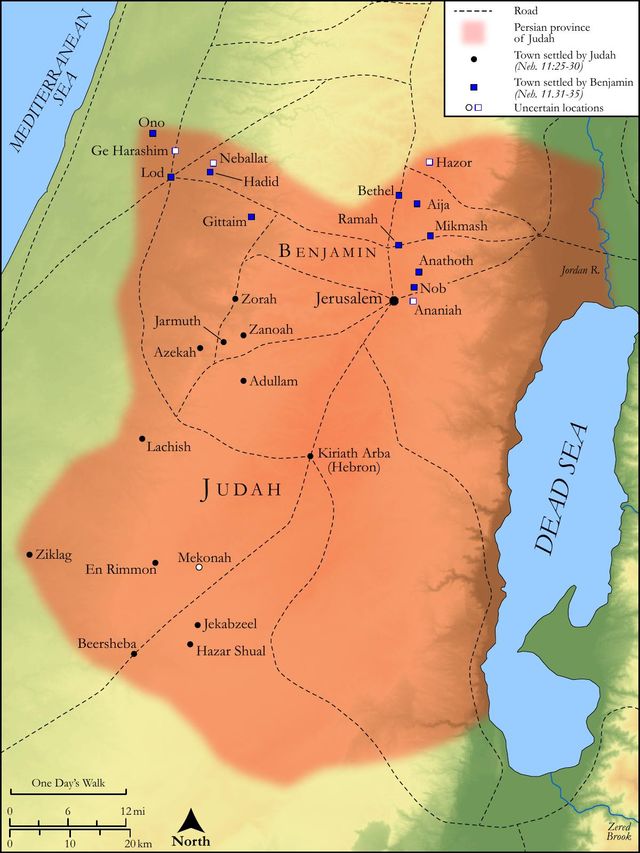
Having given an account of the principal persons that dwelt in Jerusalem (a larger account of whom he had before, Ch1 9:2, etc.), Nehemiah, in these verses, gives us some account of the other cities, in which dwelt the residue of Israel, Neh 11:20. It was requisite that Jerusalem should be replenished, yet not so as to drain the country. The king himself is served of the field, which will do little service if there be not hands to manage it. Let there therefore be no strife, no envy, no contempt, no ill will, between the inhabitants of the cities and those of the villages; both are needful, both useful, and neither can be spared. 1. The Nethinims, the posterity of the Gibeonites, dwelt in Ophel, which was upon the wall of Jerusalem (Neh 3:26), because they were to do the servile work of the temple, which therefore they must be posted near to, that they might be ready to attend, Neh 11:21. 2. Though the Levites were dispersed through the cities of Judah, yet they had an overseer who resided in Jerusalem, superior of their order and their provincial, to whom they applied for direction, who took care of their affairs and took cognizance of their conduct, whether they did their duty, Neh 11:22. 3. Some of the singers were appointed to look after the necessary repairs of the temple, being ingenious men, and having leisure between their hours of service; they were over the business of the house of God, Neh 11:22. And, it seems, the king of Persia had such a kindness for their office that he allotted a particular maintenance for them, besides what belonged to them as Levites, Neh 11:23. 4. Here is one that was the king's commissioner at Jerusalem. He was of the posterity of Zerah (Neh 11:24); for of that family of Judah there were some new settled in Jerusalem, and not all of Pharez, as appears by that other catalogue, Ch1 9:6. He is said to be at the king's hand, or on the king's part, in all matters concerning the people, to determine controversies that arose between the king's officers and his subjects, to see that what was due to the king from the people was duly paid in and what was allowed by the king for the temple service was duly paid out, and happy it was for the Jews that one of themselves was in this post. 5. Here is an account of the villages, or country towns, which were inhabited by the residue of Israel - the towns in which the children of Judah dwelt (Neh 11:25-30), those that were inhabited by the children of Benjamin (Neh 11:31-35), and divisions for the Levites among both, Neh 11:36. We will now suppose them safe and easy, though few and poor, but by the blessing of God they were likely to increase in wealth and power, and they would have been more likely if there had not been that general profaneness among them, and lukewarmness in religion, with which they were charged in God's name by the prophet Malachi, who, it is supposed, prophesied about this time, and in whom prophecy ceased for some ages, till it revived in the great prophet and his forerunner.
Historical interpretation
Historical reception
1 surviving comment on this verse from the historical church.
Of the sons of Judah, they dwelled in Kiriath-arba, etc. For Beer-sheba was the boundary of Judah to the south, and the Valley of the Sons of Hinnom to the north next to Jerusalem to the east. Then the cities of the sons of Benjamin are recounted in a similar order. After listing these, it is added:
Continue studying Nehemiah 11:25 across the web’s major study libraries — every link below opens this exact verse, chapter, or book on the destination site.
Read & Compare
 BibleGatewayThis verse in more than 200 translations and 70 languages.
 Bible.comThe YouVersion reader — hundreds of translations, reading plans, and highlights.
 ESV.orgCrossway's official English Standard Version reader.
 NET BibleThe NET translation with 60,000+ translators' notes on every rendering decision.
 STEP BibleTyndale House's free study tool — original text, vocabulary, and scholarly resources.
 BibliaLogos Bible Software's free web reader.
 USCCBThe New American Bible (Revised Edition) with the U.S. bishops' study notes.
Commentaries
 BibleHub CommentariesDozens of classic commentaries on this verse, gathered on one page.
 StudyLightMore than 100 commentary sets — the largest collection on the web.
 BibleRefPlain-English commentary on what this verse means, verse by verse.
 Enduring WordDavid Guzik's free commentary on this chapter, widely used by Bible teachers.
 Bible Study ToolsVerse commentary alongside Greek and Hebrew study aids.
Original Language & Research
- BibleHub InterlinearThe verse word by word — original language, transliteration, and English.
- BibleHub LexiconEvery word's original-language definition and Strong's entry.
 Blue Letter BibleDeep-study tools — Strong's numbers, concordance, and word studies.
 SefariaThe Hebrew text with Rashi and centuries of Jewish commentary.
Sermons, Hymns & Audio


TrulyRandomVerse is not affiliated with these sites and doesn’t control their content. They’re linked because they’re genuinely useful.
Summary
Nehemiah 11:25 provides a meticulous record of the post-exilic resettlement of the "children of Judah" in various towns and their surrounding agricultural lands beyond the fortified walls of Jerusalem. This verse is an integral part of the larger administrative and historical account in Nehemiah chapter 11, which details the strategic efforts to repopulate not only the capital city but also the broader territory of Judah. It signifies a crucial, tangible step in the restoration of the land and its people, demonstrating the comprehensive re-establishment of life and community in the ancestral inheritance after generations of exile.
Context
ShowHideLiterary Context
Nehemiah 11:25 is situated within a pivotal phase of Israel's post-exilic restoration. Following the monumental completion of Jerusalem's walls (Nehemiah 6-7) and a profound spiritual revival marked by the public reading of the Law and a covenant renewal (Nehemiah 8-10), the narrative transitions to the practical, yet equally vital, challenge of repopulating the land. Jerusalem, though fortified, remained sparsely inhabited, and many Israelites were hesitant to leave the security of their established settlements to move into the capital, which still required significant commitment and posed potential risks, as highlighted in Nehemiah 11:1. To address this demographic challenge, a system involving lots and voluntary commitments was implemented to ensure a stable population for both Jerusalem and the surrounding towns and villages. This verse, therefore, is part of a detailed administrative record, listing specific communities where the people of Judah settled, thereby illustrating the widespread and organized re-establishment of life across the ancestral territory, not solely confined to the capital.
Historical & Cultural Context
The period described in Nehemiah is the mid-5th century BCE, during the Persian Empire's rule. The returned exiles faced immense challenges: a ruined land, a depleted population, and the urgent need to re-establish economic, social, and religious structures. Land ownership and inheritance were foundational to Israelite identity, deeply intertwined with the covenant promises and their sense of belonging. The physical re-occupation of their ancestral territory was thus a deeply significant act, symbolizing a return to their heritage and a reclaiming of their identity as God's chosen people. The specific towns listed, like Kirjatharba (ancient Hebron), carried immense historical and spiritual weight, connecting the returned generation directly to the patriarchs and the original conquest of Canaan. Re-establishing communities in these strategic locations was crucial for agricultural sustenance, economic viability, and asserting a renewed presence in the land, signaling a return to normalcy and a reclaiming of their heritage after generations of exile.
Key Themes
ShowHideThis verse, though a geographical list, contributes significantly to several overarching themes in Nehemiah and the broader biblical narrative. The Restoration of the Land and People is paramount; it highlights the tangible fulfillment of God's promises to bring His people back from exile and re-establish them in their inheritance. This is not merely a spiritual return but a physical re-inhabitation, signifying God's faithfulness to His covenant, as prophesied in passages like Jeremiah 29:10-14. Furthermore, the meticulous detail in listing these towns underscores Divine Providence and Order in the restoration process; even the seemingly mundane administrative details of resettlement reflect God's guiding hand and sovereign oversight in rebuilding His nation. Finally, the act of settling in these specific towns, many with deep historical roots, represents the Reclaiming of Inheritance and Identity. By re-occupying places like Kirjatharba (Hebron) and Jekabzeel (also known as Kabzeel in Joshua 15:21), the descendants of Judah were literally stepping back into their ancestral heritage, reinforcing their unique identity as God's chosen people rooted in His promises.
Exposition and Analysis
ShowHideKey Word Analysis
ShowHideFrom יָדָה; celebrated; Jehudah (or Judah), the name of five Israelites; also of the tribe descended from the first, and of its territory. This word identifies the specific tribal group whose members are being resettled. "Judah" is not merely a geographical designation but represents the lineage through which the messianic promises would ultimately be fulfilled, emphasizing the continuity of God's covenant people even after exile. Their return to their ancestral land is a powerful testament to God's faithfulness to His chosen line.
A primitive root; properly, to sit down (specifically as judge. in ambush, in quiet); by implication, to dwell, to remain; causatively, to settle, to marry. The verb "dwelt" signifies a permanent, settled occupation rather than a temporary encampment. It conveys the idea of re-establishing homes, communities, and a stable presence in the land. This act of "dwelling" is fundamental to the restoration, indicating a return to normalcy and the re-rooting of a people in their promised inheritance.
From קִרְיָה and אַרְבַּע or אַרְבַּע; city of Arba, or city of the four (giants); Kirjath-Arba or Kirjath-ha-Arba, a place in Palestine. This is the ancient, pre-Israelite name for Hebron, a city of profound historical and covenantal significance. Hebron was a major city in the tribal territory of Judah, known as the burial place of Abraham, Isaac, Jacob, Sarah, Rebekah, and Leah in the Cave of Machpelah (Genesis 23:19). Its inclusion here signifies the return of Judahites to a foundational part of their heritage, a place deeply connected to the patriarchal promises and the very roots of their nation. The name "city of Arba" also implicitly recalls the Anakim giants, underscoring the Israelites' reclaiming of land previously occupied by formidable foes.
Verse Breakdown
ShowHide"And for the villages, with their fields,"
This introductory phrase immediately sets the scope of the verse beyond the urban center of Jerusalem, emphasizing the importance of the rural areas. "Villages" (Hebrew: chatzerim, H2691) refers to unfortified settlements, often dependent on larger towns, while "fields" (Hebrew: sadeh, H7704) highlights the agricultural land vital for sustenance and economic recovery. This indicates a comprehensive repopulation effort aimed at re-establishing a full and functioning society, not just a fortified capital.
"[some] of the children of Judah dwelt at Kirjatharba, and [in] the villages thereof,"
This clause specifies the tribal group (Judah, H3063) and their primary settlement in Kirjatharba (Hebron, H7153), a city of immense historical and spiritual significance. The phrase "and in the villages thereof" underscores that the resettlement extended beyond the main town to its satellite communities, indicating a thorough re-rooting of the people in their ancestral heartland and the re-establishment of complete, functioning local communities.
"and at Dibon, and [in] the villages thereof,"
This continues the meticulous listing of repopulated areas, identifying Dibon (H1769) as another key settlement within Judah's territory. While a more famous Dibon existed in Moab, the context here clearly places this Dibon within the sphere of Judah's repopulation efforts, likely a town in southern Judah. The repetition of "and in the villages thereof" further emphasizes the widespread nature of the resettlement, covering not just the central towns but also their dependent rural areas, crucial for agricultural productivity and population density.
"and at Jekabzeel, and [in] the villages thereof,"
The verse concludes by listing Jekabzeel (H3343), located in the extreme south of Judah, thereby extending the geographical scope of the repopulation to the very boundaries of the tribal inheritance. The name "Jekabzeel" possibly means "God gathers" or "God will gather," which is highly symbolic and fitting for a community of returned exiles, reinforcing the theological theme of God's active hand in reassembling His scattered people. This final mention reinforces the comprehensive and deliberate nature of the resettlement, demonstrating that the returned exiles were re-establishing their presence across the full extent of their ancestral lands.
Literary Devices
ShowHideNehemiah 11:25 primarily employs Cataloging/Listing, a common literary device in historical and administrative texts, to meticulously document the specific locations of resettlement. This detailed enumeration serves to emphasize the thoroughness of the repopulation effort and lends an air of historical accuracy and divine oversight to the process. The verse also utilizes Repetition with the recurring phrase "and [in] the villages thereof." This repeated phrase is not merely redundant; it underscores the comprehensive nature of the resettlement, highlighting that the restoration extended beyond the main towns to their surrounding agricultural and residential dependencies, signifying the re-establishment of complete, functioning communities. Furthermore, there is an element of Symbolism embedded within the very names of the places mentioned, particularly Kirjatharba (Hebron) and Jekabzeel. These names are laden with historical and covenantal weight, representing the reclaiming of ancestral land, the re-establishment of national identity, and the tangible fulfillment of God's promises to His people.
Theological and Thematic Connections
ShowHideNehemiah 11:25, with its seemingly mundane list of towns, powerfully illustrates God's unwavering faithfulness to His covenant promises. Despite Israel's disobedience and the devastating period of exile, God, in His restorative power, meticulously orchestrates their return and re-establishment in the very land He promised to Abraham. This physical re-occupation of ancestral territory is a tangible demonstration of God's commitment to His people and their heritage, a partial fulfillment of the prophecies concerning the return from captivity. It underscores that God cares not only about grand spiritual revivals but also about the practical, earthy details of His people's lives and their physical dwelling places, ensuring their security, sustenance, and flourishing. The detailed nature of the record points to a divine order at work, bringing life and structure back to a desolate land, demonstrating that His plans for His people are comprehensive and extend to every facet of their existence.
Reflection and Application
ShowHideThis verse, though a historical record of ancient resettlement, offers profound lessons for contemporary believers. It reminds us that God is deeply invested in the practical details of our lives and communities, just as He was concerned with the precise locations of Israel's repopulation. We are called to be active participants in building and contributing to the health and vitality of our local communities, whether that be our neighborhoods, workplaces, or, most importantly, our local churches. The returnees' willingness to settle in various places, even those less prominent than Jerusalem, underscores the importance of every part of the body and the value of faithful service in seemingly "small" or overlooked areas. Furthermore, Nehemiah 11:25 serves as a powerful testament to God's unwavering faithfulness. Even after periods of desolation, judgment, or personal "exile" from His purposes, God remains committed to restoring what was lost, bringing His people back to their inheritance, and rebuilding what was broken, all in His perfect timing and according to His sovereign plan. This should inspire perseverance and trust in His restorative power in our own lives and in the life of the church, encouraging us to faithfully participate in His ongoing work of restoration in the world.
Questions for Reflection
ShowHideFAQ
ShowHideWhy does Nehemiah 11:25 list specific, seemingly obscure villages?
ShowHideNehemiah 11:25, along with the rest of Nehemiah chapter 11, serves as a vital administrative and historical record of the post-exilic repopulation efforts. The detailed listing of specific villages, even those that might seem obscure to a modern reader, highlights several key points. First, it demonstrates the comprehensive nature of the resettlement, showing that the return extended far beyond the capital city of Jerusalem into the surrounding agricultural and rural areas. This was crucial for establishing economic viability, food security, and a robust population base for the nascent Jewish community. Second, it underscores the meticulous care taken by the leaders, under divine guidance, to ensure the re-establishment of a functioning society across the ancestral land. Finally, it serves as a tangible testament to God's faithfulness in bringing His people back to their inheritance, fulfilling ancient prophecies of return and restoration.
What is the significance of Kirjatharba being mentioned?
ShowHideKirjatharba is the ancient name for Hebron, a city of profound historical, cultural, and covenantal significance in Israelite history. Its mention in Nehemiah 11:25 is highly significant because Hebron was a foundational city in the tribal territory of Judah. It was the place where Abraham purchased the Cave of Machpelah as a burial site for Sarah and himself, and later for Isaac, Rebekah, Jacob, and Leah (Genesis 23:19). Hebron was also a key city in the conquest of Canaan and later became one of the cities of refuge. Its re-occupation by the returned exiles signifies a powerful reclaiming of deep spiritual and historical roots, reinforcing the continuity of God's covenant with His people and their connection to the land promised to their patriarchs. It represents a return to the very heart of their heritage.
Christ-Centered Fulfillment
ShowHideThe physical return to the land and the reclaiming of an earthly inheritance detailed in Nehemiah 11:25 powerfully foreshadow a greater, spiritual fulfillment found in Jesus Christ. Just as the exiles returned to their promised land, believers in Christ are brought into a new, eternal inheritance that transcends geographical boundaries and earthly possessions. Christ is the true "dwelling place" for God's people, the ultimate "city" for which Abraham longed, "whose architect and builder is God" (Hebrews 11:10). Through His atoning work, we are no longer "foreigners and strangers" but "fellow citizens with God's people and members of God's household, built on the foundation of the apostles and prophets, with Christ Jesus himself as the chief cornerstone" (Ephesians 2:19-22). The re-establishment of physical communities in Nehemiah points to the building of the Church, the spiritual body of Christ, which is God's dwelling place among humanity, composed of living stones being built into a spiritual house, with Christ as the cornerstone (1 Peter 2:4-5). Ultimately, the vision of a restored land culminates in the new heavens and new earth, where God dwells with His people in the New Jerusalem, a city without end, where "He will wipe every tear from their eyes. There will be no more death or mourning or crying or pain, for the old order of things has passed away" (Revelation 21:1-4). Thus, Nehemiah 11:25, with its detailed list of earthly settlements, points forward to the glorious, eternal dwelling place and inheritance secured for us in Jesus Christ.