


Nahum 1:10
Bible text: King James Version (1769 Blayney text) · Public domain
Bible text: Berean Standard Bible · Public domain
Bible text: American Standard Version (1901) · Public domain
Bible text: World English Bible, Messianic edition · Public domain
Bible text: Geneva Bible (1599) · Public domain
Bible text: Young's Literal Translation · Public domain
- כִּיkiforH3588PrtParticle Conditional
- עַד'adtoH5704PrepPreposition
- סִירִיםsi·RimthornsH5518N-mpNoun Plural Masculine Absolute
- סְבֻכִיםse·vu·KhiminterwovenH5440V-Qal-PassPrtcpl-mpVerb Qal Participle Passive Plural Masculine Absolute
- וּכְסָבְאָםu·khe·sa·ve·'Amand like their drinkH5435Conj-w ¦ Prep-k ¦ N-msc ¦ 3mpNoun Singular Masculine Constructוּandכְlikeסָבְאָdrinkםtheir
- סְבוּאִיםse·vu·'ImdrunkardsH5433V-Qal-PassPrtcpl-mpVerb Qal Participle Passive Plural Masculine Absolute
- אֻכְּלוּ'u·ke·Luthey will be consumedH398V-Pual-Perf-3cpVerb Pual Perfect 3rd Plural common gender
- כְּקַשׁke·Kashlike stubbleH7179Prep-k ¦ N-msNoun Singular Masculine Absoluteכְּlikeקַשׁstubble
- יָבֵשׁya·VeshdryH3002Adj-msAdjective Singular Masculine Absolute
- מָלֵאma·Le'fullH4392Adj-msAdjective Singular Masculine Absolute
English is a literal word-by-word gloss of the Hebrew, not the KJV's wording. Why?
This is the original text the KJV's translators worked from — each Hebrew word with its own literal English meaning in this verse, prepared by scholars at Tyndale House, Cambridge. The KJV translates whole sentences, not word by word, so its wording differs: one Hebrew word can become several English words, and the KJV may choose “the LORD” where the gloss reads “Yahweh”. Both are faithful — they answer different questions. For the KJV's own rendering, switch to the KJV text.
Details
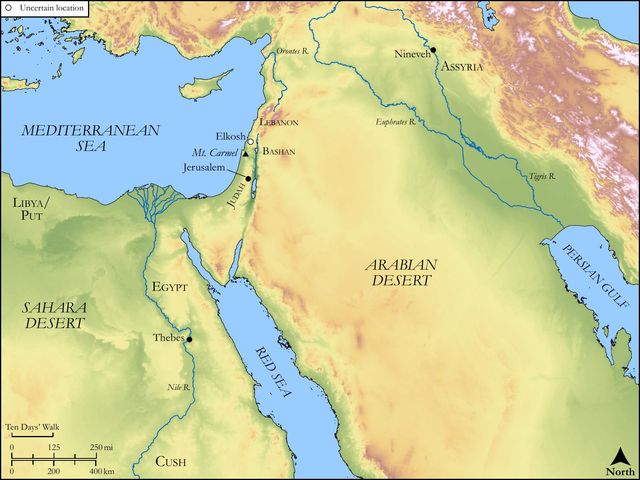
See on the biblical-era map
Study this verse
Public-domain commentary
Matthew Henry
From his Commentary on the Whole Bible. Henry comments on passages, not single verses — this entry covers Nahum 1:9–15. His three-level outline is real structure in the source text, so it is rendered as structure.
These verses seem to point at the destruction of the army of the Assyrians under Sennacherib, which may well be reckoned a part of the burden of Nineveh, the head city of the Assyrian empire, and a pledge of the destruction of Nineveh itself about 100 years after; and this was an event which Isaiah, with whom probably this prophet was contemporary, spoke much of. Now observe here,
I.The great provocation which the Assyrians gave to God, the just and jealous God, for which, though slow to anger, he would take vengeance (Nah 1:11): There is one come out of thee, that imagines evil against the Lord - Sennacherib, and his spokesman Rabshakeh. They framed an evil letter and an evil speech, not only against Hezekiah and his people, but against God himself, reflecting upon him as level with the gods of the heathen, and unable to protect his worshippers, dissuading his people from putting confidence in him, and urging them rather to put themselves under the protection of the great king, the king of Assyria. They contrived to alter the property of Jerusalem, that it should be no longer the city of the Lord, the holy city. This one, this mighty one, so he thinks himself, that comes out of Nineveh, imagining evil against the Lord, brings upon Nineveh this burden. Never was the glorious Majesty of heaven and earth more daringly, more blasphemously affronted than by Sennacherib at that time. He was a wicked counsellor who counselled them to despair of God's protection, and surrender themselves to the king of Assyria, and endeavour to put them out of conceit with Hezekiah's reformation (Isa 36:7); with this wicked counsellor he here expostulates (Nah 1:9): "What do you imagine against the Lord? What a foolish wicked thing it is for you to plot against God, as if you could outwit divine wisdom and overpower omnipotence itself!" Note, There is a great deal imagined against the Lord by the gates of hell, and against the interests of his kingdom in the world; but it will prove a vain thing, Psa 2:1, Psa 2:2. He that sits in heaven laughs at the imaginations of the pretenders to politics against him, and will turn their counsels headlong.
II.The great destruction which God would bring upon them for it, not immediately upon the whole monarchy (the ruin of that was deferred till the measure of their iniquity was full), but,
1.Upon the army; God will make an utter end of that; it shall be totally cut off and ruined at one blow; one fatal stroke of the destroying angel shall lay them dead upon the spot; affliction shall not rise up the second time, for it shall not need. With some sinners God makes a quick despatch, does their business at once. Divine vengeance goes not by one certain rule, nor in one constant track, but one way or other, by acute diseases or chronical ones, by slow deaths or lingering ones, he will make an utter end of all his enemies, who persist in their imaginations against him. We have reason to think that the Assyrian army were mostly of the same spirit, and spoke the same language, with their general, and now God would take them to task, though they did but say as they were taught; and it shall appear that they have laid themselves open to divine wrath by their own act and deed, Nah 1:10.
(1.)They are as thorns that entangle one another, and are folded together. They make one another worse, and more inveterate against God and his Israel, harden one another's hearts, and strengthen one another's hands, in their impiety; and therefore God will do with them as the husbandman does with a bush of thorns when he cannot part them: he puts them all into the fire together.
(2.)They are as drunken men, intoxicated with pride and rage; and such as they shall be irrecoverably overthrown and destroyed. They shall be as drunkards, besotted to their own ruin, and shall stumble and fall, and make themselves a reproach, and be justly laughed at.
(3.)They shall be devoured as stubble fully dry, which is irresistibly and irrecoverably consumed by the flame. The judgments of God are as devouring fire to those that make themselves as stubble to them. It is again threatened concerning this great army (Nah 1:12) that though they be quiet and likewise many, very secure, not fearing the sallies out of the besieged upon them, because they are numerous, yet thus shall they be cut down, or certainly shall they be cut down, as grass and corn are cut down, with as little ado, when he shall pass through, even the destroying angel that is commissioned to cut them down. Note, The security of sinners, and their confidence in their own strength, are often presages of ruin approaching.
2.Upon the king. He imagined evil against the Lord, and shall he escape? No (Nah 1:14): "The Lord has given a commandment concerning thee; the decree has gone forth, that thy name be no more sown, that thy memory perish, that thou be no more talked of as thou hast been, and that the report of thy mighty actions be dispersed upon the wings of fame and celebrated with her trumpet." Because Sennacherib's son reigned in his stead, some make this to point at the overthrow of the Assyrian empire not long after. Note, Those that imagine evil against the Lord hasten evil upon themselves and their own families and interests, and ruin their own names by dishonouring his name. It is further threatened,
(1.)That the images he worshipped should be cut off from their temple, the graven image and the molten image out of the house of his gods, which, some think, was fulfilled when Sennacherib was slain by his two sons, as he was worshipping in the house of Nisroch his god, by which barbarous parricide we may suppose the temple was looked upon as defiled, and was therefore disused, and the images were cut off from it, the worshippers of those images no longer attending there. Or it may be taken more generally to denote the utter ruin of Assyria; the army of the enemy shall lay all waste, and not spare even the images of their gods, by which God would intimate to them that one of the grounds of his controversy with them was their idolatry.
(2.)That Sennacherib's grave shall be made there, some think in the house of his god; there he is slain, and there he shall be buried, for he is vile; he lies under this perpetual mark of disgrace, that he had so far lost his interest in the natural affection of his own children that two of them murdered him. Or it may be meant of the ignominious fall of the Assyrian monarchy itself, upon the ruins of which that of Babylon was raised. What a noise was made about the grave of that once formidable state, but now despicable, is largely described, Eze 31:3, Eze 31:11, Eze 31:15, Eze 31:16. Note, Those that make themselves vile by scandalous sins God will make vile by shameful punishments.
III.The great deliverance which God would hereby work for his own people and the city that was called by his name.
The ruin of the church's enemies is the salvation of the church, and a very great salvation it was that was wrought for Jerusalem by the overthrow of Sennacherib's army.
1.The siege shall hereby be raised: "Now will I break his yoke from off thee, by which thou art kept in servitude, and will burst thy bonds asunder, by which thou seemest bound over to the Assyrian's wrath." That vast victorious army, when it forced free quarters for itself throughout all the land of Judah, and lived at discretion there, was as yokes and bonds upon them. Jerusalem, when it was besieged, was, as it were, bound and fettered by it; but, when the destroying angel had done his work, Jerusalem's bonds were burst asunder, and it was set at liberty again. This was a figure of the great salvation, by which the Jerusalem that is above is made free, is made free indeed.
2.The enemy shall be so weakened and dispirited that they shall never make any such attempt again, and the end of this trouble shall be so well gained by the grace of God that there shall be no more occasion for such a severe correction.
(1.)God will not again afflict Jerusalem; his anger is turned away, and he says, It is enough; for he has by this fright accomplished his whole work upon Mount Zion (Isa 10:12), and therefore "though I have afflicted thee, I will afflict thee no more;" the bitter portion shall not be repeated unless there be need and the patient's case call for it; for God doth not afflict willingly.
(2.)The enemy shall not dare again to attack Jerusalem (Nah 1:15): The wicked shall no more pass through thee as they have done, to lay all waste, for he is utterly cut off and disabled to do it. His army is cut off, his spirit cut off, and at length he himself is cut off.
3.The tidings of this great deliverance shall be published and welcomed with abundance of joy throughout the kingdom, Nah 1:15. While Sennacherib prevailed, and carried all before him, every day brought bad news; but now, behold, upon the mountains, the feet of him that bringeth good tidings, the feet of the evangelist; he is seen coming at a distance upon the mountains, as fast as his feet will carry him; and how pleasant a sight is it once more to see a messenger of peace, after we have received so many of Job's messengers! We find these words made use of by another prophet to illustrate the mercy of the deliverance of the people of God out of Babylon (Isa 52:7), not that the prophets stole the word one from another (as those did, Jer 23:30), but speaking by the same Spirit, they often used the same expressions; and it may be of good use for ministers to testify their consent to wholesome truths (Ti1 6:3) by concurring in the same forms of sound words, Ti2 1:13. These words are also quoted by the apostle, both from Isaiah and Nahum, and applied to the great redemption wrought out for us by our Lord Jesus, and the publishing of it to the world by the everlasting gospel, Rom 10:15. Christ's ministers are those messengers of good tidings, that preach peace by Jesus Christ. How beautiful are the feet of those messengers! How welcome their message to those that see their misery and danger by reason of sin! And observe, He that brings these good tidings brings with them a call to Judah to keep her solemn feasts and perform her vows. During the trouble,
(1.)The ordinary feasts had been intermitted. Inter arma silent leges - The voice of law cannot be heard amidst the shouts of battle. While Jerusalem was encompassed with armies they could not go thither to worship; but now that the embargo is taken off they must return to the observance of their feasts; and the feasts of the Lord will be doubly sweet to the people of God when they have been for some time deprived of the benefit of them and God graciously restores them their opportunities again, for we are taught the worth of such mercies by the want of them.
(2.)They had made vows to God, that, if he would deliver them out of this distress, they would do something extraordinary in his service, to his honour; and now that the deliverance is wrought they are called upon to perform their vows; the promise they had then made must now be made good, for better it is not to vow than to vow and not to pay. And those words, The wicked shall no more pass through thee, may be taken as a promise of the perfecting of the good work of reformation which Hezekiah had begun; the wicked shall not, as they have done, walk on every side, but they shall be cut off, and the baffling of the attempts from the wicked enemies abroad is a mercy indeed to a nation when it is accompanied with the restraint and reformation of the wicked at home, who are its more dangerous enemies.
Historical interpretation
Historical reception
1 surviving comment on this verse from the historical church.
(Verse 10.) Because just as thorns embrace each other, so their feast will be consumed by those who drink together, like straw full of dryness. Septuagint: Because they will be reduced to thorns down to their foundations, and will be eaten like a rolling wheel surrounded, and like straw full of dryness. The three different types that the Lord placed in the parable of the sower (Matt. 13), except for the good soil, which produces a thirtieth, sixtieth, and a hundredth, seem to me the prophet to be replying, one which falls beside the road, and another that is among the rocks, and a third that is among the thorns: which indeed the Apostle also points out about those who do not build well on the foundation of Christ (1 Cor. 3), showing that some build with wood, hay, and straw. Therefore let us carry the wood to that which is now called: Because they will be reduced to thorns even to their foundations. But the hay refers to that which follows: And it will be consumed like the wrapping around a piece of meat. Moreover, the chaff is clearly referred to the chaff, of which it is now said: And it will be like chaff full of dryness. Therefore the Lord will not twice take vengeance on the same thing, because the malice that had arisen in the authors of heresy will be consumed even to its foundation and roots. But even if someone among them seemed to have a display of words, that is, empty leaves that only please the eye, like the volvola, which is called σμίλαξ in Greek, it will be devoured and consumed into nothingness. Volvola (also called Vulvula) is a plant similar to ivy, which is usually surrounded by vines and branches, and it creeps along. Whatever also seems to have the pomp of a harvest in them, but does not have ears and grains of wheat, like straw filled with dryness, will be handed over to the fire. This is according to the Septuagint. However, according to the Hebrew, the covenants and relationships of the heretics are like thorns embracing each other, and their feast and mysteries, because they also claim to have the Lord's table, are a covenant of thorns, a feast and drink of those who eat and drink together. For when the drunkards of the vineyard of Sodom blaspheme against the creator with their ravenous mouths, is it not a feast of the senses? Yet it will be consumed by its own authors, like straw full of dryness.
Continue studying Nahum 1:10 across the web’s major study libraries — every link below opens this exact verse, chapter, or book on the destination site.
Read & Compare
 BibleGatewayThis verse in more than 200 translations and 70 languages.
 Bible.comThe YouVersion reader — hundreds of translations, reading plans, and highlights.
 ESV.orgCrossway's official English Standard Version reader.
 NET BibleThe NET translation with 60,000+ translators' notes on every rendering decision.
 STEP BibleTyndale House's free study tool — original text, vocabulary, and scholarly resources.
 BibliaLogos Bible Software's free web reader.
 USCCBThe New American Bible (Revised Edition) with the U.S. bishops' study notes.
Commentaries
 BibleHub CommentariesDozens of classic commentaries on this verse, gathered on one page.
 StudyLightMore than 100 commentary sets — the largest collection on the web.
 BibleRefPlain-English commentary on what this verse means, verse by verse.
 Enduring WordDavid Guzik's free commentary on this chapter, widely used by Bible teachers.
 Bible Study ToolsVerse commentary alongside Greek and Hebrew study aids.
Original Language & Research
- BibleHub InterlinearThe verse word by word — original language, transliteration, and English.
- BibleHub LexiconEvery word's original-language definition and Strong's entry.
 Blue Letter BibleDeep-study tools — Strong's numbers, concordance, and word studies.
 SefariaThe Hebrew text with Rashi and centuries of Jewish commentary.
Sermons, Hymns & Audio


TrulyRandomVerse is not affiliated with these sites and doesn’t control their content. They’re linked because they’re genuinely useful.
Summary
Nahum 1:10 delivers a stark prophecy of Nineveh's complete and irreversible destruction, employing vivid metaphors to underscore the Assyrian capital's vulnerability despite its perceived strength. This verse serves as a powerful declaration of divine judgment against an oppressive empire, assuring the people of Judah that God's righteous wrath will swiftly consume those who persist in wickedness, rendering their unity and revelry utterly useless against His sovereign power.
Context
ShowHideLiterary Context
Nahum 1:10 is situated within the opening chapter of the Book of Nahum, a prophetic oracle directed exclusively against the city of Nineveh, the capital of the Assyrian Empire. The preceding verses (Nahum 1:2-8) establish the character of God as a zealous, avenging, and powerful deity who is slow to anger but great in power, and who will by no means clear the guilty. This sets the stage for the specific pronouncements of judgment that follow. Verse 9 poses a rhetorical question, "What do ye imagine against the LORD?" implying that Nineveh's schemes are futile. Verse 10, therefore, provides the immediate answer: their imagined strength and unity will be utterly consumed by God's wrath, a direct consequence of their antagonism towards the Lord and His people. The imagery here transitions from God's overwhelming power to the specific, graphic nature of Nineveh's impending doom.
Historical & Cultural Context
The prophecy of Nahum is believed to have been delivered in the late 7th century BC, likely after the Assyrian destruction of Thebes (No-amon) in 663 BC (referenced in Nahum 3:8-10) but before the fall of Nineveh in 612 BC. Assyria, with Nineveh as its formidable capital, was the dominant superpower of that day, notorious for its brutal military campaigns, cruel treatment of conquered peoples, and aggressive expansionism. They had previously conquered the Northern Kingdom of Israel and frequently oppressed the Southern Kingdom of Judah, demanding tribute and instilling terror. The cultural context of Nineveh was one of immense wealth, military might, and idolatry, often characterized by excessive revelry and a sense of invincibility. This verse directly challenges that self-assuredness, portraying their unity as a tangled mess of thorns and their celebrations as drunken stupor, both making them ripe for destruction.
Key Themes
ShowHideNahum 1:10 contributes significantly to several overarching themes within the book. Firstly, it powerfully illustrates the theme of Divine Justice and Retribution. God, as the righteous judge, will not allow unrepentant wickedness and oppression to go unpunished. Nineveh's long history of cruelty and pride has accumulated a debt that God is now prepared to collect, demonstrating that even the most formidable human empires are accountable to His moral law. Secondly, the verse highlights the Vulnerability of Human Power before God's Sovereignty. Despite Assyria's military might and political dominance, the metaphors of "thorns" and "drunkards" expose their inherent weakness and moral decay, emphasizing that no human strength or alliance can withstand the Lord's judgment. This echoes the broader biblical truth that "the Lord brings the counsel of the nations to nothing; he frustrates the plans of the peoples" as found in Psalm 33:10. Finally, the imagery of being "devoured as stubble fully dry" underscores the theme of Swift and Complete Annihilation. The destruction promised is not partial but total, irreversible, and easily accomplished by God, much like dry stubble is effortlessly consumed by fire. This imagery is consistent with other prophetic warnings of judgment, such as the day that "will burn like a furnace" and consume the wicked "like stubble" in Malachi 4:1.
Exposition and Analysis
ShowHideKey Word Analysis
ShowHideThis root means "to entwine" or "to wrap." In this context, it suggests a dense, entangled mass, like a thicket of thorns. It can imply a unified, perhaps even formidable, arrangement, but one that is ultimately self-destructive or easily consumed. The imagery evokes a sense of being hopelessly intertwined, perhaps in their evil schemes or their sheer numbers, yet this very entanglement makes them more susceptible to being consumed.
This verb signifies "to quaff to satiety" or "to become tipsy." It describes a state of intoxication, indicating a lack of sobriety, sound judgment, or awareness of impending danger. Applied to Nineveh, it portrays a society steeped in self-indulgence, moral stupor, and reckless abandon, blinding them to the divine judgment at their doorstep. Their revelry is not a sign of strength but of a fatal spiritual and moral decay.
This primitive root means "to eat," but frequently carries the figurative sense of "to consume" or "to burn up." Here, it powerfully conveys the idea of complete destruction, an overwhelming consumption that leaves nothing behind. The passive voice ("they shall be devoured") emphasizes that the action is done to them by an external, irresistible force – God Himself.
Verse Breakdown
ShowHide"For while [they be] folden together [as] thorns,"
This clause introduces the first metaphor comparing the Assyrians to thorns. The phrase "folden together" suggests their unity, their dense numbers, or perhaps their intricate and thorny nature (harmful, irritating). Like a tangled thicket, they might seem impenetrable or difficult to approach, but thorns are also dry, combustible, and ultimately useless, fit only for burning. This highlights their inherent vulnerability and the ease with which they can be destroyed despite their collective strength.
"and while they are drunken [as] drunkards,"
The second metaphor portrays the Assyrians as "drunken [as] drunkards." This imagery speaks to their moral dissipation, self-indulgence, and lack of spiritual discernment. Their revelry and arrogance have dulled their senses and blinded them to the impending judgment. This state of intoxication renders them unprepared and incapable of resisting the divine wrath, making them easy prey.
"they shall be devoured as stubble fully dry."
This concluding clause delivers the devastating verdict and the ultimate outcome. The "thorns" and "drunkards" will be "devoured," consumed completely and without resistance. The comparison to "stubble fully dry" intensifies the imagery of swift, total, and effortless destruction. Stubble is the worthless residue after harvest, extremely flammable and offering no resistance to fire. This powerful simile emphasizes the utter worthlessness of Nineveh's power and its inevitable, fiery end at the hand of God.
Literary Devices
ShowHideNahum 1:10 is rich in Imagery and Simile, employing vivid comparisons to convey its message of impending doom. The Assyrians are likened to "thorns" and "drunkards," and their destruction is compared to "stubble fully dry." The Simile "as thorns" suggests their harmful, irritating nature and their tangled, dense numbers, while also foreshadowing their flammability. Similarly, "as drunkards" paints a picture of moral decay, self-indulgence, and a fatal lack of awareness, rendering them helpless. The most potent Simile is "devoured as stubble fully dry," which powerfully communicates the swiftness, completeness, and effortlessness of Nineveh's annihilation. The use of Metaphor is also evident in the underlying portrayal of Nineveh's power as something inherently weak and combustible. There is also an element of Irony present: Nineveh, a mighty empire that instilled fear and destroyed nations, is reduced to something as insignificant and easily consumed as dry stubble. This stark contrast highlights the absolute sovereignty of God over human might.
Theological and Thematic Connections
ShowHideNahum 1:10 powerfully articulates the theological truth that God is sovereign over all nations and that His justice will ultimately prevail against all forms of wickedness and oppression. It underscores the principle that human power, no matter how formidable or seemingly unified, is ultimately fragile and fleeting before the omnipotence of the Lord. The destruction of Nineveh serves as a stark historical example of divine retribution, assuring God's people that He sees their suffering and will act on their behalf. This passage reminds us that God's patience has limits, and unrepentant sin, particularly that which involves cruelty and arrogance, will inevitably lead to devastating consequences. It is a testament to God's unwavering commitment to righteousness and His ultimate control over the course of human history.
Reflection and Application
ShowHideNahum 1:10 offers profound insights for contemporary reflection and application. It serves as a potent reminder that God's justice is not an abstract concept but a living reality that will manifest in due time. For those who feel oppressed or witness rampant injustice in the world, this verse offers a deep wellspring of hope and assurance that God sees, God cares, and God will act. It encourages believers to trust in God's ultimate sovereignty, even when circumstances seem overwhelming and evil appears to triumph. Conversely, for those who might be tempted by pride, self-indulgence, or the abuse of power, this passage stands as a solemn warning: human strength, unity in wickedness, or fleeting pleasures are no match for divine judgment. It calls us to sober self-assessment, urging us to align our lives with God's righteous standards, to pursue justice, and to live with spiritual sobriety, recognizing that true security is found only in Him.
Questions for Reflection
ShowHideFAQ
ShowHideWhat is the significance of Nineveh's destruction for believers today?
ShowHideThe destruction of Nineveh, as prophesied in Nahum 1:10, holds profound significance for believers today. It serves as a powerful historical testament to God's unwavering justice and His ultimate sovereignty over all nations and empires. For those who suffer under oppression or witness widespread injustice, Nineveh's fall provides assurance that God sees and will ultimately bring retribution upon unrepentant wickedness. It reinforces the biblical truth that no human power, no matter how formidable, can ultimately defy the Lord. This narrative encourages believers to trust in God's perfect timing and righteous judgment, finding comfort in His control over history. Furthermore, it serves as a solemn warning against pride, cruelty, and moral decay, reminding all people that accountability before God is inevitable, as seen in passages like Romans 2:5-6.
Christ-Centered Fulfillment
ShowHideWhile Nahum 1:10 vividly portrays God's righteous judgment against Nineveh, its ultimate fulfillment and deeper theological significance are found in the person and work of Jesus Christ. The judgment against Nineveh, a city steeped in sin and rebellion, foreshadows the ultimate judgment that awaits all who reject God. However, Christ stands as the one who fulfills both the promise of judgment and the hope of salvation. He is the righteous judge who will one day return to "devour as stubble fully dry" all unrighteousness and those who persist in rebellion against God, as described in 2 Thessalonians 1:7-9. Yet, for those who believe, Christ has already borne the full wrath and judgment of God on the cross, becoming the "stubble fully dry" in our place, consumed by divine fire so that we might not be. His sacrifice on Calvary is the ultimate demonstration of God's justice and His boundless love, offering an escape from the judgment prophesied in Nahum. Through faith in Him, believers are rescued from the wrath to come, finding refuge in the Lamb of God who takes away the sin of the world (John 1:29), thus transforming the prophecy of destruction into a message of redemption for all who turn to Him.