


Matthew 8:34
- καὶkaiAndG2532CONJConjunction
- ἰδοὺidoubeholdG2400INJInterjection
- πᾶσαpasaallG3956A-NSFAdjective Nominative Singular Feminine
- ἡhētheG3588T-NSFDefinite article Nominative Singular Feminine
- πόλιςpoliscityG4172N-NSFNoun Nominative Singular Feminine
- ἐξῆλθενexēlthenwent outG1831V-2AAI-3SVerb 2nd Aorist Active Indicative 3rd Singular
- εἰςeistoG1519PREPPreposition
- ὑπάντησινhupantēsinmeetG5222N-ASFNoun Accusative Singular Feminine
- τῷtō<the>G3588T-DSMDefinite article Dative Singular Masculine
- ἸησοῦIēsouJesusG2424N-DSM-PNoun Dative Singular Masculine Individual
- καὶkaiAndG2532CONJConjunction
- ἰδόντεςidonteshaving seenG1492V-2AAP-NPMVerb 2nd Aorist Active Participle Nominative Plural Masculine
- αὐτὸνautonHimG846P-ASMPersonal pronoun Accusative Singular Masculine
- παρεκάλεσανparekalesanthey begged [Him]G3870V-AAI-3PVerb Aorist Active Indicative 3rd Plural
- ὅπωςhopōsthatG3704CONJConjunction
- μεταβῇmetabēaHe may departG3327V-2AAS-3SVerb 2nd Aorist Active Subjunctive 3rd Singular
- ἀπὸapofromG575PREPPreposition
- τῶνtōntheG3588T-GPNDefinite article Genitive Plural Neuter
- ὁρίωνhoriōnregionG3725N-GPNNoun Genitive Plural Neuter
- αὐτῶνautōnof themG846P-GPMPersonal pronoun Genitive Plural Masculine
English is a literal word-by-word gloss of the Greek, not the KJV's wording. Why?
This is the original text the KJV's translators worked from — each Greek word with its own literal English meaning in this verse, prepared by scholars at Tyndale House, Cambridge. The KJV translates whole sentences, not word by word, so its wording differs: one Greek word can become several English words, and the KJV may choose “charity” where the gloss reads “love”. Both are faithful — they answer different questions. For the KJV's own rendering, switch to the KJV text.
Details
See on the biblical-era map
Study this verse
Public-domain commentary
Matthew Henry
From his Commentary on the Whole Bible. Henry comments on passages, not single verses — this entry covers Matthew 8:28–34. His four-level outline is real structure in the source text, so it is rendered as structure.
We have here the story of Christ's casting the devils out of two men that were possessed. The scope of this chapter is to show the divine power of Christ, by the instances of his dominion over bodily diseases, which to us are irresistible; over winds and waves, which to us are yet more uncontrollable; and lastly, over devils, which to us are most formidable of all. Christ has not only all power in heaven and earth and all deep places, but has the keys of hell too. Principalities and powers were made subject to him, even while he was in his estate of humiliation, as an earnest of what should be at his entrance into his glory (Eph 1:21); he spoiled them, Col 2:15. It was observed in general (Mat 8:16), that Christ cast out the spirits with his word; here we have a particular instance of it, which have some circumstances more remarkable than the rest. This miracle was wrought in the country of the Gergesenes; some think, they were the remains of the old Girgashites, Deu 7:1. Though Christ was sent chiefly to the lost sheep of the house of Israel, yet some sallies he made among the borderers, as here, to gain this victory over Satan, which was a specimen of the conquest of his legions in the Gentile world.
Now, besides the general instance which this gives us of Christ's power over Satan, and his design against him to disarm and dispossess him, we have here especially discovered to us the way and manner of evil spirits in their enmity to man. Observe, concerning this legion of devils, What work they made where they were, and where they went.
I.What work they made where they were; which appears in the miserable condition of these two that were possessed by them; and some think, these two were man and wife, because the other Evangelists speak but of one.
1.They dwelt among the tombs; thence they came when the met Christ. The devil having the power of death, not as judge, but as executioner, he delighted to converse among the trophies of his victory, the dead bodies of men; but there, where he thought himself in the greatest triumph and elevation, as afterwards in Golgotha, the place of a skull, did Christ conquer and subdue him. Conversing among the graves increased the melancholy and frenzy of the poor possessed creatures, and so strengthened the hold he had of them by their bodily distemper, and also made them more formidable to other people, who generally startle at any thing that stirs among the tombs.
2.They were exceeding fierce; not only ungovernable themselves, but mischievous to others, frightening many, having hurt some; so that no man durst pass that way. Note, The devil bears malice to mankind, and shows it by making men spiteful and malicious one to another. Mutual enmities, where they should be mutual endearments and assistances, are effects and evidences of Satan's enmity to the whole race; he makes one man a wolf, a bear, a devil, to another - Homo homini lupus. Where Satan rules in a man spiritually, by those lusts that war in the members, pride, envy, malice, revenge, they make him as unfit for human society, as unworthy of it, and as much an enemy to the comfort of it, as these poor possessed creatures were.
3.They bid defiance to Jesus Christ, and disclaimed all interest in him, Mat 8:29. It is an instance of the power of God over the devils, that, notwithstanding the mischief they studied to do by and to these poor creatures, yet they could not keep them from meeting Jesus Christ, who ordered the matter so as to meet them. It was his overpowering hand that dragged these unclean spirits into his presence, which they dreaded more than any thing else: his chains could hold them, when the chains that men made for them could not. But being brought before him, they protested against his jurisdiction, and broke out into a rage, What have we to do with thee, Jesus, thou Son of God? Here is,
(1.)One word that the devil spoke like a saint; he addressed himself to Christ as Jesus the Son of God; a good word, and at this time, when it was a truth but in the proving, it was a great word too, what flesh and blood did not reveal to Peter, Mat 16:17. Even the devils know, and believe, and confess Christ to be the Son of God, and yet they are devils still, which makes their enmity to Christ so much the more wicked, and indeed a perfect torment to themselves; for how can it be otherwise, to oppose one they know to be the Son of God? Note, It is not knowledge, but love, that distinguishes saints from devils. He is the first-born of hell, that knows Christ and yet hates him, and will not be subject to him and his law. We may remember that not long since the devil made a doubt whether Christ were the Son of God or not, and would have persuaded him to question it (Mat 4:3), but now he readily owns it. Note, Though God's children may be much disquieted in an hour of temptation, by Satan's questioning their relation to God as a Father, yet the Spirit of adoption shall at length clear it up to them so much to their satisfaction, as to set it even above the devil's contradiction.
(2.)Two words that he said like a devil, like himself.
[1.]A word of defiance; What have we to do with thee? Now, First, It is true that the devils have nothing to do with Christ as a Saviour, for he took not on him the nature of the angels that fell, nor did he lay hold on them (Heb 2:16); they are in no relation to him, they neither have, nor hope for, any benefit by him. O the depth of this mystery of divine love, that fallen man hath so much to do with Christ, when fallen angels have nothing to do with him! Surely here was torment enough before the time, to be forced to own the excellency that is in Christ, and yet that he has no interest in him. Note, It is possible for me to call Jesus the Son of God, and yet have nothing to do with him. Secondly, It is as true, that the devils desire not to have any thing to do with Christ as a Ruler; they hate him, they are filled with enmity against him, they stand in opposition to him, and are in open rebellion against his crown and dignity. See whose language they speak, that will have nothing to do with the gospel of Christ, with his laws and ordinances, that throw off his yoke, that break his bands in sunder, and will not have him to reign over them; that say to the Almighty Jesus, Depart from us: they are of their father the devil, they do his lusts, and speak his language. Thirdly, But it is not true, that the devils have nothing to do with Christ as a Judge, for they have, and they know it. These devils could not say, What hast thou to do with us? could not deny that the Son of God is the Judge of devils; to his judgment they are bound over in chains of darkness, which they would fain shake off, and shake off the thought of.
[2.]A word of dread and deprecation; "Art thou come hither to torment us - to cast us out from these men, and to restrain us from doing the hurt we would do?" Note, To be turned out, and tied up, from doing mischief, is a torment to the devil, all whose comfort and satisfaction are man's misery and destruction. Should not we then count it our heaven to be doing well, and reckon that our torment, whether within or without, that hinders us from well-doing? Now must we be tormented by thee before the time; Note, First, There is a time in which devils will be more tormented than they are, and they know it. The great assize at the last day is the time fixed for their complete torture, in that Tophet which is ordained of old for the king, for the prince of the devils, and his angels (Isa 30:33; Mat 25:41); for the judgment of that day they are reserved, Pe2 2:4. Those malignant spirits that are, by the divine permission, prisoners at large, walking to and fro through the earth (Job 1:7), are even now in a chain; hitherto shall their power reach, and no further; they will then be made close prisoners: they have now some ease; they will then be in torment without ease. This they here take for granted, and ask not never to be tormented (despair of relief is the misery of their case), but they beg that they may not be tormented before the time; for though they knew not when the day of judgment should be, they knew it should not be yet. Secondly, The devils have a certain fearful looking for of that judgment and fiery indignation, upon every approach of Christ, and every check that is given to their power and rage. The very sight of Christ and his word of command to come out of the man, made them thus apprehensive of their torment. Thus the devils believe, and tremble, Jam 2:19. It is their own enmity to God and man that puts them upon the rack, and torments them before the time. The most desperate sinners, whose damnation is sealed, yet cannot quite harden their hearts against the surprise of fearfulness, when they see the day approaching.
II.Let us now see what work they made where they went, when they were turned out of the men possessed, and that was into a herd of swine, which was a good way off, Mat 8:30. These Gergesenes, though living on the other side Jordan, were Jews. What had they to do with swine, which by the law were unclean, and not to be eaten nor touched? Probably, lying in the outskirts of the land, there were many Gentiles among them, to whom this herd of swine belonged: or they kept them to be sold, or bartered, to the Romans, with whom they had now great dealings, and who were admirers of swine's flesh. Now observe,
1.How the devils seized the swine. Though they were a good way off, and, one would think, out of danger, yet the devils had an eye upon them, to do them a mischief: for they go up and down, seeking to devour, seeking an opportunity; and they seek not long but they find. Now here,
(1.)They asked leave to enter into the swine (Mat 8:31); they besought him, with all earnestness, If thou cast us out, suffer us to go away into the herd of swine. Hereby,
[1.]They discover their own inclination to do mischief, and what a pleasure it is to them; those, therefore, are their children, and resemble them, whose sleep departeth from them, except they cause some to fall, Pro 4:16. "Let us go into the herd of swine, any where rather than into the place of torment, any where to do mischief." If they might not be suffered to hurt men in their bodies, they would hurt them in their goods, and in that too they intend hurt to their souls, by making Christ a burthen to them: such malicious devices hath that old subtle serpent!
[2.]They own Christ's power over them; that, without his sufferance and permission, they could not so much as hurt a swine. This is comfortable to all the Lord's people, that, though the devil's power be very great, yet it is limited, and not equal to his malice (what would become of us, if it were?) especially that it is under the control of our Lord Jesus, our most faithful, powerful friend and Saviour; that Satan and his instruments can go no further than he is pleased to permit; here shall their proud waves be stayed.
(2.)They had leave. Christ said unto them, Go (Mat 8:32), as God did to Satan, when he desired leave to afflict Job. Note, God does often, for wise and holy ends, permit the efforts of Satan's rage, and suffer him to do the mischief he would, and even by it serve his own purposes. The devils are not only Christ's captives, but his vassals; his dominion over them appears in the harm they do, as well as in the hindrance of them from doing more. Thus even their wrath is made to praise Christ, and the remainder of it he does and will restrain. Christ permitted this,
[1.]For the conviction of the Sadducees that were then among the Jews, who denied the existence of spirits, and would not own that there were such beings, because they could not see them. Now Christ would, by this, bring it as near as might be to an ocular demonstration of the being, multitude, power, and malice, of evil spirits, that, if they were not hereby convinced, they might be left inexcusable in their infidelity. We see not the wind, but it would be absurd to deny it, when we see trees and houses blown down by it.
[2.]For the punishment of the Gadarenes, who perhaps, though Jews, took a liberty to eat swine's flesh, contrary to the law: however, their keeping swine bordered upon evil; and Christ would also show what a hellish crew they were delivered fRom. which, if he had permitted it, would soon have choked them, as they did their swine. The devils, in obedience to Christ's command, came out of the men, and having permission, when they were come out, immediately they went into the herd of swine. See what an industrious enemy Satan is, and how expeditious; he will lose no time in doing mischief. Observe,
2.Whither they hurried them, when they had seized them. They were not bid to save their lives, and, therefore, they were made to run violently down a steep place into the sea, where they all perished, to the number of about two thousand, Mar 5:13. Note, The possession which the devil gets is for destruction. Thus the devil hurries people to sin, hurries them to that which they have resolved against, and which they know will be shame and grief to them: with what a force doth the evil spirit work in the children of disobedience, when by so many foolish and hurtful lusts they are brought to act in direct contradiction, not only to religion, but to right reason, and their interest in this world! Thus, likewise, he hurries them to ruin, for he is Apollyon and Abaddon, the great destroyer. By his lusts which men do, they are drowned in destruction and perdition. This is Satan's will, to swallow up and to devour; miserable then is the condition of those that are led captive by him at his will. They are hurried into a worse lake than this, a lake that burns with fire and brimstone. Observe,
3.What effect this had upon the owners. The report of it was soon brought them by the swine-herds, who seemed to be more concerned for the loss of the swine than any thing else, for they went not to tell what was befallen to the possessed of the devils, till the swine were lost, Mat 8:33. Christ went not into the city, but the news of his being there did, by which he was willing to feel how their pulse beat, and what influence it had upon them, and then act accordingly.
Now, (1.) Their curiosity brought them out to see Jesus. The whole city came out to meet him, that they might be able to say, they had seen a man who did such wonderful works. Thus many go out, in profession, to meet Christ for company, that have no real affection for him, nor desire to know him.
(2.)Their covetousness made them willing to be rid of him. Instead of inviting him into their city, or bringing their sick to him to be healed, they desired him to depart out of their coasts, as if they had borrowed the words of the devils, What have we to do with thee, Jesus thou Son of God? And now the devils had what they aimed at in drowning the swine; they did it, and then made the people believe that Christ had done it, and so prejudiced them against him. He seduced our first parents, by possessing them with hard thoughts of God, and kept the Gadarenes from Christ, by suggesting that he came into their country to destroy their cattle, and that he would do more hurt than good; for though he had cured two men, yet he had drowned two thousand swine. Thus the devil sows tares in God's field, does mischief in the Christian church, and then lays the blame upon Christianity, and incenses men against that. They besought him that he would depart, lest, like Moses in Egypt, he should proceed to some other plague. Note, There are a great many who prefer their swine before their Saviour, and so come short of Christ, and salvation by him. They desire Christ to depart out of their hearts, and will not suffer his word to have a place in them, because he and his word will be the destruction of their brutish lusts - those swine which they give up themselves to feed. And justly will Christ forsake those that thus are weary of him, and say to them hereafter, Depart, ye cursed, who now say to the Almighty, Depart from us.
Historical interpretation
Seven Centuries of Reception
20 surviving comments on this verse. Each one is dated, so this reads as a timeline rather than a list.
Select a marker to jump to its quote. Markers stagger vertically where authors wrote within a few decades of each other.
(Hil. Quæst. V. et N. T. 9, 66.) When the dæmons cry out, What have we to do with thee, Jesus, thou Son of God? (1 Cor. 2:8.) we must suppose them to have spoken from suspicion rather than knowledge. For had they known him, they never would have suffered the Lord of glory to be crucified.
Thus the daemons held the two men among the tombs without the town, that is, without the synagogue of the Law and the Prophets; that is, they infested the original seats of the two nations, the abodes of the dead, making the way of this present life dangerous to the passers by.
By their coming forth to meet Him is signified the willingness of men flocking to the faith. The daemons seeing that there is no longer any place left for them among the Gentiles, pray that they may be suffered to dwell among the heretics; these, seized by them, are drowned in the sea, that is, in worldly desires, by the instigations of the daemons, and perish in the unbelief of therest of the Gentiles.
Thus the dæmons held the two men among the tombs without the town, that is, without the synagogue of the Law and the Prophets; that is, they infested the original seats of the two nations, the abodes of the dead, making the way of this present life dangerous to the passers by.
By their coming forth to meet Him is signified the willingness of men flocking to the faith. The dæmons seeing that there is no longer any place left for them among the Gentiles, pray that they may be suffered to dwell among the heretics; these, seized by them, are drowned in the sea, that is, in worldly desires, by the instigations of the dæmons, and perish in the unbelief of the rest of the Gentiles.
Or; The town is a type of the Jewish nation, which having heard of Christ's works goes forth to meet its Lord, to forbid Him to approach their country and town; for they have not received the Gospel.
(in Luc. 8. 30.) The two dæmoniacs are also a type of the Gentile world; for Noah having three sons, Shem, Ham, and Japhet, Shem's posterity alone was taken into the inheritance of God, while from the other two sprang the nations of the Gentiles.
The town from which they came to meet the Lord, asking him to leave their district, represents the synagogue, which did not want to receive the Lord and Savior of the human race even after witnessing his divine power. He therefore returned to his own town. Because he was rejected by the synagogue, he came to his church, which is properly called the city of Christ. On seeing him, the Gerasenes entreated the Lord to depart from their district. Such people are also found among us. Out of faithlessness they compel the Lord and Savior of the world to depart from the district of their hearts, for according to Scripture, “the Holy Spirit will not enter a perverse soul or dwell in a body enslaved to sin.”
And Matthew indeed relates that they said, "Art Thou come hither before the time to torment us?" but the other evangelists have added, that they also entreated and adjured Him not to cast them into the deep. For they supposed that their punishment was now close upon them, and feared, as even now about to fall into vengeance.
And though Luke and those who follow him say that it was one person, but this evangelist two, this doth not exhibit any discrepancy at all. I grant if they had said, there was only one, and no other, they would appear to disagree with Matthew; but if that spake of the one, this of the two, the statement comes not of disagreement, but of a different manner of narration. That is, I for my part think, Luke singled out the fiercest one of them for his narrative, wherefore also in more tragical wise doth he report their miserable case; as, for instance, that bursting his bonds and chains he used to wander about the wilderness. And Mark saith, that he also cut himself with the stones.
And their words too are such as well betray their implacable and shameless nature. For, saith he, "Art thou come hither to torment us before the time?" You see, that they had sinned, they could not deny, but they demand not to suffer their punishment before the time. For, since He had caught them in the act of perpetrating those horrors so incurable and lawless, and deforming and punishing His creature in every way; and they supposed that He, for the excess of their crimes, would not await the time of their punishment: therefore they besought and entreated Him: and they that endured not even bands of iron come bound, and they that run about the mountains, are gone forth into the plain; and those who hinder all others from passing, at sight of Him blocking up the way, stand still.
Now when He is departed from the sea, there follows another miracle yet more awful. For men possessed with devils, like wicked runaways at sight of their master, said, "What have we to do with Thee, Jesus, Thou Son of God? Art Thou come hither to torment us before the time?"
For, because the multitudes called Him man, the devils came proclaiming His Godhead, and they that heard not the sea swelling and subsiding, heard from the devils the same cry, as it by its calm was loudly uttering.
Then, lest the thing might seem to come of flattery, according to their actual experience they cry out and say, "Art Thou come hither to torment us before the time?" With this view, then, their enmity is avowed beforehand, that their entreaty may not incur suspicion. For indeed they were invisibly receiving stripes, and the sea was not in such a storm as they; galled, and inflamed, and suffering things intolerable from His mere presence. Accordingly, no man daring to bring them to Him, Christ of Himself goes unto them.
But for what intent did the devils destroy the swine? Everywhere they have labored to drive men to dismay, and everywhere they rejoice in destruction. This, for instance, the devil did with respect to Job, although in that case too God suffered it, but neither in that case as complying with the devil, but willing to show His own servant the more glorious, cutting off from the evil spirit all pretext for his shamelessness, and turning on his own head what was done against the righteous man. Because now also the contrary of what they wished came to pass. For the power of Christ was gloriously proclaimed, and the wickedness of the demons, from which He delivered those possessed by them, was more plainly indicated; and how they want power to touch even swine, without permission from the God of all.
And if any would take these things in a hidden sense, there is nothing to hinder. For the history indeed is this, but we are to know assuredly, that the swinish sort of men are especially liable to the operations of the demons. And as long as they are men that suffer such things, they are often able yet to prevail; but if they are become altogether swine, they are not only possessed, but are also cast down the precipice. And besides, lest any should suppose what was done to be mere acting, instead of distinctly believing that the devils were gone out; by the death of the swine this is rendered manifest.
And mark also His meekness together with His power. For when the inhabitants of that country, after having received such benefits, were driving Him away, He resisted not, but retired, and left those who had shown themselves unworthy of His teaching, having given them for teachers them that had been freed from the demons, and the swine-herds, that they might of them learn all that had happened; whilst Himself retiring leaves the fear vigorous in them. For the greatness withal of the loss was spreading the fame of what had been done, and the event penetrated their mind. And from many quarters were wafted sounds, proclaiming the strangeness of the miracle; from the cured, and from the drowned, from the owners of the swine, from the men that were feeding them.
Because there were who thought Christ to be a man, therefore the dæmons came to proclaim His divinity, that they who had not seen the sea raging and again still, might hear the dæmons crying; And when he was come to the other side in the country of the Gergesenes, there met him two men having dæmons.
Or; Luke and Mark chose to speak of one who was more grievously afflicted; whence also they add a further description of his calamity; Luke saying that he brake his bonds and was driven into the desert; Mark telling that he ofttimes cut himself with stones. But they neither of them say that there was only one, which would be to contradict Matthew. What is added respecting them that they came from among the tombs, alludes to a mischievous opinion, that the souls of the dead become dæmons. Thus many soothsayers use to kill children, that they may have their souls to cooperate with them; and dæmoniacs also often cry out, I am the spirit of such an one. But it is not the soul of the dead man that then cries out, the dæmon assumes his voice to deceive the hearers. For if the soul of a dead man has power to enter the body of another, much more might it enter its own. And it is more unreasonable to suppose that a soul that has suffered cruelty should cooperate with him that injured it, or that a man should have power to change an incorporeal being into a different kind of substance, such as a human soul into the substance of a dæmon. For even in material body, this is beyond human power; as, for example, no man can change the body of a man into that of an ass. And it is not reasonable to think that a disembodied spirit should wander to and fro on the earth. The souls of the righteous are in the hand of God, (Wisd. 3:1.) therefore those of young children must be so, seeing they are not evil. And the souls of sinners are at once conveyed away from hence, as is clear from Lazarus, and the rich man. Because none dared to bring them to Christ because of their fierceness, therefore Christ goes to them. This their fierceness is intimated when it is added, Exceeding fierce, so that no man might pass that way. So they who hindered all others from passing that way, found one now standing in their way. For they were tortured in an unseen manner, suffering intolerable things from the mere presence of Christ. And, lo, they cried out, saying, What have we to do with thee, Jesus, thou Son of David?
That this should not be thought to be flattery, they cry out what they were experiencing, Art thou come to torment us before the time?
They could not say they had not sinned, because Christ had found them doing evil, and marring the workmanship of God; whence they supposed that for their more abundant wickedness the time of the last punishment which shall be at the day of judgment should not be tarried for to punish them.
Jesus did not say this, as though persuaded by the dæmons, but with many designs therein. One, that He might show the mighty power to hurt of these dæmons, who were in possession of the two men; another, that all might see that they had no power against the swine unless by His sufferance; thirdly, to show that they would have done more grievous hurt to the men, had they not even in their calamities been aided by Divine Providence, for they hate men more than irrational animals. By this it is manifest that there is no man who is not supported by Divine Providence; and if all are not equally supported by it, neither after one manner, this is the highest characteristic of Providence, that it is extended to each man according to his need. Besides the above-mentioned things, we learn also that He cares not only for the whole together, but for each one in particular; which one may see clearly in these dæmoniacs, who would have been long before choked in the deep, had not Divine care preserved them. He also permitted them to go into the herd of swine, that they that dwelt in those parts might know His power. For where He was known to none, there He makes His miracles to shine forth, that He may bring them to a confession of His divinity.
The dæmons destroyed the swine because they are ever striving to bring men into distress, and rejoice in destruction. The greatness of the loss also added to the fame of that which was done; for it was published by many persons; namely, by the men that were healed, by the owners of the swine, and by those that fed them; as it follows, But they that fed them fled, and went into the town, and told all, and concerning them that had the dæmons; and, behold, the whole town went out to meet Jesus. But when they should have adored Him, and wondered at His excellent power, they cast Him from them, as it follows, And when they saw him, they besought him that he would depart out of their coasts. Observe the clemency of Christ next to His excellent power; when those who had received favours from Him would drive Him away, He resisted not, but departed, and left those who thus pronounced themselves unworthy of His teaching, giving them as teachers those who had been delivered from the dæmons, and the feeders of the swine.
But what can be the reason that they love also to dwell in the tombs? They would fain suggest to the multitude a pernicious opinion, as though the souls of the dead become demons, which God forbid we should ever admit into our conception. "But what then wilt thou say," one may ask, "when many of the sorcerers take children and slay them, in order to have the soul afterwards to assist them?" Why, whence is this evident? for of their slaying them, indeed, many tell us, but as to the souls of the slain being with them, whence knowest thou it, I pray thee? "The possessed themselves," it is replied, "cry out, I am the soul of such a one." But this too is a kind of stage-play, and devilish deceit. For it is not the spirit of the dead that cries out, but the evil spirit that feigns these things in order to deceive the hearers. For if it were possible for a soul to enter into the substance of an evil spirit, much more into its own body.
And besides, it stands not to reason that the injured soul should co-operate with the wrong-doer, or that a man should be able to change an incorporeal power into another substance. For if in bodies this were impossible, and one could not make a man's body become that of an ass; much more were this impossible in the invisible soul; neither could one transform it into the substance of an evil spirit. So that these are the sayings of besotted old wives, and spectres to frighten children.
Nor indeed is it possible for a soul, torn away from the body, to wander here any more. For "the souls of the righteous are in the hand of God;" and if of the righteous, then those children's souls also; for neither are they wicked: and the souls too of sinners are straightway led away hence. And it is evident from Lazarus and the rich man; and elsewhere too Christ saith, "This day they require thy soul of thee." And it may not be that a soul, when it is gone forth from the body, should wander here; nor is the reason hard to see. For if we, going about on the earth which is familiar and well known to us, being encompassed with a body, when we are journeying in a strange road, know not which way to go unless we have some one to lead us; how should the soul, being rent away from the body, and having gone out from all her accustomed region, know where to walk without one to show her the way?
And from many other things too one might perceive, that it is not possible for a disembodied soul to remain here. For both Stephen saith, "Receive my spirit;" and Paul, "To depart and to be with Christ is far better;" and of the patriarch too the Scripture saith, that "he was gathered unto his fathers, being cherished in a good old age." And as to the proof, that neither can the souls of sinners continue here; hear the rich man making much entreaty for this, and not obtaining it; since had it been at all possible, he would have come, and have told what had come to pass there. Whence it is evident that after their departure hence our souls are led away into some place, having no more power of themselves to come back again, but awaiting that dreadful day.
Now, should any one say, "And wherefore did Christ fulfill the devils' request, suffering them to depart into the herd of swine?" this would be our reply, that He did so, not as yielding to them, but as providing for many objects thereby. One, to teach them that are delivered from those wicked tyrants, how great the malice of their insidious enemies; another, that all might learn, how not even against swine are they bold, except He allow them; a third, that they would have treated those men more grievously than the swine, unless even in their calamity they had enjoyed much of God's providential care. For that they hate us more than the brutes is surely evident to every man. So then they that spared not the swine, but in one moment of time cast them all down the precipice, much more would they have done so to the men whom they possessed, leading them towards the desert, and carrying them away, unless even in their very tyranny the guardian care of God had abounded, to curb and check the excess of their violence. Whence it is manifest that there is no one, who doth not enjoy the benefit of God's providence. And if not all alike, nor after one manner, this is itself a very great instance of providence; in that according to each man's profit, the work also of providence is displayed.
And besides what hath been mentioned, there is another thing also, which we learn from this; that His providence is not only over all in common, but also over each in particular; which He also declared with respect to His disciples, saying, "But the very hairs of your head are numbered." And from these demoniacs too, one may clearly perceive this; who would have been choked long before, if they had not enjoyed the benefit of much tender care from above.
For these reasons then He permitted them to depart into the herd of swine, and that they also who dwelt in those places should learn His power. For where His name was great, He did not greatly display Himself: but where no one knew Him, but they were still in an insensible condition, He made His miracles to shine out, so as to bring them over to the knowledge of His Godhead. For it is evident from the event that the inhabitants of that city were a sort of senseless people; for when they ought to have adored and marvelled at His power, they sent Him away, and "besought Him that He would depart out of their coasts."
(Verse 34) And behold, the whole city went out to meet Jesus, and when they saw Him, they begged Him to pass through their borders. They ask Him to pass through their borders, not out of pride as some think, but out of humility by which they judged themselves unworthy of the Lord's presence, just as Peter, falling to the knees of the Savior in the catch of fish, said: Depart from me, Lord, for I am a sinful man (Luke 5:8).
This is no voluntary confession followed up by a reward to the utterer, but one extorted by the compulsion of necessity. A runaway slave, when after long time he first beholds his master, straight thinks only of deprecating the scourge; so the dæmons, seeing the Lord suddenly moving upon the earth, thought He was come to judge them. Some absurdly suppose, that these dæmons knew the Son of God, while the Devil knew Him not, because their wickedness was less than his. But all the knowledge of the disciple must be supposed in the Master.
But both the Devil and the dæmons may be said to have rather suspected, than known, Jesus to be the Son of God.
For the presence of the Saviour is the torment of dæmons.
The Saviour bade them go, not as yielding to their request, but that by the death of the swine, an occasion of man's salvation might be offered. But they went out, (to wit, out of the men,) and went into the swine; and, lo, the whole herd rushed violently headlong into the sea, and perished in the waters. Let Manichæus blush; if the souls of men and of beasts be of one substance, and one origin, how should two thousand swine have perished for the sake of the salvation of two men?
Otherwise; This request may have proceeded from humility as well as pride; like Peter, they may have held themselves unworthy of the Lord's presence, Depart from me, for I am a sinful man, O Lord. (Luke 5:8.)
They entreat him to leave their district, not out of pride on their part (as many believe) but out of humility. They judge themselves unworthy of the Lord’s presence, just as Peter after the catch of fish fell before the Savior’s knees and said, “Depart from me, for I am a sinful man, O Lord.”
But as often as they were tortured by His excellent power, and saw Him working signs and miracles, they supposed Him to be the Son of God; when they saw Him hungry and thirsty, and suffering such things, they doubted, and thought Him mere man. It should be considered that even the unbelieving Jews when they said that Christ cast out dæmons in Beelzebub, and the Arians who said that He was a creature, deserve condemnation not only on God's sentence, but on the confession of the dæmons, who declare Christ to be the Son of God. Rightly do they say, What have we to do with thee, Jesus, thou Son of God? that is, our malice and Thy grace have nothing in common, according to that the Apostle speaks, There is no fellowship of light with darkness. (2 Cor. 6:14.)
They did not ask to be sent into men, because they saw Him by whose excellence they were tortured existing in human shape. Nor did they ask to be sent into sheep, because sheep are by God's institution clean animals, and were then offered in the temple of God. But they requested to be sent into the swine rather than into any of the other unclean animals, because this is of all animals the most unclean; whence also it has its name 'porcus,' as being 'spurcus,' filthy, and delighting in filthiness; and dæmons also delight in the filthiness of sin. They did not pray that they might be sent into the air, because of their eager desire of hurting men. And he saith unto them, Go.
(Mor. ii. 10.) For the Devil knows that of himself he has no power to do any thing, because it is not of himself that he exists as a spirit.
(in Luc. 8.) Or; The swine are they that delight in filthy manners; for unless one live as a swine, the devils do not receive power over him; or at most, only to try him, not to destroy him. That the swine were sent headlong into the lake, signifies, that when the people of the Gentiles are delivered from the condemnation of the dæmons, yet still they who would not believe in Christ, perform their profane rites in secret, drowned in a blind and deep curiosity. That they that fed the swine, fled and told what was done, signifies that even the leaders of the wicked though they shun the law of Christianity, yet cease not to proclaim the wonderful power of Christ. When struck with terror, they entreat Him to depart from them, they signify a great number who, well satisfied with their ancient life, show themselves willing to honour the Christian law, while they declare themselves unable to perform it.
Gerasa is a town of Arabia beyond Jordan, close to Mount Gilead, which was in the possession of the tribe of Manasseh, not far from the lake of Tiberias, into which the swine were precipitated.
Gerasa is interpreted 'casting out the dweller,' or, 'a stranger approaching;' this is the Gentile world which cast out the Devil from it; and which was first far off, but now made near, after the resurrection being visited by Christ through His preachers.
It is not without cause that he speaks of them as dwelling among the tombs; for what else are the bodies of the faithless but sepulchres of the dead, in which the word of God dwells not, but there is enclosed the soul dead in sins. He says, So that no man might pass through that way, because before the coming of the Saviour the Gentile world was inaccessible. Or, by the two, understand both Jews and Gentiles, who did not abide in the house, that is, did not rest in their conscience. But they abode in tombs, that is, delighted themselves in dead works, and suffered no man to pass by the way of faith, which way the Jews obstructed.
. The inhabitants of the city begged Jesus to leave because they were grieved and thought that they would suffer something worse thereafter. You, O reader, learn that where there is swinish life, it is not Christ Who dwells there, but demons.
The inhabitants of the city begged Jesus to leave because they were grieved and thought that they would suffer something worse thereafter. You, O reader, learn that where there is swinish life, it is not Christ Who dwells there, but demons.
Continue studying Matthew 8:34 across the web’s major study libraries — every link below opens this exact verse, chapter, or book on the destination site.
Read & Compare
 BibleGatewayThis verse in more than 200 translations and 70 languages.
 Bible.comThe YouVersion reader — hundreds of translations, reading plans, and highlights.
 ESV.orgCrossway's official English Standard Version reader.
 NET BibleThe NET translation with 60,000+ translators' notes on every rendering decision.
 STEP BibleTyndale House's free study tool — original text, vocabulary, and scholarly resources.
 BibliaLogos Bible Software's free web reader.
 USCCBThe New American Bible (Revised Edition) with the U.S. bishops' study notes.
Commentaries
 BibleHub CommentariesDozens of classic commentaries on this verse, gathered on one page.
 StudyLightMore than 100 commentary sets — the largest collection on the web.
 BibleRefPlain-English commentary on what this verse means, verse by verse.
 Enduring WordDavid Guzik's free commentary on this chapter, widely used by Bible teachers.
 Bible Study ToolsVerse commentary alongside Greek and Hebrew study aids.
Original Language & Research
- BibleHub InterlinearThe verse word by word — original language, transliteration, and English.
- BibleHub LexiconEvery word's original-language definition and Strong's entry.
 Blue Letter BibleDeep-study tools — Strong's numbers, concordance, and word studies.
 CNTR CollationThe earliest Greek manuscripts of this verse, collated letter by letter.
Sermons, Hymns & Audio


TrulyRandomVerse is not affiliated with these sites and doesn’t control their content. They’re linked because they’re genuinely useful.
Summary
Following Jesus' dramatic exorcism of demons into a herd of pigs, resulting in the herd's destruction, the entire city of the Gadarenes emerged from their homes. Instead of celebrating the miraculous deliverance or acknowledging Jesus' divine authority, they were overcome with fear and concern for their material losses. Their immediate and urgent plea to Jesus was that He would leave their territory, demonstrating a profound spiritual blindness and a preference for worldly comfort over the transformative presence of the Son of God.
Context
ShowHideLiterary Context
Matthew 8:34 concludes a powerful narrative segment that began with Jesus calming the storm on the Sea of Galilee (Matthew 8:23-27) and immediately precedes His encounter with two demon-possessed men in the region of the Gadarenes (Matthew 8:28-33). The casting out of the demons into a large herd of pigs, which then rushed down a steep bank and drowned, serves as the direct catalyst for the city's reaction in verse 34. The swineherds, having witnessed this astonishing and economically devastating event, fled to the city to report everything, including the liberation of the demoniacs. The city's response, therefore, is directly tied to the perceived cost of Jesus' miraculous power.
Historical & Cultural Context
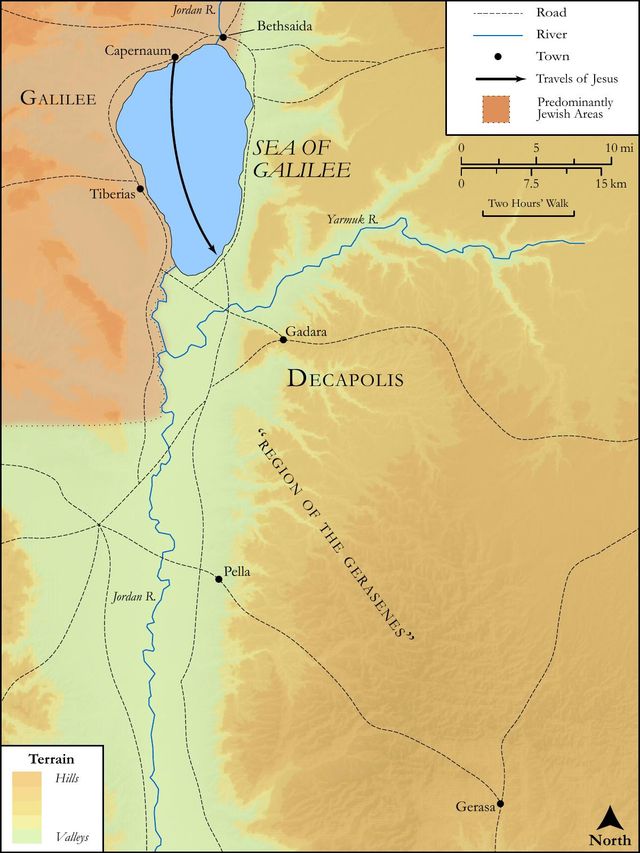
The region of the Gadarenes (or Gergesenes/Gerasenes in other Gospel accounts) was primarily Gentile territory, located on the eastern side of the Sea of Galilee. For Jews, pigs were unclean animals according to Mosaic Law (Leviticus 11:7). However, for Gentiles, raising pigs was a legitimate and profitable enterprise, likely for food and trade. The destruction of "a great herd of swine" (Matthew 8:30) represented a significant economic loss to the community. Their fear was not just of Jesus' power, but of the potential future disruption and financial ruin His presence might bring. This incident highlights the clash between the spiritual realm and worldly concerns, where economic stability took precedence over spiritual deliverance in the eyes of the Gadarenes.
Key Themes
ShowHideThe immediate reaction of the Gadarenes introduces several significant themes that recur throughout Jesus' ministry. First, it powerfully illustrates the conflict between fear and faith. The people chose fear of economic loss over awe at divine power and compassion for the healed individuals. Second, it presents an early and stark instance of the rejection of divine presence. Despite witnessing undeniable power over spiritual forces, the people actively sought Jesus' departure, preferring His absence to the disruption His presence caused to their established order and comfort. This foreshadows the broader theme of rejection that Jesus would face, culminating in His crucifixion (John 1:11). Third, the incident underscores the theme of misplaced priorities, where material possessions (the swine) were valued above spiritual well-being and the transformative power of God. This contrasts sharply with the centurion's faith earlier in the chapter, where he prioritized healing over social standing (Matthew 8:8).
Exposition and Analysis
ShowHideKey Word Analysis
ShowHideThis verb signifies a strong plea, an earnest entreaty, or an urgent request. It implies more than a casual suggestion; it was a deliberate and insistent appeal. The people were not merely asking Jesus to consider leaving; they were imploring Him to depart, indicating a deep-seated desire for His immediate absence.
Meaning "to change place," "to go away," or "to remove." This word emphasizes their desire for Jesus to completely exit their physical location and sphere of influence. It wasn't a request to merely stop performing miracles, but to physically remove Himself from their territory.
This term refers to a boundary-line or, by implication, a frontier region or territory. Their request was not just for Jesus to leave the city, but to vacate their entire district, indicating a comprehensive desire to be rid of His presence and the unsettling power He wielded.
Verse Breakdown
ShowHide"And, behold, the whole city came out to meet Jesus:"
This opening clause highlights the widespread and collective response of the populace. The phrase "behold" (Greek, idoú) draws attention to the unexpected nature of their coming forth. They did not send a delegation; the entire community mobilized, indicating the profound impact of the swine incident and the urgency of their concern. Their "meeting" was not one of welcome or adoration, but of confrontation and apprehension.
"and when they saw him,"
This brief phrase underscores the direct encounter. Their request was made after seeing Jesus with their own eyes, confirming His presence and, by extension, His responsibility for the events that had transpired. This direct visual confirmation solidified their resolve to act.
"they besought [him] that he would depart out of their coasts."
This is the climax of the verse, revealing the city's ultimate desire. Their "beseeching" (a strong plea) for Jesus to "depart" (to leave their territory entirely) demonstrates a clear rejection of His presence. Their fear of economic loss and disruption outweighed any potential spiritual benefit or wonder at the miraculous healing of the demoniacs. They prioritized their material well-being and comfort over the divine power manifested in their midst.
Literary Devices
ShowHideMatthew 8:34 is rich with Irony and Contrast. The Irony is palpable: one would expect a community to rejoice at the liberation of two of their own from demonic oppression, especially after witnessing such a powerful display of divine authority. Instead, their reaction is one of fear and rejection. This creates a stark Contrast between Jesus' compassionate power to heal and deliver, and humanity's often self-serving, fear-driven response to that power. The drowned pigs themselves serve as a Symbol of the worldly possessions and comforts that the Gadarenes prioritized over spiritual liberation. Their request for Jesus to depart symbolizes humanity's frequent preference for maintaining a comfortable status quo, even if it means rejecting the disruptive, yet ultimately redemptive, presence of God.
Theological and Thematic Connections
ShowHideMatthew 8:34 serves as a profound theological statement on human nature's resistance to God's transformative presence when it challenges established comforts or material security. The Gadarenes' reaction exemplifies the human tendency to value worldly possessions and perceived stability over spiritual realities and the radical demands of divine encounter. This incident foreshadows the broader narrative of Jesus' ministry, where His presence often elicited fear, opposition, and rejection from those whose systems or priorities He threatened. It underscores the spiritual blindness that can accompany material attachment, where the miraculous liberation of human souls is overshadowed by the loss of livestock.
Reflection and Application
ShowHideMatthew 8:34 presents a sobering mirror for self-reflection. It challenges us to honestly evaluate our own priorities: do we, like the Gadarenes, prioritize our material security, comfort, and established routines over the radical, often disruptive, presence of Jesus in our lives? True faith often demands a willingness to surrender what we hold dear—be it possessions, control, or comfortable habits—for the sake of spiritual transformation and the advancement of God's kingdom. Are we willing to welcome Jesus into every "coast" of our existence, even when His presence might expose our idols, challenge our values, or call us to costly obedience? This passage reminds us that genuine spiritual freedom and the profound blessings of God's power may come with a perceived cost, but the eternal value far outweighs any earthly loss.
Questions for Reflection
ShowHideFAQ
ShowHideWhy did the people of the city ask Jesus to leave?
ShowHideThe people of the city asked Jesus to leave primarily out of fear and concern for their economic well-being. Jesus had just cast a legion of demons into a large herd of pigs, causing the entire herd to rush into the sea and drown (Matthew 8:32). This represented a significant financial loss for the community. They were not focused on the miraculous healing of the two demon-possessed men but on the tangible, costly disruption Jesus' power had caused. Their request was a plea for Him to depart and restore their sense of normalcy and economic stability, even if it meant rejecting the presence of the Son of God.
Was the destruction of the pigs justified?
ShowHideFrom a divine perspective, the destruction of the pigs served several purposes. First, it provided undeniable proof that the demons had truly departed from the men and had gone somewhere, confirming the reality of the exorcism. Second, it demonstrated Jesus' absolute authority not only over demons but also over creation, highlighting the immense power that had been unleashed. Third, it exposed the misplaced priorities of the Gadarene people, revealing their greater concern for their livestock than for the spiritual deliverance of their fellow citizens. While the economic loss was real for the people, the spiritual victory and the demonstration of God's power were paramount in Jesus' mission.
Did Jesus ever return to the region of the Gadarenes after this event?
ShowHideThe Gospels do not explicitly state that Jesus returned to the region of the Gadarenes (or Gergesenes/Gerasenes) to minister there after this incident. Matthew's account immediately shows Jesus departing from their coasts and crossing back to "his own city" (Capernaum) (Matthew 9:1). However, Mark and Luke record that one of the healed demoniacs, often called the Gerasene demoniac, was commanded by Jesus to "Go home to your people and report to them what great things the Lord has done for you" (Mark 5:19). This man became a powerful witness in the Decapolis, a region that included the Gadarenes, effectively bringing the message of Jesus back to the very people who had rejected Him.
Christ-Centered Fulfillment
ShowHideThe rejection of Jesus by the Gadarenes in Matthew 8:34 serves as a poignant foreshadowing of the broader human response to Christ throughout history, culminating in His ultimate rejection and crucifixion. Just as the Gadarenes valued their swine more than the spiritual liberation offered by Jesus, humanity often prioritizes worldly comforts, possessions, and self-interest over the radical, life-transforming call of the Gospel. This incident highlights the profound irony of a world that would rather be rid of its Savior than surrender its idols. Yet, in His divine grace, Jesus did not force His presence upon them; He departed, demonstrating His respect for human free will, even when exercised in spiritual blindness. This act of departure, however, ultimately leads to His journey towards Jerusalem, where He would willingly embrace the ultimate rejection—the cross—to secure salvation for those who would receive Him. The very people who cried for His departure would later see Him "despised and rejected by men" (Isaiah 53:3), bearing the sin of the world. Thus, the Gadarenes' plea for Jesus to leave their "coasts" finds its Christ-centered fulfillment in the Lamb of God who "laid down His life for the sheep" (John 10:11), willingly departing from the glory of heaven to enter a world that would ultimately cast Him out, so that all who believe might be welcomed into His eternal presence (John 3:16).