


Luke 24:18
Bible text: King James Version (1769 Blayney text) · Public domain
Bible text: King James Version with Strong's numbers · Public domain
Bible text: Berean Standard Bible · Public domain
Bible text: American Standard Version (1901) · Public domain
Bible text: World English Bible, Messianic edition · Public domain
Bible text: Geneva Bible (1599) · Public domain
Bible text: Young's Literal Translation · Public domain
- ἀποκριθεὶςapokritheisAnsweringG611V-AOP-NSMVerb Aorist Passive Deponent Participle Nominative Singular Masculine
- δὲdenowG1161CONJConjunction
- ὁhotheG3588T-NSMDefinite article Nominative Singular Masculine
- εἷςheisoneG1520A-NSMAdjective Nominative Singular Masculine
- ᾧhōwhoseG3739R-DSMRelative pronoun Dative Singular Masculine
- ὀνόματιonomatinameG3686N-DSNNoun Dative Singular Neuter
- ΚλεοπᾶςKleopasCleopasG2810N-NSM-PNoun Nominative Singular Masculine Individual
- εἶπενeipensaidG2036V-2AAI-3SVerb 2nd Aorist Active Indicative 3rd Singular
- πρὸςprostoG4314PREPPreposition
- αὐτόν·autonHimG846P-ASMPersonal pronoun Accusative Singular Masculine
- σὺsuYou yourselfG4771P-2NSPersonal pronoun Nominative 2nd Singular
- μόνοςmonosaloneG3441A-NSMAdjective Nominative Singular Masculine
- παροικεῖςparoikeisvisitG3939V-PAI-2SVerb Present Active Indicative 2nd Singular
- ἐνeninG1722PREPPreposition
- ἸερουσαλὴμIerousalēmJerusalemG2419N-ASF-LNoun Accusative Singular Feminine Location
- καὶkaiandG2532CONJConjunction
- οὐκouknotG3756PRT-NNegative Particle Negative
- ἔγνωςegnōshave knownG1097V-2AAI-2SVerb 2nd Aorist Active Indicative 2nd Singular
- τὰtathe [things]G3588T-APNDefinite article Accusative Plural Neuter
- γενόμεναgenomenahaving come to passG1096V-2ADP-APNVerb 2nd Aorist Middle Deponent Participle Accusative Plural Neuter
- ἐνeninG1722PREPPreposition
- αὐτῇautēaitG846P-DSFPersonal pronoun Dative Singular Feminine
- ἐνeninG1722PREPPreposition
- ταῖςtais<the>G3588T-DPFDefinite article Dative Plural Feminine
- ἡμέραιςhēmeraisdaysG2250N-DPFNoun Dative Plural Feminine
- ταύταις;tautaisthese?G3778D-DPFDemonstrative pronoun Dative Plural Feminine
English is a literal word-by-word gloss of the Greek, not the KJV's wording. Why?
This is the original text the KJV's translators worked from — each Greek word with its own literal English meaning in this verse, prepared by scholars at Tyndale House, Cambridge. The KJV translates whole sentences, not word by word, so its wording differs: one Greek word can become several English words, and the KJV may choose “charity” where the gloss reads “love”. Both are faithful — they answer different questions. For the KJV's own rendering, switch to the KJV text.
Details
See on the biblical-era maps
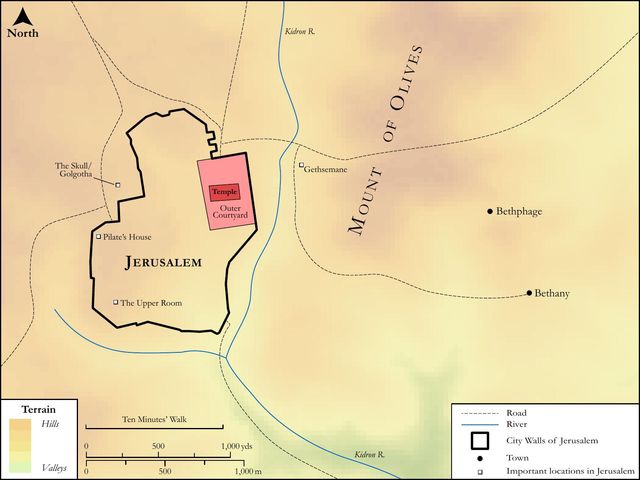
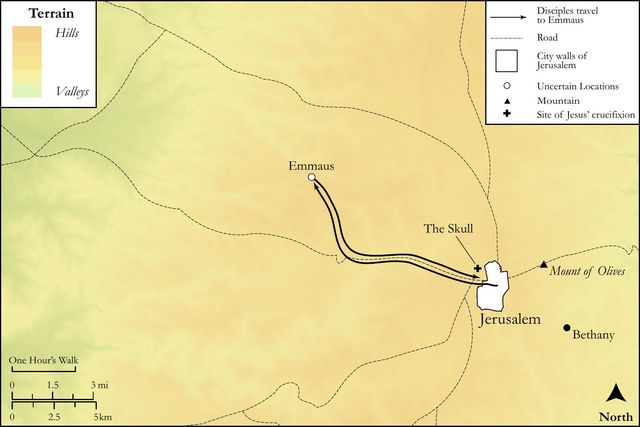
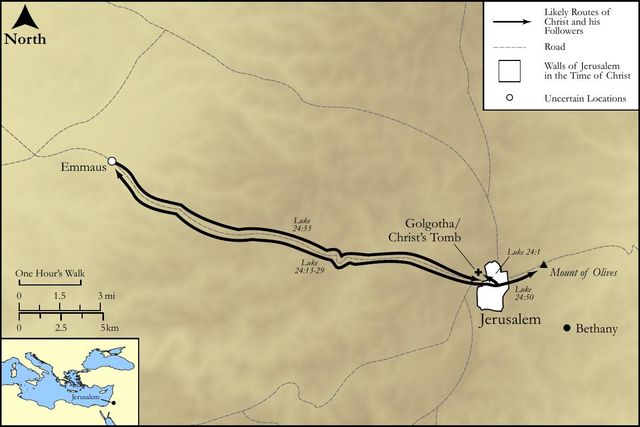
Study this verse
Public-domain commentary
Matthew Henry
From his Commentary on the Whole Bible. Henry comments on passages, not single verses — this entry covers Luke 24:13–35. His four-level outline is real structure in the source text, so it is rendered as structure.
This appearance of Christ to the two disciples going to Emmaus was mentioned, and but just mentioned, before (Mark xvi. 12); here it is largely related. It happened the same day that Christ rose, the first day of the new world that rose with him. One of these two disciples was Cleopas or Alpheus, said by the ancients to be the brother of Joseph, Christ's supposed father; who the other was is not certain. Some think it was Peter; it should seem indeed that Christ did appear particularly to Peter that day, which the eleven spoke of among themselves (v. 34), and Paul mentions, 1 Cor. xv. 5. But it could not be Peter that was one of the two, for he was one of the eleven to whom the two returned; and, besides, we know Peter so well as to think that if he had been one of the two he would have been the chief speaker, and not Cleopas. It was one of those that were associated with the eleven, mentioned v. 9. Now in this passage of story we may observe,
I.The walk and talk of these two disciples:
They went to a village called Emmaus, which is reckoned to be about two hours' walk from Jerusalem; it is here said to be about sixty furlongs, seven measured miles, v. 13. Whether they went thither upon business, or to see some friend, does not appear. I suspect that they were going homewards to Galilee, with an intention not to enquire more after this Jesus; that they were meditating a retreat, and stole away from their company without asking leave or taking leave; for the accounts brought them that morning of their Master's resurrection seemed to them as idle tales; and, if so, no wonder that they began to think of making the best of their way home. But as they travelled they talked together of all those things which had happened, v. 14. They had not courage to confer of these things, and consult what was to be done in the present juncture at Jerusalem, for fear of the Jews; but, when they were got out of the hearing of the Jews, they could talk it over with more freedom. They talked over these things, reasoning with themselves concerning the probabilities of Christ's resurrection; for, according as these appeared, they would either go forward or return back to Jerusalem. Note, It well becomes the disciples of Christ, when they are together, to talk of his death and resurrection; thus they may improve one another's knowledge, refresh one another's memory, and stir up one another's devout affections.
II.The good company they met with upon the road, when Jesus himself came, and joined himself to them (v.
15): They communed together, and reasoned, and perhaps were warm at the argument, one hoping that their Master was risen, and would set up his kingdom, the other despairing. Jesus himself drew near, as a stranger who, seeing them travel the same way that he went, told them that he should be glad of their company. We may observe it, for our encouragement to keep up Christian conference and edifying discourse among us, that where but two together are well employed in work of that kind Christ will come to them, and make a third. When they that fear the Lord speak one to another the Lord hearkens and hears, and is with them of a truth; so that two thus twisted in faith and love become a threefold cord, not easily broken, Eccl. iv. 12. They in their communings and reasonings together were searching for Christ, comparing notes concerning him, that they might come to more knowledge of him; and now Christ comes to them. Note, They who seek Christ shall find him: he will manifest himself to those that enquire after him, and give knowledge to those who use the helps for knowledge which they have. When the spouse enquired of the watchman concerning her beloved, it was but a little that she passed from them, but she found him. Cant. iii. 4. But, though they had Christ with them, they were not at first aware of it (v. 16): Their eyes were held, that they should not know him. It should seem, there were both an alteration of the object (for it is said in Mark that now he appeared in another form) and a restraint upon the organ (for here it is said that their eyes were held by a divine power); or, as some think, there was a confusion in the medium; the air was so disposed that they could not discern who it was. No matter how it was, but so it was they did not know him, Christ so ordering it that they might the more freely discourse with him and he with them, and that it might appear that his word, and the influence of it, did not depend upon his bodily presence, which the disciples had too much doted upon, and must be weaned from; but he could teach them, and warm their hearts, by others, who should have his spiritual presence with them, and should have his grace going along with them unseen.
III.The conference that was between Christ and them, when he knew them, and they knew not him.
Now Christ and his disciples, as is usual when friends meet incognito, or in a disguise, are here crossing questions.
1.Christ's first question to them is concerning their present sadness, which plainly appeared in their countenances: What manner of communications are those that you have one with another as you walk, and are sad? v. 17. It is a very kind and friendly enquiry. Observe,
(1.)They were sad; it appeared to a stranger that they were so.
[1.]They had lost their dear Master, and were, in their own apprehensions, quite disappointed in their expectations from him. They had given up the cause, and knew not what course to take to retrieve it. Note, Christ's disciples have reason to be sad when he withdraws from them, to fast when the Bridegroom is taken from them.
[2.]Though he was risen from the dead, yet either they did not know it or did not believe it, and so they were still in sorrow. Note, Christ's disciples are often sad and sorrowful even when they have reason to rejoice, but through the weakness of their faith they cannot take the comfort that is offered to them.
[3.]Being sad, they had communications one with another concerning Christ. Note, First, It becomes Christians to talk of Christ. Were our hearts as full of him, and of what he has done and suffered for us, as they should be, out of the abundance of the heart the mouth would speak, not only of God and his providence, but of Christ and his grace and love. Secondly, Good company and good converse are an excellent antidote against prevailing melancholy. When Christ's disciples were sad they did not each one get by himself, but continued as he sent them out, two and two, for two are better than one, especially in times of sorrow. Giving vent to the grief may perhaps give ease to the grieved; and by talking it over we may talk ourselves or our friends may talk us into a better frame. Joint mourners should be mutual comforters; comforts sometimes come best from such.
(2.)Christ came up to them, and enquired into the matter of their talk, and the cause of their grief: What manner of communications are these? Though Christ had now entered into his state of exaltation, yet he continued tender of his disciples, and concerned for their comfort. He speaks as one troubled to see their melancholy: Wherefore look ye so sadly to-day? Gen. xl. 7. Note, Our Lord Jesus takes notice of the sorrow and sadness of his disciples, and is afflicted in their afflictions. Christ has hereby taught us,
[1.]To be conversable. Christ here fell into discourse with two grave serious persons, though he was a stranger to them and they knew him not, and they readily embraced him. It does not become Christians to be morose and shy, but to take pleasure in good society.
[2.]We are hereby taught to be compassionate. When we see our friends in sorrow and sadness, we should, like Christ here, take cognizance of their grief, and give them the best counsel and comfort we can: Weep with them that weep.
2.In answer to this, they put a question to him concerning his strangeness. Art thou only a stranger in Jerusalem, and hast not known the things that are come to pass there in these days? Observe,
(1.)Cleopas gave him a civil answer. He does not rudely ask him. "As for what we are talking of, what is that to you?" and bid him go about his business. Note, We ought to be civil to those who are civil to us, and to conduct ourselves obligingly to all, both in word and deed. It was a dangerous time now with Christ's disciples; yet he was not jealous of this stranger, that he had any design upon them, to inform against them, or bring them into trouble. Charity is not forward to think evil, no, not of strangers.
(2.)He is full of Christ himself and of his death and sufferings, and wonders that every body else is not so too: "What! art thou such a stranger in Jerusalem as not to know what has been done to our Master there?" Note, Those are strangers indeed in Jerusalem that know not of the death and sufferings of Christ. What! are they daughters of Jerusalem, and yet so little acquainted with Christ as to ask, What is thy beloved more than another beloved?
(3.)He is very willing to inform this stranger concerning Christ, and to draw on further discourse with him upon this subject. He would not have any one that had the face of a man to be ignorant of Christ. Note, Those who have themselves the knowledge of Christ crucified should do what they can to spread that knowledge, and lead others into an acquaintance with him. And it is observable that these disciples, who were so forward to instruct the stranger, were instructed by him; for to him that has, and uses what he has, shall be given.
(4.)It appears, by what Cleopas says, that the death of Christ made a great noise in Jerusalem, so that it could not be imagined that any man should be such a stranger in the city as not to know of it; it was all the talk of the town, and discoursed of in all companies. Thus the matter of fact came to be universally known, which, after the pouring out of the Spirit, was to be explained.
3.Christ, by way of reply, asked concerning their knowledge (v. 19): He said unto them, What things? thus making himself yet more a stranger. Observe,
(1.)Jesus Christ made light of his own sufferings, in comparison with the joy set before him, which was the recompence of it. Now that he was entering upon his glory, see with what unconcernedness he looks back upon his sufferings: What things? He had reason to know what things; for to him they were bitter things, and heavy things, and yet he asks, What things? The sorrow was forgotten, for joy that the man-child of our salvation was born. He took pleasure in infirmities for our sakes, to teach us to do so for his sake.
(2.)Those whom Christ will teach he will first examine how far they have learned; they must tell him what things they know, and then he will tell them what was the meaning of these things. and lead them into the mystery of them.
4.They, hereupon, gave him a particular account concerning Christ, and the present posture of his affairs. Observe the story they tell, v. 19, &c.
(1.)Here is a summary of Christ's life and character. The things they are full of are concerning Jesus of Nazareth (so he was commonly called), who was a prophet, a teacher come from God. He preached a true and excellent doctrine, which had manifestly its rise from heaven, and its tendency towards heaven. He confirmed it by many glorious miracles, miracles of mercy, so that he was mighty in deed and word before God and all the people; that is, he was both a great favourite of heaven and a great blessing to this earth. He was, and appeared to be, greatly beloved of God, and much the darling of his people. He had great acceptance with God, and a great reputation in the country. Many are great before all the people, and are caressed by them, who are not so before God, as the scribes and Pharisees; but Christ was mighty both in his doctrine and in his doings, before God and all the people. Those were strangers in Jerusalem that did not know this.
(2.)Here is a modest narrative of his sufferings and death, v. 20. "Though he was so dear both to God and man, yet the chief priests and our rulers, in contempt of both, delivered him to the Roman power, to be condemned to death, and they have crucified him." It is strange that they did not aggravate the matter more, and lay a greater load upon those that had been guilty of crucifying Christ; but perhaps because they spoke to one that was a stranger they thought it prudent to avoid all reflections upon the chief priests and their rulers, how just soever.
(3.)Here is an intimation of their disappointment in him, as the reason of their sadness: "We trusted that it had been he who should have redeemed Israel, v. 21. We are of those who not only looked upon him to be a prophet, like Moses, but, like him, a redeemer too." He was depended upon, and great things expected from him, by them that looked for redemption, and in it for the consolation of Israel. Now, if hope deferred makes the heart sick, hope disappointed, especially such a hope, kills the heart. But see how they made that the ground of their despair which if they had understood it aright was the surest ground of their hope, and that was the dying of the Lord Jesus: We trusted (say they) that it had been he that should have redeemed Israel. And is it not he that doth redeem Israel? Nay, is he not by his death paying the price of their redemption? Was it not necessary, in order to his saving Israel from their sins, that he should suffer? Sop that now, since that most difficult part of his undertaking was got over, they had more reason than ever to trust that this was he that should deliver Israel; yet now they are ready to give up the cause.
(4.)Here is an account of their present amazement with reference to his resurrection. [1.] "This is the third day since he was crucified and died, and that was the day when it was expected, if ever, that he should rise again, and rise in glory and outward pomp, and show himself as publicly in honour as he had been shown three days before in disgrace; but we see no sign of it; nothing appears, as we expected, to the conviction and confusion of his prosecutors, and the consolation of his disciples, but all is silent." [2.] They own that there was a report among them that he was risen, but they seem to speak of it very slightly, and as what they gave no credit at all to (v. 22, 23): "Certain women also of our company made us astonished (and that was all), who were early at the sepulchre, and found the body gone, and they said that they had seen a vision of angels, who said that he was alive; but we are ready to think it was only their fancy, and no real thing, for angels would have been sent to the apostles, not to the women, and women are easily imposed upon." [3.] They acknowledge that some of the apostles had visited the sepulchre, and found it empty, v. 24. "But him they saw not, and therefore we have reason to fear that he is not risen, for, if he be, surely he would have shown himself to them; so that, upon the whole matter, we have no great reason to think that he is risen, and therefore have no expectations from him now; our hopes were all nailed to his cross, and buried in his grave."
(5.)Our Lord Jesus, though not known by face to them, makes himself known to them by his word.
[1.]He reproves them for their incogitancy, and the weakness of their faith in the scriptures of the Old Testament: O fools, and slow of heart to believe, v. 25. When Christ forbade us to say to our brother, Thou fool, it was intended to restrain us from giving unreasonable reproaches, not from giving just reproofs. Christ called them fools, not as it signifies wicked men, in which sense he forbade it to us, but as it signifies weak men. He might call them fools, for he knows our foolishness, the foolishness that is bound in our hearts. Those are fools that act against their own interest; so they did who would not admit the evidence given them that their Master was risen, but put away the comfort of it. That which is condemned in them as their foolishness is, First, Their slowness to believe. Believers are branded as fools by atheists, and infidels, and free-thinkers, and their most holy faith is censured as a fond credulity; but Christ tells us that those are fools who are slow of heart to believe, and are kept from it by prejudices never impartially examined. Secondly, Their slowness to believe the writings of the prophets. He does not so much blame them for their slowness to believe the testimony of the women and of the angels, but for that which was the cause thereof, their slowness to believe the prophets; for, if they had given the prophets of the Old Testament their due weight and consideration, they would have been as sure of Christ's rising from the dead that morning (being the third day after his death) as they were of the rising of the sun; for the series and succession of events as settled by prophecy are no less certain and inviolable than as settled by providence. Were we but more conversant with the scripture, and the divine counsels as far as they are made known in the scripture, we should not be subject to such perplexities as we often entangle ourselves in.
[2.]He shows them that the sufferings of Christ, which were such a stumbling-block to them, and made them unapt to believe his glory, were really the appointed way to his glory, and he could not go to it any other way (v. 26): "Ought not the Christ (the Messiah) to have suffered these things, and to enter into his glory? Was it not decreed, and was not that decree declared, that the promised Messiah must first suffer and then reign, that he must go by his cross to his crown?" Had they never read the fifty-third of Isaiah and the ninth of Daniel, where the prophets speak so very plainly of the sufferings of Christ and the glory that should follow? 1 Pet. i. 11. The cross of Christ was that to which they could not reconcile themselves; now here he shows them two things which take off the offence of the cross:—First, That the Messiah ought to suffer these things; and therefore his sufferings were not only no objection against his being the Messiah, but really a proof of it, as the afflictions of the saints are an evidence of their sonship; and they were so far from ruining their expectations that really they were the foundation of their hopes. He could not have been a Saviour, if he had not been a sufferer. Christ's undertaking our salvation was voluntary; but, having undertaken it, it was necessary that he should suffer and die. Secondly, That, when he had suffered these things, he should enter into his glory, which he did at his resurrection; that was his first step upward. Observe, It is called his glory, because he was duly entitled to it, and it was the glory he had before the world was; he ought to enter into it, for in that, as well as in his sufferings, the scripture must be fulfilled. He ought to suffer first, and then to enter into his glory; and thus the reproach of the cross is for ever rolled away, and we are directed to expect the crown of thorns and then that of glory.
[3.]He expounded to them the scriptures of the Old Testament, which spoke of the Messiah, and showed them how they were fulfilled in Jesus of Nazareth, and now can tell them more concerning him than they could before tell him (v. 27): Beginning at Moses, the first inspired writer of the Old Testament, he went in order through all the prophets, and expounded to them the things concerning himself, showing that the sufferings he had now gone through were so far from defeating the prophecies of the scripture concerning him that they were the accomplishment of them. He began at Moses, who recorded the first promise, in which it was plainly foretold that the Messiah should have his heel bruised, but that by it the serpent's head should be incurably broken. Note, First, There are things dispersed throughout all the scriptures concerning Christ, which it is of great advantage to have collected and put together. You cannot go far in any part of scripture but you meet with something that has reference to Christ, some prophecy, some promise, some prayer, some type or other; for he is the true treasure his in the field of the Old Testament. A golden thread of gospel grace runs through the whole web of the Old Testament. There is an eye of that white to be discerned in every place. Secondly, The things concerning Christ need to be expounded. The eunuch, though a scholar, would not pretend to understand them, except some man should guide him (Acts viii. 31); for they were delivered darkly, according to that dispensation: but now that the veil is taken away the New Testament expounds the Old. Thirdly, Jesus Christ is himself the best expositor of scripture, particularly the scriptures concerning himself; and even after his resurrection it was in this way that he led people into the knowledge of the mystery concerning himself; not by advancing new notions independent upon the scripture, but by showing how the scripture was fulfilled, and turning them over to the study of it. Even the Apocalypse itself is but a second part of the Old-Testament prophecies, and has continually an eye to them. If men believe not Moses and the prophets, they are incurable. Fourthly, In studying the scriptures, it is good to be methodical, and to take them in order; for the Old-Testament light shone gradually to the perfect day, and it is good to observe how at sundry times, and in divers manners (subsequent predictions improving and giving light to the preceding ones), God spoke to the fathers concerning his Son, by whom he has now spoken to us. Some begin their bible at the wrong end, who study the Revelation first; but Christ has here taught us to begin at Moses. Thus far the conference between them.
IV.Here is the discovery which Christ at length made of himself to them.
One would have given a great deal for a copy of the sermon Christ preached to them by the way, of that exposition of the bible which he gave them; but it is not thought fit that we should have it, we have the substance of it in other scriptures. The disciples are so charmed with it, that they think they are come too soon to their journey's end; but so it is: They drew nigh to the village whither they went (v. 28), where, it should seem, they determined to take up for that night. And now,
1.They courted his stay with them: He made as though he would have gone further; he did not say that he would, but he seemed to them to be going further, and did not readily turn into their friend's house, which it would not be decent for a stranger to do unless he were invited. He would have gone further if they had not courted his stay; so that here was nothing like dissimulation in the case. If a stranger be shy, every one knows the meaning of it; he will not thrust himself rudely upon your house or company; but, if you make it appear that you are freely desirous of him for your guest or companion, he knows not but he may accept your invitation, and this was all that Christ did when he made as though he would have gone further. Note, Those that would have Christ dwell with them must invite him, and be importunate with him; though he is often found of those that seek him not, yet those only that seek can be sure to find; and, if he seem to draw off from us, it is but to draw out our importunity; as here, they constrained him; both of them laid hold on him, with a kind and friendly violence, saying, Abide with us. Note, Those that have experienced the pleasure and profit of communion with Christ cannot but covet more of his company, and beg of him, not only to walk with them all day, but to abide with them at night. When the day is far spent, and it is towards evening, we begin to think of retiring for our repose, and then it is proper to have our eye to Christ, and to beg of him to abide with us, to manifest himself to us and to fill our minds with good thoughts of him and good affections to him. Christ yielded to their importunity: He went in, to tarry with them. Thus ready is Christ to give further instructions and comforts to those who improve what they have received. He has promised that if any man open the door, to bid him welcome, he will come in to him, Rev. iii. 20.
2.He manifested himself to them, v. 30, 31. We may suppose that he continued his discourse with them, which he began upon the road; for thou must talk of the things of God when thou sittest in the house as well as when thou walkest by the way. While supper was getting ready (which perhaps was soon done, the provision was so small and mean), it is probable that he entertained them with such communications as were good and to the use of edifying; and so likewise as they sat at meat his lips fed them. But still they little thought that it was Jesus himself that was all this while talking with them, till at length he was pleased to throw off his disguise, and then to withdraw.
(1.)They began to suspect it was he, when, as they sat down to meat, he undertook the office of the Master of the feast, which he performed so like himself, and like what he used to do among his disciples, that by it they discerned him: He took bread, and blessed it, and brake, and gave to them. This he did with his usual air both of authority and affection, with the same gestures and mien, with the same expressions perhaps in craving a blessing and in giving the bread to them. This was not a miraculous meal like that of the five loaves, nor a sacramental meal like that of the eucharist, but a common meal; yet Christ here did the same as he did in those, to teach us to keep up our communion with God through Christ in common providences as well as in special ordinances, and to crave a blessing and give thanks at every meal, and to see our daily bread provided for us and broken to us by the hand of Jesus Christ, the Master, not only of the great family, but of all our families. Wherever we sit down to eat, let us set Christ at the upper end of the table, take our meat as blessed to us by him, and eat and drink to his glory, and receive contentedly and thankfully what he is pleased to carve out to us, be the fare ever so coarse and mean. We may well receive it cheerfully, if we can by faith see it coming to us from Christ's hand, and with his blessing.
(2.)Presently their eyes were opened, and then they saw who it was, and knew him well enough. Whatever it was which had hitherto concealed him from them, it was now taken out of the way; the mists were scattered, the veil was taken off, and then they made no question but it was their Master. He might, for wise and holy ends, put on the shape of another, but no other could put on his; and therefore it must be he. See how Christ by his Spirit and grace makes himself known to the souls of his people.
[1.]He opens the scriptures to them, for they are they which testify of him to those who search them, and search for him in them.
[2.]He meets them at his table, in the ordinance of the Lord's supper, and commonly there makes further discoveries of himself to them, is known to them in the breaking of bread. But,
[3.]The work is completed by the opening of the eyes of their mind, and causing the scales to fall off from them, as from Paul's in his conversion. If he that gives the revelation do not give the understanding, we are in the dark still.
3.He immediately disappeared: He vanished out of their sight. Aphantos egeneto—He withdrew himself from them, slipped away of a sudden, and went out of sight. Or, he became not visible by them, was made inconspicuous by them. It should seem that though Christ's body, after his resurrection, was the very same body in which he suffered and died, as appeared by the marks in it, yet it was so far changed as to become either visible or not visible as he thought fit to make it, which was a step towards its being made a glorious body. As soon as he had given his disciples one glimpse of him he was gone presently. Such short and transient views have we of Christ in this world; we see him, but in a little while lose the sight of him again. When we come to heaven the vision of him will have no interruptions.
V.Here is the reflection which these disciples made upon this conference, and the report which they made of it to their brethren at Jerusalem.
1.The reflection they each of them made upon the influence which Christ's discourse had upon them (v. 32): They said one to another, Did not our hearts burn within us? "I am sure mine did," saith one; "And so did mine," saith the other, "I never was so affected with any discourse in all my life." Thus do they not so much compare notes as compare hearts, in the review of the sermon Christ had preached to them. They found the preaching powerful, even when they knew not the preacher. It made things very plain and clear to them; and, which was more, brought a divine heat with a divine light into their souls, such as put their hearts into a glow, and kindled a holy fire of pious and devout affections in them. Now this they take notice of, for the confirming of their belief, that it was indeed, as at last they saw, Jesus himself that had been talking with them all along. "What fools were we, that we were not sooner aware who it was! For none but he, no word but his, could make our hearts burn within us as they did; it must be he that has the key of the heart; it could be no other." See here,
(1.)What preaching is likely to do good—such as Christ's was, plain preaching, and that which is familiar and level to our capacity—he talked with us by the way; and scriptural preaching—he opened to us the scriptures, the scriptures relating to himself. Ministers should show people their religion in their bibles, and that they preach no other doctrine to them than what is there; they must show that they make that the fountain of their knowledge and the foundation of their faith. Note, The expounding of those scriptures which speak of Christ has a direct tendency to warm the hearts of his disciples, both to quicken and to comfort them.
(2.)What hearing is likely to do good—that which makes the heart burn; when we are much affected with the things of God, especially with the love of Christ in dying for us, and have our hearts thereby drawn out in love to him, and drawn up in holy desires and devotions, then our hearts burn within us; when our hearts are raised and elevated, and are as the sparks which fly upwards towards God, and when they are kindled and carried out with a holy zeal and indignation against sin, both in others and in ourselves, and we are in some measure refined and purified from it by the spirit of judgment and the spirit of burning, then we may say, "Through grace our hearts are thus inflamed."
2.The report they brought of this to their brethren at Jerusalem (v. 33): They rose up the same hour, so transported with joy at the discovery Christ had made of himself to them that they could not stay to make an end of their supper, but returned with all speed to Jerusalem, though it was towards evening. If they had had any thoughts of quitting their relation to Christ, this soon banished all such thoughts out of their mind, and there needed no more to send them back to his flock. It should seem that they intended at least to take up their quarters to-night at Emmaus; but now that they had seen Christ they could not rest till they had brought the good news to the disciples, both for the confirmation of their trembling faith and for the comfort of their sorrowful spirits, with the same comforts wherewith they were comforted of God. Note, It is the duty of those to whom Christ has manifested himself to let others know what he has done for their souls. When thou art converted, instructed, comforted, strengthen thy brethren. These disciples were full of this matter themselves, and must go to their brethren, to give vent to their joys, as well as to give them satisfaction that their Master was risen. Observe,
(1.)How they found them, just when they came in among them, discoursing on the same subject, and relating another proof of the resurrection of Christ. They found the eleven, and those that were their usual companions, gathered together late in the night, to pray together, it may be, and to consider what was to be done in this juncture; and they found them saying among themselves (legontas it is the saying of the eleven, not of the two, as is plain by the original), and when these two came in, they repeated to them with joy and triumph, The Lord is risen indeed, and hath appeared to Simon, v. 34. That Peter had a sight of him before the rest of the disciples had appears 1 Cor. xv. 5, where it is said, He was seen of Cephas, then of the twelve. The angel having ordered the women to tell Peter of it particularly (Mark xvi. 7), for his comfort, it is highly probable that our Lord Jesus did himself presently the same day appear to Peter, though we have no particular narrative of it, to confirm the word of his messengers. This he had related to his brethren; but, observe, Peter does not here proclaim it, and boast of it, himself (he thought this did not become a penitent), but the other disciples speak of it with exultation, The Lord is risen indeed, ontos—really; it is now past dispute, no room is left to doubt it, for he has appeared not only to the women, but to Simon.
(2.)How they seconded their evidence with an account of what they had seen (v. 35): They told what things were done in the way. The words that were spoken by Christ to them in the way, having a wonderful effect and influence upon them, are here called the things that were done in the way; for the words that Christ speaks are not an empty sound, but they are spirit and they are life, and wondrous things are done by them, done by the way, by the by as it were, where it is not expected. They told also how he was at length known to them in the breaking of bread; then, when he was carving out blessings to them, God opened their eyes to discern who it was. Note, It would be of great use for the discovery and confirmation of truth if the disciples of Christ would compare their observations and experiences, and communicate to each other what they know and have felt in themselves.
Historical interpretation
Nine Centuries of Reception
9 surviving comments on this verse. Each one is dated, so this reads as a timeline rather than a list.
Select a marker to jump to its quote. Markers stagger vertically where authors wrote within a few decades of each other.
After Nero and Domitian … persecution was raised against us sporadically among the cities as a result of insurrection among the people. In this persecution we have learned that Simon [Symeon], the son of Clopas, whom we have shown to have been the second bishop of the church at Jerusalem, gave up his life by martyrdom. The witness of this is Hegisippus, whom we have already quoted. When relating about certain heretics, he goes on to show that Symeon was accused by them at this time and was tortured in many ways for a great many days because he was clearly a Christian. He astonished to the highest degree both the judge himself and those with him, and won for himself an end similar to the passion of the Lord.
Or to two of the disciples by themselves our Lord showed Himself in the evening, namely, Ammaon and Cleophas.
You heard just now that the Lord Jesus, after rising from the dead, found two of his disciples on the road, talking to each other about all that had happened, and said to them, “What is this conversation you are having with each other, and why are you so sad?” …So what is the benefit of this reading for us? A very considerable one, if we understand it rightly. Jesus appeared. They saw him with their eyes and did not recognize him. The Master was walking with them along the way, and he himself was the way. But they weren’t yet walking along the way. He found, you see, that they had wandered off the way. After all, when he had been with them before the passion, he had foretold everything: that he was going to suffer, to die and to rise again on the third day. He had foretold it all, but his death had erased it from their memories. They were so shattered when they saw him hanging on the tree that they forgot about his teaching. They did not expect him to rise, nor did they hold on to what he had promised.
(23. in Ev.) Rightly also He refrained from manifesting to them a form which they might recognise, doing that outwardly in the eyes of the body, which was done by themselves inwardly in the eyes of the mind. For they in themselves inwardly both loved and doubted. Therefore to them as they talked of Him He exhibited His presence, but as they doubted of Him He concealed the appearance which they knew. He indeed conversed with them, for it follows, And he said to them, What manner of communications, &c.
And one of them, named Cleophas, answering, said to him: Are you alone a stranger in Jerusalem, and do not know the things which have happened there in these days? They thought him to be a stranger, whose face they did not recognize. But truly, he was a stranger to them, from whose perception the glory of the resurrection already obtained was far removed from their frail nature. He was a stranger to them, from whose still uninformed faith, as yet ignorant of his resurrection, he remained a foreigner.
It is the same as Nicopolis, a remarkable town in Palestine, which after the taking of Judæa under the Emperor Marcus Aurelius Antonius, changed together with its condition its name also. But the stadium which, as the Greeks say, was invented by Hercules to measure the distances of roads, is the eighth part of a mile; therefore sixty stades are equal to seven miles and fifty paces. And this was the length of journey which they were walking, who were certain about our Lord's death and burial, but doubtful concerning His resurrection. For the resurrection which took place after the seventh day of the week, no one doubts is implied in the number eight. The disciples therefore as they walk and converse about the Lord had completed the sixth mile of their journey, for they were grieving that He who had lived without blame, had come at length even to death, which He underwent on the sixth day. They had completed also the seventh mile, for they doubted not that He rested in the grave. But of the eighth mile they had only accomplished half; for the glory of His already triumphant resurrection, they did not believe perfectly.
And as they spoke of Him, the Lord comes near and joins them, that He may both influence their minds with faith in His resurrection, and fulfil that which He had promised, Where two or three are gathered together in my name, there am I in the midst of them (Mat. 18:20); as it follows, And it came to pans while they communed together and reasoned, Jesus himself drew near and went with them.
Or he says this, because they thought Him a stranger, whose countenance they did not recognise. But in reality He was a stranger to them, from the infirmity of whose natures, now that He had obtained the glory of the resurrection, He was far removed, and to whose faith, as yet ignorant of His resurrection, He remained foreign. But again the Lord asks; for it follows, And he said unto them, What things? And their answer is given, Concerning Jesus of Nazareth, who was a Prophet. They confess Him to be a Prophet, but say nothing of the Son of God; either not yet perfectly believing, or fearful of falling into the hands of the persecuting Jews; either knowing not who He was, or concealing the truth which they believed. They add in praise of Him, mighty in deed and word.
Reason had they then for sorrow, because in some sort they blamed themselves for having hoped redemption in Him whom now they saw dead, and believed not that He would rise again, and most of all they bewailed Him put to death without a cause, whom they knew to be innocent.
Some say that Luke was one of these two, and for this reason concealed his name.
But the disciples above mentioned talked to one another of the things which had happened, not as believing them, but as bewildered at events so extraordinary.
For having now obtained a spiritual body, distance of place is no obstacle to His being present to whom He wished, nor did He any further govern His body by natural laws, but spiritually and supernaturally. Hence as Mark says, He appeared to them in a different form, in which they were not permitted to know Him; for it follows, And their eyes were holden that they should not know him; in order truly that they may reveal their entirely doubtful conceptions, and uncovering their wound may receive a cure; and that they might know that although the same body which suffered, rose again, yet it was no longer such as to be visible to all, but only to those by whom He willed it to be seen; and that they should not wonder why henceforth He walks not among the people, seeing that His conversation was not fit for mankind, but rather divine; which is also the character of the resurrection to come, in which we shall walk as the Angels and the sons of God.
As if he said, "Art thou a mere stranger, and one dwelling beyond the confines of Jerusalem, and therefore unacquainted with what has happened in the midst of it, that thou knowest not these things?
First comes deed, then word; for no word of teaching is approved unless first he who teaches shows himself to be a doer thereof. For acting goes before sight; for unless by thy works thou hast cleansed the glass of the understanding, the desired brightness does not appear. But still further it is added, Before God and all the people. For first of all we must please God, and then have regard as far as we can to honesty before men, that placing the honour of God first, we may live without offence to mankind.
For they expected that Christ would redeem Israel from the evils that were rising up among them and the Roman slavery. They trusted also that He was an earthly king, whom they thought would be able to escape the sentence of death passed upon Him.
And yet those men seem not to have been altogether without faith, by what follows, And besides all this, to day is the third day since these things were done. Whereby they seem to have a recollection of what the Lord had told them that He would rise again on the third day.
(Anonm. in Cat. Gr.) They were in truth discoursing among themselves, no longer expecting to see Christ alive, but sorrowing as concerning their Saviour slain. Hence it follows, And one of them whose name was Cleophas, answering him said, Art thou only a stranger?
(ut sup.) They next assign the cause of their sadness, the betrayal and passion of Christ; and add in the voice of despair, But we hoped it had been he who should have redeemed Israel. We hoped, (he says,) not we hope; as if the death of the Lord were like to the deaths of other men.
The disciples also mention the report of the resurrection which was brought by the women; adding, Yea, and certain women also of our company made us astonished, &c. They say this indeed as if they did not believe it; wherefore they speak of themselves as frightened or astonished. For they did consider as established what was told them, or that there had been an angelic revelation, but derived from it reason for astonishment and alarm. The testimony of Peter also they did not regard as certain, since he did not say that he had seen our Lord, but conjectured His resurrection from the fact that His body was not lying in the sepulchre. Hence it follows, And certain of them that were with us went, &c.
(non occ.) After the manifestation of Christ's resurrection made by the Angels to the women, the same resurrection is further manifested by an appearance of Christ Himself to His disciples; as it is said, And behold two of them.
Continue studying Luke 24:18 across the web’s major study libraries — every link below opens this exact verse, chapter, or book on the destination site.
Read & Compare
 BibleGatewayThis verse in more than 200 translations and 70 languages.
 Bible.comThe YouVersion reader — hundreds of translations, reading plans, and highlights.
 ESV.orgCrossway's official English Standard Version reader.
 NET BibleThe NET translation with 60,000+ translators' notes on every rendering decision.
 STEP BibleTyndale House's free study tool — original text, vocabulary, and scholarly resources.
 BibliaLogos Bible Software's free web reader.
 USCCBThe New American Bible (Revised Edition) with the U.S. bishops' study notes.
Commentaries
 BibleHub CommentariesDozens of classic commentaries on this verse, gathered on one page.
 StudyLightMore than 100 commentary sets — the largest collection on the web.
 BibleRefPlain-English commentary on what this verse means, verse by verse.
 Enduring WordDavid Guzik's free commentary on this chapter, widely used by Bible teachers.
 Bible Study ToolsVerse commentary alongside Greek and Hebrew study aids.
Original Language & Research
- BibleHub InterlinearThe verse word by word — original language, transliteration, and English.
- BibleHub LexiconEvery word's original-language definition and Strong's entry.
 Blue Letter BibleDeep-study tools — Strong's numbers, concordance, and word studies.
 CNTR CollationThe earliest Greek manuscripts of this verse, collated letter by letter.
Sermons, Hymns & Audio


TrulyRandomVerse is not affiliated with these sites and doesn’t control their content. They’re linked because they’re genuinely useful.
Summary
Luke 24:18 captures the profound astonishment of Cleopas, one of two disciples walking to Emmaus, as he questions the unrecognized Jesus. He expresses disbelief that any visitor to Jerusalem could be ignorant of the momentous events—the crucifixion and reported resurrection of Jesus—that had just transpired in the city. This poignant interaction highlights the disciples' deep sorrow and confusion, juxtaposed with their spiritual blindness to the very presence of the resurrected Christ.
Context
ShowHideLiterary Context
This verse is situated within the pivotal Emmaus Road narrative in Luke 24. It immediately follows the accounts of the empty tomb and the women's testimony of the resurrection, which the male disciples had dismissed as "idle tales" (Luke 24:11). The journey to Emmaus (Luke 24:13-35) serves as a crucial bridge between the initial reports of the resurrection and Jesus's subsequent appearances to the larger group of apostles in Jerusalem. The disciples' inability to recognize Jesus (Luke 24:16) sets the stage for a profound lesson in divine revelation and the interpretation of Scripture.
Historical & Cultural Context
The events described occurred shortly after the Passover festival in Jerusalem, a time when the city would have been teeming with pilgrims from across the Roman world. The crucifixion of Jesus, a public execution of a prominent figure, would have been a widely known and discussed event, especially given the accompanying signs and the recent reports of an empty tomb. Cleopas's question reflects the cultural expectation that any sojourner or "stranger" in Jerusalem during such a momentous period would be acutely aware of the recent happenings. The term "stranger" (πάροικος, paroikos) implies a temporary resident or visitor, someone who might not be fully integrated into local affairs but would certainly be aware of major public events.
Key Themes
ShowHideCleopas's question contributes significantly to several key themes in Luke 24 and the broader Gospel. One prominent theme is Spiritual Blindness and Revelation. Despite walking and conversing with Jesus, the disciples are supernaturally prevented from recognizing Him (Luke 24:16), illustrating how human understanding can be veiled until God grants insight. Another theme is the Centrality of Christ's Passion and Resurrection. The "things which are come to pass" refer to Jesus's crucifixion, death, and resurrection, events so monumental that Cleopas assumes universal knowledge of them. This underscores their eternal and redemptive significance. Finally, the theme of Sorrow and Disappointed Hope is evident, as the disciples lament the perceived failure of their Messiah (Luke 24:21).
Exposition and Analysis
ShowHideKey Word Analysis
ShowHideImplying one who dwells near but is not a native, a sojourner, or a temporary resident. Cleopas's use of this word highlights his astonishment that even a visitor, unacquainted with the city's daily rhythms, could be ignorant of such widely impactful events. It emphasizes the public and profound nature of Jesus's crucifixion and the subsequent reports.
Meaning to "know" in a deep, experiential sense, not just intellectually. Cleopas is not merely asking if the stranger has heard rumors, but if he has truly apprehended or understood the significance of what has transpired. This word choice subtly points to the deeper spiritual "knowing" that the disciples themselves lacked concerning Jesus's identity and mission.
A versatile verb meaning "to become," "to come into being," or "to happen." In this context, it refers to the sequence of events surrounding Jesus's passion, death, and reported resurrection. Cleopas's phrasing underscores the reality and finality of these events, which he perceives as undeniable facts that have irrevocably altered the landscape of their hopes and understanding.
Verse Breakdown
ShowHide"And the one of them, whose name was Cleopas, answering said unto him"
This phrase introduces Cleopas, identifying him as one of the two disciples on the road to Emmaus. His "answering" implies that Jesus had initiated the conversation, likely by asking them what they were discussing. Cleopas's response is an immediate and impassioned reaction to Jesus's apparent ignorance.
"Art thou only a stranger in Jerusalem"
Cleopas's question is rhetorical, expressing profound disbelief. He implies that it would be virtually impossible for anyone, let alone a "stranger" or temporary visitor, to be unaware of the recent events. This highlights the widespread nature and public impact of Jesus's crucifixion and the subsequent reports of His resurrection in the bustling city during the Passover season.
"and hast not known the things which are come to pass there in these days?"
This concluding clause specifies the content of Cleopas's astonishment. The "things which are come to pass" refer to the crucifixion, death, and the reports of Jesus's resurrection and the empty tomb. The phrase "in these days" emphasizes the recency and immediacy of these events, making the stranger's supposed ignorance even more incredible to Cleopas. It underscores the monumental significance these events held for the disciples, even in their state of confusion and despair.
Literary Devices
ShowHideLuke employs several literary devices in this verse to heighten its impact. Dramatic Irony is powerfully at play, as the reader knows the "stranger" is, in fact, the resurrected Jesus, while Cleopas and his companion remain oblivious. This creates a tension between the characters' limited understanding and the divine reality unfolding before them. There is also a strong sense of Situational Irony, as the very person who "knows" these events most intimately—because He is the central figure of them—is ironically questioned about His ignorance. Furthermore, Cleopas's question functions as a form of Rhetorical Question, not seeking information but expressing utter incredulity and emphasizing the self-evident nature of the events he describes.
Theological and Thematic Connections
ShowHideThis verse powerfully illustrates the human tendency towards spiritual blindness, even in the very presence of divine revelation. The disciples, despite having walked with Jesus for years and heard His prophecies, are so consumed by their grief and preconceived notions of the Messiah that they fail to recognize Him in His resurrected form. This highlights a profound theological truth: true understanding and recognition of God's work often require divine intervention to open our eyes, just as Jesus would later do for them (Luke 24:31). It underscores the critical importance of divine revelation in comprehending the significance of Christ's death and resurrection, which are not merely historical events but the very core of God's redemptive plan.
Reflection and Application
ShowHideCleopas's astonished question serves as a poignant mirror for our own lives. How often do we, like the disciples, walk through seasons of confusion, disappointment, or even despair, lamenting circumstances, while the very presence of God walks alongside us, unrecognized? This verse challenges us to consider our own spiritual perceptiveness. Are we so fixated on our expectations or so clouded by our grief that we fail to see God at work, even when His hand is evident? The Emmaus road experience reminds us that God often meets us in our lowest moments, not to condemn our lack of understanding, but to patiently reveal Himself and His truth. It encourages us to cultivate a posture of openness, recognizing that God's ways are often beyond our immediate comprehension and that His presence can be found in the most unexpected encounters and through the patient unfolding of His Word.
Questions for Reflection
ShowHideFAQ
ShowHideWhy couldn't Cleopas and the other disciple recognize Jesus?
ShowHideLuke 24:16 explicitly states, "But their eyes were holden that they should not know him." This indicates a supernatural veiling, a divine act that prevented their recognition. While their emotional state (grief, confusion) and perhaps Jesus's resurrected appearance (which may have been subtly different or veiled) played a role, the primary reason was God's sovereign design. This temporary blindness allowed Jesus to teach them from the Scriptures without their preconceived notions of Him interfering, preparing them for a deeper understanding once His identity was revealed.
Christ-Centered Fulfillment
ShowHideLuke 24:18, with Cleopas's incredulous question, sets the stage for the profound Christ-centered fulfillment that unfolds on the Emmaus Road. The "things which are come to pass" in Jerusalem—Jesus's suffering, death, and resurrection—are not random events but the very fulfillment of God's ancient promises. Jesus, the unrecognized "stranger," is the ultimate answer to Cleopas's question, for He is the one through whom all things are made known. His subsequent exposition of the Scriptures, beginning with Moses and all the Prophets, reveals how His passion and glory were foretold (Luke 24:27). This encounter foreshadows the New Covenant reality where the Holy Spirit opens the eyes of believers to understand the Scriptures and recognize Christ's ongoing presence and work (John 14:26). The very "things" that caused Cleopas sorrow and confusion are revealed by Christ Himself to be the glorious climax of redemptive history, through which salvation is offered to all who believe in the Lamb of God who takes away the sin of the world.