


Luke 22:14
- καὶkaiAndG2532CONJConjunction
- ὅτεhotewhenG3753CONJConjunction
- ἐγένετοegenetowas comeG1096V-2ADI-3SVerb 2nd Aorist Middle Deponent Indicative 3rd Singular
- ἡhētheG3588T-NSFDefinite article Nominative Singular Feminine
- ὥραhōrahourG5610N-NSFNoun Nominative Singular Feminine
- ἀνέπεσενanepesenHe reclinedG377V-2AAI-3SVerb 2nd Aorist Active Indicative 3rd Singular
- καὶkaiandG2532CONJConjunction
- οἱhoitheG3588T-NPMDefinite article Nominative Plural Masculine
- δώδεκαdōdekatwelveG1427A-NUIAdjective
- ἀπόστολοιapostoloiapostlesG652N-NPMNoun Nominative Plural Masculine
- σὺνsunwithG4862PREPPreposition
- αὐτῷautōHimG846P-DSMPersonal pronoun Dative Singular Masculine
English is a literal word-by-word gloss of the Greek, not the KJV's wording. Why?
This is the original text the KJV's translators worked from — each Greek word with its own literal English meaning in this verse, prepared by scholars at Tyndale House, Cambridge. The KJV translates whole sentences, not word by word, so its wording differs: one Greek word can become several English words, and the KJV may choose “charity” where the gloss reads “love”. Both are faithful — they answer different questions. For the KJV's own rendering, switch to the KJV text.
Details
See on the biblical-era map
Study this verse
Public-domain commentary
Matthew Henry
From his Commentary on the Whole Bible. Henry comments on passages, not single verses — this entry covers Luke 22:7–20. His two-level outline is real structure in the source text, so it is rendered as structure.
What a hopeful prospect had we of Christ's doing a great deal of good by his preaching in the temple during the feast of unleavened bread, which continued seven days, when the people were every morning, and early in the morning, so attentive to hear him! But here is a stop put to it. He must enter upon work of another kind; in this, however, he shall do more good than in the other, for neither Christ's nor his church's suffering days are their idle empty days. Now here we have,
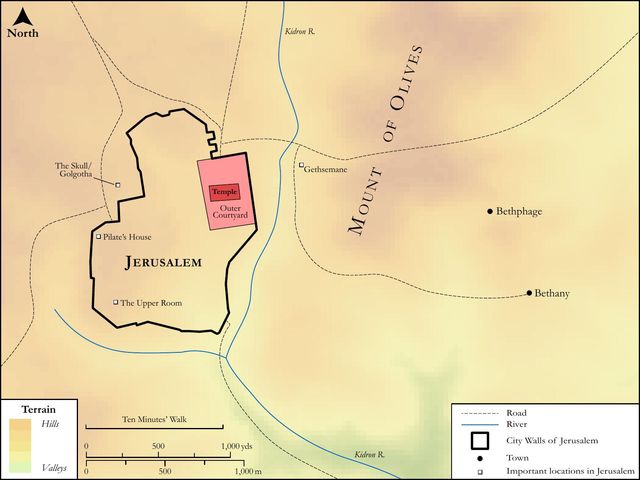
I.The preparation that was made for Christ's eating the passover with his disciples, upon the very day of unleavened bread, when the passover must be killed according to the law, Luk 22:7. Christ was made under the law, and observed the ordinances of it, particularly that of the passover, to teach us in like manner to observe his gospel institutions, particularly that of the Lord's supper, and not to neglect them. It is probable that he went to the temple to preach in the morning, when he sent Peter and John another way into the city to prepare the passover. Those who have attendants about them, to do their secular business for them in a great measure, must not think that this allows them to be idle; it engages them to employ themselves more in spiritual business, or service to the public. He directed those whom he employed whither they should go (Luk 22:9, Luk 22:10): they must follow a man bearing a pitcher of water, and he must be their guide to the house. Christ could have described the house to them; probably it was a house they knew, and he might have said no more than, Go to such a one's house, or to a house in such a street, with such a sign, etc. But he directed them thus, to teach them to depend upon the conduct of Providence, and to follow that, step by step. They went, not knowing whither they went, nor whom they followed. Being come to the house, they must desire the master of the house to show them a room (Luk 22:11), and he will readily do it, Luk 22:12. Whether it was a friend's house or a public house does not appear; but the disciples found their guide, and the house, and the room, just as he had said to them (Luk 22:13); for they need not fear a disappointment who go upon Christ's word; according to the orders given them, they got every thing in readiness for the passover, Luk 22:11.
II.The solemnizing of the passover, according to the law.
When the hour was come that they should go to supper he sat down, probably at the head-end of the table, and the twelve apostles with him, Judas not excepted; for it is possible that those whose hearts are filled with Satan, and all manner of wickedness, may yet continue a plausible profession of religion, and be found in the performance of its external services; and while it is in the heart, and does not break out into any thing scandalous, such cannot be denied the external privileges of their external profession. Though Judas has already been guilty of an overt act of treason, yet, it not being publicly known, Christ admits him to sit down with the rest at the passover. Now observe,
1.How Christ bids this passover welcome, to teach us in like manner to welcome his passover, the Lord's supper, and to come to it with an appetite (Luk 22:15): "With desire I have desired, I have most earnestly desired, to eat this passover with you before I suffer." He knew it was to be the prologue to his sufferings, and therefore he desired it, because it was in order to his Father's glory and man's redemption. He delighted to do even this part of the will of God concerning him as Mediator. Shall we be backward to any service for him who was so forward in the work of our salvation? See the love he had to his disciples; he desired to eat it with them, that he and they might have a little time together, themselves, and none besides, for private conversation, which they could not have in Jerusalem but upon this occasion. He was now about to leave them, but was very desirous to eat this passover with them before he suffered, as if the comfort of that would carry him the more cheerfully through his sufferings, and make them the easier to him. Note, Our gospel passover, eaten by faith with Jesus Christ, will be an excellent preparation for sufferings, and trials, and death itself.
2.How Christ in it takes his leave of all passovers, thereby signifying his abrogating all the ordinances of the ceremonial law, of which that of the passover was one of the earliest and one of the most eminent (Luk 22:16): "I will not any more eat thereof, nor shall it by any more celebrated by my disciples, until it be fulfilled in the kingdom of God." (1.) It was fulfilled when Christ our Passover was sacrificed for us, Co1 5:7. And therefore that type and shadow was laid aside, because now in the kingdom of God the substance was come, which superseded it. (2.) It was fulfilled in the Lord's supper, an ordinance of the gospel kingdom, in which the passover had its accomplishment, and which the disciples, after the pouring out of the Spirit, did frequently celebrate, as we find Act 2:42, Act 2:46. They ate of it, and Christ might be said to eat with them, because of the spiritual communion they had with him in that ordinance. He is said to sup with them and they with him, Rev 3:20. But, (3.) The complete accomplishment of that commemoration of liberty will be in the kingdom of glory, when all God's spiritual Israel shall be released from the bondage of death and sin, and be put in possession of the land of promise. What he had said of his eating of the paschal lamb, he repeats concerning his drinking of the passover wine, the cup of blessing, or of thanksgiving, in which all the company pledged the Master of the feast, at the close of the passover supper. This cup he took, according to the custom, and gave thanks for the deliverance of Israel out of Egypt, and the preservation of their first-born, and then said, Take this, and divide it among yourselves, Luk 22:17. This is not said afterwards of the sacramental cup, which being probably of much more weight and value, being the New Testament in his blood, he might give into every one's hand, to teach them to make a particular application of it to their own souls; but, as for the paschal cup which is to be abolished, it is enough to say, "Take it, and divide it among yourselves, do what you will with it, for we shall have no more occasion for it, Luk 22:18. I will not drink of the fruit of the vine any more, I will not have it any more drank of, till the kingdom of God shall come, till the Spirit be poured out, and then you shall in the Lord's supper commemorate a much more glorious redemption, of which both the deliverance out of Egypt and the passover commemoration of it were types and figures. The kingdom of God is now so near being set up that you will not need to eat or drink any more till it comes." Christ dying next day opened it. As Christ with a great deal of pleasure took leave of all the legal feasts (which fell of course with the passover) for the evangelical ones, both spiritual and sacramental; so may good Christians, when they are called to remove from the church militant to that which is triumphant, cheerfully exchange even their spiritual repasts, much more their sacramental ones, for the eternal feast.
III.The institution of the Lord's supper, Luk 22:19, Luk 22:20.
The passover and the deliverance out of Egypt were typical and prophetic signs of a Christ to come, who should by dying deliver us from sin and death, and the tyranny of Satan; but they shall no more say, The Lord liveth, that brought us up out of the land of Egypt; a much greater deliverance shall eclipse the lustre of that, and therefore the Lord's supper is instituted to be a commemorative sign or memorial of a Christ already come, that has by dying delivered us; and it is his death that is in a special manner set before us in that ordinance.
1.The breaking of Christ's body as a sacrifice for us is here commemorated by the breaking of bread; and the sacrifices under the law were called the bread of our God (Lev 21:6, Lev 21:8, Lev 21:17): This is my body which is given for you. And there is a feast upon that sacrifice instituted, in which we are to apply it to ourselves, and to take the benefit and comfort of it. This bread that was given for us is given to us to be food for our souls, for nothing can be more nourishing and satisfying to our souls than the doctrine of Christ's making atonement for sin, and the assurance of our interest in that atonement; this bread that was broken and given for us, to satisfy for the guilt of our sins, is broken and given to us, to satisfy the desire of our souls. And this we do in remembrance of what he did for us, when he died for us, and for a memorial of what we do, in making ourselves partakers of him, and joining ourselves to him in an everlasting covenant; like the stone Joshua set up for a witness, Jos 24:27.
2.The shedding of Christ's blood, by which the atonement was made (for the blood made atonement for the soul, Lev 17:11), as represented by the wine in the cup; and that cup of wine is a sign and token of the New Testament, or new covenant, made with us. It commemorates the purchase of the covenant by the blood of Christ, and confirms the promises of the covenant, which are all Yea and Amen in him. This will be reviving and refreshing to our souls, as wine that makes glad the heart. In all our commemorations of the shedding of Christ's blood, we must have an eye to it as shed for us; we needed it, we take hold of it, we hope to have benefit by it; who loved me, and gave himself for me. And in all our regards to the New Testament we must have an eye to the blood of Christ, which gave life and being to it, and seals to us all the promises of it. Had it not been for the blood of Christ, we had never had the New Testament; and, had it not been for the New Testament, we had never know the meaning of Christ's blood shed.
Historical interpretation
Eight Centuries of Reception
10 surviving comments on this verse. Each one is dated, so this reads as a timeline rather than a list.
Select a marker to jump to its quote. Markers stagger vertically where authors wrote within a few decades of each other.
Or else; When our Lord was celebrating the new Passover, He fitly said, With desire have I desired this Passover, that is, the new mystery of the New Testament which He gave to His disciples, and which many prophets and righteous men desired before Him. He then also Himself thirsting for the common salvation, delivered this mystery, to suffice for the whole world. But the Passover was ordained by Moses to be celebrated in one place, that is, in Jerusalem. Therefore it was not adapted for the whole world, and so was not desired.
Above all, however, I wish to remind you and myself along with you that the Lord does not want us to come irreverently or unprepared to the Easter feast. We must have our doctrine straight, follow the proper liturgy, and do all things properly. The historical record of Israel’s feast tells us, “No foreigner, no slave purchased with money, no uncircumcised man, may eat the Passover.” It is not supposed to be eaten in just any house. There is a proper place. He also commands it to be done in haste, because we were once groaning under the sorrow of our “bondage to Pharaoh” and the “commands of the taskmasters.” In the old days, the children of Israel were considered ready to receive the feast, which was the type, only if they had followed the instructions. That type was the forerunner of our feast, although the feast was not established because of the type.When the Word of God was ready to establish the feast, which is the fulfillment of all, he told his disciples, “I have longed very much to eat this Passover with you.” The account of how the Passover was to be celebrated, as given to us in the Scriptures, presents a marvelous word picture of what the festivity must have looked like.
On its way to Jerusalem, Israel was purified in the wilderness and was trained to forget the customs of Egypt. Similarly the Word has graciously prescribed for us the holy fast of forty days of Lent. Let us make it a time of purification and purging, so that after the fast we will be prepared to go to the upper room and eat with him, to be partakers of the joys of heaven. There is no other way for us to be prepared to go up to Jerusalem and eat the Passover but to apply ourselves to the forty-day fast.
From the moment when he broke his body for his disciples and gave it to his apostles, three days are numbered during which he was counted among the dead, like Adam. Although Adam lived for many years after having eaten of the fruit of the tree, he was still numbered among the dead for having broken the commandment. God spoke to him, “The day on which you eat of it you shall die.” Scripture also says, “Your descendants will dwell there for four hundred years,” and the years were numbered from the day on which this word was pronounced. The same way of counting applies likewise to our Lord. Alternatively, the sixth day must be counted as two and the sabbath as one. It was because he had given them his body to eat in view of the mystery of his death that he entered their bodies, as afterwards he entered the earth. Our Lord blessed and broke the bread, because Adam had not blessed the fruit at the time when, as a rebel, he gathered it. The bread entered them, making up for the greed by which Adam had rejected God. The three days might also be counted from the descent into hell and the ascent: the sixth day, the sabbath, and the first day of the week.
(adv. Hær. 30. 22.) Hereby we may refute the folly of the Ebionites concerning the eating of flesh, seeing that our Lord eats the Passover of the Jews. Therefore He pointedly said, "This Passover," that no one might transfer it to mean another.
Or He says this, because after that Passover the Cross was at hand. But we find Him frequently prophesying of His own Passion, and desiring it to take place.
(conc. de Laz.) Remember then when thou sittest down to meat that after the meal thou must pray; therefore satisfy thy hunger, but with moderation, lest being overcharged thou shouldest not be able to bend thy knees in supplication and prayer to God. Let us not then after our meals turn to sleep, but to prayer. For Christ plainly signifies this, that the partaking of food should not be followed by sleep or rest, but by prayer and reading the holy Scripture. It follows, For I say unto you, I will not drink of the fruit of the vine, until the kingdom of God come.
As soon as the disciples had prepared the Passover, they proceed to eat it; as it is said, And when the hour was come, &c.
He says this, because the covetous disciple was looking out for the time for betraying Him; but that he might not betray Him before the feast of the Passover, our Lord had not divulged either the house, or the man with whom He should keep the Passover. That this was the cause is very evident from these words.
And when the hour had come, he reclined at the table, and the twelve apostles with him. The hour of eating the Passover is designated, which, as it has been often emphasized, occurred on the fourteenth day of the first month, brought to evening, and with the fifteenth moon already appearing to the earth, according to the edicts of the law.
By the hour of eating the Passover, He signifies the fourteenth day of the first month, far gone towards evening, the fifteenth moon just appearing on the earth.
He first then desires to eat the typical Passover, and so to declare the mysteries of His Passion to the world.
Thus then was our Lord the approver of the legal Passover; and as He taught that it related to the figure of His own dispensation, He forbids it henceforth to be represented in the flesh. Therefore He adds, For I say unto you, I will not any more eat thereof, until it be fulfilled in the kingdom of God. That is, I will no more celebrate the Mosaic Passover, until, being spiritually understood, it is fulfilled in the Church. For the Church is the kingdom of God; as in Luke, The kingdom of God is within you. (Luke 17:21.) Again, the ancient Passover, which He desired to bring to an end, is also alluded to in what follows; And he took the cup, and gave thanks, and said, Take ye, &c. For this gave He thanks, that the old things were about to pass away, and all things to become new.
This may be also taken literally, for from the hour of supper up to the time of resurrection He was about to drink no wine. Afterwards He partook both of meat and drink, as Peter testifies, Who did eat and drink with him after he rose from the dead. (Acts 10:41.)
But it is far more natural, that as before of the typical lamb, so now also of the drink of the Passover, He should say that He would no more taste, until the glory of the kingdom of God being made manifest, the faith of the whole world should appear; that so by means of the spiritual changing of the two greatest commands of the law, namely, the eating and drinking of the Passover, you might learn that all the Sacraments of the law were to be transferred to a spiritual observance.
But how is our Lord said to sit down, whereas the Jews eat the Passover standing? They say, that when they had eaten the legal Passover, they sat down, according to the common custom, to eat their other food.
It follows, And he said unto them, With desire have I desired to eat this Passover with you, &c.
Or He says, With desire have I desired; as if to say, This is My last supper with you, therefore it is most precious and welcome to Me; just as those who are going away to a distance, utter the last words to their friends most affectionately.
The resurrection is called the kingdom of God, because it has destroyed death. Therefore David also says, The Lord reigneth: He hath put on beauty, (Ps. 93:1.) that is, a beautiful robe, having put off the corruption of the flesh. (Isa. 63:1.) But when the resurrection comes, He again drinks with His disciples; to prove that the resurrection was not a shadow only.
Continue studying Luke 22:14 across the web’s major study libraries — every link below opens this exact verse, chapter, or book on the destination site.
Read & Compare
 BibleGatewayThis verse in more than 200 translations and 70 languages.
 Bible.comThe YouVersion reader — hundreds of translations, reading plans, and highlights.
 ESV.orgCrossway's official English Standard Version reader.
 NET BibleThe NET translation with 60,000+ translators' notes on every rendering decision.
 STEP BibleTyndale House's free study tool — original text, vocabulary, and scholarly resources.
 BibliaLogos Bible Software's free web reader.
 USCCBThe New American Bible (Revised Edition) with the U.S. bishops' study notes.
Commentaries
 BibleHub CommentariesDozens of classic commentaries on this verse, gathered on one page.
 StudyLightMore than 100 commentary sets — the largest collection on the web.
 BibleRefPlain-English commentary on what this verse means, verse by verse.
 Enduring WordDavid Guzik's free commentary on this chapter, widely used by Bible teachers.
 Bible Study ToolsVerse commentary alongside Greek and Hebrew study aids.
Original Language & Research
- BibleHub InterlinearThe verse word by word — original language, transliteration, and English.
- BibleHub LexiconEvery word's original-language definition and Strong's entry.
 Blue Letter BibleDeep-study tools — Strong's numbers, concordance, and word studies.
 CNTR CollationThe earliest Greek manuscripts of this verse, collated letter by letter.
Sermons, Hymns & Audio


TrulyRandomVerse is not affiliated with these sites and doesn’t control their content. They’re linked because they’re genuinely useful.
Summary
Luke 22:14 introduces the solemn and profoundly significant setting of the Last Supper, marking a pivotal moment in Jesus' earthly ministry. This verse succinctly states the arrival of a divinely appointed "hour" and depicts Jesus reclining at the table with His twelve chosen apostles, signifying the commencement of the Passover meal that would soon be transformed into the institution of the New Covenant. It underscores the intentionality of God's redemptive plan and the intimate fellowship shared between Christ and His disciples before His ultimate sacrifice.
Context
ShowHideLiterary Context
Luke 22:14 immediately follows the preparations for the Passover meal. Verses 7-13 detail the disciples' inquiry about where to prepare the Passover, Jesus' specific instructions for finding the upper room, and their diligent execution of these preparations. This meticulous setup emphasizes the deliberate and pre-arranged nature of the meal. The verse also serves as a crucial transition, moving from the conspiracy of the religious leaders (Luke 22:1-6) and the practical arrangements to the actual commencement of the meal, which will lead directly into the institution of the Lord's Supper (Luke 22:15-20), the foretelling of betrayal (Luke 22:21-23), and teachings on true greatness (Luke 22:24-30). It is the narrative pivot point for the passion week's most sacred gathering.
Historical & Cultural Context
The event takes place during the Jewish feast of Passover, a central annual celebration commemorating Israel's liberation from slavery in Egypt (Exodus 12). The Passover Seder was a highly ritualized meal, traditionally eaten by families or groups reclining on cushions around low tables, a posture that signified freedom and rest. The phrase "he sat down" (or more accurately, "reclined") reflects this custom. The presence of "the twelve apostles" highlights the communal and covenantal nature of the meal, mirroring the twelve tribes of Israel. This meal occurred in Jerusalem, a city charged with religious and political tension, especially during major feasts, making Jesus' public gathering with His disciples a bold act in the face of escalating opposition from the Jewish authorities and the omnipresent Roman rule.
Key Themes
ShowHideLuke 22:14 contributes significantly to several overarching themes within Luke's Gospel and the broader biblical narrative. The phrase "when the hour was come" powerfully emphasizes divine sovereignty and timing, indicating that Jesus' passion was not a random tragedy but the fulfillment of God's predetermined plan, a theme woven throughout Jesus' ministry (e.g., John 2:4 and John 13:1). The gathering of Jesus with His "twelve apostles" underscores the theme of intimate fellowship and discipleship, even as the shadow of betrayal looms (foreshadowed in Luke 22:21-23). Furthermore, this verse sets the stage for the establishment of the New Covenant through Jesus' self-sacrifice, transforming the ancient Passover ritual into a forward-looking celebration of His body and blood, a pivotal theological development elaborated in Luke 22:19-20).
Exposition and Analysis
ShowHideKey Word Analysis
ShowHideThis word (G5610) denotes not merely a specific sixty-minute period, but often in the New Testament, a divinely appointed season or moment of destiny. Here, it signifies the precise, predetermined time for Jesus to enter into His passion, including the Last Supper, His betrayal, trial, crucifixion, and resurrection. It underscores the theological concept of God's sovereign control over redemptive history.
This verb (G377) literally means "to fall back" or "to recline." It refers to the customary posture for eating a formal meal, especially the Passover Seder, in the ancient Near East. Guests would recline on couches or cushions, leaning on their left elbow, allowing their right hand to be free for eating. This detail paints a vivid picture of the setting, emphasizing the relaxed yet significant nature of the gathering, rather than a formal, upright seating arrangement.
Derived from a verb meaning "to send forth," this term (G652) refers to a delegate, an ambassador, or one who is officially commissioned. In this context, "the twelve apostles" are Jesus' specially chosen and commissioned disciples, entrusted with carrying forward His message and mission after His departure. Their presence highlights the authoritative and foundational nature of the teachings and events that are about to unfold.
Verse Breakdown
ShowHide"And when the hour was come"
This phrase immediately establishes the divine intentionality and predetermined nature of the events. The "hour" is not merely a chronological point but a theological moment, the culmination of God's plan for redemption, long foretold and now arriving with precision. It signals the beginning of Jesus' passion.
"he sat down"
This describes Jesus taking His place at the table, specifically reclining as was the custom for the Passover meal. This posture conveys a sense of intimacy and readiness for the sacred meal. It is a deliberate action, signifying His willingness to enter into the final phase of His redemptive work.
"and the twelve apostles with him"
The presence of all twelve apostles, including Judas Iscariot, emphasizes the communal and covenantal nature of this final meal. It highlights the intimate fellowship Jesus shared with His inner circle, even as one among them was poised to betray Him. Their collective presence underscores the foundational significance of this event for the nascent church.
Literary Devices
ShowHideLuke 22:14 employs several literary devices to convey its profound meaning. The phrase "when the hour was come" functions as Foreshadowing, hinting at the momentous and divinely orchestrated events that are about to unfold—Jesus' suffering, death, and resurrection. It also underscores Divine Sovereignty, portraying God's meticulous control over the timeline of salvation history, rather than a series of accidental occurrences. The simple, direct statement of Jesus "sitting down" with "the twelve apostles" uses Understatement to describe what is arguably the most significant meal in human history, allowing the subsequent narrative to fully unpack its profound implications. Furthermore, the inclusion of "the twelve apostles" carries Symbolism, representing the new Israel, founded upon the teachings and sacrifice of Christ, mirroring the twelve tribes of old.
Theological and Thematic Connections
ShowHideLuke 22:14 serves as a theological gateway to understanding the climax of God's redemptive plan. The "hour" signifies the fulfillment of prophecy and the precise timing of God's intervention in human history through Christ's passion. This verse underscores the covenantal faithfulness of God, as the Passover meal, a memorial of the Old Covenant liberation, is about to be transformed into the institution of the New Covenant through Christ's body and blood. It highlights the intimacy of God with humanity through Jesus' fellowship with His disciples, even in the shadow of betrayal, demonstrating profound love and commitment to those He had chosen. The gathering of the twelve also points to the foundational nature of the apostolic witness in transmitting the truths of the Gospel and the significance of Christ's sacrifice.
Reflection and Application
ShowHideLuke 22:14 invites us to reflect on the profound intentionality and divine timing that undergird God's work in the world and in our individual lives. Just as Jesus' "hour" was precisely appointed, so too are the significant moments and transitions in our own journeys part of a larger, sovereign plan. This verse also calls us to cherish the gift of Christian fellowship, recognizing the importance of communal worship and shared meals as expressions of our unity in Christ, even when faced with challenges or the imperfections of others. It encourages us to approach the Lord's Supper with reverence and understanding, remembering that it is not merely a ritual but a sacred memorial of Christ's ultimate sacrifice and the establishment of the New Covenant, drawing us into deeper communion with Him and with one another.
Questions for Reflection
ShowHideFAQ
ShowHideWhy is the "hour" so significant in this verse?
ShowHideThe "hour" (Greek: hōra) in Luke 22:14 is significant because it refers to a divinely appointed and predetermined moment, not just a chronological time. Throughout the Gospels, particularly in John, Jesus often speaks of "His hour" as the destined time for His suffering, death, and glorification (e.g., John 12:23). Here, it marks the beginning of the culmination of God's redemptive plan through Jesus' passion, signaling that these events are not accidental but part of God's sovereign will and prophetic fulfillment.
What does "he sat down" imply about the meal's setting?
ShowHideThe phrase "he sat down" (Greek: anapíptō) actually means "he reclined" or "leaned back." This indicates the customary posture for a formal meal like the Passover Seder in ancient Jewish culture. Guests would recline on low couches or cushions around a table, leaning on one arm. This posture signified a position of rest and freedom, contrasting with the standing posture of the original Passover in Egypt (Exodus 12:11). It highlights the intimate and communal nature of the Last Supper.
Christ-Centered Fulfillment
ShowHideLuke 22:14, by setting the stage for the Last Supper, profoundly points to Christ's ultimate fulfillment of God's redemptive plan. The "hour" that had "come" is the very moment when the shadows of the Old Covenant give way to the substance of the New. The Passover, which commemorated Israel's liberation through the blood of a lamb, is here transformed by Jesus into the institution of the Lord's Supper, where He Himself becomes the true Lamb of God who takes away the sin of the world. His reclining with the twelve signifies the establishment of a new covenant community, founded not on Mosaic law, but on His impending sacrifice. This meal foreshadows the ultimate communion believers will share with Christ in His kingdom (Luke 22:16), and His body broken and blood shed become the new covenant sealed for the forgiveness of sins (Matthew 26:28). Thus, Luke 22:14 is not merely a historical detail but a sacred prelude to the cross and resurrection, through which Christ fully accomplishes our redemption and invites us into eternal fellowship with Him.