


Judges 9:24
- לָבוֹאla·Vo'to comeH935Prep-l ¦ V-Qal-InfVerb Qal Infinitive Constructלָtoבוֹאcome
- חֲמַסcha·Mas[the] violence ofH2555N-mscNoun Singular Masculine Construct
- שִׁבְעִיםshiv·'ImseventyH7657N-mpNoun Plural Masculine Absolute
- בְּנֵיbe·nei[the] sons ofH1121N-mpcNoun Plural Masculine Construct
- יְרֻבָּעַלye·ru·Ba·'alJerub-BaalH3378N-proper-mNoun Proper Masculine
- וְדָמָםve·da·Mamand their bloodH1818Conj-w ¦ N-msc ¦ 3mpNoun Singular Masculine Constructוְandדָמָbloodםtheir
- לָשׂוּםla·Sumto putH7760Prep-l ¦ V-Qal-InfVerb Qal Infinitive Constructלָtoשׂוּםput
- עַל'alonH5921PrepPreposition
- אֲבִימֶלֶךְ'a·vi·Me·lekhAbimelechH40N-proper-mNoun Proper Masculine
- אֲחִיהֶם'a·chi·Hemtheir brotherH251N-msc ¦ 3mpNoun Singular Masculine Constructאֲחִיbrotherהֶםtheir
- אֲשֶׁר'a·SherwhoH834RelParticle Relative
- הָרַגha·Raghe killedH2026V-Qal-Perf-3msVerb Qal Perfect 3rd Singular Masculine
- אוֹתָם'o·Tam<obj.> themH853DirObjM ¦ 3mpParticle Object Indicatorאוֹתָ<obj.>םthem
- וְעַלve·'Aland onH5921Conj-w ¦ PrepPrepositionוְandעַלon
- בַּעֲלֵיba·'a·Lei[the] citizens ofH1167N-mpcNoun Plural Masculine Construct
- שְׁכֶםshe·KhemShechemH7927N-properNoun Proper Location
- אֲשֶׁר'a·SherwhoH834RelParticle Relative
- חִזְּקוּchi·ze·Kuthey strengthenedH2388V-Piel-Perf-3cpVerb Piel Perfect 3rd Plural common gender
- אֶת'et<obj.>H853DirObjMParticle Object Indicator
- יָדָיוya·Davhis handsH3027N-cdc ¦ 3msNoun Dual common gender Constructיָדָיhandsוhis
- לַהֲרֹגla·ha·Rogto killH2026Prep-l ¦ V-Qal-InfVerb Qal Infinitive Constructלַtoהֲרֹגkill
- אֶת'et<obj.>H853DirObjMParticle Object Indicator
- אֶחָיו'e·Chavhis brothersH251N-mpc ¦ 3msNoun Plural Masculine Constructאֶחָיbrothersוhis
English is a literal word-by-word gloss of the Hebrew, not the KJV's wording. Why?
This is the original text the KJV's translators worked from — each Hebrew word with its own literal English meaning in this verse, prepared by scholars at Tyndale House, Cambridge. The KJV translates whole sentences, not word by word, so its wording differs: one Hebrew word can become several English words, and the KJV may choose “the LORD” where the gloss reads “Yahweh”. Both are faithful — they answer different questions. For the KJV's own rendering, switch to the KJV text.
Details
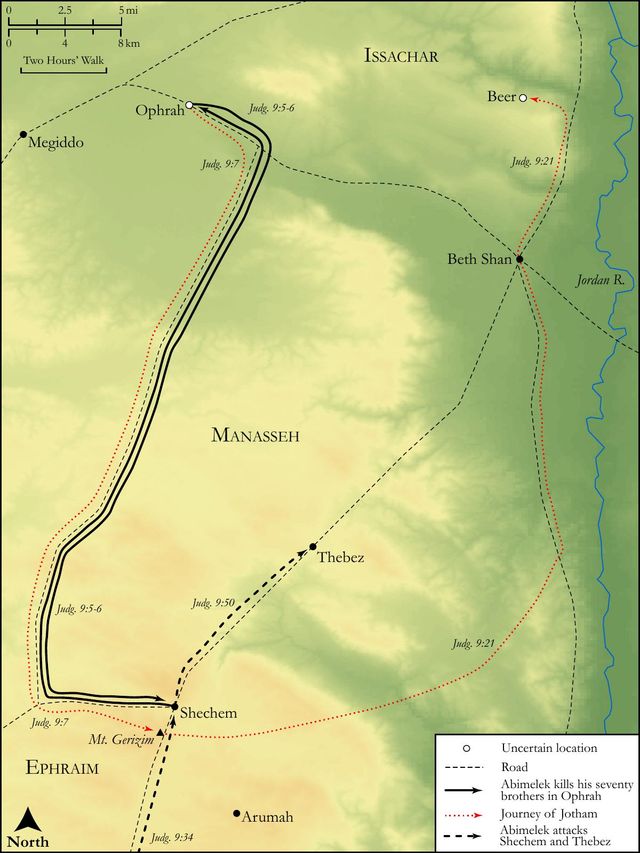
See on the biblical-era map

Study this verse
Public-domain commentary
Matthew Henry
From his Commentary on the Whole Bible. Henry comments on passages, not single verses — this entry covers Judges 9:22–49. His three-level outline is real structure in the source text, so it is rendered as structure.
Three years Abimelech reigned, after a sort, without any disturbance; it is not said, He judged Israel, or did any service at all to his country, but so long he enjoyed the title and dignity of a king; and not only the Shechemites, but many other places, paid him respect. They must have been fond of a king that could please themselves with such a one as this. But the triumphing of the wicked is short. Within three years, as the years of a hireling, all this glory shall be contemned, and laid in the dust, Isa 16:14. The ruin of these confederates in wickedness was from the righteous hand of the God to whom vengeance belongs. He sent an evil spirit between Abimelech and the Shechemites (Jdg 9:23), that is, they grew jealous one of another and ill-affected one to another. He slighted those that set him up, and perhaps countenanced other cities which now began to come into his interests more than he did theirs; and then they grew uneasy at his government, blamed his conduct, and quarrelled at his impositions. This was from God. He permitted the devil, that great mischief-maker, to sow discord between them, and he is an evil spirit, whom God not only keeps under his check, but sometimes serves his own purposes by. Their own lusts were evil spirits; they are devils in men's own hearts; from them come wars and fightings. These God gave them up to, and so might be said to send the evil spirits between them. When men's sin is made their punishment, though God is not the author of the sin, yet the punishment is from him. The quarrel God had with Abimelech and the Shechemites was for the murder of the sons of Gideon (Jdg 9:24): That the cruelty done to them might come and their blood be laid as a burden upon Abimelech that slew them, and the men of Shechem that helped him. Note, 1. Sooner or later God will make inquisition for blood, innocent blood, and will return it on the heads of those that shed it, who shall have blood given them to drink, for they are worthy. 2. Accessaries shall be reckoned with, as well as principals, in that and other sins. The Shechemites that countenanced Abimelech's pretensions, aided and abetted him in his bloody project, and avowed the fact by making him king after he had done it, must fall with him, fall by him, and fall first. 3. Those that combine together to do wickedly are justly dashed in pieces one against another. Blood cannot be a lasting cement to any interest.
I.The Shechemites began to affront Abimelech, perhaps they scarcely knew why or wherefore, but they were given to change.
1.They dealt treacherously with him, Jdg 9:23. It is not said, They repented of their sin in owning him. Had they done so, it would have been laudable to disown him; but they did it only upon some particular pique conceived against him by their pride or envy. Those that set him up were the first that deserted him and endeavoured to dethrone him. It is not strange that those who were ungrateful to Gideon were unfaithful to Abimelech; for what will hold those that will not be held by the obligation of such merits as Gideon's? Note, It is just with God that those who tempt others to be cone perfidious should afterwards be themselves betrayed by those whom they have taught to be perfidious.
2.They aimed to seize him when he was at Arumah (Jdg 9:41), his country-seat. Expecting him to come to town, they set liers in wait for him (Jdg 9:25), who should make him their prisoner whom they had lately made their prince. Those who were thus posted, he not coming, took the opportunity of robbing travellers, which would help to make the people more and more uneasy under Abimelech, when they saw he could not or would not protect them from highway-men.
3.They entertained one Gaal, and set him up as their head in opposition to Abimelech, Jdg 9:26. This Gaal is said to be the son of Ebed, which signifies a servant, perhaps denoting the meanness of his extraction. As Abimelech was by the mother's side, so he by the father's, the son of a servant. Here was one bramble contesting with another. We have reason to suspect that this Gaal was a native Canaanite, because he courts the Shechemites into subjection to the men of Hamor, who was the ancient lord of this city in Jacob's time. He was a bold ambitious man, served their purpose admirably well when they were disposed to quarrel with Abimelech, and they also served his purpose; so he went over to them to blow the coals, and they put their confidence in him.
4.They did all the despite they could to Abimelech's name, Jdg 9:27. They made themselves very merry in his absence, as those who were glad he was out of the way, and who, now that they had another to head them, were in hopes to get clear of him; nay, they went into the house of their god, to solemnize their feast of in-gathering, and there they did eat, and drink, and cursed Abimelech, not only said all the ill they could of him in their table-talk and the song of their drunkards, but wished all the ill they could to him over their sacrifices, praying to their idol to destroy him. They drank healths to his confusion, and with as loud huzzas as ever they had drunk them to his prosperity. That very temple whence they had fetched money to set him up with did they now meet in to curse him and contrive his ruin. Had they deserted their idol-god with their image-king, they might have hoped to prosper; but, while they still cleave to the former, the latter shall cleave to them to their ruin. How should Satan cast out Satan?
5.They pleased themselves with Gaal's vaunted defiance of Abimelech, Jdg 9:28, Jdg 9:29. They loved to hear that impudent upstart speak scornfully,
(1.)Of Abimelech, though calling him in disdain Shechem, or a Shechemite, he reflected upon their own city.
(2.)Of his good father likewise, Gideon: Is not he the son of Jerubbaal? So he calls him, perhaps in an impious indignation at his name and memory for throwing down the altar of Baal, turning that to his reproach which was his praise.
(3.)Of his prime minister of state, Zebul his officer, and ruler of the city. "We may well be ashamed to serve them, and need not be afraid to oppose them." Men of turbulent ambitious spirits thus despise dominion, and speak evil of dignities. Gaal aimed not to recover Shechem's liberty, only to change their tyrant: "O that this people were under my hand! What I would do! I would challenge Abimelech to try titles for the crown;" and it should seem he desired his friends to send him word that he was ready to dispute it with him whenever he pleased: "Increase thy army, and come out. Do thy worst; let the point be determined by the sword." This pleased the Shechemites, who were now as sick of Abimelech as ever they had been fond of him. Men of no conscience will be men of no constancy.
II.Abimelech turned all his force upon them, and, in a little time, quite ruined them. Observe the steps of their overthrow.
1.The Shechemites' counsels were betrayed to Abimelech by Zebul his confidant, the ruler of the city, who continued hearty for him. His anger was kindled (Jdg 9:30), and the more because Gaal had spoken slightly of him (Jdg 9:28), for perhaps, if he had complimented and caressed him now that things were in this ferment, he might have gained him to his interest; but he, being disobliged, sends notice to Abimelech of all that was said and done in Shechem against him, Jdg 9:31. Betrayers are often betrayed by some among themselves, and the cursing of the king is sometimes strangely carried by a bird of the air. He prudently advises him to come against the city immediately, and lose no time, Jdg 9:32, Jdg 9:33. He thinks it best that he should march his forces by night into the neighbourhood, surprise the city in the morning, and then make the best of his advantages. How could the Shechemites hope to speed in their attempt when the ruler of their city was in the interests of their enemy? They knew it, and yet took no care to secure him.
2.Gaal, that headed their faction, having been betrayed by Zebul, Abimelech's confidant, was most wretchedly bantered by him. Abimelech, according to Zebul's advice, drew all his forces down upon Shechem by night, Jdg 9:34. Gaal, in the morning, went out to the gate (Jdg 9:35) to see what posture things were in, and to enquire, What news? Zebul, as a ruler of the city, met him there as a friend. Abimelech and his forces beginning to move towards the city, Gaal discovers them (Jdg 9:36), takes notice of their approach to Zebul that was standing with him, little thinking that he had sent for them and was now expecting them. "Look," says he, "do not I see a body of men coming down from the mountain towards us? Yonder they are," pointing to the place. "No, no," says Zebul; "thy eye-sight deceives thee; it is but the shadow of the mountains which thou takest to be an army." By this he intended,
(1.)To ridicule him, as a man of no sense or spirit, and therefore very unfit for what he pretended to, as a man that might easily be imposed upon and made to believe any thing, and that was so silly and so cowardly that he apprehended danger where there was none, and was ready to fight with a shadow.
(2.)To detain him, and hold him in talk, while the forces of Abimelech were coming up, that thereby they might gain advantage. But when Gaal, being content to believe those he now saw to be but the shadow of the mountains (perhaps the mountains of Ebal and Gerizim, which lay close by the city), was undeceived by the discovery of two other companies that marched apace towards the city, then Zebul took another way to banter him, upbraiding him with what he had said but a day or two before, in contempt of Abimelech (Jdg 9:38): Where is now thy mouth, that foul mouth of thine, wherewith thou saidst, Who is Abimelech? Note, Proud and haughty people are often made in a little time to change their note, and to dread those whom they had most despised. Gaal had, in a bravado, challenged Abimelech to increase his army and come out; but now Zebul, in Abimelech's name, challenges him: Go out, and fight with them, if thou darest. Justly are the insolent thus insulted over.
3.Abimelech routed Gaal's forces that sallied out of the town, Jdg 9:39, Jdg 9:40. Gaal, disheartened no doubt by Zebul's hectoring him, and perceiving his interest weaker than he thought it was, though he marched out against Abimelech with what little force he had, was soon put to the worst, and obliged to retire into the city with great precipitation. In this action the Shechemites' loss was considerable: Many were overthrown and wounded, the common effect of popular tumults, in which the inconsiderate multitude are often drawn into fatal snare by those that promise them glorious success.
4.Zebul that night expelled Gaal, and the party he had brought with him into Shechem, out of the city (Jdg 9:41), sending him to the place whence he came. For though the generality of the city continued still averse to Abimelech, as appears by the sequel of the story, yet they were willing to part with Gaal, and did not oppose his expulsion, because, though he had talked big, both his skill and courage had failed him when there was occasion for them. Most people judge of men's fitness for business by their success, and he that does not speed well is concluded not to do well. Well, Gaal's interest in Shechem is soon at an end, and he that had talked of removing Abimelech is himself removed, nor do we ever hear of him any more. Exit Gaal - Gaal retires.
5.Abimelech, the next day, set upon the city, and quite destroyed it, for their treacherous dealings with him. Perhaps Abimelech had notice of their expelling Gaal, who had headed the faction, with which they thought he would have been satisfied, but the crime was too keep to be thus atoned for, and his resentments were too keen to be pacified by so small an instance of submission, besides that it was more Zebul's act than theirs; by it their hands were weakened, and therefore he resolved to follow his blow, and effectually to chastise their treachery.
(1.)He had intelligence brought him that the people of Shechem had come out into the field, Jdg 9:42. Some think into the field of business to plough and sow (having lately gathered in their harvest), or to perfect their harvest, for it was only their vintage that they had made an end of (Jdg 9:27), and then it intimates that they were secure. And because Abimelech had retired (Jdg 9:41) they thought themselves in no danger from him, and then the issue of it is an instance of sudden destruction coming upon those that cry, Peace and safety. Others think they went out into the field of battle; though Gaal was driven out, they would not lay down their arms, but put themselves into a posture for another engagement with Abimelech, in which they hoped to retrieve what they had lost the day before,
(2.)He himself, with a strong detachment, cut off the communication between them and the city, stood in the entering of the gate (Jdg 9:44), that they might neither make their retreat into the city nor receive any succours from the city, and then sent two companies of his men, who were too strong for them, and they put them all to the sword, ran upon those that were in the fields and slew them. When we go out about our business we are not sure that we shall come home again; there are deaths both in the city and in the field.
(3.)He then fell upon the city itself, and, with a rage reaching up to heaven, though it was the place of his nativity, laid it in ruins, slew all the people, beat down all the buildings, and, in token of his desire that it might be a perpetual desolation, sowed it with salt, that it might remain a lasting monument of the punishment of perfidiousness. Yet Abimelech prevailed not to make its desolations perpetual; for it was afterwards rebuilt, and became so considerable a place that all Israel came thither to make Rehoboam king, Kg1 12:1. And the place proved an ill omen. Abimelech intended hereby to punish the Shechemites for their serving him formerly in the murder of Gideon's sons. Thus, when God makes use of men as instruments in his hand to do his work, he means one thing and they another, Isa 10:6, Isa 10:7. They design to maintain their honour, but God to maintain his.
6.Those that retired into a strong-hold of their idol-temple were all destroyed there. These are called the men of the tower of Shechem (Jdg 9:46, Jdg 9:47), some castle that belonged to the city, but lay at some distance from it. They, hearing of the destruction of the city, withdrew into a hold of the temple, trusting, it is likely, not so much to its strength as to its sanctity; they put themselves under the protection of their idol: for thus all people will walk in the name of their god, and shall not we then choose to dwell in the house of the Lord all the days of our life? For in the time of trouble he shall hide us in his pavilion, Psa 27:5. The name of the Lord is a strong tower, Pro 18:10. But that which they hoped would be for their welfare proved to them a snare and a trap, as those will certainly find that run to idols for shelter; it will prove a refuge of lies. When Abimelech had them altogether penned up in that hold he desired no more. That barbarous project immediately came into his head of setting fire to the strong-hold, and, so to speak, burning all the birds together in the nest. He kept the design to himself, but set all his men on work to expedite the execution of it, Jdg 9:48, Jdg 9:49. He ordered them all to follow him, and do as he did: as his father had said to his men (Jdg 7:17), Look on me, and do likewise; so saith he to his, as becomes a general that will not be wanting to give both the plainest direction and the highest encouragement that can be to his soldiers: What you have seen me do make haste to do, as I have done. Not Ite illuc - Go thither; but Venite huc - Come hither. The officers in Christ's army should thus teach by their example, Phi 4:9. He and they fetched each of them a bough from a wood not far off, laid all their boughs together under the wall of this tower, which it is probable was of wood, set fire to their boughs, and so burnt down their hold and all that were in it, who were either burnt or stifled with the smoke. What inventions men have to destroy one another! Whence come these cruel wars and fightings but from their lusts? Some think that the men of the tower of Shechem were the same with the house of Millo, and then Jotham's just imprecation was answered in the letter: Let fire come out from Abimelech, and devour not only in general the men of Shechem, but in particular the house of Millo, Jdg 9:20. About 1000 men and women perished in these flames, many of whom, it is probable, were no way concerned in the quarrel between Abimelech and the Shechemites, nor meddled with either side, yet, in this civil war, they came to this miserable end; for men of factious turbulent spirits perish not alone in their iniquity, but involve many more, that follow them in their simplicity, in the same calamity with them.
Continue studying Judges 9:24 across the web’s major study libraries — every link below opens this exact verse, chapter, or book on the destination site.
Read & Compare
 BibleGatewayThis verse in more than 200 translations and 70 languages.
 Bible.comThe YouVersion reader — hundreds of translations, reading plans, and highlights.
 ESV.orgCrossway's official English Standard Version reader.
 NET BibleThe NET translation with 60,000+ translators' notes on every rendering decision.
 STEP BibleTyndale House's free study tool — original text, vocabulary, and scholarly resources.
 BibliaLogos Bible Software's free web reader.
 USCCBThe New American Bible (Revised Edition) with the U.S. bishops' study notes.
Commentaries
 BibleHub CommentariesDozens of classic commentaries on this verse, gathered on one page.
 StudyLightMore than 100 commentary sets — the largest collection on the web.
 BibleRefPlain-English commentary on what this verse means, verse by verse.
 Enduring WordDavid Guzik's free commentary on this chapter, widely used by Bible teachers.
 Bible Study ToolsVerse commentary alongside Greek and Hebrew study aids.
Original Language & Research
- BibleHub InterlinearThe verse word by word — original language, transliteration, and English.
- BibleHub LexiconEvery word's original-language definition and Strong's entry.
 Blue Letter BibleDeep-study tools — Strong's numbers, concordance, and word studies.
 SefariaThe Hebrew text with Rashi and centuries of Jewish commentary.
Sermons, Hymns & Audio


TrulyRandomVerse is not affiliated with these sites and doesn’t control their content. They’re linked because they’re genuinely useful.
Summary
Judges 9:24 serves as a profound declaration of divine justice, asserting that the horrific violence perpetrated by Abimelech against his seventy half-brothers, and the active complicity of the men of Shechem in this atrocity, would inevitably be met with God's righteous retribution. This verse encapsulates the immutable principle that no act of wickedness, particularly the shedding of innocent blood and profound betrayal, escapes the moral order established and meticulously upheld by God, thereby ensuring that justice, though sometimes seemingly delayed, will ultimately and decisively prevail.
Context
ShowHideLiterary Context
Judges 9:24 functions as a pivotal interpretive statement within the unfolding narrative of Abimelech's tyrannical reign and subsequent downfall, serving as a divine commentary on the events. It immediately follows Jotham's powerful and prophetic parable of the trees and his subsequent curse pronounced upon Abimelech and the men of Shechem in Judges 9:7-20. This verse explicitly articulates the divine purpose behind the escalating conflict between Abimelech and Shechem, framing it not as random misfortune but as the direct, divinely ordained consequence and fulfillment of Jotham's prophetic imprecation. This declaration sets the stage for the dramatic and bloody events detailed in the latter half of the chapter, where Abimelech turns against Shechem, and both ultimately meet their deserved, violent ends, powerfully demonstrating God's active involvement in human history to uphold His righteous standards of justice.
Historical & Cultural Context
The events of Judges 9 are situated in the tumultuous period following the death of Gideon, a time characterized by a significant lack of centralized leadership and a fierce struggle for power among various tribal factions and aspiring strongmen. Shechem was an ancient and highly significant city, serving as a vital covenant site with deep historical and spiritual roots for Israel (Joshua 24). Abimelech, being the son of Gideon by a concubine from Shechem, shrewdly leveraged his maternal ties to garner political and financial support from the city's influential leaders. The brutal murder of his seventy half-brothers (with only Jotham escaping) "on one stone" (as chillingly described in Judges 9:5) was a ruthless act of political expediency designed to eliminate all rivals and consolidate his grip on power, reflecting the brutal and often lawless political realities of the era. The concept of "bloodguilt"—the profound defilement of the land and the community by the shedding of innocent blood, which demanded divine retribution—was deeply ingrained in ancient Israelite law and culture, profoundly underscoring the immense gravity of Abimelech's heinous crime and Shechem's active complicity.
Key Themes
ShowHideJudges 9:24 powerfully articulates several core themes central to the overarching message of the book of Judges and broader biblical theology. Foremost among these is the theme of Divine Justice and Retribution, where God is depicted as actively intervening in human affairs to punish wickedness, particularly the egregious sin of shedding innocent blood. The phrase "their blood be laid upon" serves as a potent theological idiom signifying ultimate accountability and unavoidable divine judgment. This verse also vividly highlights the Inevitable Consequences of Wickedness, illustrating that those who seize power through violence, treachery, and a callous disregard for human life will inevitably face ruin and destruction. Both Abimelech and the men of Shechem, despite their initial unholy alliance, are ultimately consumed by the very violence and deceit they embraced. Furthermore, the verse emphasizes Accountability for Complicity, making it unequivocally clear that responsibility for sin extends not only to the primary perpetrator but also to those who actively aid, abet, and enable the crime. Finally, Judges 9:24 serves as a declarative statement of the Fulfillment of Prophecy, specifically Jotham's curse, reinforcing the profound theological idea that God works through historical events to bring about His righteous judgments, as further detailed in Judges 9:56-57.
Exposition and Analysis
ShowHideKey Word Analysis
ShowHideThis term is far more potent and encompassing than mere cruelty; it denotes profound violence, injustice, wrongdoing, and oppression. It carries a strong connotation of wrongful aggression, the abuse of power, and a fundamental violation of moral and legal order. In biblical usage, ḥāmāṣ frequently describes acts of physical violence, oppression, or deep moral corruption that are so grievous they are said to "cry out" for divine intervention, as powerfully illustrated in Genesis 6:11. Here, it refers to the heinous and unjust act of mass murder committed by Abimelech.
In this context, "blood" refers to the lifeblood of the seventy murdered sons of Jerubbaal. The shedding of blood, particularly innocent blood, carries immense theological weight in the Old Testament, signifying not merely physical death but also a profound defilement that demands retribution and justice. The phrase "their blood be laid upon" is an idiom that signifies the imputation of guilt and the direct, inescapable accountability for this life-taking act. It is a declaration that the consequences of this bloodshed would fall squarely upon the perpetrators.
This verb, meaning "to strengthen" or "to seize," when combined with the implied "hands" (from H3027, yāḏ), forms the idiom "strengthened his hands." This phrase vividly describes the active support, empowerment, and complicity of the men of Shechem. They did not merely stand by passively but actively provided Abimelech with the financial means and political backing necessary to carry out the massacre of his brothers. This emphasizes their shared and direct culpability in the crime, as they enabled the violence through their material and political assistance.
Verse Breakdown
ShowHide"That the cruelty [done] to the threescore and ten sons of Jerubbaal might come"
This initial clause reveals the overarching divine purpose behind the subsequent narrative events. The unfolding conflict, betrayal, and ultimate destruction are not random occurrences but are divinely ordained consequences for the "cruelty" (the violent injustice and mass murder) inflicted upon Gideon's seventy sons. The use of the passive voice, "might come," subtly but powerfully implies God's sovereign hand orchestrating these events to bring about His righteous justice.
"and their blood be laid upon Abimelech their brother, which slew them"
This part of the verse precisely identifies the primary perpetrator and the direct recipient of the impending judgment. Abimelech, who was personally and directly responsible for the massacre of his own half-brothers, is singled out to bear the full weight of the bloodguilt. The poignant emphasis on "their brother" highlights the profound betrayal, unnaturalness, and moral depravity of his fratricidal crime.
"and upon the men of Shechem, which aided him in the killing of his brethren"
This concluding clause extends the scope of the divine judgment to include the accomplices. The men of Shechem are held equally accountable because they actively "aided" Abimelech, providing the crucial resources and unwavering support that enabled him to commit the heinous murders. This underscores a vital biblical principle: complicity in sin, especially in acts of violence and injustice, carries its own grave and inescapable consequences.
Literary Devices
ShowHideJudges 9:24 employs several potent literary devices to convey its profound message of divine justice and retribution. The most prominent is the Divine Passive, particularly evident in the phrase "might come," which implicitly attributes the unfolding retribution to God's sovereign agency without explicitly naming Him. This technique powerfully underscores that the subsequent events are not mere chance or human machinations but the direct outworking of a divine decree and a moral order upheld by God. The phrase "their blood be laid upon" functions as a powerful Idiom, a common and deeply significant expression in the ancient Near East signifying the imputation of guilt and the subsequent, inevitable judgment for bloodshed. This idiom vividly communicates the concept of bloodguilt and its inescapable consequences. Furthermore, the verse serves as a declaration of Foreshadowing and Prophecy, explicitly stating the divine intention that the "cruelty" would "come" upon the perpetrators. This sets up the subsequent narrative of their mutual destruction as the direct and just fulfillment of this divine pronouncement, ensuring that the events that follow in Judges 9 are presented as the inevitable and righteous culmination of the wickedness described.
Theological and Thematic Connections
ShowHideJudges 9:24 profoundly articulates the unwavering biblical truth of God's steadfast commitment to justice, particularly in the face of egregious violence and profound injustice. It demonstrates unequivocally that God is not a passive observer of human wickedness but actively intervenes in history to ensure that moral wrongs are addressed and that righteousness ultimately prevails. The shedding of innocent blood, as shockingly exemplified in Abimelech's massacre, is presented as an offense that cries out to heaven, demanding divine retribution. This verse underscores the foundational principle that sin carries inherent, inescapable consequences, and that both direct perpetrators and those who enable or are complicit in evil will ultimately face divine accountability. It powerfully reinforces the theological concept that God's moral order cannot be defied indefinitely, providing a foundational assurance that despite the temporary triumphs of wickedness, divine justice will ultimately and perfectly prevail.
Reflection and Application
ShowHideJudges 9:24 provides a sobering yet profoundly comforting reminder that God's justice is an immutable and non-negotiable aspect of His divine character. In a world too often marked by seemingly unpunished evil, pervasive injustice, and the apparent prosperity of the wicked, this verse calls believers to place their unwavering trust in God's ultimate sovereignty and His absolute commitment to righteousness. It challenges us to recognize that while evil may appear to flourish and triumph for a time, it inherently carries within itself the seeds of its own destruction, meticulously orchestrated by the divine hand. Moreover, the verse serves as a powerful and urgent cautionary tale against complicity in sin. The men of Shechem, by actively "aiding" Abimelech, became willing and active participants in his wickedness and consequently shared fully in his judgment. This compels us to engage in a rigorous self-examination: are we, through our actions, our silence, our passive acceptance, or even our pursuit of personal gain, inadvertently enabling or contributing to injustice in our communities, our workplaces, or even within the sacred confines of the church? This passage issues a clarion call for discernment, courage, and an unyielding commitment to stand for righteousness, even when such a stance is unpopular, costly, or challenging, trusting implicitly that God's moral order will ultimately and definitively prevail.
Questions for Reflection
ShowHideFAQ
ShowHideWhat does "threescore and ten sons" mean, and why were they killed?
ShowHide"Threescore and ten" is an archaic English expression meaning seventy (three scores, or 3 x 20 = 60, plus ten = 70). These were the seventy sons of Gideon, also known as Jerubbaal, who were Abimelech's half-brothers. Abimelech, born of a concubine from Shechem, brutally murdered them all to eliminate any potential rivals to his ambition for kingship. His ruthless act was designed to consolidate power by eradicating all potential claimants to Gideon's legacy, ensuring his own sole rule over Shechem and potentially wider Israel. Only Jotham, the youngest of Gideon's sons, managed to escape the massacre, as recorded in Judges 9:5.
Why is Gideon referred to as Jerubbaal in this verse?
ShowHideGideon possessed two names: Gideon and Jerubbaal. The name Jerubbaal (meaning "Let Baal contend" or "Baal will contend") was bestowed upon him after he courageously tore down his father's altar to Baal and cut down the Asherah pole, demonstrating his zealous opposition to idolatry (see Judges 6:32). In Judges 9, the deliberate use of "Jerubbaal" might serve to highlight the profound and tragic irony: Gideon, the deliverer from Baal worship, has a son, Abimelech, whose ungodly pursuit of power leads to the shedding of innocent blood and the ultimate destruction of the very people who supported him, a stark contrast to his father's legacy.
How was the "cruelty" and "blood" of Gideon's sons "laid upon" Abimelech and the men of Shechem?
ShowHideThe "cruelty" and "blood" were "laid upon" them through a series of divinely orchestrated events that led directly to their mutual destruction, thereby fulfilling Jotham's prophetic curse. God allowed a "wicked spirit" to come between Abimelech and the men of Shechem, fostering discord, conflict, and ultimately betrayal (Judges 9:23). Abimelech eventually launched a devastating attack on Shechem, destroying the city and slaughtering its inhabitants (Judges 9:45). Ultimately, Abimelech himself met a humiliating and ignominious death, struck down by a millstone thrown by a woman from the tower of Thebez. This ensured that his end was a direct consequence of his violent actions and a clear fulfillment of divine judgment, demonstrating that the bloodshed they caused ultimately returned upon their own heads (Judges 9:53-57).
Christ-Centered Fulfillment
ShowHideWhile Judges 9:24 speaks of a specific historical act of divine retribution for bloodshed, it profoundly points forward to a greater, ultimate justice that finds its complete and perfect fulfillment in the person and work of Jesus Christ. The Old Testament consistently emphasizes that the shedding of innocent blood demands an accounting, a principle that underscores the gravity of sin and the absolute necessity of atonement (Hebrews 9:22). In Christ, we witness the ultimate innocent blood shed, not for His own sin, but as the perfect, once-for-all sacrifice to atone for the sins of humanity. He is the Lamb of God who takes away the sin of the world, whose precious blood cleanses us from all unrighteousness, thereby satisfying the righteous demands of divine justice for all who believe (Romans 3:25). Furthermore, while Abimelech and Shechem faced a temporal, earthly judgment, Christ's glorious return will usher in the final, perfect, and comprehensive judgment where all injustice will be rectified, every wrong will be set right, and every tear will be wiped away. He is the righteous judge who will justly render to each according to their deeds (Revelation 19:11), ensuring that the "blood of all the righteous shed on earth" will ultimately be accounted for and avenged (Matthew 23:35). Thus, the justice foreshadowed in Judges 9:24 finds its redemptive, ultimate, and eternal consummation in the person and atoning work of Jesus Christ.