


Judges 9:18
- וְאַתֶּםve·'a·Temand youH859Conj-w ¦ Pro-2mpPronoun Personal 2nd Plural Masculineוְandאַתֶּםyou
- קַמְתֶּםkam·Temyou have risen upH6965V-Qal-Perf-2mpVerb Qal Perfect 2nd Plural Masculine
- עַל'alonH5921PrepPreposition
- בֵּיתbeit[the] house ofH1004N-mscNoun Singular Masculine Construct
- אָבִי'a·Vimy fatherH1N-msc ¦ 1csNoun Singular Masculine Constructאָבִfatherיmy
- הַיּוֹםhai·Yomthis dayH3117Art ¦ N-msNoun Singular Masculine Absoluteהַthisיּוֹםday
- וַתַּהַרְגוּva·ta·har·Guand you have killedH2026Conj-w ¦ V-Qal-ConsecImperf-2mpVerb Qal Consecutive Imperfect 2nd Plural Masculineוַandתַּהַרְגוּyou have killed
- אֶת'et<obj.>H853DirObjMParticle Object Indicator
- בָּנָיוba·Navhis sonsH1121N-mpc ¦ 3msNoun Plural Masculine Constructבָּנָיsonsוhis
- שִׁבְעִיםshiv·'ImseventyH7657N-mpNoun Plural Masculine Absolute
- אִישׁ'ishmanH376N-msNoun Singular Masculine Absolute
- עַל'alonH5921PrepPreposition
- אֶבֶן'E·venstoneH68N-fsNoun Singular Feminine Absolute
- אֶחָת'e·ChatoneH259N-fsNoun Singular Feminine Absolute
- וַתַּמְלִיכוּva·tam·Li·khuand you have made kingH4427Conj-w ¦ V-Hiphil-ConsecImperf-2mpVerb Hiphil Consecutive Imperfect 2nd Plural Masculineוַandתַּמְלִיכוּyou have made king
- אֶת'et<obj.>H853DirObjMParticle Object Indicator
- אֲבִימֶלֶךְ'a·vi·Me·lekhAbimelechH40N-proper-mNoun Proper Masculine
- בֶּןben[the] son ofH1121N-mscNoun Singular Masculine Construct
- אֲמָתוֹ'a·ma·Tohis female slaveH519N-fsc ¦ 3msNoun Singular Feminine Constructאֲמָתfemale slaveוֹhis
- עַל'aloverH5921PrepPreposition
- בַּעֲלֵיba·'a·Lei[the] citizens ofH1167N-mpcNoun Plural Masculine Construct
- שְׁכֶםshe·KhemShechemH7927N-properNoun Proper Location
- כִּיkiforH3588PrtParticle Conditional
- אֲחִיכֶם'a·chi·Khem[is] your brotherH251N-msc ¦ 2mpNoun Singular Masculine Constructאֲחִי[is] brotherכֶםyour
- הוּאHu'heH1931Pro-3msPronoun Personal 3rd Singular Masculine
English is a literal word-by-word gloss of the Hebrew, not the KJV's wording. Why?
This is the original text the KJV's translators worked from — each Hebrew word with its own literal English meaning in this verse, prepared by scholars at Tyndale House, Cambridge. The KJV translates whole sentences, not word by word, so its wording differs: one Hebrew word can become several English words, and the KJV may choose “the LORD” where the gloss reads “Yahweh”. Both are faithful — they answer different questions. For the KJV's own rendering, switch to the KJV text.
Details
See on the biblical-era map
Study this verse
Public-domain commentary
Matthew Henry
From his Commentary on the Whole Bible. Henry comments on passages, not single verses — this entry covers Judges 9:7–21. His four-level outline is real structure in the source text, so it is rendered as structure.
We have here the only testimony that appears to have been borne against the wicked confederacy of Abimelech and the men of Shechem. It was a sign they had provoked God to depart from them that neither any prophet was sent nor any remarkable judgment, to awaken this stupid people, and to stop the progress of this threatening mischief. Only Jotham, the youngest son of Gideon, who by a special providence escaped the common ruin of his family (Jdg 9:5), dealt plainly with the Shechemites, and his speech, which is here recorded, shows him to have been a man of such great ingenuity and wisdom, and really such an accomplished gentleman, that we cannot but the more lament the fall of Gideon's sons. Jotham did not go about to raise an army out of the other cities of Israel (in which, one would think, he might have made a good interest for his father's sake), to avenge his brethren's death, much less to set up himself in competition with Abimelech, so groundless was the usurper's suggestion that the sons of Gideon aimed at dominion (Jdg 9:2); but he contents himself with giving a faithful reproof to the Shechemites, and fair warning of the fatal consequences. He got an opportunity of speaking to them from the top of Mount Gerizim, the mount of blessings, at the foot of which probably the Shechemites were, upon some occasion or other, gathered together (Josephus says, solemnizing a festival), and it seems they were willing to hear what he had to say.
I.His preface is very serious:
"Hearken unto me, you men of Shechem, that God may hearken unto you, Jdg 9:7. As ever you hope to obtain God's favour, and to be accepted of him, give me a patient and impartial hearing." Note, Those who expect God to hear their prayers must be willing to hear reason, to hear a faithful reproof, and to hear the complaints and appeals of wronged innocency. If we turn away our ear from hearing the law, our prayer will be an abomination, Pro 28:9.
II.His parable is very ingenious - that when the trees were disposed to choose a king the government was offered to those valuable trees the olive, the fig-tree, and the vine, but they refused it, choosing rather to serve than rule, to do good than bear sway. But the same tender being made to the bramble he accepted it with vain-glorious exultation. The way of instruction by parables is an ancient way, and very useful, especially to give reproofs by.
1.He hereby applauds the generous modesty of Gideon, and the other judges who were before him, and perhaps of the sons of Gideon, who had declined accepting the state and power of kings when they might have had them, and likewise shows that it is in general the temper of all wise and good men to decline preferment and to choose rather to be useful than to be great.
(1.)There was no occasion at all for the trees to choose a king; they are all the trees of the Lord which he has planted (Psa 104:16) and which therefore he will protect. Nor was there any occasion for Israel to talk of setting a king over them; for the Lord was their king.
(2.)When they had it in their thoughts to choose a king they did not offer the government to the stately cedar, or the lofty pine, which are only for show and shade, and not otherwise useful till they are cut down, but to the fruit-trees, the vine and the olive. Those that bear fruit for the public good are justly respected and honoured by all that are wise more than those that affect to make a figure. For a good useful man some would even dare to die.
(3.)The reason which all these fruit-trees gave for their refusal was much the same. The olive pleads (Jdg 9:9), Should I leave my wine, wherewith both God and man are served and honoured? for oil and wine were used both at God's altars and at men's tables. And shall I leave my sweetness, saith the fig-tree, and my good fruit (Jdg 9:11), and go to be promoted over the trees? or, as the margin reads it, go up and down for the trees? It is intimated,
[1.]That government involves a man in a great deal both of toil and care; he that is promoted over the trees must go up and down for them, and make himself a perfect drudge to business.
[2.]That those who are preferred to places of public trust and power must resolve to forego all their private interests and advantages, and sacrifice them to the good of the community. The fig-tree must lose its sweetness, its sweet retirement, sweet repose, and sweet conversation and contemplation, if it go to be promoted over the trees, and must undergo a constant fatigue.
[3.]That those who are advanced to honour and dignity are in great danger of losing their fatness and fruitfulness. Preferment is apt to make men proud and slothful, and thus spoil their usefulness, with which in a lower sphere they honoured God and man, for which reason those that desire to do good are afraid of being too great.
2.He hereby exposes the ridiculous ambition of Abimelech, whom he compares to the bramble or thistle, Jdg 9:14. He supposes the trees to make their court to him: Come thou and reign over us, perhaps because he knew not that the first motion of Abimelech's preferment came from himself (as we found, Jdg 9:2), but thought the Shechemites had proposed it to him; however, supposing it so, his folly in accepting it deserved to be chastised. The bramble is a worthless plant, not to be numbered among the trees, useless and fruitless, nay, hurtful and vexatious, scratching and tearing, and doing mischief; it began with the curse, and its end is to be burned. Such a one was Abimelech, and yet chosen to the government by the trees, by all the trees; this election seems to have been more unanimous than any of the others. Let us not think it strange if we see folly set in great dignity (Ecc 10:6), and the vilest men exalted (Psa 12:8), and men blind to their own interest in the choice of their guides. The bramble, being chosen to the government, takes no time to consider whether he should accept it or no, but immediately, as if he had been born and bred to dominion, hectors, and assures them they shall find him as he found them. See what great swelling words of vanity he speaks (Jdg 9:15), what promises he makes to his faithful subjects: Let them come and trust in my shadow: a goodly shadow to trust in! How unlike to the shadow of a great rock in a weary land, which a good magistrate is compared to! Isa 32:2. Trust in his shadow! - more likely to be scratched if they came near him - more likely to be injured by him than benefited. Thus men boast of a false gift. Yet he threatens with as much confidence as he promises: If you be not faithful, let fire come out of the bramble (a very unlikely thing to emit fire) and devour the cedars of Lebanon - more likely to catch fire, and be itself devoured.
III.His application is very close and plain. In it,
1.He reminds them of the many good services his father had done for them, Jdg 9:17. He fought their battles, at the hazard of his own life, and to their unspeakable advantage. It was a shame that they needed to be put in mind of this.
2.He aggravates their unkindness to his father's family. They had not done to him according to the deserving of his hands, Jdg 9:16. Great merits often meet with very ill returns. especially to posterity, when the benefactor if forgotten, as Joseph was among the Egyptians. Gideon had left many sons that were an honour to his name and family, and these they had barbarously murdered; one son he had left that was the blemish of his name and family, for he was the son of his maid-servant, whom all that had any respect to Gideon's honour would endeavour to conceal, yet him they made their king. In both they put the utmost contempt imaginable upon Gideon.
3.He leaves it to the event to determine whether they had done well, whereby he lodges the appeal with the divine providence.
(1.)If they prospered long in this villany, he would give them leave to say they had done well, Jdg 9:19. "If your conduct towards the house of Gideon be such as can be justified at any bar of justice, honour, or conscience, much good may it do you with your new king." But,
(2.)If they had, as he was sure they had, dealt basely and wickedly in this matter, let them never expect to prosper, Jdg 9:20. Abimelech and the Shechemites, that had strengthened one another's hands in this villany, would certainly be a plague and ruin one to another. Let none expect to do ill and fare well.
Jotham, having given them this admonition, made a shift to escape with his life, Jdg 9:21. Either they could not reach him or they were so far convinced that they would not add the guilt of his blood to all the rest. But, for fear of Abimelech, he lived in exile, in some remote obscure place. Those whose extraction and education are ever so high know not to what difficulties and straits they may be reduced.
Continue studying Judges 9:18 across the web’s major study libraries — every link below opens this exact verse, chapter, or book on the destination site.
Read & Compare
 BibleGatewayThis verse in more than 200 translations and 70 languages.
 Bible.comThe YouVersion reader — hundreds of translations, reading plans, and highlights.
 ESV.orgCrossway's official English Standard Version reader.
 NET BibleThe NET translation with 60,000+ translators' notes on every rendering decision.
 STEP BibleTyndale House's free study tool — original text, vocabulary, and scholarly resources.
 BibliaLogos Bible Software's free web reader.
 USCCBThe New American Bible (Revised Edition) with the U.S. bishops' study notes.
Commentaries
 BibleHub CommentariesDozens of classic commentaries on this verse, gathered on one page.
 StudyLightMore than 100 commentary sets — the largest collection on the web.
 BibleRefPlain-English commentary on what this verse means, verse by verse.
 Enduring WordDavid Guzik's free commentary on this chapter, widely used by Bible teachers.
 Bible Study ToolsVerse commentary alongside Greek and Hebrew study aids.
Original Language & Research
- BibleHub InterlinearThe verse word by word — original language, transliteration, and English.
- BibleHub LexiconEvery word's original-language definition and Strong's entry.
 Blue Letter BibleDeep-study tools — Strong's numbers, concordance, and word studies.
 SefariaThe Hebrew text with Rashi and centuries of Jewish commentary.
Sermons, Hymns & Audio


TrulyRandomVerse is not affiliated with these sites and doesn’t control their content. They’re linked because they’re genuinely useful.
Summary
Judges 9:18 captures the searing indictment delivered by Jotham, the sole surviving son of Gideon, against the men of Shechem. It vividly recounts their profound treachery in conspiring with Abimelech, Gideon's ambitious son by a concubine, to brutally murder seventy of Gideon's legitimate sons upon a single stone, thereby clearing Abimelech's path to kingship. Jotham's words expose the Shechemites' deep ingratitude toward Gideon's family and their cynical justification for elevating Abimelech based solely on a shallow claim of kinship. This verse stands as a powerful declaration of the heinous crime that sets the stage for the unfolding divine judgment upon both Abimelech and the city of Shechem.
Context
ShowHideLiterary Context
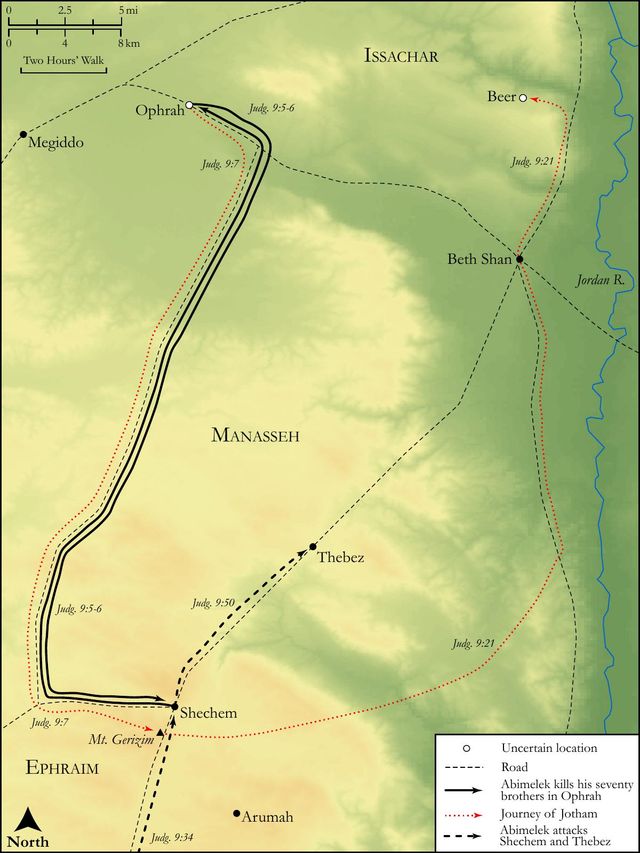
Judges 9:18 is a pivotal moment within Jotham's prophetic speech, delivered from the secure vantage point of Mount Gerizim. This speech immediately follows the horrific massacre orchestrated by Abimelech, who, with the support of the men of Shechem, brutally murdered all but one of Gideon's seventy sons at Ophrah, as recounted in Judges 9:5. Jotham, having miraculously escaped the slaughter, uses his address to expose the Shechemites' profound ingratitude and treachery towards Gideon's legacy, who had previously delivered them. The verse directly accuses them of complicity in the fratricide and the illegitimate enthronement of Abimelech, setting the stage for the prophetic curse that Jotham pronounces in the preceding parable of the trees, found in Judges 9:8-15, which subsequently unfolds throughout the rest of Judges chapter 9.
Historical & Cultural Context
Shechem was an ancient and historically significant city in central Canaan, deeply rooted in Israelite history as a place where Abraham built an altar (Genesis 12:6-7), Jacob settled (Genesis 33:18-20), and Joshua renewed the covenant (Joshua 24:1-28). During the period of the Judges, Israel lacked a centralized monarchy, and the concept of "king" was often viewed with suspicion, as Yahweh alone was considered Israel's true King. The men of Shechem, particularly the "citizens of Shechem" or "lords of Shechem" (Hebrew: ba'alei Shechem), had strong ties to the local Baal worship, specifically Baal-Berith, as mentioned in Judges 9:4, indicating a syncretistic or apostate community. The phrase "upon one stone" likely refers to a specific, perhaps cultic or public, location within Ophrah, emphasizing the public and ritualistic nature of the mass execution, designed to consolidate Abimelech's power and eliminate all rivals.
Key Themes
ShowHideThis verse powerfully contributes to several key themes within the Book of Judges. Foremost among them is the theme of betrayal and ingratitude, as the Shechemites, who had benefited from Gideon's leadership, turn against his family. It highlights the usurpation of power through violence and deceit, contrasting sharply with the divinely appointed, charismatic leadership (judgeship) that God typically raised up. The narrative also underscores the dangers of political expediency over divine principles, as the Shechemites prioritize a shallow familial connection ("because he is your brother") over justice and righteousness. Furthermore, Jotham's words serve as a prophetic warning of the inevitable consequences of such heinous acts, foreshadowing the divine judgment that would ultimately fall upon Abimelech and the men of Shechem, illustrating the principle that "what a man sows, that he will also reap," as echoed in Galatians 6:7.
Exposition and Analysis
ShowHideKey Word Analysis
ShowHideThis primitive root signifies to "smite with deadly intent," encompassing killing, murdering, and putting to death. In Judges 9:18, it underscores the deliberate and violent nature of the act committed against Gideon's sons, emphasizing that this was not accidental death but a calculated, murderous plot. The word conveys the brutality and finality of the seventy lives taken.
Derived from a root meaning "to build," ʼeben refers to a stone. Here, "upon one stone" is a chilling detail that points to a singular, perhaps prominent or even cultic, location for the mass execution. This suggests a highly organized, public, and possibly ritualistic act of extermination, rather than a chaotic slaughter. The concentration of the murders on a single stone amplifies the horror and calculated cruelty of Abimelech's actions and the Shechemites' complicity.
This term denotes a maidservant or female slave. In this context, it refers to Gideon's concubine, as mentioned in Judges 8:31. The emphasis on Abimelech being "the son of his maidservant" highlights his lesser status or potentially contested lineage compared to Gideon's other sons, who were born of legitimate wives. The Shechemites' willingness to elevate such a figure, despite his violent means, underscores their disregard for traditional or divinely sanctioned leadership in favor of political expediency and a shallow appeal to tribal kinship.
Verse Breakdown
ShowHide"And ye are risen up against my father's house this day"
Jotham begins with a direct and forceful accusation, laying the blame for the treachery squarely at the feet of the men of Shechem. "Risen up against" implies an act of rebellion, conspiracy, and violent opposition against Gideon's family, who had previously served and delivered them. The phrase "this day" emphasizes the immediacy and recency of their heinous act, bringing the gravity of their crime into sharp focus.
"and have slain his sons, threescore and ten persons, upon one stone"
This clause details the horrific crime. It specifies the staggering number of victims (seventy) and the brutal method and location of their execution ("upon one stone"). This is the core of the Shechemites' offense – their complicity in the mass murder of Gideon's sons, an act of unparalleled cruelty and betrayal that sought to eradicate Gideon's legitimate lineage.
"and have made Abimelech, the son of his maidservant, king over the men of Shechem"
This part reveals the ultimate goal and outcome of their conspiracy: the enthronement of Abimelech. The explicit mention of his lineage ("the son of his maidservant") serves to highlight the questionable legitimacy of his claim to power, contrasting him with Gideon's more legitimate heirs and underscoring the Shechemites' willingness to disregard proper succession or divine appointment for their own ends.
"because he [is] your brother;"
This final phrase exposes the cynical and shallow justification for their actions. The appeal to Abimelech's kinship (through his Shechemite mother, Gideon's concubine) is presented as the sole reason for their support. This "brotherhood" is a flimsy pretext for their complicity in murder and usurpation, revealing a warped sense of loyalty that prioritizes tribal ties over justice, righteousness, and the legacy of a true deliverer.
Literary Devices
ShowHideJotham's speech in Judges 9:18 is rich with literary devices that amplify its impact and underscore the gravity of the Shechemites' actions. The most prominent is Direct Address, as Jotham directly confronts the "men of Shechem," using the second-person plural "ye" to place the blame squarely on them. This creates an immediate, confrontational, and accusatory tone, leaving no room for ambiguity regarding culpability. The vivid imagery of "threescore and ten persons upon one stone" employs Hyperbole or intense Emphasis, graphically portraying the staggering scale and concentrated brutality of the massacre. This leaves a powerful and disturbing image in the listener's mind, highlighting the calculated cruelty. There is profound Irony in the justification "because he is your brother," given that Abimelech's first act of kingship was to murder his own brothers. This highlights the twisted morality and self-serving logic of the Shechemites, who betray true kinship for political gain. Furthermore, the entire speech, including this verse, serves as Foreshadowing, as Jotham's prophetic curse (from the parable of the trees) predicts the destructive "fire" that will consume both Abimelech and the men of Shechem, a divine judgment that indeed comes to pass later in the chapter.
Theological and Thematic Connections
ShowHideJudges 9:18 stands as a stark testament to the profound consequences of human sin, particularly the lust for power and the betrayal of covenant. Theologically, it illustrates the principle that God's justice will ultimately prevail, even when human actions are marked by profound injustice and treachery. The Shechemites' actions reflect a rejection of God's chosen deliverer (Gideon) and an embrace of a self-appointed, violent ruler, highlighting the dangers of seeking human solutions outside of divine guidance. This narrative serves as a cautionary tale against prioritizing political expediency or tribal loyalty over moral integrity and divine righteousness. It underscores the corrupting influence of unchecked ambition and the cyclical nature of sin and judgment that characterizes the period of the Judges.
Reflection and Application
ShowHideJudges 9:18 offers timeless lessons for individuals and communities grappling with issues of leadership, loyalty, and justice. It compels us to reflect on the nature of true authority, which is characterized not by seizure through violence or manipulation, but by integrity, service, and divine appointment. The Shechemites' willingness to overlook Abimelech's heinous crime for the sake of perceived political advantage or shallow kinship serves as a powerful warning against compromising moral principles for expediency. We are challenged to examine our own loyalties: are we swayed by superficial connections or self-interest, or are we committed to truth and righteousness, even when it is costly? The narrative reminds us that actions born of treachery and unrighteous ambition often lead to cycles of violence and ultimately, divine retribution. It calls us to cultivate discernment in choosing our leaders and to stand against injustice, remembering that God's justice ultimately prevails.
Questions for Reflection
ShowHideFAQ
ShowHideWho was Jotham, and why was he the one delivering this scathing rebuke?
ShowHideJotham was the youngest and only surviving son of Gideon (also known as Jerubbaal). He escaped the brutal massacre orchestrated by his half-brother, Abimelech, who murdered Gideon's other seventy sons "upon one stone," as detailed in Judges 9:5. Jotham delivered this rebuke from Mount Gerizim, a strategically elevated position overlooking Shechem, after Abimelech had been made king. His unique position as the sole survivor and a direct victim of Abimelech's treachery gave him moral authority to speak prophetically against the men of Shechem and Abimelech, exposing their wickedness and foretelling their downfall through his famous parable of the trees, found in Judges 9:7-15.
What is the significance of the phrase "upon one stone"?
ShowHideThe phrase "upon one stone" (Hebrew: 'al 'even 'echat') is highly significant. It vividly portrays the horrific, collective, and likely ritualistic nature of the execution. It suggests that the seventy sons were not killed in a chaotic skirmish but were systematically slaughtered at a single, designated location, perhaps a prominent altar or public stone in Ophrah. This detail emphasizes the calculated cruelty and public display of power intended by Abimelech and his co-conspirators. It underscores the profound brutality and the deliberate, almost ceremonial, extermination of Gideon's legitimate lineage, making the act even more heinous and memorable.
Why did the men of Shechem choose Abimelech as king, despite his violent actions and questionable lineage?
ShowHideThe men of Shechem chose Abimelech for several reasons, primarily out of political expediency and a distorted sense of loyalty. First, Abimelech appealed to their tribal ties, reminding them that he was "your brother" through his Shechemite mother, Gideon's concubine, as recorded in Judges 9:2. This familial connection likely made him seem more amenable to their local interests than Gideon's other sons. Second, Abimelech offered a clear path to power, even if it involved fratricide. The Shechemites, perhaps weary of the decentralized leadership of the Judges, desired a king, and Abimelech was willing to seize that role by any means necessary. They provided him with money from the temple of Baal-Berith, as seen in Judges 9:4, to hire mercenaries, demonstrating their active complicity and shared ambition, prioritizing their own perceived advantage over justice and righteousness.
Christ-Centered Fulfillment
ShowHideThe tragic narrative of Abimelech and the men of Shechem, culminating in Jotham's prophetic curse in Judges 9:18, serves as a profound contrast to the true King and His kingdom, ultimately pointing to Jesus Christ. Abimelech, a self-appointed king who seized power through violence, treachery, and the murder of his own seventy brothers, embodies the corrupt nature of human rule apart from God. His reign is marked by bloodshed, ambition, and ultimately, divine judgment, as the "fire" of Jotham's curse consumes both him and his conspirators, as prophesied and fulfilled in Judges 9:56-57. This stands in stark opposition to Jesus, the true King of Israel, who did not come to be served, but to serve, and to give His life as a ransom for many (Mark 10:45). Unlike Abimelech, who shed the blood of his brothers to ascend to a throne, Jesus, the perfect "brother" to humanity (Hebrews 2:11-12), willingly shed His own blood on the cross to establish a kingdom of righteousness, peace, and joy (Romans 14:17). His kingdom is not of this world, built on human power and violence (John 18:36), but on divine love and sacrificial service. The judgment that fell upon Abimelech and Shechem foreshadows the ultimate judgment on all who reject God's righteous rule and embrace the ways of the world, while Christ offers eternal life and true kingship to all who believe in Him and submit to His gracious reign (John 3:16).