


Judges 6:35
- וּמַלְאָכִיםu·mal·'a·Khimand messengersH4397Conj-w ¦ N-mpNoun Plural Masculine Absoluteוּandמַלְאָכִיםmessengers
- שָׁלַחsha·Lachhe sentH7971V-Qal-Perf-3msVerb Qal Perfect 3rd Singular Masculine
- בְּכָלbe·kholin allH3605Prep-b ¦ N-mscNoun Singular Masculine Constructבְּinכָלall
- מְנַשֶּׁהme·na·ShehManassehH4519N-proper-mNoun Proper Masculine
- וַיִזָּעֵקvai·yi·za·'Ekand it was called togetherH2199Conj-w ¦ V-Niphal-ConsecImperf-3msVerb Niphal Consecutive Imperfect 3rd Singular Masculineוַandיִזָּעֵקit was called together
- גַּםgamalsoH1571AdvAdverb
- הוּאhu'itH1931Pro-3msPronoun Personal 3rd Singular Masculine
- אַחֲרָיו'a·cha·Ravafter himH310Adj-mpc ¦ 3msAdjective Numerical Plural Masculine Constructאַחֲרָיafterוhim
- וּמַלְאָכִיםu·mal·'a·Khimand messengersH4397Conj-w ¦ N-mpNoun Plural Masculine Absoluteוּandמַלְאָכִיםmessengers
- שָׁלַחsha·Lachhe sentH7971V-Qal-Perf-3msVerb Qal Perfect 3rd Singular Masculine
- בְּאָשֵׁרbe·'a·Sherin AsherH836Prep-b ¦ N-proper-mNoun Proper MasculineבְּinאָשֵׁרAsher
- וּבִזְבֻלוּןu·viz·vu·Lunand in ZebulunH2074Conj-w ¦ Prep-b ¦ N-proper-mNoun Proper MasculineוּandבִinזְבֻלוּןZebulun
- וּבְנַפְתָּלִיu·ve·naf·ta·Liand in NaphtaliH5321Conj-w ¦ Prep-b ¦ N-proper-mNoun Proper MasculineוּandבְinנַפְתָּלִיNaphtali
- וַיַּעֲלוּvai·ya·'a·Luand they went upH5927Conj-w ¦ V-Qal-ConsecImperf-3mpVerb Qal Consecutive Imperfect 3rd Plural Masculineוַandיַּעֲלוּthey went up
- לִקְרָאתָםlik·ra·Tamto meet themH7122Prep-l ¦ V-Qal-Inf ¦ 3mpVerb Qal Infinitive Constructלִtoקְרָאתָmeetםthem
English is a literal word-by-word gloss of the Hebrew, not the KJV's wording. Why?
This is the original text the KJV's translators worked from — each Hebrew word with its own literal English meaning in this verse, prepared by scholars at Tyndale House, Cambridge. The KJV translates whole sentences, not word by word, so its wording differs: one Hebrew word can become several English words, and the KJV may choose “the LORD” where the gloss reads “Yahweh”. Both are faithful — they answer different questions. For the KJV's own rendering, switch to the KJV text.
Details
See on the biblical-era map

Study this verse
Public-domain commentary
Matthew Henry
From his Commentary on the Whole Bible. Henry comments on passages, not single verses — this entry covers Judges 6:33–40. His three-level outline is real structure in the source text, so it is rendered as structure.
Here we have, I. The descent which the enemies of Israel made upon them, Jdg 6:33. A vast number of Midianites, Amalekites, and Arabians, got together, and came over Jordan, none either caring or daring to guard that important and advantageous pass against them, and they made their headquarters in the valley of Jezreel, in the heart of Manasseh's tribe, not far from Gideon's city. Some think that the notice they had of Gideon's destroying Baal's altar brought them over, and that they came to plead for Baal and to make that a pretence for quarrelling with Israel; but it is more likely that it was now harvest-time, when they had been wont each year to make such a visit as this (Jdg 6:3), and that they were expected when Gideon was threshing, Jdg 6:11. God raised up Gideon to be ready against this terrible blow came. Their success so many years in these incursions, the little opposition they had met with and the great booty they had carried off, made them now both very eager and very confident. But it proved that the measure of their iniquity was full and the year of recompence had come; they must now make an end to spoil and must be spoiled, and they are gathered as sheaves to the floor (Mic 4:12, Mic 4:13), for Gideon to thresh.
II.The preparation which Gideon makes to attack them in their camp, Jdg 6:34, Jdg 6:35.
1.God by his Spirit put life into Gideon: The Spirit of the Lord clothes Gideon (so the word is), clothed him as a robe, to put honour upon him, clothed him as a coat of mail, to put defence upon him. Those are well clad that are thus clothed. A spirit of fortitude from before the Lord clothed Gideon; so the Chaldee. He was of himself a mighty man of valour; yet personal strength and courage, though vigorously exerted, would not suffice for this great action; he must have the armour of God upon him, and this is what he must depend upon: The Spirit of the Lord clothed him in an extraordinary manner. Whom God calls to his work he will qualify and animate for it.
2.Gideon with his trumpet put life into his neighbours, God working with him; he blew a trumpet, to call in volunteers, and more came in than perhaps he expected.
(1.)The men of Abiezer, though lately enraged against him for throwing down the altar of Baal, and though they had condemned him to death as a criminal, were now convinced of their error, bravely came in to his assistance, and submitted to him as their general: Abiezer was gathered after him, Jdg 6:34. So suddenly can God turn the hearts even of idolaters and persecutors.
(2.)Distant tribes, even Asher and Naphtali, which lay most remote, though strangers to him, obeyed his summons, and sent him in the best of their forces, Jdg 6:35. Though they lay furthest from the danger, yet, considering that if their neighbours were over-run by the Midianites their own turn would be next, they were forward to join against a common enemy.
III.The signs which God gratified him with, for the confirming both of his own faith and that of his followers; and perhaps it was more for their sakes than for his own that he desired them. Or, perhaps, he desired by these to be satisfied whether this was the time of his conquering the Midianites, or whether he was to wait for some other opportunity. Observe,
1.His request for a sign (Jdg 6:36, Jdg 6:37): "Let me by this know that thou wilt save Israel by my hand, let a fleece of wool, spread in the open air, be wet with the dew, and let the ground about it be dry." The purport of this is, Lord, I believe, help thou my unbelief. He found his own faith weak and wavering, and therefore begged of God by this sign to perfect what was lacking in it. We may suppose that God, who intended to give him these signs, for the glorifying of his own power and goodness, put it into his heart to ask them. Yet, when he repeated his request for a second sign, the reverse of the former, he did it with a very humble apology, deprecating God's displeasure, because it looked so like a peevish humoursome distrust of God and dissatisfaction with the many assurances he had already given him (Jdg 6:39): Let not thy anger be hot against me. Though he took the boldness to ask another sign, yet he did it with such fear and trembling as showed that the familiarity God had graciously admitted him to did not breed any contempt of God's glory, nor presumption on God's goodness. Abraham had given him an example of this, when God gave him leave to be very free with him (Gen 18:30, Gen 18:32), O let not the Lord be angry, and I will speak. God's favour must be sought with great reverence, a due sense of our distance, and a religious fear of his wrath.
2.God's gracious grant of his request. See how tender God is of true believers though they be weak, and how ready to condescend to their infirmities, that the bruised reed may not be broken nor the smoking flax quenched. Gideon would have the fleece wet and the ground dry; but then, lest any should object, "It is natural for wool, if ever so little moisture fall, to drink it in and retain it, and therefore there was nothing extraordinary in this," though the quantity wrung out was sufficient to obviate such an objection, yet he desires that next night the ground might be wet and the fleece dry, and it is done, so willing is God to give to the heirs of promise strong consolation (Heb 6:17, Heb 6:18), even by two immutable things. He suffers himself, not only to be prevailed with by their importunities, but even to be prescribed to by their doubts and dissatisfactions. These signs were,
(1.)Truly miraculous, and therefore abundantly serving to confirm his commission. It is said of the dew that it is from the Lord, and tarrieth not for man, nor waiteth for the sons of men (Mic 5:7); and yet God here in this matter hearkened to the voice of a man; as to Joshua, in directing the course of the sun, so to Gideon in directing that of the dew, by which it appears that it falls not by chance, but by providence. The latter sign inverted the former, and, to please Gideon, it was wrought backward and forward, whence Dr. Fuller observes that heaven's real miracles will endure turning, being inside and outside both alike.
(2.)Very significant. He and his men were going to engage the Midianites; could God distinguish between a small fleece of Israel and the vast floor of Midian? Yes, by this he is made to know that he can. Is Gideon desirous that the dew of divine grace might descend upon himself in particular? He sees the fleece wet with dew to assure him of it. Does he desire that God will be as the dew to all Israel? Behold, all the ground is wet. Some make this fleece an emblem of the Jewish nation, which, when time was, was wet with the dew of God's word and ordinances, while the rest of the world was dry; but since the rejection of Christ and his gospel they are dry as the heath in the wilderness, while the nations about are as a watered garden.
Continue studying Judges 6:35 across the web’s major study libraries — every link below opens this exact verse, chapter, or book on the destination site.
Read & Compare
 BibleGatewayThis verse in more than 200 translations and 70 languages.
 Bible.comThe YouVersion reader — hundreds of translations, reading plans, and highlights.
 ESV.orgCrossway's official English Standard Version reader.
 NET BibleThe NET translation with 60,000+ translators' notes on every rendering decision.
 STEP BibleTyndale House's free study tool — original text, vocabulary, and scholarly resources.
 BibliaLogos Bible Software's free web reader.
 USCCBThe New American Bible (Revised Edition) with the U.S. bishops' study notes.
Commentaries
 BibleHub CommentariesDozens of classic commentaries on this verse, gathered on one page.
 StudyLightMore than 100 commentary sets — the largest collection on the web.
 BibleRefPlain-English commentary on what this verse means, verse by verse.
 Enduring WordDavid Guzik's free commentary on this chapter, widely used by Bible teachers.
 Bible Study ToolsVerse commentary alongside Greek and Hebrew study aids.
Original Language & Research
- BibleHub InterlinearThe verse word by word — original language, transliteration, and English.
- BibleHub LexiconEvery word's original-language definition and Strong's entry.
 Blue Letter BibleDeep-study tools — Strong's numbers, concordance, and word studies.
 SefariaThe Hebrew text with Rashi and centuries of Jewish commentary.
Sermons, Hymns & Audio


TrulyRandomVerse is not affiliated with these sites and doesn’t control their content. They’re linked because they’re genuinely useful.
Summary
Judges 6:35 describes Gideon's decisive action to mobilize the northern tribes of Israel—Manasseh, Asher, Zebulun, and Naphtali—in direct response to the Spirit of the Lord empowering him. This verse marks a pivotal transition from Gideon's initial doubts and divine commissioning to his active leadership, demonstrating his obedience and the immediate, unified response of the people in preparing for battle against their Midianite oppressors.
Context
ShowHideLiterary Context
This verse immediately follows Judges 6:34, a crucial moment where "the Spirit of the Lord clothed Gideon." This divine empowerment is presented as the direct catalyst for Gideon's subsequent actions, transforming him from a hesitant individual into a decisive leader. Prior to this, Gideon had been called by God (see Judges 6:11-16), expressed significant doubts about his own capabilities and his family's standing, and sought confirmation through miraculous signs, including the divine consumption of his offering (see Judges 6:17-21). He had also, by divine command, torn down his father's altar to Baal and built an altar to the Lord, earning him the name Jerubbaal (see Judges 6:25-32). Thus, Judges 6:35 represents the tangible, human response to divine initiative and empowerment, setting the stage for the dramatic confrontation with the Midianites described in Judges 7.
Historical & Cultural Context
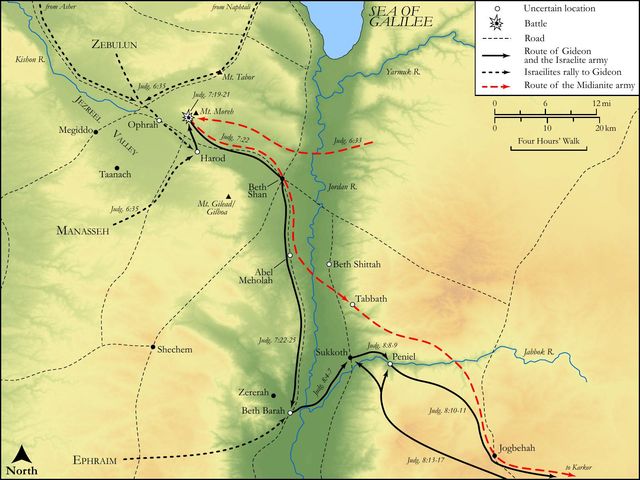
The period of the Judges (roughly 12th-11th centuries BC) was characterized by a cyclical pattern of Israelite apostasy, divine judgment through foreign oppression, the people's cry for help, and God raising up a deliverer (a "judge"). At this time, Israel was suffering under severe oppression from the Midianites, Amalekites, and "the children of the east" for seven years (see Judges 6:1-6). These nomadic raiders would sweep into the land after harvest, destroying crops and livestock, leaving Israel impoverished and hiding in caves. Israel was not a unified kingdom but a loose confederacy of tribes, often acting independently. Gideon's ability to rally multiple tribes—Manasseh (his own tribe, located in central Israel), Asher (northwest), Zebulun (north), and Naphtali (northeast)—demonstrates a significant feat of leadership and a rare moment of inter-tribal cooperation against a common enemy. Messengers were the primary means of communication for mobilizing forces in ancient Near Eastern societies, making Gideon's widespread dispatch a critical and effective strategy for national defense.
Key Themes
ShowHideThis verse powerfully illustrates several key themes within the book of Judges and the broader biblical narrative. Firstly, it highlights the theme of divine empowerment leading to human action. Gideon's decisive mobilization is not born of his own strength or courage but is a direct consequence of the Spirit of the Lord "clothing" him, enabling him to step into his divinely appointed role. Secondly, it underscores the theme of leadership and obedience. Despite his earlier hesitations and requests for signs, Gideon now acts as a proactive leader, obeying the divine call to deliver Israel. His willingness to send messengers and the tribes' positive response demonstrate a crucial moment of national obedience and trust in God's chosen deliverer. Finally, the verse emphasizes the theme of unity and national mobilization in the face of oppression. For Israel to effectively resist the Midianites, inter-tribal unity was essential. Gideon's successful call to arms signifies a critical step towards forming a cohesive front, demonstrating that God often works through the collective, unified efforts of His people to achieve His purposes, as seen in the broader narrative of Judges.
Exposition and Analysis
ShowHideKey Word Analysis
ShowHideThis Hebrew verb (H7971) means "to send away, for, or out." Its repeated use in this verse emphasizes the deliberate, intentional, and widespread nature of Gideon's actions. It signifies a proactive and authoritative command, not a hesitant request. The act of sending messengers was a formal and recognized method for rallying troops in ancient warfare, indicating Gideon's assumption of his leadership role with divine backing.
This Hebrew verb (H2199) primarily means "to shriek" or "to cry out," but by analogy, it also means "to announce or convene publicly" or "to assemble." In the context of "who also was gathered after him," it conveys a willing and prompt assembly of the tribal forces. This suggests that Gideon's authority, now clearly under divine inspiration, was recognized, and the urgency of the situation was understood, leading to an immediate and unified response from the people of Manasseh as if in response to a public proclamation.
This Hebrew verb (H5927) means "to ascend" or "to come up." The phrase "they came up to meet them" indicates an active and affirmative response from the tribes of Asher, Zebulun, and Naphtali. It implies their eager readiness to join Gideon's cause and participate in the impending conflict, signifying their physical movement and ascent from their territories to rally with Gideon's forces, demonstrating a national resolve to confront the Midianite oppressors.
Verse Breakdown
ShowHide"And he sent messengers throughout all Manasseh;"
This clause describes Gideon's immediate and strategic first step. Recognizing his own tribal affiliation, Gideon begins by mobilizing his own people, the clan of Abiezer within Manasseh. This is a natural and expected starting point for a leader seeking to rally support. The act of sending messengers indicates a formal and urgent call to arms, demonstrating Gideon's initiative after being empowered by the Spirit.
"who also was gathered after him:"
This highlights the positive and unified response from the tribe of Manasseh. The phrase "gathered after him" denotes their allegiance and willingness to follow Gideon's leadership. This swift assembly confirms the effectiveness of Gideon's call and the people's readiness to participate in the deliverance, likely bolstered by the recent signs of God's favor upon Gideon (e.g., the destruction of Baal's altar and the Spirit's anointing).
"and he sent messengers unto Asher, and unto Zebulun, and unto Naphtali;"
This expands the scope of Gideon's mobilization beyond his immediate tribal base. By sending messengers to these northern tribes, Gideon demonstrates a broader vision for national unity and a comprehensive counter-offensive. These tribes were geographically located in areas heavily impacted by the Midianite incursions, making their participation crucial for a strong, unified front against the oppressors.
"and they came up to meet them."
This final clause confirms the successful outcome of Gideon's extended call. The active phrase "came up to meet them" signifies that these tribes did not merely acknowledge the message but actively moved to join Gideon's forces. Their response underscores the widespread desire for liberation and the recognition of Gideon as God's chosen deliverer, demonstrating a remarkable display of inter-tribal cooperation in a period often marked by disunity.
Literary Devices
ShowHideThe verse employs several literary devices to convey its message effectively. Repetition is prominent with the phrase "sent messengers," which appears twice. This repetition emphasizes the deliberate, widespread, and systematic nature of Gideon's mobilization efforts. It underscores the urgency and the strategic importance of communicating the call to arms across multiple tribal territories. The use of Synecdoche or Metonymy is evident as the names "Manasseh," "Asher," "Zebulun," and "Naphtali" represent not merely geographical regions but the people and warriors of those respective tribes. This shorthand efficiently conveys the broad scope of the national rally. Furthermore, the language is highly action-oriented, utilizing strong verbs such as "sent," "gathered," and "came up to meet." This dynamic verb usage creates a sense of immediate response and decisive movement, reflecting the urgent nature of the situation and the transition from divine empowerment to human activity.
Theological and Thematic Connections
ShowHideJudges 6:35 serves as a powerful illustration of how divine empowerment (as seen in Judges 6:34) directly leads to human action and responsibility. Gideon's transformation from a hesitant individual to a decisive leader, capable of rallying an entire nation, is a testament to God's ability to equip and enable those He calls. This verse highlights the critical interplay between God's sovereign initiative and humanity's obedient response. It also underscores the importance of unity among God's people in fulfilling His purposes, demonstrating that collective action, spurred by divine anointing, is often necessary to overcome significant challenges and bring about God's deliverance.
Reflection and Application
ShowHideJudges 6:35 offers profound insights for contemporary believers. It reminds us that God's empowerment is not passive; it is given for a purpose—to enable us to act in faith and courage. Just as the Spirit "clothed" Gideon, empowering him for a seemingly insurmountable task, so too does the Holy Spirit indwell and equip believers today for their unique callings and ministries. When God calls, He also enables, and our part is to respond with obedience and decisive action, even when the task seems daunting. Furthermore, this verse highlights the vital importance of unity within the body of Christ. Gideon's success in mobilizing diverse tribes underscores that collective strength and shared purpose are essential for effective spiritual warfare and for advancing God's kingdom. We are called to lay aside tribalism and personal agendas, coming together under divine leadership to confront the spiritual challenges of our time. Our response to God's empowering presence should be one of active participation, seeking to unite with fellow believers to fulfill the mission He has entrusted to us, recognizing that God often works through our collective obedience.
Questions for Reflection
ShowHideFAQ
ShowHideWhy did Gideon only call these specific tribes (Manasseh, Asher, Zebulun, Naphtali)?
ShowHideGideon likely focused on these northern tribes for strategic and practical reasons. His own tribe, Manasseh, was a natural starting point for rallying support. Asher, Zebulun, and Naphtali were geographically adjacent to Manasseh and were also in the northern regions of Israel, making them directly exposed to and heavily impacted by the Midianite incursions that came from the east. Their proximity and shared suffering made them logical and accessible allies for an immediate mobilization. While other tribes like Ephraim later joined (see Judges 7:24), Gideon's initial call was pragmatic, targeting those most directly affected and readily available for a swift response against the immediate threat.
What does "gathered after him" imply about the tribes' response to Gideon?
ShowHideThe phrase "gathered after him" implies a willing, prompt, and unified response from the tribes. It suggests that Gideon's authority, now clearly recognized as divinely sanctioned (especially after the Spirit "clothed" him in Judges 6:34 and his earlier act of destroying Baal's altar in Judges 6:27), was accepted. The people were eager to rally behind a leader who offered hope for deliverance from the severe Midianite oppression. This immediate assembly indicates a strong sense of national urgency and a collective desire for liberation, demonstrating their trust in Gideon as God's chosen deliverer.
Christ-Centered Fulfillment
ShowHideGideon, as a deliverer raised up by God, foreshadows the ultimate Deliverer, Jesus Christ. Just as the Spirit of the Lord "clothed" Gideon, empowering him for a specific mission to rescue Israel from physical oppression, so too was Jesus fully empowered by the Holy Spirit for His mission of cosmic deliverance. From His baptism (see Matthew 3:16) to His ministry of healing and teaching, Jesus acted under the full anointing of the Spirit, fulfilling the prophecy in Luke 4:18-19. Gideon's call to the tribes to "gather after him" finds its ultimate fulfillment in Jesus' call to His disciples to "follow me" (see Matthew 4:19), gathering a new spiritual Israel—the church—into a unified body. Unlike Gideon, who gathered an army for a physical battle, Jesus gathers a people for a spiritual war against sin, death, and the powers of darkness, triumphing over them on the cross (see Colossians 2:15). The unity Gideon sought among the tribes is perfectly realized in the church, the body of Christ, where believers from every tribe and nation are brought together by the Spirit (see Ephesians 4:3-6) to participate in Christ's ongoing mission of redemption and reconciliation until His glorious return.