


Joshua 9:8
Bible text: King James Version (1769 Blayney text) · Public domain
Bible text: Berean Standard Bible · Public domain
Bible text: American Standard Version (1901) · Public domain
Bible text: World English Bible, Messianic edition · Public domain
Bible text: Geneva Bible (1599) · Public domain
Bible text: Young's Literal Translation · Public domain
- וַיֹּאמְרוּvai·yo·me·Ruand they saidH559Conj-w ¦ V-Qal-ConsecImperf-3mpVerb Qal Consecutive Imperfect 3rd Plural Masculineוַandיֹּאמְרוּthey said
- אֶל'eltoH413PrepPreposition
- יְהוֹשֻׁעַye·ho·Shu·a'JoshuaH3091N-proper-mNoun Proper Masculine
- עֲבָדֶיךָ'a·va·Dei·kha[are] your servantsH5650N-mpc ¦ 2msNoun Plural Masculine Constructעֲבָדֶי[are] servantsךָyour
- אֲנָחְנוּ'a·Na·che·nuweH587Pro-1cpPronoun Personal 1st Plural common gender
- וַיֹּאמֶרvai·Yo·merand he saidH559Conj-w ¦ V-Qal-ConsecImperf-3msVerb Qal Consecutive Imperfect 3rd Singular Masculineוַandיֹּאמֶרhe said
- אֲלֵהֶם'a·le·Hemto themH413Prep ¦ 3mpPreposition Definiteאֲלֵtoהֶםthem
- יְהוֹשֻׁעַye·ho·Shu·a'JoshuaH3091N-proper-mNoun Proper Masculine
- מִיmiwho?H4310InterrogPronoun Interrogative
- אַתֶּם'a·Tem[are] youH859Pro-2mpPronoun Personal 2nd Plural Masculine
- וּמֵאַיִןu·me·'A·yinand from where?H370Conj-w ¦ Prep-m ¦ InterrogParticle Interrogativeוּandמֵfromאַיִןwhere?
- תָּבֹאוּta·Vo·'udo you comeH935V-Qal-Imperf-2mpVerb Qal Imperfect 2nd Plural Masculine
English is a literal word-by-word gloss of the Hebrew, not the KJV's wording. Why?
This is the original text the KJV's translators worked from — each Hebrew word with its own literal English meaning in this verse, prepared by scholars at Tyndale House, Cambridge. The KJV translates whole sentences, not word by word, so its wording differs: one Hebrew word can become several English words, and the KJV may choose “the LORD” where the gloss reads “Yahweh”. Both are faithful — they answer different questions. For the KJV's own rendering, switch to the KJV text.
Details
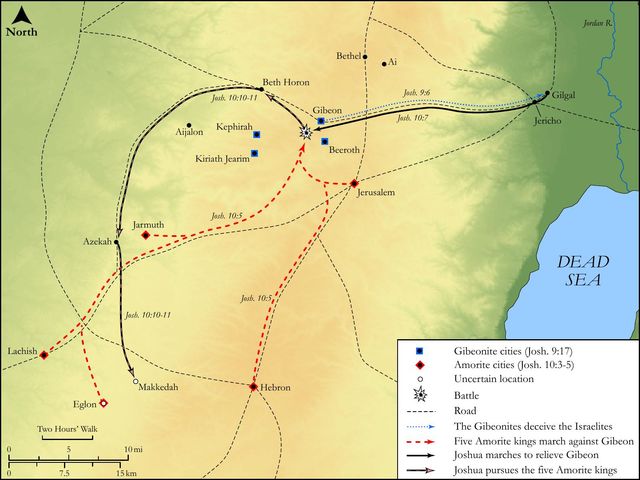
See on the biblical-era map
Study this verse
Public-domain commentary
Matthew Henry
From his Commentary on the Whole Bible. Henry comments on passages, not single verses — this entry covers Joshua 9:3–14. His four-level outline is real structure in the source text, so it is rendered as structure.
Here, I. The Gibeonites desire to make peace with Israel, being alarmed by the tidings they heard of the destruction of Jericho, Jos 9:3. Other people heard those tidings, and were irritated thereby to make war upon Israel; but the Gibeonites heard them and were induced to make peace with them. Thus the discovery of the glory and grace of God in the gospel is to some a savour of life unto life, but to others a savour of death unto death, Co2 2:16. The same sun softens wax and hardens clay. I do not remember that we read any where of a king of Gibeon. Had their government been at this time in a single person, perhaps his heart would have been too high to yield to Israel, and he would have joined with the rest of the kings against Israel. But these four united cities (mentioned Jos 9:17) seem to have been governed by elders, or senators (Jos 9:11), who consulted the common safety more than their own personal dignity. The inhabitants of Gibeon did well for themselves. We have,
II.The method they took to compass it.
They knew that all the inhabitants of the land of Canaan were to be cut off; perhaps they had some spies in the congregation at Ebal, when the law was read, who observed and brought them notice of the command given to Israel (Deu 7:1-3), that they should show no mercy to the Canaanites, give them no quarter in battle, which made them afraid of fighting them, and that they should make no covenant with them, which made them despair of gaining any advantage by treating with them; and therefore there was no way of saving their lives from the sword of Israel unless they could, by disguising themselves, make Joshua believe that they came from some very country, which the Israelites were not commanded to make war upon nor forbidden to make peace with, but were particularly appointed to offer peace to, Deu 20:10, Deu 20:15. Unless they could be admitted under this notion, they saw there was but one way with them: they must submit to the fate of Jericho and Ai. Though the neighbouring princes knew that all the men thereof were mighty (Jos 10:2), and they knew it themselves, yet they durst not contend with Israel, who had an Almighty God on their side. This therefore is the only game they have to play, and observe,
1.They play it very artfully and successfully. Never was any such thing more craftily managed.
(1.)They come under the character of ambassadors from a foreign state, which they thought would please the princes of Israel, and make them proud of the honour of being courted by distant countries: we find Hezekiah fond of those that came to him from a far country (Isa 39:3); they were not used to be thus courted.
(2.)They pretended to have undergone the fatigues of a very long journey, and produced what passed for an ocular demonstration of it. It should seem it was then usual for those that undertook long journeys to take with them, as we do now for long voyages, all manner of provision in kind, the country not being furnished as ours is now with houses of entertainment, for the convenience of which, when we have occasion to make use of them, we have reason to be very thankful. Now they here pretended that their provision, when they brought it from home, was fresh and new, but now it appeared to be old and dry, whereas it might well be presumed they had not loitered, but made the best of their way; so that hence it must be inferred that they came, as they said they did, from a very far country: their sacks or portmanteaus were old; the wine was all drunk, and the bottles in which it had been were broken; their shoes and clothes were worse than those of the Israelites in forty years, and their bread was mouldy, Jos 9:4, Jos 9:5, and again, Jos 9:12, Jos 9:13. Thus God's Israel have often been deceived and imposed upon with a show of antiquity. But (as bishop Hall expresses it) errors are never the older for being patched, and so seeming old; but those that will be caught with this Gibeonitish stratagem prove they have not consulted with God. And thus there are those who make themselves poor with the badges of want and distress and yet have great riches (Pro 13:7), or at least have no need of relief, by which fraud charity is misplaced and diverted from those that are real objects of it.
(3.)When they were suspected, and more strictly examined as to whence they came, they industriously declined telling the name of their country, till the agreement was settled. [1.] The men of Israel suspected a fraud (Jos 9:7): "Peradventure you dwell among us, and then we may not, we must not, make any league with you." This might have discouraged the Gibeonites from urging the matter any further, concluding that if the peace were made the Israelites would not think themselves obliged to keep it, having thus solemnly protested against it in case they dwelt among them; but, knowing that there was no hope at all if they stood it out, they bravely ventured a submission. "Who knows but the people of Israel may save us alive, though thus inveigled into a promise; and if we tell them at last we shall but die." [2.] Joshua put the questions to them, Who are you? and whence come you? He finds himself concerned to stand upon his guard against secret fraud as well as against open force. We in our spiritual warfare must stand against the wiles of the devil, remembering he is a subtle serpent as well as a roaring lion. In all leagues of relation and friendship we must first try and then trust, lest we repent at leisure agreements made in haste. [3.] They would not tell whence they came; but still repeat the same thing: We have come from a very far country, Jos 9:9. They will have it thought that it is a country Joshua knows nothing of nor ever heard of, and therefore would be never the wiser if they should tell him the name of it.
(4.)They profess a respect for the God of Israel, the more to ingratiate themselves with Joshua, and we charitably believe they were sincere in this profession: "We have come because of the name of the Lord thy God (v. 9), because of what we have heard of that name, which has convinced us that it is above every name, and because we have a desire towards that name and the remembrance of it, and would gladly come under its protection."
(5.)They fetch their inducements from what had been done some time before in Moses's reign, the tidings whereof might easily be supposed ere this to have reached distant regions, the plagues of Egypt and the destruction of Sihon and Og (v. 9, 10), but prudently say nothing of the destruction of Jericho and Ai (though this was the true inducement, v. 3), because they will have it supposed that they came from home long before those conquests were made. We need not be long to seek for reasons why we should submit to the God of Israel; we may be furnished either with new or old, which we will.
(6.)They make a general submission - We are our servants; and humbly sue for a general agreement - Make a league with us, v. 11. They insist not upon terms, but will be glad of peace upon any terms; nor will the case admit of delays, lest the fraud be discovered; they would fain have the bargain struck up immediately; if Joshua will but make a league with them, they have all they come for, and they hope their ragged clothes and clouted shoes will be no exception against them. God and Israel reject none for their poverty. But,
2.There is a mixture of good and evil in their conduct.
(1.)Their falsehood cannot be justified, nor ought it to be drawn into a precedent. We must not do evil that good may come. Had they owned their country but renounced the idolatries of it, resigning the possession of it to Israel and themselves to the God of Israel, we have reason to think Joshua would have been directed by the oracle of God to spare their lives, and they needed not to have made these pretensions. It is observable that when they had once said, We have come from a far country (Jos 9:6), they found themselves necessitated to say it again (Jos 9:9), and to say what was utterly false concerning their bread, their bottles, and their clothes (Jos 9:12, Jos 9:13), for one lie is an inlet to another, and that to a third, and so on. The way of that sin is down-hill. But,
(2.)Their faith and prudence are to be greatly commended. Our Lord commended even the unjust steward, because he had done wisely and well for himself, Luk 16:8. In submitting to Israel, they submitted to the God of Israel, which implied a renunciation of the god they had served, a resignation to the laws of true religion. They had heard enough to convince them of the infinite power of the God of Israel, and thence might infer his other perfections of wisdom and goodness; and how can we do better for ourselves than surrender at discretion to infinite wisdom, and cast ourselves upon the mercy of a God of infinite goodness. The submission of these Gibeonites was the more laudable because it was,
[1.]Singular. Their neighbours took another course, and expected they should join with them.
[2.]Speedy. They did not stay till Israel had besieged their cities; then it would have been too late to capitulate; but when they were at some distance they desired conditions of peace. Thy way to avoid a judgment is to meet it by repentance. Let us imitate these Gibeonites, and make our peace with God in the rags of humiliation, godly sorrow, and mortification, so our iniquity shall not be our ruin. Let us be servants to Jesus, our blessed Joshua, and make a league with him and the Israel of God, and we shall live.
Continue studying Joshua 9:8 across the web’s major study libraries — every link below opens this exact verse, chapter, or book on the destination site.
Read & Compare
 BibleGatewayThis verse in more than 200 translations and 70 languages.
 Bible.comThe YouVersion reader — hundreds of translations, reading plans, and highlights.
 ESV.orgCrossway's official English Standard Version reader.
 NET BibleThe NET translation with 60,000+ translators' notes on every rendering decision.
 STEP BibleTyndale House's free study tool — original text, vocabulary, and scholarly resources.
 BibliaLogos Bible Software's free web reader.
 USCCBThe New American Bible (Revised Edition) with the U.S. bishops' study notes.
Commentaries
 BibleHub CommentariesDozens of classic commentaries on this verse, gathered on one page.
 StudyLightMore than 100 commentary sets — the largest collection on the web.
 BibleRefPlain-English commentary on what this verse means, verse by verse.
 Enduring WordDavid Guzik's free commentary on this chapter, widely used by Bible teachers.
 Bible Study ToolsVerse commentary alongside Greek and Hebrew study aids.
Original Language & Research
- BibleHub InterlinearThe verse word by word — original language, transliteration, and English.
- BibleHub LexiconEvery word's original-language definition and Strong's entry.
 Blue Letter BibleDeep-study tools — Strong's numbers, concordance, and word studies.
 SefariaThe Hebrew text with Rashi and centuries of Jewish commentary.
Sermons, Hymns & Audio


TrulyRandomVerse is not affiliated with these sites and doesn’t control their content. They’re linked because they’re genuinely useful.
Summary
Joshua 9:8 captures a pivotal moment in the Gibeonites' elaborate deception of Israel's leaders. Following Israel's formidable, divinely-empowered victories over Jericho and Ai, the Gibeonites, unlike other Canaanite nations preparing for direct conflict, shrewdly opted for an intricate ruse. They feigned a long journey from a distant land, presenting themselves as weary travelers seeking a covenant. This verse records their immediate declaration of servanthood to Joshua, met by his initial, yet ultimately insufficient, probing questions regarding their identity and origin. This exchange critically sets the stage for a covenant made without the indispensable consultation of the Lord, leading to significant and lasting consequences for Israel.
Context
ShowHideLiterary Context
This verse is strategically positioned immediately after Israel's decisive and divinely-assisted victories over Jericho, as detailed in Joshua 6, and Ai, recounted in Joshua 8. The widespread fear of Israel had permeated throughout Canaan, prompting other kings to forge a united front against them, as described in Joshua 9:1-2. However, the Gibeonites, a Hivite people, chose a radically different and cunning strategy: deception. They meticulously presented themselves as weary travelers from a very distant land, fabricating evidence with worn-out clothes, mended wineskins, and stale bread to substantiate their elaborate story. Joshua's questions in Joshua 9:8 represent his initial, cautious response to their unexpected appearance and audacious claims, serving as a prelude to the fateful decision by the Israelite leaders to make a treaty with them without consulting the Lord, a critical oversight highlighted in Joshua 9:14.
Historical & Cultural Context
Among the nations round about, the formation of treaties and covenants constituted the bedrock of political, social, and military relations. Such agreements typically involved solemn rituals, binding oaths, and often, the invocation of deities, with their validity frequently contingent upon the identity, status, and geographical origin of the involved parties. Crucially, God had issued explicit and repeated commands to Israel to utterly destroy the inhabitants of Canaan and to make no covenant with them, as articulated in Deuteronomy 7:1-2. The Gibeonites' pretense of being from a "very distant land" was a calculated and vital component of their ruse, as it would theoretically exempt them from this divine command. Israel was, in fact, permitted to make treaties with nations situated outside the immediate boundaries of Canaan, as outlined in Deuteronomy 20:10-15. Their immediate declaration of "We are thy servants" was a culturally astute maneuver, positioning themselves as humble, non-threatening supplicants, thereby making a treaty appear as an act of mercy rather than a direct violation of divine law.
Key Themes
ShowHideJoshua 9:8 contributes profoundly to several overarching themes evident throughout the book of Joshua and the broader Old Testament narrative. The most prominent theme is Deception and Cunning, vividly exemplified by the Gibeonites' elaborate ruse designed to preserve their lives by circumventing God's explicit command for the destruction of the Canaanites, a directive reiterated in passages like Deuteronomy 20:16-18. This verse also sharply highlights the theme of Initial Caution vs. Ultimate Failure of Discernment. While Joshua's probing questions demonstrate a commendable degree of skepticism and prudence, the subsequent and critical failure of the Israelite leaders to seek the Lord's divine counsel before making a binding covenant, as underscored in Joshua 9:14, powerfully emphasizes the paramount importance of divine wisdom over mere human prudence. The passage thus functions as a potent reminder of the severe Consequences of Disobedience and the absolute necessity of Seeking God's Counsel in all matters, especially when appearances are misleading or intentions are veiled.
Exposition and Analysis
ShowHideKey Word Analysis
ShowHideA primitive root meaning "to say (used with great latitude)." This verb marks the initiation of dialogue, signifying both the Gibeonites' calculated declaration and Joshua's subsequent probing. In this context, it highlights the verbal exchange as the primary vehicle for the Gibeonites' deception and Joshua's attempt at discernment. The act of "saying" here is not merely communication but a strategic move in a high-stakes negotiation, revealing intent and eliciting response.
Meaning "a servant; bondage, bondman, (bond-) servant, (man-) servant." This term, used by the Gibeonites, is a deliberate choice to convey humility and submission. While it literally denotes a state of subservience or even slavery, in this diplomatic context, it functions as a plea for peace and protection, signaling a willingness to enter into a subordinate, non-threatening relationship. Their immediate declaration of being "thy servants" was designed to disarm Joshua and present themselves as humble supplicants rather than formidable enemies.
Meaning "where? (only in connection with prepositional prefix, whence)." This interrogative adverb is central to Joshua's second crucial question, "and from whence come ye?". It directly challenges the Gibeonites' fabricated narrative of originating from a "very distant land." Ascertaining their true geographical origin was paramount, as it would determine whether they were among the Canaanite nations Israel was commanded to dispossess or those with whom a treaty was permissible under Mosaic Law.
Verse Breakdown
ShowHide"And they said unto Joshua, We [are] thy servants"
This opening statement by the Gibeonites is a meticulously calculated act of humility, submission, and strategic communication. By immediately positioning themselves as "servants" (ʻebed), they aimed to disarm Joshua's suspicions and circumvent the immediate hostility that would typically be directed at any perceived Canaanite enemy. This declaration was designed to bypass Israel's guard and initiate a dialogue under the guise of seeking peace and protection from a supposedly distant land, thereby setting the intricate stage for their elaborate deception. It was a masterstroke of diplomacy, tailored to appeal to a sense of mercy and avoid direct confrontation.
"And Joshua said unto them, Who [are] ye?"
Joshua's immediate response demonstrates a necessary, albeit ultimately insufficient, caution and a keen awareness of the strategic implications. This direct question is a fundamental inquiry into their identity, seeking to ascertain their tribal or national affiliation. Given the divine commands regarding the inhabitants of Canaan—specifically, the prohibition against making covenants with them—knowing "who" they were was the foundational first step in determining the appropriate course of action, whether it be war or peace. It reflects a leader attempting to gather critical intelligence.
"and from whence come ye?"
This second, equally vital question from Joshua directly probes the Gibeonites' fabricated story and the linchpin of their deception. Their claim of coming from a "very distant country" (Joshua 9:6) was crucial, as it would exempt them from the divine command to utterly destroy the Canaanites residing within the Promised Land. Joshua's inquiry into their origin was designed to verify their narrative and assess their eligibility for a peaceful treaty, highlighting the critical importance of geographical context and national identity in the diplomacy and warfare of that day. This question reveals Joshua's initial skepticism and his attempt to apply God's law.
Literary Devices
ShowHideThe passage in Joshua 9:8 masterfully employs several significant literary devices that enrich its narrative and thematic depth. The most prominent is Dialogue, which serves as the primary engine for driving the narrative forward, immediately revealing the Gibeonites' deceptive strategy and Joshua's initial, cautious inquiry. The direct exchange between the Gibeonites and Joshua instantly establishes the tension and the high stakes of the encounter, setting the tone for the unfolding drama. There is also a profound element of Irony woven throughout this verse; the Gibeonites claim to be humble "servants" and from a "distant land" to save their lives, but their true identity as Hivites living nearby, whom Israel was commanded to destroy, creates a poignant and unsettling contrast between appearance and reality. This dramatic irony powerfully underscores the danger of superficial judgment and the ease with which truth can be masked. Furthermore, the verse contains clear Foreshadowing, as Joshua's probing questions, though seemingly astute, hint at the deeper deception that will soon be revealed. His caution, while present, subtly foreshadows the eventual failure of the Israelite leaders to fully discern the truth, ultimately leading to an ill-advised and binding covenant that will have lasting repercussions.
Theological and Thematic Connections
ShowHideThe encounter in Joshua 9:8 profoundly illustrates the critical biblical theme of discernment, particularly in the face of cunning deception. The Gibeonites' calculated humility and meticulously fabricated narrative serve as a stark and enduring reminder that appearances can be profoundly misleading, and outward declarations of servanthood or benign intent may skillfully mask ulterior motives. This incident underscores the spiritual imperative for believers to exercise profound wisdom and cautious scrutiny, never relying solely on human judgment or superficial evidence. The subsequent failure of Israel's leaders to seek the Lord's counsel before making a covenant with the Gibeonites highlights a foundational theological principle: true, infallible discernment emanates from divine wisdom, not merely from human prudence, no matter how well-intentioned. This narrative powerfully teaches that neglecting to consult God, even when initial caution is exercised, can lead to costly and long-lasting consequences, impacting not only the immediate generation but future ones as well, demonstrating the enduring ripple effects of spiritual oversight.
Reflection and Application
ShowHideThe interaction in Joshua 9:8 serves as a timeless warning and a powerful call to spiritual vigilance for believers today. In a world where truth is frequently obscured, intentions are often veiled, and appearances can be expertly manipulated, the Gibeonites' deception reminds us that not every humble plea or seemingly advantageous offer is genuinely what it appears to be. We are profoundly called to cultivate a spirit of discernment—not cynicism, but a godly wisdom that looks beyond the surface, probing deeper into motives and origins. This involves not only careful observation, critical thinking, and the application of sound reason but, more importantly, a consistent and unwavering reliance on the Holy Spirit and the infallible guidance of God's Word. Just as Israel suffered significant, long-term consequences for failing to inquire of the Lord, we too risk making ill-advised and potentially detrimental decisions in our relationships, business dealings, financial commitments, or spiritual pursuits if we neglect to seek divine counsel. This passage challenges us to pause, pray earnestly, and diligently consult Scripture before entering into significant agreements or embracing new paths, ensuring that our steps are aligned with God's perfect will and not merely with human logic, appealing appearances, or deceptive presentations.
Questions for Reflection
ShowHideFAQ
ShowHideWhy were Joshua's questions, "Who are ye? and from whence come ye?" so important?
ShowHideJoshua's questions were not merely polite inquiries but crucial strategic and theological probes, directly tied to God's covenant commands. According to God's explicit instructions, Israel was to utterly destroy the Canaanite nations within the promised land and make no treaties with them, as clearly stated in Deuteronomy 7:1-2. However, they were permitted to make treaties with distant nations who were not part of the Canaanite inhabitants, as outlined in Deuteronomy 20:10-15. Therefore, knowing "who" they were (their identity/ethnicity) and "from whence" they came (their geographical origin) was absolutely essential to determine if they were a people Israel was commanded to dispossess or if they were eligible for a peace treaty. The Gibeonites' entire deception hinged on fabricating a distant origin to circumvent God's specific instructions and preserve their lives.
Why did the Gibeonites immediately declare, "We are thy servants"?
ShowHideThe Gibeonites' immediate declaration, "We are thy servants," was a highly calculated and culturally astute move designed to disarm Joshua and the Israelite leaders. In Scripture, declaring oneself a "servant" (Hebrew: 'eved) to a more powerful figure was a common act of submission and humility, often a prelude to seeking peace, protection, or a covenant, as when Benhadad's servants came to Ahab with the words "Thy servant Benhadad saith, I pray thee, let me live," and a covenant followed. By adopting this posture, the Gibeonites aimed to present themselves as non-threatening supplicants from a distant land, seeking a peaceful resolution rather than engaging in conflict. This humble address was intended to evoke sympathy, lower Israel's guard, and make their subsequent plea for a treaty more appealing and less suspicious, ultimately facilitating their elaborate deception and securing their survival.
Christ-Centered Fulfillment
ShowHideThe narrative of Joshua 9:8, with its profound themes of deception, the critical need for spiritual discernment, and the lasting consequences of failing to seek divine counsel, finds its ultimate and glorious Christ-centered fulfillment. While the Gibeonites presented themselves as humble "servants" from afar to secure a deceptive and self-serving covenant, Jesus Christ is the true and ultimate Servant of God, who genuinely came from a "far country"—heaven itself—not to deceive, but to establish an everlasting covenant of grace and truth. Unlike the Gibeonites, who were masters of deceit and manipulation, Jesus unequivocally declared, "I am the way, the truth, and the life" (John 14:6), thereby exposing the lies of the "father of lies" (John 8:44). The Gibeonites' feigned humility pales in comparison to Christ's genuine and profound self-emptying, as He took "the form of a servant" (Philippians 2:7) to reconcile fallen humanity to a holy God. Israel's failure to discern the Gibeonites' true identity led to an ill-advised and binding earthly covenant; in stark contrast, believers are called to discern the true identity of Christ as the Son of God and the only Mediator of a new and infinitely better covenant (Hebrews 8:6), a covenant established not through trickery or human cunning, but through His perfect, atoning sacrifice and unwavering truth (1 Timothy 2:5). Through Him, we receive genuine peace and eternal life, founded on divine truth, not human deceit.