


Joshua 19:5
Bible text: King James Version (1769 Blayney text) · Public domain
Bible text: King James Version with Strong's numbers · Public domain
Bible text: Berean Standard Bible · Public domain
Bible text: American Standard Version (1901) · Public domain
Bible text: World English Bible, Messianic edition · Public domain
Bible text: Geneva Bible (1599) · Public domain
Bible text: Young's Literal Translation · Public domain
- וְצִקְלַגve·tzik·Lagand ZiklagH6860Conj-w ¦ N-properNoun Proper LocationוְandצִקְלַגZiklag
- וּבֵיתu·veitand BethH1024Conj-w ¦ N-properNoun Proper LocationוּandבֵיתBeth
- הַמַּרְכָּבוֹתha·mar·ka·Vot<the> MarcabothH1024Art ¦ N-properNoun Proper Locationהַ<the>מַּרְכָּבוֹתMarcaboth
- וַחֲצַרva·cha·Tzarand HazarH2701Conj-w ¦ N-properNoun Proper LocationוַandחֲצַרHazar
- סוּסָהsu·SahSusahH2701N-properNoun Proper Location
English is a literal word-by-word gloss of the Hebrew, not the KJV's wording. Why?
This is the original text the KJV's translators worked from — each Hebrew word with its own literal English meaning in this verse, prepared by scholars at Tyndale House, Cambridge. The KJV translates whole sentences, not word by word, so its wording differs: one Hebrew word can become several English words, and the KJV may choose “the LORD” where the gloss reads “Yahweh”. Both are faithful — they answer different questions. For the KJV's own rendering, switch to the KJV text.
Details
See on the biblical-era maps
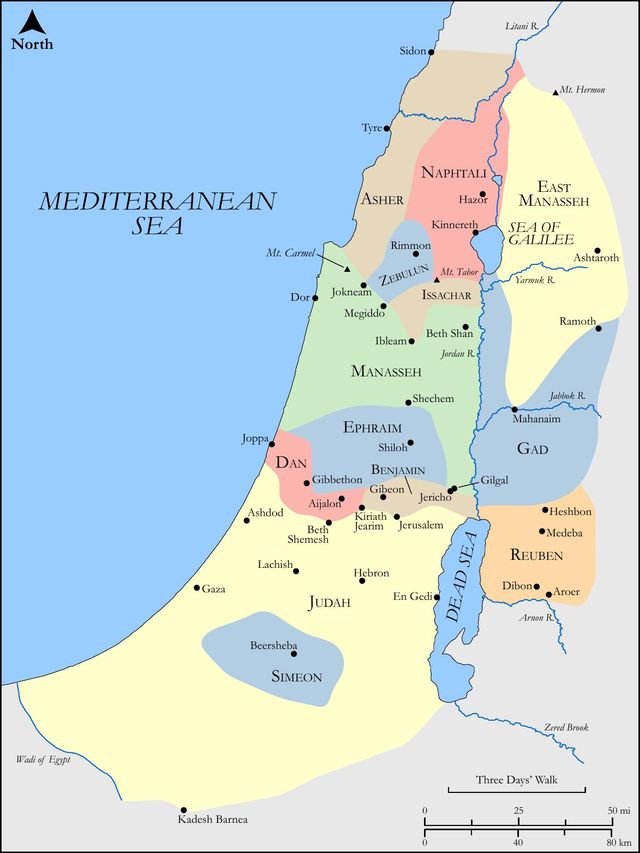
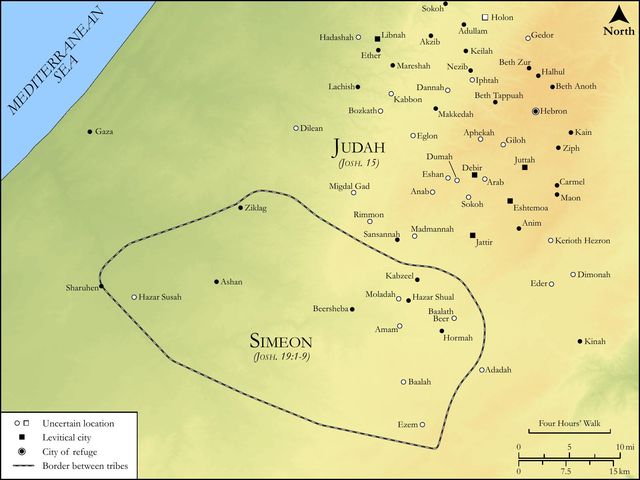
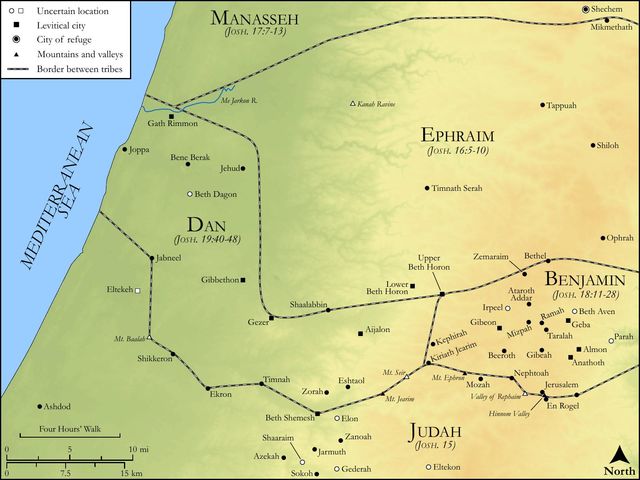
Study this verse
Public-domain commentary
Matthew Henry
From his Commentary on the Whole Bible. Henry comments on passages, not single verses — this entry covers Joshua 19:1–9. His two-level outline is real structure in the source text, so it is rendered as structure.
Simeon's lot was drawn after Judah's, Joseph's, and Benjamin's, because Jacob had put that tribe under disgrace; yet it is put before the two younger sons of Leah and the three sons of the handmaids. Not one person of note, neither judge nor prophet, was of this tribe, that we know of.
I.The situation of their lot was within that of Judah (Jos 19:1) and was taken from it, Jos 19:9.
It seems, those that first surveyed the land thought it larger than it was, and that it would have held out to give every tribe in proportion as large a share as they had carved out for Judah; but, upon a more strict enquiry, it was found that it would not reach (Jos 19:9): The part of the children of Judah was too much for them, more than they needed, and more, as it proved, than fell to their share. Yet God did not by the lot lessen it, but left it to their prudence and care afterwards to discover and rectify the mistake, which when they did,
1.The men of Judah did not oppose the taking away of the cities again, which by the first distribution fell within their border, when they were convinced that they had more than their proportion. In all such cases errors must be excepted and a review admitted if there be occasion. Though, in strictness, what fell to their lot was their right against all the world, yet they would not insist upon it when it appeared that another tribe would want what they had to spare. Note, We must look on the things of others, and not on our own only. The abundance of some must supply the wants of others, that there may be somewhat of an equality, for which there may be equity where there is not law.
2.That which was thus taken off from Judah to be put into a new lot Providence directed to the tribe of Simeon, that Jacob's prophecy concerning this tribe might be fulfilled, I will divide them in Jacob. The cities of Simeon were scattered in Judah, with which tribe they were surrounded, except on that side towards the sea. This brought them into a confederacy with the tribe of Judah (Jdg 1:3), and afterwards was a happy occasion of the adherence of many of this tribe to the house of David, at the time of the revolt of the ten tribes to Jeroboam. Ch2 15:9, out of Simeon they fell to Asa in abundance. It is good being in a good neighbourhood.
II.The cities within their lot are here named.
Beersheba, or Sheba, for these names seem to refer to the same place, is put first. Ziklag, which we read of in David's story, is one of them. What course they took to enlarge their borders and make room for themselves we find Ch1 4:39, etc.
Continue studying Joshua 19:5 across the web’s major study libraries — every link below opens this exact verse, chapter, or book on the destination site.
Read & Compare
 BibleGatewayThis verse in more than 200 translations and 70 languages.
 Bible.comThe YouVersion reader — hundreds of translations, reading plans, and highlights.
 ESV.orgCrossway's official English Standard Version reader.
 NET BibleThe NET translation with 60,000+ translators' notes on every rendering decision.
 STEP BibleTyndale House's free study tool — original text, vocabulary, and scholarly resources.
 BibliaLogos Bible Software's free web reader.
 USCCBThe New American Bible (Revised Edition) with the U.S. bishops' study notes.
Commentaries
 BibleHub CommentariesDozens of classic commentaries on this verse, gathered on one page.
 StudyLightMore than 100 commentary sets — the largest collection on the web.
 BibleRefPlain-English commentary on what this verse means, verse by verse.
 Enduring WordDavid Guzik's free commentary on this chapter, widely used by Bible teachers.
 Bible Study ToolsVerse commentary alongside Greek and Hebrew study aids.
Original Language & Research
- BibleHub InterlinearThe verse word by word — original language, transliteration, and English.
- BibleHub LexiconEvery word's original-language definition and Strong's entry.
 Blue Letter BibleDeep-study tools — Strong's numbers, concordance, and word studies.
 SefariaThe Hebrew text with Rashi and centuries of Jewish commentary.
Sermons, Hymns & Audio


TrulyRandomVerse is not affiliated with these sites and doesn’t control their content. They’re linked because they’re genuinely useful.
Summary
Joshua 19:5 is part of the meticulous enumeration of cities allocated to the tribe of Simeon, specifically listing Ziklag, Bethmarcaboth, and Hazarsusah. This detailed account underscores God's unwavering faithfulness in fulfilling His ancient promises to the patriarchs and to the nation of Israel, establishing their inheritance within the Promised Land with precision and divine order.
Context
ShowHideLiterary Context
Joshua 19 is a pivotal chapter within the book of Joshua, marking the culmination of the land distribution among the Israelite tribes following the conquest of Canaan. Having previously detailed the inheritances of Judah, Ephraim, and Manasseh, this chapter focuses on the remaining seven tribes: Simeon, Zebulun, Issachar, Asher, Naphtali, and Dan. The unique position of Simeon is highlighted, as its inheritance was not a separate contiguous territory but rather cities and villages carved out from within the larger portion initially allotted to Judah, because Judah's share was deemed too large for its population, as noted in Joshua 19:9. This verse, Joshua 19:5, is embedded within this meticulous list, emphasizing the practical and precise fulfillment of God's covenant promises regarding the land, first given in Genesis 15:18. The repetitive nature of these lists throughout chapters 13-19 serves to underscore the divine faithfulness and the tangible reality of Israel's possession.
Historical & Cultural Context
In ancient Israel, land ownership was not merely an economic asset but a fundamental aspect of identity, security, and covenant relationship with God. The tribal system, with its divinely ordained land allotments, ensured each family had a stake in the Promised Land, preventing the accumulation of vast estates by a few and promoting fairness. The meticulous surveying and division of the land, though seemingly mundane, reflects the immense logistical and administrative undertaking involved in settling a nation. Furthermore, the names of the cities themselves, such as "House of Chariots" and "Courtyard of Horses," offer insights into the strategic and economic realities of the time, suggesting military outposts, trade routes, or agricultural centers vital for the tribe's sustenance and defense. These names provide a glimpse into the practical realities of life in Canaan during the early Israelite settlement period.
Key Themes
ShowHideThe meticulous listing of cities in Joshua 19:5, and indeed throughout the land distribution chapters, contributes significantly to several overarching themes in the book of Joshua and the broader Old Testament narrative. First, it powerfully illustrates Divine Faithfulness, showcasing God's unwavering commitment to His covenant promises made to Abraham, Isaac, and Jacob. Every detail, even seemingly minor cities like those listed here, testifies to God's precision in fulfilling His word, as seen in Numbers 34:17. Second, the systematic division of the land reflects Divine Order and Provision. God did not leave His people to haphazardly claim territory but provided a structured, equitable distribution, ensuring each tribe and family had a designated place and resources necessary for their flourishing, a concept beautifully captured in Psalm 16:6. Finally, these lists emphasize the theme of Inheritance and Possession. The physical possession of the land was a tangible sign of Israel's covenant relationship with God, a reality they were to inhabit, steward, and defend. This earthly inheritance foreshadows the ultimate spiritual inheritance believers receive in Christ, as described in Ephesians 1:11.
Exposition and Analysis
ShowHideKey Word Analysis
ShowHideThe etymology of this name is uncertain, with various proposals including "winding" or "foot-press." While its initial mention here is merely as one of Simeon's allocated cities, Ziklag gains significant historical prominence much later in the biblical narrative. It became a Philistine city that was granted to David by Achish, King of Gath, and served as David's base of operations during his flight from King Saul, as recounted in 1 Samuel 27:6. Its later destruction by the Amalekites and David's subsequent recovery of all that was lost, detailed in 1 Samuel 30:1, highlight its strategic importance and its enduring presence in Israelite history, long after its initial allocation to Simeon.
This name literally translates to "place of (the) chariots." This etymology strongly suggests that the city was a strategic location related to military operations, possibly serving as a depot for chariots, a garrison town for chariot forces, or a place where chariots were manufactured or repaired. The presence of such a city within Simeon's territory indicates a practical concern for defense and military readiness, reflecting the ongoing challenges of securing and maintaining control over the newly acquired land.
Meaning "village of cavalry" or "courtyard of horses," this name, like Bethmarcaboth, points to a direct connection with horses. It likely functioned as a center for horse breeding, stabling, or as a base for cavalry units. The pairing of "House of Chariots" and "Courtyard of Horses" within the same tribal allotment suggests a concentration of military resources or specialized agricultural activities related to military support. These names provide a tangible link between the biblical text and the material life and strategic considerations of Canaan, where Solomon later kept cities for his chariots and cities for his horsemen.
Verse Breakdown
ShowHide"And Ziklag"
This phrase introduces the first of three cities listed in this specific verse as part of Simeon's inheritance. Its inclusion underscores the meticulous detail with which the land was divided, ensuring that every designated settlement was accounted for. The simple conjunction "And" connects it seamlessly to the preceding list of cities, maintaining the continuous flow of enumeration.
"and Bethmarcaboth"
Following Ziklag, Bethmarcaboth is named, further emphasizing the precise nature of the tribal allocation. The repetition of the conjunction "and" reinforces the comprehensive nature of the list, indicating that each city, regardless of its size or future prominence, was an integral part of Simeon's divinely appointed territory. Its name, "House of Chariots," hints at its potential strategic importance.
"and Hazarsusah"
The final city mentioned in this verse, Hazarsusah, completes this particular triplet of named locations. Its inclusion reiterates the thoroughness of the land distribution process. The name, "Courtyard of Horses," further suggests the practical and potentially military-oriented character of these settlements within Simeon's inheritance, highlighting the blend of agricultural, residential, and strategic sites that comprised the tribal allotments.
Literary Devices
ShowHideThe primary literary device at play in Joshua 19:5, and indeed throughout the land distribution chapters (Joshua 13-19), is Enumeration. The text systematically lists each city and boundary, providing a comprehensive catalog of the tribal inheritances. This meticulous listing serves to emphasize the divine precision and thoroughness in fulfilling God's promises. The Repetition of conjunctions ("and") before each city name creates a rhythmic, exhaustive quality, reinforcing the idea that no detail was overlooked in the divine plan. While seemingly dry, this detailed enumeration functions as a powerful testament to God's faithfulness and the tangible reality of Israel's possession of the Promised Land. Furthermore, the descriptive nature of the city names themselves, such as "House of Chariots" and "Courtyard of Horses," can be seen as a form of Descriptive Naming, where the name itself provides insight into the function or characteristic of the place, adding a layer of practical detail to the divine allocation.
Theological and Thematic Connections
ShowHideJoshua 19:5, though a simple listing of names, is profoundly significant in its theological implications. It serves as a tangible testament to God's absolute faithfulness and meticulous care for His people. The very act of precisely naming each city, no matter how small or obscure, demonstrates that God is a God of detail, who fulfills His promises not vaguely, but with exactitude. This meticulousness assures us that God's covenant with Abraham, which included the promise of land, was brought to fruition in every particular. It speaks to God's sovereignty over all creation, including geographical boundaries and human settlements, and His comprehensive provision for His chosen nation. This divine attention to detail in the physical realm provides a powerful foundation for trusting His equally precise and comprehensive spiritual provisions.
Reflection and Application
ShowHideThe seemingly mundane list of cities in Joshua 19:5 offers profound lessons for the contemporary believer. Just as God meticulously planned, surveyed, and executed the distribution of land for Israel, ensuring every tribe and family received their precise inheritance, so too does He operate in the details of our lives. This verse reminds us that God is not a God of generalities but of specifics; no aspect of our existence is too small or insignificant for His divine providence and care. His faithfulness in fulfilling ancient promises to Israel assures us that He is equally faithful to His spiritual promises to us today. We can trust that He has prepared a place for us, both in this life and eternally, and that our spiritual inheritance in Christ is as real and meticulously secured as Simeon's physical land. This should cultivate a deep sense of security, gratitude, and trust, knowing that our lives are held within the precise and loving hands of a God who keeps every single one of His words.
Questions for Reflection
ShowHideFAQ
ShowHideWhy are these detailed lists of cities important for understanding the biblical narrative?
ShowHideThese detailed lists, like the one in Joshua 19:5, are crucial for several reasons. First, they provide irrefutable evidence of God's faithfulness in fulfilling His covenant promises, specifically the promise of land to Abraham and his descendants, as recorded in Genesis 15:18. The meticulous enumeration demonstrates that the inheritance was not a vague concept but a tangible, geographically defined reality. Second, they underscore the divine order and precision in God's plan for His people, showing that every tribe received its divinely appointed portion. Third, they serve as historical and legal documents, validating Israel's claim to the land and providing a record for future generations. Finally, they offer insights into the geography, demography, and even the strategic considerations of ancient Israel, as seen in city names like "House of Chariots."
What is the later significance of Ziklag in biblical history, beyond its mention here?
ShowHideZiklag, though initially listed as a city of Simeon, later became a significant location in the life of King David. During his flight from King Saul, David sought refuge with Achish, the Philistine king of Gath, who granted Ziklag to David as his residence, as described in 1 Samuel 27:6. David and his men lived there for a year and four months, using it as a base for raids against various enemies, though they presented themselves to Achish as raiding Israelite and Judahite territories. Ziklag was famously raided and burned by the Amalekites while David and his men were away, leading to a profound crisis for David before he pursued and recovered all that was lost, detailed in 1 Samuel 30:1. This later history highlights the enduring importance of these ancient sites and the continuity of biblical narratives across different books.
Christ-Centered Fulfillment
ShowHideThe meticulous land distribution in Joshua 19:5, and indeed throughout the book of Joshua, finds its ultimate and most profound fulfillment in Jesus Christ. The earthly inheritance granted to Israel, a physical land of rest and provision, serves as a powerful type and shadow of the spiritual inheritance believers receive in Christ. Just as Simeon's portion was divinely secured and precisely defined, so too is our spiritual inheritance in Christ a guaranteed reality, purchased by His blood and secured by His resurrection. We are no longer defined by tribal boundaries or geographical locations, but by our union with Christ, in whom "we have obtained an inheritance," as declared in Ephesians 1:11. Jesus is the true "place" of rest, the ultimate fulfillment of the Sabbath rest that Israel sought in the land, as illuminated in Hebrews 4:9. He is the Lamb of God who takes away the sin of the world, making us heirs of God and co-heirs with Him, as taught in Romans 8:17, not of a physical land, but of all the spiritual blessings in the heavenly places, as affirmed in Ephesians 1:3. Through Christ, we are not merely given a portion of land, but we are made new creations, as proclaimed in 2 Corinthians 5:17, and granted citizenship in a heavenly kingdom, awaiting the new heavens and new earth where righteousness dwells, a promise found in Revelation 21:1. Thus, the precise fulfillment of land promises in Joshua points forward to the infinitely greater and eternal inheritance found in our Lord and Savior, Jesus Christ.