


Joshua 17:17
Bible text: King James Version (1769 Blayney text) · Public domain
Bible text: King James Version with Strong's numbers · Public domain
Bible text: Berean Standard Bible · Public domain
Bible text: American Standard Version (1901) · Public domain
Bible text: World English Bible, Messianic edition · Public domain
Bible text: Geneva Bible (1599) · Public domain
Bible text: Young's Literal Translation · Public domain
- וַיֹּאמֶרvai·Yo·merand he saidH559Conj-w ¦ V-Qal-ConsecImperf-3msVerb Qal Consecutive Imperfect 3rd Singular Masculineוַandיֹּאמֶרhe said
- יְהוֹשֻׁעַye·ho·Shu·a'JoshuaH3091N-proper-mNoun Proper Masculine
- אֶל'eltoH413PrepPreposition
- בֵּיתbeit[the] house ofH1004N-mscNoun Singular Masculine Construct
- יוֹסֵףyo·SefJosephH3130N-proper-mNoun Proper Masculine
- לְאֶפְרַיִםle·'ef·Ra·yimto EphraimH669Prep-l ¦ N-proper-mNoun Proper MasculineלְtoאֶפְרַיִםEphraim
- וְלִמְנַשֶּׁהve·lim·na·Shehand to ManassehH4519Conj-w ¦ Prep-l ¦ N-proper-mNoun Proper MasculineוְandלִtoמְנַשֶּׁהManasseh
- לֵאמֹרle·Mor<to> sayingH559Prep-l ¦ V-Qal-InfVerb Qal Infinitive Constructלֵ<to>אמֹרsaying
- עַם'am[are] a peopleH5971N-msNoun Singular Masculine Absolute
- רַבravnumerousH7227Adj-msAdjective Singular Masculine Absolute
- אַתָּה'a·TahyouH859Pro-2msPronoun Personal 2nd Singular Masculine
- וְכֹחַve·Kho·achand strengthH3581Conj-w ¦ N-msNoun Singular Masculine Absoluteוְandכֹחַstrength
- גָּדוֹלga·dOlgreatH1419Adj-msAdjective Singular Masculine Absolute
- לָךְLakh[belongs] to <the> youPrep-l ¦ 2msSuffix Personal 2nd Singular Masculineלָ[belongs] to <the>ךְyou
- לֹאlo'notH3808NegParticle Negative
- יִהְיֶהyih·Yehit will belongH1961V-Qal-Imperf-3msVerb Qal Imperfect 3rd Singular Masculine
- לְךָle·Khato <the> youPrep-l ¦ 2msSuffix Personal 2nd Singular Masculineלְto <the>ךָyou
- גּוֹרָלgo·Rala lotH1486N-msNoun Singular Masculine Absolute
- אֶחָד'e·ChadoneH259Adj-fsAdjective Numerical Singular Feminine Absolute
English is a literal word-by-word gloss of the Hebrew, not the KJV's wording. Why?
This is the original text the KJV's translators worked from — each Hebrew word with its own literal English meaning in this verse, prepared by scholars at Tyndale House, Cambridge. The KJV translates whole sentences, not word by word, so its wording differs: one Hebrew word can become several English words, and the KJV may choose “the LORD” where the gloss reads “Yahweh”. Both are faithful — they answer different questions. For the KJV's own rendering, switch to the KJV text.
Details
See on the biblical-era maps
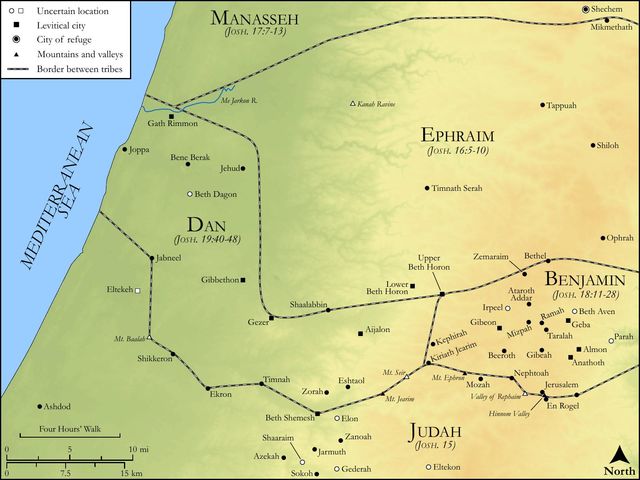
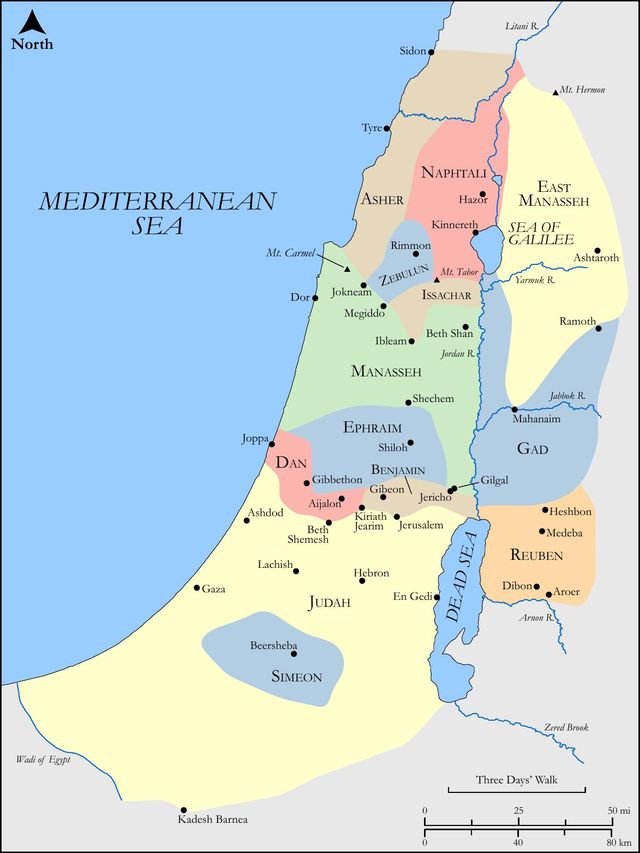
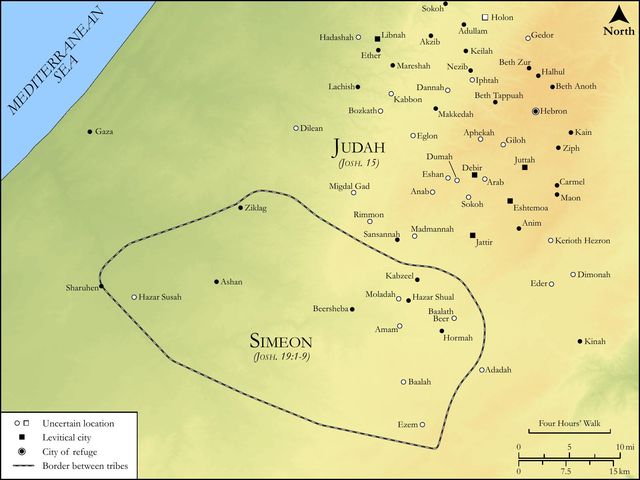
Study this verse
Public-domain commentary
Matthew Henry
From his Commentary on the Whole Bible. Henry comments on passages, not single verses — this entry covers Joshua 17:14–18.
Here, I. The children of Joseph quarrel with their lot; if they had had any just cause to quarrel with it, we have reason to think Joshua would have relieved them, by adding to it, or altering it, which it does not appear he did. It is probable, because Joshua was himself of the tribe of Ephraim, they promised themselves that they should have some particular favour shown them, and should not be confined to the decision of the lot so closely as the other tribes; but Joshua makes them know that in the discharge of his office, as a public person, he had no more regard to his own tribe than to any other, but would administer impartially, without favour or affection, wherein he has left an excellent example to all in public trusts. It was a very competent provision that was made for them, as much, for aught that appears, as they were able to manage, and yet they call it in disdain but one lot, as if that which was assigned to them both was scarcely sufficient for one. The word for complainers (Jde 1:16) is mempsimoiroi, blamers of their lot: - 1. That they were very numerous, through the blessing of God upon them (Jos 17:14): I am a great people, for the Lord has blessed me; and we have reason to hope that he that hath sent mouths will send meat. "I am a great people, and in so small a lot shall not have room to thrive." Yet observe, when they speak thankfully of their present increase, they do not speak confidently of the continuance of it. "The Lord has blessed me hitherto, however he may see fit to deal with me for the future." The uncertainty of what may be must not make us unthankful for what has been and is done in kindness to us. 2. That a good part of that country which had now fallen to their lot was in the hands of the Canaanites, and that they were formidable enemies, who brought into the field of battle chariots of iron (Jos 17:16), that is, chariots with long scythes fastened to the sides of them, or the axle-tree, which made great destruction of all that came in their way, mowing them down like corn. They urge that though they had a good portion assigned them, yet it was in bad hands, and they could not come to the possession of it, wishing to have their lot in those countries that were more thoroughly reduced than this was.
II.Joshua endeavours to reconcile them to their lot.
He owns they were a great people, and being two tribes ought to have more than one lot only (Jos 17:17), but tells them that what had fallen to their share would be a sufficient lot for them both, if they would but work and fight. They desired a lot in which they might indulge themselves in ease and luxury. "No," says Joshua, "you must not count upon that; in the sweat of thy face shalt thou eat bread is a sentence in force even in Canaan itself." He retorts their own argument, that they were a great people. "If so, you are the better able to help yourselves, and have the less reason to expect help from others. If thou hast many mouths to be filled, thou hast twice as many hands to be employed; earn, and then eat." 1. He bids them work for more (Jos 17:15): "Get thee up to the wood-country, which is within thy own border, and let all hands be set to work to cut down the trees, rid the rough lands, and make them, with art and industry, good arable ground." Note, Many wish for larger possessions who do not cultivate and make the best of what they have, think they should have more talents given them who do not trade with those with which they are entrusted. Most people's poverty is the effect of their idleness; would they dig, they need not beg. 2. He bids them fight for more (Jos 17:17, Jos 17:18), when they pleaded that they could not come at the wood-lands he spoke of because in the valley between them and it were Canaanites whom they durst not enter the lists with. "Never fear them," said Joshua, "thou hast God on thy side, and thou shalt drive out the Canaanites, if thou wilt set about it in good earnest, though they have iron chariots." We straiten ourselves by apprehending the difficulties in the way of our enlargement to be greater than really they are. What can be insuperable to faith and holy resolution?
Continue studying Joshua 17:17 across the web’s major study libraries — every link below opens this exact verse, chapter, or book on the destination site.
Read & Compare
 BibleGatewayThis verse in more than 200 translations and 70 languages.
 Bible.comThe YouVersion reader — hundreds of translations, reading plans, and highlights.
 ESV.orgCrossway's official English Standard Version reader.
 NET BibleThe NET translation with 60,000+ translators' notes on every rendering decision.
 STEP BibleTyndale House's free study tool — original text, vocabulary, and scholarly resources.
 BibliaLogos Bible Software's free web reader.
 USCCBThe New American Bible (Revised Edition) with the U.S. bishops' study notes.
Commentaries
 BibleHub CommentariesDozens of classic commentaries on this verse, gathered on one page.
 StudyLightMore than 100 commentary sets — the largest collection on the web.
 BibleRefPlain-English commentary on what this verse means, verse by verse.
 Enduring WordDavid Guzik's free commentary on this chapter, widely used by Bible teachers.
 Bible Study ToolsVerse commentary alongside Greek and Hebrew study aids.
Original Language & Research
- BibleHub InterlinearThe verse word by word — original language, transliteration, and English.
- BibleHub LexiconEvery word's original-language definition and Strong's entry.
 Blue Letter BibleDeep-study tools — Strong's numbers, concordance, and word studies.
 SefariaThe Hebrew text with Rashi and centuries of Jewish commentary.
Sermons, Hymns & Audio


TrulyRandomVerse is not affiliated with these sites and doesn’t control their content. They’re linked because they’re genuinely useful.
Summary
Joshua 17:17 captures a pivotal moment in the distribution of the Promised Land, where Joshua confronts the complaint of the powerful House of Joseph (Ephraim and Manasseh). Recognizing their substantial numerical strength and inherent capability, Joshua affirms their "greatness" and "power" but simultaneously challenges their expectation of an easy inheritance. He implies that their divinely bestowed strength necessitates active effort and perseverance to fully possess the land God had promised them, rather than passively accepting perceived limitations or fearing the remaining inhabitants.
Context
ShowHideLiterary Context
This verse immediately follows the complaint lodged by the House of Joseph in Joshua 17:14. Ephraim and Manasseh argue that their allotted territory is insufficient for their large population and express intimidation by the Canaanites in the valley, who possess formidable iron chariots. Joshua's response in Joshua 17:17 directly addresses their grievance, serving as a pivotal moment before he provides practical instruction in Joshua 17:18. This exchange highlights the ongoing tension throughout the conquest narrative between God's sovereign promise of the land and the Israelites' human responsibility to actively participate in its full possession.
Historical & Cultural Context
The period described in Joshua 13-19 represents a crucial phase after the initial military campaigns had subdued major Canaanite strongholds. Despite these victories, pockets of resistance persisted, particularly in the fertile lowlands where Canaanite city-states leveraged advanced military technology, such as "chariots of iron," which were formidable weapons of war in that era. The House of Joseph, comprising the tribes of Ephraim and Manasseh, was indeed one of the largest and most influential tribal groups, having been allotted a significant and strategically central territory. Their complaint reflects a common human tendency to seek comfort and avoid difficult tasks, even when divinely empowered, and highlights the cultural expectation that a strong tribe should be able to secure its inheritance.
Key Themes
ShowHideJoshua's interaction with the House of Joseph underscores several profound themes central to the book of Joshua and the broader Old Testament narrative. First, it powerfully illustrates the synergy between divine promise and human responsibility. While God had unequivocally promised the land to Israel, its full possession demanded the Israelites' active participation, unwavering faith, and diligent obedience, a principle consistently emphasized throughout the book of Joshua. Second, the passage highlights the theme of overcoming obstacles through God-given strength. Joshua does not dismiss their numerical superiority or inherent power but rather redirects it, challenging them to utilize their "great power" to conquer the remaining inhabitants and clear the land, rather than succumbing to fear or perceived limitations. This resonates with the broader biblical principle that God equips His people for the tasks He sets before them, as exemplified in Deuteronomy 31:6. Finally, it demonstrates wise and empowering leadership, as Joshua affirms their strength while simultaneously calling them to greater effort and responsibility in fulfilling God's will.
Exposition and Analysis
ShowHideKey Word Analysis
ShowHideThis word signifies abundance, multitude, or greatness in quantity, size, or number. When Joshua declares, "Thou art a great people," he is acknowledging the significant population size and numerical strength of the House of Joseph. This affirmation is not mere flattery but a factual recognition of their substantial tribal numbers, which should logically translate into greater capability for conquest and expansion.
This term denotes vigor, strength, ability, or might, encompassing both physical and military capacity. Joshua's statement that they "hast great power" directly addresses their complaint about the Canaanites' iron chariots. He reminds them that they possess the necessary strength, divinely endowed, to overcome such formidable adversaries. It is a direct challenge to activate their inherent potential and utilize their God-given might.
This word refers to a pebble used for casting lots, and by extension, the portion or destiny determined by such a lot. In this context, it signifies the portion of land allotted to them by divine selection, as described in Joshua 14:2. The House of Joseph's complaint of having "one lot only" implies they felt their single, albeit large, portion was insufficient. Joshua's response challenges this perception, indicating that their "lot" was not a fixed boundary of limitation but a starting point for expansion through their own effort and conquest.
Verse Breakdown
ShowHide"And Joshua spake unto the house of Joseph, [even] to Ephraim and to Manasseh, saying,"
This opening clause establishes the direct and authoritative address from Joshua, the divinely appointed leader of Israel, to the specific tribal confederation that had voiced a significant complaint. It underscores the importance of the tribes involved, as Ephraim and Manasseh were two of the most prominent, numerous, and influential tribes descended from Joseph.
"Thou [art] a great people, and hast great power:"
This is Joshua's strategic affirmation. He validates their self-perception, acknowledging their numerical strength and inherent capability. This crucial acknowledgment serves to disarm their complaint by agreeing with their premise, yet it immediately pivots to challenge their conclusion. It reminds them of the divine blessing and inherent capacity they already possess, setting the stage for his subsequent command.
"thou shalt not have one lot [only]:"
This concluding statement directly refutes their complaint that their single allotment was insufficient. Joshua is not denying they received one lot, but rather asserting that their "greatness" and "power" mean they are not confined to the current, un-cleared boundaries of that lot. Instead, they are fully capable of expanding their territory within their inheritance by clearing the land and driving out the remaining inhabitants, thereby possessing more than just a "single" (limited or unfulfilled) portion.
Literary Devices
ShowHideJoshua's statement employs several potent literary techniques. Most prominent is the rhetorical strategy of Affirmation followed by a Challenge. He begins by affirming their self-assessment ("Thou art a great people, and hast great power"), which serves to validate their status and perhaps disarm their defensive posture. This affirmation, however, is immediately followed by a Direct Address and a Challenge ("thou shalt not have one lot only"), which reinterprets their perceived limitation as an opportunity for exertion and responsibility. There is an element of Irony in Joshua's response; the very strength and numbers they cite as a reason for needing more land or a different inheritance is turned back on them as the precise reason they should take more land through their own effort. This masterful rhetorical strategy effectively shifts responsibility from Joshua, the leader, to the complaining tribes themselves, empowering them while simultaneously demanding their active participation in the divine plan.
Theological and Thematic Connections
ShowHideJoshua 17:17 profoundly illustrates the enduring biblical principle that divine promises often require human effort, courage, and faith for their full realization. God had indeed promised the entire land of Canaan to Israel as an inheritance, but the actual, full possession of it was contingent upon their obedience, courage, and active engagement in driving out the inhabitants. Joshua's words to the House of Joseph serve as a powerful reminder that God equips His people with the necessary strength and resources; therefore, perceived limitations or formidable obstacles should not lead to complacency, fear, or complaint, but rather to diligent application of that God-given power. This dynamic interplay between divine sovereignty and human responsibility is a recurring theme throughout biblical history, emphasizing that our inheritance, whether physical or spiritual, is not merely a passive gift but often demands active pursuit and perseverance in faith.
Reflection and Application
ShowHideJoshua's response to the House of Joseph offers profound and timeless lessons for contemporary believers. We often stand at the threshold of God's promises, equipped with spiritual gifts, talents, and the indwelling Holy Spirit, yet we can be tempted to complain about perceived limitations or daunting "iron chariots" in our lives—whether they be spiritual battles, personal challenges, or ministry obstacles. This verse powerfully reminds us that our "great power" comes from God, and it is given not for passive enjoyment or comfortable inaction but for active engagement in His purposes. Our spiritual inheritance, personal growth, and the fulfillment of our calling often require us to step out in faith, courageously clear the "forests" of our lives (habits, fears, complacency), and confront the "Canaanites" (sin, spiritual opposition, worldly distractions) that hinder our full possession of God's promises. It is a compelling call to move beyond complaint and embrace the responsibility that comes with divine empowerment, actively working to expand the kingdom of God in our spheres of influence and to live fully into the abundant life Christ offers.
Questions for Reflection
ShowHideFAQ
ShowHideWhy did the House of Joseph complain despite being a "great people"?
ShowHideThe House of Joseph, comprising Ephraim and Manasseh, was indeed numerically superior and powerful, having received a significant portion of the land. However, their complaint in Joshua 17:14 stemmed from a desire for an easier inheritance and a reluctance to engage in the difficult work of fully dispossessing the remaining Canaanites. They perceived their allotted territory as insufficient due to their large numbers and were particularly intimidated by the Canaanites in the fertile valleys who possessed "chariots of iron," which represented advanced military technology. Their complaint reveals a common human tendency to prefer comfort and avoid arduous tasks, even when equipped with the means to overcome challenges. Joshua's response directly addresses this by reminding them of their inherent strength and challenging them to use it to secure their full inheritance.
Christ-Centered Fulfillment
ShowHideJoshua's declaration to the House of Joseph, affirming their "greatness" and "power" while challenging them to overcome perceived limitations, finds its ultimate and profound fulfillment in Christ and the believer's inheritance in Him. Just as the tribes were given an earthly inheritance to possess through effort and faith, believers in Christ have received an infinitely greater spiritual inheritance, secured by Christ's finished work on the cross (Ephesians 1:11). We are called a "chosen race, a royal priesthood, a holy nation, a people for his own possession" (1 Peter 2:9), truly a "great people" in God's eyes, empowered by the indwelling Holy Spirit (Acts 1:8). Our "great power" is not merely human strength but the divine enablement to overcome spiritual "iron chariots"—sin, temptation, the forces of darkness, and the world's opposition (Ephesians 6:10-12). We are not to be content with a "single lot" of spiritual complacency or limited vision, but to actively "take captive every thought to make it obedient to Christ" (2 Corinthians 10:5) and to "make every effort to add to your faith goodness" (2 Peter 1:5-8). Christ has already secured the decisive victory over sin and death, and through Him, we are more than conquerors, called to actively live out and expand the reality of His kingdom in a world still marked by spiritual resistance, trusting in the power of the One who has overcome the world (John 16:33).