


Job 41:21
Bible text: King James Version (1769 Blayney text) · Public domain
Bible text: Berean Standard Bible · Public domain
Bible text: American Standard Version (1901) · Public domain
Bible text: World English Bible, Messianic edition · Public domain
Bible text: Geneva Bible (1599) · Public domain
Bible text: Young's Literal Translation · Public domain
- נַפְשׁוֹnaf·shoits breathH5315N-fsc ¦ 3msNoun Singular Feminine Constructנַפְשׁbreathוֹits
- גֶּחָלִיםge·cha·LimcoalsH1513N-mpNoun Plural Masculine Absolute
- תְּלַהֵטte·la·Hetit kindlesH3857V-Piel-Imperf-3fsVerb Piel Imperfect 3rd Singular Feminine
- וְלַהַבve·La·havand a flameH3851Conj-w ¦ N-msNoun Singular Masculine Absoluteוְandלַהַבa flame
- מִפִּיוmi·Pivfrom its mouthH6310Prep-m ¦ N-msc ¦ 3msNoun Singular Masculine Constructמִfromפִּיmouthוits
- יֵצֵאye·Tze'it goes forthH3318V-Qal-Imperf-3msVerb Qal Imperfect 3rd Singular Masculine
English is a literal word-by-word gloss of the Hebrew, not the KJV's wording. Why?
This is the original text the KJV's translators worked from — each Hebrew word with its own literal English meaning in this verse, prepared by scholars at Tyndale House, Cambridge. The KJV translates whole sentences, not word by word, so its wording differs: one Hebrew word can become several English words, and the KJV may choose “the LORD” where the gloss reads “Yahweh”. Both are faithful — they answer different questions. For the KJV's own rendering, switch to the KJV text.
Details
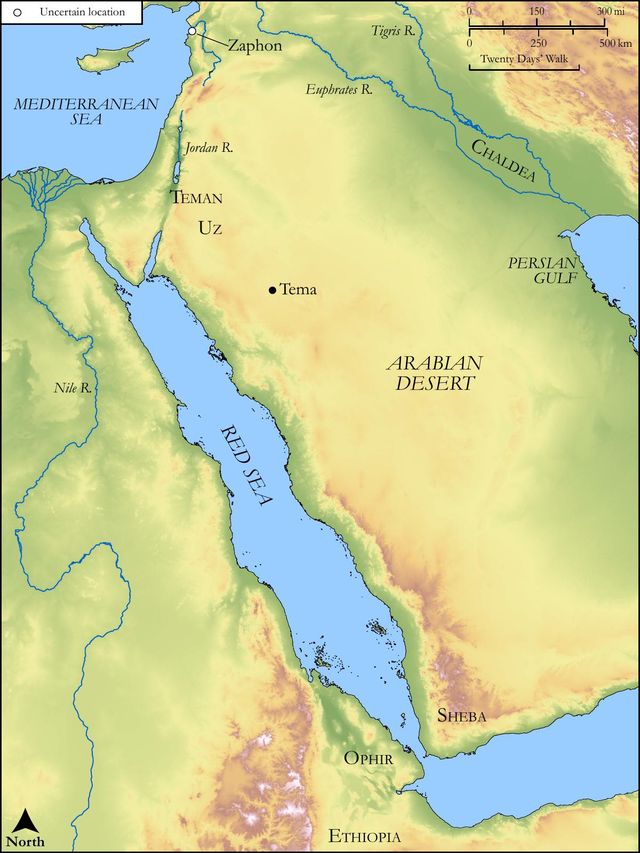
See on the biblical-era map
Study this verse
Public-domain commentary
Matthew Henry
From his Commentary on the Whole Bible. Henry comments on passages, not single verses — this entry covers Job 41:11–34. His three-level outline is real structure in the source text, so it is rendered as structure.
God, having in the foregoing verses shown Job how unable he was to deal with the leviathan, here sets forth his own power in that massy mighty creature. Here is,
I.God's sovereign dominion and independency laid down, Job 41:11.
1.That he is indebted to none of his creatures. If any pretend he is indebted to them, let them make their demand and prove their debt, and they shall receive it in full and not by composition: "Who has prevented me?" that is, "who has laid any obligations upon me by any services he has done me? Who can pretend to be before-hand with me? If any were, I would not long be behind-hand with them; I would soon repay them." The apostle quotes this for the silencing of all flesh in God's presence, Rom 11:35. Who hath first given to him, and it shall be recompensed to him again? As God does not inflict upon us the evils we have deserved, so he does bestow upon us the favours we have not deserved.
2.That he is the rightful Lord and owner of all the creatures: "Whatsoever is under the whole heaven, animate or inanimate, is mine (and particularly this leviathan), at my command and disposal, what I have an incontestable property in and dominion over." All is his; we are his, all we have and do; and therefore we cannot make God our debtor; but of thy own, Lord, have we given thee. All is his, and therefore, if he were indebted to any, he has wherewithal to repay them; the debt is in good hands. All is his, and therefore he needs not our services, nor can he be benefited by them. If I were hungry I would not tell thee, for the world is mind and the fulness thereof, Psa 50:12.
II.The proof and illustration of it, from the wonderful structure of the leviathan, Job 41:12.
1.The parts of his body, the power he exerts, especially when he is set upon, and the comely proportion of the whole of him, are what God will not conceal, and therefore what we must observe and acknowledge the power of God in. Though he is a creature of monstrous bulk, yet there is in him a comely proportion. In our eye beauty lies in that which is small (inest sua gratia parvis - little things have a gracefulness all their own) because we ourselves are so; but in God's eye even the leviathan is comely; and, if he pronounce even the whale, event he crocodile, so, it is not for us to say of any of the works of his hands that they are ugly of ill-favoured; it is enough to say so, as we have cause, of our own works. God here goes about to give us an anatomical view (as it were) of the leviathan; for his works appear most beautiful and excellent, and his wisdom and power appear most in them, when they are taken in pieces and viewed in their several parts and proportions.
(1.)The leviathan, even prima facie - at first sight, appears formidable and inaccessible, Job 41:13, Job 41:14. Who dares come so near him while he is alive as to discover or take a distinct view of the face of the garment, the skin with which he is clothed as with a garment, so near him as to bridle him like a horse and so lead him away, so near him as to be within reach of his jaws, which are like a double bridle? Who will venture to look into his mouth, as we do into a horse's mouth? He that opens the doors of his face will see his teeth terrible round about, strong and sharp, and fitted to devour; it would make a man tremble to think of having a leg or an arm between them.
(2.)His scales are his beauty and strength, and therefore his pride, Job 41:15-17. The crocodile is indeed remarkable for his scales; if we understand it of the whale, we must understand by these shields (for so the word is) the several coats of his skin; or there might be whales in that country with scales. That which is remarkable concerning the scales is that they stick so close together, by which he is not only kept warm, for no air can pierce him, but kept safe, for no sword can pierce him through those scales. Fishes, that live in the water, are fortified accordingly by the wisdom of Providence, which gives clothes as it gives cold.
(3.)He scatters terror with his very breath and looks; if he sneeze or spout up water, it is like a light shining, either with the froth or the light of the sun shining through it, Job 41:18. The eyes of the whale are reported to shine in the night-time like a flame, or, as here, like the eye-lids of the morning; the same they say of the crocodile. The breath of this creature is so hot and fiery, from the great natural heat within, that burning lamps and sparks of fire, smoke and a flame, are said to go out of his mouth, even such as one would think sufficient to set coals on fire, Job 41:19-21. Probably these hyperbolical expressions are used concerning the leviathan to intimate the terror of the wrath of God, for that is it which all this is designed to convince us of. Fire out of his mouth devours, Psa 18:7, Psa 18:8. The breath of the Almighty, like a stream of brimstone, kindles Tophet, and will for ever keep it burning, Isa 30:33. The wicked one shall be consumed with the breath of his mouth, Th2 2:8.
(4.)He is of invincible strength and most terrible fierceness, so that he frightens all that come in his way, but is not himself frightened by any. Take a view of his neck, and there remains strength, Job 41:22. his head and his body are well set together. Sorrow rejoices (or rides in triumph) before him, for he makes terrible work wherever he comes. Or, Those storms which are the sorrow of others are his joys; what is tossing to others is dancing to him. His flesh is well knit, Job 41:23. The flakes of it are joined so closely together, and are so firm, that it is hard to pierce it; he is as if he were all bone. His flesh is of brass, which Job had complained his was not, Job 6:12. His heart is as firm as a stone, Job 41:24. He has spirit equal to his bodily strength, and, though he is bulky, he is sprightly, and not unwieldy. As his flesh and skin cannot be pierced, so his courage cannot be daunted; but, on the contrary, he daunts all he meets and puts them into a consternation (Job 41:25): When he raises up himself like a moving mountain in the great waters even the mighty are afraid lest he should overturn their ships or do them some other mischief. By reason of the breakings he makes in the water, which threaten death, they purify themselves, confess their sins, betake themselves to their prayers, and get ready for death. We read (Job 3:8) of those who, when they raise up a leviathan, are in such a fright that they curse the day. It was a fear which, it seems, used to drive some to their curses and others to their prayers; for, as now, so then there were seafaring men of different characters and on whom the terrors of the sea have contrary effects; but all agree there is a great fright among them when the leviathan raises up himself.
(5.)All the instruments of slaughter that are used against him do him no hurt and therefore are not error to him, Job 41:26-29. The sword and the spear, which wound nigh at hand, are nothing to him; the darts, arrows, and sling-stones, which wound at a distance, do him no damage; nature has so well armed him cap-a-pie - at all points, against them all. The defensive weapons which men use when they engage with the leviathan, as the habergeon, or breast-plate, often serve men no more than their offensive weapons; iron and brass are to him as straw and rotten wood, and he laughs at them. It is the picture of a hard-hearted sinner, that despises the terrors of the Almighty and laughs at all the threatenings of his word. The leviathan so little dreads the weapons that are used against him that, to show how hardy he is, he chooses to lie on the sharp stones, the sharp-pointed things (Job 41:30), and lies as easy there as if he lay on the soft mire. Those that would endure hardness must inure themselves to it.
(6.)His very motion in the water troubles it and puts it into a ferment, Job 41:31, Job 41:32. When he rolls, and tosses, and makes a stir in the water, or is in pursuit of his prey, he makes the deep to boil like a pot, he raises a great froth and foam upon the water, such as is upon a boiling pot, especially a pot of boiling ointment; and he makes a path to shine after him, which even a ship in the midst of the sea does not, Pro 30:19. One may trace the leviathan under water by the bubbles on the surface; and yet who can take that advantage against him in pursuing him? Men track hares in the snow and kill them, but he that tracks the leviathan dares not come near him.
2.Having given this particular account of his parts, and his power, and his comely proportion, he concludes with four things in general concerning this animal: - (1.) That he is a non-such among the inferior creatures: Upon earth there is not his like, Job 41:33. No creature in this world is comparable to him for strength and terror. Or the earth is here distinguished from the sea: His dominion is not upon the earth (so some), but in the waters. None of all the savage creatures upon earth come near him for bulk and strength, and it is well for man that he is confined to the waters and there has a watch set upon him (Job 7:12) by the divine Providence, for, if such a terrible creature were allowed to roam and ravage upon this earth, it would be an unsafe and uncomfortable habitation for the children of men, for whom it is intended. (2.) That he is more bold and daring than any other creature whatsoever: He is made without fear. The creatures are as they are made; the leviathan has courage in his constitution, nothing can frighten him; other creatures, quite contrary, seem as much designed for flying as this for fighting. So, among men, some are in their natural temper bold, others are timorous. (3.) That he is himself very proud; though lodged in the deep, yet he beholds all high things, Job 41:34. The rolling waves, the impending rocks, the hovering clouds, and the ships under sail with top and top-gallant, this mighty animal beholds with contempt, for he does not think they either lessen him or threaten him. Those that are great are apt to be scornful. (4.) That he is a king over all the children of pride, that is, he is the proudest of all proud ones. He has more to be proud of (so Mr. Caryl expounds it) than the proudest people in the world have; and so it is a mortification to the haughtiness and lofty looks of men. Whatever bodily accomplishments men are proud of, and puffed up with, the leviathan excels them and is a king over them. Some read it so as to understand it of God: He that beholds all high things, even he, is King over all the children of pride; he can tame the behemoth (Job 40:19) and the leviathan, big as they are, and stout-hearted as they are. This discourse concerning those two animals was brought in to prove that it is God only who can look upon proud men and abase them, bring them low and tread them down, and hide them in the dust (Job 40:11-13), and so it concludes with a quod erat demonstrandum - which was to be demonstrated; there is one that beholds all high things, and, wherein men deal proudly, is above them; he is King over all the children of pride, whether brutal or rational, and can make them all either bend or break before him, Isa 2:11. The lofty looks of man shall be humbled, and the haughtiness of men shall be bowed down, and thus the Lord alone shall be exalted.
Historical interpretation
Historical reception
2 surviving comments on this verse. Each one is dated, so this reads as a timeline rather than a list.
Select a marker to jump to its quote. Markers stagger vertically where authors wrote within a few decades of each other.
Others believe that here he alludes to the fact that sneezing has the power to purify the brain; therefore, [the devil] transfigures himself into light, and even pretends to be able to purify. So [faithless] Gentiles and wizards use the devil’s power in certain rites of purification, pretending that they have the power of the light, whereas they are entirely full of filth.
67. For what does He call ‘coals,’ but the minds of reprobate men, kindled with earthly desires. For they are on fire when they seek after any temporal object; doubtless because their longings, which suffer not their mind to be quiet and whole [‘integrum’], inflame them. The breath of Leviathan therefore kindles the coals, as often as his secret suggestion allures the minds of men to unlawful pleasures. For it inflames some with the torches of pride, some with those of envy, some with those of lust, some with those of avarice. For he applied in truth the torch of pride to the mind of Eve, when he instigated her to despise the words of the Lord’s command. [Gen. 3, 6] He kindled the mind of Cain with the flame of envy, when he was grieved at his brother’s sacrifice being accepted, and in this way arrived as far as the sin of fratricide. [Gen. 4, 5] He inflamed the heart of Solomon with the torches of lust, whom he overcame with such great love for women, that by having been led to the worship of idols, he forgot the reverence due to his Maker, when he was pursuing the pleasure of the flesh. [1 Kings 11, 4] He also burnt up the mind of Ahab with the fire of avarice, when he urged him with impatient desires to seek for the vineyard of another, and drew him on in this way even to the guilt of homicide. [ib. 21, 2] This Leviathan therefore blows on the coals, with a breath as great as the effort of secret suggestion with which he inflames the minds of men to aim at what is forbidden. Whence also it is immediately subjoined;
And a flame goeth out of his mouth.
68. For the flame of his mouth is in truth the very instigation of secret suggestion. For he addresses the words of evil persuasion to the mind of each person, but that which goes out of his mouth is a flame; because the mind burns with desires, when it is instigated by his suggestions. These he daily suggests, these he ceases not to suggest even to the end of the present life: but he then expands himself more wickedly when coming in that accursed man, he displays himself more openly in the glory of this world. A mightier smoke proceeds then from his nostrils, because a greater instigation assails the hearts of men when frightened at the marvels of his wonders. Then does his breath make the coals to burn more fiercely, because, on finding the minds of the reprobate already warm with the love of temporal glory, he inflames them with the breath of his suggestion, even to the wickedness of exercising cruelty. Then does a flame go forth from his mouth, because whatever he says by himself or by his preachers, is a fire with which unfruitful trees are burnt up. But the mind of those who do not at all wish to become precious metals, is touched by the fire of earthly concupiscence. Whosoever therefore wishes not to suffer from the flame of his mouth should take care, according to the expression of the teacher of truth, to be found, not wood, hay, stubble, but gold, silver, and precious stone. [1 Cor. 3, 12] Because the fire of his persuasion burns them the more fiercely, the softer every one has rendered himself to yielding his consent. But because a mind, when placed in this corruptible flesh, is in no way permitted not to be touched by the heat of his persuasion, it remains for it, when parched by its malignant blasts, to betake itself unceasingly to the aid of prayer. For a wave of tears quickly extinguishes the flame of his suggestions.
Continue studying Job 41:21 across the web’s major study libraries — every link below opens this exact verse, chapter, or book on the destination site.
Read & Compare
 BibleGatewayThis verse in more than 200 translations and 70 languages.
 Bible.comThe YouVersion reader — hundreds of translations, reading plans, and highlights.
 ESV.orgCrossway's official English Standard Version reader.
 NET BibleThe NET translation with 60,000+ translators' notes on every rendering decision.
 STEP BibleTyndale House's free study tool — original text, vocabulary, and scholarly resources.
 BibliaLogos Bible Software's free web reader.
 USCCBThe New American Bible (Revised Edition) with the U.S. bishops' study notes.
Commentaries
 BibleHub CommentariesDozens of classic commentaries on this verse, gathered on one page.
 StudyLightMore than 100 commentary sets — the largest collection on the web.
 BibleRefPlain-English commentary on what this verse means, verse by verse.
 Enduring WordDavid Guzik's free commentary on this chapter, widely used by Bible teachers.
 Bible Study ToolsVerse commentary alongside Greek and Hebrew study aids.
Original Language & Research
- BibleHub InterlinearThe verse word by word — original language, transliteration, and English.
- BibleHub LexiconEvery word's original-language definition and Strong's entry.
 Blue Letter BibleDeep-study tools — Strong's numbers, concordance, and word studies.
 SefariaThe Hebrew text with Rashi and centuries of Jewish commentary.
Sermons, Hymns & Audio


TrulyRandomVerse is not affiliated with these sites and doesn’t control their content. They’re linked because they’re genuinely useful.
Summary
Job 41:21 offers a breathtaking and terrifying description of Leviathan, a creature presented by God as the ultimate demonstration of His unparalleled power and sovereignty. This verse vividly portrays Leviathan's breath as capable of igniting coals and emitting literal flames from its mouth, painting a picture of an untamable, destructive force that utterly transcends human control and comprehension. This awe-inspiring imagery serves to humble Job, redirecting his focus from his own suffering and questions to the Creator's infinite wisdom, unchallengeable might, and absolute dominion over all creation, even its most chaotic and fearsome elements.
Context
ShowHideLiterary Context
Job 41:21 is a pivotal verse within God's second and final discourse to Job, spanning chapters 38-41. This divine monologue serves as the climax of the book, following Job's profound lamentations and the extended, often misguided, theological debates with his three friends. God directly intervenes, not to explain the reason for Job's suffering, but to challenge Job's presumption of understanding divine governance and to re-establish His own unassailable authority. Chapters 38-39 meticulously detail God's mastery over the heavens and the earth and various wild creatures, setting the stage for the descriptions of Behemoth in Job 40:15-24 and, more extensively, Leviathan in Job 41. The portrayal of Leviathan, culminating in verses like 41:21, is the apex of God's demonstration, presenting a creature so formidable that it is utterly beyond human subjection, thereby reinforcing God's unchallengeable power and wisdom over all creation. The description emphasizes Leviathan's invincibility to human weaponry and its terrifying demeanor, all to underscore the vast chasm between human weakness and divine omnipotence.
Historical & Cultural Context
The book of Job is set in the land of Uz, a region often associated with Edom or northern Arabia, giving its universal themes the setting of "the men of the east." The descriptions of Leviathan and Behemoth set forth monstrous creatures that stand for the untamed sea and the forces of evil that only the Creator could subdue, since He alone made them. While the text does not explicitly clarify whether Leviathan is a literal creature (perhaps a hyperbolic description of a large crocodile or a dinosaur) or a purely symbolic representation, its description employs highly exaggerated and hyperbolic language characteristic of ancient wisdom literature designed to convey immense power and awe. In Job, significant emphasis falls on divine power manifested through control over nature and chaotic elements, as Job himself says, "He divideth the sea with his power, and by his understanding he smiteth through the proud." Human wisdom was often understood as humility and reverence before such overwhelming divine might, contrasting sharply with any attempts to question or contend with the divine order.
Key Themes
ShowHideThe vivid imagery of Leviathan's fiery breath in Job 41:21 powerfully contributes to several overarching themes in the book of Job. Firstly, it profoundly underscores the Divine Sovereignty and Omnipotence of God, demonstrating that His power extends even to the most formidable, chaotic, and seemingly untamable elements of creation, which are utterly beyond human control. This reasserts God's absolute dominion over all things, visible and invisible. Secondly, it highlights the Limits of Human Understanding and Wisdom, serving to humble Job by illustrating that if humanity cannot even contend with a creature like Leviathan, how much less can it grasp or challenge the infinite wisdom of God's ways and His governance of the universe. This resonates with the recurring theme that God's judgments are unsearchable and His paths inscrutable, as echoed in Romans 11:33. Finally, the description evokes a profound sense of Awe and Mystery in Creation, inviting Job and the reader to marvel at the vastness, complexity, and sheer power of God's creative work, which far surpasses human comprehension and inspires worship rather than questioning or complaint. The creature's terrifying nature ultimately serves to magnify the glory of its Creator.
Exposition and Analysis
ShowHideKey Word Analysis
ShowHideWhile nephesh (H5315) is often translated as "soul" or "life," its primary meaning is "a breathing creature" or "vitality." In this context, it refers to Leviathan's very essence of life, its vital exhalation. The fact that its "breath" kindles coals implies that the creature's life force itself is imbued with an inherent, intense heat and destructive power, not merely a byproduct. This suggests a creature whose very existence is a furnace, making its exhalation a terrifying manifestation of its internal power.
The verb lâhaṭ (H3857) means "to blaze," "to burn (up)," or "to kindle." It conveys an active, intense process of combustion. In the context of Leviathan's breath, it signifies that the exhalation is not just hot air, but so intensely fiery that it can spontaneously ignite or intensify existing embers. This emphasizes the creature's formidable, almost supernatural, internal furnace, capable of generating extreme heat and fire through the simple act of breathing. It is an active, consuming flame.
The noun lahab (H3851) denotes a "flame," "blaze," or even the "blade" of a polished weapon, suggesting both intense light and destructive sharpness. The phrase "a flame goeth out of his mouth" is a direct and unambiguous depiction of fire-breathing. This moves beyond metaphorical heat to literal, visible fire, reinforcing the creature's terrifying and unapproachable nature. The "flame" signifies not just heat, but light, destruction, and an active, offensive capability, solidifying its portrayal as a living, breathing weapon, a force of nature unleashed.
Verse Breakdown
ShowHide"His breath kindleth coals"
This initial clause establishes the internal, generative power of Leviathan's fiery nature. It suggests that the very act of breathing for this creature is so intensely hot that it has the effect of igniting or intensifying glowing embers. This is not merely a hot exhalation but a breath imbued with such extreme thermal energy that it can cause combustion, implying a creature of immense, self-contained destructive potential. The imagery evokes a forge or a furnace, where intense heat is produced and maintained, highlighting Leviathan's inherent power and the danger it poses.
"and a flame goeth out of his mouth"
This second clause provides the direct, visible manifestation of the power described in the first. It unequivocally states that actual fire, a "flame," emanates from Leviathan's mouth. This moves beyond the internal heat to an external, aggressive display of power, making Leviathan a truly terrifying and unapproachable entity. The "flame" signifies not just heat, but light, destruction, and an active, offensive capability, solidifying its portrayal as an unconquerable force. This direct emission of fire underscores its monstrous and formidable nature, making it a living weapon that no human can withstand or control.
Literary Devices
ShowHideJob 41:21 masterfully employs several literary devices to convey Leviathan's terrifying power and, by extension, God's ultimate sovereignty. Hyperbole is prominently featured in the description of a creature whose breath kindles coals and emits literal flames; while some interpretations seek a naturalistic explanation, the language clearly pushes beyond the mundane to depict an exaggerated, awe-inspiring, and almost mythical force. This exaggeration serves to emphasize the creature's formidable nature and its utter invincibility to human efforts. Vivid Imagery is paramount, painting a clear and immediate picture of a fire-breathing monster, engaging the reader's senses of sight and heat. The phrases "kindleth coals" and "a flame goeth out of his mouth" are highly evocative, creating a profound sense of dread, wonder, and the creature's overwhelming power. Furthermore, the description uses Personification by attributing human-like actions and capabilities (breathing, having a mouth from which fire emerges) to an animal, enhancing its monstrous and almost sentient portrayal, making it more terrifying and relatable as an adversary. Ultimately, Leviathan functions as a powerful Symbolism for the untamed forces of chaos, the limits of human power, and the terrifying aspects of nature that are utterly beyond human control, yet entirely subject to God's dominion.
Theological and Thematic Connections
ShowHideJob 41:21, with its graphic depiction of Leviathan's fiery breath, serves as a profound theological statement on the nature of God's power and humanity's finite place within creation. The creature's untamable and destructive attributes are not merely for dramatic effect; they are a divine rhetorical tool designed to humble Job and all humanity, demonstrating that if such a creature is beyond human mastery, then the Creator of such a creature is infinitely more so. This highlights God's absolute sovereignty over all creation, including the most chaotic, fearsome, and seemingly uncontrollable elements, assuring us that nothing, no force of nature or evil, is outside His ultimate control. It challenges any human presumption of wisdom, self-sufficiency, or ability to question God's ways, fostering a necessary posture of profound awe, reverent trust, and humble submission before the Almighty. The verse implicitly asks: if you cannot even face Leviathan, how can you contend with its Maker?
Reflection and Application
ShowHideThe terrifying image of Leviathan's fiery breath in Job 41:21, presented within God's grand discourse to Job, offers profound lessons for contemporary believers. It is a powerful reminder that our God is not a domesticated deity, confined to our understanding or expectations, but an infinitely powerful, sovereign Creator whose wisdom and might far exceed our comprehension. In a world that often seeks to control, explain away, or even diminish God's absolute authority, this passage calls us to a posture of profound humility and reverent awe. Just as Job was brought to a place of repentance and renewed trust by encountering God's unassailable power over creation, we too are invited to relinquish our need for complete understanding and instead rest in the assurance that the One who controls even the most chaotic and destructive forces is also the One who holds our lives, our futures, and all of history in His hands. This understanding cultivates a deeper, more resilient faith, enabling us to trust God's purposes even when our circumstances seem overwhelming, inexplicable, or unjust, knowing that His control extends to all things, seen and unseen, good and seemingly chaotic.
Questions for Reflection
ShowHideFAQ
ShowHideIs Leviathan a literal creature or symbolic?
ShowHideThe nature of Leviathan in Job 41 has been a subject of extensive debate among scholars and commentators for centuries. While some interpretations propose it was a real, albeit perhaps now extinct, creature like a massive crocodile, a dinosaur, or an exaggerated whale, the hyperbolic language used to describe it—such as its fiery breath in Job 41:21, its impenetrable scales, and its utter invincibility to human weaponry—strongly suggests it is more likely a symbolic representation. In the psalms and the prophets, Leviathan stands for the untamable forces of the sea and for the evil that God alone can overcome. Within the book of Job, Leviathan primarily functions as a powerful symbol of God's absolute dominion over all creation, including the most formidable, chaotic, and fearsome elements, which are utterly beyond human control. The central point is not its biological classification, but its function as an unchallengeable display of divine power and a rhetorical tool to humble Job.
What is the main purpose of God describing Leviathan to Job?
ShowHideGod's primary purpose in describing Leviathan (and Behemoth in Job 40) to Job is not to provide a direct explanation for the reasons behind Job's suffering, but rather to humble Job and profoundly reorient his perspective towards God's infinite wisdom, unsearchable ways, and absolute power. Throughout the preceding chapters, Job has questioned God's justice and governance, seeking an explanation for his plight. By presenting creatures like Leviathan, which are utterly beyond human control or comprehension, God dramatically demonstrates the vast chasm between His divine wisdom and Job's finite understanding. The implicit question is: if Job cannot even contend with Leviathan, how can he presume to understand or challenge the Creator of the universe? This divine discourse serves to silence Job's complaints and lead him to a place of profound humility, awe, and renewed trust in God's sovereign plan, culminating in Job's confession and repentance in Job 42:1-6.
Does Leviathan's fiery breath have any spiritual meaning for believers today?
ShowHideWhile Leviathan's fiery breath is a literal description within the narrative, its spiritual meaning for believers today lies in its profound symbolic power. It represents the ultimate, untamable force, the epitome of chaos and destructive power that only God can control. For us, this imagery reinforces God's absolute sovereignty over all forms of chaos, evil, and destructive power in the world, whether natural or spiritual. It assures us that no matter how overwhelming, fearsome, or inexplicable our circumstances may seem, or how potent the forces of evil may appear, God is ultimately in sovereign control. This understanding should inspire profound trust and unwavering faith, knowing that the God who can command Leviathan's breath and subdue the most formidable creatures is also the God who cares intimately for His people and works all things, even the most challenging, for His ultimate glory and our good, as promised in Romans 8:28.
Christ-Centered Fulfillment
ShowHideWhile Job 41:21 directly describes the fearsome Leviathan, its ultimate Christ-centered fulfillment lies in the New Testament revelation of Jesus Christ as the embodiment of God's supreme power and dominion over all creation, including the very forces of chaos and evil that Leviathan symbolizes. The untamable, fire-breathing monster of Job finds its ultimate master and conqueror in Christ, who is "the image of the invisible God, the firstborn of all creation," and in whom "all things were created, in heaven and on earth, visible and invisible, whether thrones or dominions or rulers or authorities—all things were created through him and for him" (Colossians 1:15-16). Jesus demonstrates this absolute dominion not by creating a fire-breathing creature, but by calming the raging storm with a mere word (Mark 4:39), casting out legions of demons with unparalleled authority (Mark 1:27), and ultimately conquering the ultimate enemies—sin and death—through His crucifixion and glorious resurrection (Hebrews 2:14-15). The terrifying power of Leviathan, which serves to humble Job and reveal God's unchallengeable might, points forward to the even greater, redemptive power of the Lamb of God, who not only controls all creation but also reconciles it to Himself, ultimately establishing His eternal kingdom where all chaos is subdued, every enemy is put under His feet, and all things are made gloriously new (Revelation 21:5).