


Job 4:17
- הַאֱנוֹשׁHa·'e·no·osh¿ a personH582Interrog ¦ N-msNoun Singular Masculine Absoluteהַ¿אֱנוֹשׁa person
- מֵאֱלוֹהַme·'e·Lo·hafrom GodH433Prep-m ¦ N-msNoun Singular Masculine AbsoluteמֵfromאֱלוֹהַGod
- יִצְדָּקyitz·Dakwill he be righteousH6663V-Qal-Imperf-3msVerb Qal Imperfect 3rd Singular Masculine
- אִם'imor?H518PrtParticle Conditional
- מֵעֹשֵׂהוּme·'o·Se·hufrom his makerH6213Prep-m ¦ V-Qal-Prtcpl-ms ¦ 3msVerb Qal Participle Singular Masculine Constructמֵfromעֹשֵׂmakerהוּhis
- יִטְהַרyit·harwill he be pureH2891V-Qal-Imperf-3msVerb Qal Imperfect 3rd Singular Masculine
- גָּבֶרGa·vera manH1397N-msNoun Singular Masculine Absolute
English is a literal word-by-word gloss of the Hebrew, not the KJV's wording. Why?
This is the original text the KJV's translators worked from — each Hebrew word with its own literal English meaning in this verse, prepared by scholars at Tyndale House, Cambridge. The KJV translates whole sentences, not word by word, so its wording differs: one Hebrew word can become several English words, and the KJV may choose “the LORD” where the gloss reads “Yahweh”. Both are faithful — they answer different questions. For the KJV's own rendering, switch to the KJV text.
Details
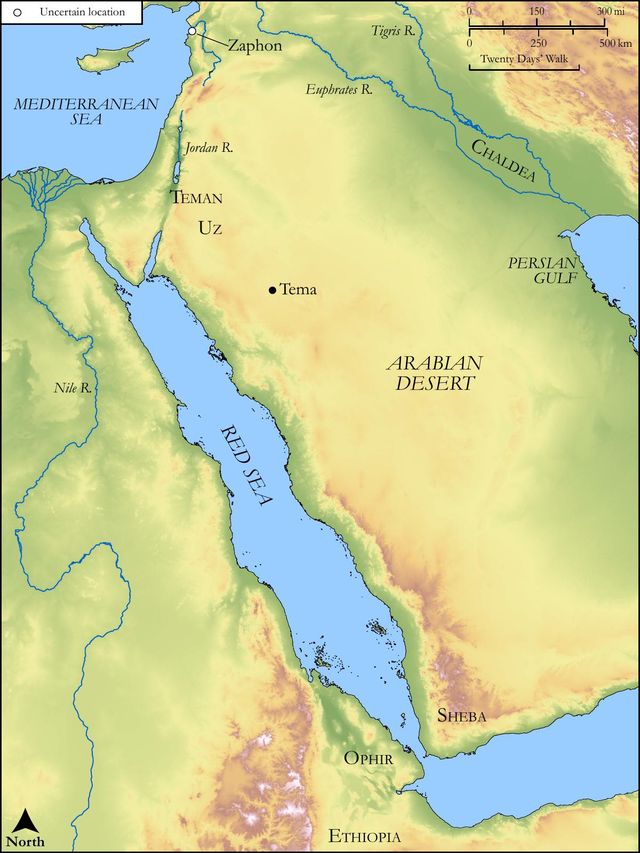
See on the biblical-era map
Study this verse
Public-domain commentary
Matthew Henry
From his Commentary on the Whole Bible. Henry comments on passages, not single verses — this entry covers Job 4:12–21. His four-level outline is real structure in the source text, so it is rendered as structure.
Eliphaz, having undertaken to convince Job of the sin and folly of his discontent and impatience, here vouches a vision he had been favoured with, which he relates to Job for his conviction. What comes immediately from God all men will pay a particular deference to, and Job, no doubt, as much as any. Some think Eliphaz had this vision now lately, since he came to Job, putting words into his mouth wherewith to reason with him; and it would have been well if he had kept to the purport of this vision, which would serve for a ground on which to reprove Job for his murmuring, but not to condemn him as a hypocrite. Others think he had it formerly; for God did, in this way, often communicate his mind to the children of men in those first ages of the world, Job 33:15. Probably God had sent Eliphaz this messenger and message some time or other, when he was himself in an unquiet discontented frame, to calm and pacify him. Note, As we should comfort others with that wherewith we have been comforted (Co2 1:4), so we should endeavour to convince others with that which has been powerful to convince us. The people of God had not then any written word to quote, and therefore God sometimes notified to them even common truths by the extraordinary ways of revelation. We that have Bibles have there (thanks be to God) a more sure word to depend upon than even visions and voices, Pe2 1:19. Observe,
I.The manner in which this message was sent to Eliphaz, and the circumstances of the conveyance of it to him.
1.It was brought to him secretly, or by stealth. Some of the sweetest communion gracious souls have with God is in secret, where no eye sees but that of him who is all eye. God has ways of bringing conviction, counsel, and comfort, to his people, unobserved by the world, by private whispers, as powerfully and effectually as by the public ministry. His secret is with them, Psa 25:14. As the evil spirit often steals good words out of the heart (Mat 13:19), so the good Spirit sometimes steals good words into the heart, or ever we are aware.
2.He received a little thereof, Job 4:12. And it is but a little of divine knowledge that the best receive in this world. We know little in comparison with what is to be known, and with what we shall know when we come to heaven. How little a portion is heard of God! Job 26:14. We know but in part, Co1 13:12. See his humility and modesty. He pretends not to have understood it fully, but something of it he perceived.
3.It was brought to him in the visions of the night (Job 4:13), when he had retired from the world and the hurry of it, and all about him was composed and quiet. Note, The more we are withdrawn from the world and the things of it the fitter we are for communion with God. When we are communing with our own hearts, and are still (Psa 4:4), then is a proper time for the Holy Spirit to commune with us. When others were asleep Eliphaz was ready to receive this visit from Heaven, and probably, like David, was meditating upon God in the night-watches; in the midst of those good thoughts this thing was brought to him. We should hear more from God if we thought more of him; yet some are surprised with convictions in the night, Job 33:14, Job 33:15.
4.It was prefaced with terrors: Fear came upon him, and trembling, Job 4:14. It should seem, before he either heard or saw any thing, he was seized with this trembling, which shook his bones, and perhaps the bed under him. A holy awe and reverence of God and his majesty being struck upon his spirit, he was thereby prepared for a divine visit. Whom God intends to honour he first humbles and lays low, and will have us all to serve him with holy fear, and to rejoice with trembling.
II.The messenger by whom it was sent - a spirit, one of the good angels, who are employed not only as the ministers of God's providence, but sometimes as the ministers of his word. Concerning this apparition which Eliphaz saw we are here told (Job 4:15, Job 4:16),
1.That it was real, and not a dream, not a fancy. An image was before his eyes; he plainly saw it; at first it passed and repassed before his face, moved up and down, but at length it stood still to speak to him. If some have been so knavish as to impose false visions on others, and some so foolish as to be themselves imposed upon, it does not therefore follow but that there may have been apparitions of spirits, both good and bad.
2.That it was indistinct, and somewhat confused. He could not discern the form thereof, so as to frame any exact idea of it in his own mind, much less to give a description of it. His conscience was to be awakened and informed, not his curiosity gratified. We know little of spirits; we are not capable of knowing much of them, nor is it fit that we should: all in good time; we must shortly remove to the world of spirits, and shall then be better acquainted with them.
3.That it puts him into a great consternation, so that his hair stood on end. Ever since man sinned it has been terrible to him to receive an express from heaven, as conscious to himself that he can expect no good tidings thence; apparitions therefore, even of good spirits, have always made deep impressions of fear, even upon good men. How well it is for us that God sends us his messages, not by spirits, but by men like ourselves, whose terror shall not make us afraid! See Dan 7:28; Dan 10:8, Dan 10:9.
III.The message itself.
Before it was delivered there was silence, profound silence, Job 4:16. When we are to speak either from God or to him it becomes us to address ourselves to it with a solemn pause, and so to set bounds about the mount on which God is to come down, and not be hasty to utter any thing. It was in a still small voice that the message was delivered, and this was it (Job 4:17): "Shall mortal man be more just than God, the immortal God? Shall a man be thought to be, or pretend to be, more pure than his Maker? Away with such a thought!" 1. Some think that Eliphaz aims hereby to prove that Job's great afflictions were a certain evidence of his being a wicked man. A mortal man would be thought unjust and very impure if he should thus correct and punish a servant or subject, unless he had been guilty of some very great crime: "If therefore there were not some great crimes for which God thus punishes thee, man would be more just than God, which is not to be imagined." 2. I rather think it is only a reproof of Job's murmuring and discontent: "Shall a man pretend to be more just and pure than God? more truly to understand, and more strictly to observe, the rules and laws of equity than God? Shall Enosh, mortal and miserable man, be so insolent; nay, shall Geber, the strongest and most eminent man, man at his best estate, pretend to compare with God, or stand in competition with him?" Note, It is most impious and absurd to think either others or ourselves more just and pure than God. Those that quarrel and find fault with the directions of the divine law, the dispensations of the divine grace, or the disposals of the divine providence, make themselves more just and pure than God; and those who thus reprove God, let them answer it. What! sinful man! (for he would not have been mortal if he had not been sinful) short-sighted man! Shall he pretend to be more just, more pure, than God, who, being his Maker, is his Lord and owner? Shall the clay contend with the potter? What justice and purity there is in man, God is the author of it, and therefore is himself more just and pure. See Psa 94:9, Psa 94:10.
IV.The comment which Eliphaz makes upon this, for so it seems to be; yet some take all the following verses to be spoken in vision. It comes all to one.
1.He shows how little the angels themselves are in comparison with God, Job 4:18. Angels are God's servants, waiting servants, working servants; they are his ministers (Psa 104:4); bright and blessed beings they are, but God neither needs them nor is benefited by them and is himself infinitely above them, and therefore, (1.) He puts no trust in them, did not repose a confidence in them, as we do in those we cannot live without. There is no service in which he employs them but, if he pleased, he could have it done as well without them. he never made them his confidants, or of his cabinet-council, Mat 24:36. He does not leave his business wholly to them, but his own eyes run to and fro through the earth, Ch2 16:9. See this phrase, Job 39:11. Some give this sense of it: "So mutable is even the angelical nature that God would not trust angels with their own integrity; if he had, they would all have done as some did, left their first estate; but he saw it necessary to give them supernatural grace to confirm them." (2.) He charges them with folly, vanity, weakness, infirmity, and imperfection, in comparison with himself. If the world were left to the government of the angels, and they were trusted with the sole management of affairs, they would take false steps, and everything would not be done for the best, as now it is. Angels are intelligences, but finite ones. Though not chargeable with iniquity, yet with imprudence. This last clause is variously rendered by the critics. I think it would bear this reading, repeating the negation, which is very common: He will put no trust in his saints; nor will he glory in his angels (in angelis suis non ponet gloriationem) or make his boast of them, as if their praises, or services, added any thing to him: it is his glory that he is infinitely happy without them.
2.Thence he infers how much less man is, how much less to be trusted in or gloried in. If there is such a distance between God and angels, what is there between God and man! See how man is represented here in his meanness.
(1.)Look upon man in his life, and he is very mean, Job 4:19. Take man in his best estate, and he is a very despicable creature in comparison with the holy angels, though honourable if compared with the brutes. It is true, angels are spirits, and the souls of men are spirits; but,
[1.]Angels are pure spirits; the souls of men dwell in houses of clay: such the bodies of men are. Angels are free; human souls are housed, and the body is a cloud, a clog, to it; it is its cage; it is its prison. It is a house of clay, mean and mouldering; an earthen vessel, soon broken, as it was first formed, according to the good pleasure of the potter. It is a cottage, not a house of cedar or a house of ivory, but of clay, which would soon be in ruins if not kept in constant repair.
[2.]Angels are fixed, but the very foundation of that house of clay in which man dwells is in the dust. A house of clay, if built upon a rock, might stand long; but, if founded in the dust, the uncertainty of the foundation will hasten its fall, and it will sink with its own weight. As man was made out of the earth, so he is maintained and supported by that which cometh out of the earth. Take away that, and his body returns to its earth. We stand but upon the dust; some have a higher heap of dust to stand upon than others, but still it is the earth that stays us up and will shortly swallow us up.
[3.]Angels are immortal, but man is soon crushed; the earthly house of his tabernacle is dissolved; he dies and wastes away, is crushed like a moth between one's fingers, as easily, as quickly; one may almost as soon kill a man as kill a moth. A little thing will destroy his life. He is crushed before the face of the moth, so the word is. If some lingering distemper, which consumes like a moth, be commissioned to destroy him, he can no more resist it than he can resist an acute distemper, which comes roaring upon him like a lion. See Hos 5:12-14. Is such a creature as this to be trusted in, or can any service be expected from him by that God who puts no trust in angels themselves?
(2.)Look upon him in his death, and he appears yet more despicable, and unfit to be trusted. Men are mortal and dying, Job 4:20, Job 4:21.
[1.]In death they are destroyed, and perish for ever, as to this world; it is the final period of their lives, and all the employments and enjoyments here; their place will know them no more.
[2.]They are dying daily, and continually wasting: Destroyed from morning to evening. Death is still working in us, like a mole digging our grave at each remove, and we so continually lie exposed that we are killed all the day long.
[3.]Their life is short, and in a little time they are cut off. It lasts perhaps but from morning to evening. It is but a day (so some understand it); their birth and death are but the sun-rise and sun-set of the same day.
[4.]In death all their excellency passes away; beauty, strength, learning, not only cannot secure them from death, but must die with them, nor shall their pomp, their wealth, or power, descend after them.
[5.]Their wisdom cannot save them from death: They die without wisdom, die for want of wisdom, by their own foolish management of themselves, digging their graves with their own teeth.
[6.]It is so common a thing that nobody heeds it, nor takes any notice of it: They perish without any regarding it, or laying it to heart. The deaths of others are much the subject of common talk, but little the subject of serious thought. Some think the eternal damnation of sinners is here spoken of, as well as their temporal death: They are destroyed, or broken to pieces, by death, from morning to evening; and, if they repent not, they perish for ever (so some read it), Job 4:20. They perish for ever because they regard not God and their duty; they consider not their latter end, Lam 1:9. They have no excellency but that which death takes away, and they die, they die the second death, for want of wisdom to lay hold on eternal life. Shall such a mean, weak, foolish, sinful, dying creature as this pretend to be more just than God and more pure than his Maker? No, instead of quarrelling with his afflictions, let him wonder that he is out of hell.
Historical interpretation
Historical reception
2 surviving comments on this verse. Each one is dated, so this reads as a timeline rather than a list.
Select a marker to jump to its quote. Markers stagger vertically where authors wrote within a few decades of each other.
And do not think, Eliphaz says, that I am speaking these words to you reproachfully. No person, in fact, is totally blameless, and if he can hide his sins from people, he does not hide them from God’s all-seeing eye that knows everything accurately. This indicates what is contrary to the Lord.
67. Human righteousness compared with the righteousness of God is unrighteousness, for even a candle is seen to shine bright in the dark, but being set in the ray of the sun its light is darkened. What then did Eliphaz learn when he was transported in contemplation, saving that man cannot be justified in comparison with God? For we believe that what we do outwardly is righteous, but when we never at all acquaint ourselves with the things of the interior, we are as it were blind whilst set in the ray of the sun. But when we, little as we can, discern the one, it is not a little [non utcunque] that we judge the others, in that a man judges the darkness more exactly, in proportion as the brightness [A.B.C.D. ‘reality’] of light is more truly manifested to him. For he, that seeth light, knoweth what to account of the darkness, as he, that is ignorant of the whiteness of light, lets pass even dark objects for light ones. And it is rightly added, Shall a man be more pure than his Maker? For whoso murmurs at the stroke, what does he, but charge the justice of the striker? Thus a man accounts himself more pure than his Maker, if he stirs complaint against the scourge, and without doubt he makes Him give place to himself, Whose judgment he blames in the case of his own affliction. Thus, that man may never dare charge his Judge with offence, let him humbly bethink himself that He is the Author of Nature; for He, That with marvellous skill made man out of nothing, does not pitilessly afflict him that He has made; which Eliphaz then learnt when he ‘heard the voice as it were of a light breath.’ For by the contemplation of the greatness of God we learn, how humbly we should abase ourselves with fear under His visitation. And he, that hath a taste of things above, bears with resignation all events below, in that he perfectly sees within, whereat he should reckon that which he does without. For he miscounts himself righteous, who knows not the rule of the Supreme Righteousness. And it often happens that a piece of wood is counted straight, if it be not applied to the rule; but so soon as it is put thereto, we discover the degree of distortion wherewith it swells out, in that, truly, the straight line cuts off and condemns that, which the cheated eye approved as good. Thus Eliphaz, in that he beheld things above, delivered a strict judgment on all below, and though it was not rightly he reproved blessed Job, yet by comparison with the Creator of all things he rightly describes the measure of the creature.
Continue studying Job 4:17 across the web’s major study libraries — every link below opens this exact verse, chapter, or book on the destination site.
Read & Compare
 BibleGatewayThis verse in more than 200 translations and 70 languages.
 Bible.comThe YouVersion reader — hundreds of translations, reading plans, and highlights.
 ESV.orgCrossway's official English Standard Version reader.
 NET BibleThe NET translation with 60,000+ translators' notes on every rendering decision.
 STEP BibleTyndale House's free study tool — original text, vocabulary, and scholarly resources.
 BibliaLogos Bible Software's free web reader.
 USCCBThe New American Bible (Revised Edition) with the U.S. bishops' study notes.
Commentaries
 BibleHub CommentariesDozens of classic commentaries on this verse, gathered on one page.
 StudyLightMore than 100 commentary sets — the largest collection on the web.
 BibleRefPlain-English commentary on what this verse means, verse by verse.
 Enduring WordDavid Guzik's free commentary on this chapter, widely used by Bible teachers.
 Bible Study ToolsVerse commentary alongside Greek and Hebrew study aids.
Original Language & Research
- BibleHub InterlinearThe verse word by word — original language, transliteration, and English.
- BibleHub LexiconEvery word's original-language definition and Strong's entry.
 Blue Letter BibleDeep-study tools — Strong's numbers, concordance, and word studies.
 SefariaThe Hebrew text with Rashi and centuries of Jewish commentary.
Sermons, Hymns & Audio


TrulyRandomVerse is not affiliated with these sites and doesn’t control their content. They’re linked because they’re genuinely useful.
Summary
Job 4:17 presents a profound rhetorical question posed by Eliphaz the Temanite, challenging the very possibility of mortal humanity achieving a state of righteousness or purity superior to or even comparable with God. This verse serves as a foundational premise for Eliphaz's initial argument, subtly implying Job's inherent sinfulness as the root cause of his suffering by emphasizing the vast, unbridgeable chasm between God's absolute righteousness and humanity's inherent impurity and fallen state.
Context
ShowHideLiterary Context
This verse is strategically placed within Eliphaz's first discourse (Job 4-5), which immediately follows Job's raw and agonizing lament in Job 3. Having just cursed the day of his birth and expressed a profound desire for death, Job has laid bare his despair. Eliphaz, the first of Job's three friends to respond, attempts to console Job by appealing to traditional wisdom and a prevailing retribution theology. He argues that the innocent do not perish, and suffering is a direct consequence of sin. Job 4:17 functions as a critical theological axiom for Eliphaz, establishing the premise that if God is perfectly just and pure, and Job is suffering, then Job must be less just and pure than God, and thus, implicitly, guilty of some hidden transgression. This verse sets the stage for Eliphaz's subsequent counsel, which urges Job to confess his sin and seek God.
Historical & Cultural Context
The Book of Job is set in the ancient Near East, a region renowned for its rich tradition of wisdom literature. Within this cultural milieu, a dominant understanding of divine justice, particularly among those who adhered to a simplified retribution theology, posited a direct and unyielding correlation between one's moral conduct and one's earthly prosperity or suffering. This belief system, while containing elements of truth regarding God's justice, often struggled to account for the complexities of suffering, especially when it afflicted the seemingly innocent. Eliphaz's arguments, including the pointed rhetorical questions of Job 4:17, reflect this prevalent cultural framework. His perspective prioritizes the vindication of God's honor and the justification of His actions, leading him to the conclusion that human suffering, particularly of such magnitude, must invariably be deserved. This context highlights the intellectual and spiritual struggle of the characters to reconcile their theological frameworks with Job's inexplicable suffering.
Key Themes
ShowHideJob 4:17 contributes significantly to several overarching themes explored throughout the Book of Job and within broader biblical theology. Firstly, it powerfully underscores the absolute righteousness and sovereignty of God. God is presented as the ultimate, unchallengeable standard of justice and purity, beyond any human comparison or critique, echoing the biblical declaration that God's "work is perfect, for all his ways are justice" found in Deuteronomy 32:4. Secondly, the verse highlights the inherent frailty and sinfulness of humanity. The stark contrast drawn between "mortal man" and "his maker" emphasizes humanity's created, limited, and fallen state, a truth consistently affirmed throughout Scripture, as seen in Romans 3:23, which states that "all have sinned and fall short of the glory of God." Finally, while Eliphaz misapplies this truth to Job, the verse implicitly touches upon the profound problem of suffering and the human struggle to reconcile it with divine justice, a central inquiry that the entire Book of Job meticulously explores.
Exposition and Analysis
ShowHideKey Word Analysis
ShowHideThis term (H582) for "man" often carries connotations of frailty, weakness, and mortality, distinguishing it from other Hebrew words for humanity (like 'adam). Its use here emphasizes the inherent limitations and vulnerability of humanity when juxtaposed with the eternal, immutable, and all-powerful nature of God. It highlights that humanity, in its created and fallen state, is fundamentally incapable of reaching God's perfect standard of righteousness or purity.
Meaning (H6663) "to be righteous," "innocent," or "justified," this word refers to a state of moral and ethical uprightness. When applied to God, it signifies His perfect and unblemished character, His unwavering adherence to moral law, and His equitable judgment. The rhetorical question posits the absurdity of any created being possessing a greater or even equal degree of this divine attribute, underscoring God's unique and absolute righteousness.
This term (H6213) emphasizes God's role as the Creator and sustainer of all things. By referring to God as "his maker," the verse underscores the fundamental ontological difference between creature and Creator. The one who is made cannot possibly surpass, or even truly compare with, the one who made him, especially in the very attributes that define the Maker's perfection. This reinforces God's inherent authority, sovereignty, and absolute superiority over His creation.
Verse Breakdown
ShowHide"Shall mortal man be more just than God?"
This first clause poses an unanswerable rhetorical question, designed not to elicit information but to compel an emphatic "No!" from the listener. It challenges the very possibility of a human being, in their finite, mortal, and fallen state, possessing a greater or even comparable degree of righteousness to the infinitely and perfectly just God. The question implies that any human attempt to claim superior or even equal justice to God is utterly preposterous, serving to humble human pride and self-righteousness.
"shall a man be more pure than his maker?"
The second clause functions as a synonymous parallel to the first, reinforcing the same profound truth with slightly different terminology. "Pure" (Hebrew, ṭâhêr) refers to moral and ceremonial cleanness, holiness, and unblemished character. This question reiterates the impossibility of a created being surpassing their Creator in holiness. It underscores God's absolute moral perfection and the inherent impurity of humanity, regardless of perceived human virtue or effort, thereby emphasizing the divine standard as utterly unattainable by human means.
Literary Devices
ShowHideEliphaz's statement in Job 4:17 is masterfully crafted using two primary literary devices. The most prominent is the Rhetorical Question. This device is employed not to solicit an answer but to make a forceful assertion or to produce a specific effect on the audience. By posing a question with an obvious, undeniable answer (no, mortal man cannot be more just or pure than God), Eliphaz powerfully conveys his conviction about God's absolute transcendence and humanity's inherent inferiority and sinfulness. The verse also employs Parallelism, specifically Synonymous Parallelism, where the second line reiterates the thought of the first line using different but equivalent words. "More just than God" is paralleled by "more pure than his maker," reinforcing the central idea of God's incomparable righteousness and holiness and the impossibility of human parity. This repetition adds significant emphasis and rhetorical force to Eliphaz's argument, driving home the profound theological truth of God's unapproachable perfection.
Theological and Thematic Connections
ShowHideThe theological truth embedded in Job 4:17 is profound and foundational to biblical theology: God is infinitely more righteous and pure than any human being. While Eliphaz misapplies this truth to Job's specific situation, using it to condemn an innocent man, the statement itself stands as a crucial reminder of God's transcendence, His absolute moral perfection, and humanity's utter dependence on His grace. It challenges any human pride or self-righteousness, calling for profound humility before the divine. This verse establishes a baseline for understanding divine justice, even if human understanding of its application in the world is often flawed and limited. It points to the necessity of a righteousness that originates from God, not from human effort, setting the stage for the New Testament's revelation of justification by faith.
Reflection and Application
ShowHideFor believers today, Job 4:17 serves as a vital call to profound humility and reverent awe before our Creator. It reminds us that our own righteousness, no matter how diligently pursued or outwardly commendable, is inherently insufficient when measured against God's perfect, unblemished standard. This profound inadequacy points us away from self-reliance and towards the absolute necessity of a divine righteousness, a truth that finds its ultimate and glorious fulfillment in the Gospel of Jesus Christ. Understanding God's absolute purity and justice should cultivate a deep sense of worship and respect in our hearts and daily lives, prompting us to approach Him not on the basis of our own merit, but solely on the basis of His boundless grace and mercy. Furthermore, like Job, we are often confronted with circumstances that challenge our understanding of God's ways and His justice. This verse encourages us to trust God's character even when His actions or permissions are mysterious to our finite minds, acknowledging that our limited human perspective cannot fully grasp the depths of His wisdom, His overarching plans, or the complexities of His justice.
Questions for Reflection
ShowHideFAQ
ShowHideIs Eliphaz's statement true, even if his application to Job was wrong?
ShowHideYes, the theological truth expressed in Job 4:17 regarding God's absolute righteousness and purity compared to human sinfulness is a foundational truth consistently affirmed throughout Scripture. Eliphaz's error was not in the theological premise itself, but in his flawed and rigid application of it to Job's specific suffering. He operated under a simplified retribution theology that assumed all suffering was a direct consequence of personal sin, leading him to wrongly accuse Job and invalidate his experience. The Book of Job ultimately reveals that God's ways are far more complex than human wisdom can fully grasp, and suffering is not always a direct result of personal transgression, but can serve other divine purposes.
How does this verse relate to the concept of human dignity if it emphasizes human frailty?
ShowHideWhile Job 4:17 highlights human frailty, mortality, and inherent impurity in comparison to God's perfection, it does not negate true human dignity. Rather, it grounds true human dignity not in self-achieved righteousness or inherent moral perfection, but in humanity's unique status as being created in God's image (Genesis 1:27) and in the profound potential for redemption, restoration, and a righteousness that is gifted by God. The verse sets the stage for understanding the profound need for divine intervention for humanity to be truly "just" or "pure" in God's sight, thereby exalting God's grace and redemptive power rather than diminishing human worth. It teaches that our ultimate value and hope for righteousness are not found in our ability to be "more just than God," but in God's willingness to make us just through His own gracious provision.
Christ-Centered Fulfillment
ShowHideJob 4:17, though spoken by Eliphaz with a flawed and misapplied intention, powerfully sets the stage for the New Testament's glorious revelation of Jesus Christ. The rhetorical question, "Shall mortal man be more just than God? shall a man be more pure than his maker?" highlights humanity's undeniable and profound inability to meet God's perfect standard of righteousness and purity. This foundational theological truth finds its ultimate and singular fulfillment in Jesus Christ. He is the only "man" who could ever stand before God not only as "just" and "pure" but as perfectly so, being God incarnate, "holy, innocent, unstained, separated from sinners" (Hebrews 7:26). Because "all have sinned and fall short of the glory of God" (Romans 3:23), humanity desperately needed a righteousness outside of itself. Christ, "who knew no sin," became "sin for us, so that in him we might become the righteousness of God" (2 Corinthians 5:21). Through His perfect life, atoning sacrifice, and resurrection, Jesus provides the perfect justice and purity that Job 4:17 asserts humanity lacks. Our justification is not achieved by our own futile efforts to be "more just than God," but by faith in the One who was perfectly just and pure on our behalf, granting us a "righteousness that comes from God and is by faith" (Philippians 3:9). He is the Lamb of God who takes away the sin of the world (John 1:29), perfectly fulfilling the purity and justice that no mortal man could ever attain.