


Job 28:7
Bible text: King James Version (1769 Blayney text) · Public domain
Bible text: Berean Standard Bible · Public domain
Bible text: American Standard Version (1901) · Public domain
Bible text: World English Bible, Messianic edition · Public domain
Bible text: Geneva Bible (1599) · Public domain
Bible text: Young's Literal Translation · Public domain
- נָתִיבNa·tiv[the] pathH5410N-msNoun Singular Masculine Absolute
- לֹאlo'notH3808NegParticle Negative
- יְדָעוֹye·Da·'ovit knows itH3045V-Qal-Perf-3ms ¦ 3msVerb Qal Perfect 3rd Singular Masculineיְדָעit knowsוֹit
- עָיִט'A·yita bird of preyH5861N-msNoun Singular Masculine Absolute
- וְלֹאve·Lo'and notH3808Conj-w ¦ NegParticle Negativeוְandלֹאnot
- שְׁזָפַתּוּShe·za·Fa·tuit catches sight of itH7805V-Qal-Perf-3fs ¦ 3msVerb Qal Perfect 3rd Singular Feminineשְׁזָפַתּit catches sight ofוּit
- עֵין'ein[the] eye ofH5869N-fscNoun Singular Feminine Construct
- אַיָּה'ai·Yaha hawkH344N-fsNoun Singular Feminine Absolute
English is a literal word-by-word gloss of the Hebrew, not the KJV's wording. Why?
This is the original text the KJV's translators worked from — each Hebrew word with its own literal English meaning in this verse, prepared by scholars at Tyndale House, Cambridge. The KJV translates whole sentences, not word by word, so its wording differs: one Hebrew word can become several English words, and the KJV may choose “the LORD” where the gloss reads “Yahweh”. Both are faithful — they answer different questions. For the KJV's own rendering, switch to the KJV text.
Details
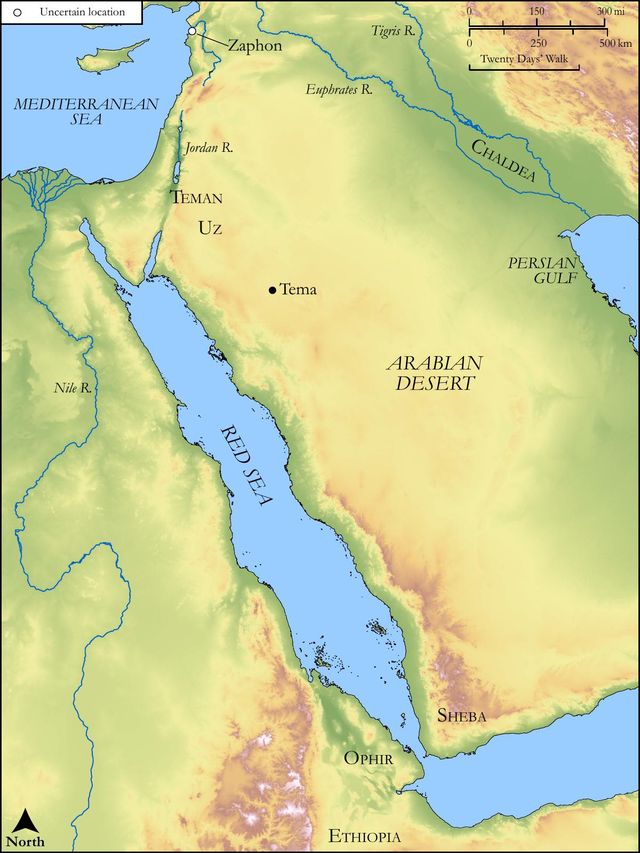
See on the biblical-era map
Study this verse
Public-domain commentary
Matthew Henry
From his Commentary on the Whole Bible. Henry comments on passages, not single verses — this entry covers Job 28:1–11. His three-level outline is real structure in the source text, so it is rendered as structure.
Here Job shows, 1. What a great way the wit of man may go in diving into the depths of nature and seizing the riches of it, what a great deal of knowledge and wealth men may, by their ingenious and industrious searches, make themselves masters of. But does it therefore follow that men may, by their wit, comprehend the reasons why some wicked people prosper and others are punished, why some good people prosper and others are afflicted? No, by no means. The caverns of the earth may be discovered, but not the counsels of heaven. 2. What a great deal of care and pains worldly men take to get riches. He had observed concerning the wicked man (Job 27:16) that he heaped up silver as the dust; now here he shows whence that silver came which he was so fond of and how it was obtained, to show what little reason wicked rich men have to be proud of their wealth and pomp. Observe here,
I.The wealth of this world is hidden in the earth.
Thence the silver and the gold, which afterwards they refine, are fetched, Job 28:1. There they lay mixed with a great deal of dirt and dross, like a worthless thing, of no more account than common earth; and abundance of them will so lie neglected, till the earth and all the works therein shall be burnt up. Holy Mr. Herbert, in his poem called Avarice, takes notice of this, to shame men out of the love of money: -
Money, thou bane of bliss, thou source of woe,
Whence com'st thou, that thou art so fresh and fine?
I know thy parentage is base and low;
Man found thee poor and dirty in a mine.
Surely thou didst so little contribute
To this great kingdom which thou now hast got
That he was fain, when thou wast destitute,
To dig thee out of thy dark cave and grot.
Man calleth thee his wealth, who made thee rich,
And while he digs out thee falls in the ditch.
Iron and brass, less costly but more serviceable metals, are taken out of the earth (Job 28:2), and are there found in great abundance, which abates their price indeed, but is a great kindness to man, who could much better be without gold than without iron. Nay, out of the earth comes bread, that is, bread-corn, the necessary support of life, Job 28:5. Thence man's maintenance is fetched, to remind him of his own original; he is of the earth, and is hastening to the earth. Under it is turned up as it were fire, precious stones, that sparkle as fire - brimstone, that is apt to take fire - coal, that is proper to feed fire. As we have our food, so we have our fuel, out of the earth. There the sapphires and other gems are, and thence gold-dust is digged up;, Job 28:6. The wisdom of the Creator has placed these things, 1. Out of our sight, to teach us not to set our eyes upon them, Pro 23:5. 2. Under our feet, to teach us not to lay them in our bosoms, nor to set our hearts upon them, but to trample upon them with a holy contempt. See how full the earth is of God's riches (Psa 104:24) and infer thence, not only how great a God he is whose the earth is and the fulness thereof (Psa 24:1), but how full heaven must needs be of God's riches, which is the city of the great King, in comparison with which this earth is a poor country.
II.The wealth that is hidden in the earth cannot be obtained but with a great deal of difficulty.
1.It is hard to be found out: there is but here and there a vein for the silver, Job 28:1. The precious stones, though bright themselves, yet, because buried in obscurity and out of sight, are called stones of darkness and the shadow of death. Men may search long before they light on them.
2.When found out it is hard to be fetched out. Men's wits must be set on work to contrive ways and means to get this hidden treasure into their hands. They must with their lamps set an end to darkness; and if one expedient miscarry, one method fail, they must try another, till they have searched out all perfection, and turned every stone to effect it, Job 28:3. They must grapple with subterraneous waters (Job 28:4, Job 28:10, Job 28:11), and force their way through rocks which are, as it were, the roots of the mountains, Job 28:9. Now God has made the getting of gold, and silver, and precious stones, so difficult,
(1.)For the exciting and engaging of industry. Dii laboribus omnia vendunt - Labour is the price which the gods affix to all things. If valuable things were too easily obtained men would never learn to take pains. But the difficulty of gaining the riches of this earth may suggest to us what violence the kingdom of heaven suffers.
(2.)For the checking and restraining of pomp and luxury. What is for necessity is had with a little labour from the surface of the earth; but what is for ornament must be dug with a great deal of pains out of the bowels of it. To be fed is cheap, but to be fine is chargeable.
III.Though the subterraneous wealth is thus hard to obtain, yet men will have it.
He that loves silver is not satisfied with silver, and yet is not satisfied without it; but those that have much must needs have more. See here,
1.What inventions men have to get this wealth. They search out all perfection, Job 28:3. They have arts and engines to dry up the waters, and carry them off, when they break in upon them in their mines and threaten to drown the work, Job 28:4. They have pumps, and pipes, and canals, to clear their way, and, obstacles being removed, they tread the path which no fowl knoweth (Job 28:7, Job 28:8), unseen by the vulture's eye, which is piercing and quick-sighted, and untrodden by the lion's whelps, which traverse all the paths of the wilderness.
2.What pains men take, and what vast charge they are at, to get this wealth. They work their way through the rocks and undermine the mountains, Job 28:10.
3.What hazards they run. Those that dig in the mines have their lives in their hands; for they are obliged to bind the floods from overflowing (Job 28:11), and are continually in danger of being suffocated by damps or crushed or buried alive by the fall of the earth upon them. See how foolish man adds to his own burden. He is sentenced to eat bread in the sweat of his face; but, as if that were not enough, he will get gold and silver at the peril of his life, though the more is gotten the less valuable it is. In Solomon's time silver was as stones. But,
4.Observe what it is that carries men through all this toil and peril: Their eye sees every precious thing, Job 28:10. Silver and gold are precious things with them, and they have them in their eye in all these pursuits. They fancy they see them glittering before their faces, and, in the prospect of laying hold of them, they make nothing of all these difficulties; for they make something of their toil at last: That which is hidden bringeth he forth to light, Job 28:11. What was hidden under ground is laid upon the bank; the metal that was hidden in the ore is refined from its dross and brought forth pure out of the furnace; and then he thinks his pains well bestowed. Go to the miners then, thou sluggard in religion; consider their ways, and be wise. Let their courage, diligence, and constancy in seeking the wealth that perisheth shame us out of slothfulness and faint-heartedness in labouring for the true riches. How much better is it to get wisdom than gold! How much easier and safer! Yet gold is sought for, but grace neglected. Will the hopes of precious things out of the earth (so they call them, though really they are paltry and perishing) be such a spur to industry, and shall not the certain prospect of truly precious things in heaven be much more so?
Historical interpretation
Historical reception
2 surviving comments on this verse. Each one is dated, so this reads as a timeline rather than a list.
Select a marker to jump to its quote. Markers stagger vertically where authors wrote within a few decades of each other.
Even though they sail in the air and reach paths close to heaven, they cannot approach those through which knowledge is attained. “That path no bird knows.” The context of the exposition seems to demand that effects and duties follow the knowledge that he has set out to describe and that he assigns parts of it, so that people, with its guidance, may reach in the hope of their search those places that had previously been far removed from the access of mortals. And, according to his custom, he exaggeratedly says huge deserts are reached by people that are far removed from birds and other beasts while they are trodden by human foot. “The sons of the merchants have not trodden it.” While he sets out to show that people penetrate the deserts, how can he now deny that wildernesses are trodden by the feet of merchants? Therefore, it seems that here he has shown the scarceness of the travelers and has denied the frequency of the merchants. “The lioness has not passed over it.” No bird or reptile or quadruped ever knew those things that reason, the examiner and researcher of hidden things, has found.
54. Who is denoted in this place by the title of’ the bird,’ saving He, Who in ascending poised sky wards the fleshly body, which He took to Him. Who furthermore is fitly designated by the title of the ‘vulture’ as well. For the ‘vulture’ while it is flies if it sees a carcase lying, drops itself down for the devouring of the carcase, and very often it is in this way taken in death, when it has come from on high after the dead animal. Rightly therefore is the Mediator between God and Man, our Redeemer, denoted by the appellation of a ‘vulture,’ Who whilst remaining in the loftiness of His Divine Nature, marked as it were from a kind of flight on high the carcase of our mortal being down below, and let Himself drop from the regions of heaven to the lowest places. For in our behalf He vouchsafed to become man, and while he sought the dead creature, He found death among us, Who was deathless in Himself. Now ‘the eye’ of this ‘vulture’ was the actual aiming at our Resurrection, because He Himself being dead for three days set us free from everlasting death. And so that faithless people of Judaea saw Him in the state of mortality, but how by His death He should destroy our death, it noted not. It beheld, indeed, the vulture, but’ the eyes of the vulture it did not behold.’ Which People, whereas it refused to regard the ways of His humility, whereby He lifted us up on high, ‘knew not the pathway of the bird.’ For neither did it betake itself to consider that His humility would lift us to the heavenly heights, and the aim of His death renew us to life. Therefore the pathway of the bird it knew not, nor beheld the eyes of the vulture. For though it saw Him Whom it held bound in death, it refused to see what wonderful glory by His death followed our life [al. ‘what glory in our life should follow from His death’]. And hence it was kindled to the cruelty of persecution likewise; it refused to receive the words of life; the Preachers of the kingdom of heaven, by forbidding, by evil entreating, by smiting it thrust from it. Which same, being so thrust off, abandoning Judaea whereto they had been sent, were dispersed for the gathering together of the Gentile world.
Continue studying Job 28:7 across the web’s major study libraries — every link below opens this exact verse, chapter, or book on the destination site.
Read & Compare
 BibleGatewayThis verse in more than 200 translations and 70 languages.
 Bible.comThe YouVersion reader — hundreds of translations, reading plans, and highlights.
 ESV.orgCrossway's official English Standard Version reader.
 NET BibleThe NET translation with 60,000+ translators' notes on every rendering decision.
 STEP BibleTyndale House's free study tool — original text, vocabulary, and scholarly resources.
 BibliaLogos Bible Software's free web reader.
 USCCBThe New American Bible (Revised Edition) with the U.S. bishops' study notes.
Commentaries
 BibleHub CommentariesDozens of classic commentaries on this verse, gathered on one page.
 StudyLightMore than 100 commentary sets — the largest collection on the web.
 BibleRefPlain-English commentary on what this verse means, verse by verse.
 Enduring WordDavid Guzik's free commentary on this chapter, widely used by Bible teachers.
 Bible Study ToolsVerse commentary alongside Greek and Hebrew study aids.
Original Language & Research
- BibleHub InterlinearThe verse word by word — original language, transliteration, and English.
- BibleHub LexiconEvery word's original-language definition and Strong's entry.
 Blue Letter BibleDeep-study tools — Strong's numbers, concordance, and word studies.
 SefariaThe Hebrew text with Rashi and centuries of Jewish commentary.
Sermons, Hymns & Audio


TrulyRandomVerse is not affiliated with these sites and doesn’t control their content. They’re linked because they’re genuinely useful.
Summary
Job 28:7, situated within a profound wisdom poem, vividly portrays humanity's remarkable ingenuity and tireless effort in unearthing hidden earthly treasures like precious metals and gems. The verse employs striking imagery of a "path" inaccessible even to the keenest natural perception, specifically "no fowl" and "the vulture's eye," to underscore the extreme depths and secrecy of these human-made mining routes. This powerful illustration serves as a poignant analogy, setting the stage for the chapter's overarching argument: if humanity expends such immense effort to find material wealth in places hidden from all natural sight, how much more elusive and profound is true, divine wisdom, which cannot be discovered through human effort or natural means alone.
Context
ShowHideLiterary Context
Job 28 stands as a magnificent poetic interlude within the larger book of Job, appearing after Job's final discourse (chapters 26-27) and before the climactic speeches of God (chapters 38-41). It is a self-contained wisdom poem, distinct from the preceding dialogues where Job and his friends debate the nature of suffering and divine justice. This chapter shifts the focus from Job's personal lament and theological arguments to a universal exploration of the source and nature of wisdom. Verses 1-11 describe humanity's incredible skill in mining, delving deep into the earth to extract precious resources. Verse 7 specifically contributes to this vivid portrayal of human ingenuity, emphasizing the hidden, inaccessible nature of these mining paths, thereby building the contrast that will be fully developed in the latter half of the chapter, particularly in Job 28:12 where the question of wisdom's location is explicitly posed.
Historical & Cultural Context
The lands of the east, including Edom (often associated with the setting of Job), were known for its extensive mining activities, particularly for copper, iron, gold, and precious stones. This passage reflects a sophisticated understanding of ancient mining techniques, which involved digging deep shafts and intricate tunnels into the earth, often in remote and treacherous terrains. The "path" mentioned in Job 28:7 is not a surface trail but refers to these subterranean passages. The immense value placed on these extracted minerals drove humans to undertake incredibly dangerous and laborious endeavors. The imagery of birds, especially the vulture, highlights the contrast between the natural world and the human domain. Vultures and eagles were (and are) renowned for their exceptional long-distance eyesight, making their inability to "see" these paths a powerful testament to the extreme hiddenness and human-specific nature of these underground ventures.
Key Themes
ShowHideThe primary theme of Job 28 is the elusiveness and divine origin of true wisdom. The initial verses, including Job 28:7, establish humanity's remarkable capacity for discovering and extracting earthly treasures, demonstrating human ingenuity and perseverance in the pursuit of material wealth. This sets up a profound contrast between the discoverability of physical riches and the profound mystery surrounding the acquisition of divine wisdom. The chapter argues that while humans can conquer the physical world, they cannot, through their own efforts or natural senses, discover true wisdom. This theme culminates in Job 28:28, which declares that "the fear of the Lord, that is wisdom; and to depart from evil is understanding." Thus, the verse contributes to the overarching message that genuine wisdom is not a human discovery but a divine revelation, rooted in a right relationship with God.
Exposition and Analysis
ShowHideKey Word Analysis
ShowHideFrom an unused root meaning "to tramp," this word refers to a beaten track or pathway. In this context, it signifies the specific, often hidden, and sometimes dangerous routes created by miners. It implies a difficult, carved-out way, not a naturally occurring one, emphasizing human determination and skill in penetrating the earth's secrets for material gain.
This term broadly refers to swift, rapacious birds, often birds of prey. In biblical literature, it frequently denotes birds known for their keen eyesight and predatory nature. The inclusion of "fowl" here emphasizes that even creatures with superior natural senses, capable of surveying vast landscapes from above, cannot discern these hidden, human-made routes.
This word is thought to derive from a root meaning "to scream" and refers to a hawk or a vulture, both known for their exceptionally sharp, far-reaching vision. By specifically mentioning the "vulture," the text intensifies the hyperbole, underscoring the extreme concealment of these mining paths. If even the creature with the most acute vision in the natural world cannot see them, their hiddenness is truly profound.
Verse Breakdown
ShowHide"[There is] a path"
This phrase introduces the central image of the verse: a specific, hidden route. The use of "path" (Hebrew nātîb) here is crucial, as it refers not to a common, open road but to the intricate, often subterranean, and deliberately concealed passages created by human miners to access deep veins of ore and precious stones. It signifies a way that is not naturally occurring or easily discernible.
"which no fowl knoweth"
This clause emphasizes the extreme hiddenness of this path. "Fowl" refers to birds, particularly those with keen senses and the ability to survey large areas from above. The assertion that no bird, despite its natural instincts and aerial perspective, can "know" or find this path highlights its artificial, human-made nature and its deep concealment from the natural world. It underscores the unique domain of human endeavor.
"and which the vulture's eye hath not seen"
This second clause intensifies the previous statement through specific example. The "vulture's eye" (or eagle's eye, as the Hebrew word for vulture/eagle, nesher, often implies) is proverbial for its unparalleled sharpness and ability to spot minute details from great distances. By stating that even this most acute natural vision cannot "see" these paths, the text powerfully conveys their profound secrecy and inaccessibility to the natural world, further emphasizing the extraordinary lengths to which humans go in their pursuit of earthly treasures.
Literary Devices
ShowHideJob 28:7 masterfully employs several literary devices to convey its message. Metaphor is central, as the miner's "path" and the human pursuit of hidden earthly treasures serve as a profound metaphor for the equally arduous, yet ultimately futile, human quest for true wisdom through natural means. The verse also utilizes Hyperbole by exaggerating the hiddenness of these paths, stating that not even the keenest natural sight—that of "fowl" and specifically the "vulture's eye"—can perceive them. This exaggeration effectively underscores the extraordinary lengths and unique human ingenuity involved in mining. Furthermore, there is a strong element of Contrast, subtly setting up the distinction between the discoverability of material wealth through human effort and the ultimate inaccessibility of divine wisdom by similar means, a contrast that becomes the driving force of the entire chapter.
Theological and Thematic Connections
ShowHideThis verse, by vividly illustrating humanity's relentless and ingenious pursuit of material wealth in the earth's hidden places, lays the groundwork for a profound theological truth: the ultimate source and nature of true wisdom. While humans can penetrate the deepest parts of the earth for gold and jewels, they are utterly incapable of discovering divine wisdom through similar means of exploration, ingenuity, or natural perception. This wisdom is not found in the physical world, nor is it a product of human intellect or effort. Instead, the chapter strongly implies, and later explicitly states, that true wisdom is a revelation from God, rooted in reverent submission to Him. This aligns with a consistent biblical theme that divine wisdom is distinct from human knowledge and is ultimately found in God alone.
Reflection and Application
ShowHideJob 28:7 challenges us to consider what we prioritize and where we direct our most intense efforts. Just as ancient miners expended incredible energy, skill, and risk to unearth hidden earthly treasures, so too do we often dedicate our lives to pursuing wealth, status, knowledge, or fleeting pleasures. The "path" we tread for these earthly gains can be incredibly complex, demanding, and hidden from plain sight, requiring immense focus and determination. Yet, this verse, in the context of the entire chapter, gently but firmly redirects our gaze. If we are willing to go to such extraordinary lengths for what is temporal and material, how much more should we strive for the wisdom that is eternal and divine? It prompts us to examine whether our pursuit of God's wisdom—which begins with the fear of the Lord—is as fervent and dedicated as our pursuit of worldly success. This verse calls us to re-evaluate our ultimate treasures and to seek the wisdom that truly enriches the soul and guides us in the ways of righteousness.
Questions for Reflection
ShowHideFAQ
ShowHideWhy is the "vulture's eye" specifically mentioned in this verse?
ShowHideThe "vulture's eye" is specifically mentioned to emphasize the extreme hiddenness and inaccessibility of the miner's path to the natural world. Vultures (or eagles, as the Hebrew word nesher can also mean) are renowned for their exceptionally keen eyesight, capable of spotting small prey from vast distances. By stating that even such a creature, with its superlative vision, cannot see these paths, the text uses hyperbole to powerfully convey just how deeply concealed and uniquely human these underground routes are. This serves to amplify the contrast later in the chapter, highlighting that if human ingenuity can hide paths from the sharpest natural senses, then true wisdom is even more profoundly hidden from human discovery, requiring a divine source.
How does this verse relate to the rest of Job 28?
ShowHideJob 28:7 is a crucial part of the introductory section of the wisdom poem in Job 28. Verses 1-11 describe the remarkable human capacity to explore the earth's depths and extract its hidden treasures—gold, silver, iron, and precious stones. Verse 7 specifically illustrates the extreme lengths and ingenuity involved in this human endeavor, portraying mining paths that are so secret and deep that no creature, not even those with the keenest natural senses like the vulture, can find them. This vivid depiction of human mastery over the physical world sets up a powerful analogy for the central question of the chapter: if humans are so adept at finding earthly riches, where then can true wisdom be found? The verse thus establishes the premise for the profound contrast developed in the rest of the chapter, ultimately leading to the conclusion in Job 28:28 that true wisdom is not discovered by human effort but is found in the fear of the Lord.
Christ-Centered Fulfillment
ShowHideJob 28:7, with its imagery of a hidden path to invaluable treasures, finds its ultimate Christ-centered fulfillment in the person of Jesus Christ, who is the very embodiment and revelation of God's hidden wisdom. While humanity diligently seeks earthly riches through complex and unseen "paths," the true, divine wisdom that eludes human discovery (as highlighted in Job 28:12) is fully revealed in Christ. He is not merely a path to wisdom, but wisdom incarnate, the one "in whom are hidden all the treasures of wisdom and knowledge" (Colossians 2:3). The "path" to God, which no natural eye or human ingenuity could ever discern, is made manifest in Jesus, who declares, "I am the way, the truth, and the life; no one comes to the Father except through Me" (John 14:6). He is the "wisdom of God" (1 Corinthians 1:24) who reveals the Father, making known the deep things of God that were previously hidden from human understanding (Matthew 11:27). Thus, the ultimate treasure, divine wisdom, is not found in the earth's depths but is freely given to those who, by faith, embrace Christ, the very wisdom of God.