


Job 28:21
Bible text: King James Version (1769 Blayney text) · Public domain
Bible text: Berean Standard Bible · Public domain
Bible text: American Standard Version (1901) · Public domain
Bible text: World English Bible, Messianic edition · Public domain
Bible text: Geneva Bible (1599) · Public domain
Bible text: Young's Literal Translation · Public domain
- וְנֶעֶלְמָהVe·ne·'el·mahand it has been concealedH5956Conj-w ¦ V-Niphal-ConsecPerf-3fsVerb Niphal Consecutive Perfect 3rd Singular Feminineוְandנֶעֶלְמָהit has been concealed
- מֵעֵינֵיme·'ei·Neifrom [the] eyes ofH5869Prep-m ¦ N-fdcNoun Dual Feminine Constructמֵfromעֵינֵי[the] eyes of
- כָלkholeveryH3605N-mscNoun Singular Masculine Construct
- חָיChailiving [thing]H2416Adj-msAdjective Singular Masculine Absolute
- וּמֵעוֹףu·me·'ofand from [the] bird[s] ofH5775Conj-w ¦ Prep-m ¦ N-mscNoun Singular Masculine Constructוּandמֵfromעוֹף[the] bird[s] of
- הַשָּׁמַיִםha·sha·Ma·yimthe heavensH8064Art ¦ N-mpNoun Plural Masculine Absoluteהַtheשָּׁמַיִםheavens
- נִסְתָּרָהnis·Ta·rahit has been hiddenH5641V-Niphal-Perf-3fsVerb Niphal Perfect 3rd Singular Feminine
English is a literal word-by-word gloss of the Hebrew, not the KJV's wording. Why?
This is the original text the KJV's translators worked from — each Hebrew word with its own literal English meaning in this verse, prepared by scholars at Tyndale House, Cambridge. The KJV translates whole sentences, not word by word, so its wording differs: one Hebrew word can become several English words, and the KJV may choose “the LORD” where the gloss reads “Yahweh”. Both are faithful — they answer different questions. For the KJV's own rendering, switch to the KJV text.
Details
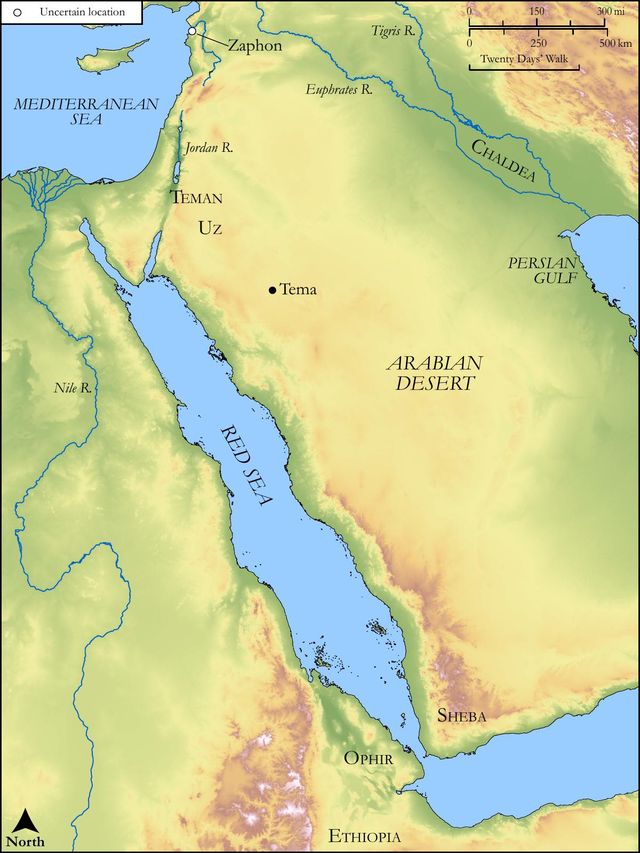
See on the biblical-era map
Study this verse
Public-domain commentary
Matthew Henry
From his Commentary on the Whole Bible. Henry comments on passages, not single verses — this entry covers Job 28:20–28. His four-level outline is real structure in the source text, so it is rendered as structure.
The question which Job had asked (Job 28:12) he asks again here; for it is too worthy, too weighty, to be let fall, until we speed in the enquiry. Concerning this we must seek till we find, till we get some satisfactory account of it. By a diligent prosecution of this enquiry he brings it, at length, to this issue, that there is a twofold wisdom, one hidden in God, which is secret and belongs not to us, the other made known by him and revealed to man, which belongs to us and to our children.
I.The knowledge of God's secret will, the will of his providence, is out of our reach, and what God has reserved to himself.
It belongs to the Lord our God. To know the particulars of what God will do hereafter, and the reasons of what he is doing now, is the knowledge Job first speaks of.
1.This knowledge is hidden from us. It is high, we cannot attain unto it (Job 28:21, Job 28:22): It is hid from the eyes of all living, even of philosophers, politicians, and saints; it is kept close from the fowls of the air; though they fly high and in the open firmament of heaven, though they seem somewhat nearer that upper world where the source of this wisdom is, though their eyes behold afar off (Job 39:29), yet they cannot penetrate into the counsels of God. No, man is wiser than the fowls of heaven, and yet comes short of this wisdom. Even those who, in their speculations, soar highest, and think themselves, like the fowls of the air, above the heads of other people, yet cannot pretend to this knowledge. Job and his friends had been arguing about the methods and reasons of the dispensations of Providence in the government of the world. "What fools are we" (says Job) "to fight in the dark thus, to dispute about that which we do not understand!" The line and plummet of human reason can never fathom the abyss of the divine counsels. Who can undertake to give the rationale of Providence, or account for the maxims, measure, and methods of God's government, those arcana imperii - cabinet counsels of divine wisdom? Let us then be content not to know the future events of the Providence until time discover them (Act 1:7) and not to know the secret reasons of Providence until eternity discover them. God is now a God that hideth himself (Isa 45:15); clouds and darkness are round about him. Though this wisdom be hidden from all living, yet destruction and death say, We have heard the fame of it. Though they cannot give an account of themselves (for there is no wisdom, nor device, nor knowledge at all in the grave, much less this), yet there is a world on the other side death and the grave, on which those dark regions border, and to which we must pass through them, and there we shall see clearly what we are now in the dark about. "Have a little patience," says Death to the inquisitive soul: "I will fetch thee shortly to a place where even this wisdom will be found." When the mystery of God shall be finished it will be laid open, and we shall know as we are known; when the veil of flesh is rent, and the interposing clouds are scattered, we shall know what God does, though we know not now, Joh 13:7.
2.This knowledge is hidden in God, as the apostle speaks, Eph 3:9. Known unto God are all his works, though they are not known to us, Act 15:18. There are good reasons for what he does, though we cannot assign them (Job 28:23): God understands the way thereof. Men sometimes do they know not what, but God never does. Men do what they did not design to do; new occurrences put them upon new counsels, and oblige them to take new measures. But God does all according to the purpose which he purposed in himself, and which he never alters. Men sometimes do that which they cannot give a good reason for, but in every will of God there is a counsel: he knows both what he does and why he does it, the whole series of events and the order and place of every occurrence. This knowledge he has in perfection, but keeps to himself. Two reasons are here given why God must needs understand his own way, and he only: -
(1.)Because all events are now directed by an all-seeing and almighty Providence, Job 28:24, Job 28:25. He that governs the world is,
[1.]Omniscient; for he looks to the ends of the earth, both in place and time; distant ages, distant regions, are under his view. We do not understand our own way, much less can we understand God's way, because we are short-sighted. How little do we know of what is doing in the world, much less of what will be done? But the eyes of the Lord are in every place; nay, they run to and fro through the earth. Nothing is, or can be, hidden from him; and therefore the reasons why some wicked people prosper remarkably and others are remarkably punished in this world, which are secret to us, are known to him. One day's events, and one man's affairs, have such a reference to, and such a dependence upon, another's, that he only to whom all events and all affairs are naked and open, and who sees the whole at one entire and certain view, is a competent Judge of every part.
[2.]He is omnipotent. He can do every thing, and is very exact in all he does. For proof of this Job mentions the winds and waters, Job 28:25. What is lighter than the wind? Yet God hath ways of poising it. He knows how to make the weight for the winds, which he brings out of his treasuries (Psa 135:7), keeping a very particular account of what he draws out, as men do of what they pay out of their treasuries, not at random, as men bring out their trash. Nothing sensible is to us more unaccountable than the wind. We hear the sound of it, yet cannot tell whence it comes, nor whither it goes; but God gives it out by weight, wisely ordering both from what point it shall blow and with what strength. The waters of the sea, and the rain-waters, he both weighs and measures, allotting the proportion of every tide and every shower. A great and constant communication there is between clouds and seas, the waters above the firmament and those under it. Vapours go up, rains come down, air is condensed into water, water rarefied into air; but the great God keeps an exact account of all the stock with which this trade is carried on for the public benefit and sees that none of it be lost. Now if, in these things, Providence be so exact, much more in dispensing frowns and favours, rewards and punishments, to the children of men, according to the rules of equity.
(2.)Because all events were from eternity designed and determined by an infallible prescience and immutable decree, Job 28:26, Job 28:27. When he settled the course of nature he foreordained all the operations of his government.
[1.]He settled the course of nature. Job mentions particularly a decree for the rain and a way for the thunder and lightening. The general manner and method, and the particular uses and tendencies, of these strange performances, both their causes and their effects, were appointed by the divine purpose; hence God is said to prepare lightnings for the rain, Psa 135:7; Jer 10:13.
[2.]When he did that he laid all the measures of his providence, and drew an exact scheme of the whole work from first to last. Then, from eternity, did he see in himself, and declare to himself, the plan of his proceedings. Then he prepared it, fixed it, and established it, set every thing in readiness for all his works, so that, when any thing was to be done, nothing was to seek, nor could any thing unforeseen occur, to put it either out of its method or out of its time; for all was ordered as exactly as if he had studied it and searched it out, so that, whatever he does, nothing can be put to it nor taken from it, and therefore it shall be for ever, Ecc 3:14. Some make Job to speak of wisdom here as a person, and translate it, Then he saw her and showed her, etc., and then it is parallel with that of Solomon concerning the essential wisdom of the Father, the eternal Word, Pro 8:22, etc. Before the earth was, then was I by him, Joh 1:1, Joh 1:2.
II.The knowledge of God's revealed will, the will of his precept, and this is within our reach; it is level to our capacity, and will do us good (Job 28:28): Unto man he said, Behold, the fear of the Lord that is wisdom. Let it not be said that when God concealed his counsels from man, and forbade him that tree of knowledge, it was because he grudged him any thing that would contribute to his real bliss and satisfaction; no, he let him know as much as he was concerned to know in order to his duty and happiness; he shall be entrusted with as much of his sovereign mind as is needful and fit for a subject, but he must not think himself fit to be a privy-counsellor. He said to Adam (so some), to the first man, in the day in which he was created; he told him plainly it was not for him to amuse himself with over-curious searches into the mysteries of creation, nor to pretend to solve all the phenomena of nature; he would find it neither possible nor profitable to do so. No less wisdom (says archbishop Tillotson) than that which made the world can thoroughly understand the philosophy of it. But let him look upon this as his wisdom, to fear the Lord and to depart from evil; let him learn that, and he is learned enough; let this knowledge serve his turn. When God forbade man the tree of knowledge he allowed him the tree of life, and this is that tree, Pro 3:18. We cannot attain true wisdom but by divine revelation. The Lord giveth wisdom, Pro 2:6. Now the matter of that is not found in the secrets of nature or providence, but in the rules for our own practice. Unto man he said, not, "Go up to heaven, to fetch happiness thence;" or, "Go down to the deep, to draw it up thence." No, the word is nigh thee, Deu 30:14. He hath shown thee, O man! not what is great, but what is good, not what the Lord thy God designs to do with thee, but what he requires of thee, Mic 6:8. Unto you, O men! I call, Pro 8:4. Lord, what is man that he should be thus minded, thus visited! Behold, mark, take notice of this; he that has ears let him hear what the God of heaven says to the children of men: The fear of the Lord, that is the wisdom. Here is,
1.The description of true religion, pure religion, and undefiled; it is to fear the Lord and depart from evil, which agrees with God's character of Job, Job 1:1. The fear of the Lord is the spring and summary of all religion. There is a slavish fear of God, springing from hard thoughts of him, which is contrary to religion, Mat 25:24. There is a selfish fear of God springing from dreadful thoughts of him, which may be a good step towards religion, Act 9:5. But there is a filial fear of God, springing from great and high thoughts of him, which is the life and soul of all religion. And, wherever this reigns in the heart, it will appear by a constant care to depart from evil, Pro 16:6. This is essential to religion. We must first cease to do evil, or we shall never learn to do well. Virtus est vitium fugere - Even in our flight from vice some virtue lies.
2.The commendation of religion: it is wisdom and understanding. To be truly religious is to be truly wise. As the wisdom of God appears in the institution of religion, so the wisdom of man appears in the institution of religion, so the wisdom of man appears in the practice and observance of it. It is understanding, for it is the best knowledge of truth; it is wisdom, for it is the best management of our affairs. Nothing more surely guides our way and gains our end than being religious.
Historical interpretation
Two Centuries of Reception
2 surviving comments on this verse. Each one is dated, so this reads as a timeline rather than a list.
Select a marker to jump to its quote. Markers stagger vertically where authors wrote within a few decades of each other.
These words suggest that even though Christ is presented through a simile, he is, however, above any simile or figure or type and is by no means comparable to the saints. He is said to be similar to the hidden and superior powers, but it is well known that they cannot even direct their looks to him.
2. For in Holy Scripture ‘birds’ are sometimes given to be understood in a bad sense, and sometimes in a good sense. Since by the birds of the air occasionally the powers of the air are denoted, being hostile to the settled purposes of good men. Whence it is said by the mouth of Truth, And when he sowed, some seeds fell by the wayside, and the fowls of the air came and devoured it; [Matt. 13, 4] in this way, because evilspirits besetting the minds of men, whilst they bring in bad thoughts, pluck the word of life out of the memory. Hence again it is said to a certain rich man full of proud thoughts; the foxes have holes, and the birds of the air have nests, but the Son of Man hath not where to lay His Head. [Matt. 8, 20. Luke 9, 58.] For foxes are very cunning animals, that hide themselves in ditches and caves; and when they face the light, they never run in straight courses, but always by crooked doublings. But the birds as we know with lofty flight lift themselves into the air. So, then, by the name of ‘foxes,’ the crafty and cunning demons, and by the title of the ‘birds of the air’ these same proud demons are denoted. As if he said, ‘The deceitful and uplifted demons find their habitation in your heart; i.e. in the imagination of pride,’ ‘but the Son of Man hath not where to lay His Head,’ i.e. ‘My humility findeth not rest in your proud mind.’ For as by a kind of flight that first bird lifted itself up, which said in the uplifted imagination of the heart; I will ascend into heaven, I will exalt my throne above the stars of God: I will sit also upon the mount of the congregation in the sides of the North. I will ascend above the heights of the clouds. I will be like the Most High. [Is. 14, 13] Mark how he in flying sought the regions on high with pride. Which same flight also he recommended to the first of human kind as well. For they themselves by flying as it were tried to go above their own selves, when it was told them that they should taste and be like gods. And while they seek after the likeness of the Deity, they lost the blessings of immortality, which same would not by dying have gone into the earth, if they had been willing to stand with humility upon the earth.
3. But, on the other hand, ‘the birds of the air’ are wont to be put in a good sense, as in the Gospel the Lord, when He was declaring a likeness of the kingdom of heaven by a grain of mustard seed, said, Unto what is the kingdom of heaven like? and whereunto shall I resemble it? It is like a grain of mustard seed, which a man took and cast into his garden, and it grew and waxed a great tree, and the fowls of the air lodged in the branches of it. [Luke 13, 18. 19.] For He is Himself ‘a grain of mustard seed,’ Who, when He was planted in the burial place of the garden, rose up a great tree. For He was ‘a grain,’ whereas He died, but ‘a tree,’ whereas He rose again. ‘A grain,’ through the abasement of the flesh, ‘a tree,’ through the mightiness of His Majesty. ‘A grain,’ because we have seen Him, and He was not regarded [Is. 53, 2]; but ‘a tree,’ because fairer in form than the children of men. [Ps. 45, 2] The branches of this tree are the holy preachers. And let us see how wide they are stretched out. For what is said concerning them? Their sound is gone forth into all the earth, and their words to the end of the world. [Ps. 19, 4] In these ‘boughs the birds of the air rest,’ because the holy souls, which by a kind of wings of virtues lift themselves up from earthly thinking, do in the word and consolations of these take breath from the wearying of this life. And so in this place after it was said of ‘Wisdom,’ It is hid from the eyes of all men; it is rightly added, It is kept close also from the fowls of the air: because being settled in the corruptible flesh, these very persons do not in seeing penetrate the mightiness of His Nature, who earn by holy contemplation even now to fly with wings.
Continue studying Job 28:21 across the web’s major study libraries — every link below opens this exact verse, chapter, or book on the destination site.
Read & Compare
 BibleGatewayThis verse in more than 200 translations and 70 languages.
 Bible.comThe YouVersion reader — hundreds of translations, reading plans, and highlights.
 ESV.orgCrossway's official English Standard Version reader.
 NET BibleThe NET translation with 60,000+ translators' notes on every rendering decision.
 STEP BibleTyndale House's free study tool — original text, vocabulary, and scholarly resources.
 BibliaLogos Bible Software's free web reader.
 USCCBThe New American Bible (Revised Edition) with the U.S. bishops' study notes.
Commentaries
 BibleHub CommentariesDozens of classic commentaries on this verse, gathered on one page.
 StudyLightMore than 100 commentary sets — the largest collection on the web.
 BibleRefPlain-English commentary on what this verse means, verse by verse.
 Enduring WordDavid Guzik's free commentary on this chapter, widely used by Bible teachers.
 Bible Study ToolsVerse commentary alongside Greek and Hebrew study aids.
Original Language & Research
- BibleHub InterlinearThe verse word by word — original language, transliteration, and English.
- BibleHub LexiconEvery word's original-language definition and Strong's entry.
 Blue Letter BibleDeep-study tools — Strong's numbers, concordance, and word studies.
 SefariaThe Hebrew text with Rashi and centuries of Jewish commentary.
Sermons, Hymns & Audio


TrulyRandomVerse is not affiliated with these sites and doesn’t control their content. They’re linked because they’re genuinely useful.
Summary
Job 28:21 is a pivotal declaration within a profound poetic discourse on the nature of wisdom, asserting its utter inaccessibility to all created beings. It highlights that true wisdom, unlike the material treasures humanity so ingeniously extracts from the earth, remains beyond the grasp of natural perception, intellectual prowess, or any earthly endeavor, underscoring its exclusively divine origin and possession.
Context
ShowHideLiterary Context
Chapter 28 of Job stands as a unique and self-contained poetic interlude, often termed the "Hymn to Wisdom." It functions as a theological pause, distinct from the ongoing, often contentious, dialogue between Job and his friends. The chapter opens by marveling at humanity's remarkable ingenuity in mining precious metals and stones from the earth's deepest, darkest recesses, showcasing their mastery over the physical world and their ability to conquer natural obstacles, even where "the vulture's eye has not seen, nor the falcon's eye has spied it" (Job 28:7). However, this celebration of human achievement dramatically shifts in focus, posing the rhetorical question: "But where shall wisdom be found? And where is the place of understanding?" (Job 28:12). Verses 13-19 emphatically state that wisdom cannot be bought with gold, silver, or precious jewels, nor is it found in the deep or the sea. Verse 21, therefore, serves as a crucial reinforcement of wisdom's inaccessibility to all created beings, setting the stage for the chapter's climax where God alone is declared to know its path and place (Job 28:23).
Historical & Cultural Context
The Book of Job is set in the land of Uz among the men of the east, likely reflecting a patriarchal society deeply engaged with the pursuit of wisdom. Wisdom was a prominent theme in Israel (e.g., Proverbs, Ecclesiastes) and among the wise men of Egypt. The detailed description of mining operations in the early part of the chapter (Job 28:1-11) reflects a sophisticated understanding of ancient metallurgy and engineering, highlighting humanity's impressive capabilities in mastering the material world. This context amplifies the contrast: if humans can achieve such feats in the physical realm, yet cannot find wisdom, it emphasizes that divine wisdom operates on a fundamentally different plane, beyond human discovery. The imagery of "fowls of the air" might also subtly allude to ancient beliefs about birds as observers or carriers of knowledge, further emphasizing that even the most perceptive natural creatures cannot grasp this hidden truth, reinforcing the unique transcendence of divine wisdom.
Key Themes
ShowHideJob 28:21 contributes significantly to several overarching themes within the Book of Job and biblical wisdom literature. Primarily, it underscores the elusiveness and transcendence of true wisdom, establishing that it is not a commodity to be discovered or acquired through human effort or intellect, but rather a divine attribute and revelation. This highlights human limitation in comprehending ultimate truth, contrasting humanity's impressive earthly achievements with its inherent inability to grasp divine mysteries. The verse also implicitly points to divine prerogative, setting the stage for the chapter's conclusion that only God "understands its way and knows its place" (Job 28:23). This theme aligns with the broader biblical teaching that "the fear of the Lord, that is wisdom" (Job 28:28), positioning God as the exclusive source and possessor of ultimate wisdom, a truth echoed throughout scripture, such as in Proverbs 2:6.
Exposition and Analysis
ShowHideKey Word Analysis
ShowHideFrom a primitive root meaning "to veil from sight, i.e., conceal (literally or figuratively)." This word implies an intentional act of concealment, suggesting that wisdom is not merely undiscovered due to human inadequacy, but is actively withheld or veiled from perception by a divine design. It denotes a profound and deliberate inaccessibility.
Literally "an eye," but used figuratively to represent perception, understanding, and discernment. In this context, "eyes of all living" signifies the full spectrum of created beings' sensory and intellectual capacities. The fact that wisdom is hidden from their "eyes" emphasizes that it cannot be grasped through natural observation, intellectual insight, or any form of creaturely perception.
Refers to birds, often collectively. Birds are frequently associated with keen eyesight and the ability to survey vast landscapes from elevated vantage points. Their inclusion here represents the epitome of natural observation and perception, symbolizing the most perceptive and far-reaching of natural creatures. By stating that wisdom is hidden even from them, the text uses hyperbole to underscore its utter transcendence beyond any created being's natural capacity for discovery.
Verse Breakdown
ShowHide"Seeing it is hid from the eyes of all living,"
This clause establishes the universal inaccessibility of wisdom. "All living" encompasses humanity and all other creatures, emphasizing that no created being, regardless of their intelligence, sensory acuity, or position, can naturally perceive or discover true wisdom. The phrase "from the eyes" metaphorically refers to perception, understanding, and discovery, highlighting that wisdom is not merely difficult to find but is intentionally concealed from all natural means of discernment.
"and kept close from the fowls of the air."
This second clause functions as a poetic reinforcement and intensification of the first. The phrase "kept close" (from H5641 çâthar, meaning "to hide, conceal, keep secret") reinforces the idea of intentional and profound concealment. By specifically mentioning "fowls of the air," known for their elevated perspective and sharp vision, the text employs hyperbole to underscore the absolute nature of wisdom's concealment. If even creatures with the keenest natural senses and highest vantage points cannot perceive it, then its hiddenness is complete and undeniable, transcending all earthly means of discovery.
Literary Devices
ShowHideThe verse employs several powerful literary devices to convey its message. Parallelism is evident in the two clauses, "hid from the eyes of all living" and "kept close from the fowls of the air," which are synonymous, reinforcing the same idea of wisdom's inaccessibility through different but complementary imagery. This repetition emphasizes the absolute nature of its hiddenness. Hyperbole is skillfully used by including "the fowls of the air," creatures known for their superior vision and elevated perspective. By stating that wisdom is hidden even from them, the text exaggerates to underscore that wisdom is utterly beyond any natural means of discovery, no matter how keen one's perception or how far one searches. Furthermore, the verse uses metaphor, as "eyes" represent not just physical sight but also intellectual perception and understanding. Wisdom itself is almost personified as something that can be intentionally "hid" and "kept close," implying a deliberate act of concealment by its divine possessor.
Theological and Thematic Connections
ShowHideJob 28:21 is a profound theological statement on the nature of divine wisdom and human limitations. It asserts that true wisdom is not an inherent human capacity or a discovery waiting to be made through scientific inquiry or philosophical reasoning, but rather a transcendent reality that originates with God and is known fully only by Him. This perspective humbles humanity, reminding us that despite our impressive intellectual and technological achievements, there are ultimate truths that remain beyond our grasp without divine revelation. It sets the stage for the understanding that wisdom is not found in the material world or through human ingenuity, but through a relationship with the divine. The verse prepares the reader for the conclusion that the "fear of the Lord" is the beginning of wisdom, shifting the search from external exploration to internal, spiritual reverence and obedience.
Reflection and Application
ShowHideJob 28:21 serves as a profound call to humility in our pursuit of knowledge and understanding. In an age that often prioritizes human intellect, scientific discovery, and technological advancement, this verse reminds us that the deepest, most foundational truths about life, purpose, and reality are not accessible through human effort alone. It challenges us to recognize the limits of our own perception and to acknowledge that true wisdom ultimately resides with God. For believers, this means shifting our reliance from purely intellectual endeavors to a posture of dependence on divine revelation. It encourages us to seek wisdom not in the hidden depths of the earth or the farthest reaches of the sky, but in the revealed Word of God and through the guidance of the Holy Spirit. This verse underscores the importance of a reverent, worshipful approach to knowledge, recognizing that wisdom begins with the fear of the Lord and is graciously bestowed by Him.
Questions for Reflection
ShowHideFAQ
ShowHideDoes this verse suggest that humans cannot gain any wisdom at all?
ShowHideNo, Job 28:21 does not suggest that humans cannot gain any wisdom at all. Rather, it emphasizes that true, ultimate, and divine wisdom—the kind that comprehends the very essence of existence and God's sovereign plan—is not discoverable by natural human means or observation. Humanity is capable of great ingenuity and understanding in the natural world, as the preceding verses in Job 28:1-11 demonstrate. However, the wisdom being discussed here is of a different order, a transcendent wisdom that originates with God and is revealed by Him, not unearthed or observed by created beings. It sets a boundary on human autonomy in the pursuit of ultimate truth, directing us towards God as the sole source of such profound understanding, as stated in Proverbs 2:6.
Christ-Centered Fulfillment
ShowHideJob 28:21, declaring wisdom to be hidden from all living, finds its ultimate and glorious fulfillment in Jesus Christ. While Old Testament wisdom was elusive and often veiled, Christ is revealed as the very embodiment of divine wisdom. 1 Corinthians 1:24 proclaims Him as "Christ the power of God and the wisdom of God." What was hidden from the "eyes of all living" is now made manifest in Him. Colossians 2:2-3 reveals that "in Christ are hidden all the treasures of wisdom and knowledge," yet these treasures are in Him for us to discover by faith. The mystery of God's wisdom, once concealed, has been unveiled through Christ's incarnation, life, death, and resurrection (Ephesians 3:9-10). The Holy Spirit, sent by Christ, now illuminates our understanding, guiding us into all truth and revealing the "deep things of God" which no human eye or mind could ever discern on its own (1 Corinthians 2:10-12). Thus, the hidden wisdom of Job 28:21 is no longer entirely inaccessible, but is graciously revealed to those who are "in Christ," who is Himself the wisdom of God made visible and understandable to humanity.