


Jeremiah 44:27
- הִנְנִיhi·Nihere IH2005Prt ¦ 1csParticle InterjectionהִנְhereנִיI
- שֹׁקֵדsho·Ked[am] watchingH8245V-Qal-Prtcpl-msVerb Qal Participle Singular Masculine Absolute
- עֲלֵיהֶם'a·lei·Hemover themH5921Prep ¦ 3mpPreposition Definiteעֲלֵיoverהֶםthem
- לְרָעָהle·ra·'Ahfor harmH7451Prep-l ¦ N-fsNoun Singular Feminine Absoluteלְforרָעָהharm
- וְלֹאve·Lo'and notH3808Conj-w ¦ NegParticle Negativeוְandלֹאnot
- לְטוֹבָהle·to·Vahfor goodH2896Prep-l ¦ N-fsNoun Singular Feminine Absoluteלְforטוֹבָהgood
- וְתַמּוּve·ta·Muand they will meet their endH8552Conj-w ¦ V-Qal-ConsecPerf-3cpVerb Qal Consecutive Perfect 3rd Plural common genderוְandתַמּוּthey will meet their end
- כָלkholeveryH3605N-mscNoun Singular Masculine Construct
- אִישׁ'ishperson ofH376N-mscNoun Singular Masculine Construct
- יְהוּדָהye·hu·DahJudahH3063N-properNoun Proper Location
- אֲשֶׁר'a·SherwhoH834RelParticle Relative
- בְּאֶרֶץbe·'e·retz[is] in [the] land ofH776Prep-b ¦ N-fscNoun Singular Feminine Constructבְּ[is] inאֶרֶץ[the] land of
- מִצְרַיִםmitz·Ra·yimEgyptH4714N-properNoun Proper Location
- בַּחֶרֶבba·Che·revby the swordH2719Prep-b ¦ N-fsNoun Singular Feminine Absoluteבַּby theחֶרֶבsword
- וּבָרָעָבu·va·ra·'Avand by <the> famineH7458Conj-w ¦ Prep-b ¦ N-msNoun Singular Masculine Absoluteוּandבָby <the>רָעָבfamine
- עַד'aduntilH5704PrepPreposition
- כְּלוֹתָםke·lo·Tamthey come to an endH3615V-Qal-Inf ¦ 3mpVerb Qal Infinitive Constructכְּלוֹתָcome to an endםthey
English is a literal word-by-word gloss of the Hebrew, not the KJV's wording. Why?
This is the original text the KJV's translators worked from — each Hebrew word with its own literal English meaning in this verse, prepared by scholars at Tyndale House, Cambridge. The KJV translates whole sentences, not word by word, so its wording differs: one Hebrew word can become several English words, and the KJV may choose “the LORD” where the gloss reads “Yahweh”. Both are faithful — they answer different questions. For the KJV's own rendering, switch to the KJV text.
Details
See on the biblical-era map
Study this verse
Public-domain commentary
Matthew Henry
From his Commentary on the Whole Bible. Henry comments on passages, not single verses — this entry covers Jeremiah 44:20–30. His three-level outline is real structure in the source text, so it is rendered as structure.
Daring sinners may speak many a bold word and many a big word, but, after all, God will have the last word; for he will be justified when he speaks, and all flesh, even the proudest, shall be silent before him. Prophets may be run down, but God cannot; nay, here the prophet would not.
I.Jeremiah has something to say to them from himself, which he could say without a spirit of prophecy, and that was to rectify their mistake (a wilful mistake it was) concerning the calamities they had been under and the true intent and meaning of them. They said that these miseries came upon them because they had now left off burning incense to the queen of heaven. "No," says he, "it was because you had formerly done it, not because you had now left it off." When they gave him that answer, he immediately replied (Jer 44:20) that the incense which they and their fathers had burnt to other gods did indeed go unpunished a great while, for God was long-suffering towards them, and during the day of his patience it was perhaps, as they said, well with them, and they saw no evil; but at length they grew so provoking that the Lord could no longer bear (Jer 44:22), but began a controversy with them, whereupon some of them did a little reform; their sins left them, for so it might be said, rather than that they left their sins. But their old guilt being still upon the score, and their corrupt inclinations still the same, God remembered against them the idolatries of their fathers, their kings, and their princes, in the streets of Jerusalem, which they, instead of being ashamed of, gloried in as a justification of them in their idolatries; they all came into his mind (Jer 44:21), all the abominations which they had committed (Jer 44:22) and all their disobedience to the voice of the Lord (Jer 44:23), all were brought to account; and therefore, to punish them for these, is their land a desolation and a curse, as at this day (Jer 44:22); therefore, not for their late reformation, but for their old transgressions, has all this evil happened to them, as at this day, Jer 44:23. Note, The right understanding of the cause of our troubles, one would think, should go far towards the cure of our sins. Whatever evil comes upon us, it is because we have sinned against the Lord, and should therefore stand in awe and sin not.
II.Jeremiah has something to say to them, to the women particularly, from the Lord of hosts, the God of Israel, They have given their answer; now let them hear God's reply, Jer 44:24. Judah, that dwells in the land of Egypt, has God speaking to them, even there; that is their privilege. Let them observe what he says; that is their duty, Jer 44:26. Now God, in his reply, tells them plainly,
1.That, since they were fully determined to persist in their idolatry, he was fully determined to proceed in his controversy with them; if they would go on to provoke him, he would go on to punish them, and see which would get the better at last. God repeats what they had said (Jer 44:25): "You and your wives are agreed in this obstinacy; you have spoken with your mouths and fulfilled with your hands; you have said it, and you stand to it, have said it and go on to do accordingly, We will surely perform our vows that we have vowed, to burn incense to the queen of heaven," as if, though it were a sin, yet their having vowed to do it were sufficient to justify them in the doing of it; whereas no man can by his vow make that lawful to himself, much less duty, which God has already made sin. "Well" (says God), "you will accomplish, you will perform, your wicked vows: now hear what is my vow, what I have sworn by my great name;" and, if the Lord hath sworn, he will not repent, since they have sworn and will not repent. With the froward he will show himself froward, Psa 18:26.
(1.)He had sworn that what little remains of religion there were among them should be lost, Jer 44:26. Though they joined with the Egyptians in their idolatries, yet they continued upon many occasions to make mention of the name of Jehovah, particularly in their solemn oaths; they said, Jehovah liveth, he is the living God, so they owned him to be, though they worshipped dead idols; they swear, The Lord liveth (Jer 5:2), but I fear they retained this form of swearing more in honour of their nation than of their God. But God declares that his name shall no more be thus named by any man of Judah in all the land of Egypt; that is, there shall be no Jews remaining to use this dialect of their country, or, if there be, they shall have forgotten it and shall learn to swear, as the Egyptians do, by the life of Pharaoh, not of Jehovah. Note, Those are very miserable whom God has so far left to themselves that they have quite forgotten their religion and lost all the remains of their good education. Or this may intimate that God would take it as an affront to him and would resent it accordingly, if they did make mention of his name and profess any relation to him.
(2.)He hath sworn that what little remnant of people there was there should all be consumed (Jer 44:27): I will watch over them for evil; no opportunity shall be let slip to bring some judgment upon them, until there be an end of them and they be rooted out. Note, To those whom God finds impenitent sinners he will be found an implacable Judge. And, when it comes to this, they shall know (Jer 44:28) whose word shall stand, mind or theirs. They said that they should recover themselves when they returned to worship the queen of heaven; God said they should ruin themselves; and now the event will show which was in the right. The contest between God and sinners is whose word shall stand, whose will shall be done, and who shall get the better. Sinners say that they shall have peace though they go on; God says they shall have no peace. But when God judges he will overcome; God's word shall stand, and not the sinner's.
2.He tells them that a very few of them should escape the sword, and in process of time return into the land of Judah, a small number (Jer 44:28), next to none, in comparison with the great numbers that should return out of the land of the Chaldeans. This seems designed to upbraid those who boasted of their numbers that concurred in sin; there were none to speak of that did not join in idolatry: "Well," says God, "and there shall be as few that shall escape the sword and famine."
3.He gives them a sign that all these threatenings shall be accomplished in their season, that they shall be consumed here in Egypt and shall quite perish: Pharaoh-hophra, the present king of Egypt, shall be delivered into the hand of his enemies that seek his life - of his own rebellious subjects (so some) under Amasis, who usurped his throne - of Nebuchadnezzar king of Babylon (so others), who invaded his kingdom; the former is related by Herodotus, the latter by Josephus. It is likely that this Pharaoh had tempted the Jews to idolatry by promises of his favour; however, they depended upon him for his protection, and it would be more than a presage of their ruin, it would be a step towards it, if he were gone. They expected more from him than from Zedekiah king of Judah; he was a more potent and politic prince. "But," says God, "I will give him into the hand of his enemies, as I gave Zedekiah." Note, Those creature-comforts and confidences that we promise ourselves most from may fail us as soon as those that we promise ourselves least from, for they are all what God makes them, not what we fancy them.
The sacred history records not the accomplishment of this prophecy, but its silence is sufficient; we hear no more of these Jews in Egypt, and therefore conclude them, according to this prediction, lost there; for no word of God shall fall to the ground.
Continue studying Jeremiah 44:27 across the web’s major study libraries — every link below opens this exact verse, chapter, or book on the destination site.
Read & Compare
 BibleGatewayThis verse in more than 200 translations and 70 languages.
 Bible.comThe YouVersion reader — hundreds of translations, reading plans, and highlights.
 ESV.orgCrossway's official English Standard Version reader.
 NET BibleThe NET translation with 60,000+ translators' notes on every rendering decision.
 STEP BibleTyndale House's free study tool — original text, vocabulary, and scholarly resources.
 BibliaLogos Bible Software's free web reader.
 USCCBThe New American Bible (Revised Edition) with the U.S. bishops' study notes.
Commentaries
 BibleHub CommentariesDozens of classic commentaries on this verse, gathered on one page.
 StudyLightMore than 100 commentary sets — the largest collection on the web.
 BibleRefPlain-English commentary on what this verse means, verse by verse.
 Enduring WordDavid Guzik's free commentary on this chapter, widely used by Bible teachers.
 Bible Study ToolsVerse commentary alongside Greek and Hebrew study aids.
Original Language & Research
- BibleHub InterlinearThe verse word by word — original language, transliteration, and English.
- BibleHub LexiconEvery word's original-language definition and Strong's entry.
 Blue Letter BibleDeep-study tools — Strong's numbers, concordance, and word studies.
 SefariaThe Hebrew text with Rashi and centuries of Jewish commentary.
Sermons, Hymns & Audio


TrulyRandomVerse is not affiliated with these sites and doesn’t control their content. They’re linked because they’re genuinely useful.
Summary
Jeremiah 44:27 serves as a stark divine decree against the Jewish remnant who, in defiance of God's explicit command, sought refuge in Egypt after Jerusalem's fall. It pronounces that the Lord's vigilant oversight would be directed not for their welfare or prosperity, but for their utter destruction through the twin instruments of sword and famine, culminating in their complete eradication from the land they had mistakenly believed would be their sanctuary. This verse powerfully underscores the unwavering certainty of God's judgment against persistent disobedience and idolatry.
Context
ShowHideLiterary Context
This verse represents the culmination of God's final, severe pronouncement to the Jewish exiles who had settled in Egypt, as recorded in Jeremiah 44. The preceding verses detail their stubborn and unrepentant idolatry, particularly their devotion to the "Queen of Heaven," which they brazenly defended as the source of their former prosperity, directly contradicting God's truth (Jeremiah 44:17-19). Jeremiah had earlier and unequivocally warned them against fleeing to Egypt, prophesying that such disobedience would lead to death by sword, famine, and plague (Jeremiah 42:15-18). Thus, Jeremiah 44:27 functions as the definitive and inescapable fulfillment of these prior warnings, demonstrating God's unwavering commitment to His word, whether for blessing or for judgment. It underscores the tragic irony of their seeking safety in the very place God had forbidden, only to meet the very destruction they sought to escape.
Historical & Cultural Context
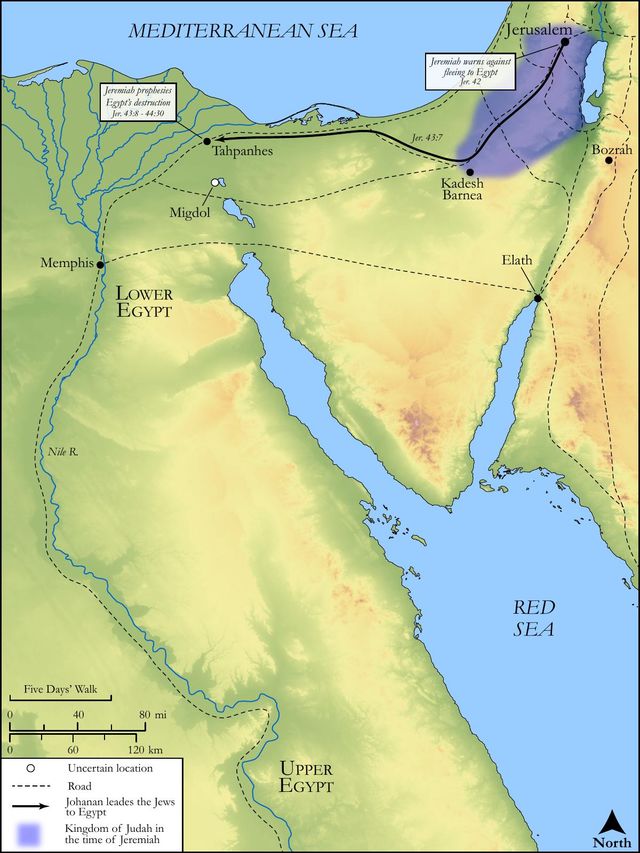
Following the catastrophic destruction of Jerusalem by Babylon in 586 BC and the subsequent assassination of Gedaliah, the Babylonian-appointed governor, a significant portion of the remaining Jewish population, including prominent leaders, fled to Egypt. This desperate flight was motivated by fear of further Babylonian reprisals and a misguided search for security, despite the prophet Jeremiah's clear and repeated divine warnings against it. Historically, Egypt had often served as a place of refuge for Israelites during times of distress, as seen in the narratives of Abraham and Jacob's family (Genesis 12:10-20; Genesis 46:1-7). However, it was also a land deeply entrenched in pervasive idolatry. The Jewish remnant, already compromised by syncretistic practices in Judah, rapidly assimilated into Egyptian religious customs, embracing deities like the "Queen of Heaven" in a false belief that such worship would bring them prosperity, a notion vehemently condemned by God through Jeremiah (Jeremiah 44:8). The judgment pronounced in Jeremiah 44:27 therefore highlights the profound futility and spiritual danger of seeking refuge in a foreign land and foreign gods when God's explicit command was to remain in Judah and trust in His provision.
Key Themes
ShowHideThe severe pronouncement in Jeremiah 44:27 powerfully articulates several foundational themes woven throughout the book of Jeremiah and the broader Old Testament. Firstly, it emphasizes Divine Sovereignty and Active Judgment, demonstrating God's absolute control over the destinies of nations and individuals. The phrase "I will watch over them for evil" signifies God's deliberate, active, and inescapable involvement in bringing about the declared calamity, underscoring that His justice is not passive but a direct execution of His word. Secondly, the verse highlights the dire Consequences of Persistent Disobedience and Rebellion. Despite repeated warnings and clear divine instructions, the remnant defiantly chose their own path, leading them directly into the very destruction they sought to avoid. This illustrates the profound biblical principle that true safety, blessing, and prosperity are found solely in humble obedience to God's commands, not in self-devised schemes or human wisdom. Thirdly, it powerfully exposes the Futility of Idolatry and False Security. Their flight to Egypt and continued worship of foreign deities were acts of seeking security and well-being outside of God's covenant and His explicit will. The pronounced judgment unequivocally proves that such pursuits are ultimately vain, leading only to ruin, and stand in stark contrast to the true refuge and unwavering security found only in the Lord (Psalm 91:2).
Exposition and Analysis
ShowHideKey Word Analysis
ShowHideThis primitive root means "to be alert, i.e. sleepless; hence to be on the lookout (whether for good or ill); hasten, remain, wake, watch (for)." In Jeremiah 1:12, God declares He "watches over" His word to perform it for good. Here, the same intense, diligent, and active vigilance is applied to bringing about judgment, emphasizing the certainty, intentionality, and inescapable nature of the impending doom. It conveys that God is not merely allowing events to unfold but is actively and deliberately focused on executing His declared judgment.
This word signifies "bad or (as noun) evil (natural or moral); adversity, affliction, calamity, distress, grief, harm, hurt, mischief, misery, sorrow, trouble, wickedness." When God watches over them "for evil," it means for their calamity, disaster, and suffering. This "evil" is not a random misfortune but a divinely ordained punitive outcome, directly linked to their moral evil of disobedience and idolatry. It denotes a comprehensive state of adversity and destruction.
This word is broad, meaning "good (as an adjective) in the widest sense; used likewise as a noun... (good, a good or good thing...); also as an adverb (well); beautiful, best, better, bountiful, cheerful, at ease, favour, fine, glad, good, graciously, joyful, kindly, kindness, pleasant, pleasure, prosperity, welfare." The stark contrast "and not for good" underscores the complete absence of any benefit, blessing, favor, or prosperity from God's hand for this disobedient remnant. Their future in Egypt would be entirely devoid of divine favor and marked by the antithesis of welfare and well-being.
Verse Breakdown
ShowHide"Behold, I will watch over them for evil, and not for good:"
This opening clause is a profoundly impactful declaration of divine intent. "Behold" (הִנֵּה, hinneh) serves as an imperative, demanding immediate and serious attention to the momentous pronouncement that follows. The Lord unequivocally asserts His active and deliberate oversight ("I will watch over them," אֶשְׁקֹד עֲלֵיהֶם, 'eshqod 'alehem), but critically, this divine vigilance is "for evil" (לְרָעָה, lᵉraʻah), meaning for their harm, calamity, and destruction. This is set in direct, dramatic opposition to "and not for good" (וְלֹא לְטוֹבָה, wᵉlo' lᵉṭôvah), signifying a complete absence of welfare, prosperity, or blessing. This statement marks a terrifying reversal of God's usual posture of watchful care for His covenant people when they are obedient, emphasizing that their persistent rebellion has transformed His diligent attention into an instrument of judgment.
"and all the men of Judah that are in the land of Egypt shall be consumed by the sword and by the famine,"
This clause specifies the comprehensive scope and the precise instruments of the impending destruction. The judgment is portrayed as all-encompassing, targeting "all the men of Judah" who are "in the land of Egypt," indicating that none who defied God's command to avoid Egypt would escape the consequences. The primary means of this consumption ("shall be consumed," יִתַּמּוּ, yittammû, from H8552 tâmam, meaning to complete, finish, or perish utterly) are "the sword and the famine." These were common and devastating judgments in the Old Testament, representing the horrors of warfare and its subsequent scarcity, and they were precisely the threats Jeremiah had warned them about if they chose to go to Egypt (Jeremiah 42:16).
"until there be an end of them."
This concluding phrase powerfully emphasizes the totality and finality of the judgment. "Until there be an end of them" (עַד כְּלוֹתָם, ʻad kᵉlôtām, from H3615 kâlâh, meaning to end, cease, perish, or consume completely) signifies their utter annihilation or reduction to a negligible, non-viable remnant. It conveys a thorough and decisive judgment, leaving no hope for their continued existence as a distinct, viable community in Egypt, effectively bringing their rebellious lineage in that land to a definitive close.
Literary Devices
ShowHideJeremiah 44:27 masterfully employs several potent literary devices to convey its message of impending, inescapable judgment. Anthropomorphism is strikingly present in the phrase "I will watch over them," attributing a human-like action of vigilant observation and active oversight to God. This device renders God's direct and deliberate involvement in their fate more comprehensible and impactful, emphasizing His intentionality rather than a passive allowance of events. A profound and tragic Irony underpins the entire verse: the very place the remnant sought refuge and safety (Egypt) becomes the inescapable locus of their destruction. They fled from the sword and famine in Judah, only to meet them with certainty and finality in Egypt, highlighting the utter futility of seeking security outside of God's explicit will. Furthermore, the phrase "until there be an end of them" functions as Hyperbole or, more precisely, a form of Merism, signifying a complete and utter destruction, leaving no substantial remnant. While a few individuals might survive, the prophetic language emphasizes the near-total annihilation of the disobedient group, underscoring the severity, totality, and finality of God's judgment against their persistent rebellion.
Theological and Thematic Connections
ShowHideJeremiah 44:27 profoundly illustrates God's unwavering commitment to His word, whether for blessing or for judgment. It reveals a God who is not merely reactive but actively and sovereignly involved in the outworking of human choices, particularly in response to covenant faithfulness or persistent rebellion. The divine "watching" for evil signifies a deliberate, sovereign act of justice, demonstrating that continuous disobedience and idolatry inevitably lead to severe, divinely ordained consequences. This verse reinforces the truth that true security, prosperity, and well-being are found only in humble obedience to God's commands and unwavering reliance on His provision and protection, not in human strategies, foreign alliances, or false gods. It serves as a stark reminder that God's patience, though vast, has limits, and His righteous justice will ultimately prevail against all forms of rebellion.
Reflection and Application
ShowHideJeremiah 44:27 stands as a solemn and enduring warning for all generations, underscoring the profound gravity of deliberate disobedience to God's revealed will. It compels us to critically examine where we place our trust, seek our security, and derive our guidance. Do we, like the remnant in Egypt, trust in human wisdom, worldly solutions, or perceived safe havens, even when these paths clearly contradict God's explicit commands or principles? Or do we find our ultimate refuge, direction, and peace in His word, even when His path seems more difficult, counter-intuitive, or demands radical faith? The passage powerfully reminds us that God is not passive; He actively "watches over" His word to perform it, whether for blessing upon the obedient or for judgment upon the rebellious. Our choices carry eternal consequences, and true flourishing, genuine peace, and lasting security are always found within the boundaries of His covenant and humble, consistent obedience to His perfect will. It calls us to a radical trust in God's sovereignty and a humble submission to His wisdom, understanding that His ways, though sometimes challenging, always lead to life and truth.
Questions for Reflection
ShowHideFAQ
ShowHideWhy did God "watch over them for evil" instead of for good?
ShowHideGod's watching "for evil" was a direct, just, and inevitable consequence of Judah's persistent and defiant disobedience to His explicit commands. Through the prophet Jeremiah, God had repeatedly and unequivocally warned them not to go to Egypt, promising destruction by sword, famine, and plague if they did (Jeremiah 42:15-18). Despite these clear warnings, they chose to flee there and, once settled, continued and even intensified their idolatrous practices, openly defying God's authority (Jeremiah 44:8). Therefore, God's "watching for evil" was not an arbitrary act but a righteous and certain execution of the judgment He had previously declared. It powerfully demonstrated His unwavering commitment to His word and the severe, inescapable consequences of rebellion against His covenant and His revealed will.
What was the significance of Egypt as the place of their destruction?
ShowHideEgypt held a complex and deeply significant place in Israel's history. It was the land of their initial enslavement, from which God miraculously delivered them through the Exodus, establishing His covenant with them (Exodus 12). Yet, it also consistently represented a place of spiritual temptation, idolatry, and reliance on human power rather than divine provision. Throughout their history, Israel was repeatedly warned against returning to Egypt for help, refuge, or military alliances (Deuteronomy 17:16; Isaiah 30:1-3). By fleeing to Egypt, the remnant of Judah not only directly disobeyed a divine command but also symbolically returned to a place of spiritual bondage and reliance on a pagan nation, fundamentally rejecting their identity as God's distinct covenant people. Thus, their destruction in Egypt underscored the profound futility of seeking refuge in the world's perceived security when God had commanded a different, faithful path. It served as a powerful and tragic reversal of the Exodus narrative, where God had delivered them out of Egypt, now demonstrating His judgment in Egypt.
Christ-Centered Fulfillment
ShowHideJeremiah 44:27, with its stark pronouncement of divine judgment for persistent disobedience and idolatry, finds its ultimate fulfillment and profound transformation in the person and work of Jesus Christ. While the Old Testament repeatedly demonstrates God's righteous wrath against sin and rebellion, culminating in the exile and the destruction described here, the New Testament reveals how God's perfect justice and boundless mercy converge uniquely in Christ. The "evil" that God watched over Judah to bring upon them—sword and famine leading to an "end"—foreshadows the ultimate spiritual death and separation from God that sin inevitably brings. However, Jesus Christ, the true Lamb of God, willingly bore the full weight of God's righteous judgment against sin on the cross (Isaiah 53:5-6; 2 Corinthians 5:21). He became the one upon whom God's "watch for evil" was directed, enduring the curse and the "end" of sin, so that all who believe in Him might receive God's "watch for good"—eternal life, peace, and reconciliation. In Christ, the curse of the law is broken (Galatians 3:13), and true refuge is found not in fleeing to a foreign land or relying on worldly security, but in spiritual union with Him, where our lives are "hidden with Christ in God" (Colossians 3:3). He is the ultimate fulfillment of God's promise to be a watchful Shepherd, not for judgment upon His redeemed, but for eternal life and abundant peace for all who trust in Him, delivering them from the spiritual "sword and famine" of sin and death (John 10:10).