


Jeremiah 44:28
Bible text: King James Version (1769 Blayney text) · Public domain
Bible text: King James Version with Strong's numbers · Public domain
Bible text: Berean Standard Bible · Public domain
Bible text: American Standard Version (1901) · Public domain
Bible text: World English Bible, Messianic edition · Public domain
Bible text: Geneva Bible (1599) · Public domain
Bible text: Young's Literal Translation · Public domain
- וּפְלִיטֵיu·fe·li·Teiand escapees ofH6412Conj-w ¦ N-mpcNoun Plural Masculine Constructוּandפְלִיטֵיescapees of
- חֶרֶבChe·rev[the] swordH2719N-fsNoun Singular Feminine Absolute
- יְשֻׁבוּןye·shu·Vunthey will return !H7725V-Qal-Imperf-3mp ¦ SfxVerb Qal Imperfect 3rd Plural Masculineיְשֻׁבוּthey will returnן!
- מִןminfromH4480PrepPreposition
- אֶרֶץ'E·retz[the] land ofH776N-fscNoun Singular Feminine Construct
- מִצְרַיִםmitz·Ra·yimEgyptH4714N-properNoun Proper Location
- אֶרֶץ'E·retz[the] land ofH776N-fscNoun Singular Feminine Construct
- יְהוּדָהye·hu·DahJudahH3063N-properNoun Proper Location
- מְתֵיme·Teimen ofH4962N-mpcNoun Plural Masculine Construct
- מִסְפָּרmis·ParnumberH4557N-msNoun Singular Masculine Absolute
- וְיָדְעוּve·ya·de·'Uand they will knowH3045Conj-w ¦ V-Qal-ConsecPerf-3cpVerb Qal Consecutive Perfect 3rd Plural common genderוְandיָדְעוּthey will know
- כָּלkolallH3605N-mscNoun Singular Masculine Construct
- שְׁאֵרִיתshe·'e·Rit[the] remnant ofH7611N-fscNoun Singular Feminine Construct
- יְהוּדָהye·hu·DahJudahH3063N-properNoun Proper Location
- הַבָּאִיםha·ba·'Imwho wentH935Art ¦ V-Qal-Prtcpl-mpVerb Qal Participle Plural Masculine Absoluteהַwhoבָּאִיםwent
- לְאֶרֶץle·'e·retzto [the] land ofH776Prep-l ¦ N-fscNoun Singular Feminine Constructלְtoאֶרֶץ[the] land of
- מִצְרַיִםmitz·Ra·yimEgyptH4714N-properNoun Proper Location
- לָגוּרla·Gurto sojournH1481Prep-l ¦ V-Qal-InfVerb Qal Infinitive Constructלָtoגוּרsojourn
- שָׁםShamthereH8033AdvAdverb
- דְּבַרde·var[the] word ofH1697N-mscNoun Singular Masculine Construct
- מִיmiwhom?H4310InterrogPronoun Interrogative
- יָקוּםya·Kumwill it be establishedH6965V-Qal-Imperf-3msVerb Qal Imperfect 3rd Singular Masculine
- מִמֶּנִּיmi·Me·nifrom meH4480Prep ¦ 1csPrepositionמִמֶּfromנִּיme
- וּמֵהֶםu·me·Hemand from <the> themConj-w ¦ Prep-m ¦ 3mpSuffix Personal 3rd Plural Masculineוּandמֵfrom <the>הֶםthem
English is a literal word-by-word gloss of the Hebrew, not the KJV's wording. Why?
This is the original text the KJV's translators worked from — each Hebrew word with its own literal English meaning in this verse, prepared by scholars at Tyndale House, Cambridge. The KJV translates whole sentences, not word by word, so its wording differs: one Hebrew word can become several English words, and the KJV may choose “the LORD” where the gloss reads “Yahweh”. Both are faithful — they answer different questions. For the KJV's own rendering, switch to the KJV text.
Details
See on the biblical-era map
Study this verse
Public-domain commentary
Matthew Henry
From his Commentary on the Whole Bible. Henry comments on passages, not single verses — this entry covers Jeremiah 44:20–30. His three-level outline is real structure in the source text, so it is rendered as structure.
Daring sinners may speak many a bold word and many a big word, but, after all, God will have the last word; for he will be justified when he speaks, and all flesh, even the proudest, shall be silent before him. Prophets may be run down, but God cannot; nay, here the prophet would not.
I.Jeremiah has something to say to them from himself, which he could say without a spirit of prophecy, and that was to rectify their mistake (a wilful mistake it was) concerning the calamities they had been under and the true intent and meaning of them. They said that these miseries came upon them because they had now left off burning incense to the queen of heaven. "No," says he, "it was because you had formerly done it, not because you had now left it off." When they gave him that answer, he immediately replied (Jer 44:20) that the incense which they and their fathers had burnt to other gods did indeed go unpunished a great while, for God was long-suffering towards them, and during the day of his patience it was perhaps, as they said, well with them, and they saw no evil; but at length they grew so provoking that the Lord could no longer bear (Jer 44:22), but began a controversy with them, whereupon some of them did a little reform; their sins left them, for so it might be said, rather than that they left their sins. But their old guilt being still upon the score, and their corrupt inclinations still the same, God remembered against them the idolatries of their fathers, their kings, and their princes, in the streets of Jerusalem, which they, instead of being ashamed of, gloried in as a justification of them in their idolatries; they all came into his mind (Jer 44:21), all the abominations which they had committed (Jer 44:22) and all their disobedience to the voice of the Lord (Jer 44:23), all were brought to account; and therefore, to punish them for these, is their land a desolation and a curse, as at this day (Jer 44:22); therefore, not for their late reformation, but for their old transgressions, has all this evil happened to them, as at this day, Jer 44:23. Note, The right understanding of the cause of our troubles, one would think, should go far towards the cure of our sins. Whatever evil comes upon us, it is because we have sinned against the Lord, and should therefore stand in awe and sin not.
II.Jeremiah has something to say to them, to the women particularly, from the Lord of hosts, the God of Israel, They have given their answer; now let them hear God's reply, Jer 44:24. Judah, that dwells in the land of Egypt, has God speaking to them, even there; that is their privilege. Let them observe what he says; that is their duty, Jer 44:26. Now God, in his reply, tells them plainly,
1.That, since they were fully determined to persist in their idolatry, he was fully determined to proceed in his controversy with them; if they would go on to provoke him, he would go on to punish them, and see which would get the better at last. God repeats what they had said (Jer 44:25): "You and your wives are agreed in this obstinacy; you have spoken with your mouths and fulfilled with your hands; you have said it, and you stand to it, have said it and go on to do accordingly, We will surely perform our vows that we have vowed, to burn incense to the queen of heaven," as if, though it were a sin, yet their having vowed to do it were sufficient to justify them in the doing of it; whereas no man can by his vow make that lawful to himself, much less duty, which God has already made sin. "Well" (says God), "you will accomplish, you will perform, your wicked vows: now hear what is my vow, what I have sworn by my great name;" and, if the Lord hath sworn, he will not repent, since they have sworn and will not repent. With the froward he will show himself froward, Psa 18:26.
(1.)He had sworn that what little remains of religion there were among them should be lost, Jer 44:26. Though they joined with the Egyptians in their idolatries, yet they continued upon many occasions to make mention of the name of Jehovah, particularly in their solemn oaths; they said, Jehovah liveth, he is the living God, so they owned him to be, though they worshipped dead idols; they swear, The Lord liveth (Jer 5:2), but I fear they retained this form of swearing more in honour of their nation than of their God. But God declares that his name shall no more be thus named by any man of Judah in all the land of Egypt; that is, there shall be no Jews remaining to use this dialect of their country, or, if there be, they shall have forgotten it and shall learn to swear, as the Egyptians do, by the life of Pharaoh, not of Jehovah. Note, Those are very miserable whom God has so far left to themselves that they have quite forgotten their religion and lost all the remains of their good education. Or this may intimate that God would take it as an affront to him and would resent it accordingly, if they did make mention of his name and profess any relation to him.
(2.)He hath sworn that what little remnant of people there was there should all be consumed (Jer 44:27): I will watch over them for evil; no opportunity shall be let slip to bring some judgment upon them, until there be an end of them and they be rooted out. Note, To those whom God finds impenitent sinners he will be found an implacable Judge. And, when it comes to this, they shall know (Jer 44:28) whose word shall stand, mind or theirs. They said that they should recover themselves when they returned to worship the queen of heaven; God said they should ruin themselves; and now the event will show which was in the right. The contest between God and sinners is whose word shall stand, whose will shall be done, and who shall get the better. Sinners say that they shall have peace though they go on; God says they shall have no peace. But when God judges he will overcome; God's word shall stand, and not the sinner's.
2.He tells them that a very few of them should escape the sword, and in process of time return into the land of Judah, a small number (Jer 44:28), next to none, in comparison with the great numbers that should return out of the land of the Chaldeans. This seems designed to upbraid those who boasted of their numbers that concurred in sin; there were none to speak of that did not join in idolatry: "Well," says God, "and there shall be as few that shall escape the sword and famine."
3.He gives them a sign that all these threatenings shall be accomplished in their season, that they shall be consumed here in Egypt and shall quite perish: Pharaoh-hophra, the present king of Egypt, shall be delivered into the hand of his enemies that seek his life - of his own rebellious subjects (so some) under Amasis, who usurped his throne - of Nebuchadnezzar king of Babylon (so others), who invaded his kingdom; the former is related by Herodotus, the latter by Josephus. It is likely that this Pharaoh had tempted the Jews to idolatry by promises of his favour; however, they depended upon him for his protection, and it would be more than a presage of their ruin, it would be a step towards it, if he were gone. They expected more from him than from Zedekiah king of Judah; he was a more potent and politic prince. "But," says God, "I will give him into the hand of his enemies, as I gave Zedekiah." Note, Those creature-comforts and confidences that we promise ourselves most from may fail us as soon as those that we promise ourselves least from, for they are all what God makes them, not what we fancy them.
The sacred history records not the accomplishment of this prophecy, but its silence is sufficient; we hear no more of these Jews in Egypt, and therefore conclude them, according to this prediction, lost there; for no word of God shall fall to the ground.
Continue studying Jeremiah 44:28 across the web’s major study libraries — every link below opens this exact verse, chapter, or book on the destination site.
Read & Compare
 BibleGatewayThis verse in more than 200 translations and 70 languages.
 Bible.comThe YouVersion reader — hundreds of translations, reading plans, and highlights.
 ESV.orgCrossway's official English Standard Version reader.
 NET BibleThe NET translation with 60,000+ translators' notes on every rendering decision.
 STEP BibleTyndale House's free study tool — original text, vocabulary, and scholarly resources.
 BibliaLogos Bible Software's free web reader.
 USCCBThe New American Bible (Revised Edition) with the U.S. bishops' study notes.
Commentaries
 BibleHub CommentariesDozens of classic commentaries on this verse, gathered on one page.
 StudyLightMore than 100 commentary sets — the largest collection on the web.
 BibleRefPlain-English commentary on what this verse means, verse by verse.
 Enduring WordDavid Guzik's free commentary on this chapter, widely used by Bible teachers.
 Bible Study ToolsVerse commentary alongside Greek and Hebrew study aids.
Original Language & Research
- BibleHub InterlinearThe verse word by word — original language, transliteration, and English.
- BibleHub LexiconEvery word's original-language definition and Strong's entry.
 Blue Letter BibleDeep-study tools — Strong's numbers, concordance, and word studies.
 SefariaThe Hebrew text with Rashi and centuries of Jewish commentary.
Sermons, Hymns & Audio


TrulyRandomVerse is not affiliated with these sites and doesn’t control their content. They’re linked because they’re genuinely useful.
Summary
Jeremiah 44:28 serves as a definitive and chilling pronouncement of divine judgment against the Judean remnant who defiantly settled in Egypt, having rejected God's explicit commands delivered through Jeremiah. This verse prophesies that while the vast majority of these disobedient individuals will perish by sword, famine, and pestilence in Egypt, a very small, divinely preserved number will escape and return to the land of Judah. This stark and contrasting outcome is intended to unequivocally demonstrate whose words—God's infallible declarations or the people's rebellious assertions—will ultimately stand and be proven true.
Context
ShowHideLiterary Context
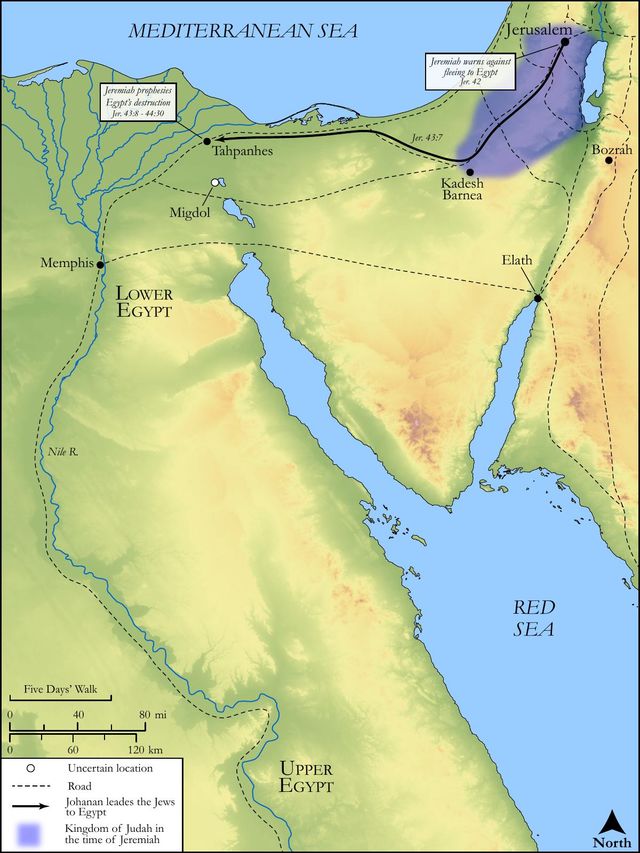
Jeremiah 44:28 concludes Jeremiah's final major prophetic message, delivered to the Judean exiles and refugees who had fled to Egypt following the fall of Jerusalem in 586 BC. The preceding chapters, Jeremiah 42-43, meticulously detail the people's initial request for Jeremiah to inquire of the Lord regarding their future. Despite receiving a clear divine instruction not to go to Egypt, they defiantly rejected God's word, choosing instead to migrate to various Egyptian cities such as Tahpanhes, Migdol, Noph, and Pathros, compelling Jeremiah and Baruch to accompany them. Jeremiah 44 specifically records God's severe judgment against these Judeans for their persistent idolatry, particularly their open veneration of the "queen of heaven" (Jeremiah 44:17), even in a foreign land. Verse 28 acts as the climactic pronouncement, emphasizing the absolute certainty of God's word and the impending, undeniable proof of His sovereignty over their rebellion.
Historical & Cultural Context
After the destruction of Jerusalem and the temple by Babylon in 586 BC, many Judeans were deported to Babylon. However, a significant number, including a remnant who had survived the siege, chose to flee to Egypt, seeking refuge from Babylonian rule and the perceived instability in Judah. This move was made despite Jeremiah's clear prophetic warnings that going to Egypt would lead to their destruction, not safety (Jeremiah 42:19-22). Culturally, their continued worship of foreign deities, especially the "queen of heaven," represented a deep-seated syncretism that had plagued Judah for generations, signifying a profound rejection of the covenant with Yahweh. Their defiance in Egypt was a continuation of this pattern, demonstrating a deep-seated spiritual rebellion and a refusal to acknowledge Yahweh as the sole sovereign God. The prophecy in verse 28 highlights the cultural clash between divine authority and human stubbornness, where the outcome would serve as undeniable proof of God's word.
Key Themes
ShowHideThis verse powerfully encapsulates several overarching themes prevalent in Jeremiah and the broader prophetic literature. Firstly, it underscores Divine Sovereignty and Prophetic Fulfillment, asserting that God's word is utterly reliable and will always prevail over human defiance and false claims. The rhetorical challenge, "whose words shall stand, mine, or theirs," is a stark affirmation of God's ultimate authority. Secondly, it highlights Judgment for Disobedience and Idolatry, demonstrating the severe consequences of rejecting God's explicit commands and engaging in syncretistic worship. The perishing of the vast majority by sword, famine, and pestilence is a direct result of their stubborn rebellion, as foretold in Jeremiah 44:12-13. Thirdly, the concept of The Remnant is crucial; despite widespread destruction, God promises that "a small number that escape the sword shall return." This recurring biblical theme, seen in books like Isaiah and Zephaniah, signifies God's preservation amidst judgment and His faithfulness to His covenant purposes, ensuring that a seed remains for future fulfillment. Finally, the verse speaks to the Vindication of God's Word, as the return of this small remnant would serve as tangible, undeniable proof that God's warnings and promises were true, and the people's defiant words were utterly false.
Exposition and Analysis
ShowHideKey Word Analysis
ShowHideThis primitive root (H1481) properly means "to turn aside from the road (for a lodging or any other purpose), i.e., sojourn (as a guest)." It also carries connotations of being a stranger or dwelling temporarily. In Jeremiah 44:28, its use emphasizes that the Judeans who went to Egypt were intended to be temporary residents, but their defiant decision to "sojourn there" became a permanent, rebellious act against God's will. Their seeking of refuge in Egypt was not a divinely sanctioned temporary stay but a willful, disobedient settlement, seeking security apart from God.
The Hebrew term (H1697) for "words" is much broader than simply spoken utterances. It encompasses "a matter (as spoken of) or thing," "act," "affair," "decree," "deed," "message," or "purpose." In this context, "my words" refers to God's entire prophetic message, His decrees, His warnings, and His promises, as delivered through Jeremiah. Conversely, "their words" refers to the defiant declarations of the Judeans, their intentions to continue idolatry, and their belief that they would find safety and prosperity in Egypt despite God's warnings. The contest articulated in the verse is not merely about spoken phrases, but about ultimate reality, authority, and whose will would prevail.
This primitive root (H6965) means "to rise," "to establish," "to confirm," or "to endure." When God's "words shall stand," it signifies their undeniable establishment, confirmation, and enduring truth. It implies that God's prophecies will be demonstrably fulfilled, proving their absolute validity and power, while the words, plans, and self-assurances of the rebellious Judeans will fall, be disproven, and come to nothing. The outcome would be an undeniable, public vindication of divine truth and authority.
Verse Breakdown
ShowHide"Yet a small number that escape the sword shall return out of the land of Egypt into the land of Judah"
This clause introduces a crucial exception to the widespread judgment pronounced earlier in the chapter. While the majority of the Judeans in Egypt would perish by sword, famine, and pestilence, God, in His sovereign grace, declares that a "small number" will "escape the sword" and be preserved. This preservation is not necessarily a sign of their faithfulness but an act of divine purpose, ensuring that a remnant survives to bear witness to God's word. Their return to Judah would be a tangible, undeniable sign of the fulfillment of God's prophecy.
"and all the remnant of Judah, that are gone into the land of Egypt to sojourn there"
This phrase clearly identifies the specific group to whom the prophecy applies: the entire "remnant of Judah" who had defiantly chosen to "sojourn" (live, dwell) in Egypt. This emphasizes that the judgment is directed at those who consciously rejected God's command to remain in Judah or submit to Babylonian rule, opting instead for a perceived, but ultimately false, refuge in Egypt, where they continued their idolatrous practices. The phrase "to sojourn there" highlights their deliberate choice to settle in defiance of God's explicit instruction.
"shall know whose words shall stand, mine, or theirs."
This is the climactic and most significant part of the verse. It presents a divine challenge and a promise of ultimate vindication. The outcome—the perishing of the many and the return of the few—would serve as irrefutable proof to all involved. The Judeans in Egypt, and by extension, all who witnessed the events, would "know" (yadaʿ, to perceive, ascertain, experience) with certainty that God's prophetic words had been fulfilled precisely, while their own defiant words, self-assurances, and idolatrous vows proved utterly futile and false. This declaration underscores God's absolute sovereignty and the infallible truth of His revealed will.
Literary Devices
ShowHideJeremiah 44:28 employs several powerful literary devices to convey its message of divine judgment and vindication. The most prominent is the Rhetorical Question embedded in the final clause: "whose words shall stand, mine, or theirs." This question is not posed to elicit an answer, but to emphatically assert the obvious truth: God's words alone will stand. It serves as a direct challenge to the people's rebellion and a powerful affirmation of God's ultimate authority. Another device is Contrast, starkly juxtaposing the "small number that escape" with "all the remnant... that are gone into the land of Egypt," highlighting the vast difference in outcomes between those who face judgment and the divinely preserved few. This contrast also extends to the "words" of God versus "their" words, emphasizing the absolute reliability of the former against the futility of the latter. There is also an element of Irony, as the Judeans fled to Egypt for safety, yet it is precisely in Egypt that the sword, famine, and pestilence would consume them, while the "small number that escape the sword" are those who survive the very dangers they sought to avoid by fleeing. The fulfillment of the prophecy thus becomes a public, undeniable demonstration of God's truth.
Theological and Thematic Connections
ShowHideJeremiah 44:28 is a profound theological statement on the nature of God's word and His unwavering sovereignty. It asserts that God's prophecies are not mere predictions but divine decrees that will inevitably come to pass, regardless of human defiance. The ultimate vindication of God's word over the rebellious declarations of humanity underscores His absolute authority and faithfulness to His covenant. This passage also highlights the severe consequences of persistent disobedience and idolatry, demonstrating that God's justice is as certain as His mercy. While judgment is widespread, the preservation of a "small number" speaks to God's enduring grace and His commitment to His redemptive purposes, ensuring that a remnant remains through whom His plans will ultimately be fulfilled. This truth resonates throughout Scripture, affirming the trustworthiness of God's communication and the ultimate triumph of His will.
Reflection and Application
ShowHideJeremiah 44:28 offers timeless and sobering lessons for believers today. Firstly, it serves as a powerful reminder of the paramount importance of obedience to God's revealed will. The tragic fate of the Judeans in Egypt underscores that persistent, defiant disobedience, especially when it involves rejecting clear divine guidance, leads to severe and often devastating consequences. We are called to trust and obey God's word, even when it seems counter-intuitive or requires sacrificing perceived safety or comfort. Secondly, this verse provides immense assurance regarding the absolute reliability of God's promises and warnings. Just as His word was unequivocally proven true for the ancient Israelites, it remains unfailing for us. We can rest in the certainty that every word God has spoken, whether of blessing or judgment, will ultimately stand. This should deepen our faith and commitment to living by every word that proceeds from the mouth of God. Finally, the concept of the "remnant" offers a glimmer of hope amidst widespread apostasy or societal decline. Even in the face of widespread rebellion, God always preserves a people for Himself, demonstrating His enduring grace and His commitment to His ultimate plan. This encourages us to remain faithful, knowing that God's purposes will ultimately be fulfilled through those who remain true to Him.
Questions for Reflection
ShowHideFAQ
ShowHideWhy did the Judeans go to Egypt despite God's warnings?
ShowHideThe Judeans went to Egypt primarily out of fear of the Babylonians and a desire for perceived safety and stability after the destruction of Jerusalem. Despite God's explicit command through Jeremiah that they should remain in Judah or submit to Babylonian rule, promising them peace if they did so (Jeremiah 42:10-12), they distrusted Jeremiah's prophecy. They believed that going to Egypt, a powerful nation, would protect them from further suffering. Furthermore, many of them were deeply entrenched in idolatrous practices, including the worship of the "queen of heaven," and they openly declared their intention to continue these practices in Egypt, believing it brought them prosperity (Jeremiah 44:17-19). Their decision was a deliberate act of rebellion against God's direct word.
What is the significance of "whose words shall stand, mine, or theirs"?
ShowHideThis phrase is a powerful rhetorical challenge that underscores the absolute sovereignty and truthfulness of God's prophetic word. The Judeans in Egypt had defiantly asserted their own will and believed their plans for safety and prosperity in Egypt would succeed, even vowing to continue their idolatry. God's declaration here is a direct refutation of their defiance. The impending judgment (perishing by sword, famine, and pestilence) and the preservation of only a "small number" would serve as undeniable, empirical proof that God's words—His warnings and judgments—were true and would be fulfilled, while the words, plans, and false hopes of the rebellious people would utterly fail and come to nothing. It is a divine vindication, demonstrating that God alone is the true and living God whose every word stands firm.
Christ-Centered Fulfillment
ShowHideJeremiah 44:28, while a prophecy of judgment and a testament to God's unwavering word in the Old Covenant, finds profound Christ-centered fulfillment. The ultimate "word" that stands eternally is not merely a spoken prophecy but the Incarnate Word, Jesus Christ, who is the full and final revelation of God (John 1:1). Just as God's words to Jeremiah proved true, Jesus Himself declared, "Heaven and earth will pass away, but my words will not pass away" (Matthew 24:35). The judgment prophesied for those who rejected God's word in Jeremiah's day foreshadows the ultimate judgment that will fall upon all who reject Christ, the living Word, who is appointed by the Father to be the judge of all (John 5:22). Furthermore, the concept of the "small number that escape" and return to Judah points forward to the spiritual remnant preserved by grace through faith in Christ. While the Old Testament remnant was often a physical survival, the New Testament remnant is a spiritual one—the Church, comprised of those from every nation who hear and obey the voice of the Good Shepherd (John 10:27). This "chosen race, a royal priesthood, a holy nation, a people for God's own possession" (1 Peter 2:9) is the true Israel of God, preserved not by fleeing to a foreign land but by being brought into Christ, the ultimate refuge and fulfillment of all God's promises. Through Him, God's word stands eternally, establishing His kingdom and gathering His people.