


Jeremiah 44:25
Bible text: King James Version (1769 Blayney text) · Public domain
Bible text: King James Version with Strong's numbers · Public domain
Bible text: Berean Standard Bible · Public domain
Bible text: American Standard Version (1901) · Public domain
Bible text: World English Bible, Messianic edition · Public domain
Bible text: Geneva Bible (1599) · Public domain
Bible text: Young's Literal Translation · Public domain
- כֹּהkohthusH3541AdvAdverb
- אָמַר'a·Marhe saysH559V-Qal-Perf-3msVerb Qal Perfect 3rd Singular Masculine
- יְהוָהYah·wehYahwehH3068N-properNoun Proper Title
- צְבָאוֹתtze·va·'Otof hostsH6635N-fpNoun Plural Feminine Absolute
- אֱלֹהֵי'e·lo·Hei[the] God ofH430N-mpcNoun Plural Masculine Construct
- יִשְׂרָאֵלYis·ra·'ElIsraelH3478N-properNoun Proper Location
- לֵאמֹרle·Mor<to> sayingH559Prep-l ¦ V-Qal-InfVerb Qal Infinitive Constructלֵ<to>אמֹרsaying
- אַתֶּם'a·TemyouH859Pro-2mpPronoun Personal 2nd Plural Masculine
- וּנְשֵׁיכֶםu·ne·shei·Khemand your wivesH802Conj-w ¦ N-mpc ¦ 2mpNoun Plural Masculine Constructוּandנְשֵׁיwivesכֶםyour
- וַתְּדַבֵּרְנָהva·te·da·Be·re·nahand you have spokenH1696Conj-w ¦ V-Piel-ConsecImperf-3fpVerb Piel Consecutive Imperfect 3rd Plural Feminineוַandתְּדַבֵּרְנָהyou have spoken
- בְּפִיכֶםbe·fi·Khemwith your mouthH6310Prep-b ¦ N-msc ¦ 2mpNoun Singular Masculine Constructבְּwithפִיmouthכֶםyour
- וּבִידֵיכֶםu·vi·dei·Khemand with your handsH3027Conj-w ¦ Prep-b ¦ N-cdc ¦ 2mpNoun Dual common gender Constructוּandבִwithידֵיhandsכֶםyour
- מִלֵּאתֶםmi·le·Temyou have fulfilledH4390V-Piel-Perf-2mpVerb Piel Perfect 2nd Plural Masculine
- לֵאמֹרle·Mor<to> sayingH559Prep-l ¦ V-Qal-InfVerb Qal Infinitive Constructלֵ<to>אמֹרsaying
- עָשֹׂה'a·Sohcertainly <to perform>H6213V-Qal-InfAbsVerb Qal Infinitive Absolute
- נַעֲשֶׂהna·'a·Sehwe will performH6213V-Qal-Imperf-1cpVerb Qal Imperfect 1st Plural common gender
- אֶת'et<obj.>H853DirObjMParticle Object Indicator
- נְדָרֵינוּne·da·Rei·nuour vowsH5088N-mpc ¦ 1cpNoun Plural Masculine Constructנְדָרֵיvowsנוּour
- אֲשֶׁר'a·SherwhichH834RelParticle Relative
- נָדַרְנוּna·Dar·nuwe have vowedH5087V-Qal-Perf-1cpVerb Qal Perfect 1st Plural common gender
- לְקַטֵּרle·ka·Terto make smokeH6999Prep-l ¦ V-Piel-InfVerb Piel Infinitive Constructלְtoקַטֵּרmake smoke
- לִמְלֶכֶתlim·Le·khetto [the] queen ofH4446Prep-l ¦ N-fscNoun Singular Feminine Constructלִtoמְלֶכֶת[the] queen of
- הַשָּׁמַיִםha·sha·Ma·yimthe heavensH8064Art ¦ N-mpNoun Plural Masculine Absoluteהַtheשָּׁמַיִםheavens
- וּלְהַסֵּךְu·le·ha·Sekhand to pour outH5258Conj-w ¦ Prep-l ¦ V-Hiphil-InfVerb Hiphil Infinitive Constructוּandלְtoהַסֵּךְpour out
- לָהּlahto <the> herPrep-l ¦ 3fsSuffix Personal 3rd Singular Feminineלָto <the>הּher
- נְסָכִיםne·sa·Khimdrink offeringsH5262N-mpNoun Plural Masculine Absolute
- הָקֵיםha·Keimcertainly <to carry out>H6965V-Hiphil-InfAbsVerb Hiphil Infinitive Absolute
- תָּקִימְנָהta·Ki·me·nahyou will carry outH6965V-Hiphil-Imperf-3fpVerb Hiphil Imperfect 3rd Plural Feminine
- אֶת'et<obj.>H853DirObjMParticle Object Indicator
- נִדְרֵיכֶםnid·rei·Khemyour vowsH5088N-mpc ¦ 2mpNoun Plural Masculine Constructנִדְרֵיvowsכֶםyour
- וְעָשֹׂהve·'a·Sohand certainly <to perform>H6213Conj-w ¦ V-Qal-InfAbsVerb Qal Infinitive Absoluteוְandעָשֹׂהcertainly <to perform>
- תַעֲשֶׂינָהta·'a·Sei·nahyou will performH6213V-Qal-Imperf-3fpVerb Qal Imperfect 3rd Plural Feminine
- אֶת'et<obj.>H853DirObjMParticle Object Indicator
- נִדְרֵיכֶםnid·rei·Khemyour vowsH5088N-mpc ¦ 2mpNoun Plural Masculine Constructנִדְרֵיvowsכֶםyour
English is a literal word-by-word gloss of the Hebrew, not the KJV's wording. Why?
This is the original text the KJV's translators worked from — each Hebrew word with its own literal English meaning in this verse, prepared by scholars at Tyndale House, Cambridge. The KJV translates whole sentences, not word by word, so its wording differs: one Hebrew word can become several English words, and the KJV may choose “the LORD” where the gloss reads “Yahweh”. Both are faithful — they answer different questions. For the KJV's own rendering, switch to the KJV text.
Details
See on the biblical-era map
Study this verse
Public-domain commentary
Matthew Henry
From his Commentary on the Whole Bible. Henry comments on passages, not single verses — this entry covers Jeremiah 44:20–30. His three-level outline is real structure in the source text, so it is rendered as structure.
Daring sinners may speak many a bold word and many a big word, but, after all, God will have the last word; for he will be justified when he speaks, and all flesh, even the proudest, shall be silent before him. Prophets may be run down, but God cannot; nay, here the prophet would not.
I.Jeremiah has something to say to them from himself, which he could say without a spirit of prophecy, and that was to rectify their mistake (a wilful mistake it was) concerning the calamities they had been under and the true intent and meaning of them. They said that these miseries came upon them because they had now left off burning incense to the queen of heaven. "No," says he, "it was because you had formerly done it, not because you had now left it off." When they gave him that answer, he immediately replied (Jer 44:20) that the incense which they and their fathers had burnt to other gods did indeed go unpunished a great while, for God was long-suffering towards them, and during the day of his patience it was perhaps, as they said, well with them, and they saw no evil; but at length they grew so provoking that the Lord could no longer bear (Jer 44:22), but began a controversy with them, whereupon some of them did a little reform; their sins left them, for so it might be said, rather than that they left their sins. But their old guilt being still upon the score, and their corrupt inclinations still the same, God remembered against them the idolatries of their fathers, their kings, and their princes, in the streets of Jerusalem, which they, instead of being ashamed of, gloried in as a justification of them in their idolatries; they all came into his mind (Jer 44:21), all the abominations which they had committed (Jer 44:22) and all their disobedience to the voice of the Lord (Jer 44:23), all were brought to account; and therefore, to punish them for these, is their land a desolation and a curse, as at this day (Jer 44:22); therefore, not for their late reformation, but for their old transgressions, has all this evil happened to them, as at this day, Jer 44:23. Note, The right understanding of the cause of our troubles, one would think, should go far towards the cure of our sins. Whatever evil comes upon us, it is because we have sinned against the Lord, and should therefore stand in awe and sin not.
II.Jeremiah has something to say to them, to the women particularly, from the Lord of hosts, the God of Israel, They have given their answer; now let them hear God's reply, Jer 44:24. Judah, that dwells in the land of Egypt, has God speaking to them, even there; that is their privilege. Let them observe what he says; that is their duty, Jer 44:26. Now God, in his reply, tells them plainly,
1.That, since they were fully determined to persist in their idolatry, he was fully determined to proceed in his controversy with them; if they would go on to provoke him, he would go on to punish them, and see which would get the better at last. God repeats what they had said (Jer 44:25): "You and your wives are agreed in this obstinacy; you have spoken with your mouths and fulfilled with your hands; you have said it, and you stand to it, have said it and go on to do accordingly, We will surely perform our vows that we have vowed, to burn incense to the queen of heaven," as if, though it were a sin, yet their having vowed to do it were sufficient to justify them in the doing of it; whereas no man can by his vow make that lawful to himself, much less duty, which God has already made sin. "Well" (says God), "you will accomplish, you will perform, your wicked vows: now hear what is my vow, what I have sworn by my great name;" and, if the Lord hath sworn, he will not repent, since they have sworn and will not repent. With the froward he will show himself froward, Psa 18:26.
(1.)He had sworn that what little remains of religion there were among them should be lost, Jer 44:26. Though they joined with the Egyptians in their idolatries, yet they continued upon many occasions to make mention of the name of Jehovah, particularly in their solemn oaths; they said, Jehovah liveth, he is the living God, so they owned him to be, though they worshipped dead idols; they swear, The Lord liveth (Jer 5:2), but I fear they retained this form of swearing more in honour of their nation than of their God. But God declares that his name shall no more be thus named by any man of Judah in all the land of Egypt; that is, there shall be no Jews remaining to use this dialect of their country, or, if there be, they shall have forgotten it and shall learn to swear, as the Egyptians do, by the life of Pharaoh, not of Jehovah. Note, Those are very miserable whom God has so far left to themselves that they have quite forgotten their religion and lost all the remains of their good education. Or this may intimate that God would take it as an affront to him and would resent it accordingly, if they did make mention of his name and profess any relation to him.
(2.)He hath sworn that what little remnant of people there was there should all be consumed (Jer 44:27): I will watch over them for evil; no opportunity shall be let slip to bring some judgment upon them, until there be an end of them and they be rooted out. Note, To those whom God finds impenitent sinners he will be found an implacable Judge. And, when it comes to this, they shall know (Jer 44:28) whose word shall stand, mind or theirs. They said that they should recover themselves when they returned to worship the queen of heaven; God said they should ruin themselves; and now the event will show which was in the right. The contest between God and sinners is whose word shall stand, whose will shall be done, and who shall get the better. Sinners say that they shall have peace though they go on; God says they shall have no peace. But when God judges he will overcome; God's word shall stand, and not the sinner's.
2.He tells them that a very few of them should escape the sword, and in process of time return into the land of Judah, a small number (Jer 44:28), next to none, in comparison with the great numbers that should return out of the land of the Chaldeans. This seems designed to upbraid those who boasted of their numbers that concurred in sin; there were none to speak of that did not join in idolatry: "Well," says God, "and there shall be as few that shall escape the sword and famine."
3.He gives them a sign that all these threatenings shall be accomplished in their season, that they shall be consumed here in Egypt and shall quite perish: Pharaoh-hophra, the present king of Egypt, shall be delivered into the hand of his enemies that seek his life - of his own rebellious subjects (so some) under Amasis, who usurped his throne - of Nebuchadnezzar king of Babylon (so others), who invaded his kingdom; the former is related by Herodotus, the latter by Josephus. It is likely that this Pharaoh had tempted the Jews to idolatry by promises of his favour; however, they depended upon him for his protection, and it would be more than a presage of their ruin, it would be a step towards it, if he were gone. They expected more from him than from Zedekiah king of Judah; he was a more potent and politic prince. "But," says God, "I will give him into the hand of his enemies, as I gave Zedekiah." Note, Those creature-comforts and confidences that we promise ourselves most from may fail us as soon as those that we promise ourselves least from, for they are all what God makes them, not what we fancy them.
The sacred history records not the accomplishment of this prophecy, but its silence is sufficient; we hear no more of these Jews in Egypt, and therefore conclude them, according to this prediction, lost there; for no word of God shall fall to the ground.
Continue studying Jeremiah 44:25 across the web’s major study libraries — every link below opens this exact verse, chapter, or book on the destination site.
Read & Compare
 BibleGatewayThis verse in more than 200 translations and 70 languages.
 Bible.comThe YouVersion reader — hundreds of translations, reading plans, and highlights.
 ESV.orgCrossway's official English Standard Version reader.
 NET BibleThe NET translation with 60,000+ translators' notes on every rendering decision.
 STEP BibleTyndale House's free study tool — original text, vocabulary, and scholarly resources.
 BibliaLogos Bible Software's free web reader.
 USCCBThe New American Bible (Revised Edition) with the U.S. bishops' study notes.
Commentaries
 BibleHub CommentariesDozens of classic commentaries on this verse, gathered on one page.
 StudyLightMore than 100 commentary sets — the largest collection on the web.
 BibleRefPlain-English commentary on what this verse means, verse by verse.
 Enduring WordDavid Guzik's free commentary on this chapter, widely used by Bible teachers.
 Bible Study ToolsVerse commentary alongside Greek and Hebrew study aids.
Original Language & Research
- BibleHub InterlinearThe verse word by word — original language, transliteration, and English.
- BibleHub LexiconEvery word's original-language definition and Strong's entry.
 Blue Letter BibleDeep-study tools — Strong's numbers, concordance, and word studies.
 SefariaThe Hebrew text with Rashi and centuries of Jewish commentary.
Sermons, Hymns & Audio


TrulyRandomVerse is not affiliated with these sites and doesn’t control their content. They’re linked because they’re genuinely useful.
Summary
Jeremiah 44:25 vividly captures the unyielding defiance of the Judean remnant who had fled to Egypt, explicitly declaring their unwavering commitment to idolatrous practices, particularly the worship of the "queen of heaven." Despite the devastating judgment that had befallen Judah due to such sins, and in the face of direct warnings from the LORD through Jeremiah, the people, including both men and women, brazenly reaffirmed their vows to continue burning incense and pouring out drink offerings to this pagan deity, thereby sealing their fate under divine judgment.
Context
ShowHideLiterary Context
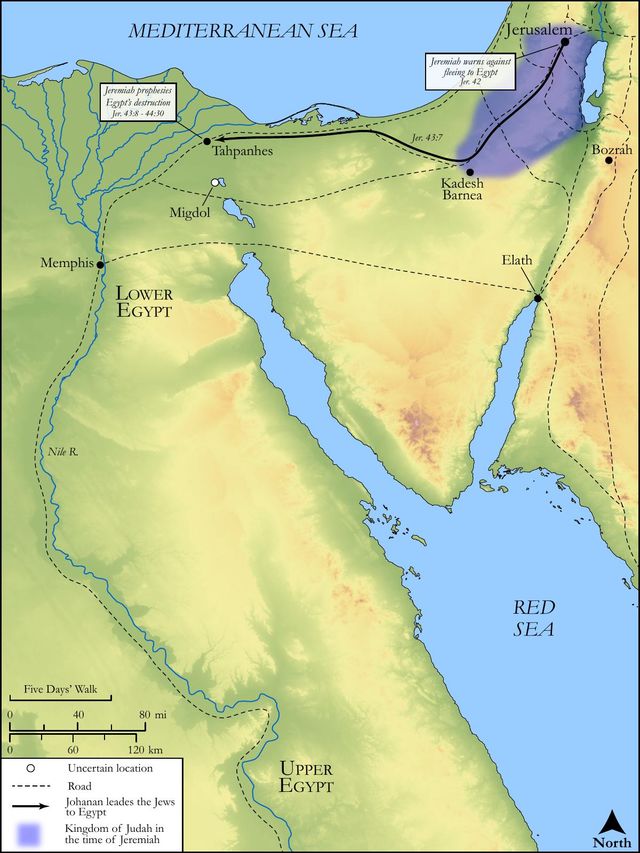
This verse is strategically placed within the concluding chapters of Jeremiah, specifically within a section (chapters 42-44) that records God's decisive message to the remnant of Judah who, after the fall of Jerusalem, sought refuge in Egypt. Jeremiah 42 details God's clear command, delivered through Jeremiah, that they should remain in the land of Judah, promising blessing for obedience and judgment for disobedience. Despite explicitly asking Jeremiah to inquire of the LORD for them, the people defiantly chose to migrate to Egypt, as seen in Jeremiah 43:7. Chapter 44 then records God's final, severe rebuke and pronouncement of judgment against them for their continued idolatry in Egypt, with verse 25 serving as the audacious declaration of their unrepentant rebellion, directly preceding God's definitive response.
Historical & Cultural Context
Following the catastrophic destruction of Jerusalem and the temple by Babylon in 586 BC, a small remnant of Judeans was left in the land under Gedaliah, the Babylonian-appointed governor. After Gedaliah's assassination, fear of Babylonian reprisal led many Judeans to flee to Egypt, directly contravening God's explicit command through Jeremiah. Egypt, a formidable and ancient kingdom, served as a traditional refuge but was also a land deeply entrenched in polytheism. The "queen of heaven" refers to a prominent Babylonian and Canaanite fertility goddess, often identified with Ishtar (Babylonian) or Astarte (Canaanite), worshipped for prosperity, fertility, and success in war. Her cult involved specific rituals like burning incense and pouring libations, practices explicitly forbidden by the Mosaic Law. The people's insistence on worshipping her reflects a long-standing syncretism and apostasy that had plagued Israel for centuries, as evidenced by earlier warnings in Jeremiah 7:18.
Key Themes
ShowHideJeremiah 44:25 powerfully encapsulates several critical themes. First, it highlights Defiant Idolatry, showcasing the people's shocking audacity in openly declaring their intention to persist in forbidden rituals, emphasizing their stubborn rebellion against the LORD. Second, it underscores the Rejection of God's Word, as the people actively choose to disregard God's commands, despite Jeremiah's tireless warnings and prophecies (e.g., Jeremiah 42:19-20). Their words, "We will surely perform our vows," demonstrate a complete dismissal of divine authority and a preference for their own desires and false gods. Third, the phrase "Ye and your wives" indicates Pervasive Apostasy, revealing that this idolatry was widespread and deeply ingrained within the community, affecting both men and women, making it a corporate sin, not merely the transgression of a few individuals. This deep-seated rebellion ultimately leads to the theme of Inevitable Judgment, as God declares their destruction for their unrepentant hearts.
Exposition and Analysis
ShowHideKey Word Analysis
ShowHideThis root means "to arrange" but is frequently used figuratively to "speak," "declare," or "pronounce." In this context, it signifies more than casual utterance; it denotes a deliberate, articulated declaration. The phrase "spoken with your mouths" emphasizes the intentional and formal nature of their verbal commitment, making their defiance explicit and undeniable before God. It highlights a firm resolve to act upon their words.
Meaning "to fill or be full of," but also "to accomplish" or "to confirm." Coupled with "with your hand," this word indicates not merely a verbal promise but a concrete, physical act of carrying out their intentions. It highlights the active and complete nature of their idolatrous practice, demonstrating that their vows were not empty words but were being tangibly performed through their actions, filling their lives with forbidden worship.
Simply meaning "a queen." In this specific context, it refers to the pagan deity known as the "queen of heaven." This title elevates the false goddess to a position of supreme authority in the minds of her worshippers, directly challenging the sovereignty and unique majesty of the LORD of hosts. The people's devotion to this "queen" represents their fundamental rejection of the one true God, the "God of Israel," in favor of a rival deity.
Verse Breakdown
ShowHide"Thus saith the LORD of hosts, the God of Israel, saying;"
This opening phrase powerfully establishes the divine authority and unchallengeable source of the message. It is not Jeremiah's personal opinion but the direct, solemn word of Yahweh, the sovereign God of armies and the covenant God of Israel, emphasizing the profound gravity of the people's defiance against their rightful King and covenant Lord.
"Ye and your wives have both spoken with your mouths, and fulfilled with your hand, saying, "
This clause highlights the corporate, pervasive, and deliberate nature of their sin. It indicates that the idolatry was not isolated but deeply ingrained within the community, involving both men and women. Their commitment was both verbal ("spoken with your mouths") and practical ("fulfilled with your hand"), demonstrating a unity of intent and action in their rebellion.
"We will surely perform our vows that we have vowed, to burn incense to the queen of heaven, and to pour out drink offerings unto her:"
This is the audacious core of their declaration, revealing the specific nature of their idolatry. They explicitly state their commitment to vows made to the "queen of heaven," involving ritualistic acts of burning incense (an act of worship reserved for God alone) and pouring out drink offerings (libations). The emphatic repetition of "surely perform our vows that we have vowed" underscores their unyielding and unrepentant commitment to this false worship.
"ye will surely accomplish your vows, and surely perform your vows."
This final, almost sardonic, repetition by the LORD confirms their stubborn resolve. God, through Jeremiah, acknowledges their stated intention, not as an endorsement, but as a recognition of their hardened hearts and unchangeable course. This divine affirmation of their rebellious choice sets the stage for the inevitable and severe judgment that will follow their unrepentant rebellion.
Literary Devices
ShowHideJeremiah 44:25 employs several potent literary devices to underscore the people's profound rebellion and the divine response. Repetition is prominently featured, particularly in the phrases "We will surely perform our vows that we have vowed" and its echoing by the LORD, "ye will surely accomplish your vows, and surely perform your vows." This emphatic repetition highlights the stubborn, unwavering resolve of the people in their idolatry, making their defiance undeniable. It also serves as a rhetorical device to underscore the certainty of their chosen path and, by extension, the certainty of the divine judgment that will inevitably follow. There is a strong element of Irony in the people's fervent commitment to their "vows" to a false deity, which stands in stark contrast to their utter disregard for the sacred covenant vows they made to the true God of Israel. Their steadfastness in sin stands in stark opposition to the faithfulness God had shown them, revealing the depth of their spiritual blindness. The opening phrase, "Thus saith the LORD of hosts, the God of Israel," functions as a powerful Divine Oracle Formula, lending absolute authority, solemnity, and unchallengeable weight to the pronouncement, making their defiance not merely a personal choice but a direct affront to the Creator and Sustainer of all.
Theological and Thematic Connections
ShowHideJeremiah 44:25 stands as a stark testament to the human capacity for spiritual stubbornness and the profound consequences of idolatry. Theologically, it underscores God's unwavering holiness and His demand for exclusive worship, viewing idolatry as a direct affront to His sovereignty and a fundamental violation of the first commandments, which prohibit having other gods before Him and making graven images (Exodus 20:3-5). The people's defiant declaration reveals a hardened heart that prefers self-will and the perceived benefits of pagan practices over the revealed truth and covenant faithfulness of the LORD. This persistent rebellion, despite repeated warnings and witnessed judgment, highlights the destructive nature of unrepentant sin and the ultimate futility of seeking life and prosperity from false gods. The "queen of heaven" represents any idol that competes with God for ultimate devotion, whether it be material possessions, power, pleasure, personal autonomy, or even self-righteousness, all of which promise life but ultimately lead to spiritual death and divine judgment.
Reflection and Application
ShowHideJeremiah 44:25 serves as a timeless and sobering warning against the insidious nature of idolatry and the peril of a hardened heart. In our contemporary context, while we may not burn incense to a physical "queen of heaven," the human heart remains profoundly prone to creating and serving idols. These modern idols can be anything that usurps God's rightful place in our lives: career, wealth, relationships, comfort, personal autonomy, social media validation, or even our own opinions and desires. The defiant declaration of the Judeans challenges us to honestly examine our own "vows"—the commitments we hold most dear and the things we prioritize above all else. Are we, like them, stubbornly clinging to practices or beliefs that subtly or overtly contradict God's revealed will, even when faced with the clear consequences of such choices in our own lives or in the world around us? This verse calls for a radical self-assessment and a humble posture of repentance, urging us to dismantle any "altars" we have built to false gods and to re-consecrate our lives wholly to the one true God, recognizing that true life, lasting peace, and genuine blessing are found only in Him.
Questions for Reflection
ShowHideFAQ
ShowHideWho was the "queen of heaven" and why was her worship so appealing to the Israelites?
ShowHideThe "queen of heaven" was a prominent pagan deity worshipped among the nations, often identified with goddesses like Ishtar (Babylonian) or Astarte (Canaanite). She was primarily associated with fertility, love, war, and prosperity. Her worship involved specific rituals such as burning incense, pouring libations, and baking cakes, as explicitly mentioned in Jeremiah 7:18. For the Israelites, her appeal likely stemmed from a desire for agricultural abundance, numerous offspring, and protection in battle, reflecting a syncretistic belief that combining the worship of Yahweh with that of other deities would guarantee greater blessings or mitigate perceived risks. This was a common temptation throughout Israel's history, as seen in their repeated turning to foreign gods for perceived benefits, despite God's clear commands against it, such as in Deuteronomy 6:14.
Why were the people so defiant, even after witnessing the destruction of Jerusalem?
ShowHideThe people's defiance, as expressed in Jeremiah 44:25, stemmed from a profound spiritual blindness and a hardened heart. Instead of attributing Jerusalem's destruction to their own idolatry and disobedience to the LORD, they ironically blamed their suffering on ceasing to worship the "queen of heaven," as stated in Jeremiah 44:17-18. This demonstrates a profound rejection of God's prophetic word and a self-deceiving rationalization of their sin. Their stubbornness was rooted in a preference for perceived immediate benefits (fertility, prosperity) over covenant faithfulness, illustrating the spiritual inertia and judicial hardening that can grip a people who have consistently rejected divine truth, as described in passages like Isaiah 6:9-10.
Christ-Centered Fulfillment
ShowHideJeremiah 44:25 vividly portrays humanity's inherent tendency towards idolatry and rebellion, a pervasive condition that finds its ultimate remedy and fulfillment in Jesus Christ. The defiant vows to the "queen of heaven" represent the universal human inclination to worship creation rather than the Creator, to seek life, security, and fulfillment in false gods and self-made systems rather than in the one true God (Romans 1:25). The Israelites' stubborn refusal to repent, even in the face of devastating judgment, highlights the depth of human sin and the utter inability of humanity, by its own efforts, to save itself or establish true righteousness.
Christ fulfills the desperate need exposed by this verse in several profound ways. As the perfect Son of God, Jesus perfectly fulfilled the covenant obedience that Israel consistently failed to maintain. Where Israel broke their vows to Yahweh through idolatry, Christ perfectly honored His Father's will, even to the point of obedient death on a cross (Philippians 2:8). His sacrificial death atones for the idolatry and rebellion of all who believe, offering forgiveness for sins that human effort or pagan rituals could never expiate (Hebrews 9:14). Furthermore, Christ, through the indwelling of His Spirit, empowers believers to turn from all forms of idolatry and to offer true, Spirit-led worship to God alone (John 4:24). He is the true King who establishes a new covenant, writing God's law not on tablets of stone but on hearts of flesh, enabling a genuine, internal desire to obey and serve Him, a stark contrast to the hardened hearts of the Judean remnant (Jeremiah 31:33). Thus, the defiance in Jeremiah 44:25 ultimately points to the desperate need for a Savior who can break the power of sin and idolatry, a need perfectly met in Jesus Christ, the only Lord worthy of all our vows and worship.