


Isaiah 7:18
Bible text: King James Version (1769 Blayney text) · Public domain
Bible text: King James Version with Strong's numbers · Public domain
Bible text: Berean Standard Bible · Public domain
Bible text: American Standard Version (1901) · Public domain
Bible text: World English Bible, Messianic edition · Public domain
Bible text: Geneva Bible (1599) · Public domain
Bible text: Young's Literal Translation · Public domain
- וְהָיָהve·ha·Yahand it will beH1961Conj-w ¦ V-Qal-ConsecPerf-3msVerb Qal Consecutive Perfect 3rd Singular Masculineוְandהָיָהit will be
- בַּיּוֹםbai·Yomin the dayH3117Prep-b ¦ N-msNoun Singular Masculine Absoluteבַּin theיּוֹםday
- הַהוּאha·Hu'<the> thatH1931Art ¦ Pro-3msPronoun Personal 3rd Singular Masculineהַ<the>הוּאthat
- יִשְׁרֹקyish·Rokhe will whistleH8319V-Qal-Imperf-3msVerb Qal Imperfect 3rd Singular Masculine
- יְהוָהYah·wehYahwehH3068N-properNoun Proper Title
- לַזְּבוּבla·ze·Vuvfor the flyH2070Prep-l ¦ N-msNoun Singular Masculine Absoluteלַfor theזְּבוּבfly
- אֲשֶׁר'a·SherwhichH834RelParticle Relative
- בִּקְצֵהbik·Tzeh[is] at [the] end ofH7097Prep-b ¦ N-mscNoun Singular Masculine Constructבִּ[is] atקְצֵה[the] end of
- יְאֹרֵיye·'o·Rei[the] canals ofH2975N-mpcNoun Plural Masculine Construct
- מִצְרָיִםmitz·Ra·yimEgyptH4714N-properNoun Proper Location
- וְלַדְּבוֹרָהve·La·de·vo·Rahand for the beeH1682Conj-w ¦ Prep-l ¦ N-fsNoun Singular Feminine Absoluteוְandלַfor theדְּבוֹרָהbee
- אֲשֶׁר'a·SherwhichH834RelParticle Relative
- בְּאֶרֶץbe·'E·retz[is] in [the] land ofH776Prep-b ¦ N-fscNoun Singular Feminine Constructבְּ[is] inאֶרֶץ[the] land of
- אַשּׁוּר'a·ShurAssyriaH804N-properNoun Proper Location
English is a literal word-by-word gloss of the Hebrew, not the KJV's wording. Why?
This is the original text the KJV's translators worked from — each Hebrew word with its own literal English meaning in this verse, prepared by scholars at Tyndale House, Cambridge. The KJV translates whole sentences, not word by word, so its wording differs: one Hebrew word can become several English words, and the KJV may choose “the LORD” where the gloss reads “Yahweh”. Both are faithful — they answer different questions. For the KJV's own rendering, switch to the KJV text.
Details
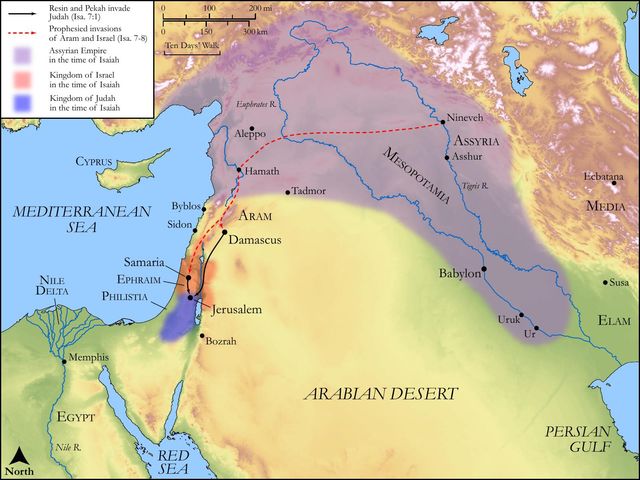
See on the biblical-era map
Study this verse
Public-domain commentary
Matthew Henry
From his Commentary on the Whole Bible. Henry comments on passages, not single verses — this entry covers Isaiah 7:17–25. His three-level outline is real structure in the source text, so it is rendered as structure.
After the comfortable promises made to Ahaz as a branch of the house of David, here follow terrible threatenings against him, as a degenerate branch of that house; for though the loving-kindness of God shall not be utterly taken away, for the sake of David and the covenant made with him, yet his iniquity shall be chastened with the rod, and his sin with stripes. Let those that will not mix faith with the promises of God expect to hear the alarms of his threatenings.
I.The judgment threatened is very great, Isa 7:17.
It is very great, for it is general; it shall be brought upon the prince himself (high as he is, he shall not be out of the reach of it), and upon the people, the whole body of the nation, and upon the royal family, upon all thy father's house; it shall be a judgment entailed on posterity, and shall go along with the royal blood. It is very great, for it shall be unprecedented - days that have not come; so dark, so gloomy, so melancholy, as never were the like since the revolt of the ten tribes, when Ephraim departed from Judah, which was indeed a sad time to the house of David. Note, The longer men continue in sin the sorer punishments they have reason to expect. It is the Lord that will bring these days upon them, for our times are in his hand, and who can resist or escape the judgments he brings?
II.The enemy that should be employed as the instrument of this judgment is the king of Assyria.
Ahaz reposed great confidence in that prince for help against the confederate powers of Israel and Syria, and minded the less what God said to him by his prophet for his encouragement because he built much upon his interest in the king of Assyria, and had meanly promised to be his servant if he would send him some succours; he had also, made him a present of gold and silver, for which he drained the treasures both of church and state, Kg2 16:7, Kg2 16:8. Now God threatens that that king of Assyria whom he made his stay instead of God should become a scourge to him. He was so speedily; for, when he came to him, he distressed him, but strengthened him not (Ch2 28:20), the reed not only broke under him, but ran into his hand, and pierced it, and thenceforward the kings of Assyria were, for a long time, grieving thorns to Judah, and gave them a great deal of trouble. Note, The creature that we make our hope commonly proves our hurt. The king of Assyria, not long after this, made himself master of the ten tribes, carried them captive, and laid their country waste, so as fully to answer the prediction here; and perhaps it may refer to that, as an explication of Isa 7:8, where it is foretold that Ephraim shall be broken, that it shall not be a people; and it is easy to suppose that the prophet (at Isa 7:17) turns his speech to the king of Israel, denouncing God's judgments against him for invading Judah. But the expositors universally understand it of Ahaz and his kingdom. Now observe,
1.Summons given to the invaders (Isa 7:18): The Lord shall whistle for the fly and the bee. See Isa 5:26. Enemies that seem as contemptible as a fly or a bee, and are as easily crushed, shall yet, when God pleases, do his work as effectually as lions and young lions. Though they are as far distant from one another as the rivers of Egypt and the land of Assyria, yet they shall punctually meet to join in this work when God commands their attendance; for, when God has work to do, he will not be at a loss for instruments to do it with.
2.Possession taken by them, Isa 7:19. It should seem as if the country were in no condition to make resistance. They find no difficulties in forcing their way, but come and rest all of them in the desolate valleys, which the inhabitants had deserted upon the first alarm, and left them a cheap and easy prey to the invaders. They shall come and rest in the low grounds like swarms of flies and bees, and shall render themselves impregnable by taking shelter in the holes of the rocks, as bees often do, and showing themselves formidable by appearing openly upon all thorns and all bushes; so generally shall the land be overspread with them. These bees shall knit upon the thorns and bushes, and there rest undisturbed.
3.Great desolations made, and the country generally depopulated (Isa 7:20): The Lord shall shave the hair of the head, and beard, and feet; he shall sweep all away, as the leper, when he was cleansed, shaved off all his hair, Lev 14:8, Lev 14:9. This is done with a razor which is hired, either which God has hired (as if he had none of his own; but what he hires, and whom he employs in any service for him, he will pay for. See Eze 29:18, Eze 29:19), or which Ahaz has hired for his assistance. God will make that to be an instrument of his destruction which he hired into his service. Note, Many are beaten with that arm of flesh which they trusted to rather than to the arm of the Lord, and which they were at a great expense upon, when by faith and prayer they might have found cheap and easy succour in God.
4.The consequences of this general depopulation.
(1.)The flocks of cattle shall be all destroyed, so that a man who had herds and flocks in abundance shall be stripped of them all by the enemy, and shall with much ado save for his own use a young cow and two sheep - a poor stock (Isa 7:21), yet he shall think himself happy in having any left.
(2.)The few cattle that are left shall have such a large compass of ground to feed in that they shall give abundance of milk, and very good milk, such as shall produce butter enough, Isa 7:22. There shall also be such want of men that the milk of one cow and two sheep shall serve a whole family, which used to keep abundance of servants and consume a great deal, but is now reduced.
(3.)The breed of cattle shall be destroyed; so that those who used to eat flesh ( as the Jews commonly did) shall be necessitated to confine themselves to butter and honey, for there shall be no flesh for them; and the country shall be so depopulated that there shall be butter and honey enough for the few that are left in it.
(4.)Good land, that used to be let well, shall be all overrun with briers and thorns (Isa 7:23); where there used to be a thousand vines planted, for which the tenants used to pay a thousand shekels, or pieces of silver, yearly rent, there shall be nothing now but briers and thorns, no profit either for landlord or tenant, all being laid waste by the army of the invaders. Note, God can soon turn a fruitful land into barrenness; and it is just with him to turn vines into briers if we, instead of bringing forth grapes to him, bring forth wild grapes, Isa 5:4.
(5.)The implements of husbandry shall be turned into instruments of war, Isa 7:24. The whole land having become briers and thorns, the grounds that men used to come to with sickles and pruning-hooks to gather in the fruits they shall now come to with arrows and bows, to hunt for wild beasts in the thickets, or to defend themselves from the robbers that lurk in the bushes, seeking for prey, or to kill the serpents and venomous beasts that are hid there. This denotes a very sad change of the face of that pleasant land. But what melancholy change is there which sin will not make with a people?
(6.)Where briers and thorns were wont to be of use and to do good service, even in the hedges, for the defence of the enclosed grounds, they shall be plucked up, and all laid in common. There shall be briers and thorns in abundance where they should not be, but none where they should be, Isa 7:25. The hills that shall be digged with the mattock, for special use, from which the cattle used to be kept off with the fear of briers and thorns, shall now be thrown open, the hedges broken down for the boar out of the wood to waste it, Psa 80:12, Psa 80:13. It shall be left at large for oxen to run in and less cattle. See the effect of sin and the curse; it has made the earth a forest of thorns and thistles, except as it is forced into some order by the constant care and labour of man. And see what folly it is to set our hearts upon possessions of lands, be they every so fruitful, ever so pleasant; if they lie ever so little neglected and uncultivated, or if they be abused by a wasteful careless heir or tenant, or the country be laid waste by war, they will soon become frightful deserts. Heaven is a paradise not subject to such changes.
Historical interpretation
Historical reception
1 surviving comment on this verse from the historical church.
(Verse 18, 19) And it shall come to pass in that day, that the LORD shall hiss for the fly that is in the uttermost part of the rivers of Egypt, and for the bee that is in the land of Assyria. And they shall come, and shall rest all of them in the desolate valleys, and in the holes of the rocks, and upon all thorns, and upon all bushes. In the same day shall the Lord shave with a razor that is hired, namely, by them beyond the river, by the king of Assyria, the head, and the hair of the feet: and it shall also consume the beard. Therefore, you are in vain afraid of present but half-burnt towers, which have no fire within. For you must know that by its hiss the Lord signifies the flies of Egypt and its rivers, with no doubt seven channels of the Nile, which are about to be called forth. And he signifies the bee, which is in the land of Assyria. But he calls the flies of Egypt on account of the filth of idolatry and the weak people. And he calls the bee Assyrians, whose kingdom was most powerful at that time, and were very ready for war. Either because all the region of the Assyrians and Persians used bows, or because they had access to them all the time. Therefore, all will come and occupy your land in the torrents of the valleys, and in the caves of rocks, and in all the fruits, and in the holes, and in the wooded groves. However, these things are said by metaphor, so that because he had mentioned flies and bees once, he would maintain consistency in the translation of the rest. Let us read the books of Kings and Chronicles, and we will find that the holy king Josiah was killed by the Egyptians, and the people of Israel were subjugated to the power of Egypt (2 Kings 23; 2 Chronicles 35): so that he would appoint a king for them. And after not much time, Nebuchadnezzar came with an innumerable multitude of warriors, captured Jerusalem, and destroyed the other cities of Judaea. He burned down the Temple and placed Assyrian inhabitants in Judaea.
Continue studying Isaiah 7:18 across the web’s major study libraries — every link below opens this exact verse, chapter, or book on the destination site.
Read & Compare
 BibleGatewayThis verse in more than 200 translations and 70 languages.
 Bible.comThe YouVersion reader — hundreds of translations, reading plans, and highlights.
 ESV.orgCrossway's official English Standard Version reader.
 NET BibleThe NET translation with 60,000+ translators' notes on every rendering decision.
 STEP BibleTyndale House's free study tool — original text, vocabulary, and scholarly resources.
 BibliaLogos Bible Software's free web reader.
 USCCBThe New American Bible (Revised Edition) with the U.S. bishops' study notes.
Commentaries
 BibleHub CommentariesDozens of classic commentaries on this verse, gathered on one page.
 StudyLightMore than 100 commentary sets — the largest collection on the web.
 BibleRefPlain-English commentary on what this verse means, verse by verse.
 Enduring WordDavid Guzik's free commentary on this chapter, widely used by Bible teachers.
 Bible Study ToolsVerse commentary alongside Greek and Hebrew study aids.
Original Language & Research
- BibleHub InterlinearThe verse word by word — original language, transliteration, and English.
- BibleHub LexiconEvery word's original-language definition and Strong's entry.
 Blue Letter BibleDeep-study tools — Strong's numbers, concordance, and word studies.
 SefariaThe Hebrew text with Rashi and centuries of Jewish commentary.
Sermons, Hymns & Audio


TrulyRandomVerse is not affiliated with these sites and doesn’t control their content. They’re linked because they’re genuinely useful.
Summary
Isaiah 7:18 presents a stark prophetic declaration from the Lord, delivered through the prophet Isaiah, to warn King Ahaz and the people of Judah of impending divine judgment. This verse vividly portrays God's absolute sovereignty over the nations, depicting Him effortlessly summoning the powerful empires of Egypt and Assyria—symbolized by a swarming fly and a stinging bee—to invade Judah. This divine summons underscores that these formidable world powers are not acting independently but are mere instruments in God's hand, to be used for His purposes of discipline and judgment upon His people for their unbelief and reliance on human alliances rather than divine faithfulness.
Context
ShowHideLiterary Context
This verse is deeply embedded within the larger prophetic narrative of Isaiah 7, specifically following the divine offer of a sign to King Ahaz and Ahaz's subsequent refusal to ask for one. The preceding verses (e.g., Isaiah 7:1-9) describe the Syro-Ephraimite War, where Aram (Syria) and Israel (Ephraim) allied against Judah, causing great fear in Jerusalem. Isaiah's initial message to Ahaz was a call to faith: "Be careful, keep calm and don't be afraid" (Isaiah 7:4). God then offers Ahaz a sign to confirm His promise of deliverance (Isaiah 7:10-11). When Ahaz, in a show of false piety, refuses to ask, God declares He will give a sign anyway—the birth of Immanuel (Isaiah 7:14). However, the immediate deliverance from Aram and Israel would be followed by a far more devastating invasion from Assyria, which Ahaz would foolishly invite by seeking their alliance. Verse 18, therefore, marks a crucial pivot, detailing the agents of this future, more severe judgment that would befall Judah due to its king's lack of faith.
Historical & Cultural Context
The historical setting is Judah during the reign of King Ahaz (735-715 BC), a period of intense geopolitical flux among the nations round about Judah. The dominant power on the horizon was the rapidly expanding Neo-Assyrian Empire to the northeast, which was aggressively extending its control. To the southwest lay Egypt, a long-standing regional power, though its influence was waning. Judah found itself precariously situated between these two colossal powers. The immediate threat was the Syro-Ephraimite alliance, which sought to depose Ahaz and install a puppet king. Ahaz, rather than trusting the Lord's promise of protection, was inclined to seek an alliance with Assyria, a move that would ultimately lead to Judah's servitude and severe oppression, as foreshadowed in this prophecy. The imagery of flies and bees is culturally resonant; both insects were common pests in Egypt and Assyria, known for their swarming, stinging, and destructive potential, making them apt metaphors for invading armies and their devastating impact.
Key Themes
ShowHideThis verse powerfully contributes to several major themes within Isaiah and the broader prophetic literature. Firstly, it highlights Divine Sovereignty and Control over all nations and human history. God is not merely a passive observer but actively orchestrates the movements of powerful empires, using them as instruments for His purposes, whether for judgment or deliverance. This is a recurring theme, seen also in passages like Isaiah 10:5-7. Secondly, it underscores the theme of Judgment for Unbelief and Disobedience. Ahaz's refusal to trust God and his subsequent reliance on foreign alliances, as documented in 2 Kings 16:7-9, directly leads to the very nations he sought to manipulate becoming agents of divine discipline. Thirdly, it illustrates the Consequences of Rejecting God's Counsel. The Lord's warning through Isaiah was a call to trust and repentance; its rejection brought about the promised devastation, emphasizing that God's word is always fulfilled, whether in blessing or in judgment. This passage also reinforces the theme of God's Providential Use of Wicked Nations to achieve His righteous ends, even when those nations act out of their own malice.
Exposition and Analysis
ShowHideKey Word Analysis
ShowHideFrom a primitive root meaning "to be shrill," this word implies whistling or hissing, often used to call animals or signal a gathering. In this context, it powerfully conveys God's effortless and sovereign command over nations. It suggests that the mighty empires of Egypt and Assyria are so completely subservient to His will that He can summon them with a simple, almost casual, sound, much like a shepherd calls his flock or a beekeeper calls his bees. This emphasizes God's ultimate authority and the subservience of even the greatest human powers to His divine purpose.
This term refers to a fly, especially one of a stinging nature. In Egypt, flies, particularly horseflies or gadflies, were a pervasive nuisance, swarming in large numbers, especially around water sources like the Nile. As a symbol for Egypt, it suggests a vast, annoying, and pervasive force that would spread across the land, bringing irritation and infestation. The "uttermost part of the rivers of Egypt" specifically points to the marshy, fly-infested regions of the Nile Delta, indicating the origin of this swarming invasion.
Derived from a root implying "orderly motion," this word denotes a bee. Bees are known for their organized colonies, their aggressive defense when provoked, and their painful sting. As a symbol for Assyria, it perfectly encapsulates the disciplined, highly organized, and militarily aggressive nature of the Assyrian army, which would invade Judah with devastating and painful force. The imagery of a bee swarm evokes an overwhelming, stinging, and destructive onslaught.
Verse Breakdown
ShowHide"And it shall come to pass in that day"
This phrase is a common prophetic marker, pointing to a specific future time when God's word will be fulfilled. It signifies a divinely appointed moment, often associated with judgment or significant historical events, emphasizing that the prophecy is not merely speculative but a certain future outcome orchestrated by God.
"that the LORD shall hiss"
This clause highlights God's active role and absolute sovereignty. The "hissing" is an anthropomorphic depiction of God's effortless summoning. It implies that the mightiest nations are but pawns in His hand, responding instantly to His call, much like trained animals. This underscores His ultimate control over world powers and historical events, demonstrating that their movements are entirely subject to His divine will.
"for the fly that is in the uttermost part of the rivers of Egypt"
This identifies Egypt as one of the instruments of God's judgment. The "fly" symbolizes the Egyptian army, characterized by its swarming numbers and pervasive, annoying presence. The "uttermost part of the rivers of Egypt" refers to the distant, marshy regions of the Nile, emphasizing that God's summons reaches even the most remote corners, bringing forth the designated agent of His will, regardless of their geographical distance or perceived autonomy.
"and for the bee that is in the land of Assyria"
This identifies Assyria as the second, and perhaps more formidable, instrument of God's judgment. The "bee" symbolizes the Assyrian army, renowned for its disciplined organization, aggressive tactics, and devastating "sting" or destructive power. The phrase "in the land of Assyria" simply states their origin, reinforcing that God's command extends across vast distances to bring forth His chosen agents of discipline, demonstrating His comprehensive reach and authority over all earthly kingdoms.
Literary Devices
ShowHideIsaiah 7:18 is rich in Imagery and Metaphor. The "fly" representing Egypt and the "bee" representing Assyria are powerful Metaphors, transforming these formidable empires into common, yet impactful, insects. This not only makes the prophecy vivid and memorable but also underscores God's perspective: from His vantage point, even mighty nations are easily summoned and controlled, like pests. The act of "hissing" is an instance of Anthropomorphism, attributing a human-like action (whistling or calling) to God, which emphasizes His direct and effortless command over creation and nations. The phrase "uttermost part" can be seen as a form of Hyperbole, stressing the vast reach of God's summons, implying that no corner of the earth is beyond His control. Furthermore, there is a strong sense of Irony in the passage: King Ahaz sought to avoid the Syro-Ephraimite threat by relying on Assyria, yet God declares that these very nations (Egypt and Assyria) will become the instruments of a far greater judgment upon Judah, highlighting the futility and tragic consequences of human schemes when pursued apart from divine trust.
Theological and Thematic Connections
ShowHideIsaiah 7:18 profoundly illustrates the biblical truth of God's absolute sovereignty over all creation, including human nations and their leaders. It demonstrates that history is not a random sequence of events but is meticulously orchestrated by the Lord, who raises up and casts down empires according to His divine purposes. This principle is seen throughout Scripture, where God uses seemingly independent world powers—whether for judgment, as here, or for the deliverance of His people. The "hissing" signifies His effortless command, reminding us that even the most formidable human forces are ultimately subservient to His will. This verse serves as a powerful warning against relying on human strength, political alliances, or worldly wisdom instead of placing complete trust in God. It underscores that disobedience and a lack of faith inevitably lead to divine discipline, often through the very means one sought to avoid or control, thereby affirming God's justice and the certainty of His word.
Reflection and Application
ShowHideIsaiah 7:18 calls us to a profound trust in God's sovereign control over all things, even in times of global instability or personal crisis. Just as God effortlessly summoned ancient empires to fulfill His purposes, He remains actively involved in the affairs of nations and individuals today. This truth should lead us away from fear and anxiety, and toward a deeper reliance on His wisdom and power, rather than on human strategies or alliances. It challenges us to examine where our ultimate trust lies: in the shifting sands of worldly power or in the unshakeable foundation of God's faithfulness. When we observe nations rise and fall, or experience personal difficulties, this verse reminds us that God is always working, even through challenging circumstances, to bring about His righteous will and to refine His people. It encourages us to pray for discernment to recognize His hand in current events and to respond with faithfulness and obedience, knowing that true security, peace, and purpose are found only in Him, the sovereign Lord of history.
Questions for Reflection
ShowHideFAQ
ShowHideWhat do the "fly" and "bee" symbolize in this verse?
ShowHideThe "fly" symbolizes Egypt, and the "bee" symbolizes Assyria. These are powerful metaphors used to depict the invading armies of these two dominant empires. The fly, particularly a stinging or swarming variety, represents Egypt's pervasive and numerous forces, often associated with the marshy, fly-infested regions of the Nile. The bee, known for its organized colonies, aggressive nature, and painful sting, represents the disciplined, formidable, and destructive military campaigns of the Assyrian Empire. God uses these common insects to illustrate His effortless command over these mighty nations, showing them to be mere instruments in His hand.
Why does the LORD "hiss" for them?
ShowHideThe Hebrew word for "hiss" (shâraq) implies whistling or summoning, often used to call animals or signal a gathering. This anthropomorphic language emphasizes God's absolute and effortless control over the nations. It suggests that the powerful empires of Egypt and Assyria are so completely subservient to His will that He can summon them with a simple sound, much like a shepherd calls his flock or a beekeeper calls his bees. This imagery underscores God's ultimate authority and the subservience of even the greatest human powers to His divine purpose, highlighting that they are merely instruments for His judgment or other plans, as seen in Isaiah 10:5-6.
What is the significance of "in that day"?
ShowHide"In that day" is a common prophetic idiom used throughout the Old Testament, particularly in Isaiah. It refers to a specific, divinely appointed future time when God's word will be fulfilled, often involving judgment, deliverance, or a significant shift in history. In the immediate context of Isaiah 7, it points to the future period of devastation that would follow Ahaz's refusal to trust God and his subsequent alliance with Assyria, which would bring about the very invasions described. More broadly, in prophetic literature, "that day" can also point to the ultimate "Day of the Lord," encompassing the final judgment and the establishment of God's eternal kingdom.
Christ-Centered Fulfillment
ShowHideWhile Isaiah 7:18 speaks of a temporal judgment on Judah through the nations of Egypt and Assyria, its deeper theological truths find profound fulfillment and ultimate meaning in Jesus Christ. The "day" of judgment foreshadowed here points ultimately to the "Day of the Lord," which culminates in Christ's final return and the establishment of His eternal kingdom. The sovereign God who effortlessly "hisses" for nations to execute His will is the same God revealed in Christ, who holds "all authority in heaven and on earth" (Matthew 28:18). The judgment brought by the "fly" and "bee" for Judah's unbelief foreshadows the ultimate judgment that will fall upon all who reject the true "sign" of Immanuel, God with us (Matthew 1:23), who came to save His people from their sins (Matthew 1:21). Christ, as the rightful King and Judge, will ultimately command all forces, visible and invisible, to bring about His perfect justice and establish a new heavens and new earth, where righteousness dwells (2 Peter 3:13). Thus, the terrifying sovereignty depicted in Isaiah 7:18 finds its redemptive and ultimate expression in the Lord Jesus, who is both the Lamb of God who takes away the sin of the world (John 1:29) and the Lion of Judah who will execute righteous judgment (Revelation 5:5).