


Isaiah 33:5
Bible text: King James Version (1769 Blayney text) · Public domain
Bible text: Berean Standard Bible · Public domain
Bible text: American Standard Version (1901) · Public domain
Bible text: World English Bible, Messianic edition · Public domain
Bible text: Geneva Bible (1599) · Public domain
Bible text: Young's Literal Translation · Public domain
- נִשְׂגָּבnis·Gav[is] exaltedH7682V-Niphal-Prtcpl-msVerb Niphal Participle Singular Masculine Absolute
- יְהוָהYah·wehYahwehH3068N-properNoun Proper Title
- כִּיkiforH3588PrtParticle Conditional
- שֹׁכֵןsho·Khen[he is] dwellingH7931V-Qal-Prtcpl-msVerb Qal Participle Singular Masculine Absolute
- מָרוֹםma·Roma high placeH4791N-msNoun Singular Masculine Absolute
- מִלֵּאmi·Le'he will fillH4390V-Piel-Perf-3msVerb Piel Perfect 3rd Singular Masculine
- צִיּוֹןtzi·YonZionH6726N-properNoun Proper Location
- מִשְׁפָּטmish·PatjusticeH4941N-msNoun Singular Masculine Absolute
- וּצְדָקָהu·tze·da·Kahand righteousnessH6666Conj-w ¦ N-fsNoun Singular Feminine Absoluteוּandצְדָקָהrighteousness
English is a literal word-by-word gloss of the Hebrew, not the KJV's wording. Why?
This is the original text the KJV's translators worked from — each Hebrew word with its own literal English meaning in this verse, prepared by scholars at Tyndale House, Cambridge. The KJV translates whole sentences, not word by word, so its wording differs: one Hebrew word can become several English words, and the KJV may choose “the LORD” where the gloss reads “Yahweh”. Both are faithful — they answer different questions. For the KJV's own rendering, switch to the KJV text.
Details
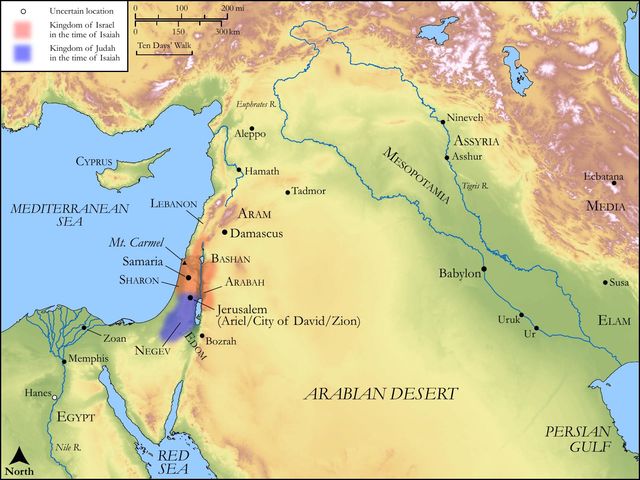
See on the biblical-era map
Study this verse
Public-domain commentary
Matthew Henry
From his Commentary on the Whole Bible. Henry comments on passages, not single verses — this entry covers Isaiah 33:1–12. His three-level outline is real structure in the source text, so it is rendered as structure.
Here we have,
I.The proud and false Assyrian justly reckoned with for all his fraud and violence, and laid under a woe, Isa 33:1. Observe,
1.The sin which the enemy had been guilty of. He had spoiled the people of God, and made a prey of them, and herein had broken his treaty of peace with them, and dealt treacherously. Truth and mercy are two such sacred things, and have so much of God in them, that those cannot but be under the wrath of God that make conscience of neither, but are perfectly lost to both, that care not what mischief they do, what spoil they make, what dissimulations they are guilty of, nor what solemn engagements they violate, to compass their own wicked designs. Bloody and deceitful men are the worst of men.
2.The aggravation of this sin. He spoiled those that had never done him any injury and that he had no pretence to quarrel with, and dealt treacherously with those that had always dealt faithfully with him. Note, The less provocation we have from men to do a wrong thing the more provocation we give to God by doing it.
3.The punishment he should fall under for this sin. He that spoiled the cities of Judah shall have his own army destroyed by an angel and his camp plundered by those whom he had made a prey of. The Chaldeans shall deal treacherously with the Assyrians and revolt from them. Two of Sennacherib's own sons shall deal treacherously with him and basely murder him at his devotions. Note, The righteous God often pays sinners in their own coin. He that leads into captivity shall go into captivity, Rev 13:10; Rev 18:6.
4.The time when he shall be thus dealt with. When he shall make an end to spoil, and to deal treacherously, not by repentance and reformation, which might prevent his ruin (Dan 4:27), but when he shall have done his worst, when he shall have gone as far as God would permit him to go, to the utmost of his tether, then the cup of trembling shall be put into his hand. When he shall have arrived at his full stature in impiety, shall have filled up the measure of his iniquity, then all shall be called over again. When he has done God will begin, for his day is coming.
II.The praying people of God earnest at the throne of grace for mercy for the land now in its distress (Isa 33:2):
"O Lord! be merciful to us. Men are cruel; be thou gracious. We have deserved thy wrath, but we entreat thy favour; and, if we may find the propitious to us, we are happy; the trouble we are in cannot hurt us, shall not ruin us. It is in vain to expect relief from creatures; we have no confidence in the Egyptians, but we have waited for thee only, resolving to submit to thee, whatever the issue of the trouble be, and hoping that it shall be a comfortable issue." Those that by faith humbly wait for God shall certainly find him gracious to them. They prayed,
1.For those that were employed in military services for them: "Be thou their arm every morning. Hezekiah, and his princes, and all the men of war, need continual supplies of strength and courage from thee; supply their need therefore, and be to them a God all-sufficient. Every morning, when they go forth upon the business of the day, and perhaps have new work to do and new difficulties to encounter, let them be afresh animated and invigorated, and, as the day, so let the strength be." In our spiritual warfare our own hands are not sufficient for us, nor can we bring any thing to pass unless God not only strengthen our arms (Gen 49:24), but be himself our arm; so entirely do we depend upon him as our arm every morning, so constantly do we depend upon his power, as well as his compassions, which are new every morning, Lam 3:23. If God leaves us to ourselves any morning, we are undone; we must therefore every morning commit ourselves to him, and go forth in his strength to do the work of the day in its day.
2.For the body of the people: "Be thou our salvation also in the time of trouble, ours who sit still, and do not venture into the high places of the field." They depend upon God not only as their Saviour, to work deliverance for them, but as their salvation itself; for, whatever becomes of their secular interests, they will reckon themselves safe and saved if they have him for their God. If he undertake to be their Saviour, he will be their salvation; for as for God his work is perfect. Some read it thus: "Thou who wast their arm every morning, who wast the continual strength and help of our fathers before us, be thou our salvation also in time of trouble. Help us as thou helpedst them; they looked unto thee and were lightened (Psa 34:5); let us then not walk in darkness."
III.The Assyrian army ruined and their camp made a rich but cheap and easy prey to Judah and Jerusalem.
No sooner is the prayer made (Isa 33:2) than it is answered (Isa 33:3), nay, it is outdone. They prayed that God would save them from their enemies; but he did more than that; he gave them victory over their enemies and abundant cause to triumph; for,
1.The strength of the Assyrian camp was broken (Isa 33:3) when the destroying angel slew so many thousands of them: At the noise of the tumult, of the shrieks of the dying men (who, we may suppose, did not die silently), the rest of the people fled, and shifted every one for his own safety. When God did thus lift up himself the several nations, or clans, of which the army was composed, were scattered. It was time to stir when such an unprecedented plague broke out among them. When God arises his enemies are scattered, Psa 68:1.
2.The spoil of the Assyrian camp is seized, by way of reprisal, for all the desolations of the defenced cities of Judah (Isa 33:4): Your spoil shall be gathered by the inhabitants of Jerusalem, like the gathering of the caterpillar, and as the running to and fro of locusts, that is, the spoilers shall as easily and as quickly make themselves masters of the riches of the Assyrians as a host of caterpillars, or locusts, make a field, or a tree, bare. Thus the wealth of the sinner is laid up for the just and Israel is enriched with the spoil of the Egyptians. Some make the Assyrians to be the caterpillars and locusts, which, when they are killed, are gathered together in heaps, as the frogs of Egypt, and are run upon, and trodden to dirt.
IV.God and his Israel glorified and exalted hereby. When the spoil of the enemy is thus gathered,
1.God will have the praise of it (Isa 33:5): The Lord is exalted. It is his honour thus to abase proud men, and hide them in the dust, together; thus he magnifies his own name, and his people give him the glory of it, as Israel when the Egyptians were drowned, Exo 15:1, Exo 15:2, etc. He is exalted as one that dwells on high, out of the reach of their blasphemies, and that has an over-ruling power over them, and wherein they deal proudly delights to show himself above them - that does what he will, and they cannot resist him.
2.His people will have the blessing of it. When God lifts up himself to scatter the nations that are in confederacy against Jerusalem (Isa 33:3) then, as a preparative for that, or as the fruit and product of it, he has filled Zion with judgment and righteousness, not only with a sense of justice, but with a zeal for it and a universal care that it be duly administered. It shall again be called, The city of righteousness, Isa 1:26. In this the grace of God is exalted, as much as his providence was in the destruction of the Assyrian army. We may conclude God has mercy in store for a people when he fills them with judgment and righteousness, when all sorts of people, and all their actions and affairs, are governed by them, and they are so full of them that no other considerations can crowd in to sway them against these. Hezekiah and his people are encouraged (Isa 33:6) with an assurance that God would stand by them in their distress. Here is,
(1.)A gracious promise of God for them to stay themselves upon: Wisdom and knowledge shall be the stability of thy times, and strength of salvation. Here is a desirable end proposed, and that is the stability of our times, that things be not disturbed and unhinged at home, and the strength of salvation, deliverance from, and success against, enemies abroad. The salvation that God ordains for his people has strength in it; it is a horn of salvation. And here are the way and means for obtaining this end - wisdom and knowledge, not only piety, but prudence. That is it which, by the blessing of God, will be the stability of our times and the strength of salvation, that wisdom which is first pure, then peaceable, and which sacrifices private interests to a public good; such prudence as this will establish truth and peace, and fortify the bulwarks in defence of them.
(2.)A pious maxim of state for Hezekiah and his people to govern themselves by: The fear of the Lord is his treasure. It is God's treasure in the world, from which he receives his tribute; or, rather, it is the prince's treasure. A good prince accounts it so (that wisdom is better than gold) and he shall find it so. Note, True religion is the true treasure of any prince or people; it denominates them rich. Those places that have plenty of Bibles, and ministers, and serious good people, are really rich; and it contributes to that which makes a nation rich in this world. It is therefore the interest of a people to support religion among them and to take heed of every thing that threatens to hinder it.
V.The great distress that Jerusalem was brought into described, that those who believed the prophet might know beforehand what troubles were coming and might provide accordingly, and that when the foregoing promise of their deliverance should have its accomplishment the remembrance of the extremity of their case might help to magnify God in it and make them the more thankful, Isa 33:7-9. It is here foretold,
1.That the enemy would be very insolent and abusive and there would be no dealing with him, either by treaties of peace (for he has broken the covenant without any hesitation, as if it were below him to be a servant to his word), or by the preparations of war, for he has despised the cities; he scorns to take notice either of their appeals to justice or of their petitions for mercy. He makes himself master of them so easily (though they are called fenced cities), and meets with so little resistance, that he despises them, and has no relentings when he puts all to the sword; for he regards no man, has no pity or concern, no, not for those that he is under particular obligations to. He neither fears God nor regards man, but is haughty and imperious to every one. There are those that take a pride in trampling upon all mankind, and have neither veneration for the honourable nor compassion for the miserable.
2.That therefore he would not be brought to any terms of reconciliation: The valiant ones of Jerusalem, being unable to make their parts good with him, must be contentedly run down with noise and insolence, which will make them cry without, because they cannot serve their country as they might have done against a fair adversary. The ambassadors sent by Hezekiah to treat of peace, finding him so haughty and unmanageable, shall weep bitterly for vexation at the disappointment they had met with in their negotiations; they shall weep like children, as despairing to find out any expedient to pacify him.
3.That the country should be made quite desolate for a time by his army.
(1.)No man durst travel the roads; so that a stop was put to trade and commerce, and (which was worse) no man could safely go up to Jerusalem, to keep the solemn feasts: The highways lie waste. While the fields lie waste, trodden like the highways, the highways lie waste, untrodden like the fields, for the traveller ceases.
(2.)No man had any profit from the grounds, Isa 33:9. The earth used to rejoice in its own productions for the service of God's Israel, but now the enemies of Israel eat them up, or tread them down: it mourns and languishes; the country looks melancholy and the country people have misery in their countenances, wanting necessary food for themselves and their families; the wonted joy of harvest is turned into lamentation, so withering and uncertain are all worldly joys. The desolation is universal. That part of the country which belonged to the ten tribes was already laid waste: "Lebanon famed for cedars, Sharon for roses, Bashan for cattle, Carmel for corn, all very fruitful, have now become like wildernesses, are ashamed to be called by their old names, they are so unlike what they were. They shake off their fruits before their time into the hand of the spoiler, which used to be gathered seasonably by the hand of the owner."
VI.God appearing, at length, in his glory against his proud invader, Isa 33:10-12. When things are brought thus to the last extremity,
1.God will magnify himself. He had seemed to sit by as an unconcerned spectator: "But now will I arise, saith the Lord; now will I appear and act, and therein I will be not only evidenced, but exalted." He will not only demonstrate that there is a God that judges in the earth, but that he is God over all, and higher than the highest. "Now will I lift up myself, will prepare for action, will act vigorously, and will be glorified in it." God's time to appear for his people is when their affairs are reduced to the lowest ebb, when their strength is gone and there is none shut up nor left, Deu 32:36. When all other helpers fail, then is God's time to help.
2.He will bring down the Assyrian: "You, O Assyrians! are big with hopes that you shall have all the wealth of Jerusalem for your own, and are in pain till it be so; but all your hopes shall come to nothing: You shall conceive chaff, and bring forth stubble, which is not only worthless and good for nothing, but combustible and proper fuel for the fire, which it cannot escape, when your own breath as fire shall devour you, that is, the breath of God's wrath, provoked against you by the breath of your sins - your malignant breath, the threatenings and slaughter you breathe out against the people of God, this shall devour you, and your blasphemous breath against God and his name." God would make their own tongues to fall upon them, and their own breath to blow the fire that should consume them; and then no wonder that the people are as the burnings of lime in a lime-kiln, all on fire together, and as thorns cut up, which are dried and withered, and therefore easily take fire and are soon burnt up. Such was the destruction of the Assyrian army; it was like the burning up of thorns, which can well be spared, or the burning of lime, which makes it good for something. The burning of that army enlightened the world with the knowledge of God's power and made his name shine brightly.
Historical interpretation
Historical reception
1 surviving comment on this verse from the historical church.
(Verse 2 and following) Lord, have mercy on us: for we have waited for you: be our strength in the morning, and our salvation in time of trouble. At the voice of the Angel, the people fled; at your exaltation the nations were scattered. And your spoil will be gathered, as the locust is gathered, as when the ditches are full of it. The Lord is magnified, for he dwells on high: he has filled Zion with judgment and justice. And there will be faith in your times: wealth of salvation, wisdom, and knowledge: the fear of the Lord is its treasure. LXX: Lord, have mercy on us, for we trust in You: the seed of the unbelievers has been brought to destruction, but our salvation is in the time of tribulation: because of the voice of fear, the peoples are astonished by your fear, and the nations are scattered. But now your spoils, both small and great, will be gathered together: when someone gathers locusts, they will mock you: O holy God who dwells on high. Zion is filled with justice and righteousness, salvation is stored in the law: wisdom, discipline, and piety come from the Lord, these are the treasures of justice. This is a chapter from the Hebrews, in which it is read: Woe to those who plunder, will they not be plundered themselves? and so on until the end. They believe that this is a statement against King Sennacherib of the Assyrians, who, after overthrowing the ten tribes known as Israel and capturing the cities of Judah, will himself be defeated and his army destroyed by the Angel. Now, from the perspective of the people, giving thanks to God and saying, 'Lord, have mercy on us, we have waited for you,' these words contend, which are contained in the present (or following) chapter, that His arm and strength were the protection for the people besieged in the morning, and salvation in their time of need and distress. For by the voice of the Angel, whom Symmachus translated as it is written in Hebrew, Amun (whom the Hebrews consider to be Gabriel) and has the etymology of the people; the Assyrian fled, and the nations that came with him were scattered here and there from the exaltation of God. As they fled, the spoils were gathered by the Jews, just as a multitude of caterpillars and locusts are collected when they have been heaped into pits. In their victory, the Lord was magnified, and Zion was filled with justice and righteousness, and the faith of the besieged people was proven. And they possessed all riches in wisdom and knowledge of God and fear of the Lord, who alone was their treasure. They said these things according to the history, striving in every way to undermine the sacraments of Christ and his Apostles. But after the happiness of the Apostles, about whom it has been said above (Ad. cap. XXXI, 20): Blessed are those who sow upon all waters, where the ox and the donkey tread, and the lamentation and mourning of those who persecute them, about whom it is said in what follows: Woe to those who make you miserable; but no one makes you miserable; and like moths on clothing, they will wear away, from the person of the same Apostles, we confirm these words for all believers. And this is the sense: Lord, we have hoped in your help, and have trusted in you. The seed of the unbelievers has perished forever, and our salvation has appeared in the time of tribulation. For with your assistance, the multitude of nations has been scattered, and those who sought to conquer and deceive have been defeated. And this has happened because the holy Lord dwells on high, and Zion is filled with judgment and justice, as it is written: Justice and judgment will rest in the wilderness. Therefore, she is Zion, which was previously called a desert, and whoever dwells in her will receive the law of the Gospel, in whose treasure our salvation is, and the wisdom of the believers, and discipline and piety, or faith, which is specifically of the Christians, and the fear of the Lord, in which the treasures of wisdom are contained.
Continue studying Isaiah 33:5 across the web’s major study libraries — every link below opens this exact verse, chapter, or book on the destination site.
Read & Compare
 BibleGatewayThis verse in more than 200 translations and 70 languages.
 Bible.comThe YouVersion reader — hundreds of translations, reading plans, and highlights.
 ESV.orgCrossway's official English Standard Version reader.
 NET BibleThe NET translation with 60,000+ translators' notes on every rendering decision.
 STEP BibleTyndale House's free study tool — original text, vocabulary, and scholarly resources.
 BibliaLogos Bible Software's free web reader.
 USCCBThe New American Bible (Revised Edition) with the U.S. bishops' study notes.
Commentaries
 BibleHub CommentariesDozens of classic commentaries on this verse, gathered on one page.
 StudyLightMore than 100 commentary sets — the largest collection on the web.
 BibleRefPlain-English commentary on what this verse means, verse by verse.
 Enduring WordDavid Guzik's free commentary on this chapter, widely used by Bible teachers.
 Bible Study ToolsVerse commentary alongside Greek and Hebrew study aids.
Original Language & Research
- BibleHub InterlinearThe verse word by word — original language, transliteration, and English.
- BibleHub LexiconEvery word's original-language definition and Strong's entry.
 Blue Letter BibleDeep-study tools — Strong's numbers, concordance, and word studies.
 SefariaThe Hebrew text with Rashi and centuries of Jewish commentary.
Sermons, Hymns & Audio


TrulyRandomVerse is not affiliated with these sites and doesn’t control their content. They’re linked because they’re genuinely useful.
Summary
Isaiah 33:5 powerfully declares the LORD's supreme majesty and active engagement with His creation, asserting that while He is transcendent and dwells in unapproachable height, He intimately saturates Zion—His chosen city and the heart of His covenant people—with His divine attributes of judgment and righteousness. This verse serves as a profound theological anchor, affirming God's immutable character and His unwavering commitment to establishing moral order, equity, and justice amidst the chaos and uncertainty of human affairs, thereby offering both profound comfort and a compelling call to ethical living.
Context
ShowHideLiterary Context
Isaiah chapter 33 unfolds as a complex prophetic oracle that masterfully weaves together themes of lament, divine judgment, and glorious future salvation. The chapter commences with a severe "woe" pronounced against the oppressor, widely understood to be Assyria, vividly depicting the devastation and profound distress inflicted upon Judah. However, a dramatic and pivotal shift in tone occurs from verse 5 onward, transitioning from the depths of human despair and the apparent triumph of the enemy to a resounding declaration of divine intervention. Isaiah 33:5 acts as the theological fulcrum of this transition, asserting God's absolute sovereignty and His unwavering commitment to His people and His holy city, Zion, even when it appears to be on the brink of overwhelming destruction. This declaration sets the stage for the subsequent promises of deliverance, the establishment of a righteous king, and a vision of future peace, providing a crucial theological anchor for a nation grappling with existential threats.
Historical & Cultural Context
The historical backdrop for Isaiah 33 is the tumultuous late 8th century BCE, specifically the Assyrian invasion of Judah during the reign of King Hezekiah, culminating in the siege of Jerusalem around 701 BCE. Sennacherib, the formidable Assyrian king, had systematically swept through Judah, conquering numerous fortified cities and laying siege to the capital. The people of Judah were plunged into a state of profound fear, desperation, and spiritual crisis, facing what seemed like inevitable annihilation. In this dire context, the prophetic declaration that "The LORD is exalted; for he dwelleth on high" would have resonated as a powerful counter-narrative to the overwhelming military might and apparent triumph of a pagan empire. Zion, representing Jerusalem, was far more than a mere geographical location; it was the chosen dwelling place of God, the site of the Temple, and the potent symbol of God's covenant faithfulness to His people, a place He had promised to protect (see Psalm 48). The idea of God actively "filling Zion with judgment and righteousness" would have deeply resonated with the Israelite understanding of their covenant obligations and the ideal state of a society governed by divine law, standing in stark contrast to the lawless aggression and moral corruption of their enemies.
Key Themes
ShowHideThis verse significantly contributes to several overarching theological and narrative themes prevalent within the book of Isaiah and the broader prophetic literature. Firstly, it powerfully underscores God's absolute sovereignty and transcendence, emphasizing His supreme position above all earthly powers, human conflicts, and historical contingencies. This theme is a cornerstone of biblical theology, frequently echoed throughout the Psalms, where God is consistently praised as the one who is high above all nations, and his glory above the heavens. Secondly, it highlights the theme of Divine Justice and Righteousness, portraying God not merely as a distant, detached ruler but as actively and immanently involved in establishing and upholding moral order. The concepts of mishpat (judgment/justice) and tsedakah (righteousness) are foundational to God's character and His covenant relationship with Israel, signifying His unwavering commitment to equity, integrity, and moral purity within His kingdom. Prophets like Amos consistently called for justice to roll down like waters, and righteousness like an ever-flowing stream, reflecting this divine imperative. Finally, the verse powerfully reinforces the Significance and Security of Zion, portraying it as the sacred locus of God's presence and the direct recipient of His divine attributes. Despite the immediate threat of siege, Zion is ultimately secure because God Himself is its defender and the very source of its moral foundation, a theme that anticipates the glorious vision of the new Jerusalem where God's presence will fully and eternally dwell among His redeemed people.
Exposition and Analysis
ShowHideKey Word Analysis
ShowHideThis primitive root means "to be (causatively, make) lofty, especially inaccessible; by implication, safe, strong." In Isaiah 33:5, the declaration that the LORD is "exalted" powerfully conveys His supreme, unassailable position, not merely in terms of physical elevation but as majestic, utterly beyond the reach or challenge of human or earthly powers. This inherent loftiness is the profound source of His security and strength, providing an unshakable foundation of trust and hope for His people even in times of extreme vulnerability and despair.
This primitive root signifies "to fill or (intransitively) be full of, in a wide application (literally and figuratively)." Here, it denotes God's active, pervasive, and complete impartation of His divine attributes into Zion. It is not a partial or superficial presence, but a thorough saturation, suggesting that judgment and righteousness are not merely external laws imposed by God but intrinsic, transformative qualities that permeate the very fabric of His holy city and, by extension, profoundly shape the character of His people.
This comprehensive term encompasses "a verdict (favorable or unfavorable) pronounced judicially, especially a sentence or formal decree... divine law... justice... a participant's right or privilege... order, ordinance." In this context, mishpâṭ refers to God's just rule, His righteous decisions, and the establishment of proper, equitable order. It implies the active administration of divine law, ensuring fairness, equity, and the upholding of what is right. It is not solely about condemnation but about the active implementation of divine standards that bring about societal rectitude, proper governance, and the flourishing of a community rooted in justice.
Verse Breakdown
ShowHide"The LORD is exalted; for he dwelleth on high"
This opening clause establishes the absolute transcendence, supreme authority, and unassailable majesty of God. "The LORD" (Hebrew: Yᵉhôvâh, H3068) refers to Yahweh, the covenant God of Israel, emphasizing His personal and faithful relationship with His people. His being "exalted" (Hebrew: sâgab, H7682) signifies His majestic, unassailable, and sovereign position above all creation and earthly powers. The phrase "for he dwelleth on high" (Hebrew: shâkan for "dwelleth," H7931; mârôwm for "on high," H4791) further reinforces His elevated, transcendent dwelling place, implying His ultimate control, perfect perspective, and unwavering oversight over all events, including the immediate Assyrian crisis. This divine elevation provides a secure and unshakeable foundation for hope and trust.
"he hath filled Zion with judgment and righteousness"
This second clause shifts from God's transcendent nature to His powerful and immanent action within His chosen sphere. "Zion" (Hebrew: Tsîyôwn, H6726) represents Jerusalem, God's holy city, the central place of His worship, and the promised dwelling place of His presence. The verb "filled" (Hebrew: mâlêʼ, H4390) indicates a complete, pervasive, and transformative impartation. God doesn't merely visit Zion; He saturates it with His divine character and attributes. "Judgment" (Hebrew: mishpâṭ, H4941) and "righteousness" (Hebrew: tsᵉdâqâh, H6666) are paired, representing the holistic and inseparable nature of God's rule. Mishpâṭ refers to the just administration of law and order, ensuring equity and fairness, while tsᵉdâqâh denotes moral uprightness, integrity, and conformity to God's holy character. Together, they describe the ideal state of a society under God's dominion, characterized by fairness, equity, and moral purity, perfectly reflecting His own holy and just nature.
Literary Devices
ShowHideIsaiah 33:5 employs several powerful literary devices to convey its profound theological message with striking impact. Personification is subtly present as Zion is depicted as being "filled" with abstract qualities like judgment and righteousness, suggesting that these divine attributes permeate the very essence and being of the city, making it a living embodiment of God's character and moral order. The pairing of "judgment" (mishpâṭ) and "righteousness" (tsᵉdâqâh) constitutes a Merism, where two complementary terms are used to express a single, comprehensive idea—the holistic and inseparable nature of God's just and moral governance. This emphasizes that God's rule is not merely about legal decrees but about the establishment of a morally upright, equitable, and flourishing society. Furthermore, the verse presents a stark Contrast between the chaos, injustice, and devastation of the Assyrian invasion, vividly described in the preceding verses, and the stable, righteous, and divinely ordered state established by the exalted LORD. This contrast powerfully amplifies God's unparalleled power to bring order out of disorder and light out of darkness. Finally, the imagery of God dwelling "on high" while simultaneously "filling Zion" evokes a profound sense of Divine Presence that is both transcendent and immanent, emphasizing that God is not a distant, detached deity but one who is actively and intimately engaged in the affairs of His people, upholding His perfect character within their midst.
Theological and Thematic Connections
ShowHideIsaiah 33:5 profoundly illustrates the dual nature of God's sovereignty: His transcendent majesty and His immanent engagement with His creation. The declaration that "The LORD is exalted; for he dwelleth on high" speaks to His absolute holiness, His unapproachable glory, and His position as the supreme ruler over all things, utterly unthreatened by earthly powers. Yet, this infinitely exalted God is not distant or disengaged; He actively "fills Zion with judgment and righteousness," demonstrating His unwavering commitment to establishing moral order and justice within the human sphere. This divine action reveals that true societal flourishing and the ideal community are rooted in God's character and His active, transformative presence, where mishpat (justice) ensures equity and fairness, and tsedakah (righteousness) upholds moral integrity and conformity to divine standards. This theological truth serves as a foundational principle for understanding God's kingdom, where His reign is characterized by both omnipotent power and perfect ethical standards, providing a divine blueprint for the ideal community and a source of hope for its realization.
Reflection and Application
ShowHideIsaiah 33:5 offers profound and enduring truths that resonate deeply with believers today, providing both immense comfort and a compelling call to action in a world often marked by pervasive injustice, moral decay, and overwhelming chaos. The opening declaration of the LORD's exaltation and His dwelling "on high" serves as an unshakeable anchor for our faith, reminding us that no earthly power, no personal crisis, and no global injustice can diminish His ultimate sovereignty or challenge His supreme authority. In moments of profound personal struggle or widespread societal turmoil, this truth invites us to lift our gaze beyond immediate circumstances and rest securely in the assurance that God is eternally on His throne, perfectly in control, and meticulously working all things according to His righteous and sovereign purpose. Furthermore, the verse's powerful assertion that God "fills Zion with judgment and righteousness" challenges us to actively reflect and embody His character in our own lives, families, and communities. As those who bear His name and are called to be His representatives, we are commissioned to be active agents of His justice and righteousness in a fallen world, diligently pursuing fairness, upholding integrity, rebuking the powerful, and pleading the cause of the vulnerable and overlooked. This means not only living according to His impeccable moral standards but also engaging thoughtfully and courageously in the public square, striving to see His divine order established in our societies, all fueled by the unwavering hope of His ultimate and glorious reign.
Questions for Reflection
ShowHideFAQ
ShowHideWhat does it mean for God to "dwell on high" yet "fill Zion"?
ShowHideThis verse beautifully encapsulates a core theological paradox: God's dual nature as both transcendent and immanent. To "dwell on high" (Hebrew: shâkan mârôwm) emphasizes God's supreme, unapproachable majesty, His infinite holiness, and His position as sovereign over all creation, far above earthly limitations and human comprehension. It speaks to His ultimate authority and glory. However, simultaneously, "he hath filled Zion" (Hebrew: mâlêʼ Tsîyôwn) signifies His active, pervasive, and intimate presence within His chosen dwelling place, Jerusalem (Zion). It means that while God is infinitely exalted and utterly distinct from His creation, He is also personally and powerfully at work among His people, saturating their lives and their community with His divine attributes of justice and righteousness. This demonstrates that God is not a distant, disengaged deity but one who is both majestic in His transcendence and intimately involved in the affairs of humanity, particularly in establishing His righteous kingdom. This profound paradox of God's transcendence and immanence is a central aspect of His character revealed throughout Scripture, from His covenant presence in the tabernacle and Temple (e.g., Exodus 40:34-35) to the ultimate manifestation of His immanence in the incarnation of Christ.
Christ-Centered Fulfillment
ShowHideIsaiah 33:5 finds its ultimate and most profound fulfillment in the person and redemptive work of Jesus Christ. The "LORD who is exalted" is perfectly embodied in Jesus, who, though eternally divine and equal with God, voluntarily humbled Himself by taking on human form, enduring the cross, and was subsequently exalted to the right hand of God where He reigns in supreme authority. His ascension to dwell "on high" is not merely a physical relocation but a glorious declaration of His supreme authority and reign over all creation, thereby fulfilling the prophetic vision of God's ultimate exaltation. Furthermore, it is preeminently through Christ that God truly "filled Zion with judgment and righteousness." Jesus Himself is the perfect embodiment of God's righteousness, living a life without sin, and He came to establish God's righteous kingdom on earth. His life, atoning death, and triumphant resurrection executed God's ultimate judgment against sin, while simultaneously providing the gracious means for humanity's justification, reconciliation, and adoption into God's family. The "judgment" He brings is not only condemnation for sin but also the establishment of perfect justice and divine order, as He is the promised righteous King who will one day return to judge the living and the dead in perfect equity. The "Zion" that is now filled with these divine attributes is expanded beyond a physical city to encompass the spiritual body of Christ, the Church, which is called to be a holy temple in the Lord and a vibrant community reflecting His justice and righteousness in the world, eagerly anticipating the glorious descent of the New Jerusalem where God's righteous and perfect reign will be fully and eternally realized among His redeemed people.