


Isaiah 28:24
- הֲכֹלha·Khol¿ allH3605Interrog ¦ N-mscNoun Singular Masculine Constructהֲ¿כֹלall
- הַיּוֹםhai·Yomthe dayH3117Art ¦ N-msNoun Singular Masculine Absoluteהַtheיּוֹםday
- יַחֲרֹשׁya·cha·Roshdoes he plowH2790V-Qal-Imperf-3msVerb Qal Imperfect 3rd Singular Masculine
- הַחֹרֵשׁha·cho·Reshthe plowmanH2790Art ¦ V-Qal-Prtcpl-msVerb Qal Participle Singular Masculine Absoluteהַtheחֹרֵשׁplowman
- לִזְרֹעַliz·Ro·a'to sowH2232Prep-l ¦ V-Qal-InfVerb Qal Infinitive Constructלִtoזְרֹעַsow
- יְפַתַּחye·fa·Tachdoes he loosen?H6605V-Piel-Imperf-3msVerb Piel Imperfect 3rd Singular Masculine
- וִישַׂדֵּדvi·sa·Dedand he may harrow?H7702Conj-w ¦ V-Piel-ConjImperf-3msVerb Piel Conjunction+Imperfect 3rd Singular Masculineוִandישַׂדֵּדhe may harrow?
- אַדְמָתוֹ'ad·ma·Tohis landH127N-fsc ¦ 3msNoun Singular Feminine Constructאַדְמָתlandוֹhis
English is a literal word-by-word gloss of the Hebrew, not the KJV's wording. Why?
This is the original text the KJV's translators worked from — each Hebrew word with its own literal English meaning in this verse, prepared by scholars at Tyndale House, Cambridge. The KJV translates whole sentences, not word by word, so its wording differs: one Hebrew word can become several English words, and the KJV may choose “the LORD” where the gloss reads “Yahweh”. Both are faithful — they answer different questions. For the KJV's own rendering, switch to the KJV text.
Details
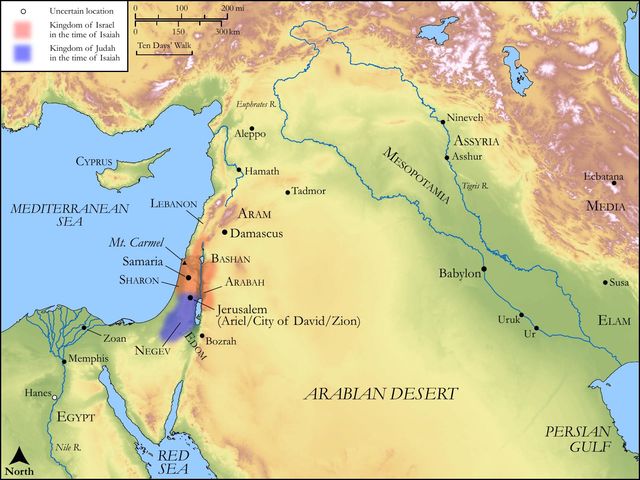
See on the biblical-era map
Study this verse
Public-domain commentary
Matthew Henry
From his Commentary on the Whole Bible. Henry comments on passages, not single verses — this entry covers Isaiah 28:23–29. His two-level outline is real structure in the source text, so it is rendered as structure.
This parable, which (like many of our Saviour's parables) is borrowed from the husbandman's calling, is ushered in with a solemn preface demanding attention, He that has ears to hear, let him hear, hear and understand, Isa 28:23.
I.The parable here is plain enough, that the husbandman applies himself to the business of his calling with a great deal of pains and prudence, secundum artem - according to rule, and, as his judgment directs him, observes a method and order in his work.
1.In his ploughing and sowing: Does the ploughman plough all day to sow? Yes, he does, and he ploughs in hope and sows in hope, Co1 9:10. Does he open and break the clods? Yes, he does, that the land may be fit to receive the seed. And when he has thus made plain the face thereof does he not sow his seed, seed suitable to the soil? For the husbandman knows what grain is fit for clayey ground and what for sandy ground, and, accordingly, he sows each in its place - wheat in the principal place (so the margin reads it), for it is the principal grain, and was a staple commodity of Canaan (Eze 27:17), and barley in the appointed place. The wisdom and goodness of the God of nature are to be observed in this, that, to oblige his creatures with a grateful variety of productions, he has suited to them an agreeable variety of earths.
2.In his threshing, Isa 28:27, Isa 28:28. This also he proportions to the grain that is to be threshed out. The fitches and the cummin, being easily got out of their husk or ear, are only threshed with a staff and a rod; but the bread-corn requires more force, and therefore that must be bruised with a threshing instrument, a sledge shod with iron, that was drawn to and fro over it, to beat out the corn; and yet he will not be ever threshing it, nor any longer than is necessary to loosen the corn from the chaff; he will not break it, or crush it, into the ground with the wheel of his cart, nor bruise it to pieces with his horsemen; the grinding of it is reserved for another operation. Observe, by the way, what pains are to be taken, not only for the earning, but for the preparing of our necessary food; and yet, after all, it is meat that perishes. Shall we then grudge to labour much more for the meat which endures to everlasting life? Bread-corn is bruised. Christ was so; it pleased the Lord to bruise him, that he might be the bread of life to us.
II.The interpretation of the parable is not so plain.
Most interpreters make it a further answer to those who set the judgments of God at defiance: "Let them know that as the husbandman will not be always ploughing, but will at length sow his seed, so God will not be always threatening, but will at length execute his threatenings and bring upon sinners the judgments they have deserved; but in wisdom, and in proportion to their strength, not that they may be ruined, but that they may be reformed and brought to repentance by them." But I think we may give this parable a greater latitude in the exposition of it.
1.In general, that God who gives the husbandman this wisdom is, doubtless, himself infinitely wise. It is God that instructs the husbandman to discretion, as his God, Isa 28:26. Husbandmen have need of discretion wherewith to order their affairs, and ought not undertake that business unless they do in some measure understand it; and they should by observation and experience endeavour to improve themselves in the knowledge of it. Since the king himself is served of the field, the advancing of the art of husbandry is a common service to mankind more than the cultivating of most other arts. The skill of the husbandman is from God, as every good and perfect gift is. This takes off somewhat of the weight and terror of the sentence passed on man for sin, that when God, in execution of it, sent man to till the ground, he taught him how to do it most to his advantage, otherwise, in the greatness of his folly, he might have been for ever tilling the sand of the sea, labouring to no purpose. It is he that gives men capacity for this business, an inclination to it, and a delight in it; and if some were not by Providence cut out for it, and mad to rejoice (as Issachar, that tribe of husbandmen) in their tents, notwithstanding the toil and fatigue of this business, we should soon want the supports of life. If some are more discreet and judicious in managing these or any other affairs than others are, God must be acknowledged in it; and to him husbandmen must seek for direction in their business, for they, above other men, have an immediate dependence upon the divine Providence. As to the other instance of the husbandman's conduct in threshing his corn, it is said, This also comes forth from the Lord of hosts, Isa 28:29. Even the plainest dictate of sense and reason must be acknowledged to come forth from the Lord of hosts. And, if it is from him that men do things wisely and discreetly, we must needs acknowledge him to be wise in counsel and excellent in working. God's working is according to his will; he never acts against his own mind, as men often do, and there is a counsel in his whole will: he is therefore excellent in working, because he is wonderful in counsel.
2.God's church is his husbandry, 1 Co. 3. 9 If Christ is the true vine, his Father is the husbandman (Joh 15:1), and he is continually by his word and ordinances cultivating it. Does the ploughman plough all day, and break the clods of his ground, that it may receive the seed, and does not God by his ministers break up the fallow ground? Does not the ploughman, when the ground is fitted for the seed, cast in the seed in its proper soil? He does so, and so the great God sows his word by the hand of his ministers (Mat 13:19), who are to divide the word of truth and give every one his portion. Whatever the soil of the heart is, there is some seed or other in the word proper for it. And, as the word of God, so the rod of God is thus wisely made use of. Afflictions are God's threshing-instruments, designed to loosen us from the world, to separate between us and our chaff, and to prepare us for use. And, as to these, God will make use of them as there is occasion; but he will proportion them to our strength; they shall be no heavier than there is need. If the rod and the staff will answer the end, he will not make use of his cart-wheel and his horsemen. And where these are necessary, as for the bruising of the bread-corn (which will not otherwise be got clean from the straw), yet he will not be ever threshing it, will not always chide, but his anger shall endure but for a moment; nor will he crush under his feet the prisoners of the earth. And herein we must acknowledge him wonderful in counsel and excellent in working.
Historical interpretation
Historical reception
2 surviving comments on this verse. Each one is dated, so this reads as a timeline rather than a list.
(Vers. 23 seqq.) Pay attention and listen to my voice: listen and hear my speech. Does the plowman plow all day to sow, break up the soil, and harrow it? When he has leveled its surface, does he not sow dill, scatter cumin, plant wheat in rows, barley, millet, and rye in their proper place? For his God instructs him and teaches him the right way. For dill is not threshed with a threshing sledge, nor is a cartwheel rolled over cumin; but dill is beaten out with a stick and cumin with a rod, and the wheat for bread is crushed. But he will not crush him forever, nor will the wheel of his cart bruise him, nor will he grind him with his hoofs. This also comes forth from the LORD of hosts, who is wonderful in counsel, and excellent in working. Listen and hear my voice; pay attention and hear my words. Does the plowman keep plowing all day to sow? Does he keep turning the soil and breaking the clods? When he has leveled its surface, does he not sow the black cumin and scatter the cumin seed? He plants wheat in rows, barley in its designated place, and spelt along its borders, for he instructs him with judgment, and teaches him knowledge. For it is not when gith is cleansed by hardness, nor when the wheel of a cart goes over the cumin; but the gith is shaken off, and the cumin is eaten with bread. For I will not be angry with you forever, nor will the voice of my bitterness trample you, and these wonders have come from the Lord. Come, consult, exalt empty consolation. Now he even speaks to the same ones to whom he said before: Hear the word of God, you scoffers, who rule over my people who are in Jerusalem: and he commands them to hear his voice, and to carefully attend to his discourse. He says, 'Does the farmer always plow so that he may scatter the seed? Will he not first break up the soil and turn over the furrows with a plow, and break up the clods with a rake and a hoe, so that when he has leveled the surface of the earth and softened the previously hard fields, then he may spread spelt or cumin and sow wheat, barley, millet, and spelt in his fields, according to the variation of the soil and the seasons; for not all things are sown at the same time.' Some understand by farre what the Greeks call ζέαν. And God, by His natural judgment, teaches the farmer, that is, the sower, and instructs him to know what cultivation he should apply to each seed. Finally, when the time for harvesting comes, barley and cumin, which are weaker seeds, are not crushed by the wheels of carts, which are turned and pulled like sawmills over the harvested crops; but they are beaten out with a stick and a staff, which are commonly called flails. But bread, that is, wheat from which bread is made, is ground with iron wheels, and all its chaff is crushed into straw. However, it is not always ground and crushed by the nails of the wheels; for this reason, it is said in Hebrew with their horses: so that because he had mentioned the nails of the wheels, he would maintain the metaphor in the rest. Some want it to be shown from the fact that he mentioned nails and horses, the herds of mares, which are usually sent into the threshing floors for grinding wheat: but the Scripture could not say that the province of Judea did not have them. However, this, that is, that the branches of gith and cumin are shaken off with a stick: the grain of barley and far, perhaps also millet, is crushed with iron wheels, is not a perpetual judgment of God, who in all things shows his wonderful counsel, and shows the greatness of his justice in all things. We have said these things paraphrastically, so that we may more easily understand the meaning for which these things are said. God dispenses the human race in various ways, now punishing, now having mercy: now rebuking, now defending; that is, now he plows, now he sows, now he harvests the ripe fruits, and threshes them in the barns, and governs his own world as he pleases. He who knew the will of his Lord, and did not do it, will be beaten with many stripes (Luke 12:47); and in another place it is written: The mighty shall suffer mighty tortures (Wisdom 6:7). But they will not be tormented forever. For it is one thing to be impious, another thing to be a sinner. What we have interpreted concerning the nations and the Jews, others explain as referring to the people and the priests, so that the ignorant multitude will be chastised like a reed and cumin with a rod; but the priests who have the key of knowledge will be tormented with great punishments. And may this be done by the judgment of the Lord, who reveals his wonderful counsel and the truth of justice in all things, so that those who have received more will be required to give more. As for what we have translated: 'On a rod the gith will be shaken, and cumin on a staff.' I do not know why the LXX translators chose to translate it this way, but cumin is actually eaten with bread. And indeed, even the ancient Greek translators, discussing the Hebrew text, remained silent about this passage, perhaps because they did not know what to say. But what we have placed according to the Hebrew is: 'He will not continually thresh him, nor will a wagon wheel drive over him, nor will his hooves crush him.' The LXX translators interpreted it not according to the exact words, but according to the meaning: 'For I will not be angry with you forever, nor will the voice of my bitterness trample you.' They were showing future blessings to sinners after torment, and that these things were like wonders and miracles that have come from the Lord. Where it is commanded to sinners who are about to be punished, that they should seek counsel and raise up their consolation, not in any way vain, as it is added by the Seventy, but absolutely consolation. For God would never command them to raise up their vain consolation, which would not be profitable for them.
I praise wedlock, I praise marriage, but it is because they give me virgins. I gather the rose from the thorns, the gold from the earth, the pearl from the shell. “Does the plowman plow all day to sow?” Shall he not also enjoy the fruit of his labor? Wedlock is the more honored, the more what is born of it is loved. Why, mother, do you grudge your daughter her virginity? She has been reared on your milk, she has come from your womb, she has grown up in your bosom. Your watchful affection has kept her a virgin. Are you angry with her because she chooses to be a king’s wife and not a soldier’s? She has conferred on you a high privilege; you are now the mother-in-law of God.
Continue studying Isaiah 28:24 across the web’s major study libraries — every link below opens this exact verse, chapter, or book on the destination site.
Read & Compare
 BibleGatewayThis verse in more than 200 translations and 70 languages.
 Bible.comThe YouVersion reader — hundreds of translations, reading plans, and highlights.
 ESV.orgCrossway's official English Standard Version reader.
 NET BibleThe NET translation with 60,000+ translators' notes on every rendering decision.
 STEP BibleTyndale House's free study tool — original text, vocabulary, and scholarly resources.
 BibliaLogos Bible Software's free web reader.
 USCCBThe New American Bible (Revised Edition) with the U.S. bishops' study notes.
Commentaries
 BibleHub CommentariesDozens of classic commentaries on this verse, gathered on one page.
 StudyLightMore than 100 commentary sets — the largest collection on the web.
 BibleRefPlain-English commentary on what this verse means, verse by verse.
 Enduring WordDavid Guzik's free commentary on this chapter, widely used by Bible teachers.
 Bible Study ToolsVerse commentary alongside Greek and Hebrew study aids.
Original Language & Research
- BibleHub InterlinearThe verse word by word — original language, transliteration, and English.
- BibleHub LexiconEvery word's original-language definition and Strong's entry.
 Blue Letter BibleDeep-study tools — Strong's numbers, concordance, and word studies.
 SefariaThe Hebrew text with Rashi and centuries of Jewish commentary.
Sermons, Hymns & Audio


TrulyRandomVerse is not affiliated with these sites and doesn’t control their content. They’re linked because they’re genuinely useful.
Summary
Isaiah 28:24 masterfully employs a series of rhetorical questions, drawing upon the universally understood practices of ancient agriculture, to illuminate the profound wisdom, deliberate purpose, and ultimate fruitfulness of God's dealings with His people. Through the vivid imagery of a farmer's methodical preparation of the soil—plowing and breaking clods—the prophet Isaiah reveals that divine actions, even those involving discipline or hardship, are never arbitrary but are meticulously designed to cultivate hearts and lives, preparing them for spiritual growth and a bountiful harvest of righteousness.
Context
ShowHideLiterary Context
This verse is strategically placed within Isaiah 28, a chapter predominantly characterized by pronouncements of "woe" against the northern kingdom of Ephraim (Israel) and, by extension, the southern kingdom of Judah. The preceding verses vividly detail their spiritual arrogance, moral corruption, and foolish reliance on human alliances, all of which foreshadow impending divine judgment. However, a significant shift in tone occurs from verse 23 onward, as Isaiah introduces what is often termed the "Parable of the Farmer" (Isaiah 28:23-29). This parable serves as a powerful counterpoint to human shortsightedness and folly, revealing the Lord as the ultimate and infinitely wise Husbandman. The rhetorical questions posed in verse 24 about the farmer's purposeful and sequential agricultural practices (plowing, breaking clods, sowing) highlight God's intelligent design, precise timing, and unwavering purpose in His work, whether it involves judgment, discipline, or restoration. His actions are always purposeful, leading to a desired and productive outcome, much like a farmer's laborious efforts culminate in a harvest.
Historical & Cultural Context
Ancient Israel was fundamentally an agrarian society, where the rhythms of life were intrinsically tied to agricultural cycles. Consequently, the imagery of plowing, sowing, and harvesting would have been immediately comprehensible and deeply resonant with Isaiah's original audience. Plowing represented the initial, arduous, yet absolutely essential step in preparing the soil (referred to as "ground" or H127 (ʼădâmâh)) for planting. Breaking up clods was a subsequent, crucial action, ensuring that the seed could penetrate the earth effectively, access moisture, and establish strong roots. This entire process was understood not as aimless toil but as a necessary, purposeful, and sequential series of labors leading directly to sustenance and prosperity. By leveraging this universal understanding of agricultural wisdom, the prophet Isaiah effectively explains the divine wisdom behind God's often seemingly harsh or difficult dealings with His people, assuring them that His actions are always geared towards a productive and life-giving end, never towards wanton destruction.
Key Themes
ShowHideIsaiah 28:24 contributes significantly to several overarching theological themes prevalent throughout the book of Isaiah and broader biblical theology. Firstly, it profoundly emphasizes Divine Wisdom and Sovereignty, portraying God not as an arbitrary ruler but as the ultimate strategist whose plans are perfectly conceived and executed, standing in stark contrast to the shortsightedness and foolishness of human leaders. His actions, whether "plowing" (discipline) or "sowing" (blessing), are integral parts of His grand, overarching design. Secondly, the verse highlights Purposeful Preparation and Discipline. Just as a farmer meticulously prepares the ground for a bountiful harvest, God's "plowing" of His people—through trials, judgments, or even periods of apparent barrenness—is a necessary preparatory work designed to break up hardened hearts and make them receptive to His Word, thereby leading to spiritual fruitfulness. This resonates deeply with the prophetic call to break up your fallow ground and the comforting assurance that God's plans are for welfare and not for evil. Thirdly, it subtly introduces the theme of God's Patience and Timing, as the farmer does not plow indefinitely but understands the precise moment to transition to sowing, implying that God's disciplinary actions have a specific duration and purpose, always leading to a season of planting and growth.
Exposition and Analysis
ShowHideKey Word Analysis
ShowHideThis word (H2790) is a primitive root meaning "to scratch," and by extension, "to plow." Its broader semantic range includes "to fabricate" (from the use of tools) and, figuratively, "to devise." In the agricultural context of this verse, it specifically refers to the intentional, often laborious act of tilling the soil, which is a foundational and indispensable step in cultivation. The "plowman" is the agent who performs this purposeful preparation, breaking new ground to make it arable and ready for planting.
This primitive root (H2232) means "to sow," and figuratively, "to disseminate," "plant," or "fructify." It denotes the deliberate act of scattering seed into the prepared ground with the clear expectation of future growth and a harvest. This action represents the direct and ultimate purpose for which the plowing and ground preparation are undertaken, highlighting the forward-looking, productive intent behind the initial labor.
This primitive root (H7702) means "to abrade," specifically "to harrow afield" or "to break clods." It describes the crucial process of pulverizing the hardened lumps of earth that remain after the initial plowing. This meticulous action ensures a finer, more uniform soil texture, which is essential for seeds to germinate easily and for roots to penetrate deeply. It signifies thorough and precise preparation aimed at creating optimal conditions for successful growth and a bountiful yield.
Verse Breakdown
ShowHide"Doth the plowman plow all day to sow?"
This is the first half of a rhetorical question, designed to elicit an obvious "no" from the audience. It underscores that the plowman's labor of plowing is not an end in itself, nor is it a perpetual, aimless activity. Instead, it is a defined, preparatory phase, specifically undertaken with the clear and immediate goal of sowing seed. This clause establishes the analogy, emphasizing that productive labor in agriculture, and by extension in God's dealings, has a distinct purpose and transitions to the next necessary stage.
"doth he open and break the clods of his ground?"
This second rhetorical question continues the theme of purposeful and thorough preparation. "Open" (H6605, pâthach') here refers to the act of breaking up the ground, and "break the clods" (H7702, sâdad') specifies the action of pulverizing the hardened earth (H127, ʼădâmâh'). Again, the implied answer is an emphatic "yes, but not indefinitely or without a specific purpose." This detailed description of soil preparation reinforces the idea that the farmer's actions are precise, thorough, and directly aimed at creating the ideal conditions for a successful harvest, not merely for the sake of breaking ground.
Literary Devices
ShowHideIsaiah 28:24 masterfully employs several literary devices to convey its profound theological message with clarity and impact. The most prominent is the Rhetorical Question, which is posed twice within the verse. These questions are not designed to solicit information but rather to make an emphatic point, assuming an obvious "no" to the idea of aimless plowing and an obvious "yes" to the necessity of breaking clods for sowing. This technique powerfully engages the audience, compelling them to acknowledge the self-evident wisdom of the farmer's actions, thereby making the subsequent application to God's divine wisdom all the more impactful and undeniable. Furthermore, the entire verse functions as an extended Analogy or Metaphor, comparing God's intricate dealings with His people to the methodical and purposeful work of a farmer. The farmer's deliberate plowing, meticulous breaking of clods, and eventual sowing become a sustained metaphor for God's divine discipline, preparatory work, and ultimate intention to bring forth spiritual fruit. This rich imagery is reinforced by vivid Imagery of agricultural labor—the plowman, the ground, the clods, and the act of sowing—which would have been deeply familiar and relatable to the original audience, making the abstract theological truth tangible and accessible to their everyday experience.
Theological and Thematic Connections
ShowHideIsaiah 28:24 profoundly illustrates the purposeful and intelligent nature of God's work in the lives of individuals and nations. Just as a wise farmer meticulously prepares the soil, understanding that difficult labor precedes growth, God orchestrates circumstances, including periods of difficulty or discipline, not for arbitrary punishment but as necessary preparation for spiritual fruitfulness. This divine "plowing" serves to break up the hardened ground of pride, stubbornness, and self-reliance within human hearts, making them receptive to His Word and capable of bearing the fruit of righteousness. The verse underscores that God's methods are always intelligent, perfectly timed, and precisely aligned with His ultimate redemptive purposes, even when they seem arduous or incomprehensible to us in the moment. His wisdom ensures that every action, no matter how challenging, is a step towards a greater, more abundant harvest.
Reflection and Application
ShowHideIsaiah 28:24 offers both a comforting assurance and a profound challenge for contemporary believers. In a world that often prioritizes immediate gratification and actively avoids discomfort, this verse serves as a vital reminder that God's processes are often long-term, deeply intentional, and involve necessary preparatory stages. When we experience seasons of divine "plowing"—periods of difficulty, discipline, deep introspection, or even painful pruning—we can find solace in the knowledge that God is not acting arbitrarily. Instead, He is purposefully working to break up the hardened "clods" of our hearts, removing obstacles to spiritual growth, softening our resistance, and cultivating deeper receptivity to His truth. Our appropriate response should be one of humble submission and patient trust, allowing Him to cultivate our inner ground, knowing that His ultimate aim is to prepare us to receive His Word more deeply and to bear more abundant fruit for His kingdom. This divine wisdom encourages us to embrace the preparatory stages of life, understanding that every trial, every challenge, and every moment of spiritual stretching is part of God's masterful design to bring us into greater conformity with Christ and greater fruitfulness for His glory.
Questions for Reflection
ShowHideFAQ
ShowHideWhat is the main message of Isaiah 28:24?
ShowHideThe main message of Isaiah 28:24 is that God's actions, much like those of a wise and experienced farmer, are always purposeful, methodical, and aimed at a specific, fruitful outcome. It illustrates that God's discipline, trials, and preparatory work in our lives are never random or punitive for their own sake, but are precisely designed to cultivate our hearts, remove spiritual obstacles, and prepare us for growth and blessing. This verse powerfully reassures us of God's sovereign wisdom and intentionality in all His dealings with humanity.
How does this verse relate to God's discipline?
ShowHideIsaiah 28:24 directly relates to God's discipline by employing the vivid agricultural analogy of plowing and breaking clods. Just as a farmer must break up hard, compacted ground to make it fertile and receptive to seed, God sometimes allows or orchestrates difficult circumstances, trials, or periods of hardship ("plowing") to break down our pride, stubbornness, self-sufficiency, or any spiritual "clods" that hinder our growth. This divine "discipline" is never intended to harm us but is a loving, purposeful act designed to soften our hearts, make us more receptive to His Word and will, and ultimately enable us to bear the "peaceable fruit of righteousness" (as clearly articulated in Hebrews 12:11). It is a necessary and beneficial preparation for greater spiritual productivity and intimacy with Him.
Christ-Centered Fulfillment
ShowHideIsaiah 28:24 finds its ultimate and most profound fulfillment in the person and work of Jesus Christ, who is simultaneously the divine Husbandman and the ultimate Sower of the Kingdom of God. While the Old Testament farmer meticulously prepares the ground for physical sustenance, Christ came to prepare human hearts for eternal life and spiritual transformation. He is the one who, through His life, His transformative teachings, and ultimately His sacrificial death on the cross, actively breaks up the fallow ground of humanity's sin-hardened hearts. His powerful parables, such as the Parable of the Sower, vividly illustrate the various conditions of human hearts and underscore the absolute necessity of "good soil" for the Word of God to take root deeply and bear abundant fruit. Jesus' suffering, death, and resurrection, though seemingly a "plowing" of immense pain and cosmic upheaval, were not aimless but the purposeful preparation for the greatest "sowing" of all—the establishment of His spiritual kingdom and the resurrection as the firstfruits of a new creation. He continues to prepare His disciples through trials, teachings, and the refining work of the Holy Spirit, equipping them to be sowers of the gospel, spreading the seeds of truth into the world. Thus, Christ perfectly embodies the purposeful wisdom of the divine farmer, ensuring that every divine action, even those involving hardship or discipline, ultimately leads to an abundant spiritual harvest and the redemption of all who believe.