


Isaiah 28:28
- לֶחֶםLe·chembreadH3899N-msNoun Singular Masculine Absolute
- יוּדָקyu·Dakit is crushedH1854V-Hophal-Imperf-3msVerb Hophal Imperfect 3rd Singular Masculine
- כִּיkiforH3588PrtParticle Conditional
- לֹאlo'notH3808NegParticle Negative
- לָנֶצַחla·Ne·tzachto perpetuityH5331Prep-l ¦ N-msNoun Singular Masculine Absoluteלָtoנֶצַחperpetuity
- אָדוֹשׁ'a·Do·oshcertainly <to thresh>H1758V-Qal-InfAbsVerb Qal Infinitive Absolute
- יְדוּשֶׁנּוּye·du·She·nuanyone threshes itH1758V-Qal-Imperf-3ms ¦ 3msVerb Qal Imperfect 3rd Singular Masculineיְדוּשֶׁanyone threshesנּוּit
- וְהָמַםVe·ha·mamand he sets in motionH2000Conj-w ¦ V-Qal-ConsecPerf-3msVerb Qal Consecutive Perfect 3rd Singular Masculineוְandהָמַםhe sets in motion
- גִּלְגַּלgil·Gal[the] wheel ofH1536N-mscNoun Singular Masculine Construct
- עֶגְלָתוֹeg·la·Tohis cartH5699N-fsc ¦ 3msNoun Singular Feminine Constructעֶגְלָתcartוֹhis
- וּפָרָשָׁיוu·fa·ra·Shavand his horsesH6571Conj-w ¦ N-mpc ¦ 3msNoun Plural Masculine Constructוּandפָרָשָׁיhorsesוhis
- לֹאlo'notH3808NegParticle Negative
- יְדֻקֶּנּוּye·duk·Ke·nuhe crushes itH1854V-Qal-Imperf-3ms ¦ 3msVerb Qal Imperfect 3rd Singular Masculineיְדֻקֶּhe crushesנּוּit
English is a literal word-by-word gloss of the Hebrew, not the KJV's wording. Why?
This is the original text the KJV's translators worked from — each Hebrew word with its own literal English meaning in this verse, prepared by scholars at Tyndale House, Cambridge. The KJV translates whole sentences, not word by word, so its wording differs: one Hebrew word can become several English words, and the KJV may choose “the LORD” where the gloss reads “Yahweh”. Both are faithful — they answer different questions. For the KJV's own rendering, switch to the KJV text.
Details
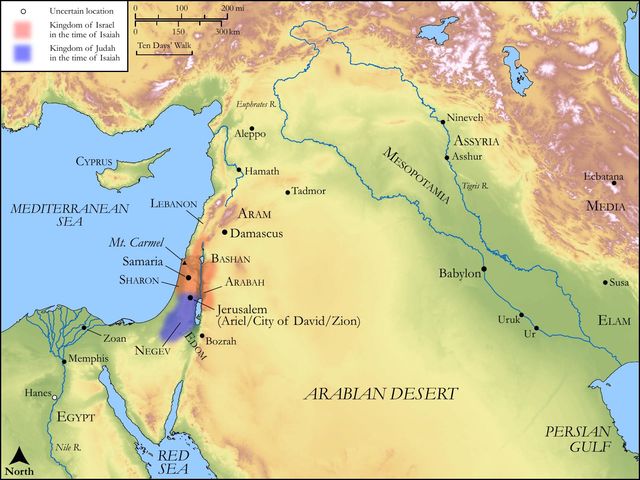
See on the biblical-era map
Study this verse
Public-domain commentary
Matthew Henry
From his Commentary on the Whole Bible. Henry comments on passages, not single verses — this entry covers Isaiah 28:23–29. His two-level outline is real structure in the source text, so it is rendered as structure.
This parable, which (like many of our Saviour's parables) is borrowed from the husbandman's calling, is ushered in with a solemn preface demanding attention, He that has ears to hear, let him hear, hear and understand, Isa 28:23.
I.The parable here is plain enough, that the husbandman applies himself to the business of his calling with a great deal of pains and prudence, secundum artem - according to rule, and, as his judgment directs him, observes a method and order in his work.
1.In his ploughing and sowing: Does the ploughman plough all day to sow? Yes, he does, and he ploughs in hope and sows in hope, Co1 9:10. Does he open and break the clods? Yes, he does, that the land may be fit to receive the seed. And when he has thus made plain the face thereof does he not sow his seed, seed suitable to the soil? For the husbandman knows what grain is fit for clayey ground and what for sandy ground, and, accordingly, he sows each in its place - wheat in the principal place (so the margin reads it), for it is the principal grain, and was a staple commodity of Canaan (Eze 27:17), and barley in the appointed place. The wisdom and goodness of the God of nature are to be observed in this, that, to oblige his creatures with a grateful variety of productions, he has suited to them an agreeable variety of earths.
2.In his threshing, Isa 28:27, Isa 28:28. This also he proportions to the grain that is to be threshed out. The fitches and the cummin, being easily got out of their husk or ear, are only threshed with a staff and a rod; but the bread-corn requires more force, and therefore that must be bruised with a threshing instrument, a sledge shod with iron, that was drawn to and fro over it, to beat out the corn; and yet he will not be ever threshing it, nor any longer than is necessary to loosen the corn from the chaff; he will not break it, or crush it, into the ground with the wheel of his cart, nor bruise it to pieces with his horsemen; the grinding of it is reserved for another operation. Observe, by the way, what pains are to be taken, not only for the earning, but for the preparing of our necessary food; and yet, after all, it is meat that perishes. Shall we then grudge to labour much more for the meat which endures to everlasting life? Bread-corn is bruised. Christ was so; it pleased the Lord to bruise him, that he might be the bread of life to us.
II.The interpretation of the parable is not so plain.
Most interpreters make it a further answer to those who set the judgments of God at defiance: "Let them know that as the husbandman will not be always ploughing, but will at length sow his seed, so God will not be always threatening, but will at length execute his threatenings and bring upon sinners the judgments they have deserved; but in wisdom, and in proportion to their strength, not that they may be ruined, but that they may be reformed and brought to repentance by them." But I think we may give this parable a greater latitude in the exposition of it.
1.In general, that God who gives the husbandman this wisdom is, doubtless, himself infinitely wise. It is God that instructs the husbandman to discretion, as his God, Isa 28:26. Husbandmen have need of discretion wherewith to order their affairs, and ought not undertake that business unless they do in some measure understand it; and they should by observation and experience endeavour to improve themselves in the knowledge of it. Since the king himself is served of the field, the advancing of the art of husbandry is a common service to mankind more than the cultivating of most other arts. The skill of the husbandman is from God, as every good and perfect gift is. This takes off somewhat of the weight and terror of the sentence passed on man for sin, that when God, in execution of it, sent man to till the ground, he taught him how to do it most to his advantage, otherwise, in the greatness of his folly, he might have been for ever tilling the sand of the sea, labouring to no purpose. It is he that gives men capacity for this business, an inclination to it, and a delight in it; and if some were not by Providence cut out for it, and mad to rejoice (as Issachar, that tribe of husbandmen) in their tents, notwithstanding the toil and fatigue of this business, we should soon want the supports of life. If some are more discreet and judicious in managing these or any other affairs than others are, God must be acknowledged in it; and to him husbandmen must seek for direction in their business, for they, above other men, have an immediate dependence upon the divine Providence. As to the other instance of the husbandman's conduct in threshing his corn, it is said, This also comes forth from the Lord of hosts, Isa 28:29. Even the plainest dictate of sense and reason must be acknowledged to come forth from the Lord of hosts. And, if it is from him that men do things wisely and discreetly, we must needs acknowledge him to be wise in counsel and excellent in working. God's working is according to his will; he never acts against his own mind, as men often do, and there is a counsel in his whole will: he is therefore excellent in working, because he is wonderful in counsel.
2.God's church is his husbandry, 1 Co. 3. 9 If Christ is the true vine, his Father is the husbandman (Joh 15:1), and he is continually by his word and ordinances cultivating it. Does the ploughman plough all day, and break the clods of his ground, that it may receive the seed, and does not God by his ministers break up the fallow ground? Does not the ploughman, when the ground is fitted for the seed, cast in the seed in its proper soil? He does so, and so the great God sows his word by the hand of his ministers (Mat 13:19), who are to divide the word of truth and give every one his portion. Whatever the soil of the heart is, there is some seed or other in the word proper for it. And, as the word of God, so the rod of God is thus wisely made use of. Afflictions are God's threshing-instruments, designed to loosen us from the world, to separate between us and our chaff, and to prepare us for use. And, as to these, God will make use of them as there is occasion; but he will proportion them to our strength; they shall be no heavier than there is need. If the rod and the staff will answer the end, he will not make use of his cart-wheel and his horsemen. And where these are necessary, as for the bruising of the bread-corn (which will not otherwise be got clean from the straw), yet he will not be ever threshing it, will not always chide, but his anger shall endure but for a moment; nor will he crush under his feet the prisoners of the earth. And herein we must acknowledge him wonderful in counsel and excellent in working.
Historical interpretation
Historical reception
1 surviving comment on this verse from the historical church.
(Vers. 23 seqq.) Pay attention and listen to my voice: listen and hear my speech. Does the plowman plow all day to sow, break up the soil, and harrow it? When he has leveled its surface, does he not sow dill, scatter cumin, plant wheat in rows, barley, millet, and rye in their proper place? For his God instructs him and teaches him the right way. For dill is not threshed with a threshing sledge, nor is a cartwheel rolled over cumin; but dill is beaten out with a stick and cumin with a rod, and the wheat for bread is crushed. But he will not crush him forever, nor will the wheel of his cart bruise him, nor will he grind him with his hoofs. This also comes forth from the LORD of hosts, who is wonderful in counsel, and excellent in working. Listen and hear my voice; pay attention and hear my words. Does the plowman keep plowing all day to sow? Does he keep turning the soil and breaking the clods? When he has leveled its surface, does he not sow the black cumin and scatter the cumin seed? He plants wheat in rows, barley in its designated place, and spelt along its borders, for he instructs him with judgment, and teaches him knowledge. For it is not when gith is cleansed by hardness, nor when the wheel of a cart goes over the cumin; but the gith is shaken off, and the cumin is eaten with bread. For I will not be angry with you forever, nor will the voice of my bitterness trample you, and these wonders have come from the Lord. Come, consult, exalt empty consolation. Now he even speaks to the same ones to whom he said before: Hear the word of God, you scoffers, who rule over my people who are in Jerusalem: and he commands them to hear his voice, and to carefully attend to his discourse. He says, 'Does the farmer always plow so that he may scatter the seed? Will he not first break up the soil and turn over the furrows with a plow, and break up the clods with a rake and a hoe, so that when he has leveled the surface of the earth and softened the previously hard fields, then he may spread spelt or cumin and sow wheat, barley, millet, and spelt in his fields, according to the variation of the soil and the seasons; for not all things are sown at the same time.' Some understand by farre what the Greeks call ζέαν. And God, by His natural judgment, teaches the farmer, that is, the sower, and instructs him to know what cultivation he should apply to each seed. Finally, when the time for harvesting comes, barley and cumin, which are weaker seeds, are not crushed by the wheels of carts, which are turned and pulled like sawmills over the harvested crops; but they are beaten out with a stick and a staff, which are commonly called flails. But bread, that is, wheat from which bread is made, is ground with iron wheels, and all its chaff is crushed into straw. However, it is not always ground and crushed by the nails of the wheels; for this reason, it is said in Hebrew with their horses: so that because he had mentioned the nails of the wheels, he would maintain the metaphor in the rest. Some want it to be shown from the fact that he mentioned nails and horses, the herds of mares, which are usually sent into the threshing floors for grinding wheat: but the Scripture could not say that the province of Judea did not have them. However, this, that is, that the branches of gith and cumin are shaken off with a stick: the grain of barley and far, perhaps also millet, is crushed with iron wheels, is not a perpetual judgment of God, who in all things shows his wonderful counsel, and shows the greatness of his justice in all things. We have said these things paraphrastically, so that we may more easily understand the meaning for which these things are said. God dispenses the human race in various ways, now punishing, now having mercy: now rebuking, now defending; that is, now he plows, now he sows, now he harvests the ripe fruits, and threshes them in the barns, and governs his own world as he pleases. He who knew the will of his Lord, and did not do it, will be beaten with many stripes (Luke 12:47); and in another place it is written: The mighty shall suffer mighty tortures (Wisdom 6:7). But they will not be tormented forever. For it is one thing to be impious, another thing to be a sinner. What we have interpreted concerning the nations and the Jews, others explain as referring to the people and the priests, so that the ignorant multitude will be chastised like a reed and cumin with a rod; but the priests who have the key of knowledge will be tormented with great punishments. And may this be done by the judgment of the Lord, who reveals his wonderful counsel and the truth of justice in all things, so that those who have received more will be required to give more. As for what we have translated: 'On a rod the gith will be shaken, and cumin on a staff.' I do not know why the LXX translators chose to translate it this way, but cumin is actually eaten with bread. And indeed, even the ancient Greek translators, discussing the Hebrew text, remained silent about this passage, perhaps because they did not know what to say. But what we have placed according to the Hebrew is: 'He will not continually thresh him, nor will a wagon wheel drive over him, nor will his hooves crush him.' The LXX translators interpreted it not according to the exact words, but according to the meaning: 'For I will not be angry with you forever, nor will the voice of my bitterness trample you.' They were showing future blessings to sinners after torment, and that these things were like wonders and miracles that have come from the Lord. Where it is commanded to sinners who are about to be punished, that they should seek counsel and raise up their consolation, not in any way vain, as it is added by the Seventy, but absolutely consolation. For God would never command them to raise up their vain consolation, which would not be profitable for them.
Continue studying Isaiah 28:28 across the web’s major study libraries — every link below opens this exact verse, chapter, or book on the destination site.
Read & Compare
 BibleGatewayThis verse in more than 200 translations and 70 languages.
 Bible.comThe YouVersion reader — hundreds of translations, reading plans, and highlights.
 ESV.orgCrossway's official English Standard Version reader.
 NET BibleThe NET translation with 60,000+ translators' notes on every rendering decision.
 STEP BibleTyndale House's free study tool — original text, vocabulary, and scholarly resources.
 BibliaLogos Bible Software's free web reader.
 USCCBThe New American Bible (Revised Edition) with the U.S. bishops' study notes.
Commentaries
 BibleHub CommentariesDozens of classic commentaries on this verse, gathered on one page.
 StudyLightMore than 100 commentary sets — the largest collection on the web.
 BibleRefPlain-English commentary on what this verse means, verse by verse.
 Enduring WordDavid Guzik's free commentary on this chapter, widely used by Bible teachers.
 Bible Study ToolsVerse commentary alongside Greek and Hebrew study aids.
Original Language & Research
- BibleHub InterlinearThe verse word by word — original language, transliteration, and English.
- BibleHub LexiconEvery word's original-language definition and Strong's entry.
 Blue Letter BibleDeep-study tools — Strong's numbers, concordance, and word studies.
 SefariaThe Hebrew text with Rashi and centuries of Jewish commentary.
Sermons, Hymns & Audio


TrulyRandomVerse is not affiliated with these sites and doesn’t control their content. They’re linked because they’re genuinely useful.
Summary
Isaiah 28:28 masterfully employs an agricultural metaphor to convey the profound wisdom and measured purpose of God's dealings with humanity. It vividly portrays the careful process of threshing grain, underscoring that while a necessary "bruising" is required to separate the valuable kernel from the worthless chaff, this process is neither endless nor arbitrary. Rather, it is precisely controlled by the divine Farmer, demonstrating that God's discipline, judgments, and refining work are always administered with perfect discernment, a specific redemptive aim, and a definite limit, ensuring purification and fruitfulness without total destruction.
Context
ShowHideLiterary Context
This verse is intricately woven into a broader prophetic oracle found in Isaiah 28:23-29, where the prophet Isaiah shifts from pronouncements of judgment to an illustration of God's intelligent and purposeful actions through the analogy of a skilled farmer. The preceding verses (Isaiah 28:1-22) deliver stern warnings and woes against the spiritual arrogance, drunkenness, and covenant infidelity of both the northern kingdom of Ephraim and the southern kingdom of Judah. Amidst these severe pronouncements, Isaiah pivots to assure his audience that God's actions are never chaotic, vindictive, or without ultimate design. Just as an experienced farmer knows the precise methods and timing for each stage of cultivation and harvest, God applies discipline with discerning wisdom, ensuring that the necessary "bruising" serves a refining, rather than an annihilating, purpose. This specific verse focuses on the final and crucial stage of grain processing—threshing—to underscore the controlled and purposeful nature of divine discipline and judgment.
Historical & Cultural Context
The agricultural imagery in Isaiah 28:28 would have resonated deeply and immediately with an ancient Israelite audience, whose society was predominantly agrarian. Threshing was a common, vital, and laborious process for preparing staple grains like wheat and barley for consumption. Different methods were employed based on the toughness of the grain and the desired outcome: lighter grains might be beaten with a rod, while tougher varieties required the use of a heavy threshing sledge (often with iron teeth) pulled by oxen, a cart wheel, or even the trampling of animals. The objective was always to separate the valuable grain from the worthless straw and chaff without damaging the grain itself. This verse specifically mentions the use of a "wheel of his cart" and "horsemen" (implying trampling by animals), indicating methods used for more robust grains. The cultural understanding was that an experienced farmer possessed the wisdom to know exactly when to stop the process, lest the grain be destroyed or ground into useless powder. This practical, everyday wisdom forms the essential backdrop for understanding God's judicious and limited application of discipline.
Key Themes
ShowHideThe primary theme powerfully conveyed by Isaiah 28:28 is God's Sovereign Wisdom and Discernment. The analogy of the farmer highlights that God's actions, even those involving severe discipline or judgment, are meticulously planned and executed with perfect knowledge of the desired outcome. He knows precisely how much pressure to apply and when to cease, ensuring purification without destruction. This leads directly to a second crucial theme: Purposeful Discipline and Refinement. The "bruising" of the grain is not an act of arbitrary punishment but a necessary process to separate the valuable from the worthless, akin to how God refines His people (compare Malachi 3:3 and Zechariah 13:9). Finally, the verse subtly introduces the profound theme of Hope Amidst Judgment. The farmer "will not ever be threshing it," implying a definite limit and a cessation to the process. This offers a powerful assurance that God's judgments, while severe and necessary, are temporary and ultimately aim for restoration and the production of spiritual fruit, not the utter annihilation of His people (see Jeremiah 30:11).
Exposition and Analysis
ShowHideKey Word Analysis
ShowHideMeaning "food (for man or beast), especially bread, or grain (for making it)." In this context, "bread" refers to the grain itself, the raw material that will be processed into food. It signifies the valuable substance that is the object of the threshing process, representing God's people or the spiritual fruit He desires to produce.
A primitive root meaning "to crush (or intransitively) crumble; beat in pieces (small), bruise, make dust, (into) [idiom] powder, (be, very) small, stamp (small)." Here, it denotes the forceful action applied to the grain to break open its husk and release the kernel. The word carries the implicit warning that excessive "bruising" would render the grain useless dust, highlighting the critical need for precise control and a defined stopping point in the process.
A primitive root meaning "to tread out (grain); thresh." This is the core agricultural activity described, the essential process of separating the valuable grain from the worthless straw and chaff. The KJV also includes "dûwsh" (H1758), a synonymous root meaning "to trample or thresh," reinforcing the action. The verse's emphasis that this necessary process will not be perpetual underscores God's intentional limitation.
A variation of galgal, meaning "a wheel; by analogy, a whirlwind; also dust (as whirled)." Here, it specifically refers to the heavy wheel of a threshing cart or sledge, a robust tool used for more resilient grains. Its mention indicates a forceful, weighty method of separation, yet the context emphasizes that even with such power, the farmer's aim is not destruction.
Verse Breakdown
ShowHide"Bread [corn] is bruised"
This opening clause immediately establishes the subject—grain, which is ultimately destined to become nourishing bread—and its initial state of being subjected to a forceful, impactful process. The "bruising" is the necessary first step in preparing the grain for consumption, signifying that a certain level of pressure, difficulty, or discipline is inherent and essential in the refining process.
"because he will not ever be threshing it"
This crucial phrase introduces the divine limitation and purposeful intent. The "he" refers to the farmer (representing God in the analogy). It profoundly signifies that the threshing, or the "bruising," is not an endless, arbitrary, or ultimately destructive act. There is a definite end point, a cessation, to the process, ensuring that the grain is refined and purified but never annihilated or rendered useless. This speaks to God's mercy and restraint.
"nor break [it with] the wheel of his cart"
This specifies one powerful method of threshing—the heavy, crushing action of a cart wheel, often equipped with iron teeth. It highlights the intensity and severity of the process, particularly for tougher grains that require significant force to separate. Yet, the preceding negative ("nor break") reinforces the idea that even with such powerful tools, the farmer's (God's) aim is not to utterly destroy the grain, but to extract its value.
"nor bruise it [with] his horsemen"
This refers to another forceful method of threshing, likely the trampling of grain by horses or oxen, driven by "horsemen." This method also involves significant, sustained force. The repetition of "nor bruise it" (using the same root as the opening clause) underscores the farmer's (God's) deliberate restraint, control, and wisdom, ensuring the integrity and usability of the grain are maintained, even under intense and prolonged pressure.
Literary Devices
ShowHideThe primary literary device at play in Isaiah 28:28 is Metaphor. The entire verse functions as an extended metaphor, comparing God's wise, purposeful, and limited discipline of His people to a skilled farmer's careful and controlled process of threshing grain. The "bruising" and "threshing" represent divine judgment, trials, chastening, or refining processes, while the "grain" symbolizes God's people or the spiritual fruit He desires to cultivate in them. The farmer's precise knowledge of when to begin and, crucially, when to stop the threshing process illustrates God's perfect wisdom, sovereignty, and control over the duration and intensity of His discipline. This metaphor is further enhanced by Analogy, drawing a direct and relatable parallel between the farmer's practical wisdom in agriculture and God's spiritual wisdom in governing His creation and His covenant people. The detailed description of various threshing methods (cart wheel, horsemen) adds vivid Imagery, making the analogy concrete, relatable, and impactful for an agrarian society, emphasizing the severity of the process while simultaneously highlighting the farmer's discerning control.
Theological and Thematic Connections
ShowHideIsaiah 28:28 powerfully articulates the profound theological truth that God's discipline is always purposeful, precisely measured, and ultimately redemptive, never arbitrary or destructive. Just as a wise farmer knows exactly how much pressure is needed to separate the valuable grain from the worthless chaff without destroying the grain itself, so God applies trials, judgments, and refining processes to His people. These experiences are designed to purify them, remove impurities, deepen their faith, and produce spiritual fruit. This verse profoundly underscores God's perfect wisdom, sovereignty, and unwavering love, assuring us that even in the midst of hardship, He is working with a specific, benevolent goal in mind, ensuring that the "bruising" leads to purification and not annihilation. It speaks to the divine balance between judgment and mercy, demonstrating that even His severest actions are rooted in His ultimate love and desire for His people's good, aiming for their restoration and flourishing.
Reflection and Application
ShowHideIsaiah 28:28 offers profound comfort and a vital, transformative perspective for believers navigating life's inevitable trials and difficulties. When we experience what feels like intense "bruising"—whether through personal suffering, relational strain, professional setbacks, spiritual struggles, or the consequences of our own choices—this verse serves as a powerful reminder that God is not a chaotic, indifferent, or cruel taskmaster. Instead, He is the infinitely wise Farmer, orchestrating every challenge with divine precision and a specific, purifying purpose. Our trials are not random acts of misfortune but divinely permitted and often divinely initiated processes designed to refine our character, expose and remove impurities, deepen our faith, and make us more useful for His kingdom and His glory. The profound assurance that He "will not ever be threshing it" means there is a limit to the intensity and duration of our hardships; God knows precisely when to ease the pressure, ensuring that we are refined, not destroyed. This understanding calls us to trust God's sovereign hand even when the process is painful, knowing that His ultimate goal is our good and His glory, transforming us into nourishing "bread" for a hungry world, ready to be broken and shared.
Questions for Reflection
ShowHideFAQ
ShowHideWhat does "corn" mean in this verse, and why is it "bruised"?
ShowHideIn the King James Version, "corn" is an archaic term referring to grain in general, such as wheat or barley, not specifically maize (which was unknown in the ancient Near East). The Hebrew word is lechem (H3899), which broadly means food, bread, or grain. The grain is "bruised" (Hebrew dâqaq, H1854) as an essential part of the threshing process, which is necessary to separate the valuable kernels from the worthless husks and straw. This "bruising" is a powerful metaphor for God's precise and purposeful discipline, which, while sometimes painful, is always intended to refine and purify His people, not to destroy them, as seen throughout Isaiah 28.
What is the significance of the farmer "not ever be threshing it"?
ShowHideThis phrase is profoundly significant because it highlights the controlled and limited nature of the threshing process. It means the farmer (representing God) will not continue to thresh indefinitely or excessively. There is a precise time to stop, ensuring that the grain is separated and prepared, but not utterly destroyed or ground into useless powder. The Hebrew word for "ever" here is netsach (H5331), implying continually or perpetually. This signifies that God's discipline, while necessary and intense, has a definite end and is always administered with a discerning purpose, never leading to the complete annihilation of His people. It offers a profound assurance of God's mercy, wisdom, and faithfulness even amidst judgment, promising that His refining work will not go beyond what is necessary to achieve His good and redemptive purposes (compare Lamentations 3:32).
Christ-Centered Fulfillment
ShowHideIsaiah 28:28 finds its ultimate and most profound Christ-centered fulfillment in the person and redemptive work of Jesus Christ. While the Old Testament speaks of God's discipline for Israel's refinement, Christ embodies the perfect wisdom of the divine Farmer in a unique way. He is the "grain" that was truly "bruised" for our sake, not by a cart wheel or horsemen, but by the crushing weight of sin and divine judgment on the cross. The prophet Isaiah himself powerfully foreshadowed this in Isaiah 53:5, declaring, "He was bruised for our iniquities, he was crushed for our transgressions." This ultimate "bruising" was not for His own purification, for He was perfectly sinless, but for the separation of humanity from the chaff of sin and death, providing the "bread of life" for all who believe. Through His sacrificial death, Christ became the perfect "bread" (as He declared in John 6:35), broken and given for the life of the world, satisfying our deepest spiritual hunger. Furthermore, as the Head of the Church, Christ continues the work of refinement in believers, allowing trials and "bruising" experiences not to destroy us, but to conform us to His own image (as described in Romans 8:29) and to prepare us as His pure and spotless bride, ultimately presenting us blameless before God (as seen in Ephesians 5:27). The limited nature of the threshing also points to Christ's finished work, where the ultimate judgment for sin was fully borne by Him, ensuring that those in Him will never face eternal condemnation, but rather eternal life and glory (see Romans 8:1).