


Isaiah 11:16
Bible text: King James Version (1769 Blayney text) · Public domain
Bible text: King James Version with Strong's numbers · Public domain
Bible text: Berean Standard Bible · Public domain
Bible text: American Standard Version (1901) · Public domain
Bible text: World English Bible, Messianic edition · Public domain
Bible text: Geneva Bible (1599) · Public domain
Bible text: Young's Literal Translation · Public domain
- וְהָיְתָהve·ha·ye·Tahand it will belongH1961Conj-w ¦ V-Qal-ConsecPerf-3fsVerb Qal Consecutive Perfect 3rd Singular Feminineוְandהָיְתָהit will belong
- מְסִלָּהme·si·Laha highwayH4546N-fsNoun Singular Feminine Absolute
- לִשְׁאָרlish·'Arto [the] remnant ofH7605Prep-l ¦ N-mscNoun Singular Masculine Constructלִtoשְׁאָר[the] remnant of
- עַמּוֹa·Mohis peopleH5971N-msc ¦ 3msNoun Singular Masculine Constructעַמּpeopleוֹhis
- אֲשֶׁר'a·SherwhichH834RelParticle Relative
- יִשָּׁאֵרyi·sha·'Erit will remainH7604V-Niphal-Imperf-3msVerb Niphal Imperfect 3rd Singular Masculine
- מֵאַשּׁוּרme·'a·Shurfrom AssyriaH804Prep-m ¦ N-properNoun Proper LocationמֵfromאַשּׁוּרAssyria
- כַּאֲשֶׁרka·'a·Sherjust asH834Prep-k ¦ RelParticle Relativeכַּjustאֲשֶׁרas
- הָיְתָהha·ye·Tahit belongedH1961V-Qal-Perf-3fsVerb Qal Perfect 3rd Singular Feminine
- לְיִשְׂרָאֵלle·Yis·ra·'Elto IsraelH3478Prep-l ¦ N-properNoun Proper LocationלְtoיִשְׂרָאֵלIsrael
- בְּיוֹםbe·Yomon [the] dayH3117Prep-b ¦ N-mscNoun Singular Masculine Constructבְּonיוֹם[the] day
- עֲלֹתוֹa·lo·Towent up itH5927V-Qal-Inf ¦ 3msVerb Qal Infinitive Constructעֲלֹתwent upוֹit
- מֵאֶרֶץme·'E·retzfrom [the] land ofH776Prep-m ¦ N-fscNoun Singular Feminine Constructמֵfromאֶרֶץ[the] land of
- מִצְרָיִםmitz·Ra·yimEgyptH4714N-properNoun Proper Location
English is a literal word-by-word gloss of the Hebrew, not the KJV's wording. Why?
This is the original text the KJV's translators worked from — each Hebrew word with its own literal English meaning in this verse, prepared by scholars at Tyndale House, Cambridge. The KJV translates whole sentences, not word by word, so its wording differs: one Hebrew word can become several English words, and the KJV may choose “the LORD” where the gloss reads “Yahweh”. Both are faithful — they answer different questions. For the KJV's own rendering, switch to the KJV text.
Details
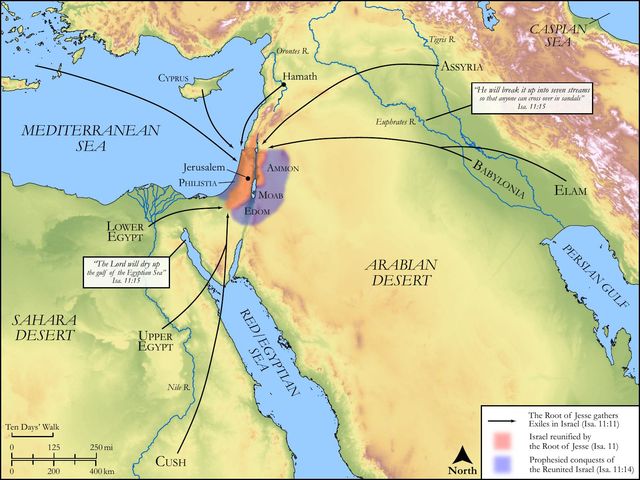
See on the biblical-era map
Study this verse
Public-domain commentary
Matthew Henry
From his Commentary on the Whole Bible. Henry comments on passages, not single verses — this entry covers Isaiah 11:10–16. His three-level outline is real structure in the source text, so it is rendered as structure.
We have here a further prophecy of the enlargement and advancement of the kingdom of the Messiah, under the type and figure of the flourishing condition of the kingdom of Judah in the latter end of Hezekiah's reign, after the defeat of Sennacherib.
I.This prediction was in part accomplished when the great things God did for Hezekiah and his people proved as an ensign, inviting the neighbouring nations to them to enquire of the wonders done in the land, on which errand the king of Babylon's ambassadors came. To them the Gentiles sought; and Jerusalem, the rest or habitation of the Jews, was then glorious, Isa 11:10. Then many of the Israelites who belonged to the kingdom of the ten tribes, who upon the destruction of that kingdom by the king of Assyria were forced to flee for shelter into all the countries about and to some that lay very remote, even to the islands of the sea, were encouraged to return to their own country and put themselves under the protection and government of the king of Judah, the rather because it was an Assyrian army by which their country had been ruined and that was not routed. This is said to be a recovery of them the second time (Isa 11:11), such an instance of the power and goodness of God, and such a reviving to them, as their first deliverance out of Egypt was. Then the outcasts of Israel should be gathered in, and brought home, and those of Judah too, who, upon the approach of the Assyrian army, shifted for their own safety. Then the old feud between Ephraim and Judah shall be forgotten, and they shall join against the Philistines and their other common enemies, Isa 11:13, Isa 11:14. Note, Those who have been sharers with each other in afflictions and mercies, dangers and deliverances, ought in consideration thereof to unite for their joint and mutual safety and protection; and it is likely to be well with the church when Ephraim and Judah are one against the Philistines. Then, whatever difficulties there may be in the way of the return of the dispersed, the Lord shall find out some way or other to remove them, as when he brought Israel out of Egypt he dried up the Red Sea and Jordan (Isa 11:15) and led them to Canaan through the invincible embarrassments of a vast howling wilderness, Isa 11:16. The like will he do this second time, or that which shall be equivalent. When God's time has come for the deliverance of his people mountains of opposition shall become plain before him. Let us not despair therefore when the interests of the church seem to be brought very low; God can soon turn gloomy days into glorious ones.
II.It had a further reference to the days of the Messiah and the accession of the Gentiles to his kingdom; for to these the apostle applies Isa 11:10, of which the following verses are a continuation. Rom 15:12, There shall be a root of Jesse; and he that shall rise to reign over the Gentiles, in him shall the Gentiles trust. That is a key to this prophecy, which speaks of Christ as the root of Jesse, or a branch out of his roots (Isa 11:1), a root out of a dry ground, Isa 53:2. He is the root of David (Rev 5:5), the root and offspring of David Rev 22:16.
1.He shall stand, or be set up, for an ensign of the people. When he was crucified he was lifted up from the earth, that, as an ensign of beacon, he might draw the eyes and the hearts of all men unto him, Joh 12:32. He is set up as an ensign in the preaching of the everlasting gospel, in which the ministers, as standard-bearers, display the banner of his love, to allure us to him (Sol 1:4), the banner of his truth, under which we may enlist ourselves, to engage in a holy war against sin and Satan. Christ is the ensign to which the children of God that were scattered abroad are gathered together (Joh 11:51), and in him they meet as the centre of their unity.
2.To him shall the Gentiles seek. We read of Greeks that did so (Joh 12:21, We would see Jesus), and upon that occasion Christ spoke of his being lifted up, to draw all men to him. The apostle, from the Septuagint (or perhaps the Septuagint from the apostle, in the editions after Christ) reads it (Rom 15:12), In him shall the Gentiles trust; they shall seek to him with a dependence on him.
3.His rest shall be glorious. Some understand this of the death of Christ (the triumphs of the cross made even that glorious), others of his ascension, when he sat down to rest at the right hand of God. Or rather it is meant of the gospel church, that Mount Zion of which Christ has said, This is my rest, and in which he resides. This, though despised by the world, having upon it the beauty of holiness, is truly glorious, a glorious high throne, Jer 17:12.
4.Both Jews and Gentiles shall be gathered to him, Isa 11:11. A remnant of both, a little remnant in comparison, which shall be recovered, as it were, with great difficulty and hazard. As formerly God delivered his people, and gathered them out of all the countries whither they were scattered (Psa 106:47; Jer 16:15, Jer 16:16), so he will a second time, in another way, by the powerful working of the Spirit of grace with the word. He shall set his hand to do it; he shall exert his power, the arm of the Lord shall be revealed to do it.
(1.)There shall be a remnant of the Jews gathered in: The outcasts of Israel and the dispersed of Judah (Isa 11:12), many of whom, at the time of the bringing of them in to Christ, were Jews of the dispersion, the twelve tribes that were scattered abroad (Jam 1:1; Pe1 1:1), shall flock to Christ; and probably more of those scattered Jews were brought into the church, in proportion, than of those which remained in their own land.
(2.)Many of the nations, the Gentiles, shall be brought in by the lifting up of the ensign. Jacob foretold concerning Shiloh that to him should the gathering of the people be. Those that were strangers and foreigners shall be made nigh. The Jews were jealous of Christ's going to the dispersed among the Gentiles and of his teaching the Gentiles, Joh 7:35.
5.There shall be a happy accommodation between Judah and Ephraim, and both shall be safe from their adversaries and have dominion over them, Isa 11:13, Isa 11:14. The coalescence between Judah and Israel at that time was a type and figure of the uniting of Jews and Gentiles, who had been so long at variance in the gospel church. The house of Judah shall walk with the house of Israel (Jer 3:18) and become one nation (Eze 37:22); so the Jews and Gentiles are made of twain one new man (Eph 2:15), and, being at peace one with another, those that are adversaries to them both shall be cut off; for they shall fly upon the shoulders of the Philistines, as an eagle strikes at her prey, shall spoil those on the west side of them, and then they shall extend their conquests eastward over the Edomites, Moabites, and Ammonites. The gospel of Christ shall be successful in all parts, and some of all nations shall become obedient to the faith.
6.Every thing that might hinder the progress and success of the gospel shall be taken out of the way. As when God brought Israel out of Egypt he dried up the Red Sea and Jordan before them (Isa 63:11, Isa 63:12), and as afterwards when he brought up the Jews out of Babylon he prepared them their way (Isa 62:10), so when Jews and Gentiles are to be brought together into the gospel church all obstructions shall be removed (Isa 11:15, Isa 11:16), difficulties that seemed insuperable shall be strangely got over, the blind shall be led by a way that they knew not. See Isa 42:15, Isa 42:16; Isa 43:19, Isa 43:20. Converts shall be brought in chariots and in litters, Isa 66:20. Some think it is the further accession of multitudes to the church that is pointed at in that obscure prophecy of the drying up of the river Euphrates, that the way of the kings of the east may be prepared (Rev 16:12), which seems to refer to this prophecy. Note, When God's time has come for the bringing of nations, or particular persons, home to himself, divine grace will be victorious over all opposition. At the presence of the Lord the sea shall flee and Jordan be driven back; and those who set their faces heavenward will find there are not such difficulties in the way as they thought there were, for there is a highway thither, Isa 35:8.
Historical interpretation
Historical reception
1 surviving comment on this verse from the historical church.
(Verse 6 and following) The wolf will live with the lamb, and the leopard will lie down with the young goat; the calf, the lion, and the sheep will all stay together, and a small child will lead them. The calf and the bear will graze together; their young ones will lie down together, and the lion will eat straw like an ox. The infant will play near the cobra's den, and the young child will put his hand into the viper's nest. They will not cause harm or destroy on my holy mountain, for the earth will be filled with the knowledge of the Lord, as the waters cover the sea. This also the Jews and our Jewish followers contend will happen literally, that in the glory of Christ, whom they believe will come at the end of the world, all beasts will be tamed, and the former ferocity, the wolf and the lamb will feed together, and the other things with the others, which we now see as contrary to each other. We should ask those who accept everything in the present text as it is written, and do not relate to spiritual understanding, according to the saying of the Apostle, who says: Blessed be the God and Father of our Lord Jesus Christ, who has blessed us with every spiritual blessing in the heavenly places in Christ (2 Corinthians 1:3), therefore, the root, and the branch, and the flower should not be understood literally: and when it is said that the earth was struck by the word of God, and the wicked were killed by the breath of his lips, they should be understood as written: and they should be compelled to teach how the Lord's loins are surrounded by incorporeal things with righteousness and truth. But let us also ask them what is worthy of the majesty of the Lord, that the wolf and the lamb may feed together, and the leopard may lie down with the young goat, and the lion may eat straw like the ox, and a small child may put his hand into the hole of the venomous snake? Unless, perhaps, according to the fables of the poets, they will restore to us the golden age of Saturn, in which wolves and lambs will feed together, and rivers will flow with sweet wine, and the sweetest honey will drip from the leaves of trees, and everything will be filled with milk from the fountains. But if they respond that for the happiness of the times these things are to come, so that without anyone's harm, men may enjoy all good things, let them hear from us that nothing is good except virtue, and nothing is evil except vice, as the Psalmist says: Who is the man that desires life, and loves to see good days? Restrain your tongue from evil, and your lips from speaking deceit. Turn away from evil, and do good. (Psalm 34:14; 31:27). But riches, and bodily health, and abundance of all things, and their contraries, poverty, weakness, and lack, even among the philosophers of the world, are neither reckoned among good things nor among bad things, but are called indifferent. And the Stoics also, who agree in most respects with our doctrine, consider nothing to be good except honesty and virtue alone, and nothing to be evil except shamefulness. We have briefly stated these things in order to convincingly refute those who Judaize while in a deep sleep. However, through the life-giving spirit, understanding is easy. For Paul, formerly a persecutor and destroyer of the Church, is like a wolf, of whom it is said: Benjamin is a ravenous wolf; he dwelt with the lamb, or like Ananias, by whom he was baptized (Gen. XLIX, 27; Acts VIII), or like the Apostle Peter, to whom it was said: Feed my lambs (John XXI). And the leopard, who previously did not change its spots, lies down in the fountain of the Lord with the kid, not the one on the left, but the one sacrificed on the Lord's Passover. And this must be noted, that neither the lamb nor the kid dwell and lie down with the wolf and the leopard, but the wolf and the leopard imitate the innocence of the lamb and the kid. The lion also will dwell together with the most ferocious, and the sheep, and the calf. This we see daily in the Church, the rich and the poor, the powerful and the humble, kings and commoners dwelling together, and being ruled in the Church by little children, whom we understand to be the Apostles, and by Apostolic men, unskilled in language, but not in knowledge. When those who are bound together in the discipline of the Lord are united among themselves, so that their families are also joined, then this will be fulfilled: their young ones will rest together. The lion will also not eat meat, but straw, so that it may feed on simple food. And here it must be observed that it is not the ox that eats meat, but the lion that eats straw. I think that in Holy Scriptures, straw is understood as simple words. However, wheat and the inner marrow represent the meaning that is found in the letter: and it often happens that people of the world, who are ignorant of the mysteries, feed on simple reading of the Scriptures. The infant, who is small in wickedness, also puts his hand into the snake's hole and drives away the demons from the bodies of those possessed. But the child who is weaned is no longer nourished by milk but now eats solid food. He puts his hand into the cave of the ruler, that is, into the dwelling place of Satan himself, and from there he pulls him out. Hence, the power was given to the Apostles to tread on serpents and scorpions and over all the power of the enemy (Luke 10). However, poisonous animals will never be able to harm or kill those who dwell in the holy mountain of God, which is interpreted as the Church, as it is said in the Gospel: A city set on a hill cannot be hidden (Matt. 5:14). But lest we think that this is said about Mount Zion according to the error of the Hebrews, the following verse of the Gospel preaching shows the sacraments: For the earth shall be filled with the knowledge of the Lord (Isaiah 11:9). This is what was said above more obscurely: The wolf shall dwell with the lamb, and the leopard shall lie down with the kid (Isaiah 11:6). And according to their custom, the words of the prophets are revealed at the end: As the waters cover the sea (Habakkuk 2:14). Just as the depths of the sea are covered by the waters of the sea, that is, the land covered by the waves, so the knowledge of the Lord will fill the whole earth. The blessed Apostle Peter also testifies to the diverse conjunction of previous manners in the linen cloth (Acts 10), which was sent down from heaven, having four elements, which we understand as representing the four regions of the world, so that we may know the earth filled with the knowledge of God: in this vessel there were quadrupeds, and serpents, and wild beasts, and birds of the sky, so that just as the Ark did in the Flood, the Church may provide in the world.
On that day the root of Jesse shall stand as a signal to the peoples; the nations shall inquire of him, and his dwelling shall be glorious. LXX: On that day the root of Jesse shall stand as a signal to the peoples; the nations shall seek him out, and his dwelling shall be honored. For his resting place has been chosen in Hebrew, Mnuatho (), which all have likewise translated. And for his honor, in Hebrew it is read as Chabod (), which clearly signifies glory. And the meaning is: his death will be glorious, so that what the Savior prays for in the Gospel may be fulfilled: Father, glorify me with the glory which I had before the world was with you (John 17:5). It has been said about his birth, it has been said about the others in the midst of the Sacraments: he came to death, which is not called by the usual name of mortals, but because eternal life was in Christ, it is called rest. But we, in order to make the meaning clear to the reader, translate it as dormition and rest, with another word but the same meaning, we turn it into a tomb. Therefore, in that time, when the Gospel of Christ will shine forth throughout the whole world, and the knowledge of the Lord will fill all the earth like the waters cover the sea, the root of Jesse will be and the one who will rise from his lineage as a sign for all peoples, so that the nations may see the sign of the Son of Man in heaven (Matt. 24). He will have horns in his hands, in which his strength will be hidden, so that when exalted, he may draw all things to himself (Hab. 3). As the Septuagint translated, he will rise from the dead to be the prince of all nations, and all peoples will hope in him. This is also testified by Jacob in a mystical message about the tribe of Judah: The prince will not fail from Judah, nor the leader from his loins, until he comes to whom it belongs, and he will be the expectation of the nations. And in that day, the Lord will stretch out his hand a second time to possess the remnant of his people, which will be left behind by the Assyrians, and by Egypt, and by Phut, and by Ethiopia, and by Elam, and by Shinar, and by Hamath, and by the islands of the sea. And He will lift up a signal for the nations, and will gather the outcasts of Israel, and assemble the scattered ones of Judah from the four corners of the earth. The jealousy of Ephraim will depart, and the enemies of Judah will be destroyed. Ephraim will not be jealous of Judah, and Judah will not fight against Ephraim. They will swoop down on the Philistines' shoulder through the sea, together they will plunder the sons of the East. And Edom and Moab will be under their control, and the sons of Ammon will obey them. In that day, which is the time mentioned before, when the Root of Jesse rises as a signal for the peoples, in order to rule over the nations, the Lord will stretch out His hand a second time, so that not according to our Jewish understanding at the end of the world, when the fullness of the Gentiles has come in, then all Israel will be saved (Rom. XI); but let us understand all these things in relation to His first coming. For we cannot, when the same day is said both now and above, refer it to the first coming, and the one below to the second: lest by these things which follow, and those which precede, Christ whom the Jews contend has not yet come but is to come, should be referred to him. After the calling of the Gentiles, therefore, which were formerly reckoned in the tail, Israel shall be reckoned in the tail, in order that the Lord may again put forth his hand a second time, and possess the remnant of his people, of whom we have read above, not all Israel, but the remnants are to be saved, which shall be left by the Assyrians and by Egypt, and by the various nations around. For first the Twelve Apostles, and seventy, and one hundred twenty souls, and five hundred, who were gathered together, the Lord appeared to them, then three thousand, and five thousand Jews believed in the Lord. James also speaks to the apostle Paul, who himself was among the others: See, brother, how many thousands there are of believing Jews? all of these are zealous for the law (Acts 21:20). And in the same volume we read: Now there were dwelling in Jerusalem Jews, devout men from every nation under heaven, who were amazed and said: Are not all these Galileans, and how is it that we hear, each of us in his own native language? Parthians, Medes, Elamites, and residents of Mesopotamia, Judea and Cappadocia, Pontus and Asia, Phrygia and Pamphylia, Egypt and the parts of Libya near Cyrene; visitors from Rome, both Jews and converts to Judaism; Cretans and Arabs—we hear them declaring the wonders of God in our own tongues! (Acts 2:9-11) From all these nations, people from Israel, through the apostles, will be saved. The Ecclesiastical Histories report that the apostles preached the Gospel in the whole world, in such a way that some reached Persia and India, and Ethiopia extended its hands to God, and gifts for Christ were brought from across the rivers of Ethiopia. So that it may not seem to signify only the eastern peoples, it also includes the rest: And from the islands of the sea. However, the islands of the sea signify the western region, which is enclosed by the circuit of the ocean. Therefore, the sign of the Cross will be raised among all nations, and first it will gather the people of Israel from the synagogues, in order to fulfill the command of the Savior given to the Apostles, who said: Go to the lost sheep of the house of Israel (Matthew 10:6). Finally, Paul also speaks to the unbelievers among the Jews, saying: It was necessary for the word of God to be spoken to you first; but since you have rejected it and judge yourselves unworthy of eternal life, behold, we turn to the Gentiles, as the Lord has commanded us (Acts 13:46-47). But the four cardinal directions, east and west, south and north, signify, as by these the calling of the world is demonstrated. In that time, Isaiah says, Ephraim and Judah, who now, as prophesied by me, dissent with hostile hatred between themselves, will not be enemies, but according to the prophecy of Ezekiel, two rods will be joined into one rod, and they will be joined in the Church of Christ, who were previously separated (Ezek. VII), so that they may work together in the nations and willingly bear the burden of the Philistines on their shoulders across the sea, that is, they may first preach to the coastal Palestinians and swiftly proceed by sea to the other nations. Or according to the Seventy Interpreters: they will fly in the ships of foreigners, they will plunder the sea together; from which let us understand the example of the apostle Paul, who was carried by ships of foreigners through Pamphylia, and Asia, and Macedonia, and Achaia, and various islands and provinces, even to Italy (Acts 28), and as he himself writes, to Spain also (Romans 15). Therefore, Ephraim and Judah, that is, those who believed in Christ from the twelve tribes of the Jews, will plunder the East together, and extend their hands in Idumea and Moab, according to what Christ speaks mystically in the person of David: I will stretch out my shoe to Idumea: to me foreigners will serve (Psalm 59:10). For at that time when Isaiah prophesied, these nations were adversaries to the people of Judah, and therefore he now says that after the root of Jesse rises, to reign over the nations, and the banner of the Cross for the salvation of the whole world is raised up, then even Idumea, Moab, and the sons of Ammon, in fact, the entire extent of Arabia, will give their hands to the Apostles, and in the places of idolatry the Church of Christ will be raised up.
And the Lord will dry up the tongue of the sea of Egypt, and he will lift his hand over the river with the strength of his spirit, and he will strike it in the seven streams, so that people can cross it in sandals. And there will be a highway for the remnant of my people who are left from Assyria, just as there was for Israel on the day when they came up from the land of Egypt. Just as Edom and Moab, and the sons of Ammon will submit their hands to the Apostles, so that they may obey the preaching of the Gospel, in the same way the Lord himself, who fulfilled those things in his Apostles, will dry up not the sea according to the Septuagint, but according to the Hebrews, the tongue of the sea of Egypt, which previously blasphemed against the Lord and presided over the Egyptian superstition. And in the Psalms we read: This great and spacious sea, wherein are reptiles without number (Psalm 10:25-26). It is said of them: This dragon, whom you have made to mock at him. Therefore, he shall desolate, that is, put under a curse, as Theodotion, Aquila, and Symmachus translated it, the tongue of the Egyptian sea, and he shall lift up his hand over the rivers of Egypt in the strength of his spirit, or his most violent spirit, which we understand to be the kingdom of the Romans. For when Caesar Augustus was reigning (Luke 2), when the flower of Jesse's root ascended, and the first census was made in the Roman world, the most powerful kingdom of the Egyptians, which lasted for many generations, was destroyed by the death of Cleopatra, and the Egyptian river was struck into seven streams, or into seven valleys. For the Nile, which previously flowed in one channel and was impassable, was divided and cut into seven very humble valleys and streams, so that it could be crossed on foot. However, this symbolically signifies that the nation of the Egyptians, given over to such great idolatry and worthless superstition, consecrated hawks, owls, dogs, goats, and donkeys with divine names, in order to distribute the infinite power of the kingdom through individual judges of the Roman empire, so that Thebes has one judge, Libya has another, Pentapolis has another, Egypt has another, Alexandria has another, and various regions, which the Egyptians call 'laws'. Therefore, under the metaphor, the Nile is divided into parts and cut into streams, so that the Evangelical word can flow freely and reach the farthest people of Egypt without any hindrance. And just as in the time of Moses the Red Sea was dried up so that the people could flee from Egypt, in contrast, the rivers of Egypt will dry up so that the remaining people of God, who will be saved from the Assyrians and various nations, can pass into Egypt, not fleeing from it, but entering and treading on it with their own feet. A wise and Christian reader should have this rule of the promises of the prophets, that we may teach spiritually things which the Jews, and not only our, rather not our Judaizers, contend carnally will happen in the future, lest we be compelled to judaize by the occasion of such fables and inextricable questions, according to the Apostle (II Tim. II).
Continue studying Isaiah 11:16 across the web’s major study libraries — every link below opens this exact verse, chapter, or book on the destination site.
Read & Compare
 BibleGatewayThis verse in more than 200 translations and 70 languages.
 Bible.comThe YouVersion reader — hundreds of translations, reading plans, and highlights.
 ESV.orgCrossway's official English Standard Version reader.
 NET BibleThe NET translation with 60,000+ translators' notes on every rendering decision.
 STEP BibleTyndale House's free study tool — original text, vocabulary, and scholarly resources.
 BibliaLogos Bible Software's free web reader.
 USCCBThe New American Bible (Revised Edition) with the U.S. bishops' study notes.
Commentaries
 BibleHub CommentariesDozens of classic commentaries on this verse, gathered on one page.
 StudyLightMore than 100 commentary sets — the largest collection on the web.
 BibleRefPlain-English commentary on what this verse means, verse by verse.
 Enduring WordDavid Guzik's free commentary on this chapter, widely used by Bible teachers.
 Bible Study ToolsVerse commentary alongside Greek and Hebrew study aids.
Original Language & Research
- BibleHub InterlinearThe verse word by word — original language, transliteration, and English.
- BibleHub LexiconEvery word's original-language definition and Strong's entry.
 Blue Letter BibleDeep-study tools — Strong's numbers, concordance, and word studies.
 SefariaThe Hebrew text with Rashi and centuries of Jewish commentary.
Sermons, Hymns & Audio


TrulyRandomVerse is not affiliated with these sites and doesn’t control their content. They’re linked because they’re genuinely useful.
Summary
Isaiah 11:16 concludes a profound prophetic vision of future restoration, declaring that a divinely prepared "highway" will be established for the surviving remnant of God's people to return from Assyria and other places of exile. This grand re-gathering is explicitly likened to the foundational Exodus from Egypt, signifying an even greater, sovereignly orchestrated act of deliverance and re-establishment for Israel. The verse powerfully underscores God's unwavering faithfulness to His covenant promises and His omnipotent power to bring about comprehensive national and spiritual restoration.
Context
ShowHideLiterary Context
Isaiah 11 unfolds as a majestic prophecy concerning the future Messianic Kingdom. It commences with the promise of the Branch from Jesse, a righteous king endowed with the Spirit of the Lord, who will rule with perfect wisdom and justice. Verses 6-9 vividly depict the transformed creation under this Messiah's reign, where peace and harmony prevail even among formerly predatory animals, symbolizing the profound restorative impact of His rule. The focus then shifts in verses 10-16 to the global gathering of God's scattered people. Verse 11 specifically mentions a "second time" that the Lord will recover His remnant from diverse nations, highlighting the comprehensive scope of this ingathering. The passage details the reunification of Judah and Ephraim and the subjugation of their historical adversaries, culminating in the powerful imagery of the highway in Isaiah 11:16, which serves as the means for this glorious return. The entire chapter anticipates a future marked by justice, universal peace, and the complete restoration of Israel under the Messiah's benevolent and powerful dominion.
Historical & Cultural Context
The immediate historical backdrop for Isaiah's prophecy was the looming and very real threat of the Assyrian Empire. Assyria had already conquered the northern kingdom of Israel (722 BC) and posed a constant, formidable menace to Judah. While Isaiah 11:16 specifically names "Assyria," this term likely functions as a synecdoche, representing all nations and places of exile and oppression where God's people would be scattered, especially given the broader scope of the "second time" gathering from various nations mentioned in Isaiah 11:11. The profound comparison to the Exodus from Egypt is deeply significant within Israelite culture and theology. The Exodus was the quintessential redemptive event in Israel's history, the moment God demonstrated His power to deliver His people from bondage, establishing their national identity and covenant relationship with Him. By drawing this parallel, Isaiah elevates the promised future restoration to an unparalleled level of divine intervention and historical magnitude, promising a deliverance that would not only rival but potentially surpass the original Exodus in its glory and scope.
Key Themes
ShowHideIsaiah 11:16 powerfully articulates several central themes found throughout Isaiah and broader biblical theology. A primary theme is The Remnant of God's People, referring to the faithful and preserved portion of Israel who survive judgment and exile, through whom God's covenant promises will ultimately be fulfilled. The mention of those "left, from Assyria" underscores God's commitment to preserving a core of His people even in the midst of severe oppression and dispersion. Another dominant theme is Divine Deliverance and Restoration, emphasizing God's sovereign, miraculous, and active intervention to bring His people home, not through human might but through His mighty hand. This act of restoration is explicitly linked to the New Exodus, a recurring and significant motif in Isaiah (e.g., Isaiah 43:16-21) that prophesies a future deliverance even grander than the first, demonstrating God's enduring faithfulness to His covenant. Finally, the imagery of The Highway of Return signifies God's providential care in preparing a clear, unobstructed, and safe path for His people, echoing the "highway of holiness" in Isaiah 35:8 and symbolizing the ease, security, and divine guidance of their journey back.
Exposition and Analysis
ShowHideKey Word Analysis
ShowHideFrom the root סָלַל (salal), meaning "to be turnpiked" or "elevated," this word denotes a thoroughfare, a prepared and often raised road. It suggests a cleared, easy, and safe path, implying a divinely engineered route rather than a difficult, natural terrain. This highlights God's active role in removing obstacles and facilitating the smooth return of the remnant.
Derived from the root שָׁאַר (sha'ar), meaning "to swell up" or "to be redundant," this term refers to a remainder or residue. In prophetic contexts, it carries profound theological weight, signifying the faithful portion of God's people who are preserved through judgment and exile. It is through this preserved group that God's redemptive purposes and covenant promises will continue and ultimately be fulfilled.
This term refers to both Upper and Lower Egypt. Its specific inclusion in this verse is crucial as it directly invokes the historical Exodus, which was the foundational redemptive event for the nation of Israel. By drawing a parallel between the future return and the "day that he came up out of the land of Egypt," the prophet elevates the promised restoration to the level of Israel's most significant act of divine deliverance, emphasizing its miraculous nature and God's sovereign power.
Verse Breakdown
ShowHide"And there shall be a highway for the remnant of his people"
This opening clause introduces the central image of the verse: a divinely prepared, clear, and unhindered path. This "highway" is specifically designated for the "remnant," referring to the preserved and faithful portion of God's chosen people who have endured exile and judgment. It signifies God's active provision and preparation, ensuring their return journey is not arduous but divinely facilitated and secure.
"which shall be left, from Assyria"
This phrase specifies the geographical origin of a significant portion of the remnant. While "Assyria" was the dominant oppressive power of Isaiah's era, it likely serves as a representative term for all nations and places where Israel was scattered, symbolizing the comprehensive and global nature of God's re-gathering. The phrase "shall be left" underscores God's sovereign preservation of a faithful core amidst widespread dispersion and suffering.
"like as it was to Israel in the day that he came up out of the land of Egypt"
This powerful simile draws an explicit and profound parallel to the Exodus, the defining moment of Israel's liberation from slavery and their formation as a nation. By comparing the future return to this foundational redemptive event, the prophet elevates the promised restoration to an unparalleled level of divine intervention and miraculous deliverance, suggesting it will be just as, if not more, grand, awe-inspiring, and demonstrative of God's power than the first Exodus.
Literary Devices
ShowHideIsaiah 11:16 skillfully employs several potent literary devices to convey its message of future restoration. The most explicit is Simile, clearly stated in the phrase "like as it was to Israel in the day that he came up out of the land of Egypt." This comparison to the Exodus is not merely an illustrative analogy but a profound theological statement, elevating the promised future restoration to the status of Israel's most significant past redemptive act. The imagery of a "highway" functions as powerful Symbolism, representing a divinely prepared, unobstructed, and safe path for the returning exiles, signifying God's meticulous providential care and sovereign power to remove all obstacles. Furthermore, "Assyria" can be understood as a form of Synecdoche, where a part (one specific, prominent oppressor) stands for the whole (all nations where Israel was scattered and from which they would be gathered), thereby broadening the scope of the promised return to encompass a universal re-gathering of God's people.
Theological and Thematic Connections
ShowHideIsaiah 11:16 stands as a powerful declaration of God's unwavering faithfulness to His covenant promises and His sovereign power to restore His people. The "new Exodus" imagery signifies that God's redemptive work is not a singular historical event but an ongoing demonstration of His character, culminating in a future restoration that will surpass even the miraculous deliverance from Egypt. This prophecy assures believers that no matter how scattered, oppressed, or seemingly lost God's people may be, He will always make a way for their return and ultimate restoration, fulfilling His purposes through a preserved remnant. It speaks to the profound hope of a divinely orchestrated journey home, both physically for Israel and spiritually for all who trust in Him, demonstrating God's ultimate victory over all forms of bondage and His commitment to establishing His kingdom.
Reflection and Application
ShowHideIsaiah 11:16 offers profound hope and deep reassurance, serving as a powerful reminder of God's unwavering faithfulness to His promises, even when circumstances appear bleak or His people are scattered and in despair. It teaches us that God possesses the omnipotent power to deliver His people from any form of captivity, oppression, or spiritual exile, just as He miraculously did for ancient Israel from Egypt. For contemporary readers, this verse can symbolize God's ability to create a clear path through challenging life seasons, guiding His people towards their ultimate spiritual and physical restoration. It encourages a steadfast trust in God's grand redemptive plan, which often involves miraculous intervention and the gathering of His chosen ones, looking forward to the ultimate new heaven and new earth where all things are made new. It calls us to recognize God's sovereign hand actively orchestrating events in history to bring about His purposes, and to find immense comfort in His steadfast promise to always provide a way for His people to return to Him, both in this life and eternally.
Questions for Reflection
ShowHideFAQ
ShowHideWhat is the significance of the "highway" imagery in Isaiah 11:16?
ShowHideThe "highway" (Hebrew: mᵉçillâh') signifies a divinely prepared, unobstructed, and safe path. It's not a natural, difficult wilderness trail, but a well-built road, often elevated, designed for easy travel. This imagery emphasizes God's sovereign power and providential care in removing all obstacles and making the return journey easy and secure for His people. It highlights that this restoration is not a human effort but a miraculous act of God, ensuring the safe passage of the remnant back to their homeland. This concept is powerfully echoed in other prophecies, such as the Highway of Holiness in Isaiah 35:8.
How does the comparison to the Exodus from Egypt enhance the meaning of this verse?
ShowHideThe explicit comparison to the Exodus from the land of Egypt is profoundly significant because the Exodus was the foundational redemptive act for ancient Israel, establishing their identity as God's chosen people and demonstrating His unparalleled power to deliver them from bondage. By drawing this parallel, Isaiah prophesies an even greater act of deliverance and re-gathering, a "new Exodus" that will surpass the first in its scope and wonder. It underscores God's continued faithfulness to His covenant promises and assures His people that His future intervention will be just as, if not more, miraculous and comprehensive than their past liberation, demonstrating His enduring commitment to His people.
Christ-Centered Fulfillment
ShowHideIsaiah 11:16, with its profound promise of a "highway" for the returning remnant and its powerful echoes of a "new Exodus," finds its ultimate and spiritual fulfillment in the person and work of Jesus Christ. While the prophecy initially pointed to a physical return of Israel from exile, the New Testament reveals that the true and eternal "highway" to God is Christ Himself, who declared, "I am the way, and the truth, and the life; no one comes to the Father except through me." He is the divine means by which God's scattered people—both Jew and Gentile—are gathered into one unified body, the Church, forming the spiritual "remnant" of God's elect (Romans 9:27). The "new Exodus" is realized in Christ's redemptive work on the cross, where He delivered humanity from the far greater bondage of sin and death, a liberation infinitely more profound and comprehensive than the physical escape from Egypt. Just as God miraculously made a way through the Red Sea, Christ has opened a new and living way through His torn flesh, granting direct access to God (Hebrews 10:19-20). Through His sacrifice and glorious resurrection, believers are brought out of spiritual exile and into the glorious freedom of God's kingdom, journeying on the "highway of holiness" that is Christ Himself, towards the ultimate dwelling with God in the new heavens and new earth.