


Hosea 5:7
Bible text: King James Version (1769 Blayney text) · Public domain
Bible text: Berean Standard Bible · Public domain
Bible text: American Standard Version (1901) · Public domain
Bible text: World English Bible, Messianic edition · Public domain
Bible text: Geneva Bible (1599) · Public domain
Bible text: Young's Literal Translation · Public domain
- בַּיהוָהba·Yah·wehwith YahwehH3068Prep-b ¦ N-properNoun Proper TitleבַּwithיהוָהYahweh
- בָּגָדוּba·Ga·duthey have dealt treacherouslyH898V-Qal-Perf-3cpVerb Qal Perfect 3rd Plural common gender
- כִּיkiforH3588PrtParticle Conditional
- בָנִיםva·NimchildrenH1121N-mpNoun Plural Masculine Absolute
- זָרִיםza·RimstrangeH2114Adj-mpAdjective Plural Masculine Absolute
- יָלָדוּya·La·duthey have borneH3205V-Qal-Perf-3cpVerb Qal Perfect 3rd Plural common gender
- עַתָּה'a·TahnowH6258AdvAdverb
- יֹאכְלֵםyokh·Lemit will devour themH398V-Qal-Imperf-3ms ¦ 3mpVerb Qal Imperfect 3rd Singular Masculineיֹאכְלֵit will devourםthem
- חֹדֶשׁCho·desha new moonH2320N-msNoun Singular Masculine Absolute
- אֶת'etwithH854PrepPreposition
- חֶלְקֵיהֶםchel·kei·Hemtheir portionsH2506N-mpc ¦ 3mpNoun Plural Masculine Constructחֶלְקֵיportionsהֶםtheir
English is a literal word-by-word gloss of the Hebrew, not the KJV's wording. Why?
This is the original text the KJV's translators worked from — each Hebrew word with its own literal English meaning in this verse, prepared by scholars at Tyndale House, Cambridge. The KJV translates whole sentences, not word by word, so its wording differs: one Hebrew word can become several English words, and the KJV may choose “the LORD” where the gloss reads “Yahweh”. Both are faithful — they answer different questions. For the KJV's own rendering, switch to the KJV text.
Details
See on the biblical-era map
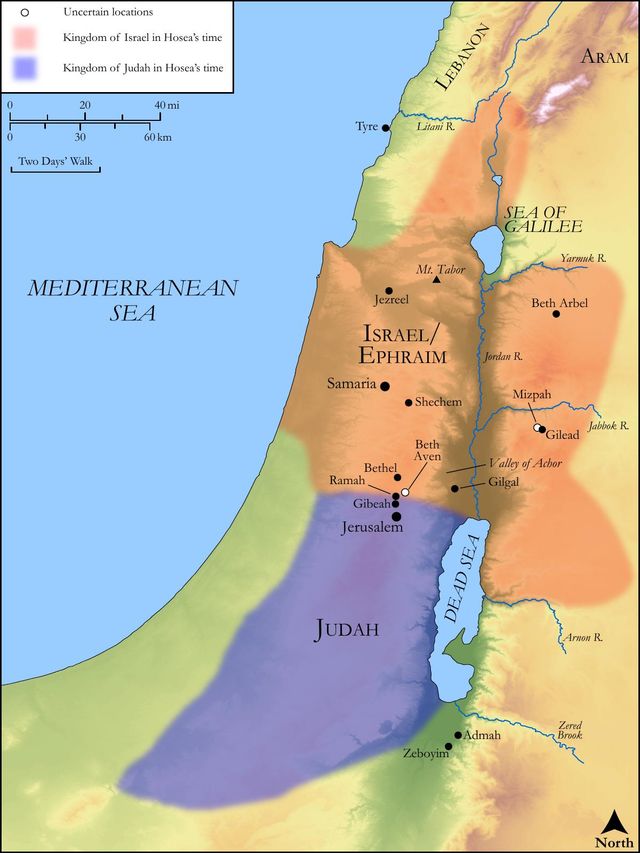
Study this verse
Public-domain commentary
Matthew Henry
From his Commentary on the Whole Bible. Henry comments on passages, not single verses — this entry covers Hosea 5:1–7. His three-level outline is real structure in the source text, so it is rendered as structure.
Here, I. All orders and degrees of men are cited to appear and answer to such things as shall be laid to their charge (Hos 5:1): Hear you this, O priests! whether in holy orders (as those in Judah, and perhaps many in Israel too, for in the ten tribes there were divers cities of priests and Levites, who, it is probable, staid in their own lot after the revolt of the ten tribes and did so much of their office as might be done at a distance from the temple) or pretending holy orders, as the priests of the calves, who, some think, are included here. "Hearken, you house of Israel, the common people, and give ear, O house of the king!" let them all take notice, for they have all contributed to the national guilt, and they shall all share in the national judgments. Note, If neither the sanctity of the priesthood nor the dignity of the royal family will prevail to keep out sin, it cannot be expected that they should avail to keep out wrath. If the priests, and the house of the king, though they bear such noble characters, sin like others, their noble characters will not excuse them, but they must smart like others. Nor shall it be any plea for the house of Israel that they were misled by their priests and princes, but they shall receive their doom with them, and neither their meanness nor their multitude shall be their exemption.
II.Witness is produced against them, one instead of a thousand; it is God's omniscience (Hos 5:3):
I know Ephraim, and Israel is not hidden from me. They have not known the Lord (Hos 5:4), but the Lord has known them, knows their true character however disguised, knows their secret wickedness however concealed. Note, Men's rejecting the knowledge of God will not secure them from his knowledge of them; and when he contends with them he will prove their sins upon them by his own knowledge, so that is will be in vain to plead Not guilty.
III.Very bad things are laid to their charge.
1.They had been very ingenious and very industrious to draw people either into sin or into trouble: You have been a snare on Mizpah, and a net spread upon Tabor (Hos 5:1), that is, such snares and nets as the huntsmen used to lay upon those mountains in pursuit of their game. When the worship of the calves was set up in Israel the patrons of that idolatry, and sticklers for it, contrived by all possible arts and wiles to draw men into it and reconcile those to it that at first had a dread of it. Note, Those that allure and entice men to sin, however they may pretend friendship and good-will, are to be looked upon as snares and nets to them, and their hands as bands, Ecc 7:26. But to those whom they could not seduce into sin they were as a net and a snare to bring them into trouble. Some think it was their practice to set spies in the road, and particularly upon the mountains of Mizpah and Tabor, at the times of the solemn feasts at Jerusalem, to watch if any of their people who were piously affected went thither, and to inform against them, that they might be prosecuted for it, thus doing the devil's work, who disquiets those whom he cannot debauch.
2.They had been both very crafty and very cruel in carrying on their designs (Hos 5:2): The revolters are profound to make slaughter. Note, Those who have themselves apostatized from the truths of God are often the most subtle and barbarous persecutors of those who still adhere to them. Nothing will serve them but to make slaughter (it is the blood of the saints that they thirst after): and with the serpent's sting they have his head; they are profound to do it. O the depth of the depths of Satan, of the wickedness of his agents, of those that have deeply revolted! Isa 31:6. Now that which aggravated this was the many reproofs and warnings that had been given them: Though I have been a rebuker of them all. The prophet had been so, a reprover by office. He had many a time told them of the evil of their ways and doings, had dealt plainly with them all, and had not spared either the priests or the house of the king. God himself had been a rebuker of them all by their own consciences and by his providences. Note, Sins against reproof are doubly sinful, Pro 29:1.
3.They had committed whoredom, had defiled their own bodies with fleshly lusts, had defiled their own souls with the worship of idols, Hos 5:3. This God was a witness to, though secretly committed and artfully palliated. Nay, the piercing eye of God saw the spirit of whoredom that was in the midst of them, their secret inclination and disposition to those sins, the love they had to their sins, and the dominion their sins had over them, how much they were under the power of a spirit of whoredom, that root of bitterness which bore all this gall and wormwood, that corrupt and poisoned fountain.
4.They had no disposition at all to come into acquaintance and communion with God. The spirit of whoredoms, having caused them to err from him, keeps them wandering endlessly, Hos 5:4.
(1.)They have not known the Lord, nor desire to know him, but have rather declined, nay dreaded, the knowledge of him, for that would disturb them in their sinful ways.
(2.)Therefore they will not frame their doings to turn to their God, by which it appeared that they did not know him aright. This intimates their obstinate persistence in their apostasy from God; they would not turn to God, though he was their God, theirs in covenant, by whose name they had been called, and whom they were bound to serve. They would not return to the worship of him, from which they had turned aside. Nay, they would not frame their doings to turn to God. They would not consider their ways, nor dispose themselves into a serious temper, nor apply their minds to think of those things that would bring them to God. It is true we cannot by our own power, without the special grace of God, turn to him; but we may by the due improvement of our faculties, and the common aids of his Spirit, frame our doings to turn to him. Those that will not do this, that prepare not their hearts to seek the Lord (Ch2 12:14), owe it to themselves that they are not turned; they die because they will die; and to those that will do this further grace shall not be wanting. (5.) They were guilty of notorious arrogancy, and insolence in sin (Hos 5:5): The pride of Israel doth testify to his face, doth witness against him that he is a rebel to God and his government. The spirit of whoredoms which was in the midst of them showed itself in the gaiety and gaudiness of their worship, as a harlot is known by her attire, Pro 7:10. The wantonness of her dress testifies to her face that she is not a modest woman. Or their pride in confronting the prophets God sent them and the message they brought (Jer 43:2), or a haughty scornful conduct towards their brethren and those that were under them, witnessed against them that they were not God's people and justified God in all the humbling judgments he brought upon them. His pride testifies in his face; so some read it, agreeing with Isa 3:9, The show of their countenance doth witness against them. They have that proud look which the Lord hates. (6.) They departed from God to idols, and bred up their children in idolatry (Hos 5:7): They have dealt treacherously against the Lord, as a wife, who, in contempt of the marriage covenant, forsakes her husband, and lives in adultery with another. Thus those who are guilty of spiritual idolatry, whose god is their money, whose god is their belly, deal treacherously against the Lord; they violate their engagements to him and frustrate his expectations from them. Note, Wilful sinners are treacherous dealers. They have begotten strange children, that is, their children which they have begotten are estranged from God, and trained up in a false way of worship; they are a spurious brood, as children of fornication (Joh 8:41), whom God will disown. Note, Those deal treacherously with God indeed who not only turn from following him themselves but train up their children in wicked ways.
IV.Very sad things are made to be their doom.
In general (Hos 5:1), "Judgment is towards you. God is coming forth to contend with you, and to testify his displeasure against you for your sins." It is time to hearken when judgment is towards us. In particular,
1.They shall fall in their iniquity. This follows upon their pride testifying to their face (Hos 5:5) Therefore shall Israel and Ephraim fall in their iniquity. Note, Pride will have a fall; it is the certain presage and forerunner of it. Those that exalt themselves shall be abased. The face in which pride testifies shall be filled with confusion. They shall not only fall, but fall in their iniquity, the saddest fall of any. Their pride kept them from repenting of their iniquity, and therefore they shall fall in it. Note, Those that are not humbled for their sins are likely to perish for ever in their sins. it is added, Judah also shall fall with them in her iniquity. As the ten tribes were carried captive into Assyria, for their idolatry, so the two tribes, in process of time, were carried into Babylon for following their bad example; but the former fell and were utterly cast down, the latter fell and were raised up again. Judah had the temple and priesthood, and yet these shall not secure them, but, if they sin with Israel and Ephraim, with them they shall fall.
2.They shall fall short of God's favour when they profess to seek it (Hos 5:6): They shall go with their flocks and with their herds to seek the Lord, but in vain; they shall not find him. This seems to be spoken principally of Judah, when they fell into their iniquity, and when they fell in their iniquity.
(1.)When they fell into their iniquity they sought the Lord; but they did not seek him only, and therefore he was not found of them. When they worshipped strange gods, yet they kept up the show and shadow of the worship of the true God; they went as usual, at the solemn feasts, with their flocks and herds to seek the Lord; but their hearts were not upright with him, because they were not entire for him, and therefore he would not accept them; for then only shall we find him when we seek him with our whole heart, not divided between God and Baal, Eze 14:3.
(2.)When they fell in their iniquity, or found themselves falling by it, they sought the Lord; but they did not seek him early, and therefore he will not be found of them. They shall see ruin coming upon them, and shall then, in their distress, flee to God, and think to make him their friend with burnt-offerings and sacrifices; but it will be too late then to turn away his wrath when the decree has gone forth. Even Josiah's reformation did not prevail to turn away the wrath of God, Kg2 23:25, Kg2 23:26. Those that go with their flocks and their herds only to seek the Lord, and not with their hearts and souls, cannot expect to find him, for his favour is not to be purchased with thousands of rams. Nor shall those speed who do not seek the Lord while he may be found, for there is a time when he will not be found. They shall not find him, for he has withdrawn himself; he will not be enquired of by them, but will turn a deaf ear to their sacrifices. See how much it is our concern to seek God early, now while the accepted time is, and the day of salvation.
3.They and their portions shall all be swallowed up. They have dealt treacherously against the Lord, and have thought to strengthen themselves in it by their alliances with strange children; but now shall a month devour them with their portions, that is, their estates and inheritances, all those things which they have taken, and taken up with, as their portion; or by their portions is meant their idols, whom they chose for their portion instead of God. Note, Those that make an idol of the world, by taking it for their portion, will themselves perish with it. A month shall devour them, or eat them up - a certain time prefixed, and a short time. When God's judgments begin with them they shall soon make an end; one month will do their business. How much may a body be weakened by one month's sickness, or a kingdom wasted by one month's war! Three shepherds (says God) I cut off in one month, Zac 11:8. Note, The judgments of God sometimes make quick work with a sinful people. A month devours more, and more portions, than many years can repair.
Historical interpretation
Fourteen Centuries of Reception
2 surviving comments on this verse. Each one is dated, so this reads as a timeline rather than a list.
Select a marker to jump to its quote. Markers stagger vertically where authors wrote within a few decades of each other.
"In their flocks and herds they will go to seek the Lord, but they will not find Him; He has withdrawn Himself from them. They have transgressed against the Lord, for they have produced illegitimate children. Now the month and its parts will devour them." LXX: "When they go with sheep and calves seeking the Lord, but shall not find him, he hath withdrawn himself from them. Because they have forsaken the Lord, and have brought up strange children, their rust shall devour them and their portions." Not only Israel and Ephraim will go with flocks and herds to seek the Lord, but also Judah, of whom it is written above: "Judah will also fall with them," all having this struggle, that they may try to appease with sacrifices those whom they have offended with their transgressions; and they will not find whom they seek, because he also departed from those who were departing. Especially when elsewhere he says, "Will I eat the flesh of bulls or drink the blood of goats?" And again, "I will not accept a bull from your house, nor goats from your flocks" (Ps. 49:13 and 9). And in Isaiah: "I do not want the sacrifices of rams or the fat of lambs or the blood of goats and bulls" (Isaiah 1:11). For they have transgressed against the Lord; because fornicating with idols, they did not beget children to God, but to demons. Some think that this signifies what is said in Ezra much later (1 Esdras 10) when they took foreign wives, creating children with them, and later were compelled to repudiate them. But it is better to accept foreign children who were generated in idolatrous error or whom they consecrated to idols by leading them through fire. Because, therefore, they did this, shortly afterwards, not after infinite periods of years, and as I used to predict before, far from the future; but now and in the present, the Assyrian and Chaldean will come and devour them with their parts, that is, with the possessions that they received in the division of the land according to the measure of the rope. Because we said "he will devour them," the Seventy translated "rust" for "them"; yet indeed rust, that is, ἐρυσίβη, in Hebrew is called Hasil, as they also said in the Prophet Joel: "The remnants of a worm will eat rust," which is to say, Hasil. But the month is called Hodes; finally Aquila translated "neomenias," that is, "Kalendas"; Symmachus and Theodotion translated "month"; and the sense is, the enemy will come each month and devastate all things. We read the Books of Kings and Chronicles, and we find that under King Pekah, who reigned over ten tribes, Tiglath-pileser, the king of Assyria, came and took a great part of the people of Samaria to the Assyrians, at which time, according to the Greeks, it was the second year of the first Olympiad; and among the Latins (not yet founded Rome) Amulius was ruling in the twentieth year, whom later Romulus drove out of the kingdom. Heretics suspect that God is pleased with the multitude of sacrifices; and ecclesiastics, that by giving alms, they redeem sins, in which they remain: whereas every sacrifice except past sins, not present ones; thus, they do not find the Lord, Who removes Himself from such things, and retreats far away. These have truly ($"Al." however$) acted deceitfully against God, and have begotten children for the devil, not for Christ: therefore their works are cursed at all times, and all things that they do, the rusty color of blood lays waste, because they are closely related to blood and killing. But the rusty color is said in a proper sense to come down in the night dew, and to stain the lactating grains of wheat with the color of vermilion or red lead, and suitably in accordance with conversion, it devastates the clergy of heretics, of whom it is said, "Their clergy shall not " "profit them" (Jeremiah XII, 13, according to the LXX).
Children that are strangers: That is, aliens from God: and therefore they are threatened with speedy destruction.
Continue studying Hosea 5:7 across the web’s major study libraries — every link below opens this exact verse, chapter, or book on the destination site.
Read & Compare
 BibleGatewayThis verse in more than 200 translations and 70 languages.
 Bible.comThe YouVersion reader — hundreds of translations, reading plans, and highlights.
 ESV.orgCrossway's official English Standard Version reader.
 NET BibleThe NET translation with 60,000+ translators' notes on every rendering decision.
 STEP BibleTyndale House's free study tool — original text, vocabulary, and scholarly resources.
 BibliaLogos Bible Software's free web reader.
 USCCBThe New American Bible (Revised Edition) with the U.S. bishops' study notes.
Commentaries
 BibleHub CommentariesDozens of classic commentaries on this verse, gathered on one page.
 StudyLightMore than 100 commentary sets — the largest collection on the web.
 BibleRefPlain-English commentary on what this verse means, verse by verse.
 Enduring WordDavid Guzik's free commentary on this chapter, widely used by Bible teachers.
 Bible Study ToolsVerse commentary alongside Greek and Hebrew study aids.
Original Language & Research
- BibleHub InterlinearThe verse word by word — original language, transliteration, and English.
- BibleHub LexiconEvery word's original-language definition and Strong's entry.
 Blue Letter BibleDeep-study tools — Strong's numbers, concordance, and word studies.
 SefariaThe Hebrew text with Rashi and centuries of Jewish commentary.
Sermons, Hymns & Audio


TrulyRandomVerse is not affiliated with these sites and doesn’t control their content. They’re linked because they’re genuinely useful.
Summary
Hosea 5:7 delivers a severe prophetic indictment against the Northern Kingdom of Israel (Ephraim) for their profound spiritual infidelity to the LORD, manifested in their covenant breaking and the propagation of a generation alienated from God. This treachery is met with a swift and complete divine judgment, signaling the imminent and devastating consequences of their persistent unfaithfulness.
Context
ShowHideLiterary Context
This verse is situated within a broader section of Hosea (chapters 4-6) where the prophet pronounces judgment against Israel's pervasive sin, particularly their idolatry, moral corruption, and political alliances that bypass reliance on God. Chapter 5 specifically begins with a call for priests, the house of Israel, and the house of the king to listen, as judgment is decreed upon them for their spiritual defilement. The preceding verses lament Israel's harlotry and their refusal to return to God, despite their suffering. Verse 7 acts as a direct consequence of the sins detailed in the earlier verses, linking their spiritual adultery to the corrupted generation they produce and the swift judgment that awaits them.
Historical & Cultural Context
Hosea prophesied during the turbulent final decades of the Northern Kingdom of Israel, spanning the reigns of Uzziah, Jotham, Ahaz, and Hezekiah in Judah, and Jeroboam II through Hoshea in Israel (c. 750-715 BC). This period was marked by political instability, assassinations of kings, and a desperate oscillation between alliances with Assyria and Egypt, rather than trust in Yahweh. Culturally, the syncretism of Yahweh worship with Canaanite Baal worship was rampant, leading to widespread moral decay, oppression, and the adoption of pagan religious practices. The "portions" mentioned in the verse would have referred to their land, wealth, and inheritance, which were tied to the covenant and now stood to be consumed by judgment.
Key Themes
ShowHideHosea 5:7 powerfully encapsulates several core themes prevalent throughout the book. The primary theme is Covenant Unfaithfulness, depicted as spiritual harlotry, where Israel's relationship with God is likened to an unfaithful wife. This is a central metaphor established early in the book, as seen in Hosea 1:2. This unfaithfulness leads directly to Generational Corruption, where the "strange children" represent a populace alienated from God's covenant, perpetuating the nation's spiritual decline. This concept echoes warnings found in the Mosaic Law about the intergenerational consequences of idolatry, as highlighted in Exodus 20:5. Finally, the verse underscores Divine Judgment, emphasizing its swiftness and totality, a recurring motif that culminates in the eventual Assyrian exile and the destruction of Israel's "portions," their land and inheritance, as prophesied throughout Hosea.
Exposition and Analysis
ShowHideKey Word Analysis
ShowHide(bâgad), a primitive root meaning "to cover (with a garment); figuratively, to act covertly; by implication, to pillage; deal deceitfully (treacherously, unfaithfully), offend, transgress(-or), (depart), treacherous (dealer, -ly, man), unfaithful(-ly, man), [idiom] very." This word signifies a profound betrayal of trust, often used in contexts of marital infidelity or breaking a covenant. It emphasizes Israel's deliberate and deep-seated disloyalty to their covenant relationship with the LORD.
(zûwr), a primitive root meaning "to turn aside (especially for lodging); hence to be aforeigner, strange, profane; specifically (active participle) to commit adultery; (come from) another (man, place), fanner, go away, (e-) strange(-r, thing, woman)." In this context, "strange" children are not merely illegitimate in a physical sense, but spiritually alienated, foreign to the covenant, or born into idolatrous practices, thus becoming estranged from Yahweh.
(chôdesh), meaning "the new moon; by implication, a month; month(-ly), new moon." The use of "month" here signifies a short, definite, and swift period of time. It conveys the suddenness and inevitability of the impending judgment, implying that the destruction will not be prolonged but will occur within a brief, specified timeframe.
Verse Breakdown
ShowHide"They have dealt treacherously against the LORD"
This clause serves as the primary accusation, highlighting Israel's profound and deliberate betrayal of their covenant relationship with Yahweh. The term "treacherously" (bâgad) implies a violation of trust and loyalty, akin to spiritual adultery. Despite being chosen and sustained by God, Israel consistently turned away from Him, pursuing idolatry and foreign alliances, thus breaking the sacred vows made at Sinai.
"for they have begotten strange children"
This phrase explains the consequence and manifestation of their treachery. The "strange children" are not necessarily illegitimate in a biological sense, but rather spiritually alienated. They are children raised in an environment of idolatry and syncretism, who have adopted "strange" (foreign, pagan) practices and are therefore estranged from the true God of Israel. This points to the intergenerational impact of their unfaithfulness, where the parents' spiritual harlotry results in a corrupted, ungodly offspring.
"now shall a month devour them with their portions"
This final clause pronounces the swift and comprehensive divine judgment. "A month" indicates a short, definite period, emphasizing the suddenness and inevitability of the impending destruction. The verb "devour" signifies complete consumption and devastation. "Their portions" refers to everything they possess—their land, inheritance, wealth, and possibly even their national identity—all of which will be consumed in this judgment, leaving them desolate. This foreshadows the impending Assyrian invasion and exile, which would indeed swiftly strip them of their land and autonomy.
Literary Devices
ShowHideHosea 5:7 employs several powerful literary devices to convey its message of judgment. Metaphor is central, particularly in the implied comparison of Israel's unfaithfulness to marital infidelity, where "dealing treacherously" (bâgad) carries strong connotations of betrayal in a covenantal or marital context. The phrase "begotten strange children" further extends this metaphor, portraying the spiritual offspring of Israel's idolatry as alienated and foreign to God. Symbolism is evident in "a month," which symbolizes a short, decisive, and inescapable period of divine judgment, emphasizing the suddenness of the impending doom. The verb "devour" acts as a form of Hyperbole or intense imagery, suggesting a total and utterly destructive consumption, leaving nothing behind for the unfaithful nation. Together, these devices create a vivid and stark picture of the consequences of Israel's spiritual rebellion.
Theological and Thematic Connections
ShowHideHosea 5:7 profoundly underscores the sanctity of the covenant relationship between God and His people, highlighting the severe consequences of its betrayal. Israel's "treachery" is not merely a moral failing but a direct violation of their sacred vows to Yahweh, revealing the depth of God's pain over their spiritual harlotry. This verse serves as a stark reminder that persistent unfaithfulness and the propagation of a generation alienated from God's truth inevitably lead to divine judgment. It emphasizes God's justice, which, though patient, is ultimately certain and comprehensive, consuming not only the people but also their perceived security and inheritance. The theological implication is that God's covenant demands exclusive loyalty, and any deviation, especially through idolatry and syncretism, will result in the loss of blessing and the experience of His righteous wrath.
Reflection and Application
ShowHideHosea 5:7 stands as a timeless warning for all who claim allegiance to God. It challenges us to examine the depth of our own faithfulness, not merely in outward observance but in the true devotion of our hearts. Are we "dealing treacherously" against the LORD by allowing worldly values, personal idols, or spiritual apathy to dilute our commitment to Him? This verse also powerfully highlights the profound intergenerational impact of our spiritual choices. Parents and spiritual leaders bear a weighty responsibility to raise up children who are truly God's, not "strange children" alienated by spiritual compromise or indifference. Our actions and beliefs today shape the spiritual landscape for future generations. Furthermore, the swiftness of the "month" devouring "portions" reminds us that while God is merciful and patient, His justice is real and will eventually bring consequences for unrepentant sin. This calls us to continuous self-examination, genuine repentance, and a renewed commitment to walk in complete faithfulness to our divine covenant partner, ensuring that our lives and the lives of those we influence are truly devoted to Him.
Questions for Reflection
ShowHideFAQ
ShowHideWhat does "strange children" mean in this context?
ShowHideIn Hosea 5:7, "strange children" (Hebrew: zarim) does not primarily refer to biological illegitimacy but to spiritual alienation. It signifies children who are "foreign" to the covenant relationship with Yahweh, either because they were born into a culture steeped in idolatry and syncretism, or because they have adopted pagan practices themselves, thereby becoming estranged from the true God of Israel. Their very existence and spiritual formation are a direct consequence and manifestation of their parents' "treachery" or unfaithfulness to the LORD. This concept underscores the tragic generational impact of Israel's spiritual harlotry and their failure to transmit true faith.
Why does the verse say "a month devour them with their portions"?
ShowHideThe phrase "a month devour them with their portions" signifies the swift, definite, and comprehensive nature of God's impending judgment. "A month" (Hebrew: chôdesh) implies a short, fixed period, emphasizing the suddenness and inevitability of the destruction, rather than a prolonged or gradual decline. The verb "devour" (Hebrew: ʼâkal) indicates a complete consumption, leaving nothing behind. "Their portions" (Hebrew: chêleq) refers to their inheritance, land, wealth, and all that they possess and rely upon. This imagery powerfully conveys that not only the people themselves but also their entire way of life, their security, and their national identity would be swiftly and utterly consumed by divine wrath, likely foreshadowing the Assyrian invasion and exile that would indeed strip Israel of its land and autonomy, as described in 2 Kings 17:6.
Christ-Centered Fulfillment
ShowHideHosea 5:7, with its stark prophecy of judgment against Israel's treachery and the begetting of "strange children," finds its ultimate fulfillment and resolution in the person and work of Jesus Christ. Israel's failure to maintain covenant faithfulness, leading to a corrupted lineage, stands in stark contrast to Christ's perfect obedience and fidelity. He is the true Israel, the faithful Son who perfectly kept the covenant, even unto death on the cross, as described in Philippians 2:8. Through His sacrifice, Christ deals with the "treachery" of humanity's sin, offering a path to reconciliation with God. Furthermore, where Israel begot "strange children" alienated from God, Christ, through His atoning work, enables a new spiritual birth, transforming those who believe into "children of God" (as seen in John 1:12)—no longer strange or foreign, but adopted into God's family through faith in Him. The "month" of judgment that devoured Israel's portions points forward to the ultimate judgment for sin, which Christ bore on the cross, thereby delivering believers from the consuming wrath and establishing a new covenant where spiritual inheritance is secured eternally, as detailed in Hebrews 9:15.