


Genesis 45:12
Bible text: King James Version (1769 Blayney text) · Public domain
Bible text: Berean Standard Bible · Public domain
Bible text: American Standard Version (1901) · Public domain
Bible text: World English Bible, Messianic edition · Public domain
Bible text: Geneva Bible (1599) · Public domain
Bible text: Young's Literal Translation · Public domain
- וְהִנֵּהve·hi·Nehand there!H2009Conj-w ¦ PrtParticle Interjectionוְandהִנֵּהthere!
- עֵינֵיכֶם'ei·nei·Khemyour eyesH5869N-fdc ¦ 2mpNoun Dual Feminine Constructעֵינֵיeyesכֶםyour
- רֹאוֹתro·'ot[are] seeingH7200V-Qal-Prtcpl-fpVerb Qal Participle Plural Feminine Absolute
- וְעֵינֵיve·'ei·Neiand [the] eyes ofH5869Conj-w ¦ N-fdcNoun Dual Feminine Constructוְandעֵינֵי[the] eyes of
- אָחִי'a·Chimy brotherH251N-msc ¦ 1csNoun Singular Masculine Constructאָחִbrotherיmy
- בִנְיָמִיןvin·ya·MinBenjaminH1144N-proper-mNoun Proper Masculine
- כִּיkithatH3588PrtParticle Conditional
- פִיfimy mouthH6310N-msc ¦ 1csNoun Singular Masculine Constructפִmouthיmy
- הַמְדַבֵּרham·da·Ber[is] the [one which] speaksH1696Art ¦ V-Piel-Prtcpl-msVerb Piel Participle Singular Masculine Absoluteהַ[is] theמְדַבֵּר[one which] speaks
- אֲלֵיכֶם'a·lei·Khemto youH413Prep ¦ 2mpPrepositionאֲלֵיtoכֶםyou
English is a literal word-by-word gloss of the Hebrew, not the KJV's wording. Why?
This is the original text the KJV's translators worked from — each Hebrew word with its own literal English meaning in this verse, prepared by scholars at Tyndale House, Cambridge. The KJV translates whole sentences, not word by word, so its wording differs: one Hebrew word can become several English words, and the KJV may choose “the LORD” where the gloss reads “Yahweh”. Both are faithful — they answer different questions. For the KJV's own rendering, switch to the KJV text.
Details
See on the biblical-era maps


Study this verse
Public-domain commentary
Matthew Henry
From his Commentary on the Whole Bible. Henry comments on passages, not single verses — this entry covers Genesis 45:1–15. His two-level outline is real structure in the source text, so it is rendered as structure.
Judah and his brethren were waiting for an answer, and could not but be amazed to discover, instead of the gravity of a judge, the natural affection of a father or brother.
I.Joseph ordered all his attendants to withdraw, Gen 45:1.
The private conversations of friends are the most free. When Joseph would put on love he puts off state, and it was not fit his servants should be witnesses of this. Thus Christ graciously manifests himself and his loving-kindness to his people, out of the sight and hearing of the world.
II.Tears were the preface or introduction to his discourse, Gen 45:2.
He had dammed up this stream a great while, and with much ado: but now it swelled so high that he could no longer contain, but he wept aloud, so that those whom he had forbidden to see him could not but hear him. These were tears of tenderness and strong affection, and with these he threw off that austerity with which he had hitherto carried himself towards his brethren; for he could bear it no longer. This represents the divine compassion towards returning penitents, as much as that of the father of the prodigal, Luk 15:20; Hos 14:8, Hos 14:9.
III.He very abruptly (as one uneasy till it was out) tells them who he was:
I am Joseph. They knew him only by his Egyptian name, Zaphnath-paaneah, his Hebrew name being lost and forgotten in Egypt; but now he teaches them to call him by that: I am Joseph; nay, that they might not suspect it was another of the same name, he explains himself (Gen 45:4): I am Joseph, your brother. This would both humble them yet more for their sin in selling him, and would encourage them to hope for kind treatment. Thus when Christ would convince Paul he said, I am Jesus; and when he would comfort his disciples he said, It is I, be not afraid. This word, at first, startled Joseph's brethren; they started back through fear, or at least stood still astonished; but Joseph called kindly and familiarly to them: Come near, I pray you. Thus when Christ manifests himself to his people he encourages them to draw near to him with a true heart. Perhaps, being about to speak of their selling him, he would not speak aloud, lest the Egyptians should overhear, and it should make the Hebrews to be yet more an abomination to them; therefore he would have them come near, that he might whisper with them, which, now that the tide of his passion was a little over, he was able to do, whereas at first he could not but cry out.
IV.He endeavours to assuage their grief for the injuries they had done him, by showing them that whatever they designed God meant it for good, and had brought much good out of it (Gen 45:5): Be not grieved, nor angry with yourselves. Sinners must grieve, and be angry with themselves, for their sins; yea, though God by his power brings good out of them, for no thanks are due to the sinner for this: but true penitents should be greatly affected when they see God thus bringing good out of evil, meat out of the eater. Though we must not with this consideration extenuate our own sins and so take off the edge of our repentance, yet it may be well thus to extenuate the sins of others and so take off the edge of our angry resentments. Thus Joseph does here; his brethren needed not to fear that he would avenge upon them an injury which God's providence had made to turn so much to his advantage and that of his family. Now he tells them how long the famine was likely to last - five years; yet (Gen 45:6) what a capacity he was in of being kind to his relations and friends, which is the greatest satisfaction that wealth and power can give to a good man, Gen 45:8. See what a favourable colour he puts upon the injury they had done him: God sent me before you, Gen 45:5, Gen 45:7. Note,
1.God's Israel is the particular care of God's providence. Joseph reckoned that his advancement was not so much designed to save a whole kingdom of Egyptians as to preserve a small family of Israelites: for the Lord's portion is his people; whatever becomes of theirs, they shall be secured.
2.Providence looks a great way forward, and has a long reach. Even long before the years of plenty, Providence was preparing for the supply of Jacob's house in the years of famine. The psalmist praises God for this (Psa 105:17): He sent a man before them, even Joseph. God sees his work from the beginning to the end, but we do not, Ecc 3:11. How admirable are the projects of providence! How remote its tendencies! What wheels are there within wheels, and yet all directed by the eyes in the wheels, and the spirit of the living creature! Let us therefore judge nothing before the time.
3.God often works by contraries. The envy and contention of brethren threaten the ruin of families, yet, in this instance, they prove the occasion of preserving Jacob's family. Joseph could never have been the shepherd and stone of Israel if his brethren had not shot at him, and hated him; even those that had wickedly sold Joseph into Egypt yet themselves reaped the benefit of the good God brought out of it; as those that put Christ to death were many of them saved by his death.
4.God must have all the glory of the seasonable preservations of his people, by what way soever they are effected. It was not you that sent me hither, but God, Gen 45:8. As, on the one hand, they must not fret at it, because it ended so well, so on the other hand they must not be proud of it, because it was God's doing, and not theirs. They designed, by selling him into Egypt, to defeat his dreams, but God thereby designed to accomplish them. Isa 10:7, Howbeit he meaneth not so.
V.He promises to take care of his father and all the family during the rest of the years of famine.
1.He desires that his father may speedily be made glad with the tidings of his life and dignity. His brethren must hasten to Canaan, and must inform Jacob that his son Joseph was lord of all Egypt; (Gen 45:9): they must tell him of all his glory there, Gen 45:13. He knew it would be a refreshing oil to his hoary head and a sovereign cordial to his spirits. If any thing would make him young again, this would. He desires them to give themselves, and take with them to their father, all possible satisfaction of the truth of these surprising tidings: Your eyes see that it is my mouth, Gen 45:12. If they would recollect themselves, they might remember something of his features, speech, etc., and be satisfied.
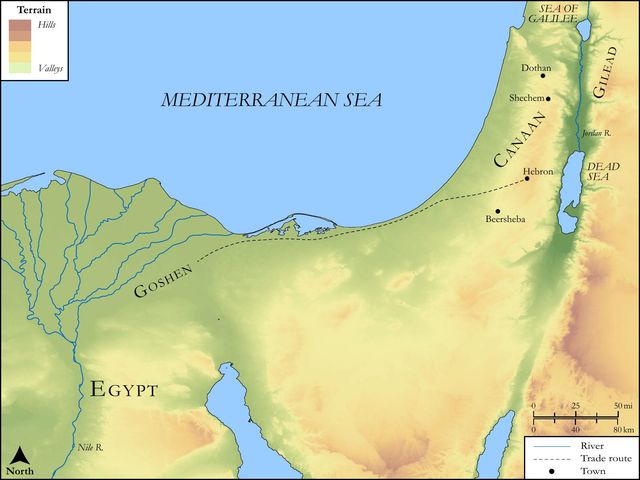
2.He is very earnest that his father and all his family should come to him to Egypt: Come down unto me, tarry not, Gen 45:9. He allots his dwelling in Goshen, that part of Egypt which lay towards Canaan, that they might be mindful of the country from which they were to come out, Gen 45:10. He promises to provide for him: I will nourish thee, Gen 45:11. Note, It is the duty of children, if the necessity of their parents do at any time require it, to support and supply them to the utmost of their ability; and Corban will never excuse them, Mar 7:11. This is showing piety at home, Ti1 5:4. Our Lord Jesus being, like Joseph, exalted to the highest honours and powers of the upper world, it is his will that all that are his should be with him where he is, Joh 17:24. This is his commandment, that we be with him now in faith and hope, and a heavenly conversation; and this is his promise, that we shall be for ever with him.
VI.Endearments were interchanged between him and his brethren.
He began with the youngest, his own brother Benjamin, who was but about a year old when Joseph was separated from his brethren; they wept on each other's neck (Gen 45:14), perhaps to think of their mother Rachel, who died in travail of Benjamin. Rachel, in her husband, Jacob, had been lately weeping for her children, because, in his apprehension, they were not - Joseph gone, and Benjamin going; and now they were weeping for her, because she was not. After he had embraced Benjamin, he, in like manner, caressed them all (Gen 45:15); and then his brethren talked with him freely and familiarly of all the affairs of their father's house. After the tokens of true reconciliation follow the instances of a sweet communion.
Continue studying Genesis 45:12 across the web’s major study libraries — every link below opens this exact verse, chapter, or book on the destination site.
Read & Compare
 BibleGatewayThis verse in more than 200 translations and 70 languages.
 Bible.comThe YouVersion reader — hundreds of translations, reading plans, and highlights.
 ESV.orgCrossway's official English Standard Version reader.
 NET BibleThe NET translation with 60,000+ translators' notes on every rendering decision.
 STEP BibleTyndale House's free study tool — original text, vocabulary, and scholarly resources.
 BibliaLogos Bible Software's free web reader.
 USCCBThe New American Bible (Revised Edition) with the U.S. bishops' study notes.
Commentaries
 BibleHub CommentariesDozens of classic commentaries on this verse, gathered on one page.
 StudyLightMore than 100 commentary sets — the largest collection on the web.
 BibleRefPlain-English commentary on what this verse means, verse by verse.
 Enduring WordDavid Guzik's free commentary on this chapter, widely used by Bible teachers.
 Bible Study ToolsVerse commentary alongside Greek and Hebrew study aids.
Original Language & Research
- BibleHub InterlinearThe verse word by word — original language, transliteration, and English.
- BibleHub LexiconEvery word's original-language definition and Strong's entry.
 Blue Letter BibleDeep-study tools — Strong's numbers, concordance, and word studies.
 SefariaThe Hebrew text with Rashi and centuries of Jewish commentary.
Sermons, Hymns & Audio


TrulyRandomVerse is not affiliated with these sites and doesn’t control their content. They’re linked because they’re genuinely useful.
Summary
Genesis 45:12 captures Joseph's profound and direct self-revelation to his brothers, particularly Benjamin, emphasizing the undeniable sensory proof of his identity. This pivotal declaration, delivered in their native tongue and without an interpreter, serves to dismantle any lingering doubt or disbelief, paving the way for genuine reconciliation and the full restoration of Jacob's family after years of separation and misunderstanding.
Context
ShowHideLiterary Context
This verse immediately follows Joseph's emotionally charged and dramatic self-disclosure in Genesis 45:1-3, where he can no longer restrain himself and sends everyone out, weeping aloud as he reveals his true identity. His brothers are understandably stunned and terrified, unable to respond. Joseph's subsequent words in Genesis 45:4-8 are aimed at reassuring them, explaining God's sovereign hand in sending him to Egypt to preserve life. Verse 12 serves as a crucial bridge, a direct, undeniable confirmation of his identity, appealing to their senses to solidify the reality of his presence and words before he commands them to bring Jacob to Egypt.
Historical & Cultural Context
Joseph, as the powerful vizier of Egypt, held immense authority, second only to Pharaoh. His brothers, as foreign supplicants, would have viewed him with awe and fear, especially after the recent trials involving Benjamin and the silver cup (Genesis 44). The cultural expectation was that such a high-ranking official would communicate through interpreters, as Joseph had done previously (Genesis 42:23). His decision to speak directly in Hebrew, appealing to their sight and hearing, was a radical departure from this norm, designed to break through their disbelief and fear with an intimate, personal confirmation that transcended the formal protocols of Egyptian court.
Key Themes
ShowHideGenesis 45:12 powerfully contributes to several overarching themes in the Joseph narrative and the book of Genesis. It highlights the theme of Divine Sovereignty, as Joseph's suffering and exaltation are revealed as part of God's plan to preserve His covenant family (Genesis 45:5 and Genesis 50:20). The verse also marks a critical turning point in the theme of Reconciliation and Forgiveness, initiating the healing of deep family wounds caused by betrayal (Genesis 37:18-28). Furthermore, it underscores the theme of Identity and Recognition, as Joseph's true self is finally revealed, moving from disguise to authentic presence, a foundational step for the restoration of trust and relationship within the family of Jacob.
Exposition and Analysis
ShowHideKey Word Analysis
ShowHideThis word refers to the physical organ of sight, but also extends metaphorically to outward appearance, perception, and even a fountain (as the "eye" of the landscape). In this context, Joseph appeals directly to their physical sight, emphasizing the undeniable visual evidence of his presence and identity. It signifies direct observation and personal witness.
This term denotes the physical mouth, but more significantly, it represents the means of speech, command, and expression. Joseph's emphasis on "my mouth" highlights that he is speaking directly, in their shared language, without any intermediary or disguise. It underscores the authenticity and personal nature of his words, contrasting with his previous use of an interpreter.
A primitive root meaning "to arrange," but primarily used figuratively for "to speak." It encompasses declaring, commanding, promising, and uttering words. Joseph's use of this verb, combined with "my mouth," confirms that he is not merely uttering sounds, but is intentionally communicating a profound truth with authority and sincerity, demanding their full attention and belief.
Verse Breakdown
ShowHide"And, behold, your eyes see,"
This opening clause is a dramatic interjection, drawing immediate attention to the sensory reality of the moment. Joseph urges his brothers to truly perceive what is before them, emphasizing that their own visual faculties are bearing witness to his presence. It's an appeal to undeniable, first-hand evidence, challenging any lingering disbelief or the perception that this might be a dream or illusion.
"and the eyes of my brother Benjamin,"
By specifically calling out Benjamin, Joseph singles out his only full brother, the one who was not involved in his original sale into slavery. This specific mention serves multiple purposes: it offers Benjamin a personal, direct reassurance, acknowledges their unique bond, and implicitly validates Joseph's identity through the eyes of the one brother least implicated in the past trauma. It also highlights Benjamin's safety, which had been a critical point of contention and testing in the preceding chapters.
"that [it is] my mouth that speaketh unto you."
This is the crux of Joseph's declaration. After years of speaking through an interpreter (Genesis 42:23) and maintaining a disguise, Joseph explicitly states that it is his own voice, in their shared language, that they are hearing. This removes all pretense and ambiguity. It is a powerful affirmation of authenticity, sincerity, and direct personal communication, essential for bridging the chasm of fear and guilt that separated him from his brothers. The emphasis on "my mouth" underscores the personal and unmediated nature of this revelation.
Literary Devices
ShowHideThe verse employs several powerful literary devices to convey its profound message. Emphasis is evident through the repetition of "eyes" and the direct, emphatic statement "it is my mouth that speaketh unto you," underscoring the undeniable reality of Joseph's presence and words. Sensory Imagery is central, as Joseph appeals directly to the brothers' senses of sight ("your eyes see," "the eyes of my brother Benjamin") and hearing ("my mouth that speaketh"). This concrete, sensory evidence is crucial for breaking through their shock and disbelief. The use of Direct Address ("unto you") creates an intimate and personal tone, fostering a sense of immediate connection and urgency. Finally, there is a subtle Contrast with Joseph's earlier interactions where he used an interpreter, highlighting the significance of this moment of unmediated, authentic communication.
Theological and Thematic Connections
ShowHideGenesis 45:12 is a profound moment of divine revelation and human reconciliation, echoing deeper theological truths. Just as Joseph, after a period of hiddenness and apparent absence, reveals himself directly to his brothers, so too does God continually reveal Himself to humanity, ultimately and most fully in the person of Jesus Christ. This direct, personal encounter is foundational for true relationship and forgiveness. The verse underscores that God's plan often unfolds through unexpected and painful circumstances, but His ultimate purpose is always redemptive, bringing about good even from human sin and suffering. Joseph's insistence on being seen and heard directly embodies the transparency and authenticity required for spiritual and relational healing.
Reflection and Application
ShowHideJoseph's powerful declaration in Genesis 45:12 offers invaluable insights into the dynamics of reconciliation and the importance of authentic communication within human relationships. In moments of deep hurt, misunderstanding, or estrangement, the willingness to step forward, drop all pretense, and communicate directly and sincerely is paramount. Joseph's appeal to his brothers' senses—"your eyes see," "my mouth that speaketh"—highlights that genuine reconciliation often requires tangible presence and unmediated truth. It's not enough to send a message; sometimes, we must show up, be vulnerable, and speak from the heart, allowing our true selves to be seen and heard. This verse encourages us to pursue honesty and transparency in our interactions, especially when seeking to mend broken bonds or to offer and receive forgiveness. Just as Joseph's direct revelation paved the way for the healing of his family, our own willingness to be truly present and authentic can open the door to profound healing and restoration in our relationships, reflecting the very heart of God's desire for reconciliation.
Questions for Reflection
ShowHideFAQ
ShowHideWhy does Joseph specifically mention "your eyes see" and "my mouth that speaketh"?
ShowHideJoseph emphasizes sensory evidence—sight and hearing—to provide undeniable proof of his identity. After years of disguise and speaking through an interpreter (Genesis 42:23), this direct appeal to their senses removes all doubt, assuring his brothers that the powerful Egyptian vizier is truly their long-lost brother, Joseph. It's a powerful statement of authenticity, designed to overcome their shock and disbelief by appealing to what they could physically perceive.
Why is Benjamin singled out in this verse?
ShowHideBenjamin was Joseph's only full brother, both being sons of Rachel. He was also the youngest and was not present when the other brothers sold Joseph into slavery (Genesis 37:28). By mentioning Benjamin specifically, Joseph not only offers him personal reassurance and acknowledges their unique bond but also subtly reassures the other brothers that Benjamin's safety, which had been a point of contention and testing (Genesis 44:1-17), is now secured. It highlights the depth of Joseph's familial affection and his desire to restore the entire family unit.
How does Joseph's direct communication here contribute to reconciliation?
ShowHideDirect and authentic communication is foundational for reconciliation. By speaking openly and without disguise, Joseph breaks down the barriers of fear, guilt, and misunderstanding that had separated him from his brothers. This personal revelation, confirmed by his own voice and presence, allows for genuine dialogue, forgiveness, and the rebuilding of trust, moving beyond the past deception and towards a future of restored family unity. It demonstrates vulnerability and a willingness to engage directly with the pain of the past, which is essential for true healing.
Christ-Centered Fulfillment
ShowHideJoseph's dramatic revelation of himself, after a long period of being unrecognized and even rejected by his brothers, serves as a profound type of Christ. Like Joseph, Jesus was rejected by His own people (John 1:11), suffered unjustly (Isaiah 53:3-7), and was exalted to a position of ultimate authority and power at the right hand of God (Philippians 2:9-11). Just as Joseph, through his suffering and subsequent exaltation, became the means of salvation for his family and many nations during a time of famine, so too did Christ, through His crucifixion and resurrection, become the unique means of eternal salvation for all humanity (Acts 4:12). This moment in Genesis 45:12 foreshadows the day when those who once rejected Christ will fully recognize Him, not through an interpreter or a veiled presence, but through His direct and authentic presence, leading to ultimate reconciliation and eternal life (Revelation 1:7).