


Genesis 36:23
Bible text: King James Version (1769 Blayney text) · Public domain
Bible text: Berean Standard Bible · Public domain
Bible text: American Standard Version (1901) · Public domain
Bible text: World English Bible, Messianic edition · Public domain
Bible text: Geneva Bible (1599) · Public domain
Bible text: Young's Literal Translation · Public domain
- וְאֵלֶּהve·'E·lehand theseH428Conj-w ¦ PrtParticle Demonstrativeוְandאֵלֶּהthese
- בְּנֵיbe·Nei[were] [the] sons ofH1121N-mpcNoun Plural Masculine Construct
- שׁוֹבָלsho·ValShobalH7732N-proper-mNoun Proper Masculine
- עַלְוָן'al·VanAlvanH5935N-proper-mNoun Proper Masculine
- וּמָנַחַתu·ma·Na·chatand ManahathH4506Conj-w ¦ N-proper-mNoun Proper MasculineוּandמָנַחַתManahath
- וְעֵיבָלve·'ei·Valand EbalH5858Conj-w ¦ N-proper-mNoun Proper MasculineוְandעֵיבָלEbal
- שְׁפוֹshe·FoShephoH8195N-proper-mNoun Proper Masculine
- וְאוֹנָםve·'o·Namand OnamH208Conj-w ¦ N-proper-mNoun Proper MasculineוְandאוֹנָםOnam
English is a literal word-by-word gloss of the Hebrew, not the KJV's wording. Why?
This is the original text the KJV's translators worked from — each Hebrew word with its own literal English meaning in this verse, prepared by scholars at Tyndale House, Cambridge. The KJV translates whole sentences, not word by word, so its wording differs: one Hebrew word can become several English words, and the KJV may choose “the LORD” where the gloss reads “Yahweh”. Both are faithful — they answer different questions. For the KJV's own rendering, switch to the KJV text.
Details
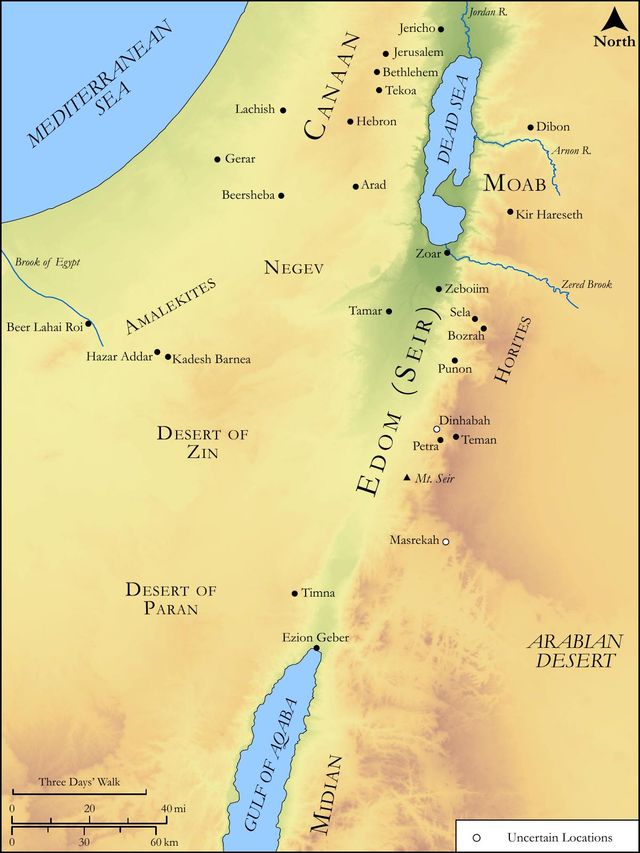
See on the biblical-era maps


Study this verse
Public-domain commentary
Matthew Henry
From his Commentary on the Whole Bible. Henry comments on passages, not single verses — this entry covers Genesis 36:20–30.
In the midst of this genealogy of the Edomites here is inserted the genealogy of the Horites, those Canaanites, or Hittites (compare Gen 26:34), that were the natives of Mount Seir. Mention is made of them, Gen 14:6, and of their interest in Mount Seir, before the Edomites took possession of it, Deu 2:12, Deu 2:22. This comes in here, not only to give light to the story, but to be a standing reflection upon the Edomites for intermarrying with them, by which, it is probable, they learned their way, and corrupted themselves. Esau having sold his birthright, and lost his blessing, and entered into alliance with the Hittites, his posterity and the sons of Seir are here reckoned together. Note, Those that treacherously desert God's church are justly numbered with those that were never in it; apostate Edomites stand on the same ground with accursed Horites. Particular notice is taken of one Anah who fed the asses of Zibeon his father (Gen 36:24), and yet is called duke Anah, Gen 36:29. Note, Those that expect to rise high should begin low. An honourable descent should not keep men from an honest employment, nor a mean employment hinder any man's preferment. This Anah was not only industrious in his business, but ingenious too, and successful; for he found mules, or (as some read it) waters, hot-baths, in the wilderness. Those that are diligent in their business sometimes find more advantages than they expected.
Continue studying Genesis 36:23 across the web’s major study libraries — every link below opens this exact verse, chapter, or book on the destination site.
Read & Compare
 BibleGatewayThis verse in more than 200 translations and 70 languages.
 Bible.comThe YouVersion reader — hundreds of translations, reading plans, and highlights.
 ESV.orgCrossway's official English Standard Version reader.
 NET BibleThe NET translation with 60,000+ translators' notes on every rendering decision.
 STEP BibleTyndale House's free study tool — original text, vocabulary, and scholarly resources.
 BibliaLogos Bible Software's free web reader.
 USCCBThe New American Bible (Revised Edition) with the U.S. bishops' study notes.
Commentaries
 BibleHub CommentariesDozens of classic commentaries on this verse, gathered on one page.
 StudyLightMore than 100 commentary sets — the largest collection on the web.
 BibleRefPlain-English commentary on what this verse means, verse by verse.
 Enduring WordDavid Guzik's free commentary on this chapter, widely used by Bible teachers.
 Bible Study ToolsVerse commentary alongside Greek and Hebrew study aids.
Original Language & Research
- BibleHub InterlinearThe verse word by word — original language, transliteration, and English.
- BibleHub LexiconEvery word's original-language definition and Strong's entry.
 Blue Letter BibleDeep-study tools — Strong's numbers, concordance, and word studies.
 SefariaThe Hebrew text with Rashi and centuries of Jewish commentary.
Sermons, Hymns & Audio


TrulyRandomVerse is not affiliated with these sites and doesn’t control their content. They’re linked because they’re genuinely useful.
Summary
A concise yet significant entry within the extensive genealogical record of Esau and the Horites, meticulously listing the five sons of Shobal—Alvan, Manahath, Ebal, Shepho, and Onam. This verse contributes to the broader narrative of tribal formation and settlement in the land of Seir, highlighting the established presence of the indigenous Horite chiefs alongside the burgeoning Edomite lineage, thereby detailing the complex demographic tapestry of the region before Edomite dominance.
Context
ShowHideLiterary Context
Genesis chapter 36 serves as a crucial genealogical interlude, strategically placed between the narratives of Jacob and Joseph. It provides a comprehensive account of Esau's descendants, also known as Edom, and their settlement in the land of Seir. The chapter meticulously details Esau's wives, his sons, and the "chiefs" (or clans) that emerged from his lineage. Interspersed within this record are the genealogies of the Horites, the indigenous inhabitants of Seir, from whom Esau's descendants intermarried and eventually displaced. This particular verse, Genesis 36:23, is part of a section (verses 20-30) dedicated to the Horite chiefs, demonstrating their prominence and the detailed knowledge the biblical author possessed regarding the pre-Edomite inhabitants of the region. This interweaving of genealogies highlights the complex tribal landscape and the process of national formation among the sons of Seir and Esau.
Historical & Cultural Context
The land of Seir, located southeast of the Dead Sea, was characterized by its rugged, mountainous terrain, which provided natural defenses and numerous caves, leading to the Horites being known as "cave dwellers." These indigenous peoples had established their own social and political structures, led by "chiefs" (or "dukes," as translated in some versions), long before Esau's descendants arrived. Esau's migration to Seir, as mentioned in Genesis 36:6-8, involved a co-existence and eventual intermingling with these Horites. The inclusion of Horite genealogies, such as that of Shobal and his sons, underscores their significant presence and the eventual process of absorption and displacement by the Edomites, a historical reality explicitly affirmed in Deuteronomy 2:12. This detailed record documents tribal lineages and land claims, providing a historical snapshot of the region's demographic evolution.
Key Themes
ShowHideGenesis 36 contributes to several overarching themes within the book of Genesis and the Pentateuch. Firstly, it illustrates the fulfillment of God's promise of multiplication, even for those outside the direct covenant line of Abraham, Isaac, and Jacob. Esau's descendants, though not the chosen line, also become a numerous nation, Edom. Secondly, the chapter highlights the theme of national formation and identity, demonstrating how distinct tribal groups coalesce into nations through intermarriage, migration, and the establishment of leadership structures. The meticulous listing of chiefs, both Edomite and Horite, emphasizes the importance of lineage and authority among the tribes of Seir and Edom. Lastly, the intermingling and eventual displacement of the Horites by the Edomites foreshadows the broader biblical theme of divine sovereignty in the allocation of land and the rise and fall of nations, a pattern seen throughout Israel's history and explicitly mentioned in Deuteronomy 2:5.
Exposition and Analysis
ShowHideKey Word Analysis
ShowHideFrom the root meaning "to build," this term refers to a son, but in the widest sense, encompassing literal and figurative relationships, including descendants, subjects, or members of a group. In this context, it signifies the direct male offspring who contribute to the building of the family name and lineage, highlighting the patriarchal structure of the Horite society and the importance of male heirs in establishing tribal identity.
Meaning "overflowing," this name suggests abundance or prosperity. As a Horite chief, Shobal's name might reflect his status, the size of his clan, or the fertility of his lineage. His inclusion in this genealogy underscores his significance among the indigenous inhabitants of Seir, whose lineage is meticulously recorded alongside that of Esau's descendants.
Meaning "strong," this name for one of Shobal's sons is indicative of personal qualities or perhaps the strength and resilience of his particular branch of the Horite clan. In Scripture, names often carried significant meaning, reflecting hopes, characteristics, or circumstances associated with the individual or their family.
Verse Breakdown
ShowHide"And the children of Shobal [were] these;"
This introductory phrase serves to specify the lineage being presented. "Children" (Hebrew: bên) here refers to the direct male descendants, the sons, who are about to be enumerated. Shobal is identified as the patriarch, a prominent Horite chief whose progeny are deemed significant enough to be recorded within this comprehensive genealogical account of the land of Seir. This clause sets the stage for the precise listing that follows, emphasizing the importance of documenting tribal leadership and succession.
"Alvan, and Manahath, and Ebal, Shepho, and Onam."
This clause provides the explicit list of Shobal's five sons. Each name represents a distinct individual who would have contributed to the Horite tribal structure and potentially founded sub-clans. The meticulous naming of each son underscores the biblical author's attention to detail in preserving historical and genealogical records. These names, though perhaps unfamiliar to the modern reader, were vital for understanding the social and political landscape of ancient Seir, illustrating the complex network of families and chiefs that constituted the Horite people before the full establishment of Edomite dominion.
Literary Devices
ShowHideThe primary literary device employed in Genesis 36:23, and indeed throughout much of Genesis 36, is Genealogy. This is a foundational literary form in Genesis, serving multiple purposes: to establish lineage, validate claims to land or authority, demonstrate the fulfillment of divine promises (e.g., multiplication), and provide historical continuity. The meticulous listing of names, often accompanied by their familial relationships, creates a sense of historical depth and authenticity. Furthermore, the inclusion of both Edomite and Horite genealogies demonstrates Interweaving Narrative, where distinct but related historical threads are presented in parallel, highlighting the complex interactions and eventual integration or displacement of peoples. The precise enumeration of names also contributes to a sense of Verisimilitude, lending credibility to the historical account by presenting specific, verifiable details.
Theological and Thematic Connections
ShowHideWhile seemingly a mere list of names, Genesis 36:23 contributes to the profound theological understanding of God's comprehensive sovereignty over all nations and His intricate plan for human history, extending beyond the immediate covenant line. It underscores that God's involvement is not limited to Israel but encompasses the rise and fall, multiplication and settlement, of all peoples, demonstrating His meticulous attention to every detail of His creation. This verse, like the entire chapter, functions as a vital historical document, meticulously detailing the early inhabitants and ruling families of the land of Edom, providing insight into the tribal structures and leadership of the peoples of Seir.
Reflection and Application
ShowHideWhile genealogical lists like Genesis 36:23 may appear tedious or irrelevant to the modern reader, they underscore the profound value Scripture places on meticulous detail and the importance of historical record. They remind us that every part of God's story is significant, even seemingly minor historical records of nations outside the direct covenant line. This encourages us to cultivate patience and diligence in studying the entirety of God's Word, recognizing that each verse serves a purpose within the larger divine narrative. It prompts us to consider how God's comprehensive plan unfolds through the generations, shaping not only the destiny of His chosen people but also the trajectories of all nations. Ultimately, these lists invite us to marvel at God's sovereign hand in human history, His intricate design, and His faithfulness in bringing about His purposes through diverse peoples and circumstances.
Questions for Reflection
ShowHideFAQ
ShowHideWhy are Horite names included in a chapter primarily about Esau's descendants?
ShowHideThe inclusion of Horite names, such as Shobal and his sons in Genesis 36:23, is crucial because it details the indigenous inhabitants of Seir, the land Esau and his descendants settled. It demonstrates the pre-existing tribal structures and leadership that the Edomites encountered and eventually intermingled with, and later displaced, as recorded in Deuteronomy 2:12. This highlights the historical reality of the region, the complex process of national formation, and the biblical author's commitment to providing a comprehensive historical account, even of those outside the direct covenant line.
Christ-Centered Fulfillment
ShowHideWhile Genesis 36:23 details a lineage outside the direct messianic line, it profoundly underscores the comprehensive scope of God's sovereign plan for humanity, which ultimately converges in Christ. The meticulous recording of diverse nations and their histories, even those destined for displacement, points to the universal reach of God's redemptive purposes. Christ, as the ultimate King, fulfills the divine pattern of establishing dominion, not through physical conquest of land as seen with the Edomites and Horites, but through a spiritual kingdom that encompasses all peoples and nations. He is the "Lamb of God" who takes away the sin of the world (John 1:29), establishing a new covenant that transcends ethnic and national boundaries (Galatians 3:28). Through His sacrificial death and resurrection, Christ brings salvation to "every tribe and language and people and nation" (Revelation 5:9), demonstrating His ultimate sovereignty over all human history and fulfilling God's ancient promise to Abraham that "all the families of the earth will be blessed" through his seed (Genesis 12:3).