


Genesis 36:22
Bible text: King James Version (1769 Blayney text) · Public domain
Bible text: Berean Standard Bible · Public domain
Bible text: American Standard Version (1901) · Public domain
Bible text: World English Bible, Messianic edition · Public domain
Bible text: Geneva Bible (1599) · Public domain
Bible text: Young's Literal Translation · Public domain
- וַיִּהְיוּvai·yih·Yuand they wereH1961Conj-w ¦ V-Qal-ConsecImperf-3mpVerb Qal Consecutive Imperfect 3rd Plural Masculineוַandיִּהְיוּthey were
- בְנֵיve·nei[the] sons ofH1121N-mpcNoun Plural Masculine Construct
- לוֹטָןlo·TanLotanH3877N-proper-mNoun Proper Masculine
- חֹרִיcho·RiHoriH2753N-proper-mNoun Proper Masculine
- וְהֵימָםve·hei·Mamand HemamH1967Conj-w ¦ N-proper-mNoun Proper MasculineוְandהֵימָםHemam
- וַאֲחוֹתva·'a·Chotand [the] sister ofH269Conj-w ¦ N-fscNoun Singular Feminine Constructוַandאֲחוֹת[the] sister of
- לוֹטָןlo·TanLotanH3877N-proper-mNoun Proper Masculine
- תִּמְנָעtim·Na'[was] TimnaH8555N-proper-mNoun Proper Masculine
English is a literal word-by-word gloss of the Hebrew, not the KJV's wording. Why?
This is the original text the KJV's translators worked from — each Hebrew word with its own literal English meaning in this verse, prepared by scholars at Tyndale House, Cambridge. The KJV translates whole sentences, not word by word, so its wording differs: one Hebrew word can become several English words, and the KJV may choose “the LORD” where the gloss reads “Yahweh”. Both are faithful — they answer different questions. For the KJV's own rendering, switch to the KJV text.
Details
See on the biblical-era maps


Study this verse
Public-domain commentary
Matthew Henry
From his Commentary on the Whole Bible. Henry comments on passages, not single verses — this entry covers Genesis 36:20–30.
In the midst of this genealogy of the Edomites here is inserted the genealogy of the Horites, those Canaanites, or Hittites (compare Gen 26:34), that were the natives of Mount Seir. Mention is made of them, Gen 14:6, and of their interest in Mount Seir, before the Edomites took possession of it, Deu 2:12, Deu 2:22. This comes in here, not only to give light to the story, but to be a standing reflection upon the Edomites for intermarrying with them, by which, it is probable, they learned their way, and corrupted themselves. Esau having sold his birthright, and lost his blessing, and entered into alliance with the Hittites, his posterity and the sons of Seir are here reckoned together. Note, Those that treacherously desert God's church are justly numbered with those that were never in it; apostate Edomites stand on the same ground with accursed Horites. Particular notice is taken of one Anah who fed the asses of Zibeon his father (Gen 36:24), and yet is called duke Anah, Gen 36:29. Note, Those that expect to rise high should begin low. An honourable descent should not keep men from an honest employment, nor a mean employment hinder any man's preferment. This Anah was not only industrious in his business, but ingenious too, and successful; for he found mules, or (as some read it) waters, hot-baths, in the wilderness. Those that are diligent in their business sometimes find more advantages than they expected.
Historical interpretation
Historical reception
1 surviving comment on this verse from the historical church.
(Verse 22.) And the sons of Lotan were Hori and Homam, and Lotan's sister was Timna. This is Timna, of whom it was said above. And Timna was the concubine of Eliphaz, the firstborn son of Esau, and from her was born Amalek. Now it is worth noting that the Horites, because the firstborn sons of Esau took their concubines as wives. And as for the names that are mentioned, Teman and Kenaz and Amalek, and so on: we will learn later the regions of the Edomites from which these names were derived.
Continue studying Genesis 36:22 across the web’s major study libraries — every link below opens this exact verse, chapter, or book on the destination site.
Read & Compare
 BibleGatewayThis verse in more than 200 translations and 70 languages.
 Bible.comThe YouVersion reader — hundreds of translations, reading plans, and highlights.
 ESV.orgCrossway's official English Standard Version reader.
 NET BibleThe NET translation with 60,000+ translators' notes on every rendering decision.
 STEP BibleTyndale House's free study tool — original text, vocabulary, and scholarly resources.
 BibliaLogos Bible Software's free web reader.
 USCCBThe New American Bible (Revised Edition) with the U.S. bishops' study notes.
Commentaries
 BibleHub CommentariesDozens of classic commentaries on this verse, gathered on one page.
 StudyLightMore than 100 commentary sets — the largest collection on the web.
 BibleRefPlain-English commentary on what this verse means, verse by verse.
 Enduring WordDavid Guzik's free commentary on this chapter, widely used by Bible teachers.
 Bible Study ToolsVerse commentary alongside Greek and Hebrew study aids.
Original Language & Research
- BibleHub InterlinearThe verse word by word — original language, transliteration, and English.
- BibleHub LexiconEvery word's original-language definition and Strong's entry.
 Blue Letter BibleDeep-study tools — Strong's numbers, concordance, and word studies.
 SefariaThe Hebrew text with Rashi and centuries of Jewish commentary.
Sermons, Hymns & Audio


TrulyRandomVerse is not affiliated with these sites and doesn’t control their content. They’re linked because they’re genuinely useful.
Summary
Genesis 36:22 serves as a concise genealogical entry within the comprehensive record of Esau's descendants, identifying Hori and Hemam as the sons of Lotan, a prominent Horite chief. Crucially, it introduces Timna as Lotan's sister, a seemingly minor detail that holds profound future significance as Timna later becomes the mother of Amalek, whose descendants, the Amalekites, would emerge as a persistent and formidable adversary of Israel throughout biblical history.
Context
ShowHideLiterary Context
This verse is situated within Genesis chapter 36, a meticulously detailed genealogical register that interrupts the narrative flow of Jacob's family history. Following the account of Jacob's return to Canaan and the reconciliation with Esau, this chapter shifts focus entirely to Esau's lineage, wives, and the chiefs of Edom, establishing the origins of the Edomite nation. Unlike the more narrative-driven sections of Genesis, chapter 36 functions as a comprehensive historical record, ensuring that the reader understands the full scope of Abraham's descendants, including those who would become a distinct nation parallel to Israel. Genesis 36:22 specifically falls within the list of Horite chiefs, the indigenous inhabitants of Mount Seir, whose land Esau's descendants would eventually occupy.
Historical & Cultural Context
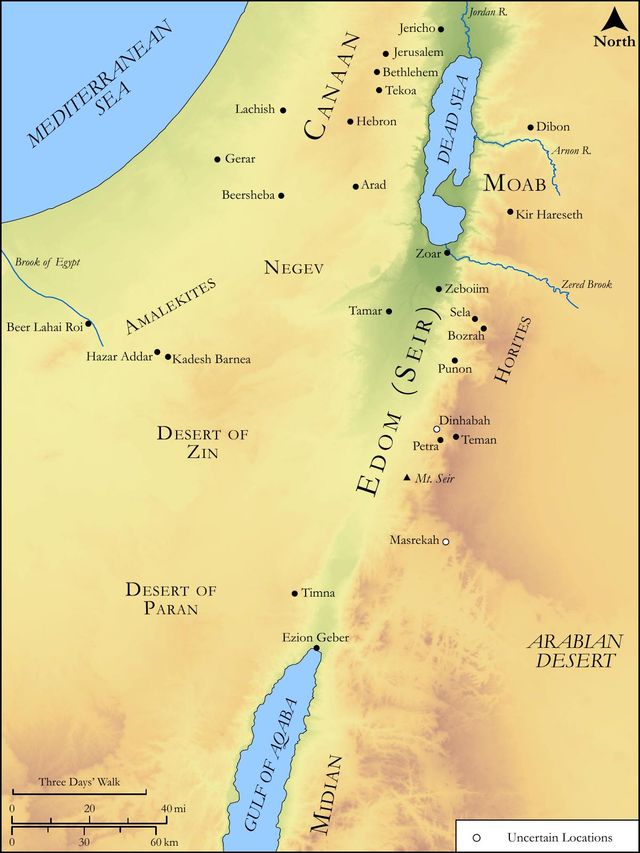
The setting for Genesis 36 is Mount Seir, a rugged, mountainous region south of the Dead Sea, which became the territory of Edom. The "Horites" mentioned in this verse, and throughout Genesis 36:20-30, were the original inhabitants of this region. Their name, possibly derived from the Hebrew word for "cave" (ḥôr), suggests they were cave-dwellers, adapting to the mountainous terrain. Esau's descendants, the Edomites, either displaced or assimilated these Horites. The mention of "chiefs" (Hebrew: alluph) indicates a tribal, clan-based societal structure. The practice of intermarriage, as seen with Timna, was common, leading to complex familial and national relationships that would profoundly impact future interactions between peoples.
Key Themes
ShowHideGenesis 36:22 contributes to several key themes within Genesis and the broader biblical narrative. Firstly, it underscores the meticulousness of God's record-keeping and the Bible's commitment to historical accuracy, even in seemingly minor genealogical details. Secondly, it highlights the divine sovereignty over all nations, demonstrating that God's plan encompasses not only His chosen people but also the rise and fall, and even the interrelationships, of surrounding nations. Thirdly, and most significantly for this verse, it lays the genealogical roots for future conflict. The seemingly incidental mention of Timna foreshadows the long and bitter enmity between Israel and the Amalekites, whose origins are traced back to her. This illustrates how seemingly minor details in Scripture can be foundational to understanding major historical and theological developments, reinforcing the theme that no detail in God's word is superfluous. This is evident in the later accounts of the Amalekites attacking Israel in the wilderness, as recorded in Exodus 17:8-16, and God's subsequent declaration of perpetual war against them.
Exposition and Analysis
ShowHideGenesis 36:22 presents a concise but profoundly significant detail within the Edomite genealogies, naming Lotan's two sons, Hori and Hemam, and then introducing his sister, Timna.
Key Word Analysis
ShowHideThis term broadly refers to a son or descendant, often implying a builder or inheritor of the family name. In this context, Hori and Hemam are presented as the direct male offspring of Lotan, continuing his lineage and contributing to the emerging tribal structure of the Horites. The word bên is foundational to understanding the genealogical purpose of this verse, establishing direct familial connections.
This term denotes a female sibling, but like its masculine counterpart "brother," it can be used more broadly to signify a close female relative or even a member of the same tribe or community. In this verse, it explicitly identifies Timna as Lotan's direct sister, establishing her immediate family tie within the Horite lineage. Her specific identification is crucial for the subsequent narrative.
Derived from a root meaning "restraint," Timna is identified here as Lotan's sister. While her name's etymology might suggest a certain characteristic, its primary significance in this verse is her identity as a specific individual within the Horite lineage. Her inclusion is not merely for genealogical completeness but, as later verses reveal, to pinpoint the maternal origin of Amalek, a figure of immense future importance in Israel's history.
Verse Breakdown
ShowHide"And the children of Lotan were Hori and Hemam"
This clause provides the primary genealogical information regarding Lotan's direct male descendants. Lotan is identified earlier in Genesis 36:20 as one of the sons of Seir the Horite, making him a prominent figure among the indigenous inhabitants of the region. Hori and Hemam are thus presented as members of this established Horite clan, indicating the continuation of their lineage and their place within the emerging socio-political landscape of Mount Seir. The naming of these two sons is typical of biblical genealogies, establishing the family tree.
"and Lotan's sister [was] Timna"
This second clause introduces a female figure, Timna, explicitly identifying her as Lotan's sister. While the primary focus of most genealogies is on male lines, the inclusion of a female, particularly with her specific relationship to a named male, often signals a significant role or connection. In Timna's case, her mention here is critically important because Genesis 36:12 reveals that she became a concubine to Eliphaz, Esau's firstborn son, and bore him Amalek. This seemingly incidental detail in Genesis 36:22 thus serves as a vital genealogical link, establishing the Horite origin of Amalek through his mother, a detail that explains the deep-seated and persistent enmity between the Amalekites and the Israelites throughout subsequent biblical history.
Literary Devices
ShowHideThe verse primarily employs Genealogy, a fundamental literary device in Genesis, serving to establish lineage, trace the development of nations, and demonstrate God's faithfulness in preserving lines of descent. The inclusion of Timna, however, introduces a potent element of Foreshadowing. While her significance is not immediately apparent in this verse, the subsequent mention of her as Amalek's mother in Genesis 36:12 transforms this seemingly minor detail into a crucial narrative link. This creates a subtle Irony of Significance, where a brief, almost overlooked, entry within a list of names holds the key to understanding centuries of future conflict and divine judgment. The meticulous naming of individuals, even those outside the direct line of promise, highlights the Bible's comprehensive scope and its assertion of God's sovereign oversight even of those who would become antagonists to His chosen people.
Theological and Thematic Connections
ShowHideGenesis 36:22, though a simple genealogical record, powerfully illustrates the intricate tapestry of God's sovereign plan, even in the details of nations seemingly outside the direct covenant line. It demonstrates that God's meticulous record-keeping extends to all peoples, revealing how seemingly minor familial connections can lay the groundwork for major historical and theological developments. The mention of Timna, an otherwise obscure figure, becomes a profound example of how God weaves together the destinies of individuals and nations, preparing the stage for future interactions—both cooperative and adversarial—that will serve His ultimate redemptive purposes. This verse underscores the biblical principle that no detail in Scripture is superfluous; every name and connection is part of a larger, divinely orchestrated narrative.
Reflection and Application
ShowHideGenesis 36:22, despite its brevity and seemingly dry genealogical nature, offers profound lessons for contemporary believers. It serves as a powerful reminder that God's grand narrative often unfolds through details that appear insignificant at first glance. Just as the mention of Timna foreshadowed centuries of conflict and divine intervention, so too do the seemingly small choices, relationships, and "insignificant" moments in our own lives contribute to larger, unforeseen outcomes within God's sovereign plan. This verse encourages us to cultivate a posture of careful attention to all of Scripture, recognizing that even the "boring" or less dramatic passages can contain vital keys to understanding God's character, His overarching purposes, and the intricate tapestry of human history under His divine hand. It prompts us to consider how seemingly minor elements in our own lives might be part of a larger, divine design, calling us to faithfulness in every detail, knowing that God works all things together for His glory.
Questions for Reflection
ShowHideFAQ
ShowHideWhy is the mention of Timna so important in this seemingly minor verse?
ShowHideThe mention of Timna is crucial because she is identified in Genesis 36:12 as the concubine of Eliphaz, Esau's firstborn son, and the mother of Amalek. Amalek's descendants, the Amalekites, became one of Israel's most persistent and bitter enemies throughout the Old Testament, from their unprovoked attack on the Israelites in the wilderness shortly after the Exodus (Exodus 17:8) to their near-annihilation by King Saul (1 Samuel 15:2). This verse, therefore, provides the precise genealogical origin of a major antagonist in the biblical narrative, explaining the deep-seated enmity that would define centuries of interaction.
Does this verse suggest God ordains conflict?
ShowHideThis verse, by detailing the lineage leading to the Amalekites, primarily demonstrates God's meticulous record-keeping and His sovereign oversight of all history, including the rise of nations and their conflicts. While it doesn't explicitly state that God directly ordains conflict in a causative sense, it certainly shows that He is aware of, and incorporates, even human animosity and opposition into His broader redemptive plan. The conflict with Amalek, for instance, served as a test for Israel's obedience and reliance on God, and ultimately highlighted the need for God's divine intervention and ultimate victory over all adversaries, a theme that finds its ultimate expression in Christ.
Christ-Centered Fulfillment
ShowHideWhile Genesis 36:22 primarily details a lineage of those outside the direct line of promise, it subtly points to the broader narrative of God's sovereign control over all nations and peoples, even those who would oppose His chosen people. The ultimate fulfillment of God's redemptive plan, culminating in Christ, required the meticulous preservation of the lineage through which the Messiah would come, even amidst the rise and fall of other nations and their conflicts. The very existence of enemies like the Amalekites, whose origins are traced here, highlights the spiritual warfare present throughout history, a conflict ultimately overcome by Christ's victory on the cross. Through His atoning sacrifice and resurrection, Jesus secured peace and triumph for His people over all their spiritual adversaries, fulfilling the promise of a descendant who would crush the head of the serpent (Genesis 3:15). The persistence of evil, genealogically rooted in verses like this, is ultimately subsumed by the triumph of the Lamb of God, who takes away the sin of the world and establishes an eternal kingdom of peace and righteousness (John 1:29; Revelation 11:15).