


Genesis 36:21
Bible text: King James Version (1769 Blayney text) · Public domain
Bible text: Berean Standard Bible · Public domain
Bible text: American Standard Version (1901) · Public domain
Bible text: World English Bible, Messianic edition · Public domain
Bible text: Geneva Bible (1599) · Public domain
Bible text: Young's Literal Translation · Public domain
- וְדִשׁוֹןve·di·Shonand DishonH1787Conj-w ¦ N-proper-mNoun Proper MasculineוְandדִשׁוֹןDishon
- וְאֵצֶרve·'E·tzerand EzerH687Conj-w ¦ N-proper-mNoun Proper MasculineוְandאֵצֶרEzer
- וְדִישָׁןve·di·Shanand DishanH1789Conj-w ¦ N-proper-mNoun Proper MasculineוְandדִישָׁןDishan
- אֵלֶּה'E·lehtheseH428PrtParticle Demonstrative
- אַלּוּפֵי'a·lu·Fei[were] [the] chiefs ofH441N-mpcNoun Plural Masculine Construct
- הַחֹרִיha·cho·Rithe Horite[s]H2752Art ¦ N-msNoun Gentilic Singular Masculine AbsoluteהַtheחֹרִיHorite[s]
- בְּנֵיbe·Nei[the] sons ofH1121N-mpcNoun Plural Masculine Construct
- שֵׂעִירse·'IrSeirH8165N-proper-mNoun Proper Masculine
- בְּאֶרֶץbe·'E·retzin [the] land ofH776Prep-b ¦ N-fscNoun Singular Feminine Constructבְּinאֶרֶץ[the] land of
- אֱדוֹם'e·DomEdomH123N-proper-mNoun Proper Masculine
English is a literal word-by-word gloss of the Hebrew, not the KJV's wording. Why?
This is the original text the KJV's translators worked from — each Hebrew word with its own literal English meaning in this verse, prepared by scholars at Tyndale House, Cambridge. The KJV translates whole sentences, not word by word, so its wording differs: one Hebrew word can become several English words, and the KJV may choose “the LORD” where the gloss reads “Yahweh”. Both are faithful — they answer different questions. For the KJV's own rendering, switch to the KJV text.
Details
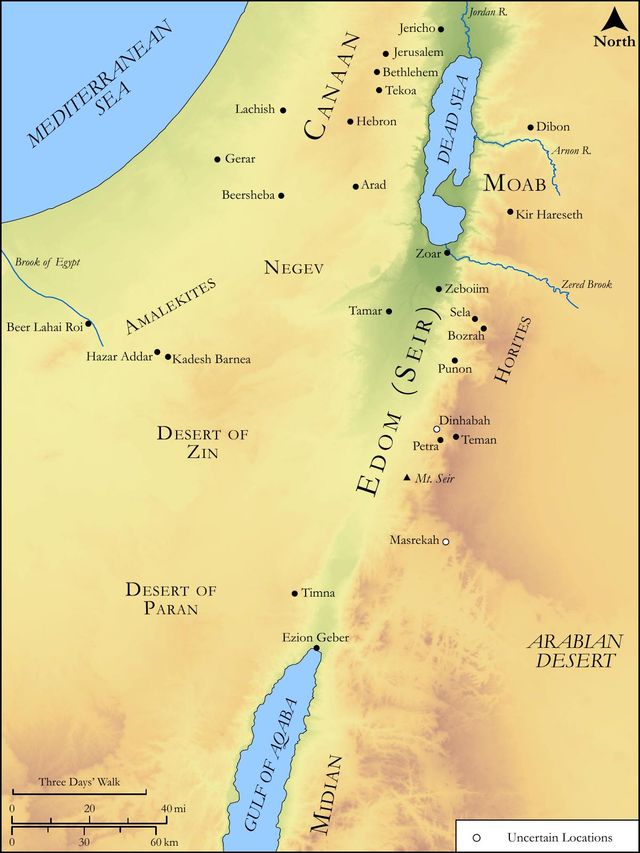
See on the biblical-era maps


Study this verse
Public-domain commentary
Matthew Henry
From his Commentary on the Whole Bible. Henry comments on passages, not single verses — this entry covers Genesis 36:20–30.
In the midst of this genealogy of the Edomites here is inserted the genealogy of the Horites, those Canaanites, or Hittites (compare Gen 26:34), that were the natives of Mount Seir. Mention is made of them, Gen 14:6, and of their interest in Mount Seir, before the Edomites took possession of it, Deu 2:12, Deu 2:22. This comes in here, not only to give light to the story, but to be a standing reflection upon the Edomites for intermarrying with them, by which, it is probable, they learned their way, and corrupted themselves. Esau having sold his birthright, and lost his blessing, and entered into alliance with the Hittites, his posterity and the sons of Seir are here reckoned together. Note, Those that treacherously desert God's church are justly numbered with those that were never in it; apostate Edomites stand on the same ground with accursed Horites. Particular notice is taken of one Anah who fed the asses of Zibeon his father (Gen 36:24), and yet is called duke Anah, Gen 36:29. Note, Those that expect to rise high should begin low. An honourable descent should not keep men from an honest employment, nor a mean employment hinder any man's preferment. This Anah was not only industrious in his business, but ingenious too, and successful; for he found mules, or (as some read it) waters, hot-baths, in the wilderness. Those that are diligent in their business sometimes find more advantages than they expected.
Continue studying Genesis 36:21 across the web’s major study libraries — every link below opens this exact verse, chapter, or book on the destination site.
Read & Compare
 BibleGatewayThis verse in more than 200 translations and 70 languages.
 Bible.comThe YouVersion reader — hundreds of translations, reading plans, and highlights.
 ESV.orgCrossway's official English Standard Version reader.
 NET BibleThe NET translation with 60,000+ translators' notes on every rendering decision.
 STEP BibleTyndale House's free study tool — original text, vocabulary, and scholarly resources.
 BibliaLogos Bible Software's free web reader.
 USCCBThe New American Bible (Revised Edition) with the U.S. bishops' study notes.
Commentaries
 BibleHub CommentariesDozens of classic commentaries on this verse, gathered on one page.
 StudyLightMore than 100 commentary sets — the largest collection on the web.
 BibleRefPlain-English commentary on what this verse means, verse by verse.
 Enduring WordDavid Guzik's free commentary on this chapter, widely used by Bible teachers.
 Bible Study ToolsVerse commentary alongside Greek and Hebrew study aids.
Original Language & Research
- BibleHub InterlinearThe verse word by word — original language, transliteration, and English.
- BibleHub LexiconEvery word's original-language definition and Strong's entry.
 Blue Letter BibleDeep-study tools — Strong's numbers, concordance, and word studies.
 SefariaThe Hebrew text with Rashi and centuries of Jewish commentary.
Sermons, Hymns & Audio


TrulyRandomVerse is not affiliated with these sites and doesn’t control their content. They’re linked because they’re genuinely useful.
Summary
Genesis 36:21 is a pivotal genealogical entry within the comprehensive record of Esau's descendants, the Edomites, and the indigenous peoples of Seir. This verse specifically names Dishon, Ezer, and Dishan as prominent "dukes" or chieftains of the Horites, the original inhabitants of the region. It highlights the established presence and leadership structure of the Horites, who were the "children of Seir," in the land that would subsequently become known as Edom, thus providing crucial historical and demographic context for the eventual Edomite ascendancy.
Context
ShowHideLiterary Context
Genesis chapter 36 serves as a detailed genealogical interlude, meticulously chronicling the lineage, family structures, and early leadership of Esau, also known as Edom. Positioned between the narratives of Jacob's family and the account of Joseph, this chapter provides a comprehensive record of Esau's descendants, their wives, children, and the "dukes" and kings who ruled in the land of Seir. Before focusing exclusively on the Edomite ascendancy, the chapter dedicates verses Genesis 36:20-30 to the Horites, the original inhabitants of Seir. Verse 21, specifically, lists three of these Horite leaders, thereby establishing the pre-Edomite demographic and political landscape of the region and setting the stage for understanding the eventual Edomite dominance over the land, as further detailed in Deuteronomy 2:12.
Historical & Cultural Context
The Horites (meaning "cave dwellers") were an ancient people group inhabiting the mountainous region of Seir, located southeast of the Dead Sea. Archaeological evidence and other ancient texts corroborate the existence of various semi-nomadic and settled groups in this region during the patriarchal period. The term "duke" (Hebrew: 'alluph) in this context reflects a tribal, clan-based leadership structure common among early societies, rather than a centralized monarchy. This indicates that the Horites had an organized, albeit decentralized, societal framework. The mention of "the land of Edom" even while the Horites are still in power is a proleptic (forward-looking) designation, reflecting the later reality of Esau's descendants taking possession of this territory, a process described as divine providence in Deuteronomy 2:22.
Key Themes
ShowHideGenesis 36:21 contributes to several overarching themes within Genesis and the Pentateuch. Firstly, it underscores the theme of divine sovereignty over nations, demonstrating God's meticulous oversight of all peoples, not just the chosen lineage of Abraham. The detailed genealogies, even of non-Israelite groups like the Horites and Edomites, reflect God's comprehensive knowledge and involvement in the historical unfolding of all humanity. Secondly, it highlights the theme of land possession and displacement, a recurring motif throughout the Pentateuch. The Horites' original habitation and eventual displacement by the Edomites foreshadows Israel's own inheritance of Canaan and the displacement of its inhabitants, as seen in passages like Numbers 33:53. Lastly, the verse contributes to the theme of historical accuracy and the divine record, affirming the Bible's commitment to documenting the diverse ethnic and political realities of the peoples of that day, providing a robust backdrop for God's redemptive plan.
Exposition and Analysis
ShowHideGenesis 36:21 provides a specific listing of three Horite leaders: Dishon, Ezer, and Dishan. These individuals are explicitly identified as "dukes of the Horites," who were the "children of Seir in the land of Edom." This verse is crucial for understanding the pre-Edomite inhabitants and their societal structure within the region.
Key Word Analysis
ShowHideMeaning "familiar; a friend, also gentle; hence, a bullock (as being tame); and so, a chieftain (as notable, like neat cattle)." This term signifies a tribal or clan leader, a chieftain, rather than a monarchical king. It is used predominantly in Genesis 36 to describe the leaders of both the Horites and the early Edomites before the establishment of a formal kingship, as seen later in Genesis 36:31. This linguistic detail helps differentiate between early tribal governance and later centralized monarchy.
Meaning "cave-dweller or troglodyte; a Chorite or aboriginal Idumaean." These were the original inhabitants of Mount Seir, a mountainous region east of the Arabah valley. Their presence is attested in other biblical texts (e.g., Deuteronomy 2:12) and extra-biblical sources. Their listing here confirms their significant presence and established leadership prior to the Edomite settlement.
Meaning "red (see Genesis 25:25); Edom, the elder twin-brother of Jacob; hence the region (Idumaea) occupied by him." This geographical designation is significant. While the Horites were the current inhabitants and leaders, the land is already referred to by its future name, "Edom." This subtly foreshadows the eventual displacement of the Horites by the descendants of Esau, who would establish the nation of Edom in this very territory.
Verse Breakdown
ShowHide"And Dishon, and Ezer, and Dishan:"
These are specific names of Horite chiefs, indicating a structured leadership among the indigenous people. Their inclusion underscores the biblical record's meticulous attention to the various peoples inhabiting the lands around Canaan, highlighting the specific individuals who held authority among the Horites.
"these [are] the dukes of the Horites,"
This clause explicitly identifies the named individuals as leaders, using the term "dukes" ('alluph), which denotes chieftains of clans or tribes. This clarifies their societal role and confirms the existence of an organized, albeit non-monarchical, leadership structure among the Horites.
"the children of Seir in the land of Edom."
This final clause connects these leaders directly to Seir the Horite, introduced as the patriarch of the Horites in Genesis 36:20. It emphasizes their lineage and their deep roots in the land. The phrase "in the land of Edom" is a proleptic geographical designation, referring to the territory by the name it would later acquire, subtly foreshadowing the future dominance of Esau's descendants over this region.
Literary Devices
ShowHideThe primary literary device at play in Genesis 36:21 is Genealogy, which is central to the entire chapter. This verse, like much of Genesis 36, functions as a detailed ancestral record, meticulously tracing lineages and establishing the relationships between different groups. The specific naming of individuals ("Dishon," "Ezer," "Dishan") employs Nomenclature, emphasizing the particularity and historical grounding of the account. Furthermore, the use of the term "land of Edom" while the Horites are still in control is a clear example of Prolepsis (or foreshadowing). This literary technique anticipates future events, subtly indicating the eventual displacement of the Horites by Esau's descendants and the establishment of the nation of Edom in this territory, a historical transition explicitly confirmed in later biblical texts.
Theological and Thematic Connections
ShowHideGenesis 36:21, though a seemingly minor genealogical detail, profoundly illustrates God's meticulous oversight of history and His sovereign control over all nations and territories. It reminds us that even the rise and fall of seemingly minor groups, like the Horites, are part of His grand narrative. This divine orchestration of human history, encompassing both the chosen people and surrounding nations, underscores God's comprehensive providence. For believers, it highlights the assurance that God's plans, including His promises concerning land and inheritance, unfold precisely according to His divine timing and purpose, even through complex historical transitions and the displacement of peoples.
Reflection and Application
ShowHideThis seemingly dry genealogical entry offers profound insights into God's character and His interaction with human history. It reveals a God who is not only intimately involved with His covenant people but also meticulously orchestrates the destinies of all nations, even those outside the direct lineage of Abraham. For us today, this should cultivate a deep trust in divine providence. In a world often characterized by geopolitical shifts, conflicts over land, and the rise and fall of powers, Genesis 36:21 reminds us that God's hand is sovereign over all these movements. It encourages us to look beyond immediate circumstances and recognize that God's eternal purposes are being worked out, even through what appears to be mundane historical record-keeping. Our lives, too, are part of His grand narrative, and we can rest assured that His plans for us, individually and collectively, will unfold according to His perfect will.
Questions for Reflection
ShowHideFAQ
ShowHideWho were the Horites?
ShowHideThe Horites were the indigenous inhabitants of Mount Seir, the mountainous region later known as Edom. They are mentioned in the Bible as a people with established leaders, referred to as "dukes," before the arrival and eventual dominance of Esau's descendants, the Edomites. Their name, meaning "cave dwellers," suggests their habitation in the numerous caves found in the region. Their displacement by the Edomites is explicitly stated in Deuteronomy 2:12.
What does "dukes" mean in this context?
ShowHideThe King James Version translates the Hebrew word 'alluph (H441) as "dukes." This term refers to tribal or clan chiefs, or chieftains, rather than a monarchical king. It indicates a form of tribal leadership common in early societies, distinct from the later centralized kingship established by the Edomites, as described in Genesis 36:31-43. It signifies a leader of a thousand or a prominent leader within a clan or family unit.
Why are these genealogies so detailed in Genesis?
ShowHideThe detailed genealogies in Genesis serve multiple crucial purposes. Firstly, they establish the historical framework for the biblical narrative, demonstrating God's faithfulness through generations and providing an anchor for the unfolding of His covenant plan. Secondly, they trace the lineage of the covenant people, ultimately leading to the promised Messiah. Thirdly, and relevant to Genesis 36, they show God's sovereignty over all nations, even those outside the direct Abrahamic line, by recording their origins, leaders, and movements. These records provide a comprehensive historical backdrop against which God's redemptive plan for all humanity unfolds, emphasizing that all of history is under His divine purview.
Christ-Centered Fulfillment
ShowHideWhile Genesis 36:21 focuses on a non-Israelite genealogy and the historical transitions of ancient peoples, its inclusion in the sacred text profoundly points to God's universal sovereignty, which finds its ultimate fulfillment in Jesus Christ. The meticulous record of nations, their lands, and their leaders, even those outside the direct Abrahamic line, affirms that God is the Lord of all history, orchestrating the rise and fall of empires and the destinies of peoples. This divine control over the historical stage, including the transitions of land ownership and the establishment of nations, culminates in the person and work of Jesus Christ. Through Him, God's ultimate plan for humanity and creation is realized, transcending earthly territorial disputes and dynastic successions. Christ's kingdom is not bound by national borders or temporal power structures, but encompasses all peoples, tribes, and tongues, drawing them into a new covenant relationship (Revelation 7:9-10). He is the true and eternal "Duke" or King, whose reign brings about a new heaven and a new earth where justice and peace, established by His righteous rule, will prevail eternally (Revelation 21:1-4). The historical movements described in Genesis 36:21, therefore, serve as a testament to the comprehensive scope of God's redemptive plan, which finds its ultimate and glorious expression in the Lord Jesus Christ.