


Genesis 36:24
Bible text: King James Version (1769 Blayney text) · Public domain
Bible text: King James Version with Strong's numbers · Public domain
Bible text: Berean Standard Bible · Public domain
Bible text: American Standard Version (1901) · Public domain
Bible text: World English Bible, Messianic edition · Public domain
Bible text: Geneva Bible (1599) · Public domain
Bible text: Young's Literal Translation · Public domain
- וְאֵלֶּהve·'E·lehand theseH428Conj-w ¦ PrtParticle Demonstrativeוְandאֵלֶּהthese
- בְנֵיve·nei[were] [the] sons ofH1121N-mpcNoun Plural Masculine Construct
- צִבְעוֹןtziv·'onZibeonH6649N-proper-mNoun Proper Masculine
- וְאַיָּהve·'ai·Yahand AiahH345Conj-w ¦ N-proper-mNoun Proper MasculineוְandאַיָּהAiah
- וַעֲנָהva·'a·Nahand AnahH6034Conj-w ¦ N-proper-mNoun Proper MasculineוַandעֲנָהAnah
- הוּאhu'heH1931Pro-3msPronoun Personal 3rd Singular Masculine
- עֲנָה'a·Nah[was] AnahH6034N-proper-mNoun Proper Masculine
- אֲשֶׁר'a·SherwhoH834RelParticle Relative
- מָצָאma·Tza'he foundH4672V-Qal-Perf-3msVerb Qal Perfect 3rd Singular Masculine
- אֶת'et<obj.>H853DirObjMParticle Object Indicator
- הַיֵּמִםhai·ye·Mimthe hot springsH3222Art ¦ N-mpNoun Plural Masculine Absoluteהַtheיֵּמִםhot springs
- בַּמִּדְבָּרba·mid·Barin the wildernessH4057Prep-b ¦ N-msNoun Singular Masculine Absoluteבַּin theמִּדְבָּרwilderness
- בִּרְעֹתוֹbir·'o·Towhen he was pasturingH7462Prep-b ¦ V-Qal-Inf ¦ 3msVerb Qal Infinitive Constructבִּwhenרְעֹתwas pasturingוֹhe
- אֶת'et<obj.>H853DirObjMParticle Object Indicator
- הַחֲמֹרִיםha·cha·mo·Rimthe donkeysH2543Art ¦ N-cpNoun Plural common gender Absoluteהַtheחֲמֹרִיםdonkeys
- לְצִבְעוֹןle·tziv·'onof ZibeonH6649Prep-l ¦ N-proper-mNoun Proper MasculineלְofצִבְעוֹןZibeon
- אָבִיו'a·Vivhis fatherH1N-msc ¦ 3msNoun Singular Masculine Constructאָבִיfatherוhis
English is a literal word-by-word gloss of the Hebrew, not the KJV's wording. Why?
This is the original text the KJV's translators worked from — each Hebrew word with its own literal English meaning in this verse, prepared by scholars at Tyndale House, Cambridge. The KJV translates whole sentences, not word by word, so its wording differs: one Hebrew word can become several English words, and the KJV may choose “the LORD” where the gloss reads “Yahweh”. Both are faithful — they answer different questions. For the KJV's own rendering, switch to the KJV text.
Details
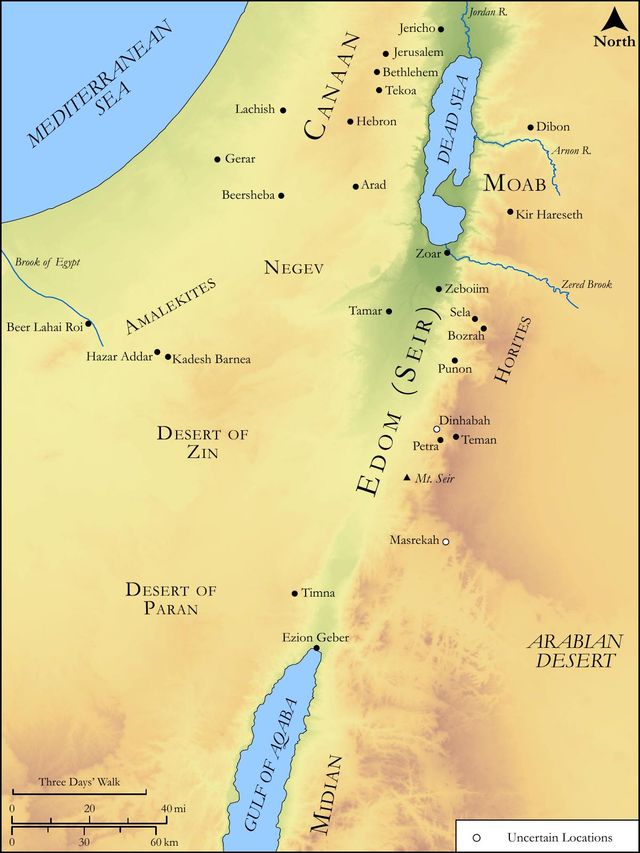
See on the biblical-era maps


Study this verse
Public-domain commentary
Matthew Henry
From his Commentary on the Whole Bible. Henry comments on passages, not single verses — this entry covers Genesis 36:20–30.
In the midst of this genealogy of the Edomites here is inserted the genealogy of the Horites, those Canaanites, or Hittites (compare Gen 26:34), that were the natives of Mount Seir. Mention is made of them, Gen 14:6, and of their interest in Mount Seir, before the Edomites took possession of it, Deu 2:12, Deu 2:22. This comes in here, not only to give light to the story, but to be a standing reflection upon the Edomites for intermarrying with them, by which, it is probable, they learned their way, and corrupted themselves. Esau having sold his birthright, and lost his blessing, and entered into alliance with the Hittites, his posterity and the sons of Seir are here reckoned together. Note, Those that treacherously desert God's church are justly numbered with those that were never in it; apostate Edomites stand on the same ground with accursed Horites. Particular notice is taken of one Anah who fed the asses of Zibeon his father (Gen 36:24), and yet is called duke Anah, Gen 36:29. Note, Those that expect to rise high should begin low. An honourable descent should not keep men from an honest employment, nor a mean employment hinder any man's preferment. This Anah was not only industrious in his business, but ingenious too, and successful; for he found mules, or (as some read it) waters, hot-baths, in the wilderness. Those that are diligent in their business sometimes find more advantages than they expected.
Historical interpretation
Historical reception
1 surviving comment on this verse from the historical church.
(Verse 24) He is Ana, who found Jamin in the desert, while feeding the donkeys of his father Zebeon. Much and varied is debated among the Hebrews about this chapter: for indeed, both the Greeks and our own are silent on this. Some believe that Ajamim () is a name for the seas. For the same letters are used to write seas as are used in the present discourse. And they say that he, while feeding the donkeys of his father in the desert, found gatherings of water, which are called seas in the Hebrew language: namely, that he discovered a lake, the discovery of which is difficult in the wilderness. Some people believe that hot springs near the border of the Punic language, which is adjacent to Hebrew, are signified by this word. There are those who think that wild donkeys have bred with female donkeys through this act, and thus the fastest offspring known as Jamim are born. Many believe that he himself was the first to ascend the herds of female horses with donkeys in the desert, so that new animals contrary to nature, mules, would be born from there. Eagle translated this passage as follows: He is Ana, who discovered it with the mimics. And Symmachus likewise translated the mimics, which signifies a plural number. However, the Seventy and Theodotion translated it equally, saying: the mimi, which indicates a singular number.
Continue studying Genesis 36:24 across the web’s major study libraries — every link below opens this exact verse, chapter, or book on the destination site.
Read & Compare
 BibleGatewayThis verse in more than 200 translations and 70 languages.
 Bible.comThe YouVersion reader — hundreds of translations, reading plans, and highlights.
 ESV.orgCrossway's official English Standard Version reader.
 NET BibleThe NET translation with 60,000+ translators' notes on every rendering decision.
 STEP BibleTyndale House's free study tool — original text, vocabulary, and scholarly resources.
 BibliaLogos Bible Software's free web reader.
 USCCBThe New American Bible (Revised Edition) with the U.S. bishops' study notes.
Commentaries
 BibleHub CommentariesDozens of classic commentaries on this verse, gathered on one page.
 StudyLightMore than 100 commentary sets — the largest collection on the web.
 BibleRefPlain-English commentary on what this verse means, verse by verse.
 Enduring WordDavid Guzik's free commentary on this chapter, widely used by Bible teachers.
 Bible Study ToolsVerse commentary alongside Greek and Hebrew study aids.
Original Language & Research
- BibleHub InterlinearThe verse word by word — original language, transliteration, and English.
- BibleHub LexiconEvery word's original-language definition and Strong's entry.
 Blue Letter BibleDeep-study tools — Strong's numbers, concordance, and word studies.
 SefariaThe Hebrew text with Rashi and centuries of Jewish commentary.
Sermons, Hymns & Audio


TrulyRandomVerse is not affiliated with these sites and doesn’t control their content. They’re linked because they’re genuinely useful.
Summary
Anah, a son of Zibeon and a Horite chief within the Edomite lineage, is notable for his unique discovery of "mules" in the wilderness while engaged in the pastoral duty of tending his father's asses. This brief but intriguing detail provides a rare glimpse into ancient animal husbandry, human ingenuity, and the daily life of early Edomite society, underscoring the Bible's meticulous record-keeping even for figures outside the direct covenant line.
Context
ShowHideLiterary Context
This verse is situated within the expansive genealogies of Esau (Edom) in Genesis chapter 36, which meticulously details his descendants, chiefs, and kings. Following the account of Jacob's family in earlier chapters, this comprehensive record of Esau's lineage serves to establish the historical backdrop for the nation of Edom, a people often in future conflict with Israel. The inclusion of Anah's specific, almost anecdotal, discovery within a list of names stands out, momentarily shifting from dry genealogy to a brief narrative highlight. This unique interjection suggests the particular significance of Anah's action or the animal he "found," distinguishing him within the extensive family tree. The surrounding verses enumerate other chiefs and their territories, solidifying the societal structure and geographical presence of the Edomites.
Historical & Cultural Context
The Edomites, descendants of Esau, inhabited the mountainous region south-east of the Dead Sea, known as Seir or Edom. This area was semi-arid, characterized by rugged terrain and wilderness, making pastoralism a primary mode of subsistence. Tending flocks of sheep, goats, and asses was a common occupation, often requiring extensive travel to find pasture. The mention of "asses" (donkeys) as primary pack and transport animals is consistent with the technology and practices of the patriarchal age. The "discovery" of "mules" (or a specific type of wild ass, as some interpret) would have been highly significant in a culture reliant on animal strength and endurance. Mules, known for their hybrid vigor, strength, and resilience in harsh conditions, would have been invaluable for trade, transport, and agriculture, potentially revolutionizing aspects of Edomite life and economy.
Key Themes
ShowHideGenesis 36:24 contributes to several overarching themes within the book of Genesis and the broader biblical narrative. Firstly, it reinforces the theme of God's meticulous record-keeping and sovereign oversight of all nations, not just the chosen lineage of Abraham, as seen in the detailed accounts of Esau's descendants. Secondly, it subtly highlights human ingenuity and stewardship within the creation mandate, where individuals like Anah, through observation and innovation, discover or develop resources that benefit their communities. This resonates with the broader theme of humanity's role in subduing and having dominion over the earth, as first commanded in Genesis 1:28. Finally, the verse, through its specific detail, underscores the historical veracity and particularity of the biblical narrative, demonstrating its commitment to recording real individuals and their unique contributions within the grand sweep of redemptive history, even seemingly minor ones.
Exposition and Analysis
ShowHideKey Word Analysis
ShowHideMeaning "an answer." This name, shared by two Edomites and one Edomitess, is significant here as it identifies the specific individual responsible for the unique discovery. The repetition of "this was that Anah" emphasizes his identity and the singular nature of his action within the genealogical record.
Meaning "to come forth to, i.e. appear or exist; transitively, to attain, i.e. find or acquire; figuratively, to occur, meet or be present." This verb implies discovery or acquisition of something previously unknown or unutilized, rather than creation. In the context of Anah and the "mules," it suggests that he either came across a previously unknown species of animal in the wilderness or that he was the first to successfully breed these hybrid animals, thus "finding" a new capability or resource.
Defined as "a warm spring; mule." This is a highly debated word in this context. While the KJV translates it as "mules," the primary meaning "warm spring" or "hot springs" is also plausible, suggesting Anah discovered such a place. However, the context of "feeding asses" and the subsequent mention of "mules" in later biblical texts (e.g., 2 Samuel 18:9) has led many ancient and modern interpreters to favor the "mules" translation, understanding it as either the first instance of successful hybrid breeding (donkey and horse) or the discovery of a distinct, wild species of ass (perhaps a particularly strong or unique variety) that came to be known as "mules" in later times. The Strong's definition itself includes "mule," indicating this interpretive tradition.
Meaning "a male ass (from its dun red)." This refers to the common donkey, a ubiquitous beast of burden and transport among the patriarchs and their neighbours. The contrast between the familiar "asses" and the newly "found" "mules" highlights the significance of Anah's discovery.
Verse Breakdown
ShowHide"And these [are] the children of Zibeon; both Ajah, and Anah:"
This opening clause introduces Zibeon, a Horite chief, and his two sons, Ajah and Anah, establishing their familial relationship and placing them within the Edomite lineage. It sets the stage for the specific detail about Anah.
"this [was that] Anah that found the mules in the wilderness,"
This is the pivotal statement of the verse, singling out Anah for a remarkable achievement. The phrase "this was that Anah" emphasizes his unique identity and deed. The "finding" of "mules" (or a significant new animal type/resource) in the "wilderness" — a vast, untamed, and often challenging environment — highlights the serendipitous nature of the discovery and Anah's keen observation or innovative spirit.
"as he fed the asses of Zibeon his father."
This final clause provides the context for Anah's discovery, grounding it in the ordinary, everyday activity of pastoral life. It shows that the discovery occurred not during a grand expedition, but while he was diligently performing his duties, tending his father's familiar animals. This detail adds a layer of realism and underscores that significant events can arise from mundane circumstances.
Literary Devices
ShowHideThe primary literary device at play in Genesis 36:24 is Anecdote within Genealogy. This verse breaks the typical pattern of a dry list of names and lineages by interjecting a specific, brief narrative detail about Anah's unique discovery. This serves to highlight Anah among his kinsmen and provides a momentary, vivid glimpse into the daily life and potential innovations of the Edomite people. The phrase "this was that Anah" functions as a form of Emphasis or Repetition, drawing particular attention to him and his notable action. There is also an element of Juxtaposition, contrasting the mundane activity of "feeding the asses" with the extraordinary "finding the mules," suggesting that significant discoveries can emerge from ordinary circumstances. This unexpected detail adds a layer of richness and historical specificity to what might otherwise be a purely functional genealogical record.
Theological and Thematic Connections
ShowHideGenesis 36:24, though seemingly a minor detail in a long genealogy, subtly reinforces profound theological truths. It speaks to God's comprehensive knowledge and sovereign oversight, demonstrating that His attention extends beyond the covenant line of Israel to encompass all nations and their histories. The inclusion of such a specific, almost anecdotal detail about Anah's discovery underscores the Bible's commitment to historical veracity and its portrayal of real individuals with unique contributions, reminding us that every life, every innovation, and every discovery holds a place within God's grand design. This verse also implicitly touches upon the theme of human ingenuity and our role as stewards of creation, reflecting the initial mandate given to humanity to explore, manage, and develop the earth's resources.
Reflection and Application
ShowHideGenesis 36:24, despite its brevity and placement within a genealogy, offers valuable insights for contemporary reflection. Anah's discovery, occurring while he was engaged in the ordinary task of feeding his father's asses, reminds us that significant moments or breakthroughs often emerge from diligent engagement with our everyday responsibilities. It encourages us to cultivate a spirit of observation, curiosity, and innovation in our own lives, recognizing that even in seemingly mundane circumstances, there may be opportunities for discovery, problem-solving, or the development of new resources. This verse also serves as a powerful reminder that God's meticulous attention extends to every individual and every detail of human history, affirming that our lives, our work, and even our small "discoveries" are seen and valued by Him. We are called to be faithful stewards of the gifts and opportunities He provides, whether in grand endeavors or the quiet tasks of daily life, knowing that all contribute to His sovereign plan.
Questions for Reflection
ShowHideFAQ
ShowHideWhat is the significance of Anah's discovery of "mules"?
ShowHideAnah's discovery of "mules" (or a significant new type of wild ass/animal resource) is significant for several reasons. It provides a rare glimpse into early animal husbandry and innovation in the days of the patriarchs, suggesting either the pioneering of hybrid animal breeding (donkey and horse) or the identification of a new, valuable species of wild ass that would have been highly useful for strength and endurance. It also highlights the Bible's meticulous attention to detail, even for figures outside the direct covenant line, underscoring the historical richness and practical insights embedded within the text. This brief note suggests that human ingenuity and the development of resources were part of the fabric of ancient life, even among Esau's descendants.
Why does the Bible include such detailed genealogies, especially for Esau's descendants?
ShowHideThe inclusion of detailed genealogies, even for Esau's descendants, serves multiple crucial purposes. Firstly, it establishes the historical context and verifies the lineage of nations that would interact with Israel throughout biblical history, such as Edom (e.g., Numbers 20:14-21 and Amos 1:11). Secondly, it demonstrates God's sovereign oversight of all peoples and their histories, not just the chosen line of Abraham. It shows that God is the God of all nations. Furthermore, these meticulous details contribute to the Bible's overall historical reliability, showing its commitment to recording the lives of real individuals and the development of distinct peoples within the broader tapestry of redemptive history.
Christ-Centered Fulfillment
ShowHideWhile Anah's discovery focuses on an Edomite figure and a seemingly mundane discovery, it subtly points to Christ by illustrating the comprehensive nature of God's redemptive plan and His sovereign rule over all creation and history. The meticulous recording of all lineages, even those seemingly peripheral to the main covenant narrative, underscores that all history, all peoples, and all human ingenuity ultimately serve God's overarching purpose, which culminates in Christ. Just as Anah's innovation contributed to the fabric of his society, Christ's work on the cross provides the ultimate and universal solution for humanity, redeeming not only individuals but also the very fabric of creation and human endeavor. In Christ, all things hold together, and through Him, God is reconciling all things to Himself, making sense of every detail, every lineage, and every discovery within His grand design for salvation and new creation, as beautifully articulated in Colossians 1:15-20. He is the ultimate "discoverer" of new life and the one who brings all scattered threads of human history and ingenuity into their perfect fulfillment.