


Genesis 34:28
Bible text: King James Version (1769 Blayney text) · Public domain
Bible text: Berean Standard Bible · Public domain
Bible text: American Standard Version (1901) · Public domain
Bible text: World English Bible, Messianic edition · Public domain
Bible text: Geneva Bible (1599) · Public domain
Bible text: Young's Literal Translation · Public domain
- אֶת'et<obj.>H853DirObjMParticle Object Indicator
- צֹאנָםtzo·Namtheir flock[s]H6629N-csc ¦ 3mpNoun Singular common gender Constructצֹאנָflock[s]םtheir
- וְאֶתve·'Etand <obj.>H853Conj-w ¦ DirObjMParticle Object Indicatorוְandאֶת<obj.>
- בְּקָרָםbe·ka·Ramtheir herd[s]H1241N-csc ¦ 3mpNoun Singular common gender Constructבְּקָרָherd[s]םtheir
- וְאֶתve·'Etand <obj.>H853Conj-w ¦ DirObjMParticle Object Indicatorוְandאֶת<obj.>
- חֲמֹרֵיהֶּםcha·mo·rei·Hemtheir donkeysH2543N-mpc ¦ 3mpNoun Plural Masculine Constructחֲמֹרֵיdonkeysהֶּםtheir
- וְאֵתve·'Etand <obj.>H853Conj-w ¦ DirObjMParticle Object Indicatorוְandאֵת<obj.>
- אֲשֶׁר'a·Sher[that] whichH834RelParticle Relative
- בָּעִירba·'Ir[was] in the cityH5892Prep-b ¦ N-fsNoun Singular Feminine Absoluteבָּ[was] in theעִירcity
- וְאֶתve·'Etand <obj.>H853Conj-w ¦ DirObjMParticle Object Indicatorוְandאֶת<obj.>
- אֲשֶׁר'a·Sher[that] whichH834RelParticle Relative
- בַּשָּׂדֶהba·sa·Deh[was] in the fieldH7704Prep-b ¦ N-msNoun Singular Masculine Absoluteבַּ[was] in theשָּׂדֶהfield
- לָקָחוּla·Ka·chuthey tookH3947V-Qal-Perf-3cpVerb Qal Perfect 3rd Plural common gender
English is a literal word-by-word gloss of the Hebrew, not the KJV's wording. Why?
This is the original text the KJV's translators worked from — each Hebrew word with its own literal English meaning in this verse, prepared by scholars at Tyndale House, Cambridge. The KJV translates whole sentences, not word by word, so its wording differs: one Hebrew word can become several English words, and the KJV may choose “the LORD” where the gloss reads “Yahweh”. Both are faithful — they answer different questions. For the KJV's own rendering, switch to the KJV text.
Details
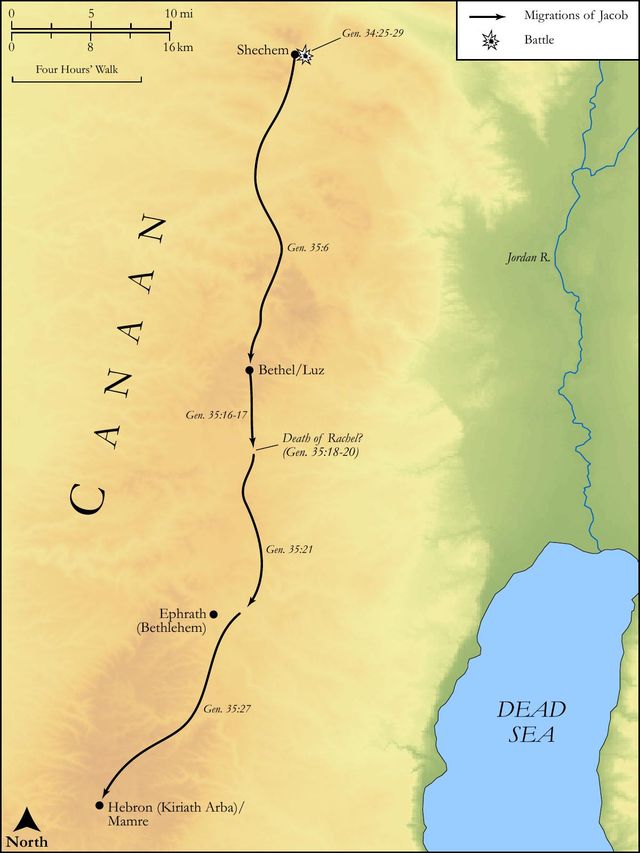
See on the biblical-era maps


Study this verse
Public-domain commentary
Matthew Henry
From his Commentary on the Whole Bible. Henry comments on passages, not single verses — this entry covers Genesis 34:25–31. His four-level outline is real structure in the source text, so it is rendered as structure.
Here, we have Simeon and Levi, two of Jacob's sons, young men not much above twenty years old, cutting the throats of the Shechemites, and thereby breaking the heart of their good father.
I.Here is the barbarous murder of the Shechemites.
Jacob himself was used to the sheep-hook, but his sons had got swords by their sides, as if they had been the seed of Esau, who was to live by his sword; we have them here,
1.Slaying the inhabitants of Shechem - all the males, Hamor and Shechem particularly, with whom they had been treating in a friendly manner but the other day, yet with a design upon their lives. Some think that all Jacob's sons, when they wheedled the Shechemites to be circumcised, designed to take advantage of their soreness, and to rescue Dinah from among them; but that Simeon and Levi, not content with that, would themselves avenge the injury - and they did it with a witness. Now,
(1.)It cannot be denied but that God was righteous in it. Had the Shechemites been circumcised in obedience to any command of God, their circumcision would have been their protection; but when they submitted to that sacred rite only to serve a turn, to please their prince and to enrich themselves, it was just with God to bring this upon them. Note, As nothing secures us better than true religion, so nothing exposes us more than religion only pretended to.
(2.)But Simeon and Levi were most unrighteous.
[1.]It was true that Shechem had wrought folly against Israel, in defiling Dinah; but it ought to have been considered how far Dinah herself had been accessory to it. Had Shechem abused her in her own mother's tent, it would have been another matter; but she went upon his ground, and perhaps by her indecent carriage had struck the spark which began the fire: when we are severe upon the sinner we ought to consider who was the tempter.
[2.]It was true that Shechem had done ill; but he was endeavouring to atone for it, and was as honest and honourable, ex post facto - after the deed, as the case would admit: it was not the case of the Levite's concubine that was abused to death; nor does he justify what he has done, but courts a reconciliation upon any terms.
[3.]It was true that Shechem had done ill; but what was that to all the Shechemites? Does one man sin, and will they be wroth with all the town? Must the innocent fall with the guilty? This was barbarous indeed.
[4.]But that which above all aggravated the cruelty was the most perfidious treachery that was in it. The Shechemites had submitted to their conditions, and had done that upon which they had promised to become one people with them (Gen 34:16); yet they act as sworn enemies to those to whom they had lately become sworn friends, making as light of their covenant as they did of the laws of humanity. And are these the sons of Israel? Cursed be their anger, for it was fierce.
[5.]This also added to the crime, that they made a holy ordinance of God subservient to their wicked design, so making that odious; as if it were not enough for them to shame themselves and their family, they bring a reproach upon that honourable badge of their religion; justly would it be called a bloody ordinance.
2.Seizing the prey of Shechem, and plundering the town. They rescued Dinah (Gen 34:26), and, if that was all they came for, they might have done that without blood, as appears by their own showing (Gen 34:17); but they aimed at the spoil; and, though Simeon and Levi only were the murderers, yet it is intimated that others of the sons of Jacob came upon the slain and spoiled the city (Gen 34:27), and so became accessory to the murder. In them it was manifest injustice; yet here we may observe the righteousness of God. The Shechemites were willing to gratify the sons of Jacob by submitting to the penance of circumcision, upon this principle, Shall not their cattle and their substance be ours? (Gen 34:23), and see what was the issue; instead of making themselves masters of the wealth of Jacob's family, Jacob's family become masters of their wealth. Note, Those who unjustly grasp at that which is another's justly lose that which is their own.
II.Here is Jacob's resentment of this bloody deed of Simeon and Levi, Gen 34:30.
Two things he bitterly complains of: - 1. The reproach they had brought upon him thereby: You have troubled me, put me into a disorder, for you have made me to stink among the inhabitants of the land, that is, "You have rendered me and my family odious among them. What will they say of us and our religion? We shall be looked upon as the most perfidious barbarous people in the world." Note, The gross misconduct of wicked children is the grief and shame of their godly parents. Children should be the joy of their parents; but wicked children are their trouble, sadden their hearts, break their spirits, and make them go mourning from day to day. Children should be an ornament to their parents; but wicked children are their reproach, and are as dead flies in the pot of ointment: but let such children know that, if they repent not, the grief they have caused to their parents, and the damage religion has sustained in its reputation through them, will come into the account and be reckoned for. 2. The ruin they had exposed him to. What could be expected, but that the Canaanites, who were numerous and formidable, would confederate against him, and he and his little family would become an easy prey to them? I shall be destroyed, I and my house. If all the Shechemites must be destroyed for the offence of one, why not all the Israelites for the offence of two? Jacob knew indeed that God had promised to preserve and perpetuate his house; but he might justly fear that these vile practices of his children would amount to a forfeiture, and cut off the entail. Note, When sin is in the house, there is reason to fear ruin at the door. The tender parents foresee those bad consequences of sin which the wicked children have no dread of. One would think this should have made them to relent, and they should have humbled themselves to their good father, and begged his pardon; but, instead of this, they justify themselves, and give him this insolent reply, Should he deal with our sister as with a harlot? No, he should not; but, if he do, must they be their own avengers? Will nothing less than so many lives, and the ruin of a whole city, serve to atone for an abuse done to one foolish girl? By their question they tacitly reflect upon their father, as if he would have been content to let them deal with his daughter as with a harlot. Note, It is common for those who run into one extreme to reproach and censure those who keep the mean as if they ran into the other. Those who condemn the rigour of revenge shall be misrepresented, as if they countenanced and justified the offence.
Continue studying Genesis 34:28 across the web’s major study libraries — every link below opens this exact verse, chapter, or book on the destination site.
Read & Compare
 BibleGatewayThis verse in more than 200 translations and 70 languages.
 Bible.comThe YouVersion reader — hundreds of translations, reading plans, and highlights.
 ESV.orgCrossway's official English Standard Version reader.
 NET BibleThe NET translation with 60,000+ translators' notes on every rendering decision.
 STEP BibleTyndale House's free study tool — original text, vocabulary, and scholarly resources.
 BibliaLogos Bible Software's free web reader.
 USCCBThe New American Bible (Revised Edition) with the U.S. bishops' study notes.
Commentaries
 BibleHub CommentariesDozens of classic commentaries on this verse, gathered on one page.
 StudyLightMore than 100 commentary sets — the largest collection on the web.
 BibleRefPlain-English commentary on what this verse means, verse by verse.
 Enduring WordDavid Guzik's free commentary on this chapter, widely used by Bible teachers.
 Bible Study ToolsVerse commentary alongside Greek and Hebrew study aids.
Original Language & Research
- BibleHub InterlinearThe verse word by word — original language, transliteration, and English.
- BibleHub LexiconEvery word's original-language definition and Strong's entry.
 Blue Letter BibleDeep-study tools — Strong's numbers, concordance, and word studies.
 SefariaThe Hebrew text with Rashi and centuries of Jewish commentary.
Sermons, Hymns & Audio


TrulyRandomVerse is not affiliated with these sites and doesn’t control their content. They’re linked because they’re genuinely useful.
Summary
meticulously details the comprehensive material spoils taken by Jacob's sons from the city of Shechem following their treacherous and brutal massacre of its male inhabitants. This verse underscores the immediate, tangible gains—specifically livestock and all other possessions found both within the urban confines and the surrounding agricultural lands—acquired through an act of profound deception and unrighteous violence, thereby highlighting the morally compromised nature of their actions and the devastating consequences for the Hivite community.
Context
ShowHideLiterary Context
This verse is situated immediately after the horrific massacre of all Hivite males in Shechem, orchestrated by Simeon and Levi, two of Jacob's sons, in retaliation for the defilement of their sister Dinah by Shechem, the son of Hamor (Genesis 34:1-7). The preceding verses describe the deceptive covenant proposed by Jacob's sons, requiring all Shechemite males to be circumcised, and their subsequent surprise attack while the men were incapacitated (Genesis 34:13-26). Verse 28, along with Genesis 34:29, then records the actions of the other sons of Jacob, who, though not explicitly involved in the killing, participated fully in the widespread plunder of the now defenseless city. This act of collective looting further compounds the moral depravity of the family's actions, culminating in Jacob's strong condemnation in Genesis 34:30. It marks a significant moral low point for Jacob's household, contrasting sharply with the covenant promises of God's blessing and protection.
Historical & Cultural Context
Among the nations of that day, the practice of plundering conquered cities was a common and expected outcome of warfare. Livestock (sheep, oxen, asses) represented significant wealth, serving as currency, food sources, and labor. Possessions within the city included household goods, precious metals, textiles, and even people (slaves, women, and children), as indicated by Genesis 34:29). Fields provided crops, tools, and additional livestock. The total despoliation described in Genesis 34:28 signifies the complete subjugation and impoverishment of the defeated community. Furthermore, the Hivites' willingness to accept circumcision for the sake of intermarriage and economic integration (Genesis 34:21-23) highlights the cultural significance of alliances and the devastating breach of trust that Jacob's sons perpetrated. This act would have been seen as a profound violation of hospitality and covenant, bringing immense shame upon Jacob's family in the eyes of their Canaanite neighbors.
Key Themes
ShowHideGenesis 34 is a pivotal chapter that explores several profound themes. Deception and Treachery are central, as Jacob's sons use a sacred covenant ritual (circumcision) as a ruse for vengeance. The theme of Unchecked Vengeance and its Consequences is vividly portrayed, demonstrating how personal injury, when responded to with disproportionate and morally corrupt violence, leads to further sin and jeopardizes the family's future and reputation, as Jacob himself laments in Genesis 34:30. The Moral Compromise of God's People is starkly evident, as Jacob's sons, the bearers of the covenant promise, act in a manner antithetical to God's character, highlighting the ongoing struggle with sin even within the chosen lineage. Finally, the narrative touches on the Vulnerability and Protection of the Covenant Family, as Jacob fears retaliation from the surrounding Canaanite tribes, underscoring their precarious position in the land and their dependence on divine providence despite their own failings.
Exposition and Analysis
ShowHideKey Word Analysis
ShowHideFrom the primitive root H3947, meaning "to take (in the widest variety of applications)." In this context, it signifies a forceful appropriation, seizing, or carrying away. It implies not a peaceful acquisition but a violent confiscation, directly linking the act of taking to the preceding massacre. The verb choice emphasizes the active, deliberate nature of the plunder by Jacob's sons.
A collective name for a flock of sheep or goats. This term represents a primary form of wealth and sustenance in the ancient pastoral economy. The inclusion of "sheep" alongside "oxen" and "asses" highlights the significant material gain in livestock, which was crucial for both immediate needs (food, clothing) and long-term economic stability.
Referring to a city, a place guarded by watching, or even an encampment. Here, "that which was in the city" refers to all the movable possessions found within the walled settlement of Shechem. This would include household goods, valuables, and other personal effects, indicating a thorough ransacking of the urban dwellings and businesses.
Verse Breakdown
ShowHide"They took their sheep"
This clause initiates the detailed list of the plunder, specifically mentioning the Shechemites' flocks of sheep. Sheep were a vital asset, providing wool, meat, and milk, and their seizure represents a significant blow to the Hivite economy and means of survival.
"and their oxen"
Following sheep, oxen are listed, indicating the appropriation of draft animals and a source of beef. Oxen were essential for plowing fields and heavy labor, signifying the loss of agricultural capacity and further economic devastation for the Shechemites.
"and their asses"
The inclusion of asses (donkeys) completes the list of primary livestock. Asses were used for transport and lighter labor, emphasizing the comprehensive nature of the seizure of all valuable animal assets.
"and that which [was] in the city"
This phrase broadens the scope of the plunder beyond livestock to encompass all movable wealth found within the urban center of Shechem. This would include household goods, clothing, precious metals, and any other valuables stored or used in the city, indicating a complete ransacking of homes and businesses.
"and that which [was] in the field"
This final clause extends the plunder to assets located outside the city walls. This would include agricultural produce (harvested crops), farming implements, and any other resources or smaller livestock kept in the fields, ensuring that no form of wealth or means of livelihood was left to the Shechemites.
Literary Devices
ShowHideThe verse employs Synecdoche by listing specific types of livestock ("sheep, and their oxen, and their asses") to represent the entirety of the Shechemites' animal wealth. This specific enumeration emphasizes the tangible and valuable nature of the spoils. Furthermore, Metonymy is evident in the phrases "that which was in the city" and "that which was in the field," where "city" and "field" stand in for the comprehensive range of possessions found within those respective locations. This highlights the absolute totality of the despoliation, leaving the Hivites utterly bereft. The cumulative effect of these detailed lists also creates a sense of Hyperbole or extreme thoroughness, underscoring the severity and completeness of the plunder. This detailed accounting of the spoils serves to emphasize the material "gain" derived from the violent act, implicitly setting up the moral judgment that follows in the broader narrative.
Theological and Thematic Connections
ShowHideThis verse starkly illustrates the immediate material consequences of unrighteous vengeance and ill-gotten gains. While Jacob's sons acquired significant wealth, their actions were rooted in deception, violence, and a profound breach of trust, bringing a deep moral stain upon their family. The narrative consistently warns that prosperity gained through such means is tainted and does not bring true blessing or security, often leading to further complications and divine disfavor. This episode serves as a powerful reminder that God's covenant people are called to a higher standard of righteousness, even when provoked, and that personal retribution, no matter how seemingly justified, often leads to greater sin and jeopardizes their standing before God and humanity.
Reflection and Application
ShowHideGenesis 34:28 stands as a somber testament to the destructive power of unchecked anger and the deceptive allure of ill-gotten gains. It forces us to confront the uncomfortable truth that sin often yields immediate, tangible "rewards," whether they be material possessions, a sense of vindication, or temporary power. However, these gains are fundamentally tainted, built upon a foundation of injustice and moral compromise, and ultimately lead to deeper spiritual, relational, and moral loss. This narrative challenges us to examine our own hearts: Do we seek justice through righteous means, trusting in God's ultimate sovereignty, or are we tempted to take matters into our own hands, even if it means compromising our integrity or harming others? The ripple effect of the sons' sin—bringing danger, shame, and moral compromise upon their entire family—serves as a potent reminder that our individual choices have far-reaching consequences, urging us to consider the broader impact of our actions on our communities and our witness to the world.
Questions for Reflection
ShowHideFAQ
ShowHideWhat does "that which [was] in the city, and that which [was] in the field" signify?
ShowHideThis phrase signifies the absolute totality and comprehensiveness of the plunder. "That which was in the city" refers to all movable goods, valuables, and even people (as explicitly detailed in Genesis 34:29) found within the walled settlement of Shechem, including household items, precious metals, and personal effects. "That which was in the field" refers to all agricultural assets, livestock, harvested crops, and equipment located outside the city walls. Together, these phrases emphasize that Jacob's sons stripped the Shechemites of every conceivable possession, leaving them utterly destitute and without means of livelihood.
Why did Jacob's other sons participate in the plunder if only Simeon and Levi committed the massacre?
ShowHideWhile Simeon and Levi were indeed the primary instigators and perpetrators of the massacre itself (Genesis 34:25), the text in Genesis 34:27 states that "the sons of Jacob came upon the slain, and spoiled the city." This indicates that the other brothers, though not directly involved in the initial killing, joined in the subsequent looting and taking of captives. Their participation in the plunder suggests a collective complicity in the sin, as they benefited materially from the violent and treacherous actions of their brothers. This highlights a broader moral failing within Jacob's household, demonstrating how the sin of a few can draw others into shared guilt and compromise the integrity of the entire family.
Christ-Centered Fulfillment
ShowHideThe narrative of Genesis 34:28 vividly portrays the destructive consequences of human sin, especially when driven by unchecked vengeance and the pursuit of ill-gotten gains. In stark contrast to the sons of Jacob, who plundered and destroyed for personal retribution, Jesus Christ came not to take, but to give His life as a ransom for many (Mark 10:45). While the brothers brought shame, danger, and moral compromise upon their family through their violent acts, Christ, through His sacrificial death on the cross, bore the shame and danger of humanity's sin, offering reconciliation and true blessing to His spiritual family. He did not seek to gain wealth or power through violence, but emptied Himself, taking the form of a servant (Philippians 2:7). The justice He brings is not one of human vengeance, but divine righteousness, forgiving sins and transforming hearts (Romans 3:25-26). Ultimately, Christ conquers sin and death not through the sword and plunder, but through self-giving love and resurrection power, providing the ultimate fulfillment of justice and redemption that human retribution can never achieve (Colossians 2:15).