


Genesis 30:39
Bible text: King James Version (1769 Blayney text) · Public domain
Bible text: Berean Standard Bible · Public domain
Bible text: American Standard Version (1901) · Public domain
Bible text: World English Bible, Messianic edition · Public domain
Bible text: Geneva Bible (1599) · Public domain
Bible text: Young's Literal Translation · Public domain
- וַיֶּחֱמוּvai·ye·che·Muand they matedH3179Conj-w ¦ V-Qal-ConsecImperf-3mpVerb Qal Consecutive Imperfect 3rd Plural Masculineוַandיֶּחֱמוּthey mated
- הַצֹּאןha·Tzonthe flockH6629Art ¦ N-csNoun Singular common gender Absoluteהַtheצֹּאןflock
- אֶל'eltoH413PrepPreposition
- הַמַּקְלוֹתha·mak·Lotthe branchesH4731Art ¦ N-fpNoun Plural Feminine Absoluteהַtheמַּקְלוֹתbranches
- וַתֵּלַדְןָva·te·Lad·naand they boreH3205Conj-w ¦ V-Qal-ConsecImperf-3fpVerb Qal Consecutive Imperfect 3rd Plural Feminineוַandתֵּלַדְןָthey bore
- הַצֹּאןha·Tzonthe flockH6629Art ¦ N-csNoun Singular common gender Absoluteהַtheצֹּאןflock
- עֲקֻדִּים'a·ku·Dimstriped [ones]H6124Adj-mpAdjective Plural Masculine Absolute
- נְקֻדִּיםne·ku·Dimspeckled [ones]H5348Adj-mpAdjective Plural Masculine Absolute
- וּטְלֻאִיםu·te·lu·'Imand spotted [ones]H2921Conj-w ¦ V-Qal-PassPrtcpl-mpVerb Qal Participle Passive Plural Masculine Absoluteוּandטְלֻאִיםspotted [ones]
English is a literal word-by-word gloss of the Hebrew, not the KJV's wording. Why?
This is the original text the KJV's translators worked from — each Hebrew word with its own literal English meaning in this verse, prepared by scholars at Tyndale House, Cambridge. The KJV translates whole sentences, not word by word, so its wording differs: one Hebrew word can become several English words, and the KJV may choose “the LORD” where the gloss reads “Yahweh”. Both are faithful — they answer different questions. For the KJV's own rendering, switch to the KJV text.
Details
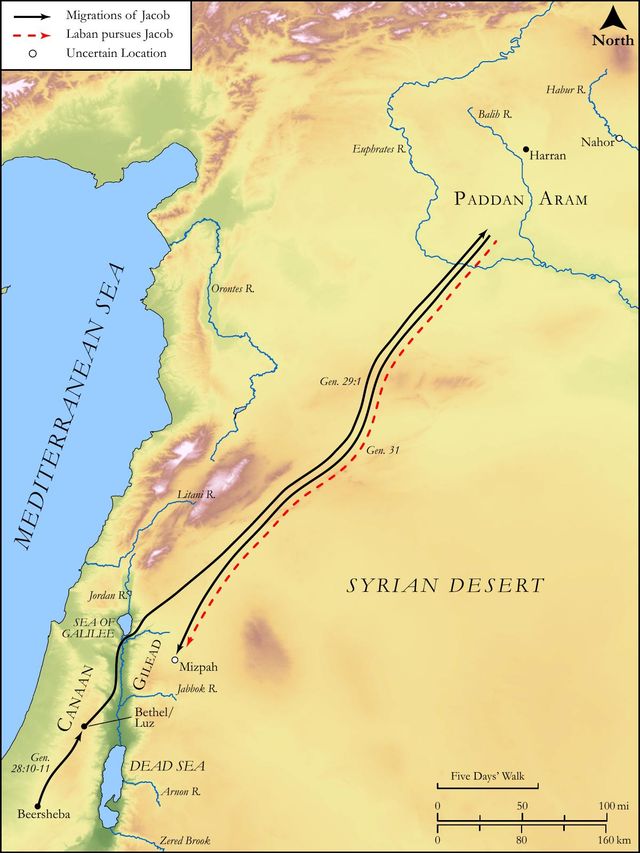
See on the biblical-era maps


Study this verse
Public-domain commentary
Matthew Henry
From his Commentary on the Whole Bible. Henry comments on passages, not single verses — this entry covers Genesis 30:37–43.
Here is Jacob's honest policy to make his bargain more advantageous to himself than it was likely to be. If he had not taken some course to help himself, it would have been a bad bargain indeed, which he knew Laban would never consider, or rather would be well pleased to see him a loser by, so little did Laban consult any one's interest but his own. Now Jacob's contrivances were, 1. To set peeled sticks before the cattle where they were watered, that, looking much at those unusual party-coloured sticks, by the power of imagination they might bring forth young ones in like manner party-coloured, Gen 30:37-39. Probably this custom was commonly used by the shepherds of Canaan, who coveted to have their cattle of this motley colour. Note, It becomes a man to be master of his trade, whatever it is, and to be not only industrious, but ingenious in it, and to be versed in all its lawful arts and mysteries; for what is a man but his trade? There is a discretion which God teaches the husbandman (as plain a trade as that is), and which he ought to learn, Isa 28:26. 2. When he began to have a stock of ringstraked and brown, he contrived to set them first, and to put the faces of the rest towards them, with the same design as in the former contrivance; but would not let his own, that were of one colour, Gen 30:40. Strong impressions, it seems, are made by the eye, with which therefore we have need to make a covenant. 3. When he found that his project succeeded, through the special blessing of God upon it, he contrived, by using it only with the stronger cattle, to secure to himself those that were most valuable, leaving the feebler to Laban, Gen 30:41, Gen 30:42. Thus Jacob increased exceedingly (Gen 30:43), and grew very rich in a little time. This success of his policy, it is true, was not sufficient to justify it, if there had been any thing fraudulent or unjust in it, which we are sure there was not, for he did it by divine direction (Gen 31:12); nor was there any thing in the thing itself but the honest improvement of a fair bargain, which the divine providence wonderfully prospered, both in justice to Jacob whom Laban had wronged and dealt hardly with and in pursuance of the particular promises made to him of the tokens of the divine favour, Note, Those who, while their beginning is small, are humble and honest, contented and industrious, are in a likely way to see their latter end greatly increasing. He that is faithful in a little shall be entrusted with more. He that is faithful in that which is another man's shall be entrusted with something of his own. Jacob, who had been a just servant, became a rich master.
Continue studying Genesis 30:39 across the web’s major study libraries — every link below opens this exact verse, chapter, or book on the destination site.
Read & Compare
 BibleGatewayThis verse in more than 200 translations and 70 languages.
 Bible.comThe YouVersion reader — hundreds of translations, reading plans, and highlights.
 ESV.orgCrossway's official English Standard Version reader.
 NET BibleThe NET translation with 60,000+ translators' notes on every rendering decision.
 STEP BibleTyndale House's free study tool — original text, vocabulary, and scholarly resources.
 BibliaLogos Bible Software's free web reader.
 USCCBThe New American Bible (Revised Edition) with the U.S. bishops' study notes.
Commentaries
 BibleHub CommentariesDozens of classic commentaries on this verse, gathered on one page.
 StudyLightMore than 100 commentary sets — the largest collection on the web.
 BibleRefPlain-English commentary on what this verse means, verse by verse.
 Enduring WordDavid Guzik's free commentary on this chapter, widely used by Bible teachers.
 Bible Study ToolsVerse commentary alongside Greek and Hebrew study aids.
Original Language & Research
- BibleHub InterlinearThe verse word by word — original language, transliteration, and English.
- BibleHub LexiconEvery word's original-language definition and Strong's entry.
 Blue Letter BibleDeep-study tools — Strong's numbers, concordance, and word studies.
 SefariaThe Hebrew text with Rashi and centuries of Jewish commentary.
Sermons, Hymns & Audio


TrulyRandomVerse is not affiliated with these sites and doesn’t control their content. They’re linked because they’re genuinely useful.
Summary
Genesis 30:39 vividly describes the extraordinary outcome of Jacob's unique breeding strategy for Laban's flocks, where the animals, having conceived in the presence of peeled rods, subsequently produced offspring with specific, desired markings—ringstraked, speckled, and spotted. This verse marks a significant turning point in Jacob's accumulation of wealth, serving as a powerful testament to God's sovereign hand in prospering His servant and ensuring justice, despite Laban's repeated attempts to defraud him.
Context
ShowHideLiterary Context
This verse is deeply embedded within the narrative of Jacob's twenty-year sojourn with Laban, a period characterized by Jacob's diligent labor and Laban's consistent deceit. Immediately preceding Genesis 30:39, Jacob has proposed a new wage agreement in Genesis 30:31-33, where his compensation would be limited to the "ringstraked, speckled, and spotted" among the sheep and goats. This proposal, seemingly disadvantageous to Jacob, was accepted by Laban, who then promptly removed all such existing animals from the flock to prevent Jacob from gaining any immediate advantage, as detailed in Genesis 30:35-36. Jacob's subsequent actions with the peeled rods, described in Genesis 30:37-38, are his response to Laban's trickery, leading directly to the miraculous results of verse 39 and the rapid expansion of his own wealth, which ultimately precipitates his departure from Laban's household in Genesis 31.
Historical & Cultural Context
The practice Jacob employs, involving peeled branches placed in watering troughs, reflects a common folk belief of that day in "sympathetic magic" or "maternal impression." It was widely thought that visual stimuli or strong impressions experienced by a pregnant female could influence the characteristics of her offspring. While modern genetics refutes a direct scientific link between such stimuli and genetic traits like coat patterns, the narrative operates within the cultural understanding of the time. Livestock, particularly sheep and goats, constituted the primary form of wealth and sustenance in this pastoral society. The ability to increase one's flock, especially with specific, desirable traits, was a direct measure of prosperity and divine favor. The contentious relationship between Jacob and Laban also highlights the patriarchal authority and contractual agreements common in the days of the patriarchs, where oaths and bargains, even if manipulated, held significant weight.
Key Themes
ShowHideGenesis 30:39 contributes significantly to several overarching themes within the book of Genesis and the broader biblical narrative. Firstly, it underscores the theme of Divine Providence and Blessing, demonstrating God's active involvement in the lives of His covenant people. Despite Laban's repeated attempts to defraud Jacob (as explicitly stated by God in Genesis 31:12), God supernaturally intervenes to ensure Jacob's prosperity and fulfill His promise to make Jacob fruitful and multiply his descendants, echoing the covenant made at Bethel in Genesis 28:13-15. Secondly, the passage highlights God's Justice and Vindication, showing that He is faithful to uphold the cause of the oppressed and turn the schemes of the wicked to the advantage of His chosen ones. Finally, it explores the theme of Human Ingenuity vs. Divine Sovereignty. While Jacob employs a culturally understood, albeit scientifically unsound, method, the ultimate success is clearly attributed to God's sovereign hand, emphasizing that true prosperity comes from the Lord, not merely from human effort or cleverness, as seen throughout the patriarchal narratives.
Exposition and Analysis
ShowHideKey Word Analysis
ShowHideThis primitive root primarily means "to be hot" but is used figuratively here to mean "to conceive." In the context of animal breeding, it denotes the act of becoming pregnant. The use of this word emphasizes the very moment of conception as being influenced by the rods, aligning with the ancient belief in maternal impression.
This word refers to a "shoot" or "stick," often with leaves, used for various purposes like walking, striking, or guiding. In this context, Jacob peeled fresh branches of poplar, almond, and plane trees, exposing white streaks, and placed them in the watering troughs. These rods were the physical instruments Jacob employed, believed to be the catalyst for the specific markings on the offspring.
Derived from a root meaning "to mark (by puncturing or branding)," this term describes animals with small spots or dots. It is one of the three specific patterns Jacob sought as his wages, indicating a distinct, dotted coat pattern on the animals.
Verse Breakdown
ShowHide"And the flocks conceived before the rods"
This clause describes the immediate action and the perceived cause of the unique offspring. The "flocks" (sheep and goats) became pregnant while in the presence of the peeled rods that Jacob had strategically placed in the watering troughs. The phrase "before the rods" implies a direct visual or psychological influence attributed to the rods during the animals' conception. This was Jacob's method, based on contemporary folk belief, to influence the genetic outcome of the breeding.
"and brought forth cattle ringstraked, speckled, and spotted"
This clause details the miraculous result of the conception. The offspring born from these "influenced" matings displayed the exact patterns that Jacob had stipulated as his wages: "ringstraked" (striped with bands), "speckled" (dotted with small spots), and "spotted" (marked with larger patches). This outcome was extraordinary because Laban had previously removed all such existing animals, making these newly born, patterned animals a clear sign of divine intervention and blessing upon Jacob.
Literary Devices
ShowHideThe narrative of Genesis 30:39 employs several literary devices to convey its profound theological message. Divine Irony is prominent, as Laban's repeated attempts to exploit Jacob by altering his wages ultimately backfire, leading to Jacob's unprecedented prosperity. Laban's greed, intended to impoverish Jacob, becomes the very mechanism through which God enriches him. Symbolism is also at play with the "rods." While seemingly a mundane agricultural tool, they become a symbol of Jacob's faith and God's power to work through unconventional means. The rods themselves do not possess inherent magical power, but they serve as a tangible point of focus for Jacob's faith and God's supernatural intervention. Furthermore, the passage contains elements of Foreshadowing, hinting at God's continued faithfulness to His covenant promises, even when human circumstances are challenging or unjust. This episode foreshadows the greater vindication and blessing God will bring to His chosen people throughout salvation history.
Theological and Thematic Connections
ShowHideGenesis 30:39 powerfully illustrates the unwavering faithfulness and sovereign power of God to bless His chosen servants and execute justice, even in the face of human deceit and manipulation. The narrative clearly attributes Jacob's extraordinary increase not to the efficacy of his "breeding method" with the rods, but to God's direct and supernatural intervention. This divine action serves as a testament to God's commitment to His covenant with Jacob, ensuring his prosperity and the growth of his household despite Laban's repeated attempts to defraud him. It underscores the biblical principle that true wealth and blessing ultimately derive from God's hand, not merely from human ingenuity or effort.
Reflection and Application
ShowHideGenesis 30:39 offers profound lessons for contemporary believers, reminding us that our ultimate provision and vindication come from God, not from our own cleverness or the fairness of human systems. In a world where injustice and exploitation can feel overwhelming, Jacob's story provides a powerful anchor for our trust in God's sovereignty. It encourages us to be diligent in our work, as Jacob was, but to simultaneously release our anxieties about outcomes into God's capable hands. God is able to work through any circumstance, even those seemingly disadvantageous or based on flawed human understanding, to accomplish His divine purposes and fulfill His promises. This passage calls us to cultivate a deep reliance on God's faithfulness, knowing that He sees our struggles, hears our cries, and is committed to ensuring His children are blessed and His justice prevails. Our prosperity, whether material or spiritual, is ultimately a gift of His grace.
Questions for Reflection
ShowHideFAQ
ShowHideDid Jacob's breeding method with the rods actually work scientifically?
ShowHideThe biblical narrative presents Jacob's method as the immediate catalyst for the specific markings on the offspring, reflecting a common folk belief of that day in "maternal impression." However, modern genetic understanding does not support the idea that visual stimuli during conception directly influence the coloration or genetic traits of offspring in this manner. The text itself, particularly in Genesis 31:12, clarifies that God Himself was supernaturally intervening to ensure Jacob's prosperity. In a dream, God tells Jacob, "I have seen all that Laban doeth unto thee... for I have seen all that Laban doeth unto thee. I am the God of Bethel, where thou anointedst the pillar, and where thou vowedst a vow unto me: now arise, get thee out from this land, and return unto the land of thy kindred." God explicitly states, "I have seen all that Laban has done to you. And I have seen all that Laban has done to you... I am the God of Bethel... And I have seen all that Laban has done to you." He then explains, "And the angel of God spake unto me in a dream, saying, Jacob: And I said, Here am I. And he said, Lift up now thine eyes, and see, all the rams which leap upon the ewes are ringstraked, speckled, and grisled: for I have seen all that Laban doeth unto thee." Thus, while Jacob employed a culturally understood practice, the ultimate success is unequivocally attributed to divine providence and God's direct, supernatural working to fulfill His promise to Jacob.
Christ-Centered Fulfillment
ShowHideThe divine intervention on behalf of Jacob in Genesis 30:39, ensuring his prosperity and vindication despite Laban's deceit, profoundly foreshadows the greater and ultimate provision and justice found in Jesus Christ. Just as God faithfully blessed Jacob and established his earthly household, so too does God, through Christ, establish His spiritual household, the Church, and provide for His people. Christ is the ultimate fulfillment of God's covenant promises, providing a spiritual inheritance and eternal blessings that far surpass any earthly wealth or vindication. In Him, believers are granted a new nature and a spiritual lineage, not through human schemes or ingenuity, but through the sovereign work of God's grace. The "flocks" of God's people are supernaturally transformed and multiplied, not by external stimuli, but by the indwelling Spirit of Christ, who produces spiritual fruit (Galatians 5:22-23). Through Christ's atoning work, we are made righteous (2 Corinthians 5:21) and receive true spiritual riches (Ephesians 1:3), securing an eternal inheritance that is incorruptible, undefiled, and unfading (1 Peter 1:3-4). This divine provision in Christ demonstrates God's unwavering faithfulness to His covenant people, ensuring their ultimate blessing and triumph over all adversaries.