


Genesis 29:1
Bible text: King James Version (1769 Blayney text) · Public domain
Bible text: Berean Standard Bible · Public domain
Bible text: American Standard Version (1901) · Public domain
Bible text: World English Bible, Messianic edition · Public domain
Bible text: Geneva Bible (1599) · Public domain
Bible text: Young's Literal Translation · Public domain
- וַיִּשָּׂאvai·yi·Sa'and he lifted upH5375Conj-w ¦ V-Qal-ConsecImperf-3msVerb Qal Consecutive Imperfect 3rd Singular Masculineוַandיִּשָּׂאhe lifted up
- יַעֲקֹבya·'a·KoJacobH3290N-proper-mNoun Proper Masculine
- רַגְלָיוrag·Lavhis feetH7272N-fdc ¦ 3msNoun Dual Feminine Constructרַגְלָיfeetוhis
- וַיֵּלֶךְvai·Ye·lekhand he wentH1980Conj-w ¦ V-Qal-ConsecImperf-3msVerb Qal Consecutive Imperfect 3rd Singular Masculineוַandיֵּלֶךְhe went
- אַרְצָה'Ar·tzah[the] land of towardsH776N-fsc ¦ SfxNoun Singular Feminine Constructאַרְצָ[the] land ofהtowards
- בְנֵיve·nei[the] people ofH1121N-mpcNoun Plural Masculine Construct
- קֶדֶםKe·dem[the] eastH6924N-msNoun Singular Masculine Absolute
English is a literal word-by-word gloss of the Hebrew, not the KJV's wording. Why?
This is the original text the KJV's translators worked from — each Hebrew word with its own literal English meaning in this verse, prepared by scholars at Tyndale House, Cambridge. The KJV translates whole sentences, not word by word, so its wording differs: one Hebrew word can become several English words, and the KJV may choose “the LORD” where the gloss reads “Yahweh”. Both are faithful — they answer different questions. For the KJV's own rendering, switch to the KJV text.
Details
See on the biblical-era maps


Study this verse
Public-domain commentary
Matthew Henry
From his Commentary on the Whole Bible. Henry comments on passages, not single verses — this entry covers Genesis 29:1–8.
All the stages Israel's march to Canaan are distinctly noticed, but no particular journal is kept of Jacob's expedition further than Beth-el; no, he had no more such happy nights as he had at Beth-el, no more such visions of the Almighty. That was intended for a feast; he must not expect it to be his daily bread. But, 1. We are here told how cheerfully he proceeded in his journey after the sweet communion he had with God at Beth-el: Then Jacob lifted up his feet; so the margin reads it, Gen 29:1. Then he went on with cheerfulness and alacrity, not burdened with his cares, nor cramped with his fears, being assured of God's gracious presence with him. Note, After the visions we have had of God, and the vows we have made to him in solemn ordinances, we should run the way of his commandments with enlarged hearts, Heb 12:1. 2. How happily he arrived at his journey's end. Providence brought him to the very field where his uncle's flocks were to be watered, and there he met with Rachel, who was to be his wife. Observe, (1.) The divine Providence is to be acknowledged in all the little circumstances which concur to make a journey, or other undertaking, comfortable and successful. If, when we are at a loss, we meet seasonably with those that can direct us - if we meet with a disaster, and those are at hand that will help us - we must not say that it was by chance, nor that fortune therein favoured us, but that it was by Providence, and that God therein favoured us. Our ways are ways of pleasantness, if we continually acknowledge God in them. (2.) Those that have flocks must look well to them, and be diligent to know their state, Pro 27:23. What is here said of the constant care of the shepherds concerning their sheep (Gen 29:2, Gen 29:3, Gen 29:7, Gen 29:8) may serve to illustrate the tender concern which our Lord Jesus, the great Shepherd of the sheep, has for his flock, the church; for he is the good Shepherd, that knows his sheep, and is known of them, Joh 10:14. The stone at the well's mouth, which is so often mentioned here, was either to secure their property in it (for water was scarce, it was not there usus communis aquarum - for every one's use), or it was to save the well from receiving damage from the heat of the sun, or from any spiteful hand, or to prevent the lambs of the flock from being drowned in it. (3.) Separate interests should not take us from joint and mutual help; when all the shepherds came together with their flocks, then, like loving neighbours, at watering-time, they watered their flocks together. (4.) It becomes us to speak civilly and respectfully to strangers. Though Jacob was no courtier, but a plain man, dwelling in tents, and a stranger to compliment, yet he addresses himself very obligingly to the people he met with, and calls them his brethren, Gen 29:4. The law of kindness in the tongue has a commanding power, Pro 31:26. Some think he calls them brethren because they were of the same trade, shepherds like him. Though he was now upon his preferment, he was not ashamed of his occupation. (5.) Those that show respect have usually respect shown to them. As Jacob was civil to these strangers, so he found them civil to him. When he undertook to teach them how to despatch their business (Gen 29:7), they did not bid him meddle with his own concerns and let them alone; but, though he was a stranger, they gave him the reason of their delay, Gen 29:8. Those that are neighbourly and friendly shall have neighbourly and friendly usage.
Continue studying Genesis 29:1 across the web’s major study libraries — every link below opens this exact verse, chapter, or book on the destination site.
Read & Compare
 BibleGatewayThis verse in more than 200 translations and 70 languages.
 Bible.comThe YouVersion reader — hundreds of translations, reading plans, and highlights.
 ESV.orgCrossway's official English Standard Version reader.
 NET BibleThe NET translation with 60,000+ translators' notes on every rendering decision.
 STEP BibleTyndale House's free study tool — original text, vocabulary, and scholarly resources.
 BibliaLogos Bible Software's free web reader.
 USCCBThe New American Bible (Revised Edition) with the U.S. bishops' study notes.
Commentaries
 BibleHub CommentariesDozens of classic commentaries on this verse, gathered on one page.
 StudyLightMore than 100 commentary sets — the largest collection on the web.
 BibleRefPlain-English commentary on what this verse means, verse by verse.
 Enduring WordDavid Guzik's free commentary on this chapter, widely used by Bible teachers.
 Bible Study ToolsVerse commentary alongside Greek and Hebrew study aids.
Original Language & Research
- BibleHub InterlinearThe verse word by word — original language, transliteration, and English.
- BibleHub LexiconEvery word's original-language definition and Strong's entry.
 Blue Letter BibleDeep-study tools — Strong's numbers, concordance, and word studies.
 SefariaThe Hebrew text with Rashi and centuries of Jewish commentary.
Sermons, Hymns & Audio


TrulyRandomVerse is not affiliated with these sites and doesn’t control their content. They’re linked because they’re genuinely useful.
Summary
Genesis 29:1 marks a pivotal moment in Jacob's life, depicting his purposeful continuation of a divinely guided journey after his transformative encounter at Bethel, culminating in his arrival in the distant "land of the people of the east." This verse sets the stage for a significant period of personal growth, family formation, and the acquisition of wealth, all undergirded by God's unwavering faithfulness as His covenant plan for the patriarchs begins to unfold in a new geographical and relational context.
Context
ShowHideLiterary Context
This verse immediately follows Jacob's profound and transformative encounter with God at Bethel, as detailed in Genesis 28. There, Jacob, fleeing from his brother Esau's wrath, experienced a vivid dream of a ladder connecting heaven and earth, receiving a powerful reaffirmation of the Abrahamic covenant promises regarding land, numerous offspring, and divine presence and protection (see Genesis 28:12-15). His response was to set up a pillar, name the place Bethel ("House of God"), and vow to serve the Lord. Thus, Genesis 29:1 signifies Jacob's immediate and purposeful action, moving forward with a renewed sense of divine assurance and direction, directly applying the spiritual revelation into physical movement.
Historical & Cultural Context
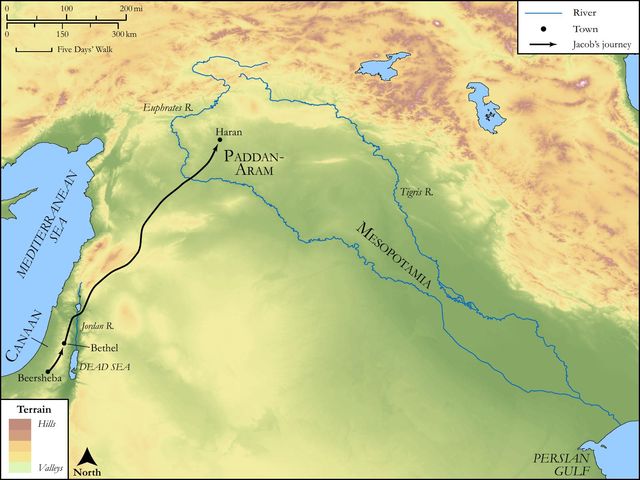
Jacob's journey is a response to multiple pressures. He is fleeing his brother Esau, who vowed to kill him after Jacob deceptively secured their father Isaac's blessing (Genesis 27:41-45). Simultaneously, he is fulfilling his parents' instruction to travel to Paddan-Aram (Haran) in Mesopotamia to find a wife from his mother Rebekah's family, avoiding marriage to a Canaanite woman (Genesis 28:1-2). The "land of the people of the east" is a general geographical designation for Mesopotamia, specifically the region where Haran was located. This journey represents a significant trek across hundreds of miles of rough country, a perilous undertaking that would have required considerable determination and reliance on divine protection, especially for a lone traveler.
Key Themes
ShowHideGenesis 29:1 contributes to several overarching themes within the book of Genesis and the broader Pentateuch. It highlights God's sovereign guidance over the patriarchs, even amidst their human flaws and difficult circumstances. Jacob's flight, though born of deception, is redirected by God into a journey that serves His redemptive purposes, echoing the theme of divine providence seen throughout Abraham's and Isaac's lives. The verse also underscores the theme of pilgrimage and exile, as Jacob leaves the promised land for a foreign territory, a pattern that will be repeated in the history of Israel. Furthermore, it sets the stage for the formation of the covenant family, as Jacob's time in the east will lead to his marriages to Leah and Rachel and the birth of the twelve sons who will become the foundational tribes of Israel, fulfilling the promise of numerous offspring first given to Abraham in Genesis 12:2.
Exposition and Analysis
ShowHideGenesis 29:1 succinctly captures Jacob's determined progress: "Then Jacob went on his journey, and came into the land of the people of the east." The opening "Then" (Hebrew: wayyisa') signifies a direct continuation from the previous chapter, emphasizing Jacob's immediate and purposeful action following his encounter with God at Bethel. This is not a hesitant step but a resolute movement forward, indicative of a new resolve born from divine assurance.
Key Word Analysis
ShowHideMeaning "heel-catcher" or "supplanter." This name, given at birth, has defined much of Jacob's character and early life, marked by cunning and striving. However, following his encounter with God at Bethel, this journey marks a transition where God's sovereign plan will begin to reshape Jacob's character, moving him from a supplanter to one who will wrestle with God and man and prevail, eventually receiving the new name Israel (Genesis 32:28).
A primitive root meaning "to lift," "bear," "carry," or "set up." In this context, it implies Jacob "took up" or "resumed" his journey, indicating a deliberate and sustained effort. It suggests a lifting of his spirit or resolve after the divine encounter, empowering him to continue a difficult and uncertain path, bearing the weight of his circumstances and God's promises.
Meaning "son" or, in a broader sense, "builder of the family name," encompassing offspring, nation, or people. The phrase "people of the east" (literally "sons of the east") refers to the descendants or inhabitants of the eastern lands. This term is significant as Jacob is going to this land to find a wife and build his own "sons" and family, which will become the foundation of the nation of Israel, fulfilling the covenant promise of numerous descendants.
Verse Breakdown
ShowHide"Then Jacob went on his journey,"
This clause emphasizes Jacob's immediate and decisive action following his profound encounter with God at Bethel. The Hebrew verb implies a "lifting up" or "taking up" of his journey, suggesting a renewed determination and purpose. It highlights that the divine assurance he received directly propelled him forward, transforming his desperate flight into a divinely directed pilgrimage. His physical movement is a direct consequence of his spiritual experience, demonstrating obedience and trust in God's guiding hand.
"and came into the land of the people of the east."
This second clause specifies Jacob's destination. "The land of the people of the east" is a general geographical descriptor for Mesopotamia, particularly the region around Haran, where his mother Rebekah's family resided. This indicates a significant distance traveled and a departure from the promised land of Canaan. The arrival signifies the end of one phase of his journey (flight and initial divine encounter) and the beginning of a new, extended period of his life in a foreign land, where he would establish his family and experience significant personal and spiritual development.
Literary Devices
ShowHideGenesis 29:1 employs several literary devices that enrich its meaning. The use of Synecdoche is evident in "the land of the people of the east," where "people" (literally "sons") represents the entire inhabitants or culture of that region, rather than just a specific group. This broad designation emphasizes the foreignness and distance of Jacob's destination. The entire verse functions as a moment of Transition, marking the end of Jacob's solitary flight and the beginning of his long sojourn in Haran, where he will marry and father the twelve tribes. Furthermore, the "journey" itself serves as a powerful Metaphor for the spiritual pilgrimage of faith, underscoring the theme of divine guidance and perseverance even when the path is uncertain or fraught with peril. The phrase "went on his journey" also subtly implies Divine Impetus, suggesting that Jacob's movement is not merely self-willed but supernaturally enabled and directed, flowing directly from the promises received at Bethel.
Theological and Thematic Connections
ShowHideGenesis 29:1 encapsulates several profound theological truths. It powerfully illustrates God's unwavering faithfulness to His covenant promises, even when His chosen instruments, like Jacob, are deeply flawed and engaged in flight due to their own deceptive actions. God does not abandon Jacob but actively guides his journey, transforming a desperate escape into a divinely purposed pilgrimage. This demonstrates the sovereignty of God in directing human affairs and fulfilling His redemptive plan, regardless of human imperfection. The verse also highlights the theme of divine providence, showing that God's hand is at work in every step of Jacob's life, leading him to the precise location where the next phase of the covenant's unfolding—the formation of the twelve tribes—will begin. Jacob's departure from the promised land and his sojourn in a foreign land also foreshadows the later exiles of Israel, establishing a pattern of temporary separation from the land for the purpose of purification and preparation, with the ultimate promise of return.
Reflection and Application
ShowHideJacob's journey in Genesis 29:1 offers powerful encouragement for believers navigating their own lives. It reminds us that even when we are facing difficult circumstances, fleeing from past mistakes, or entering unfamiliar seasons of life, God's promises and His guiding hand remain constant. Just as Jacob was assured of God's presence at Bethel and continued his journey in faith, we too are called to trust in God's providence, taking the next step even when the path ahead seems uncertain. This verse underscores that God's plan unfolds even through our human struggles and detours, calling us to persevere with faith in His ultimate purpose. It challenges us to look beyond our immediate circumstances and recognize the larger, divine narrative in which our lives are embedded, finding peace and direction in God's unwavering commitment to His covenant with us.
Questions for Reflection
ShowHideFAQ
ShowHideWhat is the significance of Jacob going "on his journey" immediately after Bethel?
ShowHideJacob's immediate departure signifies his obedience and renewed resolve following his profound encounter with God at Bethel. The dream and God's promises provided him with the necessary assurance and direction to continue his difficult journey, transforming his flight into a divinely purposed pilgrimage. It highlights the direct and transformative impact of spiritual encounters on practical action, demonstrating that true faith leads to purposeful movement in alignment with God's will, even when the path is uncertain or challenging.
Why is the destination called "the land of the people of the east" instead of Haran?
ShowHide"The land of the people of the east" is a broader geographical term, encompassing the region of Mesopotamia where Haran is located. Using this general term emphasizes that Jacob is venturing into a foreign, distant territory, highlighting the extent of his journey and the profound separation from the land of promise. It conveys a sense of the vastness and foreignness of his destination, rather than merely naming a specific city, underscoring the significant transition and the challenges he would face in this new environment. This broader designation also sets a wider stage for the unfolding of God's plan through Jacob's family, which would interact with various "peoples of the east" throughout their history.
Christ-Centered Fulfillment
ShowHideWhile Genesis 29:1 primarily details Jacob's physical journey, it implicitly points to Christ as the ultimate fulfillment of God's redemptive plan initiated through the patriarchs. Jacob's journey, though marked by human frailty and flight, is divinely orchestrated to preserve the lineage through which the Messiah would eventually come. Just as Jacob was a pilgrim seeking a place of rest and fulfillment of promises, Christ is the ultimate pilgrim who "had nowhere to lay his head" (Matthew 8:20), journeying from heaven to earth to establish God's eternal kingdom. Jacob's arrival in the "land of the east" to build his family foreshadows Christ's establishment of a spiritual family—the Church—gathered from all nations, fulfilling the covenant promises to Abraham that "in your seed all the nations of the earth shall be blessed" (Genesis 22:18). Jacob's journey of exile and eventual return to the promised land also serves as a type of Christ's redemptive work, where He, as the true Israel, journeys into the "far country" of human sin and death, only to return victoriously, bringing His people with Him into the ultimate promised land of eternal life, as foreshadowed in John 14:3.