


Genesis 22:21
Bible text: King James Version (1769 Blayney text) · Public domain
Bible text: Berean Standard Bible · Public domain
Bible text: American Standard Version (1901) · Public domain
Bible text: World English Bible, Messianic edition · Public domain
Bible text: Geneva Bible (1599) · Public domain
Bible text: Young's Literal Translation · Public domain
- אֶת'et<obj.>H853DirObjMParticle Object Indicator
- עוּץ'utzUzH5780N-proper-mNoun Proper Masculine
- בְּכֹרוֹbe·kho·Rohis firstbornH1060N-msc ¦ 3msNoun Singular Masculine Constructבְּכֹרfirstbornוֹhis
- וְאֶתve·'Etand <obj.>H853Conj-w ¦ DirObjMParticle Object Indicatorוְandאֶת<obj.>
- בּוּזbuzBuzH938N-proper-mNoun Proper Masculine
- אָחִיו'a·Chivhis brotherH251N-msc ¦ 3msNoun Singular Masculine Constructאָחִיbrotherוhis
- וְאֶתve·'Etand <obj.>H853Conj-w ¦ DirObjMParticle Object Indicatorוְandאֶת<obj.>
- קְמוּאֵלke·mu·'ElKemuelH7055N-proper-mNoun Proper Masculine
- אֲבִי'a·Vi[the] father ofH1N-mscNoun Singular Masculine Construct
- אֲרָם'a·RamAramH758N-properNoun Proper Location
English is a literal word-by-word gloss of the Hebrew, not the KJV's wording. Why?
This is the original text the KJV's translators worked from — each Hebrew word with its own literal English meaning in this verse, prepared by scholars at Tyndale House, Cambridge. The KJV translates whole sentences, not word by word, so its wording differs: one Hebrew word can become several English words, and the KJV may choose “the LORD” where the gloss reads “Yahweh”. Both are faithful — they answer different questions. For the KJV's own rendering, switch to the KJV text.
Details
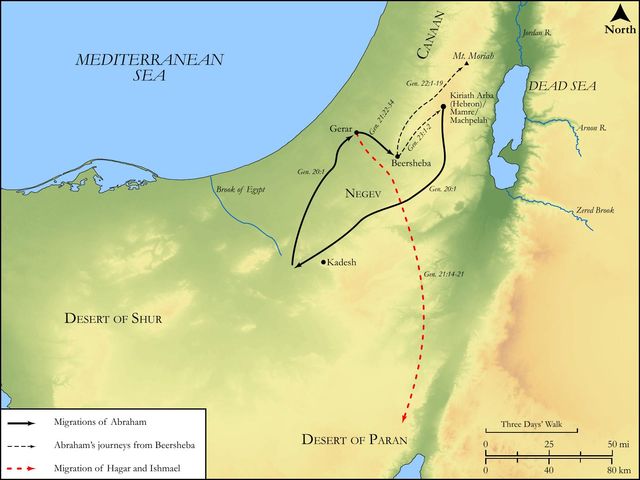
See on the biblical-era maps


Study this verse
Public-domain commentary
Matthew Henry
From his Commentary on the Whole Bible. Henry comments on passages, not single verses — this entry covers Genesis 22:20–24.
This is recorded here, 1. To show that though Abraham saw his own family highly dignified with peculiar privileges, admitted into covenant, and blessed with the entail of the promise, yet he did not look with contempt and disdain upon his relations, but was glad to hear of the increase and prosperity of their families. 2. To make way for the following story of the marriage of Isaac to Rebekah, a daughter of this family.
Continue studying Genesis 22:21 across the web’s major study libraries — every link below opens this exact verse, chapter, or book on the destination site.
Read & Compare
 BibleGatewayThis verse in more than 200 translations and 70 languages.
 Bible.comThe YouVersion reader — hundreds of translations, reading plans, and highlights.
 ESV.orgCrossway's official English Standard Version reader.
 NET BibleThe NET translation with 60,000+ translators' notes on every rendering decision.
 STEP BibleTyndale House's free study tool — original text, vocabulary, and scholarly resources.
 BibliaLogos Bible Software's free web reader.
 USCCBThe New American Bible (Revised Edition) with the U.S. bishops' study notes.
Commentaries
 BibleHub CommentariesDozens of classic commentaries on this verse, gathered on one page.
 StudyLightMore than 100 commentary sets — the largest collection on the web.
 BibleRefPlain-English commentary on what this verse means, verse by verse.
 Enduring WordDavid Guzik's free commentary on this chapter, widely used by Bible teachers.
 Bible Study ToolsVerse commentary alongside Greek and Hebrew study aids.
Original Language & Research
- BibleHub InterlinearThe verse word by word — original language, transliteration, and English.
- BibleHub LexiconEvery word's original-language definition and Strong's entry.
 Blue Letter BibleDeep-study tools — Strong's numbers, concordance, and word studies.
 SefariaThe Hebrew text with Rashi and centuries of Jewish commentary.
Sermons, Hymns & Audio


TrulyRandomVerse is not affiliated with these sites and doesn’t control their content. They’re linked because they’re genuinely useful.
Summary
Genesis 22:21 meticulously records three of Nahor's sons—Huz, Buz, and Kemuel, the father of Aram—providing a crucial genealogical link within Abraham's extended family. This seemingly brief detail is vital for establishing the lineage from which Rebekah, Isaac's future wife, will emerge, thereby advancing the covenant promises and illustrating God's precise and providential orchestration of redemptive history.
Context
ShowHideLiterary Context
This verse appears immediately following the profound and climactic narrative of Abraham's near-sacrifice of Isaac on Mount Moriah, an event that culminates in God's renewed and emphatic affirmation of His covenant promises to Abraham. The abrupt transition from such a dramatic theological peak to a seemingly dry genealogical list might initially appear jarring. However, its strategic placement is deliberate: it serves to re-establish a connection to Abraham's broader family, specifically his brother Nahor, thereby setting the stage for the crucial events of Isaac's marriage in Genesis 24, which is foundational for the continuation of the covenant lineage. This genealogical interlude provides necessary background for the subsequent narrative, ensuring the reader understands the familial ties that will soon become central to God's unfolding plan.
Historical & Cultural Context
Genealogies were of paramount importance in Israel, serving not merely as historical records but as legal documents establishing identity, inheritance rights, land claims, and tribal alliances. They provided a framework for understanding social structures and relationships between various peoples. The names listed in this verse—Huz, Buz, and Kemuel (father of Aram)—represent the progenitors of significant tribal groups and regions. The inclusion of these names highlights the intricate web of relationships among the early patriarchal families and their descendants, demonstrating how the covenant people of Israel were interconnected with other nations through common ancestry, even as they maintained their distinct identity and divine calling. The geographical implications, linking to areas like Uz (Job's homeland) and Aram (Syria), underscore the real-world historical and cultural landscape in which these events unfolded.
Key Themes
ShowHideGenesis 22:21 contributes significantly to several overarching themes within Genesis and the broader biblical narrative. Foremost among these is Divine Providence, showcasing God's meticulous and sovereign control over seemingly minute details, ensuring the fulfillment of His grand purposes. The verse underscores the theme of Covenant Continuity, as the lineage of Nahor is essential for providing Isaac with a wife from his own kin, a critical step for the perpetuation of the Abrahamic covenant promises regarding a numerous seed and a land. Furthermore, it touches upon the Interconnectedness of Peoples, illustrating how different nations and tribes trace their origins back to a common patriarchal heritage, even as God's specific redemptive focus remains on Abraham's chosen line through Isaac, as seen in passages like Genesis 12:1-3. This seemingly simple list of names thus serves as a foundational building block in the unfolding of God's redemptive history.
Exposition and Analysis
ShowHideKey Word Analysis
ShowHideApparently from a root meaning "consultation," this name refers to a son of Aram, also a Seirite, and the regions settled by them. In this context, it identifies Nahor's firstborn, connecting Abraham's extended family to the land of Uz, famously associated with the patriarch Job. This link suggests a broader geographical and tribal connection among the peoples of the east.
From the root "bakar," meaning "to be first-born," this term denotes the eldest son, implying a position of prominence and often inheriting a double portion and leadership. Identifying Huz as the "firstborn" of Nahor establishes his seniority and significance within Nahor's household, mirroring the importance of the firstborn in patriarchal society.
A primitive word denoting a literal or figurative progenitor; chief, or source. Here, it explicitly states Kemuel's relationship to Aram, identifying him as the direct ancestor of a significant people group. This highlights the genealogical function of the verse in tracing the origins of nations from patriarchal figures.
Meaning "the highland," this name refers to a geographical region (Syria) and its inhabitants (Arameans), as well as individuals. In this context, Aram is identified as the son of Kemuel, and subsequently, the progenitor of the Aramean people, who would become a prominent Semitic group with significant linguistic and cultural influence from Syria to Mesopotamia.
Verse Breakdown
ShowHide"Huz his firstborn,"
This clause introduces Huz as the eldest son of Nahor, Abraham's brother. The designation "firstborn" (Hebrew: bᵉkôwr) signifies his preeminent status within Nahor's family and indicates the order of birth, which was highly significant in patriarchal societies for matters of inheritance and lineage. This name is also associated with the land of Uz, a region of historical and biblical importance.
"and Buz his brother,"
Following Huz, Buz is introduced as another son of Nahor, explicitly identified as Huz's brother. This continues the enumeration of Nahor's direct male descendants. The name Buz is linked to a people or region, possibly in northern Arabia, and is notably associated with the Buzite family from which Elihu, one of Job's counselors, originated, further embedding this genealogy within the broader biblical narrative.
"and Kemuel the father of Aram,"
This final clause introduces Kemuel, another son of Nahor, and crucially identifies him as the progenitor of Aram. This is a highly significant detail, as Aram (Hebrew: ʼĂrâm) refers to the Arameans, a major Semitic people group who established a vast cultural and linguistic influence across Syria and the lands beyond the Euphrates. Their language, Aramaic, later became a lingua franca and was even spoken by Jesus. This designation underscores the tribal and national origins that sprung from these patriarchal figures, illustrating the complex and interconnected tribal structures of the era and highlighting the diverse family tree stemming from Terah.
Literary Devices
ShowHideThe primary literary device at play in Genesis 22:21 is Genealogy. This is a common feature in Genesis, serving to establish lineage, demonstrate historical continuity, and trace the origins of nations and key figures. The specific names listed, such as Huz (Uz), Buz (Buzites), and Aram (Arameans), exemplify Nomenclatural Significance, where names are not arbitrary but often carry geographical, tribal, or prophetic implications, connecting individuals to broader groups and territories. Furthermore, the strategic placement of this genealogy immediately after the Akeidah can be seen as a subtle form of Foreshadowing, as it implicitly sets the stage for the search for Isaac's bride in Genesis 24, who will come from this very family line. The seemingly dry list thus serves a vital narrative and theological function.
Theological and Thematic Connections
ShowHideGenealogies in Scripture, though often overlooked, are profound theological statements, demonstrating God's meticulous care and sovereignty in fulfilling His promises. Genesis 22:21 is no exception; it underscores God's active orchestration of history through specific families and their descendants. This seemingly minor detail ensures the continuation of the covenant line through Isaac by setting up the introduction of Rebekah, illustrating that God's plan unfolds not randomly, but through carefully chosen and preserved lineages. It reminds us that every person and every family, however distant from the main narrative, plays a role in God's overarching redemptive purpose.
Reflection and Application
ShowHideEven a seemingly dry list of names like Genesis 22:21 carries profound lessons for contemporary believers. It reminds us that every detail, no matter how insignificant it may appear to us, is part of God's grand tapestry of history and salvation. Just as these ancient names connect to future nations and pivotal events, our personal heritage, our seemingly small decisions, and our place in God's story are significant. This verse encourages patience and faith, demonstrating that the fulfillment of God's promises often unfolds over many generations, requiring trust in His long-term, sovereign plan. It calls us to recognize God's sovereignty not just in the dramatic moments, but in the quiet, foundational details of life and history. We are invited to see our own lives as part of a larger, divinely orchestrated narrative, trusting that God is meticulously working out His purposes, even when we cannot discern the immediate connection or significance of every event.
Questions for Reflection
ShowHideFAQ
ShowHideWhy are genealogies like this included in the Bible?
ShowHideGenealogies serve several critical purposes in the Bible. They establish historical continuity, demonstrating the fulfillment of God's promises through specific family lines, and confirm the lineage of key figures, most notably the Messiah. They show God's meticulous attention to detail in orchestrating human history to achieve His divine purposes, providing a framework for understanding relationships between individuals, families, and nations within God's unfolding plan. For example, the detailed genealogy in Genesis 5 traces the line from Adam to Noah, highlighting the preservation of humanity through the flood.
Does this verse imply that Nahor's family was as important as Abraham's?
ShowHideWhile Nahor's family is significant, particularly as the source of Rebekah, the narrative consistently centers on Abraham and his direct descendants through Isaac as the primary line of covenant promise. The inclusion of Nahor's lineage here is primarily functional, serving to introduce the family from which Isaac's wife will be chosen, thereby facilitating the continuation of the Abrahamic covenant. The emphasis is on how Nahor's family serves God's plan for Abraham's descendants, rather than on their independent importance in the covenant line. The direct covenant promises are repeatedly affirmed to Abraham and his seed through Isaac.
Christ-Centered Fulfillment
ShowHideWhile Genesis 22:21 appears to be a simple genealogical record, its ultimate significance lies in its contribution to the unfolding of God's redemptive plan, which culminates in Christ. By tracing the lineage that would eventually lead to Rebekah, the mother of Jacob (Israel), this verse indirectly points to the covenant line through which the Messiah would ultimately come. Every name, every family connection, however minor, is a thread in the grand tapestry of salvation history, meticulously woven by God to ensure the arrival of the promised Seed—Jesus Christ—who fulfills all the ancient promises and brings salvation to all nations. The Abrahamic covenant, reiterated and confirmed after Abraham's obedience in Genesis 22:15-18, explicitly states that "in your seed all the nations of the earth shall be blessed." This "seed" is ultimately Christ, as Paul clarifies in Galatians 3:16. Thus, this seemingly obscure genealogy in Genesis 22:21 is a foundational stone in the long, divinely orchestrated lineage that culminates in the birth of our Savior, through whom God's eternal covenant of grace is fully realized for all who believe, as seen in John 1:29.