


Genesis 22:19
Bible text: King James Version (1769 Blayney text) · Public domain
Bible text: Berean Standard Bible · Public domain
Bible text: American Standard Version (1901) · Public domain
Bible text: World English Bible, Messianic edition · Public domain
Bible text: Geneva Bible (1599) · Public domain
Bible text: Young's Literal Translation · Public domain
- וַיָּשָׁבvai·Ya·shovand he returnedH7725Conj-w ¦ V-Qal-ConsecImperf-3msVerb Qal Consecutive Imperfect 3rd Singular Masculineוַandיָּשָׁבhe returned
- אַבְרָהָם'av·ra·HamAbrahamH85N-proper-mNoun Proper Masculine
- אֶל'eltoH413PrepPreposition
- נְעָרָיוne·'a·Ravhis servantsH5288N-mpc ¦ 3msNoun Plural Masculine Constructנְעָרָיservantsוhis
- וַיָּקֻמוּvai·ya·Ku·muand they aroseH6965Conj-w ¦ V-Qal-ConsecImperf-3mpVerb Qal Consecutive Imperfect 3rd Plural Masculineוַandיָּקֻמוּthey arose
- וַיֵּלְכוּvai·ye·le·Khuand they wentH1980Conj-w ¦ V-Qal-ConsecImperf-3mpVerb Qal Consecutive Imperfect 3rd Plural Masculineוַandיֵּלְכוּthey went
- יַחְדָּוyach·DavtogetherH3162AdvAdverb
- אֶל'eltoH413PrepPreposition
- בְּאֵרbe·'ErBeerH884N-properNoun Proper Location
- שָׁבַעSha·va'ShebaH884N-properNoun Proper Location
- וַיֵּשֶׁבvai·Ye·shevand he dweltH3427Conj-w ¦ V-Qal-ConsecImperf-3msVerb Qal Consecutive Imperfect 3rd Singular Masculineוַandיֵּשֶׁבhe dwelt
- אַבְרָהָם'av·ra·HamAbrahamH85N-proper-mNoun Proper Masculine
- בִּבְאֵרbiv·'Erin BeerH884Prep-b ¦ N-properNoun Proper LocationבִּinבְאֵרBeer
- שָׁבַעSha·va'ShebaH884N-properNoun Proper Location
English is a literal word-by-word gloss of the Hebrew, not the KJV's wording. Why?
This is the original text the KJV's translators worked from — each Hebrew word with its own literal English meaning in this verse, prepared by scholars at Tyndale House, Cambridge. The KJV translates whole sentences, not word by word, so its wording differs: one Hebrew word can become several English words, and the KJV may choose “the LORD” where the gloss reads “Yahweh”. Both are faithful — they answer different questions. For the KJV's own rendering, switch to the KJV text.
Details
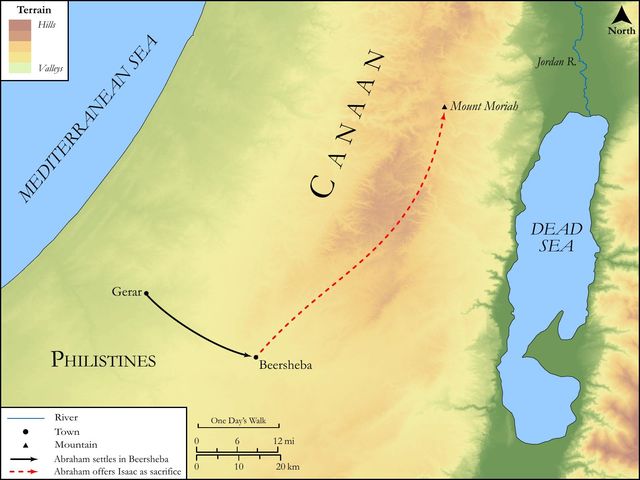
See on the biblical-era maps


Study this verse
Public-domain commentary
Matthew Henry
From his Commentary on the Whole Bible. Henry comments on passages, not single verses — this entry covers Genesis 22:15–19.
Abraham's obedience was graciously accepted; but this was not all: here we have it recompensed, abundantly recompensed, before he stirred from the place; probably while the ram he had sacrificed was yet burning God sent him this gracious message, renewed and ratified his covenant with him. All covenants were made by sacrifice, so was this by the typical sacrifices of Isaac and the ram. Very high expressions of God's favour to Abraham are employed in this confirmation of the covenant with him, expressions exceeding any he had yet been blessed with. Note, Extraordinary services shall be crowned with extraordinary honours and comforts; and favours in the promise, though not yet performed, ought to be accounted real and valuable recompences. Observe, 1. God is pleased to make mention of Abraham's obedience as the consideration of the covenant; and he speaks of it with an encomium: Because thou hast done this thing, and hast not withheld thy son, thine only son, Gen 22:16. He lays a strong emphasis on this, and (Gen 22:18) praises it as an act of obedience: in it thou hast obeyed my voice, and to obey is better than sacrifice. Not that this was a proportionable consideration, but God graciously put this honour upon that by which Abraham had honoured him. 2. God now confirmed the promise with an oath. It was said and sealed before; but now it is sworn: By myself have I sworn; for he could swear by no greater, Heb 6:13. Thus he interposed himself by an oath, as the apostle expresses it, Heb 6:17. He did (to speak with reverence) even pawn his own life and being upon it (As I live), that by all those immutable things, in which it was impossible for God to lie, he and his might have strong consolation. Note, If we exercise faith, God will encourage it. Improve the promises, and God will ratify them. 3. The particular promise here renewed is that of a numerous offspring: Multiplying, I will multiply thee, Gen 22:17. Note, Those that are willing to part with any thing for God shall have it made up to them with unspeakable advantage. Abraham has but one son, and is willing to part with that one, in obedience to God. "Well," said God, "thou shalt be recompensed with thousands and millions." What a figure does the seed of Abraham make in history! How numerous, how illustrious, were his known descendants, who, to this day, triumph in this, that they have Abraham to their father! Thus he received a thousand-fold in this life, Mat 19:29. 4. The promise, doubtless, points at the Messiah, and the grace of the gospel. This is the oath sworn to our father Abraham, which Zacharias refers to, Luk 1:73, etc. And so here is a promise, (1.) Of the great blessing of the Spirit: In blessing, I will bless thee, namely, with that best of blessings the Gift of the Holy Ghost; the promise of the Spirit was that blessing of Abraham which was to come upon the Gentiles through Jesus Christ, Gal 3:14. (2.) Of the increase of the church that believers, his spiritual seed, should be numerous as the stars of heaven. (3.) Of spiritual victories: Thy seed shall possess the gate of his enemies. Believers, by their faith, overcome the world, and triumph over all the powers of darkness, and are more than conquerors. Probably Zacharias refers to this part of the oath (Luk 1:74), That we, being delivered out of the hand of our enemies, might serve him without fear. But the crown of all is the last promise. (4.) Of the incarnation of Christ: In thy see, one particular person that shall descend from thee (for he speaks not of many, but of one, as the apostle observers, Gal 3:16), shall all the nations of the earth be blessed, or shall bless themselves, as the phrase is, Isa 65:16. In him all may be happy if they will, and all that belong to him shall be so, and shall think themselves so. Christ is the great blessing of the world. Abraham was ready to give up his son for a sacrifice to the honour of God, and, on that occasion, God promised to give his Son a sacrifice for the salvation of man.
Continue studying Genesis 22:19 across the web’s major study libraries — every link below opens this exact verse, chapter, or book on the destination site.
Read & Compare
 BibleGatewayThis verse in more than 200 translations and 70 languages.
 Bible.comThe YouVersion reader — hundreds of translations, reading plans, and highlights.
 ESV.orgCrossway's official English Standard Version reader.
 NET BibleThe NET translation with 60,000+ translators' notes on every rendering decision.
 STEP BibleTyndale House's free study tool — original text, vocabulary, and scholarly resources.
 BibliaLogos Bible Software's free web reader.
 USCCBThe New American Bible (Revised Edition) with the U.S. bishops' study notes.
Commentaries
 BibleHub CommentariesDozens of classic commentaries on this verse, gathered on one page.
 StudyLightMore than 100 commentary sets — the largest collection on the web.
 BibleRefPlain-English commentary on what this verse means, verse by verse.
 Enduring WordDavid Guzik's free commentary on this chapter, widely used by Bible teachers.
 Bible Study ToolsVerse commentary alongside Greek and Hebrew study aids.
Original Language & Research
- BibleHub InterlinearThe verse word by word — original language, transliteration, and English.
- BibleHub LexiconEvery word's original-language definition and Strong's entry.
 Blue Letter BibleDeep-study tools — Strong's numbers, concordance, and word studies.
 SefariaThe Hebrew text with Rashi and centuries of Jewish commentary.
Sermons, Hymns & Audio


TrulyRandomVerse is not affiliated with these sites and doesn’t control their content. They’re linked because they’re genuinely useful.
Summary
Genesis 22:19 concludes the profound narrative of Abraham's testing on Mount Moriah, depicting his return with Isaac to his young men and their subsequent journey to Beersheba. This verse marks the transition from a moment of intense divine encounter and ultimate obedience back to the routines of daily life, yet it signifies a deepened faith and the continued fulfillment of God's covenant promises to Abraham in a place of established dwelling and prior agreement, underscoring God's faithfulness and Abraham's enduring trust.
Context
ShowHideLiterary Context
This verse provides the immediate resolution to the climactic narrative of the Akedah, or the binding of Isaac, which began in Genesis 22:1. Following Abraham's ultimate act of obedience in his willingness to sacrifice Isaac and God's miraculous provision of a ram (Genesis 22:13), the divine covenant promises are powerfully reaffirmed to Abraham by an oath from the Lord Himself (Genesis 22:15-18). Genesis 22:19 thus serves as the narrative's denouement, depicting Abraham's descent from Mount Moriah, his reunion with the servants who had remained behind (Genesis 22:5), and their collective journey to Beersheba, signaling a return to a settled existence after an extraordinary and transformative spiritual encounter.
Historical & Cultural Context
Beersheba was a significant location in the Negeb region, holding both geographical and covenantal importance for the patriarchs. Its name, meaning "well of the oath" or "well of seven," directly references Abraham's earlier covenant with Abimelech concerning a well (Genesis 21:22-32). In a semi-nomadic society, access to water through wells was crucial for survival and settlement, making Beersheba a strategic and established dwelling place. The act of "dwelling" (Hebrew: yashab) implies a more permanent or prolonged stay, contrasting with mere transient encampments. This return to a known, covenant-rich location underscores the stability and security found within God's promises, even for a people on the move.
Key Themes
ShowHideGenesis 22:19 contributes to several overarching themes within the book of Genesis and the broader biblical narrative. It reinforces the theme of God's faithfulness and provision, demonstrating that God always keeps His promises, even when demanding the greatest sacrifice. The implicit return of Isaac with Abraham highlights God's preservation of the promised heir, crucial for the continuation of the covenant line. Furthermore, the verse subtly underscores the theme of faith's endurance beyond extraordinary moments, showing that Abraham's profound spiritual experience on Moriah was integrated into his daily life and continued walk with God. The significance of covenant and place is also evident, as Beersheba serves as a tangible reminder of God's prior agreements and Abraham's established presence in the promised land.
Exposition and Analysis
ShowHideKey Word Analysis
ShowHideThis primitive root (H7725) signifies "to turn back (hence, away) transitively or intransitively, literally or figuratively." In this context, it marks Abraham's physical turning back from Mount Moriah and resuming his journey. More profoundly, it signifies a return to the ordinary rhythms of life after an extraordinary divine encounter, bringing with him the profound lessons and reaffirmed promises from that experience.
This term (H5288) refers to a "boy (as active), from the age of infancy to adolescence; by implication, a servant." The use of "young men" here implicitly includes Isaac, as Abraham had told his servants in Genesis 22:5 that "I and the lad will go yonder and worship, and come again to you." The fact that Abraham "returned unto his young men" confirms Isaac's safe return, a testament to Abraham's faith that God would provide or even raise the dead (Hebrews 11:19).
This primitive root (H3427) properly means "to sit down; by implication, to dwell, to remain; causatively, to settle, to marry." Abraham's act of dwelling at Beersheba indicates a period of established residence, a settling down after a significant journey and spiritual ordeal. It implies stability and security, reinforcing Beersheba's role as a place of covenant and God's provision for Abraham's family.
Verse Breakdown
ShowHide"So Abraham returned unto his young men"
This clause signifies Abraham's descent from Mount Moriah and his reunion with the servants who had waited for him and Isaac. The implicit presence of Isaac, the "lad" mentioned in Genesis 22:5, underscores the miraculous preservation of the promised heir and the fulfillment of Abraham's faith that both he and Isaac would return.
"and they rose up and went together to Beersheba"
This describes the collective movement of Abraham, Isaac, and their servants. The phrase "rose up" (Hebrew: qum) indicates a preparation for departure, while "went together" (Hebrew: yachad) emphasizes their unity and shared journey. Their destination, Beersheba, is not random but a place of significant historical and covenantal importance for Abraham.
"and Abraham dwelt at Beersheba"
This final clause establishes Abraham's residence at Beersheba. The act of "dwelling" here conveys a sense of settlement and stability, marking a return to a more permanent base after the intense and transient experience on Mount Moriah. It highlights Beersheba as a place of continued covenant relationship and a secure home for Abraham and his household.
Literary Devices
ShowHideGenesis 22:19 employs several literary devices to convey its meaning and impact. The verse functions as a Resolution to the intense narrative of the Akedah, providing a sense of closure and a return to normalcy after the dramatic climax. The journey to and dwelling in Beersheba is rich with Symbolism; Beersheba itself, meaning "well of the oath," symbolizes God's covenant faithfulness and the security found in His promises. It represents a place of established relationship and divine provision, contrasting with the desolate mountain of sacrifice. There is also an implicit Contrast between the extraordinary, life-altering encounter on Mount Moriah and the subsequent return to the mundane, daily rhythms of life, highlighting that profound spiritual experiences are meant to be integrated into and sustain one's ordinary existence.
Theological and Thematic Connections
ShowHideThe safe return of Abraham and Isaac to Beersheba powerfully underscores God's unwavering faithfulness and His commitment to His covenant promises. The test on Mount Moriah was not designed to destroy Abraham or Isaac, but to refine Abraham's faith and confirm God's ability to provide and preserve life even in the most extreme circumstances. This verse highlights that profound spiritual experiences, like the Akedah, are often followed by a return to daily life, teaching us that true faith is not only demonstrated in dramatic moments of testing but also in the consistent, quiet walk of obedience and trust that follows. Beersheba, as a place of covenant and established dwelling, symbolizes the security and stability found in God's promises, reinforcing the theme that God provides a "dwelling place" for His people, both physically and spiritually, rooted in His unbreakable word.
Reflection and Application
ShowHideGenesis 22:19 offers a profound lesson on the nature of faith beyond dramatic encounters. After experiencing the ultimate test of his obedience and witnessing God's miraculous provision, Abraham returned to the routine of his life in Beersheba. This teaches us that genuine faith is not merely about the peak moments of spiritual intensity, but also about the steadfast, daily walk of trust and obedience that follows. We are called to integrate the lessons learned from our profound encounters with God into our everyday existence, finding our security and rest in His unwavering faithfulness, just as Abraham found his dwelling place in Beersheba, a place of covenant and provision. Our faith is truly tested and proven not just on the "mountains" of life, but in the valleys and the mundane routines that follow, where we continue to trust in God's character and promises.
Questions for Reflection
ShowHideFAQ
ShowHideWhat is the significance of Abraham returning to Beersheba specifically?
ShowHideBeersheba (meaning "well of the oath" or "well of seven") was a deeply significant place for Abraham. He had previously made a covenant there with Abimelech, king of Gerar, concerning a well, establishing a peaceful relationship and a place of dwelling (Genesis 21:31-32). His return signifies a re-establishment in a place of prior covenant and security, emphasizing God's faithfulness to His promises and Abraham's continued trust in His provision and guidance. It represents a return to a place where God's promises had been tangibly experienced and affirmed.
Does Genesis 22:19 imply that Isaac was not with Abraham when he returned to the young men?
ShowHideNo, the verse "So Abraham returned unto his young men" implicitly includes Isaac. Genesis 22:5 states that Abraham told his young men, "I and the lad will go yonder and worship, and come again to you." The return of "Abraham" to his young men confirms that Isaac, the "lad," was with him, fulfilling Abraham's prophetic declaration and signifying God's preservation of the promised heir, a testament to Abraham's faith that God could even raise the dead (Hebrews 11:19).
How does this verse relate to the concept of "normalcy" after a spiritual peak?
ShowHideGenesis 22:19 illustrates that even after profound and transformative spiritual experiences, life often returns to a routine. Abraham's return to Beersheba highlights that true faith is not just demonstrated in extraordinary moments of testing, but also in the consistent, daily walk of obedience and trust. It reminds believers that the lessons learned from intense spiritual encounters are meant to be integrated into everyday life, deepening one's reliance on God in the mundane and finding stability in His unchanging character and promises.
Christ-Centered Fulfillment
ShowHideGenesis 22:19, depicting Abraham's return with Isaac from the mountain of sacrifice to a place of dwelling, profoundly foreshadows the ultimate fulfillment found in Christ. Just as Isaac was "as good as dead" (Hebrews 11:19) yet returned, so too Christ, the true Son, was sacrificed and raised, returning from death to life, securing our eternal dwelling. Abraham's willingness to offer his only son, and God's provision of a substitute, points directly to God the Father's ultimate sacrifice of His only begotten Son, Jesus, who became the perfect "ram" provided by God, not merely as a substitute for Isaac, but for all humanity's sin, becoming the Lamb of God who takes away the sin of the world. Christ's resurrection is the ultimate "return" from the place of sacrifice, establishing a new covenant and securing for believers a permanent "dwelling place" in Him (John 14:2-3). The stability and security Abraham found in Beersheba, a place of covenant and promise, are fully realized in Christ, who is our true rest and the foundation of an unbreakable covenant of grace (Hebrews 8:6).