


Ezra 2:36
Bible text: King James Version (1769 Blayney text) · Public domain
Bible text: Berean Standard Bible · Public domain
Bible text: American Standard Version (1901) · Public domain
Bible text: World English Bible, Messianic edition · Public domain
Bible text: Geneva Bible (1599) · Public domain
Bible text: Young's Literal Translation · Public domain
- הַכֹּהֲנִיםha·ko·ha·Nimthe priestsH3548Art ¦ N-mpNoun Plural Masculine Absoluteהַtheכֹּהֲנִיםpriests
- בְּנֵיbe·Nei[the] descendants ofH1121N-mpcNoun Plural Masculine Construct
- יְדַעְיָהye·da'·YahJedaiahH3048N-proper-mNoun Proper Masculine
- לְבֵיתle·Veitof [the] house ofH1004Prep-l ¦ N-mscNoun Singular Masculine Constructלְofבֵית[the] house of
- יֵשׁוּעַye·Shu·a'JeshuaH3442N-proper-mNoun Proper Masculine
- תְּשַׁעte·Sha'nineH8672Adj-cscAdjective Numerical Singular common gender Construct
- מֵאוֹתme·'othundred<s>H3967Adj-fpAdjective Numerical Plural Feminine Absolute
- שִׁבְעִיםshiv·'ImseventyH7657Adj-mpAdjective Numerical Plural Masculine Absolute
- וּשְׁלֹשָׁהu·she·lo·Shahand threeH7969Conj-w ¦ Adj-csAdjective Numerical Singular common gender Absoluteוּandשְׁלֹשָׁהthree
English is a literal word-by-word gloss of the Hebrew, not the KJV's wording. Why?
This is the original text the KJV's translators worked from — each Hebrew word with its own literal English meaning in this verse, prepared by scholars at Tyndale House, Cambridge. The KJV translates whole sentences, not word by word, so its wording differs: one Hebrew word can become several English words, and the KJV may choose “the LORD” where the gloss reads “Yahweh”. Both are faithful — they answer different questions. For the KJV's own rendering, switch to the KJV text.
Details
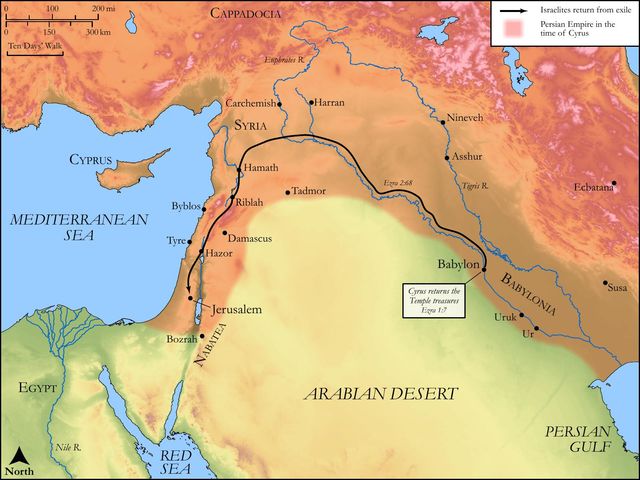
See on the biblical-era map
Study this verse
Public-domain commentary
Matthew Henry
From his Commentary on the Whole Bible. Henry comments on passages, not single verses — this entry covers Ezra 2:36–63. His three-level outline is real structure in the source text, so it is rendered as structure.
Here is an account, I. Of the priests that returned, and they were a considerable number, about a tenth part of the whole company: for the whole were above 42,000 (Ezr 2:64), and four families of priests made up above 4200 (Ezr 2:36-39); thus was the tenth God's part - a blessed decimation. Three of the fathers of the priests here named were heads of courses, Ch1 24:7, Ch1 24:8, Ch1 24:14. The fourth was Pashur, v. 38. If these were of the posterity of that Pashur that abused Jeremiah (Jer 20:1), it is strange that so bad a man should have so good a seed, and so numerous.
II.Of the Levites.
I cannot but wonder at the small number of them, for, taking in both the singers and the porters (Ezr 2:40-42), they did not make 350. Time was when the Levites were more forward to their duty than the priests (Ch2 29:34), but they were not so now. If one place, one family, has the reputation for pious zeal now, another may have it another time. The wind blows where it listeth, and shifts its points.
III.Of the Nethinim, who, it is supposed, were the Gibeonites, given (so their name signifies) by Joshua first (Jos 9:27), and again by David (Ezr 8:20), when Saul had expelled them, to be employed by the Levites in the work of God's house as hewers of wood and drawers of water; and, with them, of the children of Solomon's servants, whom he gave for the like use (whether they were Jews or Gentiles does not appear) and who were here taken notice of among the retainers of the temple and numbered with the Nethinim, Ezr 2:55, Ezr 2:58. Note, It is an honour to belong to God's house, though in the meanest office there.
IV.Of some that were looked upon as Israelites by birth, and others as priests, and yet could not make out a clear title to the honour.
1.There were some that could not prove themselves Israelites (Ezr 2:59, Ezr 2:60), a considerable number, who presumed they were of the seed of Jacob, but could not produce their pedigrees, and yet would go up to Jerusalem, having an affection to the house and people of God. These shamed those who were true-born Israelites, and yet were not called Israelites indeed, who came out of the waters of Judah (Isa 48:1), but had lost the relish of those waters.
2.There were others that could not prove themselves priests, and yet were supposed to be of the seed of Aaron. What is not preserved in black and white will, in all likelihood, be forgotten in a little time. Now we are here told,
(1.)How they lost their evidence. One of their ancestors married a daughter of Barzillai, that great man whom we read of in David's time; he gloried in an alliance to that honourable family, and, preferring that before the dignity of his priesthood, would have his children called after Barzillai's family, and their pedigree preserved in the registers of that house, not of the house of Aaron, and so they lost it. In Babylon there was nothing to be got by the priesthood, and therefore they cared not for being akin to it. Those who think their ministry, or their relation to ministers, a diminution or disparagement to them, forget who it was that said, I magnify my office.
(2.)What they lost with it. It could not be taken for granted that they were priests when they could not produce their proofs, but they were, as polluted, put from the priesthood. Now that the priests had recovered their rights, and had the altar to live upon again, they would gladly be looked upon as priests. But they had sold their birthright for the honour of being gentlemen, and therefore were justly degraded, and forbidden to eat of the most holy things. Note, Christ will be ashamed of those that are ashamed of him and his service. It was the tirshatha, or governor, that put them under this sequestration, which some understand of Zerubbabel the present governor, others of Nehemiah (who is so called, Neh 8:9, Neh 10:1, and who gave this order when he came some years after); but the prohibition was not absolute, it was only a suspension, till there should be a high priest with Urim and Thummin, by whom they might know God's mind in this matter. This, it seems, was expected and desired, but it does not appear that ever they were blessed with it under the second temple. They had the canon of the Old Testament complete, which was better than Urim; and, by the want of that oracle, they were taught to expect the Messiah the great Oracle, which the Urim and Thummim was but a type of. Nor does it appear that the second temple had the ark in it, either the old one or a new one. Those shadows by degrees vanished, as the substance approached; and God, by the prophet, intimates to his people that they should sustain no damage by the want of the ark, Jer 3:16, Jer 3:17. In those days, when they shall call Jerusalem the throne of the Lord, and all the nations shall be gathered to it, they shall say no more, The ark of the covenant of the Lord, neither shall it come to mind, for they shall do very well without it.
Continue studying Ezra 2:36 across the web’s major study libraries — every link below opens this exact verse, chapter, or book on the destination site.
Read & Compare
 BibleGatewayThis verse in more than 200 translations and 70 languages.
 Bible.comThe YouVersion reader — hundreds of translations, reading plans, and highlights.
 ESV.orgCrossway's official English Standard Version reader.
 NET BibleThe NET translation with 60,000+ translators' notes on every rendering decision.
 STEP BibleTyndale House's free study tool — original text, vocabulary, and scholarly resources.
 BibliaLogos Bible Software's free web reader.
 USCCBThe New American Bible (Revised Edition) with the U.S. bishops' study notes.
Commentaries
 BibleHub CommentariesDozens of classic commentaries on this verse, gathered on one page.
 StudyLightMore than 100 commentary sets — the largest collection on the web.
 BibleRefPlain-English commentary on what this verse means, verse by verse.
 Enduring WordDavid Guzik's free commentary on this chapter, widely used by Bible teachers.
 Bible Study ToolsVerse commentary alongside Greek and Hebrew study aids.
Original Language & Research
- BibleHub InterlinearThe verse word by word — original language, transliteration, and English.
- BibleHub LexiconEvery word's original-language definition and Strong's entry.
 Blue Letter BibleDeep-study tools — Strong's numbers, concordance, and word studies.
 SefariaThe Hebrew text with Rashi and centuries of Jewish commentary.
Sermons, Hymns & Audio


TrulyRandomVerse is not affiliated with these sites and doesn’t control their content. They’re linked because they’re genuinely useful.
Summary
Ezra 2:36 meticulously records the number of men from the priestly family of Jedaiah, specifically those associated with the house of Jeshua, who returned from Babylonian captivity to Jerusalem. This precise entry is part of a comprehensive census detailing the first wave of Jewish exiles returning under the leadership of Zerubbabel and Jeshua the High Priest, underscoring the vital importance of legitimate priestly lineage for the re-establishment of sacred Temple service and the divine orchestration of the post-exilic restoration.
Context
ShowHideLiterary Context
Ezra 2 functions as a foundational register within the book of Ezra, immediately following Cyrus's decree permitting the return of the exiles in Ezra 1. This chapter provides a meticulous and authoritative list of the individuals and families who comprised the initial wave of returnees, establishing their identity and legitimacy within the restored community. The list is structured to categorize different groups—laypeople, priests, Levites, Temple servants, and others—culminating in a grand total. Verse 36 is situated within the specific enumeration of priestly families (Ezra 2:36-39), emphasizing their indispensable role in the anticipated rebuilding of the Temple and the resumption of its worship. The practical significance of this census is immediately evident in the subsequent chapters, particularly Ezra 3, where these very individuals, including Jeshua the High Priest, actively engage in rebuilding the altar and laying the Temple's foundations, demonstrating the direct link between this detailed record and the practical work of restoration.
Historical & Cultural Context
The return from Babylonian exile, initiated by Cyrus's decree in 538 BCE, marked a pivotal moment in Israel's history, signifying the end of a seventy-year period of divine judgment and the dawn of a new era. For post-exilic Israel, meticulous genealogical records were not mere bureaucratic formalities but held profound cultural and religious significance. They served to validate claims to land, tribal inheritance, and, most crucially for the priestly class, eligibility for sacred service in the Temple. Only those who could definitively prove their Aaronic descent were permitted to serve as priests, a lineage that had to be rigorously preserved and verified, especially after generations of displacement and intermingling in exile. The "house of Jeshua" refers to Jeshua the High Priest, a prominent and legitimate leader alongside Zerubbabel, whose family line was absolutely essential for the proper and legitimate functioning of the restored cultic system.
Key Themes
ShowHideThe detailed enumeration in Ezra 2, particularly the precise accounting of priestly families, powerfully underscores the theme of Restoration and Divine Order. After the profound chaos and displacement of the exile, God is faithfully re-establishing His people, their land, and their sacred institutions according to His divine plan. This meticulous record-keeping reflects God's providential hand in preserving a faithful remnant and ensuring the proper and orderly functioning of the community. Another key theme is the Importance of Priestly Lineage and Purity. For the post-exilic community, the legitimacy of the priesthood was paramount for maintaining covenant fidelity and ensuring proper, acceptable worship. The specific mention of "the children of Jedaiah, of the house of Jeshua" highlights the meticulous concern for authentic lineage, ensuring that sacred duties could be resumed according to Mosaic Law, as vividly demonstrated by the immediate re-establishment of sacrifices in Ezra 3:2-3. The very existence of this detailed list, and the significant numbers it reports, also testifies to Divine Faithfulness, demonstrating God's unwavering commitment to fulfilling His promises to restore His people to their land and their worship, as prophesied by Jeremiah (e.g., Jeremiah 29:10).
Exposition and Analysis
ShowHideKey Word Analysis
ShowHideThis term refers to individuals divinely appointed from the lineage of Aaron, set apart to mediate between God and Israel. Their duties included offering sacrifices, maintaining the Temple, and teaching the Law. The inclusion and precise numbering of priests in this census were paramount, as the restoration of proper worship and the Temple cult was central to the post-exilic community's identity and their covenant relationship with God. The return of a significant number of priests, despite the challenges and dispersion of exile, signifies the re-establishment of divine order and the continuity of sacred service.
This word, meaning "son" or "child," is used broadly to denote descendants, members of a family, or even a particular class or group. In this context, "the children of Jedaiah" refers to the male descendants or members of the priestly clan named Jedaiah, indicating their familial connection and shared lineage. This highlights the importance of hereditary succession in the priesthood and the preservation of distinct family units even through generations of exile.
While literally meaning a physical dwelling, "house" in this context signifies a family, lineage, or dynasty. "Of the house of Jeshua" indicates a familial or ancestral connection to Jeshua the High Priest, signifying their legitimacy and authority in the restored community. This phrase may imply a direct descendant or a close familial/organizational affiliation under his overarching authority, underscoring the high priest's central role in validating priestly service.
Verse Breakdown
ShowHide"The priests:"
This opening phrase immediately identifies the specific category of individuals being enumerated, highlighting their distinct and indispensable role within the returning community. It sets apart those divinely appointed for sacred service from the general populace of returnees.
"the children of Jedaiah,"
This specifies a particular priestly family or clan. Jedaiah was one of the twenty-four priestly divisions established by King David (1 Chronicles 24:7), indicating a long-standing and recognized lineage. Their return signifies the re-establishment of specific, historical priestly lines essential for the continuity of Temple service.
"of the house of Jeshua,"
This clause further clarifies the lineage, linking the Jedaiah clan to the broader "house" or lineage associated with Jeshua the High Priest. This connection underscores the high priest's central role in the post-exilic community and validates the legitimacy of these priests through their association with the spiritual leader of the return. It implies a direct descendant or a close familial/organizational affiliation under his authority.
"nine hundred seventy and three."
This precise numerical count highlights the meticulous and authoritative nature of the census. It provides a concrete figure for the number of male priests from this specific family who returned, demonstrating the significant human resources available for the re-establishment of Temple worship and reinforcing the theme of divine faithfulness in preserving a substantial remnant.
Literary Devices
ShowHideThe primary literary device employed in Ezra 2:36, and indeed throughout the entire chapter, is Enumeration (or Census/Genealogy). This meticulous listing of names and numbers serves a critical function, providing an authoritative and verifiable record of the returning exiles. The precise numerical detail, specifying the exact count down to individual families, underscores the author's intent for Verisimilitude and historical accuracy, lending credibility to the narrative of restoration. The repetitive structure of listing family names followed by their corresponding numbers creates a powerful sense of Order and Restoration, reflecting the re-establishment of a structured society and religious system after the profound disruption of exile. While seemingly dry, this detailed accounting also functions as a form of Symbolism, where the very act of counting and naming signifies God's remembrance of His people and His providential care in preserving a remnant, ensuring the continuity of His covenant community and its sacred institutions.
Theological and Thematic Connections
ShowHideEzra 2:36, though a seemingly simple numerical entry, carries profound theological weight, underscoring God's meticulous care for His covenant people and His unwavering commitment to restoring their spiritual order. The emphasis on priestly lineage highlights the enduring importance of purity, legitimacy, and divine appointment in worship, themes central to Israel's identity and its unique relationship with Yahweh. The return of these specific priestly families, miraculously preserved through generations of exile, testifies powerfully to God's faithfulness in upholding His promises and providentially preparing the way for the re-establishment of Temple service, which was the very heart of Israel's covenant life. It demonstrates that even in the midst of divine judgment and dispersion, God maintains a faithful remnant to carry forward His redemptive purposes and ensure the continuity of His sacred institutions.
Reflection and Application
ShowHideEzra 2:36, a seemingly dry genealogical record, invites us to reflect on the profound significance of order, lineage, and divine faithfulness in our own spiritual lives and communities. Just as the returning exiles meticulously documented their heritage to ensure proper worship and the continuity of sacred service, believers today are called to value the structure, integrity, and faithful leadership within the church. This verse reminds us that God is deeply invested in the details of His people's lives, even in what might appear to be mundane record-keeping. His commitment to restoring His plan and purpose, even after periods of discipline or disruption, is unwavering. We are encouraged to embrace our spiritual heritage, understanding that our place in God's family is not random but part of His intentional design, equipping us for service in His ongoing redemptive work. It challenges us to consider how we contribute to the order and purity of the church, ensuring that our service is legitimate, honoring to God, and aligned with His divine purposes.
Questions for Reflection
ShowHideFAQ
ShowHideWhy was it so important to list the priests by family and number?
ShowHideListing the priests by family and number was critically important for several reasons. First, it established their legitimacy for Temple service. According to Mosaic Law, only direct descendants of Aaron from the tribe of Levi could serve as priests (e.g., Numbers 3:10). After generations in exile, meticulous genealogical records were necessary to prove this lineage and prevent unauthorized individuals from performing sacred duties, as seen in Nehemiah 7:64, where some were barred due to unverified lineage. Second, it ensured order and organization for the re-establishment of the Temple cult. Knowing the precise number of available priests helped in planning for the resumption of sacrifices, festivals, and daily ministrations. Third, it underscored the divine faithfulness in preserving a remnant. The very existence of these families and their return demonstrated God's unwavering commitment to His covenant promises and the restoration of His people and their proper worship.
Who was Jeshua, and why is his "house" mentioned specifically?
ShowHideJeshua (often identified as Joshua son of Jozadak) was the High Priest who returned with Zerubbabel and played a pivotal role in the post-exilic community. He was a direct descendant of the high priestly line, making him the legitimate spiritual leader of the returning exiles. His "house" refers to his direct family line or the broader priestly lineage associated with him. The mention of "the house of Jeshua" in Ezra 2:36 legitimizes the Jedaiah family's priestly status by associating them with the recognized high priestly authority. Jeshua was instrumental in the rebuilding of the altar and the Temple foundation (Ezra 3:2), and he is also prominent in the book of Zechariah, where he is a symbolic figure of the Branch, foreshadowing the Messiah (Zechariah 3:1-10).
Christ-Centered Fulfillment
ShowHideEzra 2:36, with its meticulous focus on the purity and legitimacy of the Aaronic priesthood, finds its ultimate and perfect fulfillment in Jesus Christ. While the Old Testament priests served in a temporal temple, offering animal sacrifices that merely foreshadowed a greater reality, Jesus is revealed as the eternal and perfect High Priest, "after the order of Melchizedek" (Hebrews 7:17), not dependent on human lineage or perishable life but on "the power of an indestructible life" (Hebrews 7:16). The name "Jeshua" (meaning "Jehovah saves"), a prominent figure in Ezra, itself points directly to Jesus, whose very name means "Yahweh is salvation" (Matthew 1:21). He is the true "Salvation" who entered human history. Unlike the Levitical priests who offered sacrifices repeatedly, Jesus offered "one sacrifice for sins forever" (Hebrews 10:12), perfectly fulfilling and superseding the entire sacrificial system. Furthermore, through His atoning work, believers are no longer dependent on an earthly priestly lineage but are themselves constituted as a "royal priesthood, a holy nation" (1 Peter 2:9), called to offer spiritual sacrifices of praise and service. Thus, the meticulous record of Ezra 2:36, ensuring the purity of the Old Covenant priesthood, ultimately directs our gaze to the flawless and eternally legitimate priesthood of Christ, who brings all believers into direct access to God.