


Ezra 2:64
- כָּלkolallH3605N-mscNoun Singular Masculine Construct
- הַקָּהָלha·ka·Halthe assemblyH6951Art ¦ N-msNoun Singular Masculine Absoluteהַtheקָּהָלassembly
- כְּאֶחָדke·'e·Chadas oneH259Prep-k ¦ Adj-fsAdjective Numerical Singular Feminine Absoluteכְּasאֶחָדone
- אַרְבַּע'ar·Ba'fourH702Adj-cscAdjective Numerical Singular common gender Construct
- רִבּוֹאri·Bo'ten thousandH7239Adj-csAdjective Numerical Singular common gender Absolute
- אַלְפַּיִם'al·Pa·yimtwo thousandH505Adj-cdAdjective Numerical Dual common gender Absolute
- שְׁלֹשׁshe·loshthreeH7969Adj-cscAdjective Numerical Singular common gender Construct
- מֵאוֹתme·'othundred<s>H3967Adj-fpAdjective Numerical Plural Feminine Absolute
- שִׁשִּׁיםshi·ShimsixtyH8346Adj-mpAdjective Numerical Plural Masculine Absolute
English is a literal word-by-word gloss of the Hebrew, not the KJV's wording. Why?
This is the original text the KJV's translators worked from — each Hebrew word with its own literal English meaning in this verse, prepared by scholars at Tyndale House, Cambridge. The KJV translates whole sentences, not word by word, so its wording differs: one Hebrew word can become several English words, and the KJV may choose “the LORD” where the gloss reads “Yahweh”. Both are faithful — they answer different questions. For the KJV's own rendering, switch to the KJV text.
Details
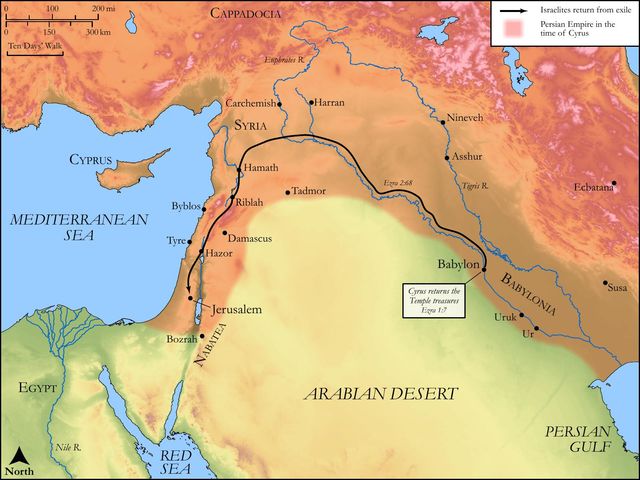
See on the biblical-era map
Study this verse
Public-domain commentary
Matthew Henry
From his Commentary on the Whole Bible. Henry comments on passages, not single verses — this entry covers Ezra 2:64–70. His two-level outline is real structure in the source text, so it is rendered as structure.
Here is, I. The sum total of the company that returned out of Babylon. The particular sums before mentioned amount not quite to 30,000 (29,818), so that there were above 12,000 that come out into any of those accounts, who, it is probable, were of the rest of the tribes of Israel, besides Judah and Benjamin, that could not tell of what particular family or city they were, but that they were Israelites, and of what tribe. Now, 1. This was more than double the number that were carried captive into Babylon by Nebuchadnezzar, so that, as in Egypt, the time of their affliction was the time of their increase. 2. These were but few to begin a nation with, and yet, by virtue of the old promise made to their fathers, they multiplied so as before their last destruction by the Romans, about 500 years after, to be a very numerous people. When God says, "Increase and multiply," a little one shall become a thousand.
II.Their retinue.
They were themselves little better than servants, and therefore no wonder that their servants were comparatively but few (Ezr 2:65) and their beasts of burden about as many, Ezr 2:66, Ezr 2:67. It was not with them now as in days past. But notice is taken of 200 singing-men and women whom they had among them, who, we will suppose, were intended (as those Ch2 35:25) to excite their mourning, for it was foretold that they should, upon this occasion, go weeping (Jer 50:4), with ditties of lamentation.
III.Their oblations. It is said (Ezr 2:68, Ezr 2:69),
1.That they came to the house of the Lord at Jerusalem; and yet that house, that holy and beautiful house, was now in ruins, a heap of rubbish. But, like their father Abraham, when the altar was gone they came with devotion to the place of the altar (Gen 13:4); and it is the character of the genuine sons of Zion that they favour even the dust thereof, Psa 102:14.
2.That they offered freely towards the setting of it up in its place. That, it seems, was the first house they talked of setting up; and though they came off a journey, and were beginning the world (two chargeable things), yet they offered, and offered freely, towards the building of the temple. Let none complain of the necessary expenses of their religion, but believe that when they come to balance the account they will find that it clears the cost. Their offering was nothing in comparison with the offerings of the princes in David's time; then they offered by talents (Ch1 29:7), now by drams, yet these drams, being after their ability, were as acceptable to God as those talents, like the widow's two mites. The 61,000 drams of gold amount, by Cumberland's calculation, to so many pounds of our money and so many groats. Every maneh, or pound of silver, he reckons to be sixty shekels (that is, thirty ounces), which we may reckon 7l. 10s. of our money, so that this 5000 pounds of silver will be above 37,000l. of our money. It seems, God had blessed them with an increase of their wealth, as well as of their numbers, in Babylon; and, as God had prospered them, they gave cheerfully to the service of his house.
3.That they dwelt in their cities, Ezr 2:70. Though their cities were out of repair, yet, because they were their cities, such as God had assigned them, they were content to dwell in them, and were thankful for liberty and property, though they had little of pomp, plenty, or power. Their poverty was a bad cause, but their unity and unanimity were a good effect of it. Here was room enough for them all and all their substance, so that there was no strife among them, but perfect harmony, a blessed presage of their settlement, as their discords in the latter times of that state were of their ruin.
Historical interpretation
Twelve Centuries of Reception
3 surviving comments on this verse. Each one is dated, so this reads as a timeline rather than a list.
Select a marker to jump to its quote. Markers stagger vertically where authors wrote within a few decades of each other.
“A canticle of David, when the house was built after the captivity.” So far as the literal sense is concerned, the heading points to the time when the temple at Jerusalem is known to have been refurbished by Zerubbabel, son of Salathiel, after it had been leveled to the ground by a hostile band of Chaldeans. But since he says nothing of this kind in what follows, and since the headings of psalms are never at variance with their content, it remains for us to investigate it in the spiritual sense. A destroyed house is built up when a soul following the captivity of sin begins to return to an understanding of the truth through the generosity of the Lord. This house, which is the universal church in which Christ dwells, is always raised up on living stones, because every day it gains increase in building from its confessors and does not cease to be built up until the number of the predestined is attained at the end of the world. We must store this psalm in our minds as the second of those proclaiming the first and the second coming of the Lord.
The whole multitude as if one, etc. Note the grace of the early Church, in which the heart and soul of the multitude of believers was one (Acts IV), being found even in this group of exiles: so that even though there was such a large army, which almost completed the total of fifty thousand, and this army of different rank and condition, nonetheless the whole multitude, on account of the same faith and love, seemed as if it were one man, by the gift of Him who makes those of one mind live in a house. But the servants and handmaids returning from Babylon to Jerusalem hold the type of those in the Church who indeed strive, through the improvement of a better life, to overcome vices and ascend to the pinnacle of virtues; yet they are not sufficient by themselves to provide the way of a regular life, but rather need to be still restrained by the industry of those who have preceded them in Christ, and to be directed to the path of the desired truth. It continues:
Forty-two thousand: Those who are reckoned up above of the tribes of Juda, Benjamin, and Levi, fall short of this number. The rest, who must be taken in to make up the whole sum, were of the other tribes.
Continue studying Ezra 2:64 across the web’s major study libraries — every link below opens this exact verse, chapter, or book on the destination site.
Read & Compare
 BibleGatewayThis verse in more than 200 translations and 70 languages.
 Bible.comThe YouVersion reader — hundreds of translations, reading plans, and highlights.
 ESV.orgCrossway's official English Standard Version reader.
 NET BibleThe NET translation with 60,000+ translators' notes on every rendering decision.
 STEP BibleTyndale House's free study tool — original text, vocabulary, and scholarly resources.
 BibliaLogos Bible Software's free web reader.
 USCCBThe New American Bible (Revised Edition) with the U.S. bishops' study notes.
Commentaries
 BibleHub CommentariesDozens of classic commentaries on this verse, gathered on one page.
 StudyLightMore than 100 commentary sets — the largest collection on the web.
 BibleRefPlain-English commentary on what this verse means, verse by verse.
 Enduring WordDavid Guzik's free commentary on this chapter, widely used by Bible teachers.
 Bible Study ToolsVerse commentary alongside Greek and Hebrew study aids.
Original Language & Research
- BibleHub InterlinearThe verse word by word — original language, transliteration, and English.
- BibleHub LexiconEvery word's original-language definition and Strong's entry.
 Blue Letter BibleDeep-study tools — Strong's numbers, concordance, and word studies.
 SefariaThe Hebrew text with Rashi and centuries of Jewish commentary.
Sermons, Hymns & Audio


TrulyRandomVerse is not affiliated with these sites and doesn’t control their content. They’re linked because they’re genuinely useful.
Summary
Ezra 2:64 serves as the climactic numerical summary of the first wave of Jewish exiles returning to Judah from Babylonian captivity, declaring the grand total of "the whole congregation together" as forty-two thousand three hundred and threescore (42,360). This verse not only provides a meticulous accounting of the returning remnant but also powerfully underscores the scale of God's faithfulness in fulfilling His prophetic promises of restoration, highlighting the collective identity and unified purpose of His people as they embarked on the monumental task of rebuilding Jerusalem and the Temple.
Context
ShowHideLiterary Context
Ezra 2:64 concludes a meticulously detailed register that begins in Ezra 2:1, enumerating the various families, clans, and individuals who returned from Babylonian exile under the leadership of Zerubbabel and Jeshua. The preceding verses (Ezra 2:1-63) systematically list the descendants of specific families, cities, and regions, alongside priests, Levites, temple servants, and the children of Solomon's servants. This precise accounting establishes the legitimacy and identity of the returning community, crucial for their resettlement and the re-establishment of their national and religious life. Verse 64 then provides the aggregate sum of these individual groups, serving as a climactic numerical summary that emphasizes the collective body of God's people. This census not only records who returned but also sets the stage for the subsequent chapters, detailing the rebuilding of the altar and temple foundation, as seen in Ezra 3:1, demonstrating the practical necessity of such a list for organization and resettlement.
Historical & Cultural Context
The return described in Ezra takes place after the seventy-year Babylonian captivity, a period of divine judgment for Israel's unfaithfulness. This return was initiated by the decree of King Cyrus of Persia, as recorded in Ezra 1:1-4, allowing the exiled Jews to return to their homeland and rebuild their Temple. The meticulous census in Ezra 2, culminating in verse 64, was culturally significant in the ancient Near East, where such records were vital for establishing lineage, land claims, taxation, and military organization. For the returning exiles, it reaffirmed their identity as the people of God, preserving their tribal and family lineages, which were crucial for maintaining their distinct religious and social structure. The large number, 42,360, though seemingly a dry statistic, represented a tangible fulfillment of prophecies like Jeremiah 29:10, which foretold a future restoration after seventy years.
Key Themes
ShowHideThe meticulous enumeration in Ezra 2:64 contributes to several key themes within the book of Ezra and the broader biblical narrative. Firstly, it powerfully illustrates the fulfillment of prophecy and God's unwavering faithfulness to His covenant promises, demonstrating His sovereignty over nations and His commitment to restoring His people to the land. Secondly, it highlights divine providence and restoration, showing that this return was not a random migration but a divinely orchestrated act, with God moving the heart of Cyrus and gathering His scattered people. Thirdly, the phrase "the whole congregation together" emphasizes community, unity, and collective identity. Despite coming from diverse families and backgrounds, they were united as "the people of God," bound by a common purpose: to re-establish worship and rebuild Jerusalem. Finally, the meticulous record-keeping reflects the importance of order, accountability, and divine oversight in God's plan, providing a clear historical record for future generations and practical details for the daunting task of rebuilding, as seen in their subsequent actions in Ezra 3.
Exposition and Analysis
ShowHideKey Word Analysis
ShowHideThis term (H6951) refers to an assembly or gathering, typically for a communal or religious purpose. In Ezra 2:64, it emphasizes that the returning exiles are not merely a collection of individuals but a divinely gathered community, unified in their identity and purpose. The use of "whole congregation together" reinforces the idea of a cohesive body, acting in concert under God's leading for the restoration of worship and the rebuilding of Jerusalem.
This word (H259), meaning "one" or "united," further underscores the unity of the returning exiles. It highlights their solidarity and collective identity as they embark on the monumental task of rebuilding. Despite their diverse family lineages detailed in the preceding verses, they are presented as a single, cohesive unit, bound by a shared faith and a common mission.
This term (H8346) is a multiple of "six," specifically meaning "sixty." In the King James Version, "forty and two thousand three hundred and threescore" translates to 42,360. The inclusion of this precise numerical detail signifies the meticulousness of the census and, by extension, the divine oversight of the entire return. It emphasizes that this was a divinely ordered and accounted-for event, not a chaotic scattering or a random migration, but a purposeful gathering of God's people.
Verse Breakdown
ShowHide"The whole congregation together"
This opening phrase powerfully establishes the collective identity and unity of the returning exiles. Despite the numerous family groups listed individually in the preceding verses, they are here presented as a single, unified body—a "congregation" or assembly. This emphasis on solidarity was crucial for their daunting mission of rebuilding and re-establishing their national and religious life in Judah. It highlights that their return was a communal effort, driven by a shared purpose and a common faith in God's restorative plan.
"[was] forty and two thousand three hundred [and] threescore"
This numerical statement provides the precise total of the returning exiles, 42,360. This figure is significant not just for its quantity but for its precision, which suggests divine orchestration and historical accuracy. It represents a substantial number of people returning to a desolate land, a tangible fulfillment of God's promise to restore His people. While there are slight discrepancies between the sum of the individual numbers in Ezra 2:1-63 and this total, and also between this total and the parallel account in Nehemiah 7:66, the overarching message remains consistent: a significant number of God's people returned to the land, demonstrating His faithfulness.
Literary Devices
ShowHideThe primary literary device at play in Ezra 2:64, and indeed the entire chapter, is Enumeration or Census. This meticulous listing and summation of numbers serves multiple purposes beyond mere factual reporting. It provides a detailed historical record, establishing the legitimacy and lineage of the returning community. The very act of counting and totaling emphasizes the Significance of the event; it was not a trivial migration but a divinely orchestrated return of a specific, identifiable group of people. The precision of the numbers, even with minor discrepancies, lends an air of Verisimilitude and historical authenticity to the narrative, reinforcing the idea that God is intimately involved in the details of human history. Furthermore, the culmination in a grand total like 42,360 creates a sense of Climax for the census, marking the completion of this vital record and preparing the reader for the subsequent actions of the community.
Theological and Thematic Connections
ShowHideEzra 2:64 stands as a powerful testament to God's enduring faithfulness and His meticulous involvement in the affairs of His people. The precise enumeration of the returning exiles underscores the truth that God remembers His covenant promises, even after periods of judgment and exile. This restoration was not a random event but a divinely orchestrated fulfillment of prophecy, demonstrating God's sovereignty over nations and His power to gather His scattered flock. It highlights the theme of a faithful remnant, a core group through whom God continues His redemptive plan. The verse reminds us that God's plans are detailed and purposeful, often working through seemingly ordinary statistics to achieve extraordinary spiritual ends, ultimately bringing His people back into right relationship and purpose.
Reflection and Application
ShowHideEzra 2:64, though a numerical summary, offers profound encouragement for contemporary believers. It reminds us that God is intimately involved in the details of our lives and the grand sweep of history. Just as He meticulously accounted for and restored His people after exile, He is faithful to bring about restoration and fulfillment in our own lives, even after periods of difficulty, wandering, or brokenness. This verse calls us to trust in God's precise and purposeful plan, recognizing that He orchestrates events for our good and His glory. It also highlights the importance of community and collective purpose in God's work. The "whole congregation together" underscores that we are not meant to navigate faith in isolation but as part of a unified body, working together to fulfill God's purposes in the world. Our individual stories are woven into a larger, divine narrative, and our collective efforts contribute to the advancement of God's kingdom.
Questions for Reflection
ShowHideFAQ
ShowHideWhy is the total number in Ezra 2:64 different from the sum of the individual numbers listed in Ezra 2:1-63?
ShowHideThis is a common observation among biblical scholars. If one adds up the individual numbers listed in Ezra 2:1-63, the sum is 29,818, which is significantly less than the 42,360 total given in Ezra 2:64. A similar discrepancy exists in the parallel account in Nehemiah 7, where the individual sums also do not match the stated total. Several explanations have been proposed for this:
What is the significance of "threescore" in this verse?
ShowHide"Threescore" is an archaic English term used in the King James Version that simply means "sixty." Therefore, "forty and two thousand three hundred and threescore" translates to 42,360. The significance lies not in the term itself, but in the precise number it conveys. In ancient Near Eastern cultures and biblical narratives, numbers often carried symbolic or theological weight beyond mere quantity. The meticulous counting and the presentation of a grand total in Ezra 2:64 underscore the divine oversight and order of the return from exile. It signifies that this was not a chaotic or accidental migration, but a divinely purposed and accounted-for movement of God's people, demonstrating His faithfulness to His covenant promises and His active involvement in the details of history.
Christ-Centered Fulfillment
ShowHideThe meticulous census and the grand total of the returning exiles in Ezra 2:64, while a historical record of physical restoration, powerfully foreshadow a far greater spiritual return and gathering accomplished in Jesus Christ. The return from Babylonian exile, though significant, was ultimately incomplete; the people still lived under foreign rule and struggled with sin. Christ, however, initiates the ultimate and eternal restoration. He is the true Shepherd who gathers His scattered sheep, not merely from physical exile, but from the spiritual bondage of sin and death, as prophesied in John 10:16. The "whole congregation together" in Ezra finds its ultimate fulfillment in the Church, the new spiritual Israel, comprised of believers from every nation, tribe, people, and language, united in Christ (see Revelation 7:9-10). Jesus, as the true Temple (as He declared in John 2:19-21), is the center of this new community, and through His sacrifice, He inaugurates a new covenant (as mentioned in Luke 22:20) that brings about a spiritual restoration far grander than any physical return to a land. The precise counting in Ezra hints at God's meticulous plan for redemption, a plan fully realized in Christ, who builds His Church, against which the gates of Hades will not prevail (Matthew 16:18).