


Exodus 36:18
Bible text: King James Version (1769 Blayney text) · Public domain
Bible text: Berean Standard Bible · Public domain
Bible text: American Standard Version (1901) · Public domain
Bible text: World English Bible, Messianic edition · Public domain
Bible text: Geneva Bible (1599) · Public domain
Bible text: Young's Literal Translation · Public domain
- וַיַּעַשׂvai·Ya·'asand he madeH6213Conj-w ¦ V-Qal-ConsecImperf-3msVerb Qal Consecutive Imperfect 3rd Singular Masculineוַandיַּעַשׂhe made
- קַרְסֵיkar·Seihooks ofH7165N-mpcNoun Plural Masculine Construct
- נְחֹשֶׁתne·Cho·shetbronzeH5178N-fsNoun Singular Feminine Absolute
- חֲמִשִּׁיםcha·mi·ShimfiftyH2572Adj-mpAdjective Numerical Plural Masculine Absolute
- לְחַבֵּרle·cha·Berto join togetherH2266Prep-l ¦ V-Piel-InfVerb Piel Infinitive Constructלְtoחַבֵּרjoin together
- אֶת'et<obj.>H853DirObjMParticle Object Indicator
- הָאֹהֶלha·'O·helthe tentH168Art ¦ N-msNoun Singular Masculine Absoluteהָtheאֹהֶלtent
- לִהְיֹתlih·Yotto beH1961Prep-l ¦ V-Qal-InfVerb Qal Infinitive Constructלִtoהְיֹתbe
- אֶחָד'e·ChadoneH259Adj-fsAdjective Numerical Singular Feminine Absolute
English is a literal word-by-word gloss of the Hebrew, not the KJV's wording. Why?
This is the original text the KJV's translators worked from — each Hebrew word with its own literal English meaning in this verse, prepared by scholars at Tyndale House, Cambridge. The KJV translates whole sentences, not word by word, so its wording differs: one Hebrew word can become several English words, and the KJV may choose “the LORD” where the gloss reads “Yahweh”. Both are faithful — they answer different questions. For the KJV's own rendering, switch to the KJV text.
Details
See on the biblical-era maps

Study this verse
Public-domain commentary
Matthew Henry
From his Commentary on the Whole Bible. Henry comments on passages, not single verses — this entry covers Exodus 36:14–34.
Here, 1. The shelter and special protection that the church is under are signified by the curtains of hair-cloth, which were spread over the tabernacle, and the covering of rams' skins and badgers' skins over them, Exo 36:14-19. God has provided for his people a shadow from the heat, and a covert from storm and rain, Isa 4:6. They are armed against all weathers; the sun and the moon shall not smite them: and they are protected from the storms of divine wrath, that hail which will sweep away the refuge of lies, Isa 28:17. Those that dwell in God's house shall find, be the tempest ever so violent, or the dropping ever so continual, it does not rain in. 2. The strength and stability of the church, though it is but a tabernacle, are signified by the boards and bars with which the curtains were borne up, Exo 36:20-34. The boards were coupled together and joined by the bars which shot through them; for the union of the church, and the hearty agreement of those that are its stays and supporters, contribute abundantly to its strength and establishment.
Continue studying Exodus 36:18 across the web’s major study libraries — every link below opens this exact verse, chapter, or book on the destination site.
Read & Compare
 BibleGatewayThis verse in more than 200 translations and 70 languages.
 Bible.comThe YouVersion reader — hundreds of translations, reading plans, and highlights.
 ESV.orgCrossway's official English Standard Version reader.
 NET BibleThe NET translation with 60,000+ translators' notes on every rendering decision.
 STEP BibleTyndale House's free study tool — original text, vocabulary, and scholarly resources.
 BibliaLogos Bible Software's free web reader.
 USCCBThe New American Bible (Revised Edition) with the U.S. bishops' study notes.
Commentaries
 BibleHub CommentariesDozens of classic commentaries on this verse, gathered on one page.
 StudyLightMore than 100 commentary sets — the largest collection on the web.
 BibleRefPlain-English commentary on what this verse means, verse by verse.
 Enduring WordDavid Guzik's free commentary on this chapter, widely used by Bible teachers.
 Bible Study ToolsVerse commentary alongside Greek and Hebrew study aids.
Original Language & Research
- BibleHub InterlinearThe verse word by word — original language, transliteration, and English.
- BibleHub LexiconEvery word's original-language definition and Strong's entry.
 Blue Letter BibleDeep-study tools — Strong's numbers, concordance, and word studies.
 SefariaThe Hebrew text with Rashi and centuries of Jewish commentary.
Sermons, Hymns & Audio


TrulyRandomVerse is not affiliated with these sites and doesn’t control their content. They’re linked because they’re genuinely useful.
Summary
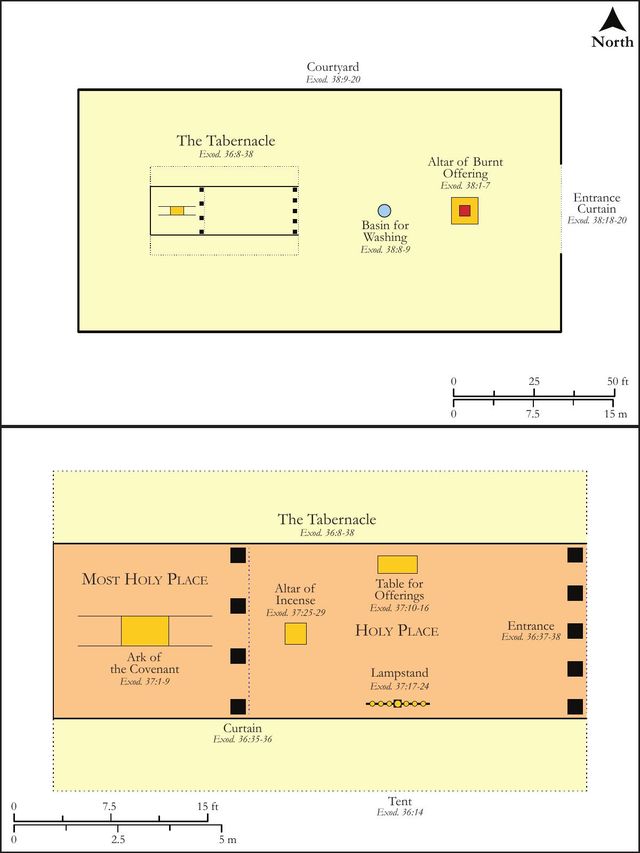
Exodus 36:18 details a seemingly small yet profoundly significant element in the Tabernacle's construction: the creation of fifty brass clasps, or "taches." These fasteners were essential for joining the two large sets of curtains that formed the inner sanctuary, ensuring they functioned as a single, unified tent. This verse underscores the divine meticulousness in the Tabernacle's design and the crucial importance of unity in God's dwelling place among His people.
Context
ShowHideLiterary Context
Exodus 36:18 is situated within the lengthy and highly detailed account of the Tabernacle's construction, spanning Exodus chapters 35-39. These chapters meticulously record the fulfillment of the divine blueprint given to Moses on Mount Sinai, which commenced with the comprehensive instructions in Exodus 25-31. Specifically, the precise instructions for the curtains and their connecting clasps are found earlier in Exodus 26:1-6. The recurring phrase "as the LORD commanded Moses" throughout these construction narratives (e.g., Exodus 39:32) serves as a powerful literary device, highlighting the Israelites' faithful adherence to every divine instruction, no matter how minute, thereby emphasizing God's absolute sovereignty and the sacredness of His dwelling place.
Historical & Cultural Context
The Tabernacle served as God's portable dwelling place for the Israelites during their nomadic journey through the wilderness after their exodus from Egypt. Its intricate design reflected a sophisticated understanding of craftsmanship and the materials available to the Israelites at Sinai. The meticulous instructions for its construction, including specific details like the brass taches, were not arbitrary but served both functional and profound symbolic purposes. In a culture where temples were central to religious life, the Tabernacle provided a unique, divinely ordained space for worship, sacrifice, and the tangible manifestation of God's presence, distinguishing Israel's monotheistic faith from the polytheistic practices of surrounding nations. The use of "brass" (more accurately bronze, an alloy of copper and tin) was common for durable components in ancient construction, signifying strength and resilience, particularly for elements exposed to wear or holding structures together, as seen in other parts of the Tabernacle like the Altar of Burnt Offering.
Key Themes
ShowHideThis verse contributes significantly to several major theological and narrative themes within Exodus and the broader Pentateuch. Firstly, it underscores the theme of Divine Meticulousness and Perfection, demonstrating that God's plan extends to the smallest details of His dwelling. Secondly, it highlights the theme of Obedience and Fidelity, as the Israelites faithfully execute every command given by God, reinforcing the covenant relationship. Most profoundly, the phrase "that it might be one" introduces the critical theme of Unity, both in the physical structure of God's dwelling and, by extension, in the spiritual community of His people. This unity is crucial for the Tabernacle to function as a complete and integrated sanctuary, mirroring the theological principle that God desires His people to be united, as seen in later calls for unity throughout Scripture (e.g., Psalm 133:1 or John 17:21).
Exposition and Analysis
ShowHideKey Word Analysis
ShowHideThe King James Version's "taches" (from Old French for "fastener" or "clasp") translates the Hebrew word qereç (H7165), which specifically refers to a "knob or belaying-pin (from its swelling form)." These were not merely decorative but highly functional components, designed to interlock and securely join the two distinct sets of curtains that formed the Tabernacle's outer and inner coverings. Their precise number (fifty) and material (brass) underscore their critical role in the structural integrity and symbolic unity of the sacred tent.
The term "brass" in the KJV often refers to bronze (H5178, nᵉchôsheth), an alloy of copper and tin, which was a common and durable metal. While gold and silver were reserved for the most sacred and ornate elements of the Tabernacle, bronze was typically employed for components requiring strength, resilience, and resistance to wear, often associated with the outer court and foundational elements. Its use for the taches signifies their robust and essential function in holding the Tabernacle's fabric together, ensuring its stability and integrity against the elements and the stresses of transport.
The Hebrew word ʼechâd (H259) means "united, i.e., one." This term is profoundly significant, as it articulates the ultimate purpose of the taches: to transform two distinct sets of curtains into a single, seamless covering. This concept of "oneness" is central to biblical theology, representing unity, singularity, and completeness. In the context of the Tabernacle, it speaks to the singular presence of God and the unified nature of His covenant relationship with Israel, emphasizing that His dwelling place must be whole and undivided.
Verse Breakdown
ShowHide"And he made fifty taches [of] brass"
This clause highlights the specific quantity and material of the clasps. The precise number "fifty" indicates that every detail of the Tabernacle's construction was divinely ordained and meticulously executed, leaving no room for human estimation or deviation. The use of "brass" (bronze) signifies the durability and strength required for these essential connectors, contrasting with the more precious metals used for other, more sacred parts of the sanctuary.
"to couple the tent together"
This phrase directly states the functional purpose of the taches. They were not ornamental but served a critical role in physically joining the two large sets of curtains—one made of fine linen and the other of goats' hair—that formed the Tabernacle's coverings. This act of "coupling" ensured the structural coherence and physical integrity of the sacred dwelling, preventing it from being merely two separate halves.
"that it might be one"
This final phrase reveals the profound symbolic and theological purpose behind the taches. Their ultimate function was to ensure the Tabernacle's unity, transforming two distinct sets of curtains into a single, seamless covering. This unity was essential for the Tabernacle to function as a complete and integrated dwelling place for God, symbolizing the singular presence of the Lord and the unified nature of His covenant relationship with Israel, a perfect and undivided sanctuary.
Literary Devices
ShowHideThe verse employs Precision and Symbolism. The Precision is evident in the exact number ("fifty") and specific material ("brass") of the taches, reflecting the meticulous nature of God's divine blueprint for the Tabernacle. This unwavering attention to detail underscores the sacredness and paramount importance of every component in God's dwelling, emphasizing that nothing was left to chance or human discretion. More significantly, the phrase "that it might be one" utilizes profound Symbolism. The physical unity achieved by the taches, joining two distinct sets of curtains into a single, seamless tent, symbolizes the spiritual unity of God's presence within the Tabernacle and, by extension, the desired unity of His people. It foreshadows the theological principle that God dwells in a unified space, and later, among a unified people, emphasizing the integrity and coherence required for His holy presence.
Theological and Thematic Connections
ShowHideExodus 36:18, though describing a seemingly minor detail, powerfully articulates core theological principles. The meticulousness of God's design, down to the number and material of the clasps, underscores His absolute sovereignty and the perfection of His plans. Nothing in His dwelling place was left to chance or human improvisation; every element served a precise purpose within a grand, divine architecture. Furthermore, the explicit purpose "that it might be one" speaks to the foundational biblical theme of unity. Just as the physical structure of God's dwelling had to be seamlessly unified, so too is unity paramount for the spiritual body of believers, the Church, which is now the dwelling place of God's Spirit. This verse reminds us that every individual, like every tache, plays a vital, interconnected role in the greater whole, contributing to the integrity, functionality, and witness of God's presence in the world.
Reflection and Application
ShowHideThe seemingly small detail of the brass taches in Exodus 36:18 carries profound implications for our lives and faith. It reminds us that God is a God of meticulous detail, caring about every aspect of His creation and His redemptive plan. This should encourage us to approach our own lives and ministries with diligence, recognizing that even the "small" tasks contribute to the greater whole of God's kingdom. Just as the taches were essential for the Tabernacle's unity, so too are we called to pursue unity within the body of Christ. Our individual gifts, talents, and efforts are meant to "couple" us together, forming a seamless and functional dwelling for God's Spirit in the world. This unity is not merely aesthetic but crucial for the Church's effectiveness, witness, and ability to reflect the unified nature of God Himself to a fragmented world. Every believer is a vital component, contributing to the structural integrity and spiritual power of the collective.
Questions for Reflection
ShowHideFAQ
ShowHideWhat is the significance of the number fifty for the taches?
ShowHideThe number fifty is significant in biblical numerology, often associated with jubilee, freedom, and completion. In the context of the Tabernacle, the fifty brass taches were precisely matched with fifty loops on the edges of the two sets of curtains—one set of five curtains, the other of six. This exact number ensured a perfect and complete connection, creating a seamless and unified covering for the sanctuary. It emphasizes the divine precision and completeness of God's design, where every component, down to the specific count, served a vital role in establishing His dwelling place among His people, as detailed in Exodus 26:1-6. The perfect numerical correspondence underscores the divine order and the flawless execution of God's blueprint.
Why were the taches made of brass (bronze) instead of more precious metals like gold or silver?
ShowHideThe choice of brass (bronze) for the taches was primarily functional, reflecting its superior durability and strength for a load-bearing application. While gold and silver were used for the most sacred and ornate elements of the Tabernacle, bronze was consistently employed for components requiring resilience and structural integrity, particularly in the outer court and for foundational elements (e.g., the bronze altar, the sockets for the court pillars). The taches needed to withstand the constant tension of holding large, heavy curtains together and the wear of dismantling and reassembling the Tabernacle during Israel's journeys. Bronze was the ideal material for this robust, load-bearing function, signifying the strength and steadfastness of the connection required for God's dwelling, ensuring its stability and longevity in the wilderness.
Christ-Centered Fulfillment
ShowHideThe meticulous design of the Tabernacle, particularly the unity achieved by the fifty brass taches, profoundly foreshadows the person and work of Jesus Christ. The Tabernacle was God's dwelling place among His people, a temporary structure that pointed to a greater, eternal reality. In Christ, God's ultimate dwelling among humanity is realized (John 1:14), for He is "Immanuel," God with us. Just as the taches brought two sets of curtains into "one" unified tent, Christ, through His sacrificial death and glorious resurrection, has broken down the dividing wall of hostility between Jew and Gentile, making them "one new humanity" in Himself (Ephesians 2:14-16). He is the true "connector," the "cornerstone" (Ephesians 2:20-22) who perfectly unites all believers into His body, the Church, which is now the spiritual temple where God's Spirit dwells (1 Corinthians 3:16). The divine meticulousness seen in the Tabernacle's construction reflects the perfect, unblemished work of Christ, who flawlessly fulfilled every detail of God's redemptive plan, ensuring the ultimate unity and reconciliation between God and humanity, and establishing a new, eternal dwelling for God's presence.