


Exodus 36:17
Bible text: King James Version (1769 Blayney text) · Public domain
Bible text: King James Version with Strong's numbers · Public domain
Bible text: Berean Standard Bible · Public domain
Bible text: American Standard Version (1901) · Public domain
Bible text: World English Bible, Messianic edition · Public domain
Bible text: Geneva Bible (1599) · Public domain
Bible text: Young's Literal Translation · Public domain
- וַיַּעַשׂvai·Ya·'asand he madeH6213Conj-w ¦ V-Qal-ConsecImperf-3msVerb Qal Consecutive Imperfect 3rd Singular Masculineוַandיַּעַשׂhe made
- לֻלָאֹתlu·la·'OtloopsH3924N-fpNoun Plural Feminine Absolute
- חֲמִשִּׁיםcha·mi·ShimfiftyH2572Adj-mpAdjective Numerical Plural Masculine Absolute
- עַל'alonH5921PrepPreposition
- שְׂפַתse·Fat[the] edge ofH8193N-fscNoun Singular Feminine Construct
- הַיְרִיעָהhay·ri·'Ahthe curtainH3407Art ¦ N-fsNoun Singular Feminine Absoluteהַtheיְרִיעָהcurtain
- הַקִּיצֹנָהha·ki·tzo·Nah<the> outermostH7020Art ¦ Adj-fsAdjective Singular Feminine Absoluteהַ<the>קִּיצֹנָהoutermost
- בַּמַּחְבָּרֶתba·mach·Ba·retin the joined setH4225Prep-b ¦ N-fsNoun Singular Feminine Absoluteבַּin theמַּחְבָּרֶתjoined set
- וַחֲמִשִּׁיםva·cha·mi·Shimand fiftyH2572Conj-w ¦ Adj-mpAdjective Numerical Plural Masculine Absoluteוַandחֲמִשִּׁיםfifty
- לֻלָאֹתlu·la·'OtloopsH3924N-fpNoun Plural Feminine Absolute
- עָשָׂה'a·Sahhe madeH6213V-Qal-Perf-3msVerb Qal Perfect 3rd Singular Masculine
- עַל'alonH5921PrepPreposition
- שְׂפַתse·Fat[the] edge ofH8193N-fscNoun Singular Feminine Construct
- הַיְרִיעָהhay·ri·'Ahthe curtainH3407Art ¦ N-fsNoun Singular Feminine Absoluteהַtheיְרִיעָהcurtain
- הַחֹבֶרֶתha·cho·Ve·retthe joined setH2279Art ¦ N-fsNoun Singular Feminine Absoluteהַtheחֹבֶרֶתjoined set
- הַשֵּׁנִיתha·she·Nit<the> secondH8145Art ¦ Adj-fsAdjective Numerical Position Singular Feminine Absoluteהַ<the>שֵּׁנִיתsecond
English is a literal word-by-word gloss of the Hebrew, not the KJV's wording. Why?
This is the original text the KJV's translators worked from — each Hebrew word with its own literal English meaning in this verse, prepared by scholars at Tyndale House, Cambridge. The KJV translates whole sentences, not word by word, so its wording differs: one Hebrew word can become several English words, and the KJV may choose “the LORD” where the gloss reads “Yahweh”. Both are faithful — they answer different questions. For the KJV's own rendering, switch to the KJV text.
Details
See on the biblical-era maps

Study this verse
Public-domain commentary
Matthew Henry
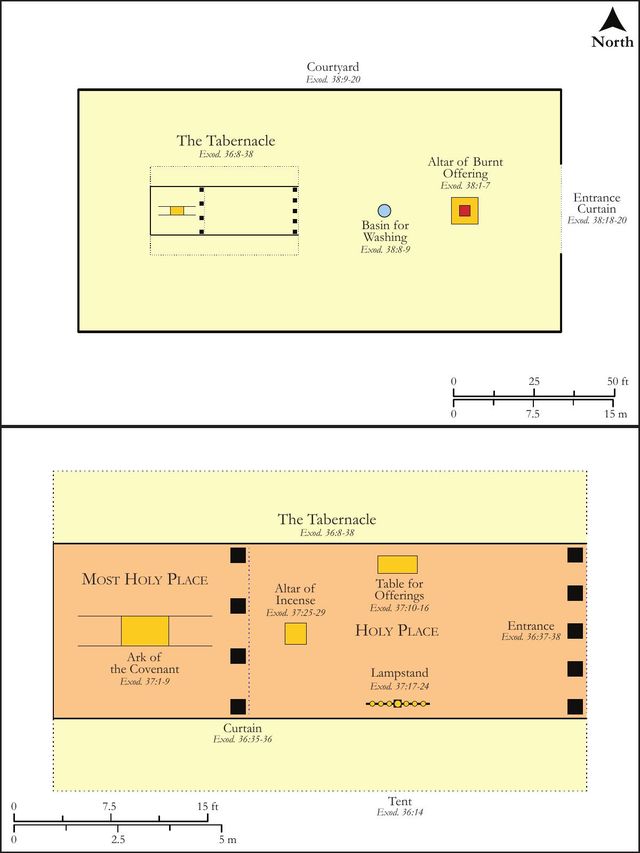
From his Commentary on the Whole Bible. Henry comments on passages, not single verses — this entry covers Exodus 36:14–34.
Here, 1. The shelter and special protection that the church is under are signified by the curtains of hair-cloth, which were spread over the tabernacle, and the covering of rams' skins and badgers' skins over them, Exo 36:14-19. God has provided for his people a shadow from the heat, and a covert from storm and rain, Isa 4:6. They are armed against all weathers; the sun and the moon shall not smite them: and they are protected from the storms of divine wrath, that hail which will sweep away the refuge of lies, Isa 28:17. Those that dwell in God's house shall find, be the tempest ever so violent, or the dropping ever so continual, it does not rain in. 2. The strength and stability of the church, though it is but a tabernacle, are signified by the boards and bars with which the curtains were borne up, Exo 36:20-34. The boards were coupled together and joined by the bars which shot through them; for the union of the church, and the hearty agreement of those that are its stays and supporters, contribute abundantly to its strength and establishment.
Continue studying Exodus 36:17 across the web’s major study libraries — every link below opens this exact verse, chapter, or book on the destination site.
Read & Compare
 BibleGatewayThis verse in more than 200 translations and 70 languages.
 Bible.comThe YouVersion reader — hundreds of translations, reading plans, and highlights.
 ESV.orgCrossway's official English Standard Version reader.
 NET BibleThe NET translation with 60,000+ translators' notes on every rendering decision.
 STEP BibleTyndale House's free study tool — original text, vocabulary, and scholarly resources.
 BibliaLogos Bible Software's free web reader.
 USCCBThe New American Bible (Revised Edition) with the U.S. bishops' study notes.
Commentaries
 BibleHub CommentariesDozens of classic commentaries on this verse, gathered on one page.
 StudyLightMore than 100 commentary sets — the largest collection on the web.
 BibleRefPlain-English commentary on what this verse means, verse by verse.
 Enduring WordDavid Guzik's free commentary on this chapter, widely used by Bible teachers.
 Bible Study ToolsVerse commentary alongside Greek and Hebrew study aids.
Original Language & Research
- BibleHub InterlinearThe verse word by word — original language, transliteration, and English.
- BibleHub LexiconEvery word's original-language definition and Strong's entry.
 Blue Letter BibleDeep-study tools — Strong's numbers, concordance, and word studies.
 SefariaThe Hebrew text with Rashi and centuries of Jewish commentary.
Sermons, Hymns & Audio


TrulyRandomVerse is not affiliated with these sites and doesn’t control their content. They’re linked because they’re genuinely useful.
Summary
Exodus 36:17 meticulously details a critical step in the construction of the Tabernacle's inner covering, specifying the creation of fifty precisely fashioned loops on the outermost edge of one set of curtains and an identical fifty loops on the corresponding edge of the second set. These loops were divinely designed to interlock with fifty golden clasps, thereby seamlessly joining the two large sections of fine linen into a single, unified covering for the Holy Place, powerfully demonstrating God's demand for absolute precision and the Spirit-empowered craftsmen's faithful, skilled execution of His intricate blueprint.
Context
ShowHideLiterary Context
This verse is situated within the comprehensive account of the Tabernacle's actual construction, detailed from Exodus 35 through Exodus 40. Following the extensive and precise instructions given to Moses on Mount Sinai in earlier chapters like Exodus 26, these chapters narrate the diligent and faithful execution of those divine blueprints by Bezaleel, Aholiab, and the other Spirit-filled artisans. Specifically, Exodus 36 focuses on the fabrication of the Tabernacle's various components, including its intricate curtains. The instructions for these very loops are found earlier in Exodus 26:4, where the Lord commanded their exact number and placement, underscoring the meticulous adherence to divine design that characterizes this entire section of Scripture. The narrative consistently emphasizes that the work was carried out "just as the LORD had commanded Moses" (as seen in Exodus 36:1 and throughout the construction narrative).
Historical & Cultural Context
The construction of the Tabernacle occurred during Israel's forty-year wilderness wanderings, a pivotal period immediately following their miraculous deliverance from Egyptian bondage. God's command to build this portable sanctuary (Exodus 25:8) was central to establishing and solidifying His covenant relationship with His newly redeemed people, providing a tangible symbol of His holy presence among them. Among the nations, temples were common as dwelling places for deities, but the Tabernacle was unique in its portability, its direct and detailed divine revelation of design, and its emphasis on a holy God dwelling among a redeemed people. The meticulous craftsmanship, particularly for elements like these loops, reflected not only the high value placed on sacred objects but also the profound belief that the dwelling of a holy God demanded absolute perfection and adherence to His specific instructions, distinguishing Israel's worship from the surrounding pagan practices which often involved human-conceived designs.
Key Themes
ShowHideThis verse, though seemingly a minor detail, contributes significantly to several major theological and narrative themes within Exodus and the broader Pentateuch. Firstly, it highlights the theme of Divine Sovereignty and Meticulous Design. God is not a God of chaos or approximation; His plans are precise and perfect, down to the number of loops on a curtain. Secondly, it underscores Obedience and Faithfulness in carrying out God's commands. The craftsmen's exact adherence to the blueprint, even for such small components, demonstrates their faithfulness and the importance of human obedience to divine instruction. Thirdly, it speaks to Unity and Wholeness. The primary function of the loops was to join two large sections into one unified covering, symbolizing the unity God desires for His people and the cohesive nature of His divine plan. This theme of unity is pervasive in the Tabernacle's construction, from the joining of curtains to the assembly of the entire structure, all pointing to God's desire for a unified people in His presence, a theme echoed in later biblical texts like Psalm 133:1. Finally, it foreshadows the concept of God's Dwelling Among His People, as the Tabernacle was the physical manifestation of God's presence, a theme that culminates in the incarnation of Christ (as seen in John 1:14) and the church as God's spiritual temple (Ephesians 2:21-22).
Exposition and Analysis
ShowHideKey Word Analysis
ShowHideThis noun (H3924) refers to the specific eyelets or rings fashioned on the edges of the curtains. The KJV uses the plural "loops," but the root transliteration provided is singular. The repetition of "fifty loops" highlights the exactness required by God's design. These were not merely decorative but highly functional, designed to interlock precisely with fifty corresponding golden clasps (Exodus 26:6) to form a seamless and secure connection. Their precise number and placement were critical for the structural integrity and symbolic unity of the Tabernacle's covering, ensuring that the two large sections functioned as one.
This noun (H4225) is derived from a root meaning "to join" or "to unite." It describes the essential function and purpose of the loops and clasps: to create a junction or connection. The phrase "in the coupling" indicates that the loops were designed specifically for the act of joining, highlighting that their form and placement were dictated by their function in connecting the two major parts of the Tabernacle's inner covering. This word is central to the verse's meaning, emphasizing the purpose of the loops as instruments of connection and integration, transforming separate pieces into a complete and functional sacred covering.
This noun (H8193) refers to the lip, border, or margin of something. Its use here, particularly with "uttermost edge" (H7020 qîytsôwn), emphasizes that the loops were placed precisely at the very extreme end or border of the curtain panels. This meticulous placement ensured that when joined by the clasps, the two sections would meet perfectly without gaps, creating a unified and aesthetically flawless appearance. This detail underscores the divine demand for meticulousness in every aspect of the Tabernacle's construction, leaving no room for approximation or imperfection, reflecting the holiness of the space.
Verse Breakdown
ShowHide"And he made fifty loops upon the uttermost edge of the curtain in the coupling"
This initial clause describes the creation of the first set of fifty loops. The "he" refers collectively to Bezaleel and the skilled craftsmen working under his direction, empowered by the Spirit of God for this divine task. These loops were meticulously fashioned on the very end of one of the large linen curtain sections. The phrase "in the coupling" anticipates their ultimate purpose: they were designed specifically for the act of joining, indicating that their precise form and placement were dictated by their function in connecting the two major parts of the covering into a cohesive whole.
"and fifty loops made he upon the edge of the curtain which coupleth the second."
This second clause mirrors the first, detailing the creation of an identical set of fifty loops on the corresponding edge of the second large curtain section. The deliberate repetition of "fifty loops" and the nearly identical phrasing underscore the symmetry, precision, and exactness required by the divine blueprint. The "curtain which coupleth the second" refers to the second of the two main curtain panels that together formed the Tabernacle's inner covering. These two sets of loops, perfectly aligned and spaced, would then be fastened by golden clasps, creating a unified, complete, and structurally sound sacred structure, reflecting God's desire for order and wholeness.
Literary Devices
ShowHideExodus 36:17 employs several significant literary devices to convey its message of precision and divine order. Repetition is prominent, with "fifty loops" appearing twice, emphasizing the exactness and numerical precision required by God's design. This repetition reinforces the theme of divine order and the meticulous adherence to instructions, highlighting that every detail was important to God. Precision itself functions as a pervasive thematic device, conveyed not just through the numerical repetition but also in the specific spatial placement "upon the uttermost edge" and the functional description of "coupling." This highlights the divine standard of perfection for sacred objects and the work done for God. Furthermore, the verse uses Synecdoche, where the "loops" stand for the entire system of joining, representing the larger concept of unity and connection within the Tabernacle's structure. The detailed, almost architectural language itself serves as a device, conveying the reality of a physical, tangible construction that perfectly matched a divine blueprint, inviting the reader to appreciate the intricate craftsmanship and divine intentionality.
Theological and Thematic Connections
ShowHideExodus 36:17, in its precise description of the Tabernacle's construction, underscores profound theological truths about God's nature and His relationship with humanity. The meticulous detail and exactness required for the loops speak to God's inherent orderliness, His demand for obedience in even the smallest matters, and the sacredness of His dwelling place. It reveals a God who cares about every detail, implying that His divine purposes are accomplished through careful, intentional design. The primary purpose of these loops – to join two separate curtain sections into a single, unified covering – powerfully symbolizes the unity God desires for His people and the way in which He brings disparate elements together to form a cohesive whole. This unity was essential for the Tabernacle to function as a complete sanctuary, reflecting the spiritual unity necessary for a holy community to worship and commune with a holy God. This foreshadows the unity of the church, the body of Christ, where diverse members are joined together by the Spirit.
Reflection and Application
ShowHideThe seemingly mundane detail of fifty loops in Exodus 36:17 offers rich insights for contemporary believers, reminding us that God is a God of order, precision, and intentionality, valuing faithfulness in the smallest of tasks. Our service to Him, whether in our daily callings, our relationships, or our church ministries, should be marked by a similar commitment to excellence and adherence to His revealed will. This verse challenges us to move beyond superficial effort, encouraging us to dedicate ourselves to quality and exactness in all that we do for the Lord, understanding that even the smallest "loop" contributes to the larger divine design. Just as the loops ensured the seamless unity of the Tabernacle's covering, so too are we called to actively pursue and maintain unity within the body of Christ. Every believer, like each loop, has a specific, divinely ordained role in joining together with others to form a complete and effective spiritual dwelling place for God. This passage challenges us to consider how our individual contributions, no matter how small they seem, are essential for the integrity and functionality of the whole, and how our commitment to unity reflects the very nature of God, who brings all things together in Christ.
Questions for Reflection
ShowHideFAQ
ShowHideWhy specifically fifty loops, and what is their significance?
ShowHideThe number fifty is precisely what God commanded in Exodus 26:4 and Exodus 36:11. The significance of fifty loops on each of the two main curtain sections, coupled with fifty golden clasps, lies in their functional purpose: to perfectly join the two large, separate panels of fine linen into a single, unified covering for the Tabernacle. This precise number ensured a secure and seamless connection, vital for the structural integrity of God's dwelling place. Theologically, this precision highlights God's demand for meticulous obedience to His instructions and symbolizes the unity and wholeness required in His sacred space and, by extension, among His people, who are called to be "one body" (Romans 12:5).
Who was responsible for making these loops and other Tabernacle components?
ShowHideThe primary individuals responsible for overseeing and executing the craftsmanship of the Tabernacle, including these loops, were Bezaleel (from the tribe of Judah) and Aholiab (from the tribe of Dan). Exodus 35:30-35 explicitly states that God "filled them with the Spirit of God, in wisdom, in understanding, and in knowledge, and in all manner of workmanship." They, in turn, were given the ability to teach others, indicating that a team of skilled artisans worked under their direction. This divine empowerment ensured that the intricate and precise work, like fashioning these exact loops, could be accomplished according to God's perfect design, demonstrating that true skill for God's service comes from His Spirit.
Christ-Centered Fulfillment
ShowHideThe meticulous detail of the loops in Exodus 36:17, designed to perfectly join two separate parts into a unified whole, powerfully foreshadows the person and work of Jesus Christ. The Tabernacle, as God's dwelling place among His people, finds its ultimate fulfillment in Christ, who is the true "tabernacle" of God, as John 1:14 declares that "the Word became flesh and dwelt among us." Just as the loops united the Tabernacle's curtains, Christ perfectly unites God and humanity in His person, bridging the chasm created by sin through His atoning sacrifice (Colossians 1:19-20). Furthermore, He is the ultimate unifier of humanity, breaking down the dividing wall of hostility between Jew and Gentile, creating "one new man" out of two (Ephesians 2:14-16). Through His sacrifice, Christ perfectly "couples" us to God, making us living stones in a spiritual house (1 Peter 2:5), where God's Spirit now dwells. The precise and perfect design of the loops thus points to the flawless, divinely orchestrated plan of redemption accomplished through the Lamb of God, who ensures our perfect union with Him and with one another, forming His unified body, the Church (Ephesians 4:15-16).