


Daniel 9:7
- לְךָle·Kha[belongs] to youPrep-l ¦ 2msSuffix Personal 2nd Singular Masculineלְ[belongs] toךָyou
- אֲדֹנָי'a·do·NaiO LordH136N-properNoun Proper Title
- הַצְּדָקָהha·tze·da·Kah<the> righteousnessH6666Art ¦ N-fsNoun Singular Feminine Absoluteהַ<the>צְּדָקָהrighteousness
- וְלָנוּve·La·nuand [belongs] to usConj-w ¦ Prep-l ¦ 1cpSuffix Personal 1st Plural common genderוְandלָ[belongs] toנוּus
- בֹּשֶׁתBo·shet[the] shame ofH1322N-fscNoun Singular Feminine Construct
- הַפָּנִיםha·pa·Nimthe facesH6440Art ¦ N-mpNoun Plural Masculine Absoluteהַtheפָּנִיםfaces
- כַּיּוֹםkai·Yomas the dayH3117Prep-k ¦ N-msNoun Singular Masculine Absoluteכַּas theיּוֹםday
- הַזֶּהha·Zeh<the> thisH2088Art ¦ PrtParticle Demonstrativeהַ<the>זֶּהthis
- לְאִישׁle·'Ishto everyone ofH376Prep-l ¦ N-mscNoun Singular Masculine Constructלְtoאִישׁeveryone of
- יְהוּדָהye·hu·DahJudahH3063N-properNoun Proper Location
- וּלְיוֹשְׁבֵיu·le·yo·she·Veiand to [the] inhabitants ofH3427Conj-w ¦ Prep-l ¦ V-Qal-Prtcpl-mpVerb Qal Participle Plural Masculine Constructוּandלְtoיוֹשְׁבֵי[the] inhabitants of
- יְרוּשָׁלִַםye·ru·sha·LimJerusalemH3389N-properNoun Proper Location
- וּלְכָלu·le·kholand to allH3605Conj-w ¦ Prep-l ¦ N-mscNoun Singular Masculine Constructוּandלְtoכָלall
- יִשְׂרָאֵלYis·ra·'ElIsraelH3478N-properNoun Proper Location
- הַקְּרֹבִיםha·ke·ro·Vim<the> nearH7138Art ¦ Adj-mpAdjective Plural Masculine Absoluteהַ<the>קְּרֹבִיםnear
- וְהָרְחֹקִיםve·ha·re·cho·Kimand <the> farH7350Conj-w ¦ Art ¦ Adj-mpAdjective Plural Masculine Absoluteוְandהָ<the>רְחֹקִיםfar
- בְּכָלbe·kholin allH3605Prep-b ¦ N-mscNoun Singular Masculine Constructבְּinכָלall
- הָאֲרָצוֹתha·'a·ra·tzOtthe landsH776Art ¦ N-fpNoun Plural Feminine Absoluteהָtheאֲרָצוֹתlands
- אֲשֶׁר'a·SherwhereH834RelParticle Relative
- הִדַּחְתָּםhi·dach·Tamyou have banished themH5080V-Hiphil-Perf-2ms ¦ 3mpVerb Hiphil Perfect 2nd Singular Masculineהִדַּחְתָּyou have banishedםthem
- שָׁםShamthereH8033AdvAdverb
- בְּמַעֲלָםbe·ma·'a·Lamin their unfaithfulnessH4604Prep-b ¦ N-msc ¦ 3mpNoun Singular Masculine Constructבְּinמַעֲלָunfaithfulnessםtheir
- אֲשֶׁר'a·SherwhichH834RelParticle Relative
- מָעֲלוּma·'a·luthey acted unfaithfullyH4603V-Qal-Perf-3cpVerb Qal Perfect 3rd Plural common gender
- בָךְVakhagainst youPrep-b ¦ 2msSuffix Personal 2nd Singular Masculineבָagainstךְyou
English is a literal word-by-word gloss of the Hebrew, not the KJV's wording. Why?
This is the original text the KJV's translators worked from — each Hebrew word with its own literal English meaning in this verse, prepared by scholars at Tyndale House, Cambridge. The KJV translates whole sentences, not word by word, so its wording differs: one Hebrew word can become several English words, and the KJV may choose “the LORD” where the gloss reads “Yahweh”. Both are faithful — they answer different questions. For the KJV's own rendering, switch to the KJV text.
Details
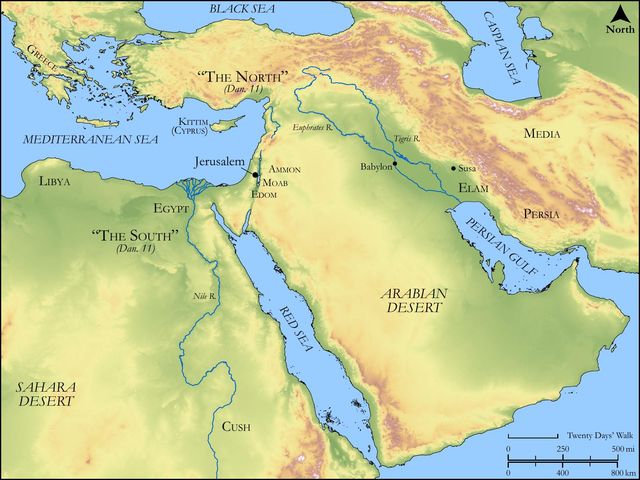
See on the biblical-era map
Study this verse
Public-domain commentary
Matthew Henry
From his Commentary on the Whole Bible. Henry comments on passages, not single verses — this entry covers Daniel 9:4–19. His two-level outline is real structure in the source text, so it is rendered as structure.
We have here Daniel's prayer to God as his God, and the confession which he joined with that prayer: I prayed, and made my confession. Note, In every prayer we must make confession, not only of the sins we have been guilty of (which we commonly call confession), but of our faith in God and dependence upon him, our sorrow for sin and our resolutions against it. It must be our confession, must be the language of our own convictions and that which we ourselves do heartily subscribe to.
Let us go over the several parts of this prayer, which we have reason to think that he offered up much more largely than is here recorded, these being only the heads of it.
I.Here is his humble, serious, reverent address to God, 1.
As a God to be feared, and whom it is our duty always to stand in awe of: "O Lord! the great and dreadful God, that art able to deal with the greatest and most terrible of the church's enemies." 2. As a God to be trusted, and whom it is our duty to depend upon and put a confidence in: Keeping the covenant and mercy to those that love him, and, as a proof of their love to him, keep his commandments. If we fulfil our part of the bargain, he will not fail to fulfil his. He will be to his people as good as his word, for he keeps covenant with them, and not one iota of his promise shall fall to the ground; nay, he will be better than his word, for he keeps mercy to them, something more than was in the covenant. It was proper for Daniel to have his eye upon God's mercy now that he was to lay before him the miseries of his people, and upon God's covenant now that he was to sue for the performance of a promise. Note, We should, in prayer, look both at God's greatness and his goodness, his majesty and mercy in conjunction.
II.Here is a penitent confession of sin, the procuring cause of all the calamities which his people had for so many years been groaning under, Dan 9:5, Dan 9:6. When we seek to God for national mercies we ought to humble ourselves before him for national sins. These are the sins Daniel here laments; and we may here observe the variety of words he makes use of to set forth the greatness of their provocations (for it becomes penitents to lay load upon themselves): We have sinned in many particular instances, nay, we have committed iniquity, we have driven a trade of sin, we have done wickedly with a hard heart and a stiff neck, and herein we have rebelled, have taken up arms against the King of kings, his crown and dignity. Two things aggravated their sins: - 1. That they had violated the express laws God had given them by Moses: "We have departed from they precepts and from thy judgments, and have not conformed to them. And (Dan 9:10) we have not obeyed the voice of the Lord our God." That which speaks the nature of sin, that it is the transgression of the law, does sufficiently speak the malignity of it; if sin be made to appear sin, it cannot be made to appear worse; its sinfulness is its greatest hatefulness, Rom 7:13. God has set his laws before us plainly and fully, as the copy we should write after, yet we have not walked in them, but turned aside, or turned back. 2. That they had slighted the fair warnings God had given them by the prophets, which in every age he had sent to them, rising up betimes and sending them (Dan 9:6): "We have not hearkened to thy servants the prophets, who have put us in mind of thy laws, and of the sanctions of them; though they spoke in thy name, we have not regarded them; though they delivered their message faithfully, with a universal respect to all orders and degrees of men, to our kings and princes, whom they had the courage and confidence to speak to, to our fathers, and to all the people of the land, whom they had the condescension and compassion to speak to, yet we have not hearkened to them, nor heard them, or not heeded them, or not complied with them." Mocking God's messengers, and despising his words, were Jerusalem's measure-filling sins, Ch2 36:16. This confession of sin is repeated here, and much insisted on; penitents should again and again accuse and reproach themselves till they find their hearts thoroughly broken. All Israel have transgressed thy law, Dan 9:11. It is Israel, God's professing people, who have known better, and from whom better is expected - Israel, God's peculiar people, whom he has surrounded with his favours; not here and there one, but it is all Israel, the generality of them, the body of the people, that have transgressed by departing and getting out of the way, that they might not hear, and so might not obey, thy voice. This disobedience is that which all true penitents do most sensibly charge upon themselves (Dan 9:14): We obeyed not his voice, and (Dan 9:15) we have sinned, we have done wickedly. Those that would find mercy must thus confess their sins.
III.Here is a self-abasing acknowledgment of the righteousness of God in all the judgments that were brought upon them; and it is evermore the way of true penitents thus to justify God, that he may be clear when he judges, and the sinner may bear all the blame.
1.He acknowledges that it was sin that plunged them in all these troubles. Israel is dispersed through all the countries about, and so weakened, impoverished, and exposed. God's hand has driven them hither and thither, some near, where they are known and therefore the more ashamed, others afar off, where they are not known and therefore the more abandoned, and it is because of their trespass that they have trespassed (Dan 9:7); they mingled themselves with the nations that they might be debauched by them, and now God mingles them with the nations that they might be stripped by them.
2.He owns the righteousness of God in it, that he had done them no wrong in all he had brought upon them, but had dealt with them as they deserved (Dan 9:7): "O Lord! righteousness belongs to thee; we have no fault to find with thy providence, no exceptions to make against thy judgments, for (Dan 9:14) the Lord our God is righteous in all his works which he does, even in the sore calamities we are now under, for we obeyed not the words of his mouth, and therefore justly feel the weight of his hand." This seems to be borrowed from Lam 1:18.
3.He takes notice of the fulfilling of the scripture in what was brought upon them. In very faithfulness he afflicted them; for it was according to the word which he had spoken. The curse is poured upon us and the oath, that is, the curse that was ratified by an oath in the law of Moses, Dan 9:11. This further justifies God in their troubles, that he did but inflict the penalty of the law, which he had given them fair notice of. It was necessary for the preserving of the honour of God's veracity, and saving his government from contempt, that the threatenings of his word should be accomplished, otherwise they look but as bugbears, nay, they seem not at all frightful. Therefore he has confirmed his words which spoke against us because we broke his laws, and against our judges that judged us because they did not according to the duty of their place punish the breach of God's laws. He told them many a time that if they did not execute justice, as terrors to evil-workers, he must and would take the work into his own hands; and now he has confirmed what he said by bringing upon us a great evil, in which the princes and judges themselves deeply shared. Note, It contributes very much to our profiting by the judgments of God's hand to observe how exactly they agree with the judgments of his mouth.
4.He aggravates the calamities they were in, lest they should seem, having been long used to them, to make light of them, and so to lose the benefit of the chastening of the Lord by despising it. "It is not some of the common troubles of life that we are complaining of, but that which has in it some special marks of divine displeasure; for under the whole heaven has not been done as has been done upon Jerusalem," Dan 9:12. It is Jeremiah's lamentation in the name of the church, Was ever sorrow like unto my sorrow? which must suppose another similar question, Was ever sin like unto my sin?
5.He puts shame upon the whole nation, from the highest to the lowest; and if they will say Amen to his prayer, as it was fit they should if they would come in for a share in the benefit of it, they must all put their hand upon their mouth, and their mouth in the dust: "To us belongs confusion of faces as at this day (Dan 9:7); we lie under the shame of the punishment of our iniquity, for shame is our due." If Israel had retained their character, and had continued a holy people, they would have been high above all nations in praise, and mane, and honour (Deu 26:19); but now that they have sinned and done wickedly confusion and disgrace belong to them, to the men of Judah and the inhabitants of Jerusalem, the inhabitants both of the country and of the city, for they have been all alike guilty before God; it belongs to all Israel, both to the two tribes, that are near, by the rivers of Babylon, and to the ten tribes, that are afar off, in the land of Assyria. "Confusion belongs not only to the common people of our land, but to our kings, our princes, and our fathers (Dan 9:8), who should have set a better example, and have used their authority and influence for the checking of the threatening torrent of vice profaneness." 6. He imputes the continuance of the judgment to their incorrigibleness under it (Dan 9:13, Dan 9:14): "All this evil has come upon us, and has lain long upon us, yet made we not our prayer before the Lord our God, not in a right manner, as we should have made it, with a humble, lowly, penitent, and obedient heart. We have been smitten, but have not returned to him that smote us. We have not entreated the face of the Lord our God" (so the word is); "we have taken no care to make our peace with God and reconcile ourselves to him." Daniel set his brethren a good example of praying continually, but he was sorry to see how few there were that followed his example; in their affliction it was expected that they would seek God early, but they sought him not, that they might turn from their iniquities and understand his truth. The errand upon which afflictions are sent is to bring men to turn from their iniquities and to understand God's truth; so Elihu had explained them, Job 36:10. God by them opens men's ears to discipline and commands that they return from iniquity. And if men were brought rightly to understand God's truth, and to submit to the power and authority of it, they would turn from the error of their ways. Now the first step towards this is to make our prayer before the Lord our God, that the affliction may be sanctified before it is removed, and that the grace of God may go along with the providence of God, to make it answer the end. Those who in their affliction make not their prayer to God, who cry not when he binds them, are not likely to turn from iniquity or to understand his truth. "Therefore, because we have not improved the affliction, the Lord has watched upon the evil, as the judge takes care that execution be done according to the sentence. Because we have not been melted, he has kept us still in the furnace, and watched over it, to make the heat yet more intense;" for when God judges he will overcome, and will be justified in all his proceedings.
IV.Here is a believing appeal to the mercy of God, and to the ancient tokens of his favour to Israel, and the concern of his own glory in their interests.
1.It is some comfort to them (and not a little) that God has been always ready to pardon sin (Dan 9:9): To the Lord our God belong mercies and forgiveness; this refers to that proclamation of his name, Exo 34:6, Exo 34:7, The Lord God, gracious and merciful, forgiving iniquity. Note, It is very encouraging to poor sinners to recollect that mercies belong to God, as it is convincing and humbling to them to recollect that righteousness belongs to him; and those who give him the glory of his righteousness may take to themselves the comfort of his mercies, Psa 62:12. There are abundant mercies in God, and not only forgiveness but forgivenesses; he is a God of pardons (Neh 9:17, marg.); he multiplies to pardon, Isa 55:7. Though we have rebelled against him, yet with him there is mercy, pardoning mercy, even for the rebellious.
2.It is likewise a support to them to think that God had formerly glorified himself by delivering them out of Egypt; so far he looks back for the encouragement of his faith (Dan 9:15): "Thou hast formerly brought thy people out of Egypt with a mighty hand, and wilt thou not now with the same mighty hand bring them out of Babylon? Were they then formed into a people, and shall they not now be reformed and new-formed? Are they now sinful and unworthy, and were they not so then? Are their oppressors now mighty and haughty, and were they not so then? And has not God said the their deliverance out of Babylon shall outshine even that out of Egypt?" Jer 16:14, Jer 16:15. The force of this plea lies in that, "Thou hast gotten thyself renown, hast made thyself a name" (so the word is) "as at this day, even to this day, by bringing us out of Egypt; and wilt thou lose the credit of that by letting us perish in Babylon? Didst thou get a renown by that deliverance which we have so often commemorated, and wilt thou not now get thyself a renown by this which we have so often prayed for, and so long waited for?"
V.Here is a pathetic complaint of the reproach that God's people lay under, and the ruins that God's sanctuary lay in, both which redounded very much to the dishonour of God and the diminution of that name and renown which God had gained by bringing them out of Egypt.
1.God's holy people were despised. By their sins and the iniquities of their fathers they had profaned their crown and made themselves despicable, and then though they are, in name and profession, God's people, and upon that account truly great and honourable, yet they become a reproach to all that are round about them. Their neighbours laugh them to scorn, and triumph in their disgrace. Note, Sin is a reproach to any people, but especially to God's people, that have more eyes upon them and have more honour to lose than other people.
2.God's holy place was desolate. Jerusalem, the holy city, was a reproach (Dan 9:16) when it lay in ruins; it was an astonishment and a hissing to all that passed by. The sanctuary, the holy house, was desolate (Dan 9:17), the altars were demolished, and all the buildings laid in ashes. Note, The desolations of the sanctuary are the grief of all the saints, who reckon all their comforts in this world buried in the ruins of the sanctuary.
VI.Here is an importunate request to God for the restoring of the poor captive Jews to their former enjoyments again.
The petition is very pressing, for God gives us leave in prayer to wrestle with him: "O Lord! I beseech thee, Dan 9:16. If ever thou wilt do any thing for me, do this; it is my heart's desire and prayer. Now therefore, O our God! hear the prayer of thy servant and his supplication (Dan 9:17), and grant an answer of peace." Now what are his petitions? What are his requests?
1.That God would turn away his wrath from them; that is it which all the saints dread and deprecate more than any thing: O let thy anger be turned away from thy Jerusalem, thy holy mountain! Dan 9:16. He does not pray for the turning again of their captivity (let the Lord do with them as seems good in his eyes), but he prays first for the turning away of God's wrath. Take away the cause, and the effect will cease.
2.That he would lift up the light of his countenance upon them (Dan 9:17): "Cause thy face to shine upon thy sanctuary that is desolate; return in thy mercy to us, and show that thou art reconciled to us, and then all shall be well." Note, The shining of God's face upon the desolations of the sanctuary is all in all towards the repair of it; and upon that foundation it must be rebuilt. If therefore its friends would begin their work at the right end, they must first be earnest with God in prayer for his favour, and recommend his desolate sanctuary to his smiles. Cause thy face to shine and then we shall be saved, Psa 80:3.
3.That he would forgive their sins, and then hasten their deliverance (Dan 9:19): O Lord! hear; O Lord! forgive. "That the mercy prayed for may be granted in mercy, let the sin that threatens to come between us and it be removed: O Lord! hearken and do, not hearken and speak only, but hearken and do; do that for us which none else can, and that speedily - defer not, O my God!" Now that he saw the appointed day approaching he could in faith pray that God would make haste to them and not defer. David often prays, Make haste, O God! to help me.
VII.Here are several pleas and arguments to enforce the petitions.
God gives us leave not only to pray, but to plead with him, which is not to move him (he himself knows what he will do), but to move ourselves, to excite our fervency and encourage our faith.
1.They disdain a dependence upon any righteousness of their own; they pretend not to merit any thing at God's hand but wrath and the curse (Dan 9:18): "We do not present our supplications before thee with hope to speed for our righteousness, as if we were worthy to receive thy favour for any good in us, or done by us, or could demand any thing as a debt; we cannot insist upon our own justification, no, though we were more righteous than we are; nay, though we knew nothing amiss of ourselves, yet are we not thereby justified, nor would we answer, but we would make supplication to our Judge." Moses had told Israel long before that, whatever God did for them, it was not for their righteousness, Deu 9:4, Deu 9:5. And Ezekiel had of late told them that their return out of Babylon would be not for their sakes, Eze 36:22, Eze 36:32. Note, Whenever we come to God for mercy we must lay aside all conceit of, and confidence in, our own righteousness.
2.They take their encouragement in prayer from God only, as knowing that his reasons of mercy are fetched from within himself, and therefore from him we must borrow all our pleas for mercy, and so give honour to him when we are suing for grace and mercy from him. (1.) "Do it for thy own sake (Dan 9:19), for the accomplishment of thy own counsel, the performance of thy own promise, and the manifestation of thy own glory." Note, God will do his own work, not only in his own way and time, but for his own sake, and so we must take it. (2.) "Do it for the Lord's sake, that is, for the Lord Christ's sake," for the sake of the Messiah promised, who is the Lord (so the most and best of our Christian interpreters understand it), for the sake of Adonai, so David called the Messiah (Psa 110:1), and mercy is prayed for for the church for the sake of the Son of man (Psa 80:17), and for thy Word's sake, he is Lord of all. It is for his sake that God causes his face to shine upon sinners when they repent and turn to him, because of the satisfaction he has made. In all our prayers that therefore must be our plea; we must make mention of his righteousness, even of his only, Psa 71:16. Look upon the face of the anointed. He has himself directed us to ask in his name. (3.) "Do it according to all thy righteousness (Dan 9:16), that is, plead for us against our persecutors and oppressors according to thy righteousness. Though we are ourselves unrighteous before God, yet with reference to them we have a righteous cause, which we leave it with the righteous God to appear in the defence of." Or, rather, by the righteousness of God here is meant his faithfulness to his promise. God had, according to his righteousness, executed the threatening, Dan 9:11. "Now, Lord, wilt thou not do according to all thy righteousness? Wilt thou not be as true to thy promises as thou hast been to thy threatenings and accomplish them also?" (4.) "Do it for thy great mercies (Dan 9:18), to make it to appear that thou art a merciful God." The good things we ask of God we call mercies, because we expect them purely from God's mercy. And, because misery is the proper object of mercy, the prophet here spreads the deplorable condition of the church before God, as it were to move his compassion: "Open thy eyes and behold our desolations, especially the desolations of the sanctuary. O look with pity upon a pitiable case!" Note, The desolations of the church must in prayer be laid before God and then left with him. (5.) "Do it for the sake of the relation we stand in to thee. The sanctuary that is desolate is thy sanctuary (Dan 9:17), dedicated to thy honour, employed in thy service, and the place of thy residence. Jerusalem is thy city and thy holy mountain (Dan 9:16); it is the city which is called by thy name," Dan 9:18. It was the city which God had chosen out of all the tribes of Israel, to put his name there. "The people that have become a reproach are thy people, and thy name suffers in the reproach cast upon them (Dan 9:16); they are called by thy name, Dan 9:19. Lord, thou hast a property in them, and therefore art interested in their interests; wilt thou not provide for thy own, for those of thy own house? They are thine, save them," Psa 119:94.
Historical interpretation
Historical reception
3 surviving comments on this verse. Each one is dated, so this reads as a timeline rather than a list.
Select a marker to jump to its quote. Markers stagger vertically where authors wrote within a few decades of each other.
“Yours is the victory, O Lord, in this case,” because you foresaw our many sins and threatened those about to sin with many curses, keeping your watch lest we might sin. Righteousness is on your side, O Lord, because no evil will besiege us that was not announced to us beforehand. So now confusion has overwhelmed us everywhere, and we are dispersed in every place.
Verse 7. "'Justice belongeth unto Thee, O Lord, but for us there is only confusion of face...'" It is of course just that we suffer what we deserve.
Lord, the things done by you proclaim your righteousness. But we are ashamed because of our great transgression and denounced for our own ingratitude. No harm comes to you because of our godlessness, but we have reaped the fruit of these seeds. He speaks in a pitiable fashion. Daniel both accuses his kin and associates himself with their trespasses.
Continue studying Daniel 9:7 across the web’s major study libraries — every link below opens this exact verse, chapter, or book on the destination site.
Read & Compare
 BibleGatewayThis verse in more than 200 translations and 70 languages.
 Bible.comThe YouVersion reader — hundreds of translations, reading plans, and highlights.
 ESV.orgCrossway's official English Standard Version reader.
 NET BibleThe NET translation with 60,000+ translators' notes on every rendering decision.
 STEP BibleTyndale House's free study tool — original text, vocabulary, and scholarly resources.
 BibliaLogos Bible Software's free web reader.
 USCCBThe New American Bible (Revised Edition) with the U.S. bishops' study notes.
Commentaries
 BibleHub CommentariesDozens of classic commentaries on this verse, gathered on one page.
 StudyLightMore than 100 commentary sets — the largest collection on the web.
 BibleRefPlain-English commentary on what this verse means, verse by verse.
 Enduring WordDavid Guzik's free commentary on this chapter, widely used by Bible teachers.
 Bible Study ToolsVerse commentary alongside Greek and Hebrew study aids.
Original Language & Research
- BibleHub InterlinearThe verse word by word — original language, transliteration, and English.
- BibleHub LexiconEvery word's original-language definition and Strong's entry.
 Blue Letter BibleDeep-study tools — Strong's numbers, concordance, and word studies.
 SefariaThe Hebrew text with Rashi and centuries of Jewish commentary.
Sermons, Hymns & Audio


TrulyRandomVerse is not affiliated with these sites and doesn’t control their content. They’re linked because they’re genuinely useful.
Summary
Daniel 9:7 is a profound declaration within Daniel's intercessory prayer, articulating the stark contrast between God's inherent righteousness and Israel's profound shame and guilt. It serves as a foundational confession, acknowledging that the nation's calamitous exile and dispersion were not arbitrary acts of divine power but the just and deserved consequence of their persistent rebellion and covenant unfaithfulness against a holy God. This verse encapsulates the core theological truth that God remains perfectly just even in judgment, while humanity bears the rightful burden of its sin.
Context
ShowHideLiterary Context
Daniel 9 is a pivotal chapter, situated within a broader narrative of prophetic visions and historical accounts. Following the vision of the ram and goat in Daniel 8, Daniel is meditating on Jeremiah's prophecy concerning the seventy years of desolation for Jerusalem (Jeremiah 25:11-12 and Jeremiah 29:10). This meditation prompts Daniel to turn to God in earnest prayer and confession, which spans Daniel 9:4-19. Verse 7 specifically initiates the core confession of Israel's sin, setting the stage for the subsequent pleas for mercy and restoration. It establishes the theological premise for the entire prayer: God is righteous, Israel is not.
Historical & Cultural Context
Daniel's prayer occurs approximately 605-536 BC, specifically around 538 BC, during the first year of Darius the Mede's reign, marking the approximate end of the seventy-year Babylonian exile. The Jewish people, including Daniel, had been forcibly removed from their homeland, Jerusalem, and scattered across the vast Babylonian (and later Persian) Empire. This exile was understood by faithful Israelites as divine judgment for centuries of covenant disobedience, idolatry, and oppression, as prophesied by Moses in Deuteronomy 28 and later by prophets like Isaiah and Jeremiah. The "confusion of faces" would have been a deeply felt public and personal shame in a culture where honor and shame were paramount, signifying the loss of national identity, sovereignty, and divine favor.
Key Themes
ShowHideDaniel 9:7 contributes significantly to several overarching themes in the book of Daniel and biblical theology. Foremost is the theme of Divine Sovereignty and Justice, emphasizing that God is in ultimate control of history and that His judgments, though severe, are always righteous and deserved. Another prominent theme is Human Sin and Corporate Responsibility, as Daniel identifies with the collective guilt of his people, acknowledging that their suffering is a direct consequence of their "trespass that they have trespassed against thee." This highlights the concept of corporate solidarity in sin and its consequences, a theme also seen in Nehemiah 9. Finally, the verse underscores the theme of Confession and Repentance, demonstrating the necessary posture of humility and self-abasement before God as a prerequisite for seeking His mercy and restoration.
Exposition and Analysis
ShowHideKey Word Analysis
ShowHideThis is an emphatic form of the Hebrew word for "lord" or "master," used here as a proper name for God. It signifies God's absolute sovereignty, authority, and ownership. By addressing God as "Adonai," Daniel acknowledges His supreme dominion and rightful claim over all creation, including Israel, and implicitly, His right to judge.
Derived from a root meaning "to be right" or "just," this term denotes moral rectitude, justice, and conformity to a divine standard. When ascribed to God, it speaks of His perfect character, His unwavering faithfulness to His covenant, and the inherent justice of all His actions, even those involving severe judgment. Daniel's declaration that "righteousness belongeth unto thee" affirms God's blamelessness and integrity in the face of Israel's suffering.
This word signifies shame, disgrace, or humiliation. It describes not merely a feeling of embarrassment but a profound state of public dishonor and inner degradation resulting from sinful or failed actions. In conjunction with "faces" (pânîym), "confusion of faces" vividly portrays the visible manifestation of this deep-seated shame, a public sign of Israel's dishonor and the loss of their former glory and favor before God and the nations.
Verse Breakdown
ShowHide"O Lord, righteousness [belongeth] unto thee,"
Daniel begins his confession by unequivocally affirming God's perfect character. Despite the dire circumstances of exile, Daniel does not question God's justice but rather declares that all righteousness, all moral rectitude, and all just dealings are inherent to God's very being. This establishes the theological framework for the entire prayer: God is just, even in His judgment.
"but unto us confusion of faces, as at this day;"
In stark contrast to God's righteousness, Daniel attributes "confusion of faces" to himself and his people. This powerful idiom, boshet panim in Hebrew, signifies deep shame, public disgrace, and humiliation. It implies a visible manifestation of dishonor, a bowed head, or a face turned away in shame. The phrase "as at this day" underscores the present reality of their disgraced state, a direct and ongoing consequence of their actions.
"to the men of Judah, and to the inhabitants of Jerusalem, and unto all Israel, [that are] near, and [that are] far off, through all the countries whither thou hast driven them,"
Daniel broadens the scope of this confession to encompass the entire nation. "Men of Judah" and "inhabitants of Jerusalem" refer to the southern kingdom, which bore the brunt of the Babylonian invasion. "All Israel" includes those from the northern kingdom who had been scattered earlier, as well as all who were dispersed, whether "near" (in Babylon) or "far off" (in other parts of the empire). This comprehensive inclusion emphasizes the corporate nature of their sin and the widespread impact of God's judgment, acknowledging that the exile was a national experience.
"because of their trespass that they have trespassed against thee."
This concluding clause provides the explicit reason for Israel's shame and suffering. The repetition of the root word for "trespass" (maʻal, verb and noun) emphasizes the deliberate, persistent, and unfaithful nature of their sin. It refers to a breach of trust, a betrayal of covenant obligations, particularly against God Himself. This clarifies that their current predicament is not arbitrary but a direct and deserved consequence of their chronic unfaithfulness to the Lord.
Literary Devices
ShowHideDaniel 9:7 is rich in literary devices that enhance its impact and theological depth. The most prominent is Contrast, setting God's perfect righteousness against Israel's profound shame and guilt. This stark juxtaposition highlights the vast chasm between divine holiness and human sinfulness. The phrase "confusion of faces" functions as vivid Imagery, evoking a powerful visual of public disgrace and internal humiliation, making the abstract concept of shame tangible. The use of Merism is evident in "near, and that are far off," which is a rhetorical device where two contrasting parts represent the whole, indicating that all of Israel, wherever they were dispersed, shared in this collective shame and judgment. Finally, the repetition of the root word for "trespass" ("their trespass that they have trespassed") is a form of Polyptoton or Emphasis, intensifying the gravity and deliberate nature of Israel's sin and underscoring that their punishment was a direct and just consequence of their repeated covenant violations.
Theological and Thematic Connections
ShowHideDaniel 9:7 is a profound theological statement on the nature of God's justice and humanity's accountability. It asserts that even in the midst of severe judgment, God's character remains unblemished; His actions are always consistent with His perfect righteousness. The nation of Israel's suffering and dispersion are not arbitrary acts of divine wrath but the just and inevitable outcome of their persistent and deliberate "trespass" against their covenant Lord. This verse serves as a model for true confession, where the focus is not on excusing sin or blaming circumstances, but on acknowledging God's holiness and taking full responsibility for one's own (and one's community's) failings. It underscores the biblical principle that sin has real, often painful, consequences, and that God's justice demands accountability, even from His chosen people.
Reflection and Application
ShowHideDaniel 9:7 calls us to a posture of profound humility and honest self-assessment before God. In a world quick to blame external circumstances or deny personal culpability, Daniel's prayer offers a powerful counter-narrative. It challenges us to acknowledge God's inherent righteousness and justice, even when His ways are difficult to comprehend or when we face the consequences of sin. This verse encourages both individual and corporate confession, recognizing that we are often implicated in the collective failings of our communities, nations, and even the broader human family. True repentance begins with this clear-eyed recognition of our "confusion of faces" – our shame and guilt – stemming from our "trespass against" a holy God. It invites us to embrace responsibility for our actions and to give God the glory and righteousness that belong to Him alone, trusting that His justice is always tempered with mercy for the truly repentant.
Questions for Reflection
ShowHideFAQ
ShowHideWhat does "confusion of faces" mean in Daniel 9:7?
ShowHide"Confusion of faces" (Hebrew: boshet panim) is a powerful idiom that signifies deep shame, public disgrace, and humiliation. It's not merely embarrassment, but a profound sense of dishonor that is so intense it's visibly reflected on one's face, perhaps through a downcast gaze, a blush, or a look of utter despair. In ancient Near Eastern culture, honor and shame were central values, and to experience "confusion of faces" meant a loss of status, dignity, and reputation, signifying that one had acted in a way that brought public disgrace upon oneself and one's community. Daniel uses this phrase to express the profound and deserved humiliation Israel experienced due to their sin, contrasting it sharply with God's unblemished righteousness. This state of shame was a direct consequence of their "trespass that they have trespassed against thee."
Christ-Centered Fulfillment
ShowHideDaniel 9:7, with its stark contrast between God's perfect righteousness and humanity's "confusion of faces" due to trespass, finds its ultimate and glorious fulfillment in Jesus Christ. Humanity's shame and guilt, stemming from countless acts of rebellion against God, are fully borne and atoned for by the Lamb of God, who takes away the sin of the world. While Israel, and indeed all humanity, deserved the "confusion of faces" and the consequences of their trespass, Christ, who "knew no sin, became sin for us, so that in him we might become the righteousness of God" (2 Corinthians 5:21). He endured the ultimate shame and disgrace, being "despised and rejected by mankind" (Isaiah 53:3), and suffering the cross, "scorning its shame" (Hebrews 12:2), so that those who believe in Him might receive His righteousness and no longer bear the "confusion of faces" for their sins. Through His atoning work, the righteous demands of God are met, and a new covenant is established where sin is remembered no more (Jeremiah 31:31-34), transforming our shame into the glory of adoption as children of God (Romans 8:15).