


Acts 15:31
Bible text: King James Version (1769 Blayney text) · Public domain
Bible text: Berean Standard Bible · Public domain
Bible text: American Standard Version (1901) · Public domain
Bible text: World English Bible, Messianic edition · Public domain
Bible text: Geneva Bible (1599) · Public domain
Bible text: Young's Literal Translation · Public domain
- ἀναγνόντεςanagnontesHaving read [it]G314V-2AAP-NPMVerb 2nd Aorist Active Participle Nominative Plural Masculine
- δὲdenowG1161CONJConjunction
- ἐχάρησανecharēsanthey rejoicedG5463V-2AOI-3PVerb 2nd Aorist Passive Deponent Indicative 3rd Plural
- ἐπὶepiatG1909PREPPreposition
- τῇtēatheG3588T-DSFDefinite article Dative Singular Feminine
- παρακλήσειparaklēseiencouragementG3874N-DSFNoun Dative Singular Feminine
English is a literal word-by-word gloss of the Greek, not the KJV's wording. Why?
This is the original text the KJV's translators worked from — each Greek word with its own literal English meaning in this verse, prepared by scholars at Tyndale House, Cambridge. The KJV translates whole sentences, not word by word, so its wording differs: one Greek word can become several English words, and the KJV may choose “charity” where the gloss reads “love”. Both are faithful — they answer different questions. For the KJV's own rendering, switch to the KJV text.
Details
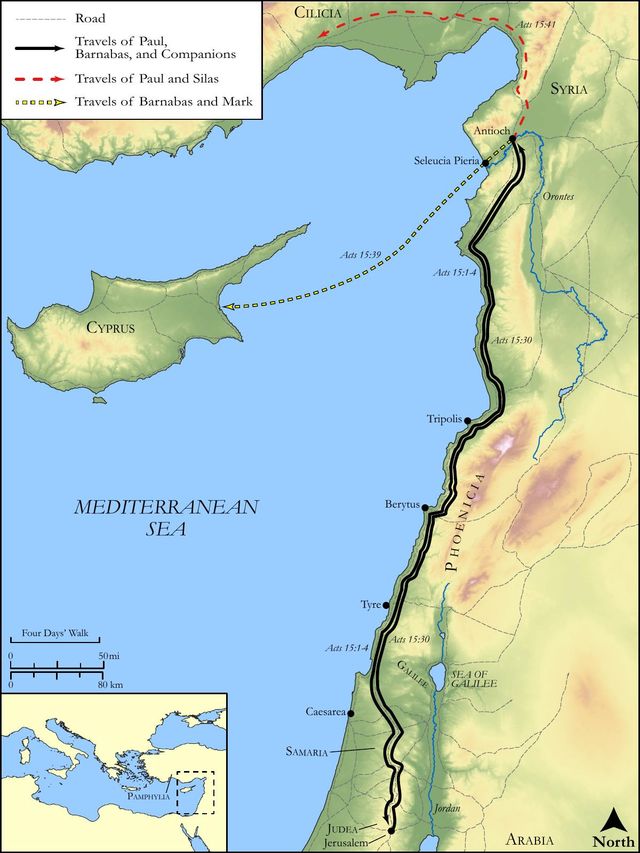
See on the biblical-era maps


Study this verse
Public-domain commentary
Matthew Henry
From his Commentary on the Whole Bible. Henry comments on passages, not single verses — this entry covers Acts 15:22–35. His four-level outline is real structure in the source text, so it is rendered as structure.
We have here the result of the consultation that was held at Jerusalem about the imposing of the ceremonial law upon the Gentiles. Much more, it is likely, was said about it than is here recorded; but at length it was brought to a head, and the advice which James gave was universally approved and agreed to nemine contradicente - unanimously; and letters were accordingly sent by messengers of their own to the Gentile converts, acquainting them with their sentiments in this matter, which would be a great confirmation to them against the false teachers. Now observe here,
I.The choice of the delegates that were to be sent with Paul and Barnabas on this errand; not as if they had any suspicion of the fidelity of these great men, and could not trust them with their letters, nor as if they thought that those to whom they sent them would suspect them to have altered any thing in their letter; no, their charity thought no such evil concerning men of such tried integrity; but,
1.They thought fit to send men of their own company to Antioch, with Paul and Barnabas, Act 15:22. This was agreed to by the apostles and elders, with the whole church, who, it is likely, undertook to bear their charges, Co1 9:7. They sent these messengers,
(1.)To show their respect to the church at Antioch, as a sister-church, though a younger sister, and that they looked upon it as upon the same level with them; as also that they were desirous further to know their state.
(2.)To encourage Paul and Barnabas, and to make their journey home the more pleasant (for it is likely they travelled on foot) by sending such excellent men to bear them company; amicus pro vehiculo - a friend instead of a carriage.
(3.)To put a reputation upon the letters they carried, that it might appear a solemn embassy, and so much the more regard might be paid to the message, which was likely to meet with opposition from some.
(4.)To keep up the communion of the saints, and cultivate an acquaintance between churches and ministers that were at a distance from each other, and to show that, though they were many, yet they were one.
2.Those they sent were not inferior persons, who might serve to carry the letters, and attest the receipt of them from the apostles; but they were chosen men, and chief men among the brethren, men of eminent gifts, graces, and usefulness; for these are the things which denominate men chief among the brethren, and qualify them to be the messengers of the churches. They are here named: Judas, who was called Barsabas (probably the brother of that Joseph who was called Barsabas, that was a candidate for the apostleship, Act 1:23), and Silas. The character which these men had in the church at Jerusalem would have some influence upon those that came from Judea, as those false teachers did, and engage them to pay the more deference to the message that was sent by them.
II.The drawing up of the letters, circular letters, that were to be sent to the churches, to notify the sense of the synod in this matter.
1.Here is a very condescending obliging preamble to this decree, Act 15:23. There is nothing in it haughty or assuming, but,
(1.)That which intimates the humility of the apostles, that they join the elders and brethren in commission with them, the ministers, the ordinary Christians, whom they had advised with in this case, as they used to do in other cases. Though never men were so qualified as they were for a monarchical power and authority in the church, nor had such a commission as they had, yet their decrees run not, "We, the apostles, Christ's vicars upon earth, and pastors of all the pastors of the churches" (as the pope styles himself), "and sole judges in all matters of faith;" but the apostles, and elders, and brethren, agree in their orders. Herein they remembered the instructions their Master gave them (Mat 23:8): Be not you called Rabbi; for you are all brethren.
(2.)That which bespeaks their respect to the churches they wrote to; they send to them greeting, wish them health and happiness and joy, and call them brethren of the Gentiles, thereby owning their admission into the church, and giving them the right hand of fellowship: "You are our brethren, though Gentiles; for we meet in Christ, the first born among many brethren, in God our common Father." Now that the Gentiles are fellow-heirs and of the same body, they are to be countenanced and encouraged, and called brethren.
2.Here is a just and severe rebuke to the judaizing teachers (Act 15:24): "We have heard that certain who went out from us have troubled you with words, and we are very much concerned to hear it; now this is to let them know that those who preached this doctrine were false teachers, both as they produced a false commission and as they taught a false doctrine." (1.) They did a great deal of wrong to the apostles and ministers at Jerusalem, in pretending that they had instructions from them to impose the ceremonial law upon the Gentiles, when there was no colour for such a pretension. "They went out from us indeed - they were such as belonged to our church, of which, when they had a mind to travel, we gave them perhaps a testimonial; but, as for their urging the law of Moses upon you, we gave them no such commandment, nor had we ever thought of such a thing, nor given them the least occasion to use our names in it." It is no new thing for apostolical authority to be pleaded in defence of those doctrines and practices for which yet the apostles gave neither command nor encouragement. (2.) They did a great deal of wrong to the Gentile converts, in saying, You must be circumcised, and must keep the law. [1.] It perplexed them: "They have troubled you with words, have occasioned disturbance and disquietment to you. You depended upon those who told you, If you believe in the Lord Jesus Christ you shall be saved; and now you are startled by those that tell you you must keep the law of Moses or you cannot be saved, by which you see yourselves drawn into a snare. They trouble you with words - words, and nothing else - mere words - sound, but no substance." How has the church been troubled with words, by the pride of men that loved to hear themselves talk! [2.] It endangered them; they subverted their souls, put them into disorder, and pulled down that which had been built up. They took them off from pursuing pure Christianity, and minding the business of that, by filling their heads with the necessity of circumcision, and the law of Moses, which were nothing to the purpose.
3.Here is an honourable testimony given of the messengers by whom these letters were sent.
(1.)Of Paul and Barnabas, whom these judaizing teachers had opposed and censured as having done their work by the halves, because they had brought the Gentile converts to Christianity only, and not to Judaism. Let them say what they will of these men, [1.] "They are men that are dear to us; they are our beloved Barnabas and Paul - men whom we have a value for, a kindness for, a concern for." Sometimes it is good for those that are of eminence to express their esteem, not only for the despised truth of Christ, but for the despised preachers and defenders of that truth, to encourage them, and weaken the hands of their opposers. [2.] "They are men that have signalized themselves in the service of Christ, and therefore have deserved well of all the churches: they are men that have hazarded their lives for the name of our Lord Jesus Christ (Act 15:26), and therefore are worthy of double honour, and cannot be suspected of having sought any secular advantage to themselves; for they have ventured their all for Christ, have engaged in the most dangerous services, as good soldiers of Christ, and not only in laborious services." It is not likely that such faithful confessors should be unfaithful preachers. Those that urged circumcision did it to avoid persecution (Gal 6:12, Gal 6:13); those that opposed it knew they thereby exposed themselves to persecution; and which of these were most likely to be in the right?
(2.)Of Judas and Silas: "They are chosen men (Act 15:25), and they are men that have heard our debates, and are perfectly apprized of the matter, and will tell you the same things by mouth," Act 15:27. What is of use to us it is good to have both in writing and by word of mouth, that we may have the advantage both of reading and of hearing it. The apostles refer them to the bearers for a further account of their judgment and their reasons, and the bearers will refer them to their letters for the certainty of the determination.
4.Here is the direction given what to require from the Gentile converts, where observe,
(1.)The matter of the injunction, which is according to the advice given by James, that, to avoid giving offence to the Jews,
[1.]They should never eat any thing that they knew had been offered in sacrifice to an idol, but look upon it as, though clean in itself, yet thereby polluted to them. This prohibition was afterwards in part taken off, for they were allowed to eat whatever was sold in the shambles, or set before them at their friend's table, though it had been offered to idols, except when there was danger of giving offence by it, that is, of giving occasion either to a weak Christian to think the worse of our Christianity, or to a wicked heathen to think the better of his idolatry; and in these cases it is good to forbear, Co1 10:25, etc. This to us is an antiquated case.
[2.]That they should not eat blood, nor drink it; but avoid every thing that looked cruel and barbarous in that ceremony which had been of so long standing.
[3.]That they should not eat any thing that was strangled, or died of itself, or had not the blood let out.
[4.]That they should be very strict in censuring those that were guilty of fornication, or marrying within the degrees prohibited by the Levitical law, which, some think, is principally intended here. See Co1 5:1. Dr. Hammond states this matter thus: The judaizing teachers would have the Gentile converts submit to all that those submitted to whom they called the proselytes of righteousness, to be circumcised and keep the whole law; but the apostles required no more of them than what was required of the proselytes of the gate, which was to observe the seven precepts of the sons of Noah, which, he thinks, are here referred to. But the only ground of this decree being in complaisance to the rigid Jews that had embraced the Christian faith, and, except in that one case of scandal, all meats being pronounced free and indifferent to all Christians as soon as the reason of the decree ceased, which, at furthest, was after the destruction of Jerusalem, the obligation of it ceased likewise. "These things are in a particular manner offensive to the Jews, and therefore do not disoblige them herein for the present; in a little time the Jews will incorporate with the Gentiles, and then the danger is over."
(2.)The manner in which it is worded.
[1.]They express themselves with something of authority, that what they wrote might be received with respect, and deference paid to it: It seemed good to the Holy Ghost, and to us, that is, to us under the guidance of the Holy Ghost, and by direction from him: not only the apostles, but others, were endued with spiritual gifts extraordinary, and knew more of the mind of God than any since those gifts ceased can pretend to; their infallibility gave an incontestable authority to their decrees, and they would not order any thing because it seemed good to them, but that they knew it first seemed good to the Holy Ghost. Or it refers to what the Holy Ghost had determined in this matter formerly. When the Holy Ghost descended upon the apostles, he endued them with the gift of tongues, in order to their preaching the gospel to the Gentiles, which was a plain indication of God's purpose to call them in. When the Holy Ghost descended upon Cornelius and his friends, upon Peter's preaching, it was plain that Christ designed the taking down of the Jewish pale, within which they fancied the spirit had been enclosed.
[2.]They express themselves with abundance of tenderness and fatherly concern. First, They are afraid of burdening them: We will lay upon you no greater burden. So far were they from delighting to impose upon them that they dreaded nothing so much as imposing too far upon them, so as to discourage them at their setting out. Secondly, They impose upon them no other than necessary things. "The avoiding of fornication is necessary to all Christians at all times; the avoiding of things strangled, and of blood, and of things offered to idols, is necessary at this time, for the keeping up of a good understanding between you and the Jews, and the preventing of offence;" and as long as it continues necessary for that end, and no longer, it is enjoined. Note, Church-rulers should impose only necessary things, things which Christ has made our duty, which have a real tendency to the edification of the church, and, as here, to the uniting of good Christians. If they impose things only to show their own authority, and to try people's obedience, they forget that they have not authority to make new laws, but only to see that the laws of Christ be duly executed, and to enforce the observance of them. Thirdly, They enforce their order with a commendation of those that shall comply with it, rather than with the condemnation of those that shall transgress it. They do not conclude, "From which if you do not keep yourselves, you shall be an anathema, you shall be cast out of the church, and accursed," according to the style of after-councils, and particularly that of Trent; but "From which if you keep yourselves, as we do not question but you will, you will do well; it will be for the glory of God, the furtherance of the gospel, the strengthening of the hands of your brethren, and your own credit and comfort." It is all sweetness and love and good humour, such as became the followers of him who, when he called us to take his yoke upon us, assured us we should find him meek and lowly in heart. The difference of the style of the true apostles from that of the false is very observable. Those that were for imposing the ceremonial laws were positive and imperious: Except you keep it, you cannot be saved (Act 15:1), you are excommunicated ipso facto - at once, and delivered to Satan. The apostles of Christ, who only recommend necessary things, are mild and gentle: "From which if you keep yourselves, you will do well, and as becomes you. Fare ye well; we are hearty well-wishers to your honour and peace."
III.The delivering of the letters, and how the messengers disposed of themselves.
1.When they were dismissed, had had their audience of leave of the apostles (it is probable that they were dismissed with prayer, and a solemn blessing in the name of the Lord, and with instructions and encouragements in their work), They then came to Antioch; they staid no longer at Jerusalem than till their business was done, and then came back, and perhaps were met at their return by those that brought them on their way at their setting out; for those that have taken pains in public service ought to be countenanced and encouraged.
2.As soon as they came to Antioch, they gathered the multitude together, and delivered the epistle to them (Act 15:30, Act 15:31), that they might all know what it was that was forbidden them, and might observe these orders, which would be no difficulty for them to do, most of them having been, before their conversion to Christ, proselytes of the gate, who had laid themselves under these restrictions already. But this was not all; it was that they might know that no more than this was forbidden them, that it was no longer a sin to eat swine's flesh, no longer a pollution to touch a grave or a dead body.
3.The people were wonderfully pleased with the orders that came from Jerusalem (Act 15:31): They rejoiced for the consolation; and a great consolation it was to the multitude,
(1.)That they were confirmed in their freedom from the yoke of the ceremonial law, and were not burdened with that, as those upstart teachers would have had them to be. It was a comfort to them to hear that the carnal ordinances were no longer imposed on them, which perplexed the conscience, but could not purify nor pacify it.
(2.)That those who troubled their minds with an attempt to force circumcision upon them were hereby for the present silenced and put to confusion, the fraud of their pretensions to an apostolical warrant being now discovered.
(3.)That the Gentiles were hereby encouraged to receive the gospel, and those that had received it to adhere to it.
(4.)That the peace of the church was hereby restored, and that removed which threatened a division. All this was consolation which they rejoiced in, and blessed God for.
4.They got the strange ministers that came from Jerusalem to give them each a sermon, and more, Act 15:32. Judas and Silas, being prophets also themselves, endued with the Holy Ghost, and called to the work, and being likewise entrusted by the apostles to deliver some things relating to this matter by word of mouth, exhorted the brethren with many words, and confirmed them. Even those that had the constant preaching of Paul and Barnabas, yet were glad of the help of Judas and Silas; the diversity of the gifts of ministers is of use to the church. Observe what is the work of ministers with those that are in Christ.
(1.)To confirm them, by bringing them to see more reason both for their faith in Christ and their obedience to him; to confirm their choice of Christ and their resolutions for Christ.
(2.)To exhort them to perseverance, and to the particular duties required of them: to quicken them to that which is good, and direct them in it. They comforted the brethren (so it may be rendered), and this would contribute to the confirming of them; for the joy of the Lord will be our strength. They exhorted them with many words; they used a very great copiousness and variety of expression. One word would affect one, and another another; and therefore, though what they had to say might have been summed up in a few words, yet it was for the edification of the church that they used many words, dia logou pollou - with much speech, much reasoning; precept must be upon precept.
5.The dismission of the Jerusalem ministers, Act 15:33. When they had spent some time among them (so it might be read), poiēsantes chronon - having made some stay, and having made it to good purpose, not having trifled away time, but having filled it up, they were let go in peace from the brethren at Antioch, to the apostles at Jerusalem, with all possible expressions of kindness and respect; they thanked them for their coming and pains, and the good service they had done, wished them their health and a good journey home, and committed them to the custody of the peace of God.
6.The continuance of Silas, notwithstanding, together with Paul and Barnabas, at Antioch.
(1.)Silas, when it came to the setting to, would not go back with Judas to Jerusalem, but let him go home by himself, and chose rather to abide still at Antioch, Act 15:34. And we have no reason at all to blame him for it, though we know not the reason that moved him to it. I am apt to think the congregations at Antioch were both more large and more lively than those at Jerusalem, and that this tempted him to stay there, and he did well: so did Judas, who, notwithstanding this, returned to his post of service at Jerusalem.
(2.)Paul and Barnabas, though their work lay chiefly among the Gentiles, yet continued for some time in Antioch, being pleased with the society of the ministers and people there, which, it should seem by divers passages, was more than ordinarily inviting. They continued there, not to take their pleasure, but teaching and preaching the word of God. Antioch, being the chief city of Syria, it is probable there was a great resort of Gentiles thither from all parts upon one account or other, as there was of Jews to Jerusalem; so that in preaching there they did in effect preach to many nations, for they preached to those who would carry the report of what they preached to many nations, and thereby prepare them for the apostles' coming in person to preach to them. And thus they were not only not idle at Antioch, but were serving their main intention.
(3.)There were many others also there, labouring at the same oar. The multitude of workmen in Christ's vineyard does not give us a writ of ease. Even where there are many others labouring in the word and doctrine, yet there may be opportunity for us; the zeal and usefulness of others should excite us, not lay us asleep.
Historical interpretation
Historical reception
1 surviving comment on this verse from the historical church.
"So when they were dismissed, they came to Antioch: and when they had gathered the multitude together, they delivered the epistle: which when they had read, they rejoiced for the consolation." Then those brethren also exhorted them: and having established them, for towards Paul they were contentiously disposed, so departed from them in peace. For it might have been done also without letters, but that there may be a law in writing they send this Epistle: again, that they may obey the law the Apostles also told those men the same things, and they did this, and confirmed them.
Continue studying Acts 15:31 across the web’s major study libraries — every link below opens this exact verse, chapter, or book on the destination site.
Read & Compare
 BibleGatewayThis verse in more than 200 translations and 70 languages.
 Bible.comThe YouVersion reader — hundreds of translations, reading plans, and highlights.
 ESV.orgCrossway's official English Standard Version reader.
 NET BibleThe NET translation with 60,000+ translators' notes on every rendering decision.
 STEP BibleTyndale House's free study tool — original text, vocabulary, and scholarly resources.
 BibliaLogos Bible Software's free web reader.
 USCCBThe New American Bible (Revised Edition) with the U.S. bishops' study notes.
Commentaries
 BibleHub CommentariesDozens of classic commentaries on this verse, gathered on one page.
 StudyLightMore than 100 commentary sets — the largest collection on the web.
 BibleRefPlain-English commentary on what this verse means, verse by verse.
 Enduring WordDavid Guzik's free commentary on this chapter, widely used by Bible teachers.
 Bible Study ToolsVerse commentary alongside Greek and Hebrew study aids.
Original Language & Research
- BibleHub InterlinearThe verse word by word — original language, transliteration, and English.
- BibleHub LexiconEvery word's original-language definition and Strong's entry.
 Blue Letter BibleDeep-study tools — Strong's numbers, concordance, and word studies.
 CNTR CollationThe earliest Greek manuscripts of this verse, collated letter by letter.
Sermons, Hymns & Audio


TrulyRandomVerse is not affiliated with these sites and doesn’t control their content. They’re linked because they’re genuinely useful.
Summary
Acts 15:31 captures the profound relief and exuberant joy experienced by the Gentile believers in Antioch upon receiving the letter from the Jerusalem Council. This pivotal communication affirmed their full inclusion in the Christian community without the burden of circumcision or adherence to the Mosaic Law, thereby validating their salvation by grace through faith in Jesus Christ and bringing immense comfort and encouragement to their hearts.
Context
ShowHideLiterary Context
Acts 15:31 immediately follows the detailed account of the Jerusalem Council, a landmark event in early church history. Verses Acts 15:1-5 introduce the divisive issue of whether Gentile converts needed to be circumcised and keep the Mosaic Law to be saved. The subsequent verses (Acts 15:6-21) record the intense debate, Peter's testimony, and James's decisive summary, which led to a consensus. The council's final decree, outlined in Acts 15:22-29, was then drafted and sent to Antioch via Paul, Barnabas, Judas, and Silas. Verse 30 describes the arrival of these delegates and the assembly of the congregation to hear the letter. Acts 15:31, therefore, serves as the immediate emotional response to the reading of this crucial document, concluding the narrative arc of the council's decision and its reception.
Historical & Cultural Context
The early church was grappling with its identity as it expanded beyond its Jewish origins into the Gentile world. The question of Gentile inclusion without full conversion to Judaism (including circumcision and adherence to the Mosaic Law) was a significant point of contention, particularly among some Jewish believers known as "Judaizers" (Acts 15:1). For centuries, God's covenant people had been identified by circumcision and the Law. To suggest that Gentiles could be full members of God's new covenant community without these markers was a radical departure for many. Antioch, a major Hellenistic city and a hub for Gentile evangelism (Acts 11:19-26), was at the forefront of this tension, as it had a large and vibrant Gentile Christian population. The letter's content, therefore, directly addressed a deeply felt theological and cultural anxiety that threatened to fracture the nascent Christian movement.
Key Themes
ShowHideThis verse, and the broader context of Acts 15, illuminates several key themes foundational to early Christianity. Firstly, it underscores the theme of Salvation by Grace Through Faith, emphasizing that salvation is a gift from God received through belief in Jesus, not through human effort or adherence to ceremonial law, a truth powerfully articulated by Peter in Acts 15:11. Secondly, it highlights the theme of Christian Liberty, freeing Gentile believers from unnecessary burdens and legalistic requirements that would hinder their walk with Christ, as later championed by Paul in his epistles, particularly Galatians 5:1. Thirdly, the resolution of this conflict demonstrates the critical importance of Unity in the Church, showing how Spirit-led discernment and apostolic authority could bridge deep theological and cultural divides. Finally, the "consolation" itself speaks to the theme of Divine Comfort and Encouragement, revealing God's pastoral care for His people through the clarity of His truth.
Exposition and Analysis
ShowHideKey Word Analysis
ShowHideThis word, derived from "to know again," signifies the act of reading aloud or publicly, which was common practice in ancient gatherings. The public reading of the letter from the Jerusalem Council was crucial for disseminating its authoritative message to the assembled believers, ensuring everyone understood the decree and its implications.
This term denotes a deep sense of gladness, cheerfulness, or calm happiness. It's not a superficial emotion but a profound inner joy that arises from a state of well-being or good news. In this context, the joy was a direct response to the relief and affirmation provided by the council's decision, alleviating their anxieties and confirming their standing in Christ.
This rich Greek word carries multiple layers of meaning, encompassing comfort, encouragement, exhortation, and solace. It is the same root from which "Paraclete" (a title for the Holy Spirit) is derived. Here, it signifies a powerful act of strengthening and reassurance that alleviated the significant anxiety and uncertainty Gentile believers faced regarding their salvation and acceptance within the Christian community. The letter provided not just information, but spiritual and emotional sustenance.
Verse Breakdown
ShowHide"[Which] when they had read"
This clause refers to the reading of the letter from the Jerusalem Council, which contained the authoritative decision regarding Gentile converts. The act of reading was public, ensuring that all present heard and understood the council's decree. This highlights the importance of authoritative communication in the early church, particularly concerning matters of doctrine and practice that affected the entire community.
"they rejoiced"
This signifies the immediate and profound emotional response of the Antiochian believers. Their joy was not merely fleeting happiness but a deep, heartfelt gladness. This reaction underscores the immense burden that had been placed upon them by the Judaizers' insistence on circumcision and adherence to the Mosaic Law. The removal of this burden brought immense relief and celebration.
"for the consolation"
This phrase explains the reason for their rejoicing. The "consolation" (Greek: paráklēsis) refers to the comfort, encouragement, and exhortation contained within the letter. It validated their faith, affirmed their freedom in Christ, and assured them of their full acceptance into the body of believers without requiring adherence to Jewish ceremonial laws. This divine comfort resolved their theological anxieties and fostered a sense of peace and belonging.
Literary Devices
ShowHideThe verse employs several literary devices to convey its powerful message. Emotional Language is prominent, with the word "rejoiced" (G5463, chaírō) immediately signaling the profound emotional impact of the letter. This is further amplified by the use of "consolation" (G3874, paráklēsis), a word laden with connotations of comfort, encouragement, and solace, indicating the deep relief felt by the recipients. There is also an element of Synecdoche, where the "consolation" stands for the entire message of the letter and the theological implications of the council's decision. The letter itself becomes the embodiment of comfort and relief. Furthermore, the narrative structure creates a sense of Climax and Resolution, as the tension built up by the dispute in Acts 15:1-5 is finally resolved with the reading of the letter and the subsequent joy of the believers.
Theological and Thematic Connections
ShowHideActs 15:31 stands as a powerful testament to the liberating truth of the Gospel: salvation is by grace through faith, not by works of the law. The joy of the Antiochian believers was a direct result of being freed from an unbiblical burden, affirming that God's acceptance is based on Christ's finished work, not human performance. This event set a crucial precedent for the early church, emphasizing that the gospel transcends cultural and ethnic boundaries, uniting believers from all backgrounds in a shared spiritual freedom. It underscores the pastoral heart of the apostles and elders, who, guided by the Holy Spirit, sought to provide clarity and comfort to the struggling congregations.
Reflection and Application
ShowHideThe scene in Acts 15:31 offers profound lessons for believers today. The overwhelming joy of the Antiochian church reminds us of the immense value of sound doctrine and the liberating power of the Gospel. When the truth of God's grace is clearly proclaimed and embraced, it removes the heavy burdens of legalism, performance, and self-justification, allowing believers to experience true peace and joy in their relationship with Christ. This verse calls us to guard against any teaching that adds human requirements to God's free gift of salvation or creates unnecessary barriers to fellowship. It also highlights the importance of unity within the church, demonstrating how Spirit-led leadership and humble reception of truth can resolve conflict and foster a vibrant, joyful community. Just as the letter brought consolation, God's Word continues to be our ultimate source of comfort, guidance, and encouragement in all of life's uncertainties.
Questions for Reflection
ShowHideFAQ
ShowHideWhat was the "consolation" that caused the believers to rejoice?
ShowHideThe "consolation" was the official letter from the Jerusalem Council, which brought immense relief and encouragement to the Gentile believers. This letter affirmed that they did not need to be circumcised or observe the full Mosaic Law to be saved or to be considered full members of the Christian community. For them, it was a profound validation of their faith in Jesus alone for salvation, freeing them from a significant theological and cultural burden that had caused much anxiety and division. It confirmed their full acceptance by God and by their Jewish Christian brethren.
Why was this letter so important to the early church?
ShowHideThis letter was critically important because it resolved a major theological dispute that threatened to split the nascent Christian movement. The question of whether Gentile converts needed to become Jewish proselytes (through circumcision and law-keeping) was a fundamental challenge to the nature of salvation and the unity of the church. The council's decision, communicated through this letter, definitively established that salvation is by grace through faith in Jesus Christ, not by works of the law (Ephesians 2:8-9). This ruling preserved the purity of the Gospel, fostered unity between Jewish and Gentile believers, and paved the way for the rapid expansion of Christianity into the wider Roman world. It also demonstrated the authority of the apostles and elders, guided by the Holy Spirit, in addressing doctrinal matters.
Christ-Centered Fulfillment
ShowHideActs 15:31, with its emphasis on "consolation" and "rejoicing," finds its ultimate fulfillment in Jesus Christ, the source of all true comfort and the bringer of the greatest joy. The relief experienced by the Gentile believers, freed from the burden of the law, foreshadows the spiritual liberation that Christ accomplished for all humanity. Jesus himself is the ultimate "Paraclete" or Comforter, and He promised the Holy Spirit as another Comforter (John 14:16, John 14:26). The joy in Antioch was a taste of the profound joy that comes from understanding and embracing the finished work of Christ, who perfectly fulfilled the law and bore its curse on the cross (Galatians 3:13). His sacrifice removed the impossible demands of legalism, offering a righteousness freely given through faith (Romans 3:21-24). Thus, the consolation in Acts 15:31 is a direct outflow of the grace and truth embodied in Jesus, who unites all believers, Jew and Gentile, into one body through His blood, bringing peace and reconciliation (Ephesians 2:13-16). The rejoicing is ultimately in Him, the Lamb of God who takes away the sin of the world (John 1:29), and in the glorious liberty found in Him (2 Corinthians 3:17).