


2 Samuel 4:8
Bible text: King James Version (1769 Blayney text) · Public domain
Bible text: King James Version with Strong's numbers · Public domain
Bible text: Berean Standard Bible · Public domain
Bible text: American Standard Version (1901) · Public domain
Bible text: World English Bible, Messianic edition · Public domain
Bible text: Geneva Bible (1599) · Public domain
Bible text: Young's Literal Translation · Public domain
- וַיָּבִאוּVai·ya·vi·'uand they broughtH935Conj-w ¦ V-Hiphil-ConsecImperf-3mpVerb Hiphil Consecutive Imperfect 3rd Plural Masculineוַandיָּבִאוּthey brought
- אֶת'et<obj.>H853DirObjMParticle Object Indicator
- רֹאשׁrosh[the] head ofH7218N-mscNoun Singular Masculine Construct
- אִישׁ'ishIsh-H378N-proper-mNoun Proper Masculine
- בֹּשֶׁתBo·shetboshethH378N-proper-mNoun Proper Masculine
- אֶל'eltoH413PrepPreposition
- דָּוִדda·VidDavidH1732N-proper-mNoun Proper Masculine
- חֶבְרוֹןchev·rOnHebronH2275N-properNoun Proper Location
- וַיֹּאמְרוּvai·yo·me·Ruand they saidH559Conj-w ¦ V-Qal-ConsecImperf-3mpVerb Qal Consecutive Imperfect 3rd Plural Masculineוַandיֹּאמְרוּthey said
- אֶל'eltoH413PrepPreposition
- הַמֶּלֶךְha·Me·lekhthe kingH4428Art ¦ N-msNoun Singular Masculine Absoluteהַtheמֶּלֶךְking
- הִנֵּהhi·nehhere!H2009PrtParticle Interjection
- רֹאשׁrosh[the] head ofH7218N-mscNoun Singular Masculine Construct
- אִישׁ'ishIsh-H378N-proper-mNoun Proper Masculine
- בֹּשֶׁתBo·shetboshethH378N-proper-mNoun Proper Masculine
- בֶּןben[the] son ofH1121N-mscNoun Singular Masculine Construct
- שָׁאוּלsha·'UlSaulH7586N-proper-mNoun Proper Masculine
- אֹיִבְךָ'o·yiv·Khayour enemyH341V-Qal-Prtcpl-ms ¦ 2msVerb Qal Participle Singular Masculine Constructאֹיִבְenemyךָyour
- אֲשֶׁר'a·SherwhoH834RelParticle Relative
- בִּקֵּשׁbi·Keshhe soughtH1245V-Piel-Perf-3msVerb Piel Perfect 3rd Singular Masculine
- אֶת'et<obj.>H853DirObjMParticle Object Indicator
- נַפְשֶׁךָnaf·She·khayour lifeH5315N-fsc ¦ 2msNoun Singular Feminine Constructנַפְשֶׁlifeךָyour
- וַיִּתֵּןvai·yi·Tenand he has givenH5414Conj-w ¦ V-Qal-ConsecImperf-3msVerb Qal Consecutive Imperfect 3rd Singular Masculineוַandיִּתֵּןhe has given
- יְהוָהYah·wehYahwehH3068N-properNoun Proper Title
- לַאדֹנִיla·do·Nito my lordH113Prep-l ¦ N-msc ¦ 1csNoun Singular Masculine Constructלַtoאדֹנִlordיmy
- הַמֶּלֶךְha·Me·lekhthe kingH4428Art ¦ N-msNoun Singular Masculine Absoluteהַtheמֶּלֶךְking
- נְקָמוֹתne·ka·mOtvengeance<s>H5360N-fpNoun Plural Feminine Absolute
- הַיּוֹםhai·Yomthe dayH3117Art ¦ N-msNoun Singular Masculine Absoluteהַtheיּוֹםday
- הַזֶּהha·Zeh<the> thisH2088Art ¦ PrtParticle Demonstrativeהַ<the>זֶּהthis
- מִשָּׁאוּלmi·sha·'Ulfrom SaulH7586Prep-m ¦ N-proper-mNoun Proper MasculineמִfromשָּׁאוּלSaul
- וּמִזַּרְעוֹu·mi·zar·'Oand from his offspringH2233Conj-w ¦ Prep-m ¦ N-msc ¦ 3msNoun Singular Masculine Constructוּandמִfromזַּרְעoffspringוֹhis
English is a literal word-by-word gloss of the Hebrew, not the KJV's wording. Why?
This is the original text the KJV's translators worked from — each Hebrew word with its own literal English meaning in this verse, prepared by scholars at Tyndale House, Cambridge. The KJV translates whole sentences, not word by word, so its wording differs: one Hebrew word can become several English words, and the KJV may choose “the LORD” where the gloss reads “Yahweh”. Both are faithful — they answer different questions. For the KJV's own rendering, switch to the KJV text.
Details
See on the biblical-era maps
Study this verse
Public-domain commentary
Matthew Henry
From his Commentary on the Whole Bible. Henry comments on passages, not single verses — this entry covers 2 Samuel 4:1–8. His three-level outline is real structure in the source text, so it is rendered as structure.
Here is, I. The weakness of Saul's house. Still it grew weaker and weaker. 1. As for Ishbosheth, who was in possession of the throne, his hands were feeble, Sa2 4:1. All the strength they ever had was from Abner's support, and now that he was dead he had no spirit left in him. Though Abner had, in a passion, deserted his interest, yet he hoped, by his means, to make good terms with David; but now even this hope fails him, and he sees himself forsaken by his friends and at the mercy of his enemies. All the Israelites that adhered to him were troubled and at a loss what to do, whether to proceed in their treaty with David or no. 2. As for Mephibosheth, who in the right of his father Jonathan had a prior title, his feet were lame, and he was unfit for any service, Sa2 4:4. He was but five years old when his father and grandfather were killed. His nurse, hearing of the Philistines' victory, was apprehensive that, in pursuit of it, they would immediately send a party to Saul's house, to cut off all that pertained to it, and would especially aim at her young master, who was now next heir to the crown. Under the apprehension of this, she fled with the child in her arms, to secure it either in some secret place where he could not be found, or in some strong place where he could not be got at; and, making more haste than good speed, she fell with the child, and by the fall some bone was broken or put out, and not well set, so that he was lame of it as long as he lived, and unfit either for court or camp. See what sad accidents children are liable to in their infancy, the effect of which may be felt by them, to their great uneasiness, all their days. Even the children of princes and great men, the children of good men, for such a one Jonathan was, children that are well tended, and have nurses of their own to take care of them, yet are not always safe. What reason have we to be thankful to God for the preservation of our limbs and senses to us, through the many perils of the weak and helpless state of infancy, and to own his goodness in giving his angels a charge concerning us, to bear us up in their arms, out of which there is no danger of falling, Psa 91:12.
II.The murder of Saul's son. We are here told,
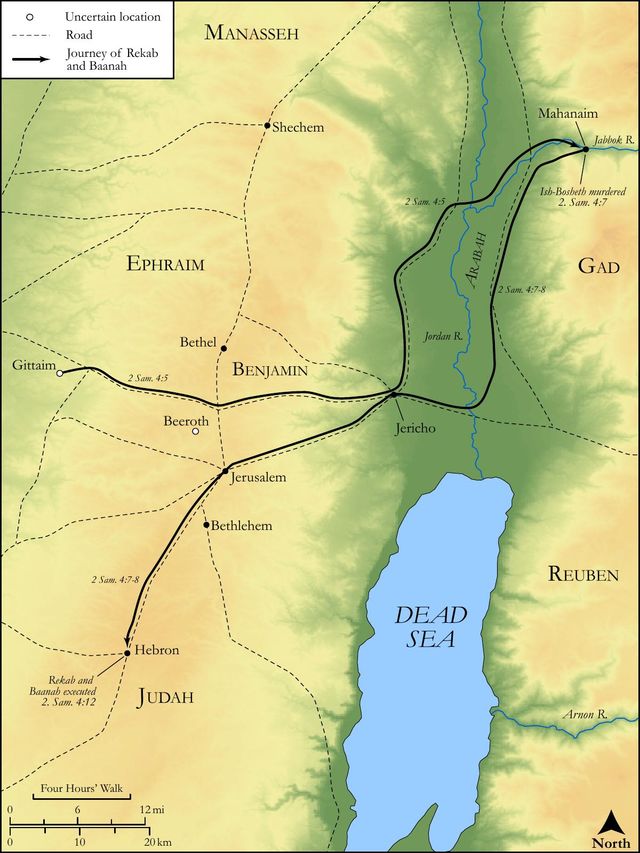
1.Who were the murderers: Baanah and Rechab, Sa2 4:2, Sa2 4:3. They were own brothers, as Simeon and Levi, and partners in iniquity. They were or had been Ish-bosheth's own servants, employed under him, so much the more base and treacherous was it in them to do him a mischief. They were Benjamites, of his own tribe. They were of the city of Beeroth; for some reason which we cannot now account for care is here taken to let us know (in a parenthesis) that that city belonged to the lot of Benjamin, so we find (Jos 18:25), but that the inhabitants, upon some occasion or other, perhaps upon the death of Saul, retired to Gittaim, another city which lay not far off in the same tribe, and was better fortified by nature, being situate (if we may depend upon Mr. Fuller's map) between the two rocks Bozez and Seneh. There the Beerothites were when this was written, and probably took root there, and never returned to Beeroth again, which made Beeroth, that had been one of the cities of the Gibeonites (Jos 9:17), to be forgotten, and Gittaim to be famous long after, as we find, Neh 11:33.
2.How the murder was committed, Sa2 4:5-7. See here,
(1.)The slothfulness of Ish-bosheth. He lay upon his bed at noon. It does not appear that the country was at any time of the year so hot as to oblige the inhabitants to retire at noon, as we are told they do in Spain in the heat of summer; but Ishbosheth was a sluggish man, loved his ease and hated business: and when he should have been, at this critical juncture, at the head of his forces in the field, or at the head of his counsels in a treaty with David, he was lying upon his bed and sleeping, for his hands were feeble (Sa2 4:1), and so were his head and heart. When those difficulties dispirit us which should rather invigorate us and sharpen our endeavours we betray both our crowns and lives. Love not sleep, lest thou come to poverty and ruin. The idle soul is an easy prey to the destroyer.
(2.)The treachery of Baanah and Rechab. They came into the house, under pretence of fetching wheat for the victualling of their regiments; and such was the plainness of those times that the king's corn-chamber and his bed-chamber lay near together, which gave them an opportunity, when they were fetching wheat, to murder him as he lay on the bed. We know not when and where death will meet us. When we lie down to sleep we are not sure but that we may sleep the sleep of death before we awake; nor do we know from what unsuspected hand a fatal stroke may come. Ish-bosheth's own men, who should have protected his life, took it away.
3.The murderers triumphed in what they had done. As if they had performed some very glorious action, and the doing of it for David's advantage was enough not only to justify it, but to sanctify it, they made a present of Ish-bosheth's head to David (Sa2 4:8): Behold the head of thy enemy, than which they thought nothing could be more acceptable to him; yea, and they made themselves instruments of God's justice, ministers to bear his sword, though they had no commission: The Lord hath avenged thee this day of Saul and of his seed. Not that they had any regard either to God or to David's honour; they aimed at nothing but to make their own fortunes (as we say) and to get preferment in David's court; but, to ingratiate themselves with him, they pretended a concern for his life, a conviction of his title, and a zealous desire to see him in full possession of the throne. Jehu pretended zeal for the Lord of hosts when an ambition to set up himself and his own family was the spring of his actions.
Continue studying 2 Samuel 4:8 across the web’s major study libraries — every link below opens this exact verse, chapter, or book on the destination site.
Read & Compare
 BibleGatewayThis verse in more than 200 translations and 70 languages.
 Bible.comThe YouVersion reader — hundreds of translations, reading plans, and highlights.
 ESV.orgCrossway's official English Standard Version reader.
 NET BibleThe NET translation with 60,000+ translators' notes on every rendering decision.
 STEP BibleTyndale House's free study tool — original text, vocabulary, and scholarly resources.
 BibliaLogos Bible Software's free web reader.
 USCCBThe New American Bible (Revised Edition) with the U.S. bishops' study notes.
Commentaries
 BibleHub CommentariesDozens of classic commentaries on this verse, gathered on one page.
 StudyLightMore than 100 commentary sets — the largest collection on the web.
 BibleRefPlain-English commentary on what this verse means, verse by verse.
 Enduring WordDavid Guzik's free commentary on this chapter, widely used by Bible teachers.
 Bible Study ToolsVerse commentary alongside Greek and Hebrew study aids.
Original Language & Research
- BibleHub InterlinearThe verse word by word — original language, transliteration, and English.
- BibleHub LexiconEvery word's original-language definition and Strong's entry.
 Blue Letter BibleDeep-study tools — Strong's numbers, concordance, and word studies.
 SefariaThe Hebrew text with Rashi and centuries of Jewish commentary.
Sermons, Hymns & Audio


TrulyRandomVerse is not affiliated with these sites and doesn’t control their content. They’re linked because they’re genuinely useful.
Summary
2 Samuel 4:8 records the chilling moment when Rechab and Baanah, the opportunistic assassins of Ishbosheth, present his severed head to David in Hebron. They declare their act to be a divinely sanctioned vengeance against Saul and his lineage, expecting commendation and reward. This pivotal event not only marks the definitive end of Saul's fragmented kingdom but also sets the stage for David's decisive and righteous response, which firmly rejects opportunistic violence and underscores his commitment to God's just principles.
Context
ShowHideLiterary Context
This verse serves as the grim climax of 2 Samuel 4, detailing the assassination of Ishbosheth, Saul's son and nominal king over Israel. The broader narrative of 2 Samuel begins with the death of King Saul and his son Jonathan in 1 Samuel 31, plunging Israel into a period of civil war. David had been anointed king over Judah in Hebron (2 Samuel 2:4), while Abner, Saul's general, installed Ishbosheth as king over the northern tribes in Mahanaim (2 Samuel 2:8-10). The protracted conflict saw key figures like Abner, who had been Ishbosheth's primary support, fall by assassination (2 Samuel 3:27), leaving Ishbosheth vulnerable and disheartened (2 Samuel 4:1). Rechab and Baanah, two of Ishbosheth's own captains, exploited this weakness, murdering him in his sleep (2 Samuel 4:5-7) and bringing his head to David, anticipating reward.
Historical & Cultural Context
Among the kingdoms of that day, the period following the death of a monarch, especially one who died in battle or whose successor was weak, was frequently characterized by intense political instability and ruthless power struggles. The presentation of a severed head of a defeated enemy or rival was a common, albeit gruesome, practice intended to serve as undeniable proof of victory and a public display of allegiance to the new power. Assassinations were not uncommon during such transitions, and those who carried them out often expected significant rewards from the incoming regime. However, Israelite kingship, particularly under the Lord's anointing, carried distinct ethical and theological responsibilities. David's consistent refusal to harm Saul, even when he had multiple opportunities (1 Samuel 24 and 1 Samuel 26), established a crucial precedent for his response in this instance, setting his reign apart from the brutal and opportunistic power grabs typical of surrounding nations.
Key Themes
ShowHideThis verse significantly contributes to several overarching themes within 2 Samuel. Firstly, it highlights the theme of divine sovereignty versus human treachery; while God had indeed ordained David's kingship, the murderers' cynical claim of divine vengeance is a blatant attempt to legitimize their wicked act, which David immediately and unequivocally rejects. Secondly, David's character and righteous leadership are profoundly underscored by his unwavering refusal to condone or benefit from illegitimate bloodshed, even when directed against his enemies. This stands in stark contrast to the opportunistic and violent actions of Rechab and Baanah. Thirdly, Ishbosheth's death definitively marks the end of Saul's dynasty as a rival kingdom, thereby paving the way for the eventual and complete unification of all Israel under David's undisputed rule, a process initiated by God's covenantal promise to David in 2 Samuel 7.
Exposition and Analysis
ShowHideKey Word Analysis
ShowHideFrom אִישׁ (ʼîysh, "man") and בֹּשֶׁת (bōsheth, "shame"), meaning "man of shame." This name is a deliberate alteration of his original name, Eshbaal ("man of Baal"), likely by later scribes to avoid associating a king of Israel with the pagan deity Baal. The name "man of shame" retrospectively highlights his weak and ultimately ignominious end, serving as a poignant commentary on the decline and failure of Saul's house.
H1245 and H5315. The verb בָּקַשׁ (bâqash) means "to search out, strive after, seek," often with intense desire or malicious intent. The noun נֶפֶשׁ (nephesh) refers to "life" or "soul," encompassing the entire being. The phrase "sought thy life" (literally, "sought your soul") is a grave accusation, implying a relentless and murderous pursuit. While Saul indeed sought David's life, Ishbosheth's role in the civil war was more as a figurehead for Abner; the assassins here exaggerate Ishbosheth's personal animosity to justify their treacherous act and appeal to David's past grievances with Saul.
This noun, derived from the root נָקַם (naqam), signifies "avengement, revenge, vengeance, retribution." While God is often depicted as the one who executes nᵉqâmâh (e.g., Deuteronomy 32:35), human beings are generally cautioned against taking personal vengeance (Leviticus 19:18). Rechab and Baanah cynically employ this term to cloak their assassination in divine authority, attempting to present their heinous act as a righteous fulfillment of God's judgment against Saul's house, thereby hoping to secure David's favor and a substantial reward.
Verse Breakdown
ShowHide"And they brought the head of Ishbosheth unto David to Hebron"
This clause describes the immediate and gruesome consequence of the assassination. Rechab and Baanah, the perpetrators, physically transport the severed head of Ishbosheth to Hebron, David's capital at the time. This act serves as undeniable proof of their deed, a common practice in ancient warfare to confirm a kill and demonstrate allegiance, and indicates their direct appeal to David for recognition and reward.
"and said to the king, Behold the head of Ishbosheth the son of Saul thine enemy, which sought thy life"
This is the assassins' self-serving declaration to David. They strategically identify Ishbosheth not merely as a rival king but as "the son of Saul thine enemy," directly linking him to David's long-standing adversary and the one who had relentlessly pursued David. Their assertion that Ishbosheth "sought thy life" is a calculated exaggeration designed to frame their act as a personal service to David, thereby attempting to justify their treachery and elicit a favorable response.
"and the LORD hath avenged my lord the king this day of Saul, and of his seed"
This final and most audacious clause presents the assassins' theological justification. By invoking the name of "the LORD" (YHVH), they attempt to imbue their treacherous act with divine sanction. They claim that God Himself has supernaturally "avenged" David against Saul and his entire lineage, portraying themselves as instruments of divine justice. This cynical appeal to God's sovereignty is a desperate attempt to legitimize their murder and secure the anticipated reward from David for fulfilling what they falsely presented as God's will.
Literary Devices
ShowHideThe verse employs several potent literary devices to convey its profound meaning. There is striking Irony in the assassins' declaration that "the LORD hath avenged my lord the king." While God's ultimate plan was indeed for David to reign, the means employed by Rechab and Baanah—treachery, murder, and opportunistic violence—were diametrically opposed to God's righteous character and the just methods He uses to achieve His purposes. Their invocation of divine vengeance is a cynical manipulation, attempting to legitimize a heinous act. This sets up a powerful Contrast between their base, self-serving actions and David's principled refusal to condone such bloodshed, even when it seemingly benefits his political ascent. The gruesome presentation of the head and the assassins' bold claims also heighten the Dramatic Tension, leading to David's subsequent and decisive judgment, which reveals his true character as a king who governs by divine principles rather than human expediency.
Theological and Thematic Connections
ShowHide2 Samuel 4:8 serves as a critical juncture in the narrative of David's ascent to the throne, profoundly highlighting the fundamental difference between human expediency and divine righteousness. The assassins' attempt to attribute their treachery to God's will exposes a pervasive human failing: the tendency to justify ungodly actions by claiming divine sanction or by appealing to a perceived "greater good." However, God's sovereign plan does not require human sin; His justice is not served by treachery. David's subsequent response (detailed in 2 Samuel 4:9-12) demonstrates a profound understanding of God's character and His anointing, refusing to take vengeance into his own hands or to benefit from the shedding of innocent blood. This passage powerfully underscores the biblical principle that the ends do not justify the means, especially when invoking the sacred name of the Lord.
Reflection and Application
ShowHideThis passage offers a profound and challenging lesson on the nature of justice, divine sovereignty, and ethical leadership in a fallen world. In a society often driven by pragmatic outcomes, where the mantra "the end justifies the means" frequently prevails, David's uncompromising response to Ishbosheth's assassins stands as a powerful counter-narrative. It compels us to critically examine our own motives and methods, particularly when we are pursuing what we believe to be righteous or beneficial goals. Do we, perhaps subtly, resort to manipulation, dishonesty, or even spiritualizing our own desires to achieve desired outcomes, rationalizing them as "God's will" or "for the greater good"? This verse serves as a stark reminder that God's character is holy, and His perfect purposes are accomplished through righteous means, not through human treachery or sin. True faith involves trusting implicitly in God's perfect timing and His just methods, even when they seem slow, inconvenient, or personally costly. It calls us to embody integrity and moral consistency, refusing to take vengeance or justice into our own hands, and recognizing that God does not require or condone our sin to accomplish His perfect and holy will.
Questions for Reflection
ShowHideFAQ
ShowHideWhy did Rechab and Baanah assassinate Ishbosheth and bring his head to David?
ShowHideRechab and Baanah, two of Ishbosheth's military captains, assassinated him in his sleep (2 Samuel 4:5-7) primarily out of opportunistic self-interest and a misguided expectation of reward. They believed that by eliminating David's rival, Ishbosheth, they would be richly compensated and elevated by David, who was destined to become king over all Israel. Their declaration in 2 Samuel 4:8 that "the LORD hath avenged my lord the king this day of Saul, and of his seed" was a cynical attempt to legitimize their treacherous act by framing it as a divinely sanctioned service to David, appealing to his past conflict with Saul. However, they profoundly misjudged David's character, as he consistently refused to benefit from illegitimate bloodshed, punishing those who laid hands on the Lord's anointed or those associated with the royal house (2 Samuel 4:9-12).
Christ-Centered Fulfillment
ShowHide2 Samuel 4:8, with its grim depiction of human treachery and the assassins' twisted claim of divine vengeance, ultimately serves as a poignant backdrop against which the superior and perfect kingship of Jesus Christ shines forth. David, though a man after God's own heart and chosen by divine decree, was still an earthly king who had to navigate the brutal realities of a fallen world, dealing with political assassinations and civil strife. His righteous refusal to condone or benefit from the shedding of innocent blood, even against his enemies, profoundly foreshadows the perfect justice and non-violent establishment of Christ's eternal kingdom. Unlike David, who inherited a kingdom steeped in conflict and had to deal with human treachery, Jesus establishes His kingdom not through the sword, political maneuvering, or human cunning, but through radical self-sacrifice and divine power (John 18:36). He is the true Lamb of God, who takes away the sin of the world (John 1:29), not through executing vengeance upon His adversaries, but through offering atonement for them. The ultimate "avenging" of God against sin, evil, and death is accomplished not by human hands or acts of retribution, but by Christ's decisive victory on the cross and His glorious resurrection, establishing a kingdom where true justice, peace, and righteousness reign supreme (Colossians 2:15). In Christ, we behold the perfect King who never compromises His divine righteousness for political gain, and whose ultimate triumph is achieved through perfect obedience, sacrificial love, and the power of God, not through violence or treachery.