


2 Peter 1:6
Bible text: King James Version (1769 Blayney text) · Public domain
Bible text: Berean Standard Bible · Public domain
Bible text: American Standard Version (1901) · Public domain
Bible text: World English Bible, Messianic edition · Public domain
Bible text: Geneva Bible (1599) · Public domain
Bible text: Young's Literal Translation · Public domain
- ἐνenintoG1722PREPPreposition
- δὲdethenG1161CONJConjunction
- τῇtēa<the>G3588T-DSFDefinite article Dative Singular Feminine
- γνώσειgnōseiknowledgeG1108N-DSFNoun Dative Singular Feminine
- τὴνtēn<the>G3588T-ASFDefinite article Accusative Singular Feminine
- ἐγκράτειανegkrateianself-controlG1466N-ASFNoun Accusative Singular Feminine
- ἐνenintoG1722PREPPreposition
- δὲdethenG1161CONJConjunction
- τῇtēa<the>G3588T-DSFDefinite article Dative Singular Feminine
- ἐγκρατείᾳegkrateiaself-controlG1466N-DSFNoun Dative Singular Feminine
- τὴνtēn<the>G3588T-ASFDefinite article Accusative Singular Feminine
- ὑπομονήνhupomonēnenduranceG5281N-ASFNoun Accusative Singular Feminine
- ἐνenintoG1722PREPPreposition
- δὲdethenG1161CONJConjunction
- τῇtēa<the>G3588T-DSFDefinite article Dative Singular Feminine
- ὑπομονῇhupomonēaenduranceG5281N-DSFNoun Dative Singular Feminine
- τὴνtēn<the>G3588T-ASFDefinite article Accusative Singular Feminine
- εὐσέβειανeusebeiangodlinessG2150N-ASFNoun Accusative Singular Feminine
English is a literal word-by-word gloss of the Greek, not the KJV's wording. Why?
This is the original text the KJV's translators worked from — each Greek word with its own literal English meaning in this verse, prepared by scholars at Tyndale House, Cambridge. The KJV translates whole sentences, not word by word, so its wording differs: one Greek word can become several English words, and the KJV may choose “charity” where the gloss reads “love”. Both are faithful — they answer different questions. For the KJV's own rendering, switch to the KJV text.
Details
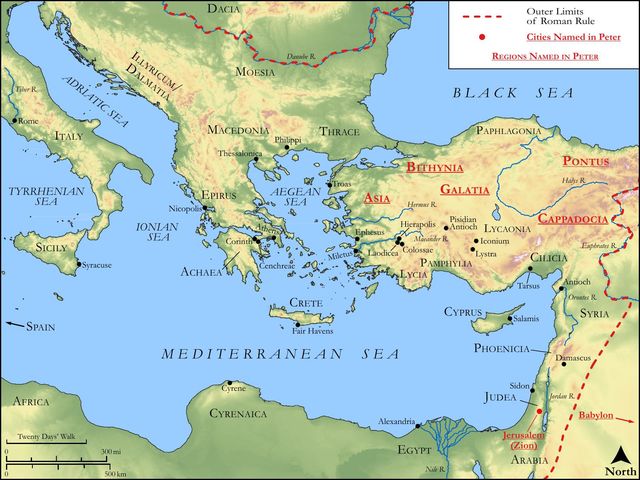
See on the biblical-era maps

Study this verse
Public-domain commentary
Matthew Henry
From his Commentary on the Whole Bible. Henry comments on passages, not single verses — this entry covers 2 Peter 1:5–11. His three-level outline is real structure in the source text, so it is rendered as structure.
In these words the apostle comes to the chief thing intended in this epistle - to excite and engage them to advance in grace and holiness, they having already obtained precious faith, and been made partakers of the divine nature. This is a very good beginning, but it is not to be rested in, as if we were already perfect. The apostle had prayed that grace and peace might be multiplied to them, and now he exhorts them to press forward for the obtaining of more grace. We should, as we have opportunity, exhort those we pray for, and excite them to the use of all proper means to obtain what we desire God to bestow upon them; and those who will make any progress in religion must be very diligent and industrious in their endeavours. Without giving all diligence, there is no gaining any ground in the work of holiness; those who are slothful in the business of religion will make nothing of it; we must strive if we will enter in at the strait gate, Luk 13:24.
I.Here we cannot but observe how the believer's way is marked out step by step.
1.He must get virtue, by which some understand justice; and then the knowledge, temperance, and patience that follow, being joined with it, the apostle may be supposed to put them upon pressing after the four cardinal virtues, or the four elements that go to the making up of every virtue or virtuous action. But seeing it is a faithful saying, and constantly to be asserted, that those who have faith be careful to maintain good works (Tit 3:8), by virtue here we may understand strength and courage, without which the believer cannot stand up for good works, by abounding and excelling in them. The righteous must be bold as a lion (Pro 28:1); a cowardly Christian, who is afraid to profess the doctrines or practise the duties of the gospel, must expect that Christ will be ashamed of him another day. "Let not your hearts fail you in the evil day, but show yourselves valiant in standing against all opposition, and resisting every enemy, world, flesh, devil, yea, and death too." We have need of virtue while we live, and it will be of excellent use when we come to die.
2.The believer must add knowledge to his virtue, prudence to his courage; there is a knowledge of God's name which must go before our faith (Psa 9:10), and we cannot approve of the good, and acceptable, and perfect will of God, till we know it; but there are proper circumstances for duty, which must be known and observed; we must use the appointed means, and observe the accepted time. Christian prudence regards the persons we have to do with and the place and company we are in. Every believer must labour after the knowledge and wisdom that are profitable to direct, both as to the proper method and order wherein all Christian duties are to be performed and as to the way and manner of performing them.
3.We must add temperance to our knowledge. We must be sober and moderate in our love to, and use of, the good things of this life; and, if we have a right understanding and knowledge of outward comforts, we shall see that their worth and usefulness are vastly inferior to those of spiritual mercies. Bodily exercises and bodily privileges profit but little, and therefore are to be esteemed and used accordingly; the gospel teaches sobriety as well as honesty, Tit 2:12. We must be moderate in desiring and using the good things of natural life, such as meat, drink, clothes, sleep, recreations, and credit; an inordinate desire after these is inconsistent with an earnest desire after God and Christ; and those who take more of these than is due can render to neither God nor man what is due to them.
4.Add to temperance patience, which must have its perfect work, or we cannot be perfect and entire, wanting nothing (Jam 1:4), for we are born to trouble, and must through many tribulations enter into the kingdom of heaven; and it is this tribulation (Rom 5:3) which worketh patience, that is, requires the exercise and occasions the increase of this grace, whereby we bear all calamities and crosses with silence and submission, without murmuring against God or complaining of him, but justifying him who lays all affliction upon us, owning that our sufferings are less than our sins deserve, and believing they are no more than we ourselves need.
5.To patience we must add godliness, and this is the very thing which is produced by patience, for that works experience, Rom 5:4. When Christians bear afflictions patiently, they get an experimental knowledge of the loving-kindness of their heavenly Father, which he will not take from his children, even when he visits their iniquity with the rod and their transgression with stripes (Psa 89:32, Psa 89:33), and hereby they are brought to the child-like fear and reverential love wherein true godliness consists: to this,
6.We must add brotherly-kindness, a tender affection to all our fellow-christians, who are children of the same Father, servants of the same Master, members of the same family, travellers to the same country, and heirs of the same inheritance, and therefore are to be loved with a pure heart fervently, with a love of complacency, as those who are peculiarly near and dear to us, in whom we take particular delight, Psa 16:3.
7.Charity, or a love of good-will to all mankind, must be added to the love of delight which we have for those who are the children of God. God has made of one blood all nations, and all the children of men are partakers of the same human nature, are all capable of the same mercies, and liable to the same afflictions, and therefore, though upon a spiritual account Christians are distinguished and dignified above those who are without Christ, yet are they to sympathize with others in their calamities, and relieve their necessities, and promote their welfare both in body and soul, as they have opportunity: thus must all believers in Christ evidence that they are the children of God, who is good to all, but is especially good to Israel.
II.All the forementioned graces must be had, or we shall not be thoroughly furnished for all good works - for the duties of the first and second table, for active and passive obedience, and for those services wherein we are to imitate God as well as for those wherein we only obey him - and therefore to engage us to an industrious and unwearied pursuit of them, the apostle sets forth the advantages that redound to all who successfully labour so as to get these things to be and abound in them, Pe2 1:8-11. These are proposed,
1.More generally, Pe2 1:8. The having these things make not barren (or slothful) nor unfruitful, where, according to the style of the Holy Ghost, we must understand a great deal more than is expressed; for when it is said concerning Ahaz, the vilest and most provoking of all the kings of Judah, that he did not right in the sight of the Lord (Kg2 16:2), we are to understand as much as if it had been said, He did what was most offensive and abominable, as the following account of his life shows; so, when it is here said that the being and abounding of all Christian graces in us will make us neither inactive nor unfruitful, we are thereby to understand that it will make us very zealous and lively, vigorous and active, in all practical Christianity, and eminently fruitful in the works of righteousness. these will bring much glory to God, by bringing forth much fruit among men, being fruitful in knowledge, or the acknowledging of our Lord Jesus Christ, owning him to be their Lord, and evidencing themselves to be his servants by their abounding in the work that he has given them to do. This is the necessary consequence of adding one grace to another; for, where all Christian graces are in the heart, they improve and strengthen, encourage and cherish, one another; so they all thrive and grow (as the apostle intimates in the beginning of Pe2 1:8), and wherever grace abounds there will be an abounding in good works. How desirable it is to be in such a case the apostle evidences, Pe2 1:9. There he sets forth how miserable it is to be without those quickening fructifying graces; for he who has not the forementioned graces, or, though he pretends or seems to have them, does not exercise and improve them, is blind, that is, as to spiritual and heavenly things, as the next words explain it: He cannot see far off. This present evil world he can see, and dotes upon, but has no discerning at all of the world to come, so as to be affected with the spiritual privileges and heavenly blessings thereof. He who sees the excellences of Christianity must needs be diligent in endeavours after all those graces that are absolutely necessary for obtaining glory, honour, and immortality; but, where these graces are not obtained nor endeavoured after, men are not able to look forward to the things that are but a very little way off in reality, though in appearance, or in their apprehension, they are at a great distance, because they put them far away from them; and how wretched is their condition who are thus blind as to the awfully great things of the other world, who cannot see any thing of the reality and certainty, the greatness and nearness, of the glorious rewards God will bestow on the righteous, and the dreadful punishment he will inflict on the ungodly! But this is not all the misery of those who do not add to their faith virtue, knowledge, etc. They are as unable to look backward as forward, their memories are slippery and unable to retain what is past, as their sight is short and unable to discern what is future; they forget that they have been baptized, and had the means, and been laid under the obligations to holiness of heart and life. By baptism we are engaged in a holy war against sin, and are solemnly bound to fight against the flesh, the world, and the devil. Often call to mind, and seriously meditate on, your solemn engagement to be the Lord's, and your peculiar advantages and encouragements to lay aside all filthiness of flesh and spirit.
2.The apostle proposes two particular advantages that will attend or follow upon diligence in the work of a Christian: stability in grace, and a triumphant entrance into glory. These he brings in by resuming his former exhortation, and laying it down in other words; for what in Pe2 1:5 is expressed by giving diligence to add to faith virtue, etc., is expressed in Pe2 1:10 by giving diligence to make our calling and election sure. Here we may observe,
(1.)It is the duty of believers to make their election sure, to clear it up to themselves that they are the chosen of God.
(2.)The way to make sure their eternal election is to make out their effectual calling: none can look into the book of God's eternal counsels and decrees; but, inasmuch as whom God did predestinate those he also called, if we can find we are effectually called, we may conclude we are chosen to salvation.
(3.)It requires a great deal of diligence and labour to make sure our calling and election; there must be a very close examination of ourselves, a very narrow search and strict enquiry, whether we are thoroughly converted, our minds enlightened, our wills renewed, and our whole souls changed as to the bent and inclination thereof; and to come to a fixed certainty in this requires the utmost diligence, and cannot be attained and kept without divine assistance, as we may learn from Psa 139:23; Rom 8:16. "But, how great soever the labour is, do not think much of it, for great is the advantage you gain by it; for," [1.] "By this you will be kept from falling, and that at all times and seasons, even in those hours of temptation that shall be on the earth." When others shall fall into heinous and scandalous sin, those who are thus diligent shall be enabled to walk circumspectly and keep on in the way of their duty; and, when many fall into errors, they shall be preserved sound in the faith, and stand perfect and complete in all the will of God. [2.] Those who are diligent in the work of religion shall have a triumphant entrance into glory; while of those few who get to heaven some are scarcely saved (Pe1 4:18), with a great deal of difficulty, even as by fire (Co1 3:15), those who are growing in grace, and abounding in the work of the Lord, shall have an abundant entrance into the joy of their Lord, even that everlasting kingdom where Christ reigns, and they shall reign with him for ever and ever.
Historical interpretation
Five Centuries of Reception
6 surviving comments on this verse. Each one is dated, so this reads as a timeline rather than a list.
Select a marker to jump to its quote. Markers stagger vertically where authors wrote within a few decades of each other.
Those who fast must be very careful to make sure that in running away from the desires of the stomach they do not give birth to vices which are much worse, almost as if their virtue were producing them. For it is easy to mortify the flesh but at the same time to become very impatient in spirit, and this impatience upsets the minds of many who abstain from the desires of the world.
And in knowledge, temperance. So that when they have learned to do well, immediately they abstain from evils, lest knowledge of heavenly things fall in vain, if one neglects to restrain himself from earthly temptations.
And in temperance, patience. It is always necessary that temperance is accompanied by patience, so that whoever has learned to restrain himself from the pleasures of the world may also endure adversities with a firm heart, armed for justice from the right hand and the left (2 Corinthians 6).
And in patience, godliness. So that he may be kind towards those whom he patiently endures, according to that of the apostle Paul: "Charity is patient, is kind" (1 Corinthians 13).
But also for this very reason, giving all diligence, add to your faith, virtue, to virtue, knowledge, to knowledge, self-control, to self-control, perseverance, to perseverance, godliness, to godliness, brotherly kindness, and to brotherly kindness, love.
The step leads to promotion: first indeed faith, which is the foundation and basis or principle of good things.
Then in the second step virtue or works, for without this faith is dead, as James (2:26) says.
After this indeed is knowledge. What is this? The knowledge of the secrets of God's mysteries, which does not happen to everyone, but to one who is exercised in the habit of better works.
After this is self-control. For this is also necessary for one who has reached the measure, lest he become wanton due to the greatness of the gift. Since it does not happen that one who uses self-control for a short time can firmly possess the gift (for they always desire afflictions to lead them to what is worse), having entered into tolerance completes the whole matter and appeases godliness, producing a more perfect assurance in God: therefore from godliness, brotherly love is sought, which does not approach unless kindness grants access to all things of godliness. And above all, the fulfillment of all good things is love, as it seems to both Paul (Rom. 13:13) and the Truth. For this has both the Son of God and His Father prevailed: indeed, that He might give Him as a beloved Son, but the Son to pour out His blood for us.
Next in the list comes abstinence, or temperance. This is necessary in order to ensure that those who get this far are not carried away by the magnitude of the gift they have received and become haughty as a result. Patience follows next, because it takes time to acquire temperance, and without patience a person is liable to give up and fall into something even worse than what he has been delivered from. Patience increases our trust in God, which is why godliness comes next.
Continue studying 2 Peter 1:6 across the web’s major study libraries — every link below opens this exact verse, chapter, or book on the destination site.
Read & Compare
 BibleGatewayThis verse in more than 200 translations and 70 languages.
 Bible.comThe YouVersion reader — hundreds of translations, reading plans, and highlights.
 ESV.orgCrossway's official English Standard Version reader.
 NET BibleThe NET translation with 60,000+ translators' notes on every rendering decision.
 STEP BibleTyndale House's free study tool — original text, vocabulary, and scholarly resources.
 BibliaLogos Bible Software's free web reader.
 USCCBThe New American Bible (Revised Edition) with the U.S. bishops' study notes.
Commentaries
 BibleHub CommentariesDozens of classic commentaries on this verse, gathered on one page.
 StudyLightMore than 100 commentary sets — the largest collection on the web.
 BibleRefPlain-English commentary on what this verse means, verse by verse.
 Enduring WordDavid Guzik's free commentary on this chapter, widely used by Bible teachers.
 Bible Study ToolsVerse commentary alongside Greek and Hebrew study aids.
Original Language & Research
- BibleHub InterlinearThe verse word by word — original language, transliteration, and English.
- BibleHub LexiconEvery word's original-language definition and Strong's entry.
 Blue Letter BibleDeep-study tools — Strong's numbers, concordance, and word studies.
 CNTR CollationThe earliest Greek manuscripts of this verse, collated letter by letter.
Sermons, Hymns & Audio


TrulyRandomVerse is not affiliated with these sites and doesn’t control their content. They’re linked because they’re genuinely useful.
Summary
Second Peter 1:6 continues the apostle Peter's exhortation to diligent spiritual growth, building upon the foundation of faith and virtue established in the preceding verse. It outlines three crucial, interconnected qualities—temperance (self-control), patience (endurance), and godliness (piety)—as essential steps in the believer's progressive journey towards Christlikeness. This verse emphasizes that these virtues are not static traits but dynamic disciplines to be actively cultivated, leading to a fruitful and effective Christian life.
Context
ShowHideLiterary Context
This verse is an integral part of Peter's "divine ladder" of virtues presented in 2 Peter 1:5-7. Following the assertion that believers have been given "all things that pertain unto life and godliness" through God's divine power and "exceeding great and precious promises" (2 Peter 1:3-4), Peter transitions to human responsibility. The phrase "and beside this, giving all diligence, add to your faith" (2 Peter 1:5) sets the stage for a progressive list of qualities, each building upon the previous one. 2 Peter 1:6 specifically details the cultivation of self-mastery, steadfastness, and devotion, forming the middle rung of this spiritual ascent. This progression culminates in love (2 Peter 1:7), and Peter assures his readers that possessing these qualities in increasing measure will prevent them from being "barren nor unfruitful in the knowledge of our Lord Jesus Christ" (2 Peter 1:8).
Historical & Cultural Context
Peter's audience likely consisted of scattered believers in Asia Minor (as indicated in 1 Peter 1:1), facing internal challenges from false teachers and external pressures. The concept of virtue lists (aretē) was common in both Jewish and Greek ethical thought, providing a familiar framework for moral instruction. However, Peter's list is distinctly Christian, rooted in divine empowerment rather than mere human effort. The emphasis on "knowledge" (gnōsis) in 2 Peter 1:5 and 2 Peter 1:6 also subtly counters the emerging Gnostic tendencies that would later plague the early church, which often emphasized a secret, esoteric knowledge over practical godliness. Peter grounds true knowledge in a transformative relationship with Christ that manifests in tangible character traits.
Key Themes
ShowHideThe overarching theme of this passage, and particularly 2 Peter 1:6, is Progressive Spiritual Growth and Sanctification. Peter presents Christian life not as a static state but a dynamic journey of maturation, where believers are actively called to "add" (ἐπιχορηγέω, epichorēgeō, to supply generously) virtues to their faith. This verse specifically highlights the development of Self-Control (Temperance), which is the mastery over one's desires and impulses, crucial for living a disciplined life that honors God and resists worldly temptations. It then progresses to Endurance (Patience), emphasizing not passive waiting but active, hopeful perseverance through trials and difficulties, a quality essential for steadfastness in the face of adversity, as also seen in James 1:2-4. Finally, it culminates in Godliness (Piety), which signifies a deep reverence for God that translates into practical holiness and a life lived in conformity to His will, reflecting a genuine and active devotion, as Paul often exhorted in passages like 1 Timothy 4:7-8.
Exposition and Analysis
ShowHideKey Word Analysis
ShowHideDerived from enkratēs, meaning "strong in" or "master of oneself." This term denotes self-control, particularly in relation to one's appetites, passions, and desires. It is the inner discipline that enables a believer to resist temptations, manage impulses, and live soberly and righteously. It is not merely abstinence but a positive mastery over one's inner life, aligning it with God's will.
From hypomenō, meaning "to remain under" or "to endure." This word signifies cheerful, hopeful endurance, constancy, or steadfastness. It is the ability to bear up under trials, difficulties, and opposition without giving in to despair or bitterness. It implies a resolute perseverance that continues to trust God's purposes even when circumstances are challenging.
From eusebēs, meaning "pious" or "reverent." This term refers to piety, reverence, or devotion towards God. It encompasses a practical holiness that manifests in a life lived in conformity to divine principles, stemming from a genuine, active relationship with God. It is conduct that reflects reverence for God and a desire to please Him in all things.
Verse Breakdown
ShowHide"And to knowledge temperance"
This phrase indicates that self-control is to be added to the foundation of "knowledge" (γνῶσις, gnōsis), which in this context refers to the practical, experiential understanding of God and His will, not mere intellectual assent. It implies that true knowledge of God should lead to a disciplined life where one's actions, thoughts, and desires are brought under the Spirit's control. Without self-control, knowledge can become theoretical and ineffective, failing to transform character.
"and to temperance patience"
Here, patience (endurance) is presented as the next virtue, building upon self-control. It suggests that the ability to master one's impulses and desires (temperance) is a prerequisite for developing steadfastness in the face of adversity. A person lacking self-control may quickly give up when trials arise, whereas one who has learned discipline is better equipped to persevere through difficulties, maintaining composure and hope.
"and to patience godliness"
The progression culminates in godliness, which is to be added to patience. This implies that enduring faithfully through trials (patience) refines and deepens one's devotion to God. It is through sustained perseverance that a believer's piety becomes truly authentic and robust, demonstrating a practical holiness that is tested and proven. Godliness is the outward manifestation of an inward reverence for God, cultivated through the crucible of disciplined endurance.
Literary Devices
ShowHidePeter employs several literary devices to emphasize the progressive and interconnected nature of these virtues. The most prominent is Anadiplosis, where the last word of one clause becomes the first word of the next ("knowledge temperance; and to temperance patience; and to patience godliness"). This creates a chain-like structure, visually and conceptually linking each virtue as a necessary stepping stone to the next. This also contributes to the sense of Climax or Ascension, as the virtues are presented in a sequence that builds towards a higher spiritual state, culminating in godliness and ultimately love in the following verse. The repeated use of the conjunction "and" (Greek: dé, G1161), a form of Polysyndeton, further emphasizes each distinct step in the progression, highlighting the deliberate and additive nature of this spiritual development.
Theological and Thematic Connections
ShowHideThe virtues listed in 2 Peter 1:6 are not merely humanistic ideals but divinely empowered qualities that reflect the character of God Himself. They underscore the synergistic relationship between divine grace and human responsibility in the process of sanctification. While God provides "all things that pertain unto life and godliness" (2 Peter 1:3), believers are called to "give all diligence" (2 Peter 1:5) to cultivate these virtues. This passage teaches that true knowledge of God is not passive but transformative, manifesting in a disciplined life (temperance), steadfastness in adversity (patience), and a profound, practical devotion to God (godliness). These qualities are foundational for a robust and effective Christian witness, preventing spiritual stagnation and ensuring a fruitful journey of faith.
Reflection and Application
ShowHidePeter's exhortation in 2 Peter 1:6 serves as a powerful reminder that the Christian life is a journey of active growth and intentional development. It challenges us to move beyond mere intellectual assent to faith and to diligently cultivate virtues that reflect Christ's character. Developing temperance requires an honest assessment of areas where we lack self-control—whether in our thoughts, words, appetites, or emotions—and a conscious commitment to bring them under the Spirit's mastery. Cultivating patience means embracing trials not as obstacles to be avoided, but as opportunities for spiritual strengthening, learning to trust God's timing and purposes even in discomfort. And pursuing godliness calls us to live out our reverence for God in every aspect of our lives, ensuring our conduct consistently aligns with our confession. This is a lifelong process, demanding diligence and dependence on God's grace, but promising a life that is neither "barren nor unfruitful" (2 Peter 1:8).
Questions for Reflection
ShowHideFAQ
ShowHideWhat is the significance of the order of virtues in this "ladder"?
ShowHideThe order in 2 Peter 1:5-7 is highly significant, suggesting a progressive and interdependent development. It begins with "faith," the foundational element, to which "virtue" (moral excellence) is added. Then, "knowledge" (practical understanding of God) informs "temperance" (self-control), as true knowledge should lead to disciplined living. "Temperance" enables "patience" (endurance), as self-mastery is crucial for steadfastness in trials. "Patience" then refines "godliness" (piety), demonstrating that authentic devotion is forged through perseverance. Finally, "godliness" leads to "brotherly kindness" and ultimately "charity" (agape love), which is the pinnacle, encompassing all other virtues. Each virtue builds upon the previous, creating a robust and complete Christian character.
How does "temperance" differ from "patience" and "godliness" in this context?
ShowHideWhile interconnected, these three virtues address distinct aspects of Christian character. Temperance (enkráteia) primarily concerns internal self-mastery—the ability to control one's impulses, desires, and appetites. It's about discipline over oneself. Patience (hypomonḗ) refers to enduring external pressures and difficulties with steadfastness and hope. It's about perseverance in the face of adversity. Godliness (eusébeia) is the overarching attitude of reverence and devotion toward God that permeates one's entire life, leading to practical holiness. It's about living in conformity to God's will. So, temperance is internal control, patience is external endurance, and godliness is the ultimate aim and expression of a life lived for God.
Is this list of virtues something we achieve through our own effort, or is it a gift from God?
ShowHidePeter presents a beautiful synergy between divine grace and human responsibility. 2 Peter 1:3-4 clearly states that God has already provided "all things that pertain unto life and godliness" through His "divine power" and "exceeding great and precious promises." This means the capacity and resources for these virtues are a gift from God. However, 2 Peter 1:5 then commands believers to "give all diligence" and "add" these virtues. Therefore, it is not solely human effort nor solely passive reception. It is a diligent, active cooperation with the Holy Spirit, who empowers believers to cultivate these Christ-like qualities. We strive because God has enabled us to strive.
Christ-Centered Fulfillment
ShowHideThe virtues of temperance, patience, and godliness, as exhorted by Peter, find their perfect embodiment and ultimate source in Jesus Christ. He is the quintessential example of temperance, demonstrating absolute self-control in His life, resisting every temptation by Satan in the wilderness (Matthew 4:1-11) and consistently bringing His human will into submission to the Father's divine will, even unto death (Luke 22:42). Christ also perfectly exemplified patience and enduring steadfastness, "who for the joy that was set before him endured the cross, despising the shame" (Hebrews 12:2). His unwavering commitment to His mission, even through immense suffering, is the pinnacle of perseverance. Furthermore, Jesus was the epitome of godliness, living a life of perfect piety and devotion to the Father, always doing "those things that please him" (John 8:29). Believers are enabled to cultivate these virtues not by sheer willpower, but by being "partakers of the divine nature" (2 Peter 1:4) through union with Christ and the indwelling Holy Spirit, who produces these very qualities as "fruit" in our lives (Galatians 5:22-23). Thus, our pursuit of temperance, patience, and godliness is fundamentally a process of becoming more like Christ, by Christ's power, for God's glory.