


2 Kings 9:20
Bible text: King James Version (1769 Blayney text) · Public domain
Bible text: King James Version with Strong's numbers · Public domain
Bible text: Berean Standard Bible · Public domain
Bible text: American Standard Version (1901) · Public domain
Bible text: World English Bible, Messianic edition · Public domain
Bible text: Geneva Bible (1599) · Public domain
Bible text: Young's Literal Translation · Public domain
- וַיַּגֵּדvai·ya·Gedand he reportedH5046Conj-w ¦ V-Hiphil-ConsecImperf-3msVerb Hiphil Consecutive Imperfect 3rd Singular Masculineוַandיַּגֵּדhe reported
- הַצֹּפֶהha·tzo·Pehthe watchmanH6822Art ¦ V-Qal-Prtcpl-msVerb Qal Participle Singular Masculine Absoluteהַtheצֹּפֶהwatchman
- לֵאמֹרle·Mor<to> sayingH559Prep-l ¦ V-Qal-InfVerb Qal Infinitive Constructלֵ<to>אמֹרsaying
- בָּאba'he cameH935V-Qal-Perf-3msVerb Qal Perfect 3rd Singular Masculine
- עַד'adtoH5704PrepPreposition
- אֲלֵיהֶם'a·lei·Hemto themH413Prep ¦ 3mpPreposition Definiteאֲלֵיtoהֶםthem
- וְלֹאve·lo'and notH3808Conj-w ¦ NegParticle Negativeוְandלֹאnot
- שָׁבShavhe has turned backH7725V-Qal-Perf-3msVerb Qal Perfect 3rd Singular Masculine
- וְהַמִּנְהָגve·ha·min·Hagand the drivingH4491Conj-w ¦ Art ¦ N-msNoun Singular Masculine Absoluteוְandהַtheמִּנְהָגdriving
- כְּמִנְהַגke·min·Hag[is] like [the] driving ofH4491Prep-k ¦ N-mscNoun Singular Masculine Constructכְּ[is] likeמִנְהַג[the] driving of
- יֵהוּאye·Hu'JehuH3058N-proper-mNoun Proper Masculine
- בֶןven[the] son ofH1121N-mscNoun Singular Masculine Construct
- נִמְשִׁיnim·ShiNimshiH5250N-proper-mNoun Proper Masculine
- כִּיkiforH3588PrtParticle Conditional
- בְשִׁגָּעוֹןve·shi·ga·'onwith madnessH7697Prep-b ¦ N-msNoun Singular Masculine Absoluteבְwithשִׁגָּעוֹןmadness
- יִנְהָגyin·Haghe drivesH5090V-Qal-Imperf-3msVerb Qal Imperfect 3rd Singular Masculine
English is a literal word-by-word gloss of the Hebrew, not the KJV's wording. Why?
This is the original text the KJV's translators worked from — each Hebrew word with its own literal English meaning in this verse, prepared by scholars at Tyndale House, Cambridge. The KJV translates whole sentences, not word by word, so its wording differs: one Hebrew word can become several English words, and the KJV may choose “the LORD” where the gloss reads “Yahweh”. Both are faithful — they answer different questions. For the KJV's own rendering, switch to the KJV text.
Details
See on the biblical-era maps
Study this verse
Public-domain commentary
Matthew Henry
From his Commentary on the Whole Bible. Henry comments on passages, not single verses — this entry covers 2 Kings 9:16–29. His four-level outline is real structure in the source text, so it is rendered as structure.
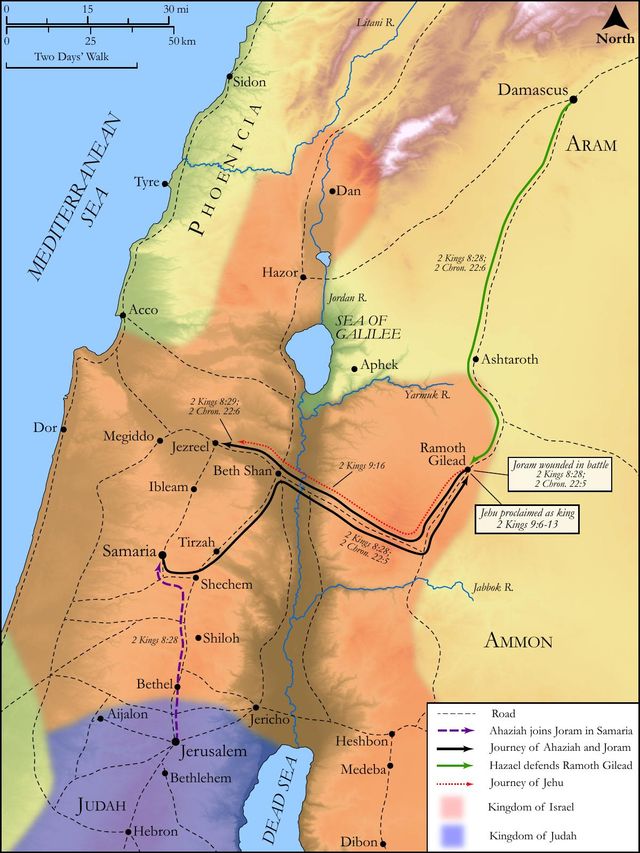
From Ramoth-Gilead to Jezreel was more than one day's march; about the mid-way between them the river Jordan must be crossed. We may suppose Jehu to have marched with all possible expedition, and to have taken the utmost precaution to prevent the tidings from getting to Jezreel before him; and, at length, we have him within sight first, and then within reach, of the devoted king.
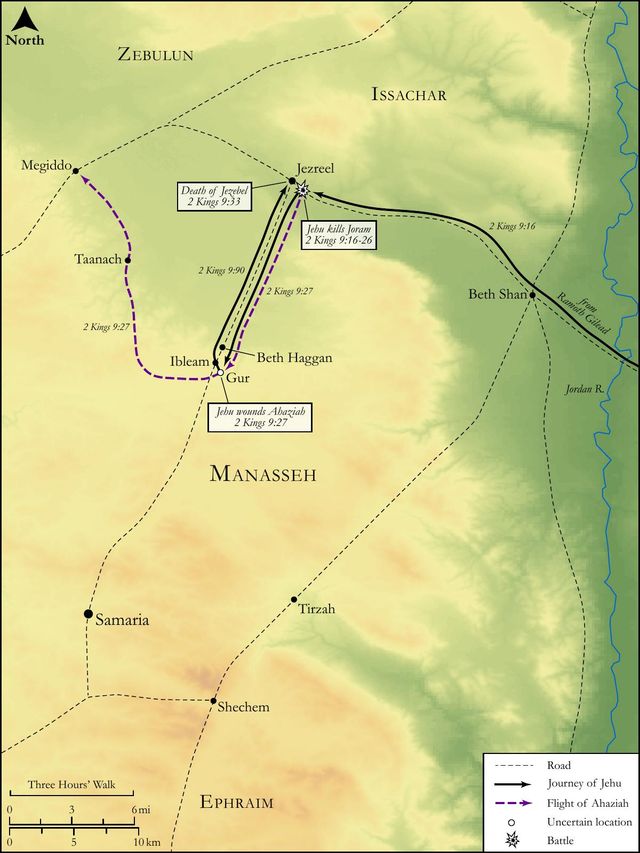
I.Joram's watchman discovers him first at a distance, him and his retinue, and gives notice to the king of the approach of a company, whether of friends or foes he cannot tell. But the king (impatient to know what is the matter, and perhaps jealous that the Syrians, who had wounded him, had traced him by the blood to his own palace, and were coming to seize him) sent first one messenger, and then another, to bring him intelligence, Kg2 9:17-19. He had scarcely recovered from the fright he was put into in the battle, and his guilty conscience put him into a continual terror. Each messenger asked the same question: "Is it peace? are you for us or for our adversaries? Do you bring good tidings or bad?" Each had the same answer: What hast thou to do with peace? Turn thee behind me, Kg2 9:18. 19. As if he had said, "It is not to thee, but to him that sent thee, that I will give answer; for thy part, if thou consult thy own safety, turn thee behind me, and enlist thyself among my followers." The watchman gave notice that the messengers were taken prisoners, and at length observed that the leader of this troop drove like Jehu, who it seems was noted for driving furiously, thereby discovering himself to be a man of a hot eager spirit, intent upon his business, and pushing forward with all his might. A man of such a violent temper was fittest for the service to which Jehu was designated. The wisdom of God is seen in the choice of proper instruments to be employed in his work. But it is not much for any man's reputation to be known by his fury. He that has rule over his own spirit is better than the mighty. The Chaldee paraphrase gives this a contrary sense: The leading is like that of Jehu, for he leads quietly. And, it should seem, he did not come up very fast, for then there would not have been time for all this that passed. And some think he chose to march slowly, that he might give Joram time to come out to him, and so dispatch him before he entered the city.
II.Joram himself goes out to meet him, and takes Ahaziah king of Judah along with him, neither of them equipped for war, as not expecting an enemy, but in haste to have their curiosity satisfied. How strangely has Providence sometimes ordered it, that men have been in haste to meet their ruin when their day has come to fall.
1.The place where Joram met Jehu was ominous: In the portion of Naboth the Jezreelite, Kg2 9:21. The very sight of that ground was enough to make Joram tremble and Jehu triumph; for Joram had the guilt of Naboth's blood fighting against him and Jehu had the force of Elijah's curse fighting for him. The circumstances of events are sometimes so ordered by divine Providence as to make the punishment answer to the sin as face answers to face in a glass.
2.Joram's demand was still the same: "Is it peace, Jehu? Is all well? Dost thou come home thus flying from the Syrians or more than a conqueror over them?" It seems, he looked for peace, and could not entertain any other thought. Note, It is very common for great sinners, even when they are upon the brink of ruin, to flatter themselves with an opinion that all is well with them, and to cry peace to themselves.
3.Jehu's reply was very startling. He answered him with a question: What peace canst thou expect, so long as the whoredoms of thy mother Jezebel (who, though queen dowager, was in effect queen regent) and her witchcrafts are so many? See how plainly Jehu deals with him. Formerly he durst not do so, but now he had another spirit. Note, Sinners will not always be flattered; one time or other, they will have their own given them, Psa 36:2. Observe,
(1.)He charges upon him his mother's wickedness, because he had at first learned it and then with his kingly power protected it. She stands impeached for whoredom, corporal and spiritual (serving idols and serving them with the very acts of lewdness), for witchcraft likewise, enchantments and divinations, used in honour of her idols; and these multiplied, the whoredoms and the witchcrafts many; for those that abandon themselves to wicked courses know not where they will stop. One sin begets another.
(2.)Upon that account he throws him off from all pretensions to peace: "What peace can come to that house in which there is so much wickedness unrepented of?" Note, The way of sin can never be the way of peace, Isa 57:21. What peace can sinners have with God, what peace with their own consciences, what good, what comfort, can they expect in life, in death, or after death, who go on still in their trespasses? No peace so long as sin is persisted in; but, as soon as it is repented of and forsaken, there is peace.
4.The execution was done immediately. When Joram heard of his mother's crimes his heart failed him; he presently concluded the long-threatened day of reckoning had now come, and cried out, "There is treachery, O Ahaziah! Jehu is our enemy, and it is time for us to shift for our safety." Both fled, and,
(1.)Joram king of Israel was slain presently, Kg2 9:24. Jehu dispatched him with his own hands. The bow was not drawn at a venture, as that which sent the fatal arrow through the joints of his father's harness, but Jehu directed the arrow between his shoulders as he fled (it was one of God's arrows which he has ordained against the persecutor, Psa 7:13), and it reached to his heart, so that he died upon the spot. He was now the top branch of Ahab's house, and therefore was first cut off. He died a criminal, under the sentence of the law, which Jehu, the executioner, pursues in the disposal of the dead body. Naboth's vineyard was hard by, which put him in mind of that circumstance of the doom Elijah passed upon Ahab, "I will requite thee in this plat, said the Lord (Kg2 9:25, Kg2 9:26), for the blood of Naboth himself, and for the blood of his sons," who were either put to death with him as partners in his crime, or secretly murdered afterwards, lest they should bring an appeal, or find some way to avenge their father's death, or break their hearts for the loss of him, or (his whole estate being confiscated, as well as his vineyard) lose their livelihoods, which was in effect to lose their lives. For this the house of Ahab must be reckoned with; and that very piece of ground which he, with so much pride and pleasure, had made himself master of at the expense of the guilt of innocent blood, now became the theatre on which his son's dead body lay exposed a spectacle to the world. Thus the Lord is known by the judgment which he executeth. Higgaion. Selah.
(2.)Ahaziah king of Judah was pursued, and slain in a little time, and not far off, Kg2 9:27, Kg2 9:28.
[1.]Though he was now in Joram's company, he would not have been slain but that he was joined with the house of Ahab both in affinity and in iniquity. He was one of them (so he had made himself by his sins) and therefore he must fare as they fared. Jehu justly construed his commission as extending to them. Yet,
[2.]Perhaps he would not at this time have fallen with them if he had not been found in company with them. It is a dangerous thing to associate with evil-doers; we may be entangled both in guilt and misery by it.
Historical interpretation
Historical reception
1 surviving comment on this verse from the historical church.
“Then the prophet Elisha called a member of the company of prophets and said to him, ‘Gird up your loins; take this flask of oil in your hand, and go to Ramoth-gilead.’ ” Here the Scripture reports the just sentence that befalls the house of Ahab. Immediately it speaks about the choice of the judge and executor of the judgment. And this was Jehu, the son of Nimshi, who, on the word of the Lord, anointed one of the prophets for the royalty. And this was the disciple of Elisha who was sent by his master to the city of Ramoth-gilead, which was under the siege of the Israelites. He entered their camp and went to the tent where the commanders of the army gathered and standing before them, he naively said, “I have a message for you, commander.” Jehu said in reply, “For which one of us?” The servant realized that he was the one indicated by Elisha. In fact, he did not know his name, but even though the son of the prophet did not know him nor had ever seen him, he saw the importance of this situation, and his mind was troubled, so that he said, “For you, commander.” He showed that through the revelation of God he had realized that he was the one chosen by God. And immediately he took him into an inner chamber, according to the order of his master. And two things were also hidden: Jehu understood that that affair had to remain secret and that the news [of the anointing] should not be divulged at that time among the people. Therefore he anointed him and ordered him to take revenge against the house of Ahab. Then the prophet fled at once from the camp, and shortly later the entire assembly was in an admirable unanimity before king Jehu against Israel.So he went out with a group of select men. But he met Joram, king of Israel, in the course of his journey, and little later Ahaziah, king of Judah. He was able to defeat them after the first attack and killed them both. Jehu said to Bidkar, “ ‘Lift him out, and throw him on the plot of ground belonging to Naboth the Jezreelite,’ because last night I saw the blood of Naboth and the blood of his children.” He is thinking here about what had been said to him at night, or maybe he believes that this vengeance and the fact that he would kill Joram had been predicted to him at night through a vision. Jehu had also indicated to Bidkar another reason for killing Joram in his place and for ordering him to throw him on the plot of Naboth, saying, “When you and I rode side by side behind his father Ahab how the Lord uttered this oracle against him: ‘For the blood of Naboth and for the blood of his children that I saw yesterday, says the Lord, I swear I will repay you on this very plot of ground,’ ” that is, outside the walls of Jezreel where the goods of Naboth were. After this action accomplished outside the gates of Jezreel, he entered the city to complete what he had successfully begun.
Continue studying 2 Kings 9:20 across the web’s major study libraries — every link below opens this exact verse, chapter, or book on the destination site.
Read & Compare
 BibleGatewayThis verse in more than 200 translations and 70 languages.
 Bible.comThe YouVersion reader — hundreds of translations, reading plans, and highlights.
 ESV.orgCrossway's official English Standard Version reader.
 NET BibleThe NET translation with 60,000+ translators' notes on every rendering decision.
 STEP BibleTyndale House's free study tool — original text, vocabulary, and scholarly resources.
 BibliaLogos Bible Software's free web reader.
 USCCBThe New American Bible (Revised Edition) with the U.S. bishops' study notes.
Commentaries
 BibleHub CommentariesDozens of classic commentaries on this verse, gathered on one page.
 StudyLightMore than 100 commentary sets — the largest collection on the web.
 BibleRefPlain-English commentary on what this verse means, verse by verse.
 Enduring WordDavid Guzik's free commentary on this chapter, widely used by Bible teachers.
 Bible Study ToolsVerse commentary alongside Greek and Hebrew study aids.
Original Language & Research
- BibleHub InterlinearThe verse word by word — original language, transliteration, and English.
- BibleHub LexiconEvery word's original-language definition and Strong's entry.
 Blue Letter BibleDeep-study tools — Strong's numbers, concordance, and word studies.
 SefariaThe Hebrew text with Rashi and centuries of Jewish commentary.
Sermons, Hymns & Audio


TrulyRandomVerse is not affiliated with these sites and doesn’t control their content. They’re linked because they’re genuinely useful.
Summary
Second Kings 9:20 captures the pivotal moment when a watchman in Jezreel definitively identifies the leader of an approaching chariot company. His recognition, based on the distinctively furious and zealous driving style, confirms the presence of Jehu, the recently anointed instrument of God's judgment against the house of Ahab. This identification signals the imminent and decisive execution of divine prophecy, setting the stage for a dramatic and violent shift in Israel's monarchy.
CONTEXT
ShowHideExposition and Analysis
ShowHideKey Word Analysis
ShowHideMeaning "to lean forward, i.e., to peer into the distance; by implication, to observe, await." This term refers to a sentinel or lookout, typically positioned on a high vantage point, such as a city tower, to observe and report on approaching individuals or groups. The watchman's role here is crucial; his accurate and immediate identification of Jehu, based solely on his distinctive driving style, underscores the reliability of his observation and the unique, unmistakable nature of Jehu's approach. His precise report serves as the immediate catalyst for the unfolding drama.
Meaning "the driving (of a chariot)." Derived from the root H5090 (nâhag), meaning "to drive forth (a person, an animal or chariot), i.e., lead, carry away." This word refers specifically to the manner, conduct, or custom of driving a chariot. It signifies Jehu's particular, recognizable technique or style of controlling his horses and chariot. The fact that this "driving" is so distinct as to be a personal identifier speaks volumes about Jehu's skill, his signature intensity, and the powerful impression his movements made on observers.
Meaning "craziness; furiously, madness." This adverbial usage describes the extreme intensity, speed, and perhaps even perceived recklessness of Jehu's driving. It does not imply that Jehu was literally insane, but rather that his driving was characterized by an almost wild, uncontrolled, or exceptionally zealous pace. This conveys a sense of single-minded determination, impetuousness, and an uncompromising approach to his mission, perfectly reflecting the zealous and violent nature of the divine judgment he was about to execute.
Verse Breakdown
ShowHide"And the watchman told, saying, He came even unto them, and cometh not again:"
This initial report from the watchman confirms the failure of the second envoy to return after approaching the advancing company. This immediately signals that the approaching group is not friendly or compliant, and their leader is not interested in parley or conventional diplomatic exchange, thereby raising the level of alarm and suspicion within the city of Jezreel.
"and the driving [is] like the driving of Jehu the son of Nimshi;"
This is the critical and definitive identification. The watchman, observing from a considerable distance from his vantage point, recognizes the distinctive and characteristic manner in which the leader of the chariot company drives. This "driving" is so unique and personal that he immediately identifies it as belonging to Jehu, the son of Nimshi, implying Jehu's driving style was widely known and utterly unmistakable.
"for he driveth furiously."
This concluding clause provides the specific, defining characteristic that makes Jehu's driving so remarkably recognizable. His driving is described as "furious"—intensely fast, zealous, perhaps even wild or reckless. This explains the watchman's certainty and powerfully foreshadows the swift, decisive, and uncompromising nature of Jehu's actions upon his arrival, indicating a man on an urgent, unyielding mission.
Literary Devices
ShowHideThe verse employs several powerful literary devices that enrich its meaning and impact. Characterization is immediately evident as Jehu's personality and disposition are conveyed not through direct description, but through his "furious" driving style; he is portrayed as zealous, decisive, and perhaps impetuous, perfectly suited for the violent task ahead. This method of indirect characterization allows the reader to grasp Jehu's nature before he even utters a word. Foreshadowing is also prominently featured, as the intensity and speed of Jehu's approach implicitly predict the swift, brutal, and uncompromising judgment he is about to unleash upon the house of Ahab. The "furious" driving serves as a potent symbolic representation of the impending divine wrath. Furthermore, the watchman's ability to identify Jehu solely by his driving highlights the profound power of Reputation and consistent behavior; Jehu's actions literally precede his physical presence, demonstrating how one's established character can be a potent and undeniable identifier.
Theological and Thematic Connections
ShowHideThe watchman's immediate recognition of Jehu by his "furious" driving style underscores a profound theological truth: God frequently employs individuals with distinct, even intense, personalities to accomplish His sovereign purposes. Jehu's zeal, though leading to violent acts of judgment, was instrumental in fulfilling God's prophetic word against the wicked house of Ahab. This passage serves as a stark reminder that God's judgment, while sometimes delayed, is ultimately certain and decisive, often executed through chosen instruments. It highlights God's absolute control over the course of history and His unwavering commitment to justice, even when it involves drastic and uncompromising measures.
Reflection and Application
ShowHideThe watchman's immediate recognition of Jehu's distinctive driving style serves as a powerful reminder that our character and actions often precede us, speaking volumes about who we are and what we represent, even before we utter a word. Just as Jehu's "furious" driving signaled his zealous and uncompromising nature, our consistent demeanor, work ethic, and commitment can powerfully communicate our values and intentions to those around us. For believers, this prompts a vital reflection on how our "driving style"—our daily conduct, the energy we bring to our tasks, and our spiritual zeal—reflects our devotion to Christ and our commitment to His kingdom. God sovereignly uses diverse personalities and gifts to accomplish His will; Jehu's story encourages us to embrace our unique temperament for God's glory, acting with decisive commitment when called to a divine task, trusting that God can use even our intense or unconventional traits for His purposes.
Questions for Reflection
ShowHideFAQ
ShowHideWhat does "furiously" mean in the context of Jehu's driving?
ShowHideThe Hebrew word translated "furiously" (from shiggâʻôwn) comes from a root meaning "madness" or "frenzy." In this context, it doesn't imply Jehu was literally insane, but rather that his driving was characterized by extreme speed, intensity, and zeal. It suggests an almost reckless or wild pace, indicative of his single-minded and uncompromising pursuit of his divinely appointed mission, without regard for conventional protocol or hesitation. This "furious" driving was a visible manifestation of his inner determination.
Why was Jehu's driving so recognizable from a distance?
ShowHideJehu's driving was likely a distinctive and well-known characteristic of his personality and leadership, perhaps a signature style that reflected his aggressive, no-nonsense approach to everything, including movement. His unique, intense, and perhaps unconventional manner of controlling his chariot made him easily identifiable, even from the city watchtower. This speaks to the power of a person's consistent actions and reputation to precede them, making their presence known even before their face is seen.
Christ-Centered Fulfillment
ShowHideWhile Jehu served as a specific instrument of God's judgment, executing a violent decree against a wicked dynasty, his zealous, decisive, and unstoppable approach powerfully foreshadows aspects of Christ's own mission, though with a profoundly different character and ultimate purpose. Jehu's "furious" driving, signifying an urgent and uncompromising mission, finds its ultimate and perfect fulfillment in the zeal of Christ. Jesus, too, was driven by an intense zeal for God's house and God's will, as vividly demonstrated when He cleansed the temple, a scene where His disciples recalled the prophecy, "Zeal for your house will consume me" (John 2:17, quoting Psalm 69:9). His coming into the world was not a hesitant or uncertain arrival, but a decisive, divinely appointed invasion of the kingdom of darkness, culminating in His triumph over sin and death, disarming the powers and authorities (Colossians 2:15). Just as Jehu's arrival signaled judgment for Ahab's house, Christ's first coming inaugurated the judgment of the world, though primarily as a mission of salvation, offering grace and truth, for "God did not send his Son into the world to condemn the world, but to save the world through him" (John 3:17). However, His second coming will be marked by a definitive and righteous judgment, where He will come swiftly and decisively, not as a Lamb, but as a conquering King, executing divine justice upon all unrighteousness, riding forth in righteousness to judge and make war (Revelation 19:11-16). Jehu's zeal was for destruction; Christ's ultimate zeal is for the complete establishment of God's righteous kingdom, bringing both salvation and final, perfect judgment.