


2 Kings 6:19
Bible text: King James Version (1769 Blayney text) · Public domain
Bible text: King James Version with Strong's numbers · Public domain
Bible text: Berean Standard Bible · Public domain
Bible text: American Standard Version (1901) · Public domain
Bible text: World English Bible, Messianic edition · Public domain
Bible text: Geneva Bible (1599) · Public domain
Bible text: Young's Literal Translation · Public domain
- וַיֹּאמֶרvai·Yo·merand he saidH559Conj-w ¦ V-Qal-ConsecImperf-3msVerb Qal Consecutive Imperfect 3rd Singular Masculineוַandיֹּאמֶרhe said
- אֲלֵהֶם'a·le·Hemto themH413Prep ¦ 3mpPrepositionאֲלֵtoהֶםthem
- אֱלִישָׁע'e·li·Sha'ElishaH477N-proper-mNoun Proper Masculine
- לֹאlo'notH3808NegParticle Negative
- זֶהzehthisH2088PrtParticle Demonstrative
- הַדֶּרֶךְha·de·reKh[is] the wayH1870Art ¦ N-csNoun Singular common gender Absoluteהַ[is] theדֶּרֶךְway
- וְלֹאve·Lo'and notH3808Conj-w ¦ NegParticle Negativeוְandלֹאnot
- זֹהzohthisH2090PrtParticle Demonstrative
- הָעִירha·'Ir[is] the cityH5892Art ¦ N-fsNoun Singular Feminine Absoluteהָ[is] theעִירcity
- לְכוּle·KhucomeH1980V-Qal-Imp-2mpVerb Qal Imperative 2nd Plural Masculine
- אַחֲרַי'a·cha·Raiafter meH310Adj-mpc ¦ 1csAdjective Numerical Plural Masculine Constructאַחֲרַafterיme
- וְאוֹלִיכָהve·'o·Li·khahso let me leadH1980Conj-w ¦ V-Hiphil-Imperf-1csVerb Hiphil Imperfect 1st Singular common genderוְsoאוֹלִיכָהlet me lead
- אֶתְכֶם'et·Khem<obj.> youH853DirObjM ¦ 2mpParticle Object Indicatorאֶתְ<obj.>כֶםyou
- אֶל'eltoH413PrepPreposition
- הָאִישׁha·'Ishthe manH376Art ¦ N-msNoun Singular Masculine Absoluteהָtheאִישׁman
- אֲשֶׁר'a·SherwhomH834RelParticle Relative
- תְּבַקֵּשׁוּןte·va·ke·Shunyou seek !H1245V-Piel-Imperf-2mp ¦ SfxVerb Piel Imperfect 2nd Plural Masculineתְּבַקֵּשׁוּyou seekן!
- וַיֹּלֶךְvai·Yo·lekhand he ledH1980Conj-w ¦ V-Hiphil-ConsecImperf-3msVerb Hiphil Consecutive Imperfect 3rd Singular Masculineוַandיֹּלֶךְhe led
- אוֹתָם'o·Tam<obj.> themH853DirObjM ¦ 3mpParticle Object Indicatorאוֹתָ<obj.>םthem
- שֹׁמְרוֹנָהsho·me·Ro·nahSamaria towardsH8111N-proper ¦ SfxNoun Proper LocationשֹׁמְרוֹנָSamariaהtowards
English is a literal word-by-word gloss of the Hebrew, not the KJV's wording. Why?
This is the original text the KJV's translators worked from — each Hebrew word with its own literal English meaning in this verse, prepared by scholars at Tyndale House, Cambridge. The KJV translates whole sentences, not word by word, so its wording differs: one Hebrew word can become several English words, and the KJV may choose “the LORD” where the gloss reads “Yahweh”. Both are faithful — they answer different questions. For the KJV's own rendering, switch to the KJV text.
Details
See on the biblical-era map
Study this verse
Public-domain commentary
Matthew Henry
From his Commentary on the Whole Bible. Henry comments on passages, not single verses — this entry covers 2 Kings 6:13–23. His four-level outline is real structure in the source text, so it is rendered as structure.
Here is, 1. The great force which the king of Syria sent to seize Elisha. He found out where he was, at Dothan (Kg2 6:13), which was not far from Samaria; thither he sent a great host, who were to come upon him by night, and to bring him dead or alive, Kg2 6:14. Perhaps he had heard that when only one captain and his fifty men were sent to take Elijah they were baffled in the attempt, and therefore he sent an army against Elisha, as if the fire from heaven that consumed fifty men could not as easily consume 50,000. Naaman could tell him that Elisha dwelt not in any strong-hold, nor was attended with any guards, nor had any such great interest in the people that he needed to fear a tumult among them; what occasion then was there for this great force? But thus he hoped to make sure of him, especially coming upon him by surprise. Foolish man! Did he believe that Elisha had informed the king of Israel of his secret counsels or not? If not, what quarrel had he with him? If he did, could he be so weak as to imagine that Elisha would not discover the designs laid against himself, and that, having interest enough in heaven to discover them, he would not have interest enough to defeat them? Those that fight against God, his people, and prophet, know not what they do.
II.The grievous fright which the prophet's servant was in, when he perceived the city surrounded by the Syrians, and the effectual course which the prophet took to pacify him and free him from his fears. It seems, Elisha accustomed his servant to rise early, that is the way to bring something to pass, and to do the work of a day in its day. Being up, we may suppose he heard the noise of soldiers, and thereupon looked out, and was aware of an army compassing the city (Kg2 6:15), with great assurance no doubt of success, and that they should have this troublesome prophet in their hands presently. Now observe,
1.What a consternation he was in. He ran straight to Elisha, to bring him an account of it: "Alas, master!" (said he) "what shall we do? We are undone, it is to no purpose to think either of fighting or flying, but we must unavoidably fall into their hands." Had he but studied David's Psalms, which were then extant, he might have learnt not to be afraid of 10,000 of people (Psa 3:6), no, not of a host encamped against him, Psa 27:3. Had he considered that he was embarked with his master, by whom God had done great things, and whom he would not now leave to fall into the hands of the uncircumcised, and who, having saved others, would no doubt save himself, he would not have been thus at a loss. If he had only said, What shall I do? it would have been like that of the disciples: Lord, save us, we perish; but he needed not to include his master as being in distress, nor to say, What shall we do?
2.How his master quieted him,
(1.)By word. What he said to him (Kg2 6:16) is spoken to all the faithful servants of God, when without are fightings and within are fears: "Fear not with that fear which has torment and amazement, for those that are with us, to protect us, are more than those that are against us, to destroy us - angels unspeakably more numerous - God infinitely more powerful." When we are magnifying the causes of our fear we ought to possess ourselves with clear, and great, and high thoughts of God and the invisible world. If God be for us, we know what follows, Rom 8:31.
(2.)By vision, Kg2 6:17.
[1.]It seems Elisha was much concerned for the satisfaction of his servant. Good men desire, not only to be easy themselves, but to have those about them easy. Elisha had lately parted with his old man, and this, having newly come into his service, had not the advantage of experience; his master was therefore desirous to give him other convincing evidence of that omnipotence which employed him and was therefore employed for him. Note, Those whose faith is strong ought tenderly to consider and compassionate those who are weak and of a timorous spirit, and to do what they can to strengthen their hands.
[2.]He saw himself safe, and wished no more than that his servant might see what he saw, a guard of angels round about him; such as were his master's convoy to the gates of heaven were his protectors against the gates of hell - chariots of fire, and horses of fire. Fire is both dreadful and devouring; that power which was engaged for Elisha's protection could both terrify and consume the assailants. As angels are God's messengers, so they are his soldiers, his hosts (Gen 32:2), his legions, or regiments, (Mat 26:53), for the good of his people.
[3.]For the satisfaction of his servant there needed no more than the opening of his eyes; that therefore he prayed for, and obtained for him: Lord, open his eyes that he may see. The eyes of his body were open, and with them he saw the danger. "Lord, open the eyes of his faith, that with them he may see the protection we are under." Note, First, The greatest kindness we can do for those that are fearful and faint-hearted is to pray for them, and so to recommend them to the mighty grace of God. Secondly, The opening of our eyes will be the silencing of our fears. In the dark we are most apt to be frightened. The clearer sight we have of the sovereignty and power of heaven the less we shall fear the calamities of this earth.
III.The shameful defeat which Elisha gave to the host of Syrians who came to seize him.
They thought to make a prey of him, but he made fools of them, perfectly played with them, so far was he from fearing them or any damage by them. 1. He prayed to God to smite them with blindness, and they were all struck blind immediately, not stone-blind, nor so as to be themselves aware that they were blind, for they could see the light, but their sight was so altered that they could not know the persons and places they were before acquainted with, Kg2 6:18. They were so confounded that those among them whom they depended upon for information did not know this place to be Dothan nor this person to be Elisha, but groped at noon day as in the night (Isa 59:10; Job 12:24, Job 12:25); their memory failed them, and their distinguishing faculty. See the power of God over the minds and understanding of men, both ways; he enlightened the eyes of Elisha's friend, and darkened the eyes of his foes, that they might see indeed, but not perceive, Isa 6:9 For this twofold judgment Christ came into this world, that those who see not might see, and that those who see might be made blind (Joh 9:39), a savour of life to some, of death to others.
2.When they were thus bewildered and confounded he led them to Samaria (Kg2 6:19), promising that he would show them the man whom they sought, and he did so. He did not lie to them when he told them, This is not the way, nor is this the city where Elisha is; for he had now come out of the city; and if they would see him, they must go to another city to which he would direct them. Those that fight against God and his prophets deceive themselves, and are justly given up to delusions.
3.When he had brought them to Samaria he prayed to God so to open their eyes and restore them their memories that they might see where they were (Kg2 6:20), and behold, to their great terror, they were in the midst of Samaria, where, it is probable, there was a standing force sufficient to cut them all off, or make them prisoners of war. Satan, the god of this world, blinds men's eyes, and so deludes them into their own ruin; but, when God enlightens their eyes, they then see themselves in the midst of their enemies, captives to Satan and in danger of hell, though before they thought their condition good. The enemies of God and his church, when they fancy themselves ready to triumph, will find themselves conquered and triumphed over.
4.When he had them at his mercy he made it appear that he was influenced by a divine goodness as well as a divine power.
(1.)He took care to protect them from the danger into which he had brought them, and was content to show them what he could have done; he needed not the sword of an angel to avenge his cause, the sword of the king of Israel is at his service if he please (Kg2 6:21): My father (so, respectfully does the king now speak to him, though, soon after, he swore his death), shall I smite them? And, again, as if he longed for the assault, Shall I smite them? Perhaps, he remembered how God was displeased at his father for letting go out of his hands those whom he had put it in his power to destroy, and he would not offend in like manner; yet such a reverence has he for the prophet that he will not strike a stroke without his commission. But the prophet would by no means suffer him to meddle with them; they were brought hither to be convinced and shamed, not to be killed, Kg2 6:22. Had they been his prisoners, taken captive by his sword and bow, when they asked quarter it would have been barbarous to deny, and, when he had given it to them, it would have been perfidious to do them any hurt, and against the laws of arms to kill men in cool blood. But they were not his prisoners; they were God's prisoners and the prophet's, and therefore he must do them no harm. Those that humble themselves under God's hand take the best course to secure themselves.
(2.)He took care to provide for them; he ordered the king to treat them handsomely and then dismiss them fairly, which he did, Kg2 6:23.
[1.]It was the king's praise that he was so obsequious to the prophet, contrary to his inclination, and, as it seemed, to his interest, Sa1 24:19. Nay, so willing was he to oblige Elisha that, whereas he was ordered openly to set bread and water before them (which are good fare for captives), he prepared great provision for them, for the credit of his court and country and of Elisha.
[2.]It was the prophet's praise that he was so generous to his enemies, who, though they came to take him, could not but go away admiring him, as both the mightiest and kindest man they ever met with. The great duty of loving enemies, and doing good to those that hate us, was both commanded in the Old Testament (Pro 25:21, Pro 25:22, If thy enemy hunger, feed him, Exo 23:4, Exo 23:5) and practised, as here by Elisha. His predecessor had given a specimen of divine justice when he called for flames of fire on the heads of his persecutors to consume them, but he have a specimen of divine mercy in heaping coals of fire on the heads of his persecutors to melt them. Let not us then be overcome of evil, but overcome evil with good.
IV.The good effect this had, for the present, upon the Syrians.
They came no more into the land of Israel (Kg2 6:23), namely, upon this errand, to take Elisha; they saw it was to no purpose to attempt that, nor would any of their bands be persuaded to make an assault on so great and good a man. The most glorious victory over an enemy is to turn him into a friend.
Historical interpretation
Historical reception
5 surviving comments on this verse. Each one is dated, so this reads as a timeline rather than a list.
Select a marker to jump to its quote. Markers stagger vertically where authors wrote within a few decades of each other.
Elisha prayed before the Lord and said, “strike this people with blindness.” And he struck them with blindness according to the words of Elisha. Ben-hadad, king of the Arameans, sent a large army to surround the city of Dothan and ordered them to arrest Elisha, who lived there at that time. Now his servant saw the army of the Arameans and was horrified. But Elisha opened the eyes of the young man and showed him the ranks of fire that the Lord had erected around him against the Arameans, and his fear disappeared. At the same time [the enemies] were struck in their eyes and did not know the route of their march. They asked Elisha to be their guide; he led them to Samaria, and they were imprisoned inside walls. Then their eyes opened and they realized the danger into which they had voluntarily thrown themselves. But Elisha ordered that nobody should hurt them, and by his command, king Jehoram warmly received them. After offering them a banquet, he sent them back to their land in peace.This is the symbolic meaning [of this passage]: God had predicted through the prophet Isaiah, “The heart of these people was hardened; they have stopped their ears and have shut their eyes, so that they cannot see with their eyes.” The people of Abraham had been blinded by a just sentence of God, because of their perverse will. They asked that the Savior of the world be killed and tried to delete any memory of him completely, but Christ has converted them from their perversity to good behavior. He has delivered his persecutors from their blindness and has given them the bread of heaven. Then he has scattered them through the earth to announce his wonders. Such were those who came back from the mount of Golgotha, beating their own chest. They said to Simon and the other apostles with contrite hearts, “Brothers, what should we do?” And such was Saul, the persecutor of the church whose eyes were open without seeing and whose eyes God wondrously closed but opened again very soon, and to whom he ordered to bring his name before the nations, the kings and the children of Israel.
But, as many delight in warfare, which is the most glorious, to bring a battle to an end by the strength of a great army or by merits before God alone? Elisha rested in one place while the king of Syria waged a great war against the people of our ancestors, and was adding to its terrors by various treacherous plans and was endeavoring to catch them in an ambush. But the prophet found out all their preparations, and being by the grace of God present everywhere in mental vigor, he told the thoughts of their enemies to his countrymen and warned them of what places to beware. And when this was known to the king of Syria, he sent an army and shut in the prophet. Elisha prayed and caused all of them to be struck with blindness and made those who had come to besiege him enter Samaria as captives.
Elsewhere, also, that is, in the books of Kings we read that Elisha was in Samaria, and suddenly an army of Syrians surrounded and set on him. Gehazi saw them and said to his master, “O master, what shall we do?” And Elisha the prophet said, “Do not fear, for there are more with us than with them.” And he prayed that the Lord would open the eyes of Gehazi. And his eyes were opened, and he saw the mountain full of horses and chariots around Elisha. And Elisha prayed that God would strike them with blindness. And they were struck, and they entered into the city whither they were going, seeing not at all. Surely, you soldiers who have been surrounded have heard that where there is perfidy, there is blindness. Rightly, therefore, was the army of the unbeliever blind. But where there is faith, there is an army of angels. Good, then, is faith, which often exercises its power among the dead. Hence our adversary [the devil] and his legions are daily hurled back by the virtue of the martyrs.
If, then, justice is binding, even in war, how much more ought we to observe it in time of peace. Such favor the prophet showed to those who came to seize him. We read that the king of Syria had sent his army to lie in wait for him, for he had learned that it was Elisha who had made known to all his plans and consultations. And Gehazi, the prophet’s servant, seeing the army, began to fear that his life was in danger. But the prophet said to him, “Do not fear, for they who are with us are more than they who are with them.” And when the prophet asked that the eyes of his servant might be opened, they were opened. Then Gehazi saw the whole mountain full of horse and chariots round about Elisha. As they came down to him the prophet says, “Strike, O God, the army of Syria with blindness.” And this prayer being granted, he says to the Syrians, “Follow me, and I will bring you to the man whom you seek.” Then they saw Elisha, whom they were endeavoring to lay hold of, and seeing him they could not hold him fast. It is clear from this that faith and justice should be observed even in war; and that it could not but be a disgraceful thing if faith were violated.
When the king of Syria wanted to capture the holy prophet Elisha and make him subject to his own authority and surrounded him with many divisions of armed men, Elisha was not terrified or distraught, but said to the servant who served as messenger: “Do not be afraid for there are more with us than there are with them.” O the faith of the holy prophet! He does not fear the enemies whom he sees, since he knows that there are angels with him whom he trusts. He does not dread earthly ambushes, because he knows that heavenly auxiliary troops are there for him. “There are more with us,” he says, “than there are with them.” This is an amazing thing. Holiness merits more defenders from heaven than the foes that immorality leads onto the field. “There are more with us than there are with them.” Behold the merit of blessedness! The prophet makes his announcement about the multitude while the servant is still uncertain of his own salvation. How much more do spiritual eyes perceive than those of the flesh! One sees the number of the armed men, while the other perceives the sign of their protection. How great is the divine mercy! A blessing is delivered to people, but it is not seen. They receive help while they are in danger, but they do not know it. For this is the mercy of the Savior, that he intervenes for salvation and in doing so he does not allow himself to be seen. He is sensed by the benefits that he bestows, but not with the eyes.So they are in error who think that when a battle is waged successfully, they have overcome through their own strength. For they should know that adversaries are conquered by merits rather than by strength, and they are overcome not so much by power as by holiness, as holy Elisha was overcoming his enemies by prayer and not by arms. For when he was telling his servant to banish his fear, that those defending them were more than those opposing them, not even then was the servant’s fear able to be dispelled. Then Elisha prayed to the Lord, saying: “Lord, open his eyes so that he can see!” And his eyes were opened and he saw, and there was a whole mountain filled with horsemen.” So the prophet’s prayer opened the servant’s eyes. It is no surprise that a prayer opened his eyes to see an army, since prayer opened heaven so that an army came. It is no surprise, I say, if the God who was promising new auxiliaries implanted new eyes. Or why could he not bring forth an army of seers who furnished an army of angels for battle? Why, I say, could not he, who through his merits penetrated the darkness of the clouds, have wiped away the dullness from the servant’s eyes? Certainly then holy Elisha granted safety by this act to the fearful servant to whom he had restored the brightness of sight.
Continue studying 2 Kings 6:19 across the web’s major study libraries — every link below opens this exact verse, chapter, or book on the destination site.
Read & Compare
 BibleGatewayThis verse in more than 200 translations and 70 languages.
 Bible.comThe YouVersion reader — hundreds of translations, reading plans, and highlights.
 ESV.orgCrossway's official English Standard Version reader.
 NET BibleThe NET translation with 60,000+ translators' notes on every rendering decision.
 STEP BibleTyndale House's free study tool — original text, vocabulary, and scholarly resources.
 BibliaLogos Bible Software's free web reader.
 USCCBThe New American Bible (Revised Edition) with the U.S. bishops' study notes.
Commentaries
 BibleHub CommentariesDozens of classic commentaries on this verse, gathered on one page.
 StudyLightMore than 100 commentary sets — the largest collection on the web.
 BibleRefPlain-English commentary on what this verse means, verse by verse.
 Enduring WordDavid Guzik's free commentary on this chapter, widely used by Bible teachers.
 Bible Study ToolsVerse commentary alongside Greek and Hebrew study aids.
Original Language & Research
- BibleHub InterlinearThe verse word by word — original language, transliteration, and English.
- BibleHub LexiconEvery word's original-language definition and Strong's entry.
 Blue Letter BibleDeep-study tools — Strong's numbers, concordance, and word studies.
 SefariaThe Hebrew text with Rashi and centuries of Jewish commentary.
Sermons, Hymns & Audio


TrulyRandomVerse is not affiliated with these sites and doesn’t control their content. They’re linked because they’re genuinely useful.
Summary
In 2 Kings 6:19, the prophet Elisha demonstrates remarkable divine wisdom and strategic cunning by confronting a large Syrian army sent to capture him. Capitalizing on a supernatural disorientation divinely inflicted upon them, Elisha approaches his would-be captors and, rather than revealing his identity or fleeing, deceptively offers to lead them to the man they seek. This audacious move culminates in Elisha guiding the entire bewildered force not to Dothan, where he was, but directly into the heart of Samaria, the capital city of Israel, setting the stage for an extraordinary display of God's protective power and unexpected mercy.
Context
ShowHideLiterary Context
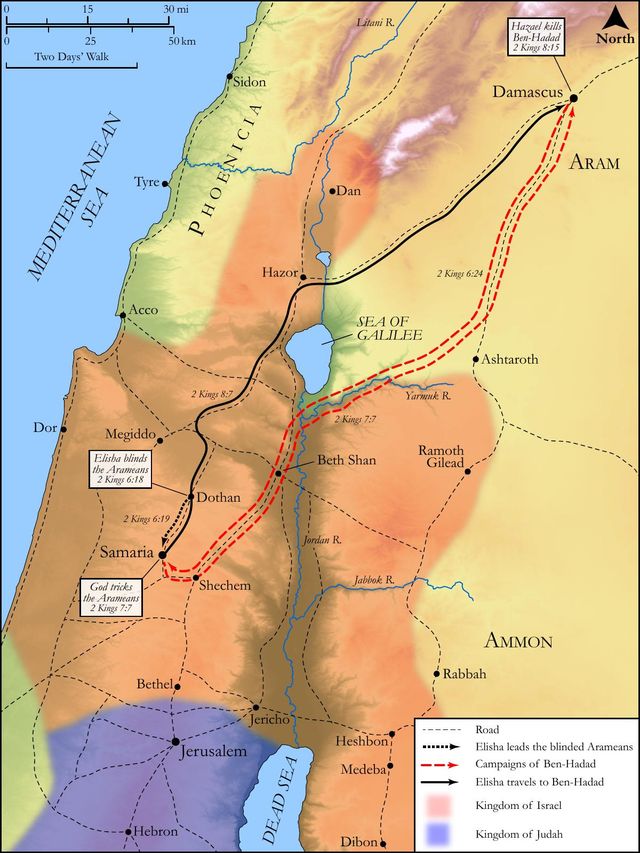
This verse is a pivotal moment within a larger narrative in 2 Kings 6, highlighting Elisha's prophetic ministry and God's miraculous intervention on behalf of Israel. The preceding verses establish the conflict: the King of Aram (Syria) is repeatedly frustrated by Elisha's supernatural ability to reveal his secret battle plans to the King of Israel, thus thwarting Syrian attacks, as seen in 2 Kings 6:8-12. Determined to eliminate this obstacle, the Syrian king dispatches a formidable army to Dothan, where Elisha is residing, as detailed in 2 Kings 6:13-14. The narrative builds suspense as Elisha's servant, overwhelmed by the sight of the Syrian forces, is reassured by Elisha, who prays for his servant's eyes to be opened to see the unseen heavenly host surrounding them, a powerful affirmation of divine protection found in 2 Kings 6:15-17. Following this, Elisha prays for the Syrian army to be struck with "blindness" or disorientation, which God grants, described in 2 Kings 6:18. It is in this state of divinely induced confusion that Elisha steps out to meet them, setting the stage for the strategic deception of verse 19 and the subsequent astonishing events in Samaria, which unfold in 2 Kings 6:20-23.
Historical & Cultural Context
The period of the Divided Kingdom (Israel and Judah) was marked by frequent conflicts between Israel and its northern neighbor, Aram (Syria). These were often border skirmishes or attempts by Aram to assert dominance over the region. Prophets like Elisha played a crucial role, not merely as spiritual guides, but often as national figures whose counsel and miraculous interventions directly impacted political and military outcomes, demonstrating God's active involvement in the nation's affairs. The Syrian army's mission to capture a single prophet highlights the significant influence Elisha wielded, indicating that even foreign powers recognized his spiritual authority and the divine power behind him. Samaria, as the capital of the Northern Kingdom of Israel, was a heavily fortified city and the seat of royal power. Leading an enemy army into its very heart, unarmed and disoriented, was an unprecedented and highly dangerous maneuver, underscoring the extraordinary nature of Elisha's actions and divine protection. The customary treatment of captured enemies in this era often involved enslavement, execution, or harsh imprisonment, making the subsequent merciful treatment of the Syrian army in Samaria, described in 2 Kings 6:22-23, even more remarkable and counter-cultural.
Key Themes
ShowHideThis passage richly contributes to several key themes prevalent in the book of 2 Kings and the broader prophetic literature. Foremost is the sovereignty and protective power of God over His chosen servants and His people. Elisha's safety is not due to his own strength or military might but entirely to divine intervention, demonstrating the truth that "those who are with us are more than those who are with them," as Elisha confidently declared in 2 Kings 6:16. Another prominent theme is divine wisdom and unconventional strategy. Elisha does not confront the army with force but with cunning, guided by God, illustrating that God's ways are often higher and more effective than human strategies, a concept echoed in Isaiah 55:8-9. The narrative also highlights the theme of deception for a higher, redemptive purpose. While Elisha's words are literally untrue, they serve a divine end: to disarm the enemy without bloodshed and to showcase God's power and mercy, rather than to cause harm or gain selfish advantage. Finally, the subsequent events in Samaria introduce the profound theme of mercy towards enemies, foreshadowing principles of compassion and reconciliation that are central to biblical ethics, as seen in Proverbs 25:21-22.
Exposition and Analysis
ShowHideKey Word Analysis
ShowHideThis word (H1870) literally means "road," "path," or "journey," but can also refer to a "course of life" or "manner of conduct." Here, it signifies the correct route to their intended destination (Dothan) and, by extension, the proper method or approach to achieve their objective of capturing Elisha. Elisha's statement, "This is not the way," is a direct contradiction of their current, divinely confused perception of their location and mission. It plays on their disorientation, suggesting they are on the wrong path entirely.
This term (H5892) refers to a fortified settlement or town. For the Syrian army, the "city" they sought was Dothan, where Elisha was. Elisha's declaration, "neither is this the city," reinforces their disorientation, making them believe they are far from their target, when in reality, they are already within the general vicinity. The profound irony is that he then leads them to the city, Samaria, which is indeed a major city, but not the one they intended to enter as conquerors.
This word (H1245) means "to search out (by any method, specifically in worship or prayer); by implication, to strive after; ask, beg, beseech, desire, enquire, get, make inquisition, procure, (make) request, require, seek (for)." In this context, it highlights the Syrian army's specific objective: to diligently search for and apprehend Elisha. Elisha's offer to bring them to "the man whom ye seek" is a masterful exploitation of their mission and their current state of confusion, as he himself is the object of their search.
Verse Breakdown
ShowHide"And Elisha said unto them, This [is] not the way, neither [is] this the city:"
Elisha, having prayed for and witnessed the Syrian army's supernatural disorientation (Hebrew: sanwerim – a bewildering confusion or blinding), boldly steps into their midst. His opening statement is a strategic misdirection. He leverages their divinely induced confusion, confirming their inability to discern their true location or Elisha's identity. This is not a malicious lie, but a tactical maneuver under divine guidance, designed to disarm and redirect the enemy without physical confrontation. It exploits their perceptual vulnerability.
"follow me, and I will bring you to the man whom ye seek."
This clause is the essence of Elisha's cunning and audacious plan. He presents himself as an ally, someone who can facilitate their mission by leading them directly to their target. The Syrians, desperate and disoriented, readily accept this offer, completely unaware that the "man whom ye seek" is the very person speaking to them. This demonstrates their complete vulnerability and trust in Elisha, a trust born out of their supernatural confusion and their single-minded pursuit of their objective.
"But he led them to Samaria."
This final phrase reveals the astonishing culmination of Elisha's divinely inspired plan. Instead of leading them to Dothan, or simply away from himself, Elisha leads the entire bewildered army directly into Samaria, the capital of Israel. This act is the ultimate display of God's power and Elisha's strategic genius, turning the hunters into the hunted and placing them completely at the mercy of the Israelite king. The "but" highlights the dramatic and ironic twist in the narrative, underscoring the unexpected and powerful reversal of fortunes.
Literary Devices
ShowHideThe passage in 2 Kings 6:19 is rich with Irony, particularly Dramatic Irony and Situational Irony. The audience is fully aware that Elisha is the very man the Syrians seek, and that he is leading them into a strategic trap, while the Syrian army remains utterly oblivious. This creates significant suspense and highlights their profound disorientation. Deception or Misdirection is the primary technique employed by Elisha, which, in this specific context, serves a higher, divine purpose rather than a malevolent one. It is a strategic maneuver, not a moral failing, used to achieve a non-violent resolution and demonstrate God's power. Furthermore, the entire episode is framed by Divine Intervention, as God directly causes the "blindness" and enables Elisha's audacious plan to succeed. This emphasizes God's sovereignty over human affairs and His ability to protect His servants through unconventional means. The narrative also employs Foreshadowing, as Elisha's leading the enemy into a vulnerable position, followed by an act of mercy, anticipates the principle of "feeding your enemy" that is explicitly stated and enacted in the subsequent verses of this chapter.
Theological and Thematic Connections
ShowHideThe account in 2 Kings 6:19 powerfully illustrates God's active involvement in human affairs, demonstrating His protective care for His servants and His sovereign control over nations. Elisha's unconventional strategy, though appearing as deception, is divinely sanctioned and serves a righteous purpose: to disarm the enemy without bloodshed and showcase God's power and mercy. This challenges human notions of warfare and conflict resolution, suggesting that God's wisdom often operates outside conventional methods. It underscores that God can use unexpected means to deliver His people and even to extend grace to their adversaries, ultimately aiming for a cessation of hostilities and a demonstration of His character, which is both powerful and merciful.
Reflection and Application
ShowHideThe narrative of Elisha and the Syrian army in 2 Kings 6:19 offers profound lessons for believers today, encouraging a deeper trust in God's unconventional wisdom and His unfailing protection. In moments of overwhelming opposition or seemingly insurmountable challenges, we are called to remember that God's resources and strategies far exceed our own. Elisha's calm and strategic response, rooted in prayer and divine guidance, teaches us that the most effective way to address conflict is not always through direct confrontation, but often through seeking God's wisdom for a path that may seem counterintuitive to human logic. This passage also challenges us to consider our response to those who oppose us. While Elisha's initial act is a strategic maneuver, the subsequent mercy shown to the Syrian army in Samaria serves as a powerful reminder of the transformative power of grace and kindness, even towards our adversaries, reflecting God's own character. It prompts us to consider how we might disarm hostility through unexpected acts of love and generosity, rather than escalating conflict.
Questions for Reflection
ShowHideFAQ
ShowHideWas Elisha's statement ("This is not the way, neither is this the city") a lie, and is it morally justifiable?
ShowHideThe Hebrew word for "blindness" in 2 Kings 6:18 is sanwerim, which implies a state of confusion, disorientation, or a spiritual/mental inability to recognize, rather than complete physical sightlessness. The Syrian soldiers were not entirely blind, but they were supernaturally disoriented, unable to recognize Elisha or their true location. Elisha's statement was a strategic misdirection that capitalized on this divine confusion. From a theological perspective, this act is often understood as a divinely sanctioned ruse, a form of "warfare deception" or "cunning" employed for a higher, righteous purpose. It was not intended to cause harm or gain selfish advantage, but to disarm the enemy without bloodshed, demonstrate God's power, and ultimately lead to an act of mercy. It aligns with God's sovereign plan to protect His prophet and to show His power to the nations, rather than being a malicious falsehood. This type of strategic deception, when divinely ordained and aimed at a redemptive outcome, is distinct from deceit driven by selfish motives.
What kind of "blindness" did the Syrian army experience?
ShowHideThe "blindness" mentioned in 2 Kings 6:18 is not necessarily a complete physical loss of sight, but rather a profound disorientation or inability to recognize their surroundings and, crucially, Elisha himself. The Hebrew term sanwerim (סַנְוֵרִים) is rare, appearing elsewhere only in Genesis 19:11 when the men of Sodom were struck with confusion and could not find the door to Lot's house. This suggests a state where one can see, but is utterly bewildered and unable to process visual information correctly or discern what is truly before them. Elisha's ability to walk among them and lead them indicates they could still follow, but their perception was so skewed that they could not identify him as their target or realize they were being led into enemy territory. It was a supernatural confusion that perfectly served God's strategic purpose, allowing Elisha to control the situation without direct confrontation.
Christ-Centered Fulfillment
ShowHideThe account of Elisha leading the disoriented Syrian army to Samaria serves as a powerful Old Testament type, foreshadowing aspects of Christ's greater work of salvation and His ultimate victory over spiritual enemies. Elisha, as a prophet empowered by God, demonstrates divine wisdom, sovereignty, and unexpected mercy. Similarly, Jesus, the ultimate Prophet and Son of God, confronts the forces of evil not with conventional warfare, but with divine strategy and sacrificial love. Just as Elisha led a physically disoriented army into a vulnerable position only to show them mercy, Christ, through His death and resurrection, disarmed the spiritual principalities and powers, leading them captive and triumphing over them (Colossians 2:15). The "blindness" of the Syrian army can also be seen as a parallel to the spiritual blindness that afflicts humanity due to sin, where people are unable to recognize their true spiritual condition or the light of the gospel, as described in 2 Corinthians 4:4. Yet, Christ, like Elisha, does not destroy those who are spiritually blind, but seeks to lead them to the true "city" of God's kingdom. His call to "love your enemies" and "pray for those who persecute you" (Matthew 5:44) is the ultimate fulfillment of the mercy shown to the Syrian army, revealing God's profound desire for reconciliation and redemption even for those who oppose Him. The entire episode points to Jesus as the one who ultimately conquers through surprising means, offering grace where judgment might be expected, and leading His people to ultimate victory and peace in His eternal kingdom.