


2 Kings 10:25
Bible text: King James Version (1769 Blayney text) · Public domain
Bible text: King James Version with Strong's numbers · Public domain
Bible text: Berean Standard Bible · Public domain
Bible text: American Standard Version (1901) · Public domain
Bible text: World English Bible, Messianic edition · Public domain
Bible text: Geneva Bible (1599) · Public domain
Bible text: Young's Literal Translation · Public domain
- וַיְהִיvay·Hiand it wasH1961Conj-w ¦ V-Qal-ConsecImperf-3msVerb Qal Consecutive Imperfect 3rd Singular Masculineוַandיְהִיit was
- כְּכַלֹּתוֹke·kha·lo·Towhen he finishedH3615Prep-k ¦ V-Piel-Inf ¦ 3msVerb Piel Infinitive Constructכְּwhenכַלֹּתfinishedוֹhe
- לַעֲשׂוֹתla·'a·Sotto offerH6213Prep-l ¦ V-Qal-InfVerb Qal Infinitive Constructלַtoעֲשׂוֹתoffer
- הָעֹלָהha·'o·Lahthe burnt offeringH5930Art ¦ N-fsNoun Singular Feminine Absoluteהָtheעֹלָהburnt offering
- וַיֹּאמֶרvai·Yo·merand he saidH559Conj-w ¦ V-Qal-ConsecImperf-3msVerb Qal Consecutive Imperfect 3rd Singular Masculineוַandיֹּאמֶרhe said
- יֵהוּאYe·hu'JehuH3058N-proper-mNoun Proper Masculine
- לָרָצִיםla·ra·Tzimto the runnersH7323Prep-l ¦ V-Qal-Prtcpl-mpVerb Qal Participle Plural Masculine Absoluteלָto theרָצִיםrunners
- וְלַשָּׁלִשִׁיםve·la·sha·li·Shimand to the officersH7991Conj-w ¦ Prep-l ¦ N-mpNoun Plural Masculine Absoluteוְandלַto theשָּׁלִשִׁיםofficers
- בֹּאוּBo·'ugoH935V-Qal-Imp-2mpVerb Qal Imperative 2nd Plural Masculine
- הַכּוּםha·Kumstrike down themH5221V-Hiphil-Imp-2mp ¦ 3mpVerb Hiphil Imperative 2nd Plural Masculineהַכּוּstrike downםthem
- אִישׁ'ishanyoneH376N-msNoun Singular Masculine Absolute
- אַל'almay notH408NegParticle Negative
- יֵצֵאye·Tze'he come outH3318V-Qal-Imperf-3msVerb Qal Imperfect 3rd Singular Masculine
- וַיַּכּוּםvai·ya·Kumand they struck down themH5221Conj-w ¦ V-Hiphil-ConsecImperf-3mp ¦ 3mpVerb Hiphil Consecutive Imperfect 3rd Plural Masculineוַandיַּכּוּthey struck downםthem
- לְפִיle·fito [the] mouth ofH6310Prep-l ¦ N-mscNoun Singular Masculine Constructלְtoפִי[the] mouth of
- חָרֶבCha·rev[the] swordH2719N-fsNoun Singular Feminine Absolute
- וַיַּשְׁלִכוּvai·yash·Li·khuand they threw [them] outH7993Conj-w ¦ V-Hiphil-ConsecImperf-3mpVerb Hiphil Consecutive Imperfect 3rd Plural Masculineוַandיַּשְׁלִכוּthey threw [them] out
- הָרָצִיםha·ra·Tzimthe runnersH7323Art ¦ V-Qal-Prtcpl-mpVerb Qal Participle Plural Masculine Absoluteהָtheרָצִיםrunners
- וְהַשָּׁלִשִׁיםve·ha·Sha·li·Shimand the officersH7991Conj-w ¦ Art ¦ N-mpNoun Plural Masculine Absoluteוְandהַtheשָּׁלִשִׁיםofficers
- וַיֵּלְכוּvai·ye·le·Khuand they wentH1980Conj-w ¦ V-Qal-ConsecImperf-3mpVerb Qal Consecutive Imperfect 3rd Plural Masculineוַandיֵּלְכוּthey went
- עַד'adtoH5704PrepPreposition
- עִיר'ir[the] city ofH5892N-fscNoun Singular Feminine Construct
- בֵּיתbeit[the] house ofH1004N-mscNoun Singular Masculine Construct
- הַבָּעַלha·Ba·'al<the> BaalH1168Art ¦ N-msNoun Title Singular Masculine Absoluteהַ<the>בָּעַלBaal
English is a literal word-by-word gloss of the Hebrew, not the KJV's wording. Why?
This is the original text the KJV's translators worked from — each Hebrew word with its own literal English meaning in this verse, prepared by scholars at Tyndale House, Cambridge. The KJV translates whole sentences, not word by word, so its wording differs: one Hebrew word can become several English words, and the KJV may choose “the LORD” where the gloss reads “Yahweh”. Both are faithful — they answer different questions. For the KJV's own rendering, switch to the KJV text.
Details
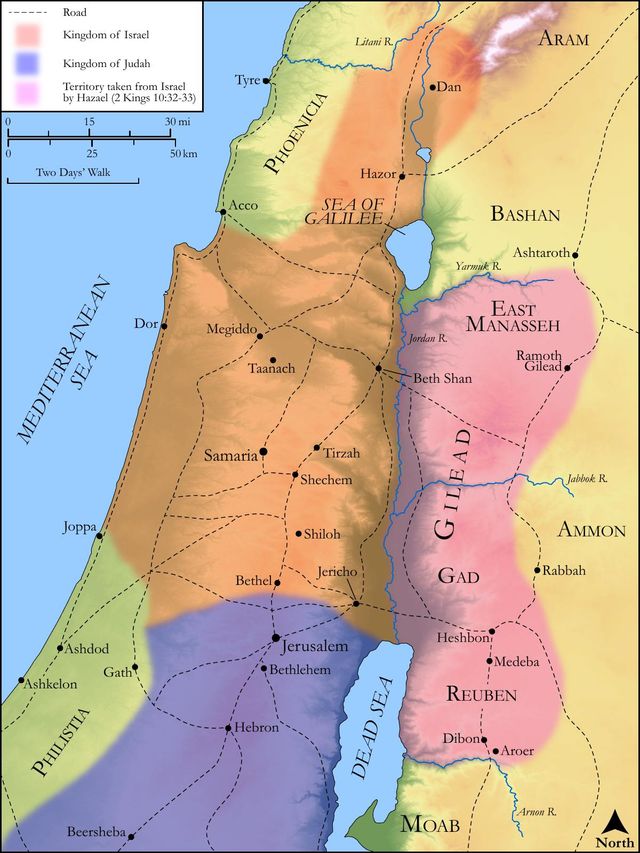
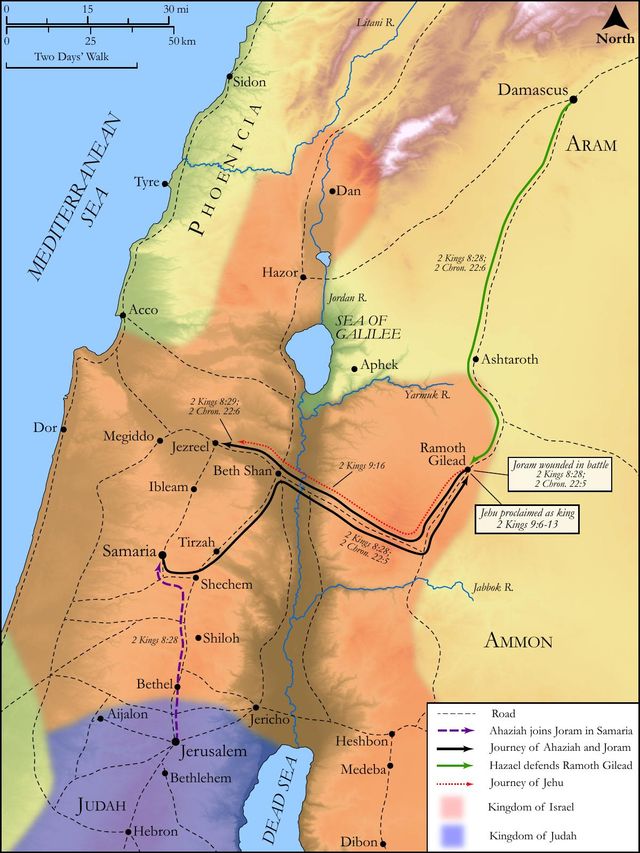
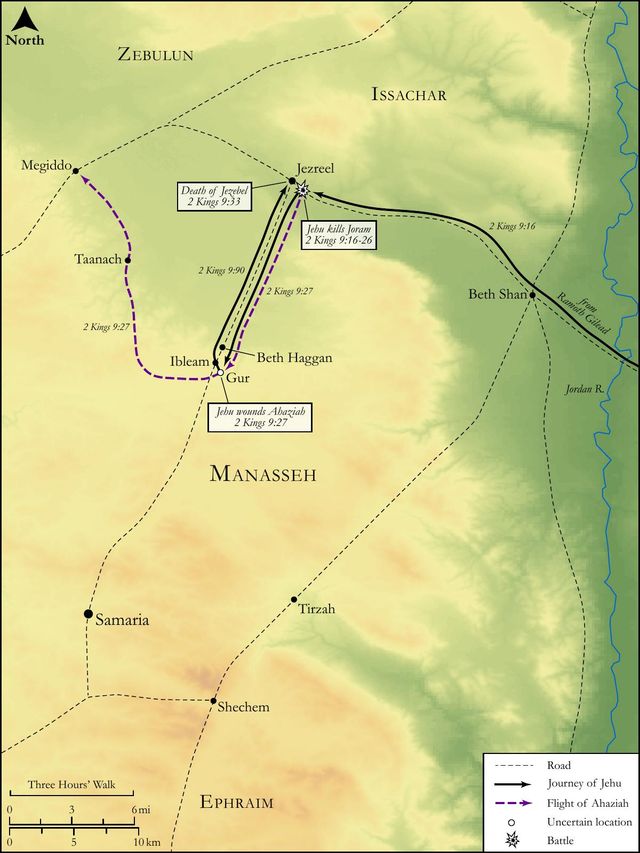
See on the biblical-era maps
Study this verse
Public-domain commentary
Matthew Henry
From his Commentary on the Whole Bible. Henry comments on passages, not single verses — this entry covers 2 Kings 10:15–28. His three-level outline is real structure in the source text, so it is rendered as structure.
Jehu, pushing on his work, is here,
I.Courting the friendship of a good man, Jehonadab the son of Rechab, Kg2 10:15, Kg2 10:16.
This Jehonadab, though mortified to the world and meddling little with the business of it (as appears by his charge to his posterity, which they religiously observed 300 years after, not to drink wine nor dwell in cities, Jer 35:6, etc.), yet, upon this occasion, went to meet Jehu, that he might encourage him in the work to which God had called him. The countenance of good men is a thing which great men, if they be wise, will value, and value themselves by. David prayed, Let those that fear thee turn to me, Psa 119:79. This Jehonadab, though no prophet, priest, or Levite, no prince or ruler, was, we may suppose, very eminent for prudence and piety, and generally respected for that life of self-denial and devotion which he lived: Jehu, though a soldier, knew him and honoured him. He did not indeed think of sending for him, but when he met him (though it is likely he drove now as furiously as ever) he stopped to speak to him; and we are here told what passed between them.
1.Jehu saluted him; he blessed him (so the word is), paid him the respect and showed him the good-will that were due to so great an example of serious godliness.
2.Jehonadab assured him that he was sincerely in his interest and a hearty well-wisher to his cause. Jehu professed that his heart was right with him, that he had a true affection for his person and a veneration for the crown of his Nazariteship, and desired to know whether he had the same affection for him and satisfaction in that crown of royal dignity which God had put upon his head: Is thy heart right? a question we should often put to ourselves. "I make a plausible profession, have gained a reputation among men, but is my heart right? Am I sincere and inward with God?" Jehonadab gave him his word (It is), and gave him his hand as a pledge of his heart, yielded to him (so giving the hand is rendered, Ch2 30:8), concurred and covenanted with him, and owned him in the work both of revenge and of reformation he was now about.
3.Jehu took him up into his chariot and took him along with him to Samaria. He put some honour upon him, by taking him into the chariot with him (Jehonadab was not accustomed to ride in a chariot, much less with a king); but he received more honour from him, and from the countenance he gave to his present work. All sober people would think the better of Jehu when they saw Jehonadab in the chariot with him. This was not the only time in which the piety of some has been made to serve the policy of others, and designing men have strengthened themselves by drawing good men into their interests. Jehonadab is a stranger to the arts of fleshly wisdom, and has his conversation in simplicity and godly sincerity; and therefore, if Jehu be a servant of God and an enemy to Ball, he will be his faithful friend. "Come then" (says Jehu), "come with me, and see my zeal for the Lord; and then thou wilt see reason to espouse my cause." This is commonly taken as not well said by Jehu, and as giving cause to suspect that his heart was not right with God in what he did, and that the zeal he pretended for the Lord was really zeal for himself and his own advancement. For,
(1.)He boasted of it, and spoke as if God and man were mightily indebted to him for it.
(2.)He desired it might be seen and taken notice of, like the Pharisees, who did all to be seen of men. An upright heart approves itself to God and covets no more than his acceptance. If we aim at the applause of men, and make their praise our highest end, we are upon a false bottom. Whether Jehu looked any further we cannot judge; however Jehonadab went with him, and, it is likely, animated and assisted him in the further execution of his commission (Kg2 10:17), destroying all Ahab's friends in Samaria. A man may hate cruelty and yet love justice, may be far from thirsting after blood and yet may wash his feet in the blood of the wicked, Psa 58:10.
II.Contriving the destruction of all the worshippers of Baal.
The service of Baal was the crying sin of the house of Ahab: that root of this idolatry was plucked up, but multitudes yet remained that were infected with it, and would be in danger of infecting others. The law of God was express, that they were to be put to death; but they were so numerous, and so dispersed throughout all parts of the kingdom, and perhaps so alarmed with Jehu's beginnings, that it would be a hard matter to find them all out and an endless task to prosecute and execute them one by one. Jehu's project therefore is to cut them all off together.
1.By a wile, by a fraud, he brought them together to the temple of Baal. He pretended he would worship Baal more than ever Ahab had done, Kg2 10:18. Perhaps he spoke this ironically, or to try the body of the people whether they would oppose such a resolution as this, and would resent his threatening to increase his predecessor's exactions, and say, "If it be so, we have no part in Jehu, nor inheritance in the son of Nimshi." But it rather seems to have been spoken purposely to deceive the worshippers of Baal, and then it cannot be justified. The truth of God needs not any man's lie. He issued a proclamation, requiring the attendance of all the worshippers of Baal to join with him in a sacrifice to Baal (Kg2 10:19, Kg2 10:20), not only the prophets and priests, but all, throughout the kingdom, who worshipped Baal, who were not nearly so many as they had been in Elijah's time. Jehu's friends, we may suppose, were aware of what he designed, and were not offended at it; but the bigoted besotted Baalites began to think themselves very happy, and that now they should see golden days again. Joram had put away the image of Baal, Kg2 3:2. If Jehu will restore it, they have what they would have, and come up to Samaria with joy from all parts to celebrate the solemnity; and they are pleased to see the house of Baal crowded (Kg2 10:21), to see his priests in their vestments (Kg2 10:22), and themselves perhaps with some badges or other to notify their relation to Baal, for there were vestments for all his worshippers.
2.He took care that none of the servants of the Lord should be among them, Kg2 10:23. This they took as a provision to preserve the worship of Baal from being profaned by strangers; but it was a wonder that they did not, by this, see themselves brought into a snare and discern a design upon them. No marvel if those that suffer themselves to be deceived by Baal (as all idolaters were by their idols), are deceived by Jehu to their destruction.
3.He gave order for the cutting of them all off, and Jehonadab joined with him therein, Kg2 10:23. When a strict search was made lest any of the servants of God should, either for company or curiosity, have got among them - lest any wheat should be mixed with those tares, and when eighty men were set to stand guard at all the avenues to Baal's temple, that none might escape (Kg2 10:24), then the guards were sent in to put them all to the sword and to mingle their blood with their sacrifices, in a way of just revenge, as they themselves had sometimes done, when, in their blind devotion, they cut themselves with knives and lancets till the blood gushed out, Kg1 18:28. This was accordingly done, and the doing of it, though seemingly barbarous, was, considering the nature of their crime, really righteous. The Lord, whose name is jealous, is a jealous God.
4.The idolaters being thus destroyed, the idolatry itself was utterly abolished. The buildings about the house of Baal (which were so many and so stately that they are here called a city), where Baal's priests and their families lived, were destroyed; all the little images, statues, pictures, or shrines, which beautified Baal's temple, with the great image of Baal himself, were brought out and burnt (Kg2 10:26, Kg2 10:27), and the temple of Baal was broken down, and made a dunghill, the common sink, or sewer, of the city, that the remembrance of it might be blotted out or made infamous. Thus was the worship of Baal quite destroyed, at least for the present, out of Israel, though it had once prevailed so far that there were but 7000 of all the thousands of Israel that had not bowed the knee to Baal, and those concealed. Thus will God destroy all the gods of the heathen, and, sooner or later, triumph over them all.
Continue studying 2 Kings 10:25 across the web’s major study libraries — every link below opens this exact verse, chapter, or book on the destination site.
Read & Compare
 BibleGatewayThis verse in more than 200 translations and 70 languages.
 Bible.comThe YouVersion reader — hundreds of translations, reading plans, and highlights.
 ESV.orgCrossway's official English Standard Version reader.
 NET BibleThe NET translation with 60,000+ translators' notes on every rendering decision.
 STEP BibleTyndale House's free study tool — original text, vocabulary, and scholarly resources.
 BibliaLogos Bible Software's free web reader.
 USCCBThe New American Bible (Revised Edition) with the U.S. bishops' study notes.
Commentaries
 BibleHub CommentariesDozens of classic commentaries on this verse, gathered on one page.
 StudyLightMore than 100 commentary sets — the largest collection on the web.
 BibleRefPlain-English commentary on what this verse means, verse by verse.
 Enduring WordDavid Guzik's free commentary on this chapter, widely used by Bible teachers.
 Bible Study ToolsVerse commentary alongside Greek and Hebrew study aids.
Original Language & Research
- BibleHub InterlinearThe verse word by word — original language, transliteration, and English.
- BibleHub LexiconEvery word's original-language definition and Strong's entry.
 Blue Letter BibleDeep-study tools — Strong's numbers, concordance, and word studies.
 SefariaThe Hebrew text with Rashi and centuries of Jewish commentary.
Sermons, Hymns & Audio


TrulyRandomVerse is not affiliated with these sites and doesn’t control their content. They’re linked because they’re genuinely useful.
Summary
This verse vividly portrays the chilling culmination of Jehu's divinely sanctioned purge of Baal worship in Israel. Having meticulously orchestrated a deceptive assembly, where Baal adherents gathered for what they believed was a grand sacrifice, Jehu, immediately upon completing his feigned burnt offering, unleashed his elite guard and captains. His command was absolute: enter the temple, execute every worshipper, and ensure no one escaped. The order was carried out with ruthless efficiency, resulting in a comprehensive slaughter of the idolaters, whose bodies were then contemptuously cast out of the temple, signaling the utter defilement and eradication of this pervasive pagan cult from the heart of the Northern Kingdom.
Context
ShowHideLiterary Context
This pivotal verse is strategically placed within the narrative of Jehu's bloody, yet divinely mandated, revolution against the house of Ahab and the pervasive Baal worship in Israel. The broader context of 2 Kings 9-10 details Jehu's anointing by a prophet of Elisha (2 Kings 9:1-10), followed by his swift and decisive execution of King Joram of Israel (2 Kings 9:24) and King Ahaziah of Judah (2 Kings 9:27). His purge continued with the gruesome death of Jezebel (2 Kings 9:30-37), the slaughter of Ahab's seventy sons (2 Kings 10:1-8), and the forty-two relatives of Ahaziah (2 Kings 10:12-14). The present passage represents the climax of Jehu's campaign against Baalism itself, which he initiated through a cunning deception, gathering all Baal worshippers to a "great sacrifice" for Baal, under threat of death for non-attendance (2 Kings 10:18-24). This verse immediately precedes the complete destruction of the temple of Baal and the thorough eradication of its cult, marking a decisive turning point in Israel's religious landscape.
Historical & Cultural Context
Baal worship, particularly under the patronage of King Ahab and Queen Jezebel, had become the deeply entrenched state religion of the Northern Kingdom of Israel (1 Kings 16:31-33). Baal was a prominent Canaanite storm and fertility deity, whose worship involved elaborate and often morally corrupt rituals, including sacrifices, cultic prostitution, and, at times, child sacrifice—all practices explicitly forbidden and abhorrent to Yahwism. The "house of Baal" mentioned in the text refers to a dedicated temple, likely a grand structure in Samaria, the capital, built to facilitate this widespread idolatry. Jehu's actions, though shocking by modern ethical standards, must be understood within the brutal realities of warfare and of the judgments upon idolaters set forth in the law of Moses, as at the brook Kishon, where Elijah slew the prophets of Baal. In this era, the complete destruction of enemy cults and the eradication of their adherents was a common, albeit severe, expression of religious purity and political dominance. Jehu's use of a "burnt offering" as a ruse is a masterstroke of calculated deception, exploiting the religious fervor and communal expectations of the Baal worshippers to gather them for their ultimate demise, a stark contrast to the true burnt offerings prescribed in the Mosaic Law, which symbolized complete devotion and atonement to Yahweh.
Key Themes
ShowHideThis verse powerfully illustrates several key themes central to the Deuteronomistic history and the book of 2 Kings. Foremost is the theme of Divine Judgment on Idolatry, demonstrating God's absolute and uncompromising intolerance for the worship of false gods, which directly violates the foundational first commandment (Exodus 20:3). Jehu acts as a direct instrument of this judgment, fulfilling specific prophetic pronouncements against Ahab's house and the pervasive Baal worship (1 Kings 21:20-24). Another significant theme is Zeal for God, as Jehu exhibits an intense, albeit ruthless and deceptive, commitment to eradicating what God abhors. While Jehu's methods are extreme, the narrative presents his actions against Baal as divinely sanctioned and even partially commended (2 Kings 10:30). The passage also underscores the theme of Thoroughness and Completeness in divine judgment, as Jehu's command "let none come forth" and the subsequent casting out of bodies emphasize the total annihilation of the Baal cult within the temple, paving the way for its complete physical destruction.
Exposition and Analysis
ShowHideKey Word Analysis
ShowHideThis Hebrew term refers to a sacrifice entirely consumed by fire on the altar, symbolizing complete devotion and atonement in the context of Yahwistic worship. In this passage, its use is profoundly ironic and deceptive. Jehu is not offering a genuine sacrifice to Yahweh, nor is he truly honoring Baal. Instead, he employs the sacred ritual of a "burnt offering" as a calculated ruse, a final act of deception to lull the Baal worshippers into a false sense of security before their slaughter. This perversion of a religious act underscores the depth of Jehu's cunning and the severity of the judgment about to be unleashed.
Literally meaning "runners," this term often refers to the king's elite personal guard or couriers, known for their swiftness, unwavering loyalty, and readiness to execute royal commands. These were not ordinary soldiers but trusted royal personnel, implying that Jehu's orders were executed by his most reliable and ruthless enforcers. Their immediate obedience highlights Jehu's absolute authority and the precision of his purge. The Strong's definition for H7323 includes "guard," which fits the context perfectly.
This idiomatic Hebrew phrase literally translates to "by the mouth of the sword." It is a common biblical expression signifying utter destruction, a merciless and comprehensive slaughter. The word peh (H6310) means "mouth," but also "edge" (as in the edge of a blade), and chereb (H2719) means "sword" or "cutting instrument." Together, they emphasize that the killing was not merely a battle but a complete, unsparing execution, reinforcing the thoroughness of Jehu's purge and the finality of the judgment.
Verse Breakdown
ShowHide"And it came to pass, as soon as he had made an end of offering the burnt offering"
This clause establishes the precise and strategic timing of Jehu's command. The "burnt offering" was the final, climactic act of the deceptive ritual, serving as the signal that all Baal worshippers were gathered, identified, and fully engaged in their idolatrous worship. The completion of this feigned sacred act marks the immediate transition from cunning deception to brutal execution, highlighting Jehu's calculated patience and strategic timing.
"that Jehu said to the guard and to the captains, Go in, [and] slay them; let none come forth."
This is Jehu's direct, unequivocal command, revealing the pre-planned nature of the operation. He addresses his most trusted and capable military personnel—the "guard" (royal elite) and "captains" (military leaders)—indicating a precise, military-style execution. The imperative "Go in, [and] slay them" is a direct order for mass execution. The subsequent "let none come forth" underscores the absolute thoroughness required; no worshipper was to escape, ensuring the complete eradication of the cult's adherents. This command reflects the uncompromising nature of the divine judgment Jehu was enacting.
"And they smote them with the edge of the sword;"
This clause describes the immediate and violent execution of Jehu's command. The phrase "smote them with the edge of the sword" signifies a comprehensive and merciless slaughter, leaving no survivors. It conveys the brutal reality of the purge, emphasizing the swiftness and totality of the destruction meted out to the Baal worshippers.
"and the guard and the captains cast [them] out, and went to the city of the house of Baal."
Following the slaughter, the bodies were "cast out," a symbolic act of defilement and desecration. This act further emphasizes the complete rejection and utter contempt for the Baal cult and its adherents. The subsequent action of "went to the city of the house of Baal" indicates that the purge was not confined to the temple interior but extended to the entire precinct or even the city where the temple was located, ensuring no remnants of the cult remained. This sets the stage for the temple's physical destruction mentioned in the following verses.
Literary Devices
ShowHideThe passage employs several potent literary devices to convey the gravity and brutality of the event. Irony is profoundly present, as Jehu manipulates the very ritual of a "burnt offering" to Baal—a sacred act in the eyes of the worshippers—as the precise trigger for their annihilation. This subversion of religious ceremony into a deadly trap highlights Jehu's cunning and the ultimate futility of false worship. Hyperbole is implied in the command "let none come forth," emphasizing the extreme thoroughness and uncompromising nature of the purge, leaving no room for escape or survival. The vivid Imagery of being "smote... with the edge of the sword" and the subsequent "casting out" of bodies creates a stark and visceral picture of the violence and defilement, underscoring the complete destruction of the Baal cult. Furthermore, the passage serves as a form of Foreshadowing, as the immediate slaughter within the temple sets the stage for the complete dismantling and desecration of the temple of Baal itself in the verses that follow, signifying the end of state-sponsored idolatry in Israel.
Theological and Thematic Connections
ShowHideThis passage serves as a stark reminder of God's unwavering holiness and His absolute intolerance for idolatry. The severity of the judgment against the Baal worshippers underscores the gravity with which God views the worship of false gods, which is a direct affront to His unique sovereignty and a betrayal of the covenant relationship. While Jehu's methods are undeniably brutal, the biblical narrative presents this event as the divinely ordained fulfillment of prophecy and a necessary act to cleanse Israel of its deep-seated apostasy. It highlights that God, in His justice, will not tolerate rivals for His glory and will act decisively to vindicate His name and restore purity among His people. This historical account, though set in a different covenantal context, points to the enduring principle that true worship demands exclusive devotion to the one true God, and any form of idolatry, whether ancient or modern, incurs divine displeasure and ultimately leads to spiritual death.
Reflection and Application
ShowHideThe account of Jehu's purge, particularly the slaughter within the temple of Baal, is undeniably unsettling due to its extreme violence and deception. However, for the believer today, it serves as a powerful, albeit challenging, illustration of God's uncompromising opposition to idolatry and His demand for exclusive devotion. While the methods of the Old Testament era are not to be replicated in the New Covenant, the underlying principle of spiritual purity remains paramount. We are called to identify and ruthlessly "slay" the "idols" in our own lives—anything that competes for God's rightful place in our hearts, whether it be wealth, power, relationships, self-image, comfort, or even spiritual practices that become ends in themselves. This passage compels us to examine our allegiances and ensure that our worship is directed solely and wholeheartedly to the Lord, demonstrating a zeal for His glory that purges all competing affections. It reminds us that true spiritual transformation often requires decisive and thorough action against entrenched patterns of sin and misplaced devotion, ensuring no spiritual "Baal" is allowed to remain.
Questions for Reflection
ShowHideFAQ
ShowHideWas Jehu's deception and violence justified by God?
ShowHideThe biblical narrative presents Jehu's actions, including his deception and violence, as the fulfillment of God's prophetic word against the house of Ahab and the eradication of Baal worship. 2 Kings 10:30 explicitly states that the Lord commended Jehu for doing "what was right in My eyes, and have done to the house of Ahab all that was in My heart." This indicates divine approval for the outcome—the destruction of Baal worship—even if the methods employed by Jehu (deception, extreme violence) are not necessarily presented as models for all believers in all times. The text focuses on God's sovereign use of an imperfect human agent to accomplish His purposes of judgment against profound apostasy, rather than endorsing deception or indiscriminate violence as general principles for righteous conduct. The narrative highlights God's unwavering commitment to His covenant and His intolerance for idolatry, which had deeply corrupted Israel.
Christ-Centered Fulfillment
ShowHideWhile 2 Kings 10:25 depicts a physical, violent purge of idolatry in ancient Israel, its theological trajectory finds a profound and spiritual fulfillment in Jesus Christ. Jehu's "zeal" for Yahweh, though expressed through the sword, foreshadows the ultimate zeal of Christ, who came not to destroy human lives but to destroy the works of the devil and cleanse hearts from spiritual idolatry. Jesus, the true temple (John 2:19-21), entered the physical temple in Jerusalem and, with righteous indignation, purged it of those who had turned it into a "den of robbers" (Matthew 21:12-13), demonstrating His authority and passionate concern for God's house. More profoundly, Christ's work on the cross is the ultimate "burnt offering," a perfect and complete sacrifice that cleanses us from all sin and idolatry, not through the shedding of others' blood by the sword, but through the shedding of His own precious blood (Hebrews 9:22). He is the "Lamb of God who takes away the sin of the world" (John 1:29), making a final, decisive end to the power of sin and false gods. For believers, the call to "slay" idolatry is now a spiritual one: to "put to death, therefore, whatever belongs to your earthly nature: sexual immorality, impurity, lust, evil desires and greed, which is idolatry" (Colossians 3:5). Through Christ, we are empowered by the Holy Spirit to thoroughly cleanse our hearts, casting out every rival to God's throne, ensuring that our devotion is exclusively to Him, the one true God, and His Son, Jesus Christ (1 John 5:21).