


2 Chronicles 5:8
Bible text: King James Version (1769 Blayney text) · Public domain
Bible text: Berean Standard Bible · Public domain
Bible text: American Standard Version (1901) · Public domain
Bible text: World English Bible, Messianic edition · Public domain
Bible text: Geneva Bible (1599) · Public domain
Bible text: Young's Literal Translation · Public domain
- וַיִּהְיוּvai·yih·Yuand they wereH1961Conj-w ¦ V-Qal-ConsecImperf-3mpVerb Qal Consecutive Imperfect 3rd Plural Masculineוַandיִּהְיוּthey were
- הַכְּרוּבִיםha·ke·ru·Vimthe cherubimH3742Art ¦ N-mpNoun Plural Masculine Absoluteהַtheכְּרוּבִיםcherubim
- פֹּרְשִׂיםpo·re·Simspreading outH6566V-Qal-Prtcpl-mpVerb Qal Participle Plural Masculine Absolute
- כְּנָפַיִםke·na·Fa·yimwingsH3671N-fdNoun Dual Feminine Absolute
- עַל'aloverH5921PrepPreposition
- מְקוֹםme·Kom[the] place ofH4725N-mscNoun Singular Masculine Construct
- הָאָרוֹןha·'a·Ronthe arkH727Art ¦ N-msNoun Singular Masculine Absoluteהָtheאָרוֹןark
- וַיְכַסּוּvay·kha·Suand they coveredH3680Conj-w ¦ V-Piel-ConsecImperf-3mpVerb Piel Consecutive Imperfect 3rd Plural Masculineוַandיְכַסּוּthey covered
- הַכְּרוּבִיםha·ke·ru·Vimthe cherubimH3742Art ¦ N-mpNoun Plural Masculine Absoluteהַtheכְּרוּבִיםcherubim
- עַל'aloverH5921PrepPreposition
- הָאָרוֹןha·'a·Ronthe arkH727Art ¦ N-msNoun Singular Masculine Absoluteהָtheאָרוֹןark
- וְעַלve·'aland overH5921Conj-w ¦ PrepPrepositionוְandעַלover
- בַּדָּיוba·Davits polesH905N-mpc ¦ 3msNoun Plural Masculine Constructבַּדָּיpolesוits
- מִלְמָעְלָהmil·Ma·'e·lahfrom to above <towards>H4605Prep-m ¦ Prep-l ¦ Adj-cs ¦ SfxAdjective Numerical Singular common gender Absoluteמִfromלְtoמָעְלָaboveה<towards>
English is a literal word-by-word gloss of the Hebrew, not the KJV's wording. Why?
This is the original text the KJV's translators worked from — each Hebrew word with its own literal English meaning in this verse, prepared by scholars at Tyndale House, Cambridge. The KJV translates whole sentences, not word by word, so its wording differs: one Hebrew word can become several English words, and the KJV may choose “the LORD” where the gloss reads “Yahweh”. Both are faithful — they answer different questions. For the KJV's own rendering, switch to the KJV text.
Details
See on the biblical-era maps
Study this verse
Public-domain commentary
Matthew Henry
From his Commentary on the Whole Bible. Henry comments on passages, not single verses — this entry covers 2 Chronicles 5:1–10.
This agrees with what we had Kg1 8:2, etc., where an account was given of the solemn introduction of the ark into the new-erected temple. 1. There needed no great solemnity for the bringing in of the dedicated things, Ch2 5:1. They added to the wealth, and perhaps were so disposed as to add to the beauty of it; but they could not add to the holiness, for it was the temple that sanctified the gold, Mat 23:17. See how just Solomon was both to God and to his father. Whatever David had dedicated to God, however much he might have liked it himself, he would by no means alienate it, but put it among the treasures of the temple. Those children that would inherit their godly parents' blessing must religiously pursue their pious intentions and not defeat them. When Solomon had made all the vessels of the temple in abundance (Ch2 4:18), many of the materials were left, which he would not convert to any other use, but laid up in the treasury for a time of need. Dedicated things must not be alienated. It is sacrilege to do it. 2. But it was fit that the ark should be brought in with great solemnity; and so it was. All the other vessels were made new, and larger, in proportion to the house, than they had been in the tabernacle. But the ark, with the mercy-seat and the cherubim, was the same; for the presence and the grace of God are the same in little assemblies that they are in large ones, in the poor condition of the church that they are in its prosperous estate. Wherever two or three are gathered together in Christ's name there is he as truly present with them as if there were 2000 or 3000. The ark was brought in attended by a very great assembly of the elders of Israel, who came to grace and solemnity; and a very sumptuous appearance no doubt they made, Ch2 5:2-4. It was carried by the priests (Ch2 5:7), brought into the most holy place, and put under the wings of the great cherubim which Solomon had set up there, Ch2 5:7, Ch2 5:8. There they are unto this day (Ch2 5:9), not the day when this book was written after the captivity, but when that was written out of which this story was transcribed. Or they were there (so it might be read) unto this day, the day of Jerusalem's desolations, that fatal day, Psa 137:7. The ark was a type of Christ, and, as such, a token of the presence of God. That gracious promise, Lo, I am with you always, even unto the end of the world, does in effect bring the ark into our religious assemblies if we by faith and prayer put that promise in suit; and this we should be most solicitous and earnest for. Lord, if thy presence go not up with us, wherefore should we go up? The temple itself, if Christ leave it, is a desolate place, Mat 23:38. 3. With the ark they brought up the tabernacle and all the holy vessels that were in the tabernacle, Ch2 5:5. Those were not alienated, because they had been dedicated to God, were not altered or melted down for the new work, though there was no need of them; but they were carefully laid up as monuments of antiquity, and probably as many of the vessels as were fit for use were still used. 4. This was done with great joy. They kept a holy feast upon the occasion (Ch2 5:3), and sacrificed sheep and oxen without number, Ch2 5:6. Note, (1.) The establishment of the public worship of God according to his institution, and with the tokens of his presence, is, and ought to be, matter of great joy to any people. (2.) When Christ is formed in a soul, the law written in the heart, the ark of the covenant settled there, so that it becomes the temple of the Holy Ghost, there is true satisfaction in that soul. (3.) Whatever we have the comfort of we must, by the sacrifice of praise, give God the glory of, and not be straitened therein; for with such sacrifices God is well pleased. If God favour us with his presence, we must honour him with our services, the best we have.
Continue studying 2 Chronicles 5:8 across the web’s major study libraries — every link below opens this exact verse, chapter, or book on the destination site.
Read & Compare
 BibleGatewayThis verse in more than 200 translations and 70 languages.
 Bible.comThe YouVersion reader — hundreds of translations, reading plans, and highlights.
 ESV.orgCrossway's official English Standard Version reader.
 NET BibleThe NET translation with 60,000+ translators' notes on every rendering decision.
 STEP BibleTyndale House's free study tool — original text, vocabulary, and scholarly resources.
 BibliaLogos Bible Software's free web reader.
 USCCBThe New American Bible (Revised Edition) with the U.S. bishops' study notes.
Commentaries
 BibleHub CommentariesDozens of classic commentaries on this verse, gathered on one page.
 StudyLightMore than 100 commentary sets — the largest collection on the web.
 BibleRefPlain-English commentary on what this verse means, verse by verse.
 Enduring WordDavid Guzik's free commentary on this chapter, widely used by Bible teachers.
 Bible Study ToolsVerse commentary alongside Greek and Hebrew study aids.
Original Language & Research
- BibleHub InterlinearThe verse word by word — original language, transliteration, and English.
- BibleHub LexiconEvery word's original-language definition and Strong's entry.
 Blue Letter BibleDeep-study tools — Strong's numbers, concordance, and word studies.
 SefariaThe Hebrew text with Rashi and centuries of Jewish commentary.
Sermons, Hymns & Audio


TrulyRandomVerse is not affiliated with these sites and doesn’t control their content. They’re linked because they’re genuinely useful.
Summary
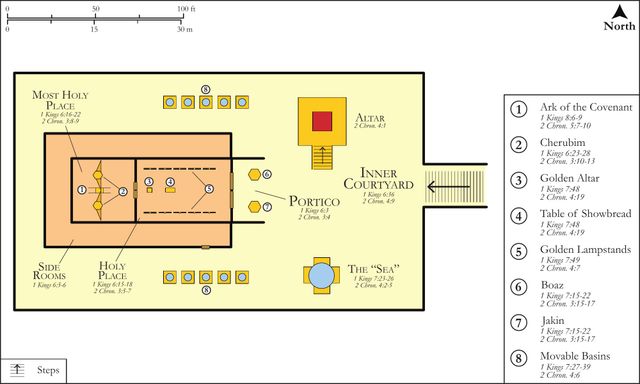
This verse meticulously details the final, sacred placement of the Ark of the Covenant within the Most Holy Place of Solomon's newly constructed Temple. It highlights the crucial role of the two colossal cherubim, commissioned by Solomon, whose outstretched wings majestically overshadowed the Ark and its carrying staves, signifying divine guardianship, the profound holiness of God's presence, and the fulfillment of God's design for His dwelling among His people.
Context
ShowHideLiterary Context
This verse is situated at a pivotal moment in the narrative of 2 Chronicles, specifically within the grand dedication of Solomon's Temple (2 Chronicles 5:1-7:22). Following the completion of the Temple and its furnishings, the priests, the Levites, and the entire assembly of Israel gather to bring the Ark of the Covenant from the City of David into its permanent resting place within the inner sanctuary. Verses 2 Chronicles 5:7-9 describe the precise actions of the priests in placing the Ark, emphasizing the cherubim's role and the unique detail about the staves. The immediate subsequent verses 2 Chronicles 5:10-14 describe the priests withdrawing, the Levites and musicians praising God, and the subsequent filling of the Temple with the glory of the Lord, rendering the priests unable to minister. Thus, 2 Chronicles 5:8 serves as the climactic moment of the Ark's installation, directly preceding the manifest presence of God.
Historical & Cultural Context
Solomon's reign (c. 970-931 BC) marked a golden age for Israel, characterized by immense wealth, political stability, and monumental building projects, chief among them the Temple in Jerusalem. This Temple was not merely a large building but the central locus of Israelite worship, replacing the portable Tabernacle and signifying God's permanent dwelling among His people. Cherubim appear in Scripture as guardians of sacred space, set at the east of the garden of Eden, and in Israel they were uniquely associated with Yahweh's throne and presence, as seen in Exodus 25:18-22 for the Tabernacle. Solomon's commissioning of these immense, golden cherubim (as described in 1 Kings 6:23-28 and 2 Chronicles 3:10-13) for the Most Holy Place underscored the Temple's grandeur and the profound sanctity of the Ark, which represented God's covenant presence.
Key Themes
ShowHideThe primary theme is the Divine Presence and Holiness. The Ark of the Covenant was the tangible symbol of God's presence among His people, serving as His throne or footstool. Its placement in the innermost sanctum, the Most Holy Place, guarded by the cherubim, underscored its unparalleled sacredness and the awe-inspiring holiness of God. This act also highlights the theme of Fulfillment of Divine Design, as Solomon's Temple, though grander, continued the principles of the Tabernacle, providing a permanent dwelling for the Lord in accordance with His promises (e.g., 2 Samuel 7:13). The meticulous details of the Ark's placement, including the staves, emphasize Order and Obedience in worship, reflecting the seriousness with which God's commands regarding His sanctuary were to be observed, a principle seen throughout the Law, such as in Leviticus 10.
Exposition and Analysis
ShowHideKey Word Analysis
ShowHideThese are angelic beings (H3742), often depicted in Scripture as guardians of sacred spaces (e.g., Genesis 3:24), or associated with God's throne or chariot (e.g., Ezekiel 1:5-28). In this context, they are not the smaller cherubim affixed to the mercy seat of the Ark itself, but two colossal, free-standing golden figures (approximately 15 feet high, with wings spanning 15 feet each, as described in 1 Kings 6:23-28) that stood within the Most Holy Place. Their presence here reinforces the Ark as the very seat of God's presence, guarded by heavenly hosts, marking the ultimate sanctity of the area.
This verb (H6566) implies an expansive, deliberate, and protective action, meaning "to break apart, disperse, lay open, scatter, spread (abroad, forth, selves, out), stretch (forth, out)." It suggests the cherubim actively extending their wings to cover the designated area, not merely having their wings in a fixed position. The imagery conveys a sense of comprehensive overshadowing and enclosure, emphasizing the completeness of their guardianship over the Ark.
This word (H3680) means "to plump, i.e. fill up hollows; by implication, to cover (for clothing or secrecy); clad self, close, clothe, conceal, cover (self), (flee to) hide, overwhelm." It reinforces the protective and sacred function of the cherubim. Their wings formed a canopy, creating a sacred enclosure around the Ark, symbolizing divine protection and the inaccessibility of God's presence to the common gaze, emphasizing the awe and reverence due to Him.
Verse Breakdown
ShowHide"For the cherubims spread forth [their] wings over the place of the ark"
This clause introduces the two massive cherubim that Solomon had constructed, distinct from those on the Ark's mercy seat. Their primary function here is to extend their wings over the precise location where the Ark was to rest. This action signifies their role as guardians of the most sacred object in Israel, emphasizing the divine protection and sanctity surrounding God's dwelling place. The "place of the ark" (H4725, mâqôwm') refers specifically to the designated spot within the Most Holy Place, the innermost sanctuary.
"and the cherubims covered the ark and the staves thereof above"
This second clause specifies that the cherubim's wings not only extended over the general area but directly "covered" or overshadowed the Ark (H727, ʼârôwn') itself, along with its carrying staves (H905, bad'). The mention of the staves is significant, as Exodus 25:15 explicitly commanded that the staves of the Ark were never to be removed. Their continued presence, even in the Temple, underscored adherence to God's ancient commands, while their being "covered" by the cherubim's wings "above" (H4605, maʻal') further emphasized the complete enclosure and protection of the Ark within the sacred space, reinforcing its profound holiness.
Literary Devices
ShowHideThe verse employs several powerful literary devices to convey its profound theological meaning. Imagery is central, with the vivid description of the colossal cherubim "spreading forth their wings" and "covering" the Ark, creating a strong visual of divine guardianship and sacred enclosure. This imagery evokes a sense of awe and reverence for the holy presence of God. Symbolism is also prominent; the cherubim themselves symbolize heavenly guardians and the divine throne, while the Ark symbolizes God's covenant presence among His people. The act of covering the Ark further symbolizes the inaccessibility of God's unmediated holiness, requiring a sacred barrier. The repetition of "cherubims" within the single verse emphasizes their singular and crucial role in this climactic moment of the Ark's placement, drawing the reader's attention to their significance and the divine authority behind their presence.
Theological and Thematic Connections
ShowHideThe placement of the Ark under the protective wings of the cherubim in Solomon's Temple profoundly illustrates the dual nature of God's presence: His immanence (dwelling among His people) and His transcendence (His absolute holiness and otherness). The Ark represented God's willingness to be present with Israel, yet the cherubim, the innermost sanctuary, and the strict protocols of access underscored His unapproachable holiness. This act marked the physical culmination of God's covenant promise to dwell among His people, providing a fixed point for worship and national identity, while simultaneously teaching them the profound reverence required when approaching a holy God. It demonstrates God's meticulous care for His dwelling place and His desire for His people to recognize the sanctity of His presence.
Reflection and Application
ShowHideWhile we no longer have a physical Temple or Ark, the principles of reverence and the profound sanctity of God's presence remain eternally relevant. This passage serves as a powerful reminder of the immense honor and awe due to God. For believers today, God's presence is not confined to a building or an object, but dwells within us through the Holy Spirit, making us "temples of the Holy Spirit" (1 Corinthians 6:19). This understanding should transform our lives, encouraging us to live with intentional purity, holiness, and a deep sense of reverence for the God who dwells within. Just as the cherubim's wings symbolized comprehensive protection over the Ark, so too does God's sovereign care and watchful eye extend over His people, assuring us of His constant presence and protection in our lives as His spiritual dwelling place. We are called to approach all spiritual matters—prayer, worship, study of His Word, and service—with the same awe and respect that characterized the approach to the Most Holy Place, recognizing that our bodies are now the sacred space where God's Spirit resides.
Questions for Reflection
ShowHideFAQ
ShowHideWhat is the significance of the cherubim's "spreading forth" and "covering" the Ark?
ShowHideThe cherubim's actions signify their role as divine guardians and protectors of God's sacred presence. Their outstretched wings created a canopy over the Ark, emphasizing the profound holiness of the object and the inaccessibility of God's unmediated presence. This act underscored the awe and reverence required when approaching the Lord, symbolizing both His protective care for His dwelling place and the sacred boundary between the divine and the human. It visually represented the sanctity and security of the Ark within the Most Holy Place, echoing the cherubim's role in guarding the entrance to Eden in Genesis 3:24.
Why is it important that the staves of the Ark were still in place?
ShowHideThe mention of the staves being "covered" but still present is a crucial detail that highlights Israel's adherence to God's ancient commands given in Exodus 25:15. This verse explicitly stated that the staves of the Ark were never to be removed from its rings. Even though the Ark was now in a permanent Temple, the continuity of this command demonstrated the people's obedience to God's precise instructions for His holy objects. It also subtly preserved the Ark's identity as a portable symbol of God's presence, recalling its journey with Israel through the wilderness and its readiness, in principle, to move with His people, even if its primary location was now fixed.
Christ-Centered Fulfillment
ShowHideThe imagery of the cherubim guarding the Ark in the Most Holy Place, symbolizing God's veiled and awe-inspiring presence, finds its ultimate fulfillment and transformation in Jesus Christ. In the Old Testament, the cherubim guarded the way to the tree of life after the Fall (Genesis 3:24) and later guarded the Ark, signifying limited access to God's holy presence. However, Jesus declares Himself to be the true "temple" (John 2:19-21), the ultimate dwelling place of God in human flesh, "Immanuel" (God with us). Through His sacrificial death on the cross, the veil of the Temple was torn from top to bottom (Matthew 27:51), signifying that the way into God's presence, once guarded and restricted, is now opened to all who believe. Christ Himself is the new and living way into the Most Holy Place, not made with hands, but into heaven itself (Hebrews 10:19-20). The cherubim's role of guarding access is transcended by Christ, who is the access, the High Priest who has entered the true sanctuary once for all (Hebrews 9:11-12). Now, through faith in Him, believers become temples of the Holy Spirit (1 Corinthians 6:19), carrying God's presence within them, no longer needing physical cherubim or a man-made sanctuary to mediate their relationship with a holy God. This profound shift underscores the accessibility and intimacy of God's presence in the new covenant, all made possible by the finished work of Christ.